
Rates of Reaction Name three ways to measure

- Slides: 25
Rates of Reaction • Name three ways to measure reaction times for a chemical reaction. Loss in mass of reactants, volume of gas produced and time taken for a solution to become opaque or coloured. • State the equipment needed to measure the change in mass Balance • State the method of collecting gas from a chemical reaction. Upturned measuring cylinder, an upturned burette or using a gas syringe. • State the equipment needed to measure the degree of opaqueness. Draw a paper with a X and put the beaker on the paper and wait for the X to disappear.
• What is a rate of reaction? The rate of reaction measures how much product is made every second. • Name a fast reaction and a slow reaction Burning and explosions are examples of fast reactions and Rusting is a slow reaction. • What is reaction time? Reaction time is the time taken for the reaction to finish, the shorter the time the quicker the reaction. • Write the formula for calculating rate of reaction Rate of reaction = quantity of reactant used or product formed ÷ time taken. • Describe the changes to a rate of reaction. Reactions are usually faster at the start and then slow down as the reactants are used up.
• How do you calculate the rate of reaction from a graph. The rate of reaction can be calculated from the gradient, y ÷ x. • State five factors that affect the rate of reaction Temperature, pressure, concentration, surface area and catalysts. • Describe how the rate of chemical reaction can be increased. Increasing concentration, increasing temperature, increasing pressure of gases, increasing the surface area of a solid and presence of a catalysts. • Explain the effects of changing the factors on rates of reaction. Chemical reactions take place when reactant particles collide to form products. By changing the factors there are more successful collisions. For a successful collision each particle must have sufficient energy to react. The more successful collision called collision frequency every second the greater the rate of reaction.
• What are catalysts? Catalysts are substances that change the speed of a chemical reaction but are not used up during the reaction. • Describe the properties of a catalysts. Only small amounts are needed, mass remain unchanged at the end of the reaction and they are specific to one single reaction. • Give examples of catalysts used in reactions. Iron in Haber process, zeolites in the cracking of long chain hydrocarbons, vanadium pentoxide in the contact process. • What is activation energy? Activation energy is the amount of energy needed to start a reaction. • How can the activation energy be altered. Activation energy can be changed by increasing temperature, pressure, surface area. • How does a catalysts alter activation energy. Catalysts lower the activation energy by providing a different pathway.
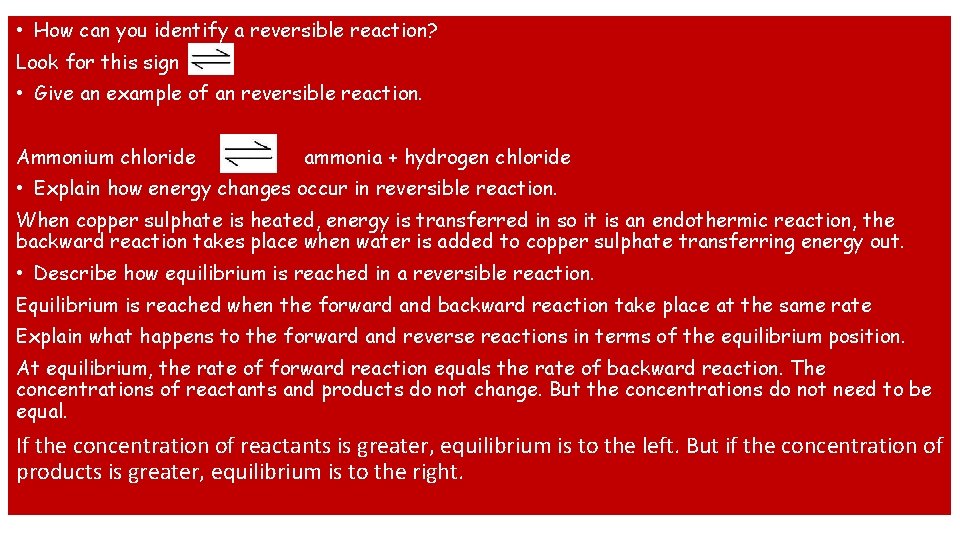
• How can you identify a reversible reaction? Look for this sign • Give an example of an reversible reaction. Ammonium chloride ammonia + hydrogen chloride • Explain how energy changes occur in reversible reaction. When copper sulphate is heated, energy is transferred in so it is an endothermic reaction, the backward reaction takes place when water is added to copper sulphate transferring energy out. • Describe how equilibrium is reached in a reversible reaction. Equilibrium is reached when the forward and backward reaction take place at the same rate Explain what happens to the forward and reverse reactions in terms of the equilibrium position. At equilibrium, the rate of forward reaction equals the rate of backward reaction. The concentrations of reactants and products do not change. But the concentrations do not need to be equal. If the concentration of reactants is greater, equilibrium is to the left. But if the concentration of products is greater, equilibrium is to the right.
Higher Tier Only • Explain how exothermic and endothermic reactions behave. • If the temperature is increased, the relative amount of products at equilibrium increases for an endothermic reaction. • The relative amount of products at equilibrium decreases for an exothermic reaction. • If the temperature is decreased, the relative amount of products at equilibrium decreases for an endothermic reaction. • The relative amount of products at equilibrium increases for an exothermic reaction. • Explain the effect of changing pressure on the equilibrium position. • Increasing the pressure causes the equilibrium position to shift towards the side with smaller number of molecules. • Decreasing the pressure causes the equilibrium position to shift towards the side with large number of molecules.
Hydrocarbons • Describe why crude oil is a finite resource. • Crude oil is a fossil fuel, it was made millions of years ago when the conditions of the earth were much more favourable. They are non-renewable source and cannot be made again. • What are hydrocarbons? Give examples. • Crude oil is a mixture of hydrocarbons made of carbon of hydrogen bonded covalently. Examples, methane, propane and butane.
• Describe and explain how is petrol separated from crude oil. • Crude oil is heated at the bottom of the tower and enters as a vapour. • Vapours cool as it rises to the top of the tower • Column is cooler at the top and hotter at the bottom • Fractions have different boiling points, so they condense at different levels in the tower. • Small molecules have weak intermolecular forces, which can be broken during heating. • Large molecules have very long chains and have many weak forces of attraction along the chains. This needs high energy to break them and have high boiling points.
• Describe the different properties of hydrocarbons. • Hydrocarbons have three different properties – viscosity, flammability and boiling points. • Hydrocarbons at the top of the tower are gases and have low boiling points, low viscosity and highly flammable. • Hydrocarbons in the middle of the tower have a slightly higher boiling points, higher viscosity and less flammable. • Hydrocarbons at the bottom of the tower have very high boiling points, very high viscosity and not flammable. • Explain how the properties of related to the size of the molecules. • Boiling points and viscosity increase with the size of the carbon chains, whereas the flammability decreases with increasing size of the carbon chains because the longer chains have many weak forces. • This means that it needs more energy to break the chains to form a vapour.
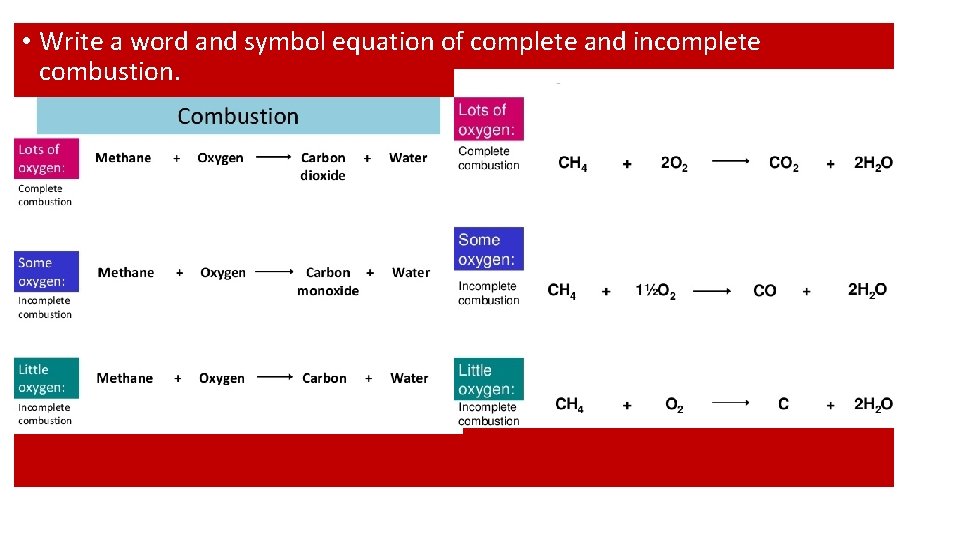
• Describe the process of complete combustion. • Complete combustion occurs when a fuel (hydrocarbon) burns completely in air. Methane reacts with oxygen to produce carbon dioxide and water. • Describe and explain the consequences of incomplete combustion. • Incomplete combustion occurs when a fuel burns with lack of oxygen. The products formed are carbon monoxide and carbon. This also results in less energy being produced. Carbon monoxide is a toxic gas and competes with oxygen to combine with haemoglobin in the red blood cells. • Describe the process of cracking • Large hydrocarbons chains are broken down to produce a shorter alkane and alkene. • Name the two types of cracking and the conditions needed • Catalytic cracking – Using a catalyst and heated to a high temperature • Steam cracking – mixing the hydrocarbon with steam and heating to high temperature.
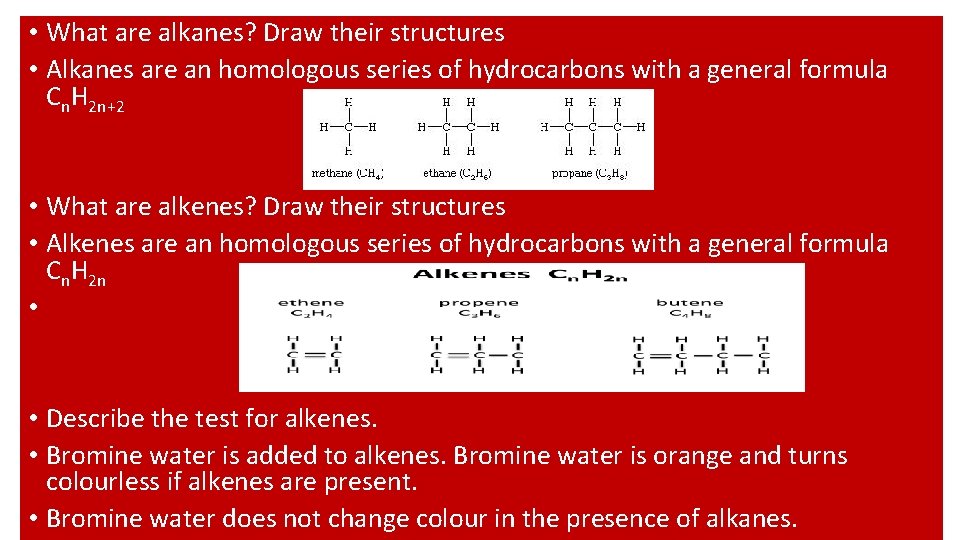
• What are alkanes? Draw their structures • Alkanes are an homologous series of hydrocarbons with a general formula Cn. H 2 n+2 • What are alkenes? Draw their structures • Alkenes are an homologous series of hydrocarbons with a general formula Cn. H 2 n • • Describe the test for alkenes. • Bromine water is added to alkenes. Bromine water is orange and turns colourless if alkenes are present. • Bromine water does not change colour in the presence of alkanes.
Chemical Analysis • Define element, compound and mixture. • Element – made up only one type of atom • Compound – made up of one or more types of atom chemically bonded. • Mixture – made up of two or more compounds that can be separated. • Name the five ways of separating mixtures • Filtration, crystallisation, distillation, fractional distillation and chromatography.
• Define a pure substance. • Pure substance is a single element or compound not chemically combined with any other substance. • What is the melting and boiling points of pure and impure substances? • Impure substances have lower melting points and higher boiling points. • Pure substances have specific melting and boiling points. • What are formulations? Give examples. • A formulation is a mixture that has been designed to be a useful product. Examples paint, alloy and fertilisers. • State the uses of formulations • Alloys are made to make certain metals stronger. Example iron is mixed with carbon to make steel which is very strong. • Fertilisers add nutrients to the soil.
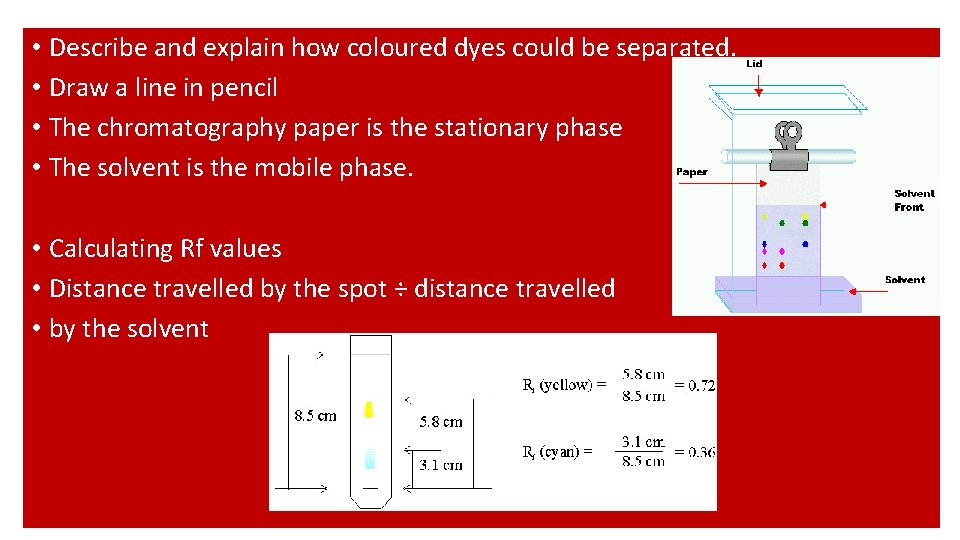
• Describe and explain how coloured dyes could be separated. • Draw a line in pencil • The chromatography paper is the stationary phase • The solvent is the mobile phase. • Calculating Rf values • Distance travelled by the spot ÷ distance travelled • by the solvent
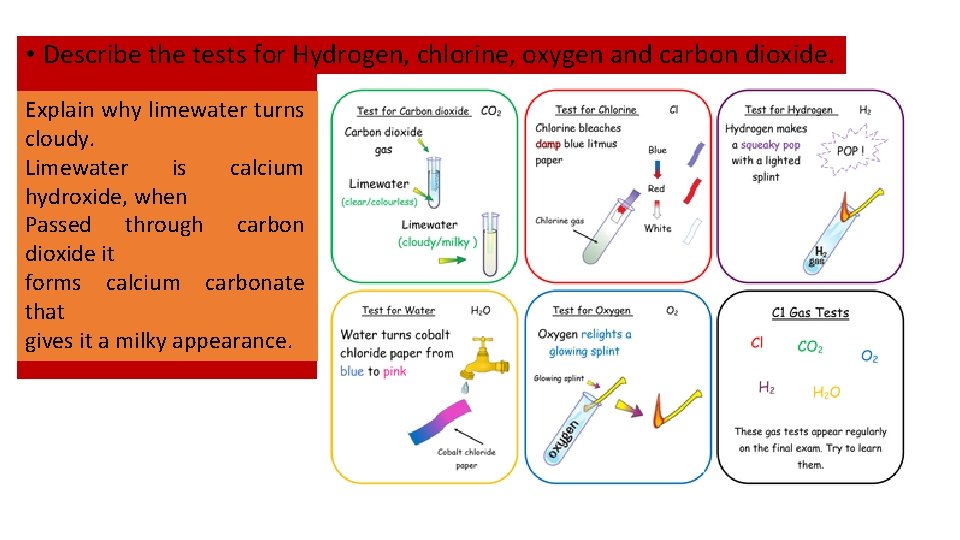
• Describe the tests for Hydrogen, chlorine, oxygen and carbon dioxide. Explain why limewater turns cloudy. Limewater is calcium hydroxide, when Passed through carbon dioxide it forms calcium carbonate that gives it a milky appearance.
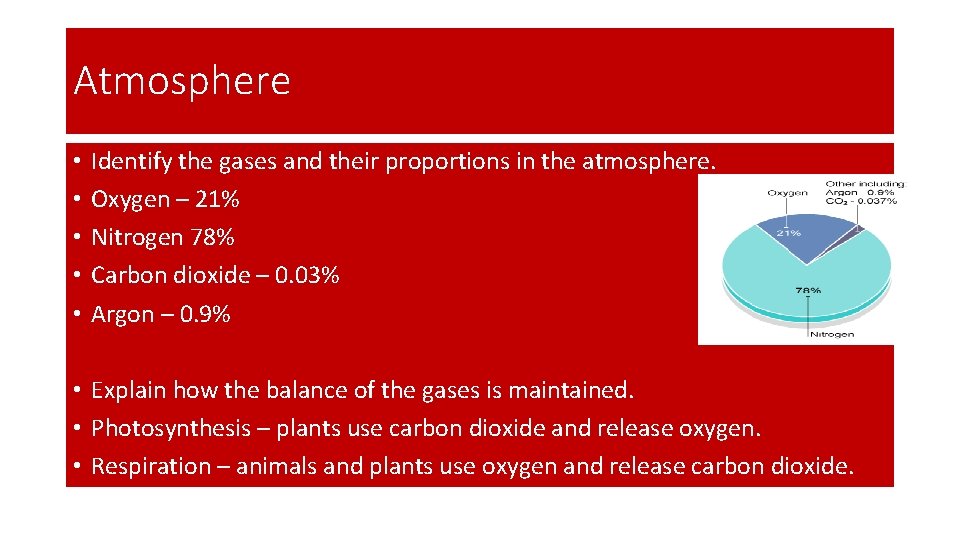
Atmosphere • • • Identify the gases and their proportions in the atmosphere. Oxygen – 21% Nitrogen 78% Carbon dioxide – 0. 03% Argon – 0. 9% • Explain how the balance of the gases is maintained. • Photosynthesis – plants use carbon dioxide and release oxygen. • Respiration – animals and plants use oxygen and release carbon dioxide.
Describe ideas about the Earth’s early atmosphere. • Billions of years ago the earth had many volcanic eruptions that released gases. The gases mainly consisted of carbon dioxide and very little oxygen. • Volcanoes produced nitrogen which slowly built up along with methane and ammonia. • When the oceans formed carbon dioxide dissolved in the water and carbonates were precipitated producing sediments reducing the amount of carbon dioxide. • State the evidence for theories of the early atmosphere. • Evidence is gained from carbon and boron isotopes. • Models use composition of gases given out from volcanoes today. • Explain the role of algae in the composition of the atmosphere. • Algae produced oxygen using photosynthesis which resulted in the amount of oxygen being increased in the atmosphere. • Carbon dioxide + water oxygen + glucose
• How carbon dioxide decreased? • Algae and plants decreased the amount of carbon dioxide by photosynthesis. • Carbon dioxide was decreased by the formation of sedimentary rocks and fossil fuels. • Name the greenhouse gases. • Water vapour, carbon dioxide and methane. • State two human activities that increase the greenhouse gases. • Deforestation and Combustion • State the potential effects of global climate change. • Sea levels rise resulting in flooding and increased coastal erosion • Frequent and severe storms and changes in rainfall.
• Define carbon footprint. • Carbon footprint is the amount of carbon dioxide and other greenhouse gases emitted into the atmosphere over the life cycle of an event or process. Example Taking a long haul flight. • How can carbon footprint be reduced. • Planting more trees and using more public transport. • State the two types of combustion. • Complete and incomplete combustion. • Describe the difference between complete and incomplete combustion. • Complete combustion uses plenty of oxygen, whereas incomplete uses a lack of oxygen. • Complete combustion produces carbon dioxide, incomplete produces carbon monoxide.
• Write a word and symbol equation of complete and incomplete combustion.
• State the effects of atmospheric pollutants. • Carbon dioxide causes global warming • Carbon monoxide is a poisonous gas, as its colourless and odourless. It combines with haemoglobin and reduces the body’s ability to carry oxygen. • Sulphur dioxide causes acid rain. • Nitrous oxide causes respiratory problems. • Carbon soot causes global dimming.
Earth’s Resources • Why do humans use earth’s resources? • Earth’s resources are used to provide shelter, food, warmth and transport. • Describe the difference between finite and renewable sources. • A finite resource is one that cannot be made again. Example crude oil, coal and iron ore. • Renewable resources are natural sources that will not run out. • Define sustainable resources. • Sustainable resources are natural resources like wood which needs to be well managed for future generations to use.
• What is potable water? • Water that is safe to drink is called potable water. Potable water is not pure water as it has dissolved substances. • Describe how water is made potable in the UK from rain water. • There are three main stages • Sedimentation of particles so the solids drop to the bottom • Filtration of very fine particles using sand • Sterilizing agents include chlorine, ozone or ultra violet light. • Describe how seawater is made potable. • Seawater is made potable by a process called desalination. • Desalination is done using distillation or reverse osmosis. • What are the disadvantages of desalination? • Uses huge amounts of energy, very expensive. It’s only done when the water supply is limited.
• Describe how sewage is treated. ØSewage treatment includes ØScreening and grit removal ØSedimentation to produce sewage sludge and effluent ØAnaerobic digestion of sewage sludge ØAerobic biological treatment of effluent. • Describe the components of a Life Cycle Assessment (LCA) ØExtracting and processing raw materials ØManufacturing the product and packaging ØThe use and operation during its lifetime ØDisposal at the end of its useful life.
Required Practical • Investigate how changes in concentration affect the rates of reaction. • https: //www. youtube. com/watch? v=Gl 6 LVl 7 o. Al. U • Investigate how paper chromatography can be used in forensic science to identify ink used in a forgery. • https: //www. youtube. com/watch? v=pn. TGNAfu 6 GE • Analysis and purification of water samples from different sources, including p. H, dissolved solids and distillation • https: //www. youtube. com/watch? v=_UGHsb. TEBv. A