
RATES OF REACTION 1 A guide for A
- Slides: 16
RATES OF REACTION - 1 A guide for A level students
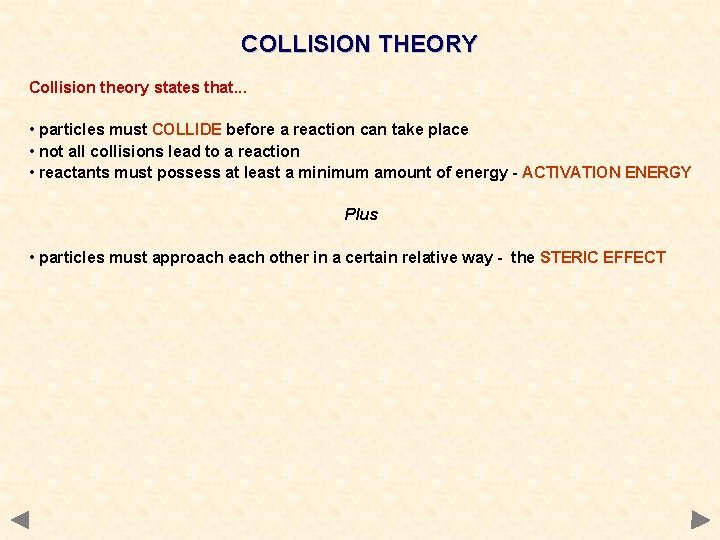
COLLISION THEORY Collision theory states that. . . • particles must COLLIDE before a reaction can take place • not all collisions lead to a reaction • reactants must possess at least a minimum amount of energy - ACTIVATION ENERGY Plus • particles must approach each other in a certain relative way - the STERIC EFFECT
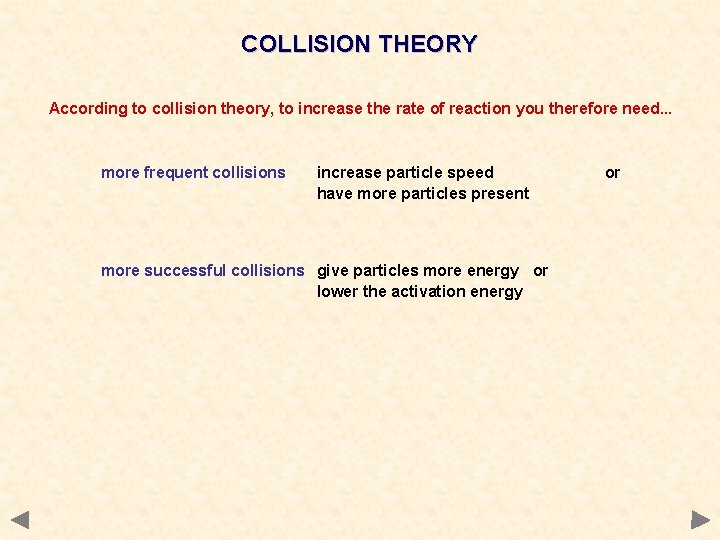
COLLISION THEORY According to collision theory, to increase the rate of reaction you therefore need. . . more frequent collisions increase particle speed have more particles present more successful collisions give particles more energy or lower the activation energy or
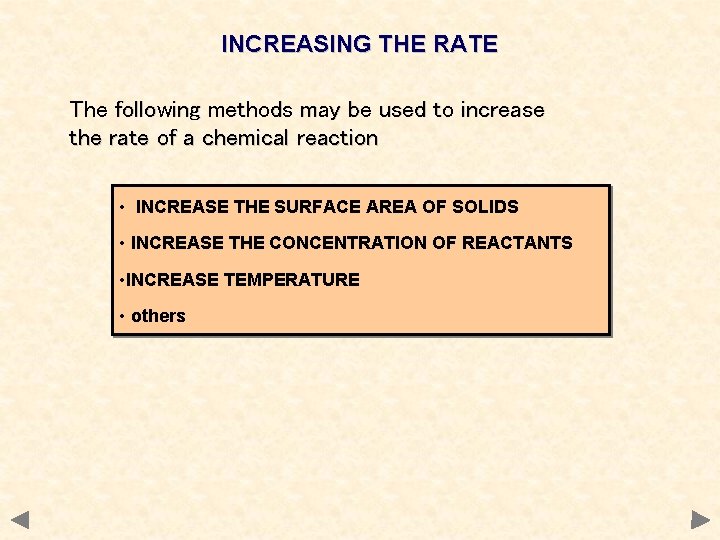
INCREASING THE RATE The following methods may be used to increase the rate of a chemical reaction • INCREASE THE SURFACE AREA OF SOLIDS • INCREASE THE CONCENTRATION OF REACTANTS • INCREASE TEMPERATURE • others
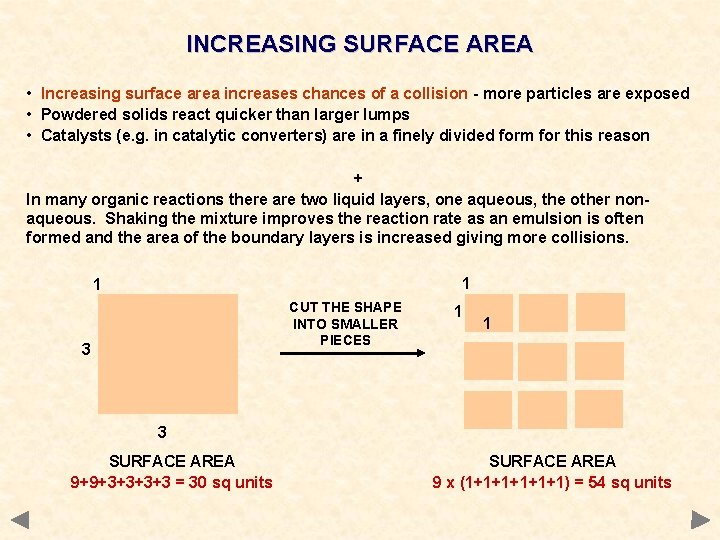
INCREASING SURFACE AREA • Increasing surface area increases chances of a collision - more particles are exposed • Powdered solids react quicker than larger lumps • Catalysts (e. g. in catalytic converters) are in a finely divided form for this reason + In many organic reactions there are two liquid layers, one aqueous, the other nonaqueous. Shaking the mixture improves the reaction rate as an emulsion is often formed and the area of the boundary layers is increased giving more collisions. 1 1 CUT THE SHAPE INTO SMALLER PIECES 3 1 1 3 SURFACE AREA 9+9+3+3 = 30 sq units SURFACE AREA 9 x (1+1+1+1) = 54 sq units
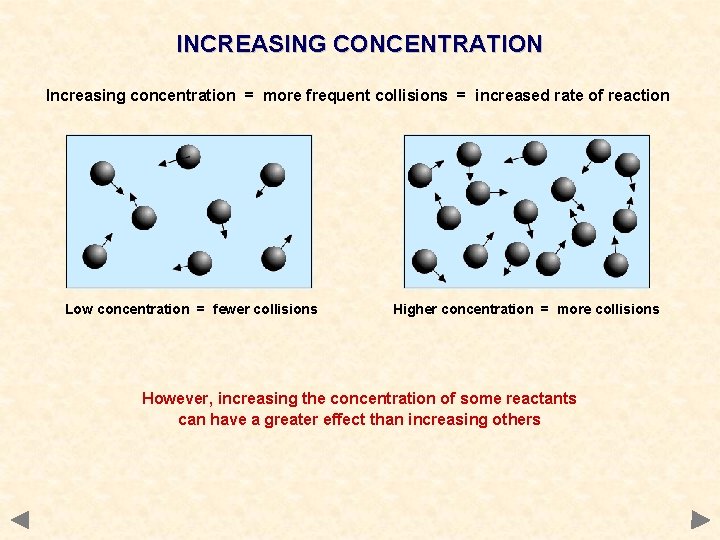
INCREASING CONCENTRATION Increasing concentration = more frequent collisions = increased rate of reaction Low concentration = fewer collisions Higher concentration = more collisions However, increasing the concentration of some reactants can have a greater effect than increasing others
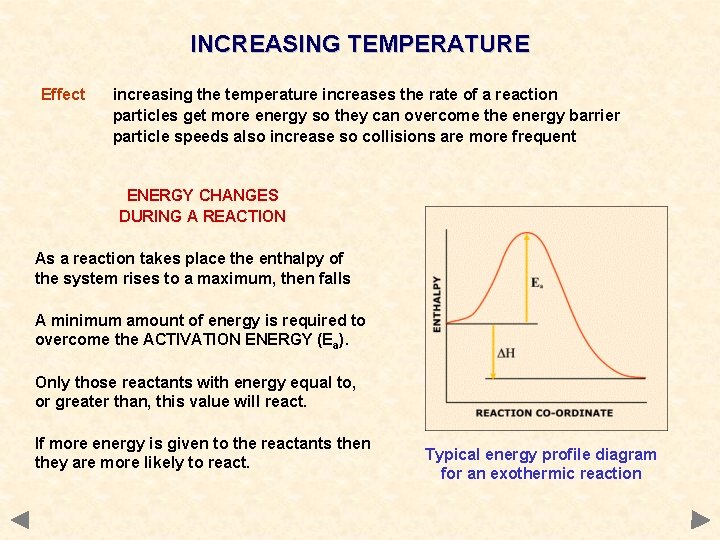
INCREASING TEMPERATURE Effect increasing the temperature increases the rate of a reaction particles get more energy so they can overcome the energy barrier particle speeds also increase so collisions are more frequent ENERGY CHANGES DURING A REACTION As a reaction takes place the enthalpy of the system rises to a maximum, then falls A minimum amount of energy is required to overcome the ACTIVATION ENERGY (Ea). Only those reactants with energy equal to, or greater than, this value will react. If more energy is given to the reactants then they are more likely to react. Typical energy profile diagram for an exothermic reaction
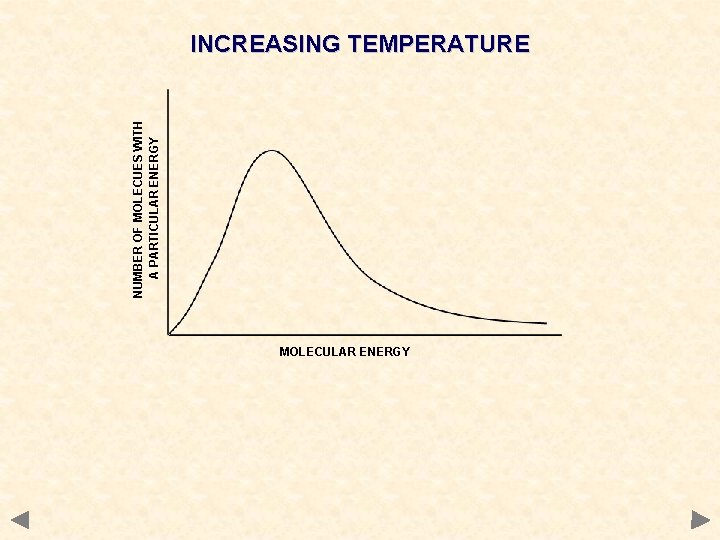
NUMBER OF MOLECUES WITH A PARTICULAR ENERGY INCREASING TEMPERATURE MOLECULAR ENERGY
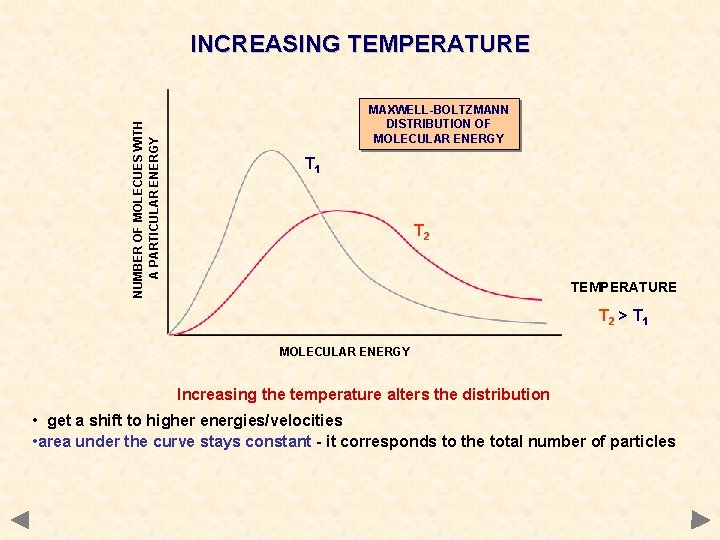
NUMBER OF MOLECUES WITH A PARTICULAR ENERGY INCREASING TEMPERATURE MAXWELL-BOLTZMANN DISTRIBUTION OF MOLECULAR ENERGY T 1 T 2 TEMPERATURE T 2 > T 1 MOLECULAR ENERGY Increasing the temperature alters the distribution • get a shift to higher energies/velocities • area under the curve stays constant - it corresponds to the total number of particles
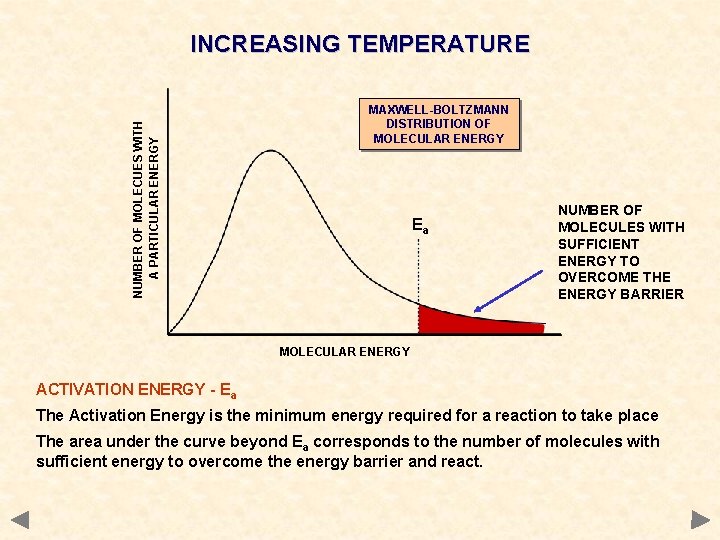
NUMBER OF MOLECUES WITH A PARTICULAR ENERGY INCREASING TEMPERATURE MAXWELL-BOLTZMANN DISTRIBUTION OF MOLECULAR ENERGY Ea NUMBER OF MOLECULES WITH SUFFICIENT ENERGY TO OVERCOME THE ENERGY BARRIER MOLECULAR ENERGY ACTIVATION ENERGY - Ea The Activation Energy is the minimum energy required for a reaction to take place The area under the curve beyond Ea corresponds to the number of molecules with sufficient energy to overcome the energy barrier and react.
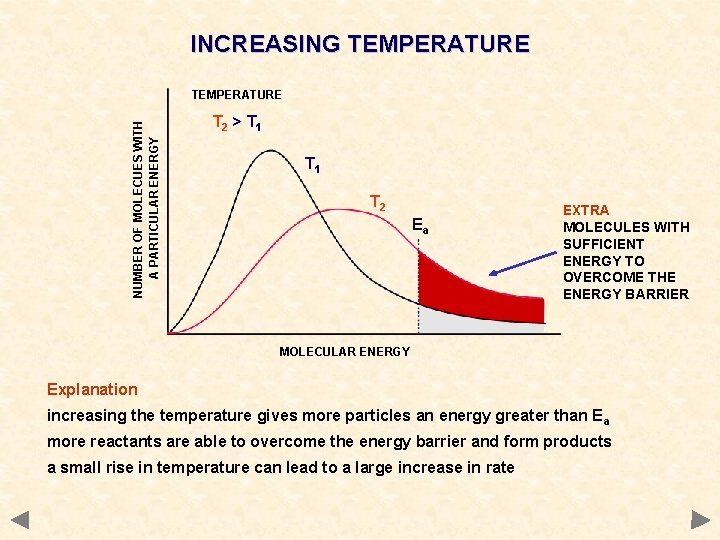
INCREASING TEMPERATURE NUMBER OF MOLECUES WITH A PARTICULAR ENERGY TEMPERATURE T 2 > T 1 T 2 Ea EXTRA MOLECULES WITH SUFFICIENT ENERGY TO OVERCOME THE ENERGY BARRIER MOLECULAR ENERGY Explanation increasing the temperature gives more particles an energy greater than E a more reactants are able to overcome the energy barrier and form products a small rise in temperature can lead to a large increase in rate
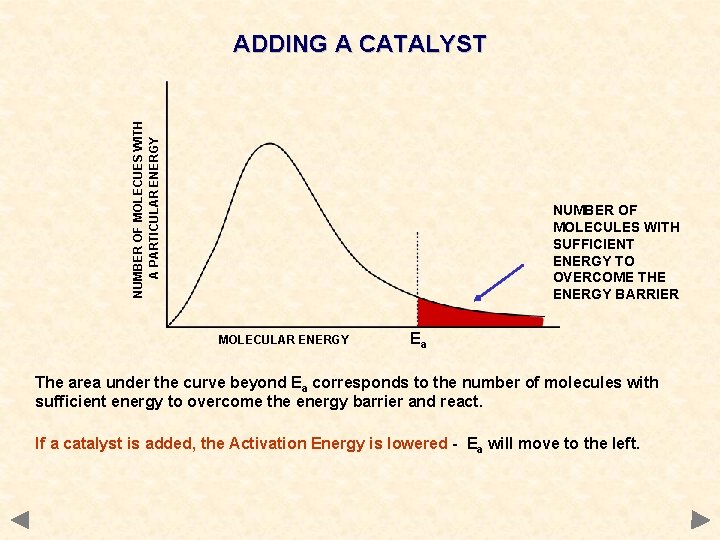
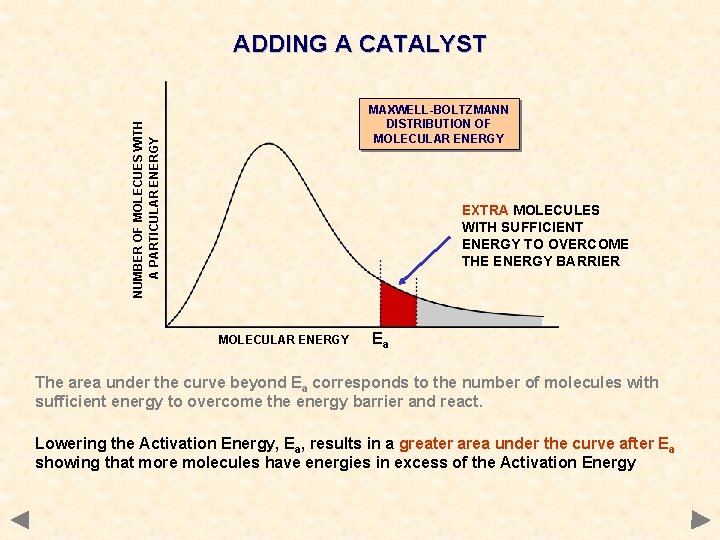
NUMBER OF MOLECUES WITH A PARTICULAR ENERGY ADDING A CATALYST NUMBER OF MOLECULES WITH SUFFICIENT ENERGY TO OVERCOME THE ENERGY BARRIER MOLECULAR ENERGY Ea The area under the curve beyond Ea corresponds to the number of molecules with sufficient energy to overcome the energy barrier and react. If a catalyst is added, the Activation Energy is lowered - Ea will move to the left.
ADDING A CATALYST NUMBER OF MOLECUES WITH A PARTICULAR ENERGY MAXWELL-BOLTZMANN DISTRIBUTION OF MOLECULAR ENERGY EXTRA MOLECULES WITH SUFFICIENT ENERGY TO OVERCOME THE ENERGY BARRIER MOLECULAR ENERGY Ea The area under the curve beyond Ea corresponds to the number of molecules with sufficient energy to overcome the energy barrier and react. Lowering the Activation Energy, Ea, results in a greater area under the curve after Ea showing that more molecules have energies in excess of the Activation Energy
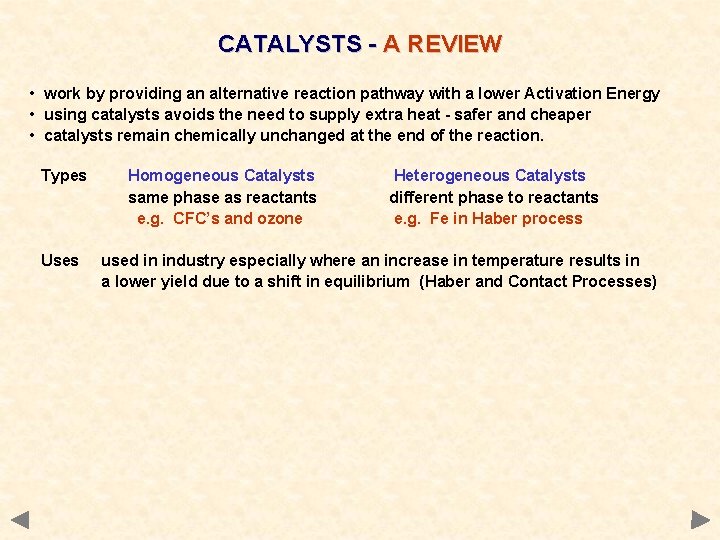
CATALYSTS - A REVIEW • work by providing an alternative reaction pathway with a lower Activation Energy • using catalysts avoids the need to supply extra heat - safer and cheaper • catalysts remain chemically unchanged at the end of the reaction. Types Uses Homogeneous Catalysts same phase as reactants e. g. CFC’s and ozone Heterogeneous Catalysts different phase to reactants e. g. Fe in Haber process used in industry especially where an increase in temperature results in a lower yield due to a shift in equilibrium (Haber and Contact Processes)
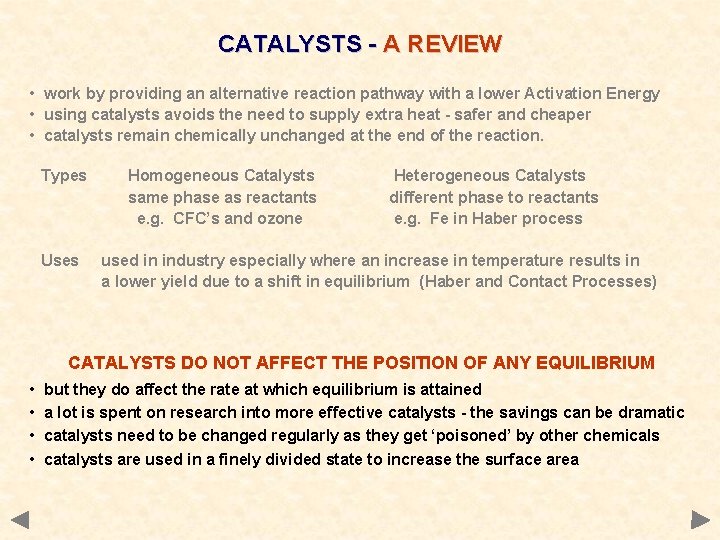
CATALYSTS - A REVIEW • work by providing an alternative reaction pathway with a lower Activation Energy • using catalysts avoids the need to supply extra heat - safer and cheaper • catalysts remain chemically unchanged at the end of the reaction. Types Uses Homogeneous Catalysts same phase as reactants e. g. CFC’s and ozone Heterogeneous Catalysts different phase to reactants e. g. Fe in Haber process used in industry especially where an increase in temperature results in a lower yield due to a shift in equilibrium (Haber and Contact Processes) CATALYSTS DO NOT AFFECT THE POSITION OF ANY EQUILIBRIUM • • but they do affect the rate at which equilibrium is attained a lot is spent on research into more effective catalysts - the savings can be dramatic catalysts need to be changed regularly as they get ‘poisoned’ by other chemicals catalysts are used in a finely divided state to increase the surface area
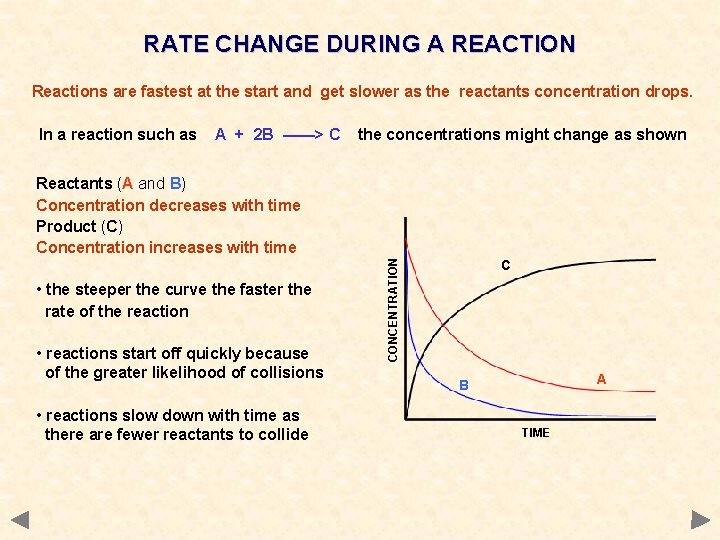
RATE CHANGE DURING A REACTION Reactions are fastest at the start and get slower as the reactants concentration drops. In a reaction such as A + 2 B ——> C the concentrations might change as shown • the steeper the curve the faster the rate of the reaction • reactions start off quickly because of the greater likelihood of collisions • reactions slow down with time as there are fewer reactants to collide CONCENTRATION Reactants (A and B) Concentration decreases with time Product (C) Concentration increases with time C A B TIME