
RATES OF POSTPARTUM GLUCOSE TESTING AMONG NATIVE AMERICAN
- Slides: 5
RATES OF POSTPARTUM GLUCOSE TESTING AMONG NATIVE AMERICAN WOMEN WITH GESTATIONAL DIABETES MELLITUS CHELSEA L. KETTERING, DRPH, MPH
INTRODUCTION • Historically, Native Americans have presented an increased risk for developing Type 2 diabetes. According to Carlson et. al. (2015), the Native American population is “ 2. 2 times more likely to have Type 2 diabetes than non -Hispanic whites. ” • Women with a history of GDM are at risk for developing Type 2 diabetes following childbirth. Therefore, American Indian women are an increased risk. • The purpose of this project is to increase the postpartum glucose screening rates among Native American mothers with a recent pregnancy that included a GDM diagnosis.
EVIDENCE BASED PRACTICE – WHAT DO WE KNOW? • Research has demonstrated that the key characteristics of successful interventions include varying patient reminder methods, education, and a carefully designed level of care for referral and followup. • Phone call/text message and/or mailed letter interventions have yielded promising results with glucose test completion rates averaging 62. 3% across four different studies.
METHODS AND RESULTS • Mailed letter and phone call reminder system • Timeframe: January 2019 through April 2019 • N=71 patients gave birth with n=19 GDM patients identified • Baseline test completion = lower than 10% • Result = 42. 1% test completion rate. Additionally, 66% of those patients that attended their postpartum appointment also completed the glucose test.
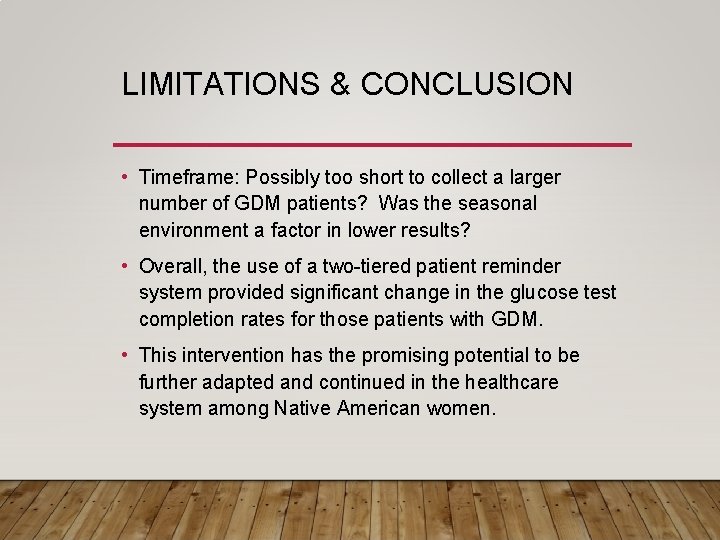
LIMITATIONS & CONCLUSION • Timeframe: Possibly too short to collect a larger number of GDM patients? Was the seasonal environment a factor in lower results? • Overall, the use of a two-tiered patient reminder system provided significant change in the glucose test completion rates for those patients with GDM. • This intervention has the promising potential to be further adapted and continued in the healthcare system among Native American women.