
Rate of change Differentiation 2 Gradient of curves
- Slides: 13
Rate of change / Differentiation (2) • Gradient of curves • Differentiating
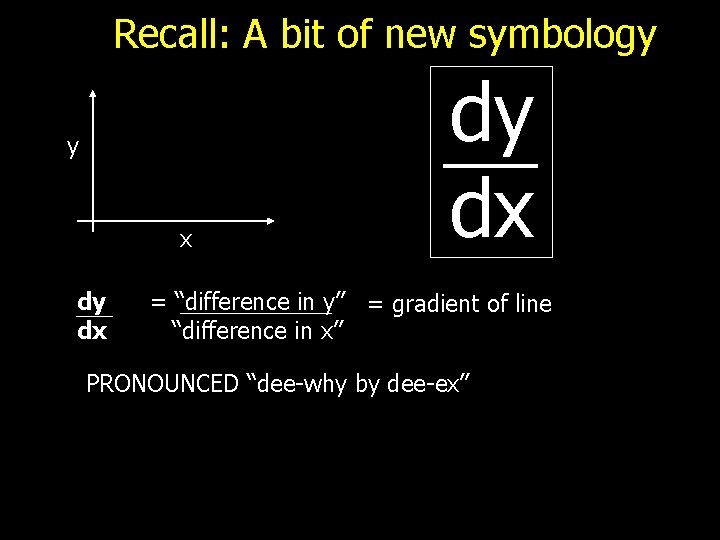
Recall: A bit of new symbology y x dy dx = “difference in y” = gradient of line “difference in x” PRONOUNCED “dee-why by dee-ex”
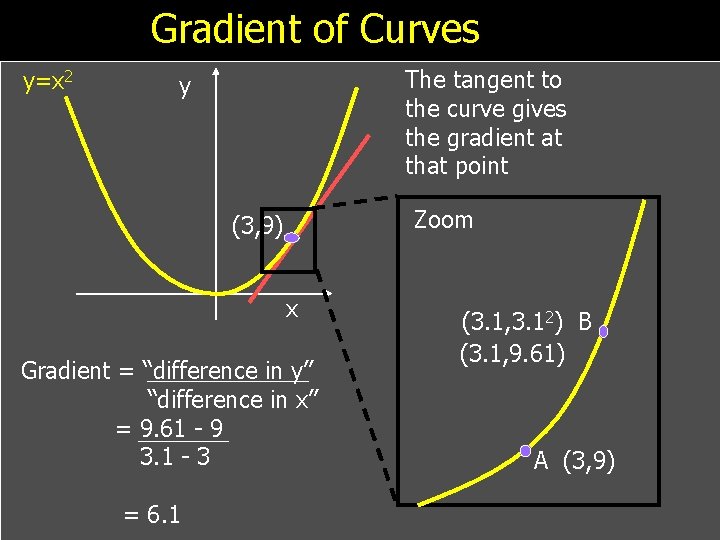
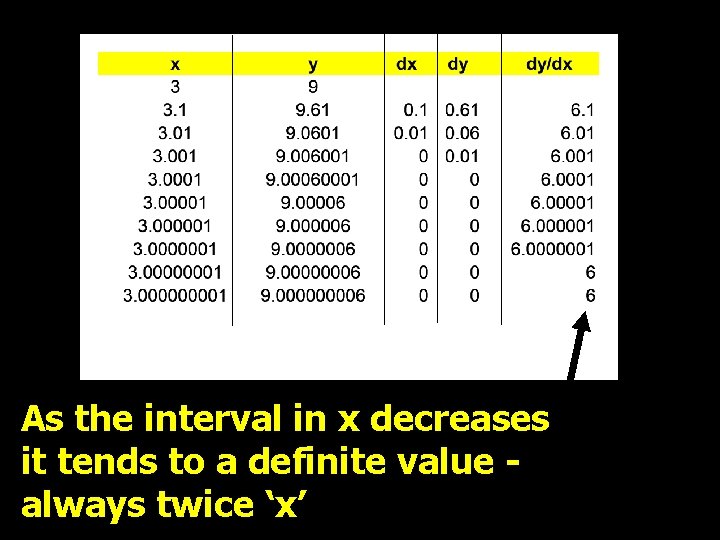
Gradient of Curves y=x 2 The tangent to the curve gives the gradient at that point y Zoom (3, 9) x Gradient = “difference in y” “difference in x” = 9. 61 - 9 3. 1 - 3 = 6. 1 (3. 1, 3. 12) B (3. 1, 9. 61) A (3, 9)
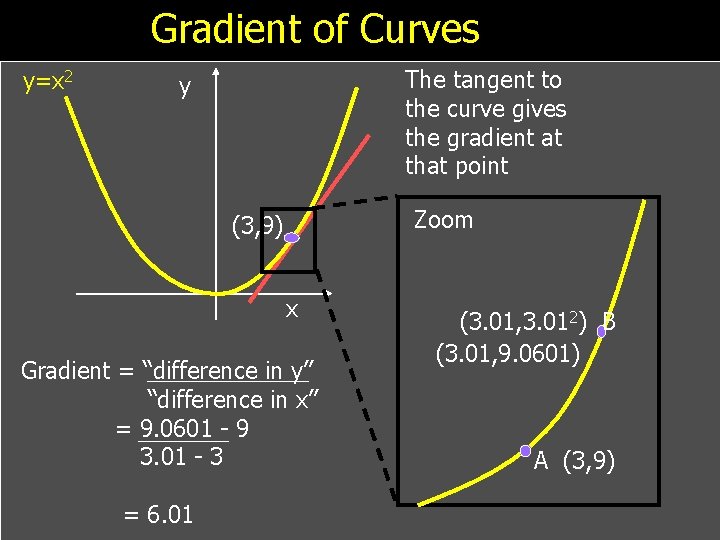
Gradient of Curves y=x 2 The tangent to the curve gives the gradient at that point y Zoom (3, 9) x Gradient = “difference in y” “difference in x” = 9. 0601 - 9 3. 01 - 3 = 6. 01 (3. 01, 3. 012) B (3. 01, 9. 0601) A (3, 9)
As the interval in x decreases it tends to a definite value always twice ‘x’
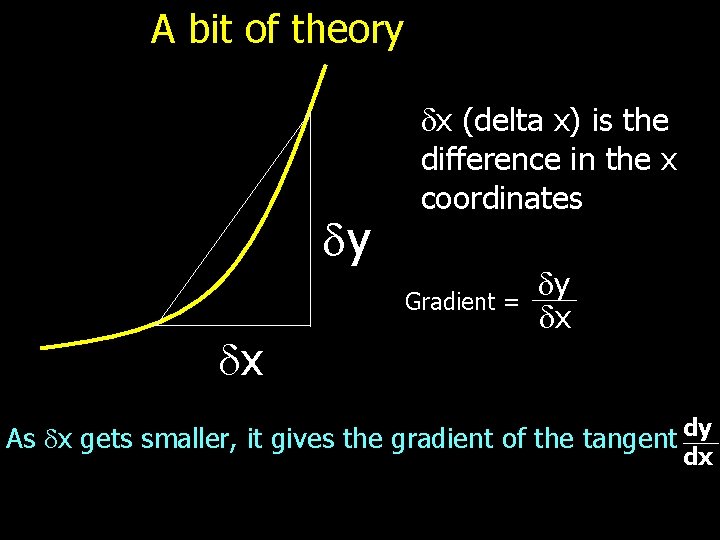
A bit of theory y x (delta x) is the difference in the x coordinates Gradient = x y x As x gets smaller, it gives the gradient of the tangent dy dx
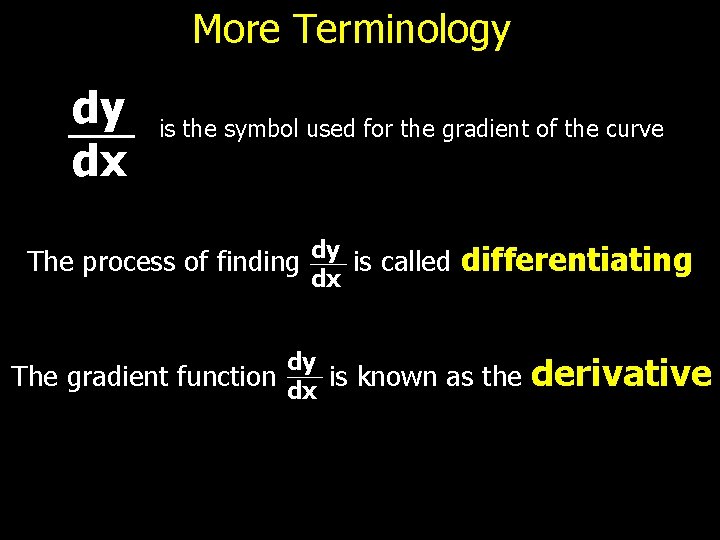
More Terminology dy dx is the symbol used for the gradient of the curve The process of finding dy is called differentiating dx dy The gradient function dx is known as the derivative
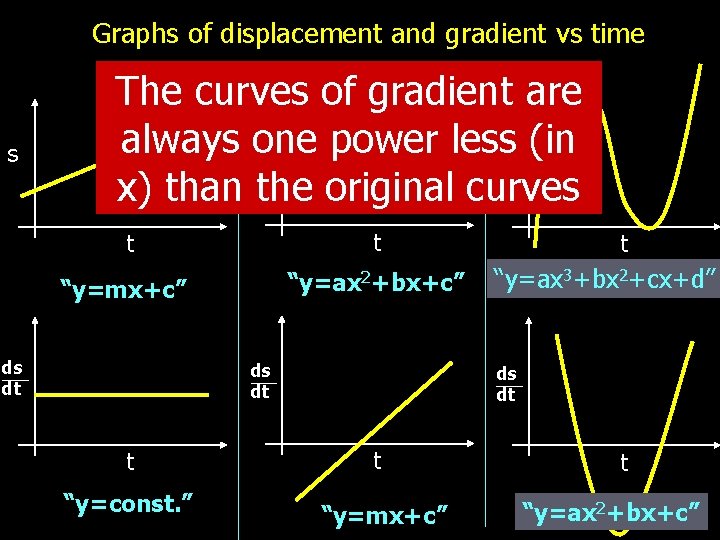
Graphs of displacement and gradient vs time s The curves of gradient are always one power lesss (in s x) than the original curves t t “y=mx+c” “y=ax 2+bx+c” ds dt t “y=ax 3+bx 2+cx+d” ds dt t t “y=const. ” “y=mx+c” t “y=ax 2+bx+c”
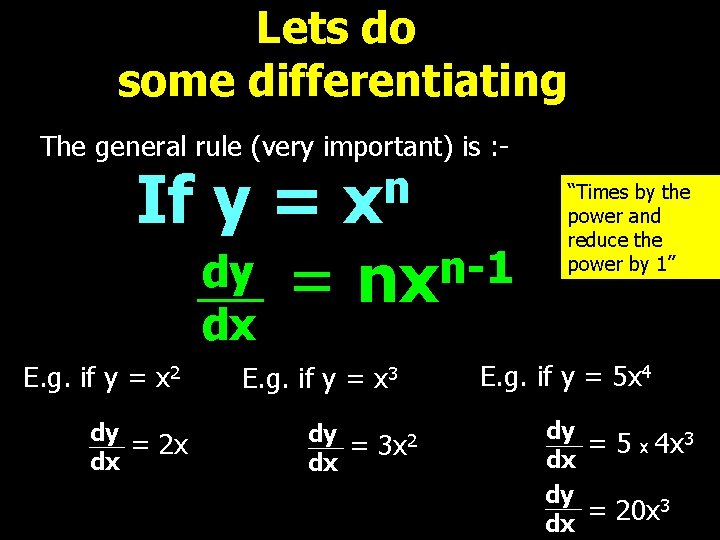
Lets do some differentiating The general rule (very important) is : - n x If y = dy = nxn-1 “Times by the power and reduce the power by 1” dx E. g. if y = x 2 dy = 2 x dx E. g. if y = x 3 dy = 3 x 2 dx E. g. if y = 5 x 4 dy = 5 x 4 x 3 dx dy 3 = 20 x dx
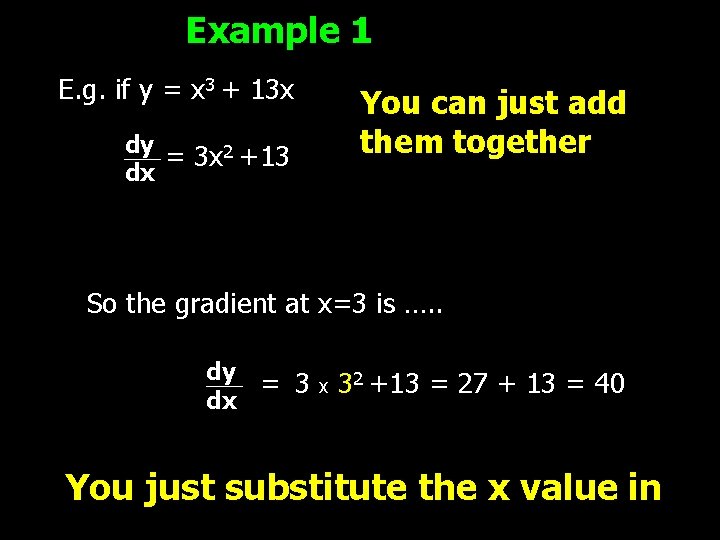
Example 1 E. g. if y = x 3 + 13 x dy = 3 x 2 +13 dx You can just add them together So the gradient at x=3 is …. . dy dx = 3 x 32 +13 = 27 + 13 = 40 You just substitute the x value in
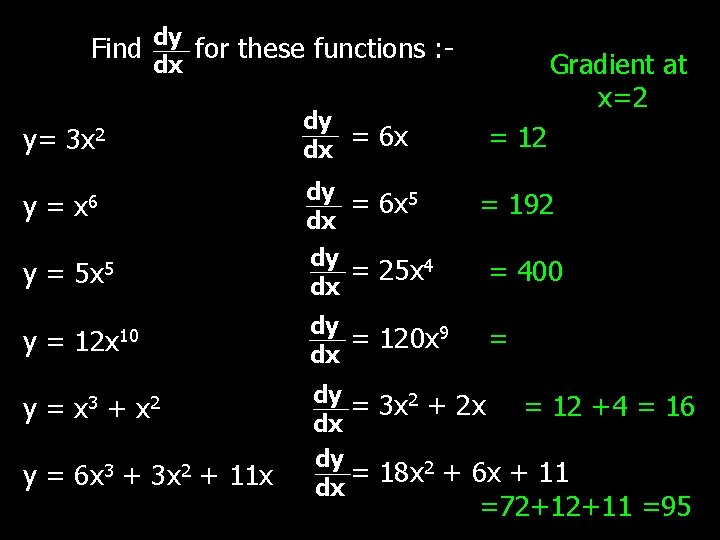
Find dy for these functions : - Gradient at x=2 dx 3 x 2 dy = 6 x dx = 12 y= x 6 dy = 6 x 5 dx = 192 y= 5 x 5 dy = 25 x 4 dx = 400 y= 12 x 10 dy = 120 x 9 dx = y= x 3 y= + x 2 y = 6 x 3 + 3 x 2 + 11 x dy = 3 x 2 + 2 x = 12 +4 = 16 dx dy 2 + 6 x + 11 = 18 x dx =72+12+11 =95
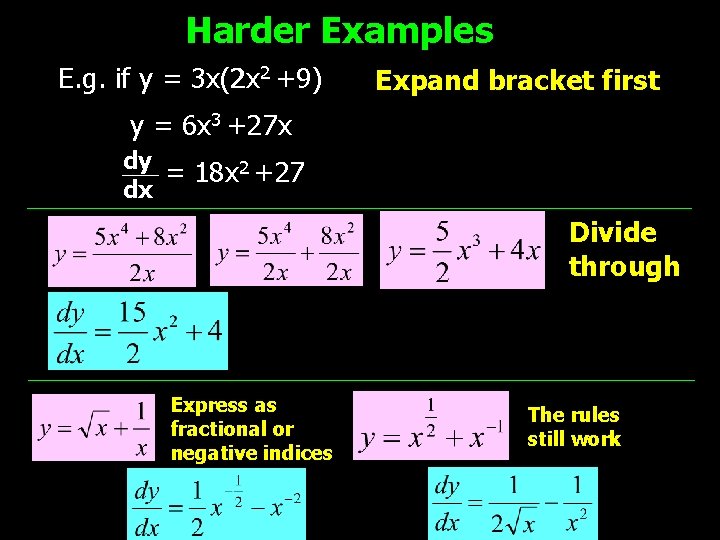
Harder Examples E. g. if y = 3 x(2 x 2 +9) Expand bracket first y = 6 x 3 +27 x dy = 18 x 2 +27 dx Divide through Express as fractional or negative indices The rules still work
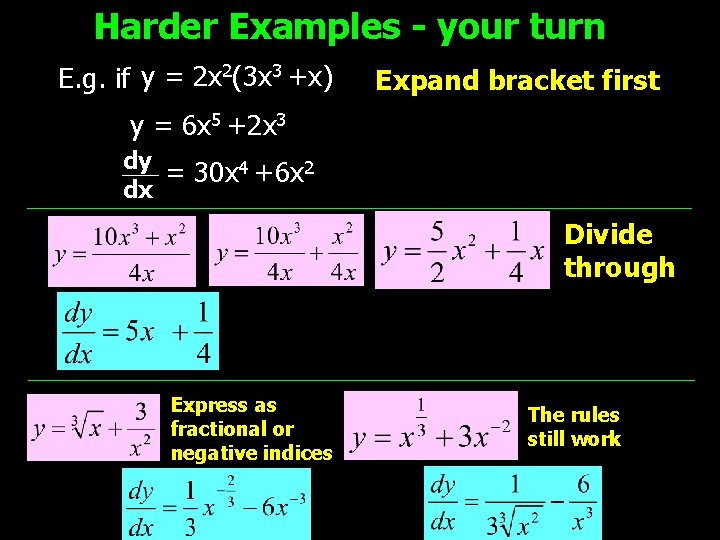
Harder Examples - your turn E. g. if y = 2 x 2(3 x 3 +x) Expand bracket first y = 6 x 5 +2 x 3 dy = 30 x 4 +6 x 2 dx Divide through Express as fractional or negative indices The rules still work