
Rate Designs for Distributed Generation State Activities A
Rate Designs for Distributed Generation: State Activities & A New Framework NASUCA 2016 Mid-Year Meeting New Orleans June 7, 2016 Tim Woolf Synapse Energy Economics
Outline Part 1: Overview of recent related activities § Fixed charges § Time-varying rates § AMI penetration § Solar NEM penetration § Two case studies Part 2: A new framework for assessing DG policies § Comprehensive § Quantitative Tim Woolf – Synapse Energy Economics Slide 2
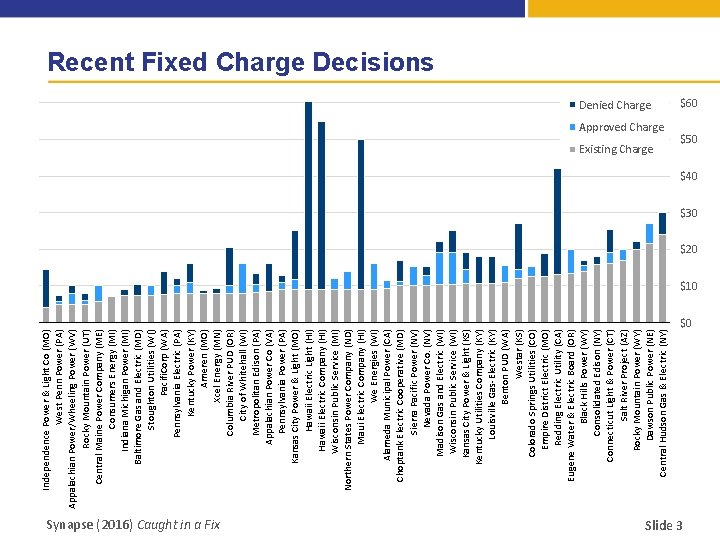
Independence Power & Light Co (MO) West Penn Power (PA) Appalachian Power/Wheeling Power (WV) Rocky Mountain Power (UT) Central Maine Power Company (ME) Consumers Energy (MI) Indiana Michigan Power (MI) Baltimore Gas and Electric (MD) Stoughton Utilities (W() Pacifi. Corp (WA) Pennsylvania Electric (PA) Kentucky Power (KY) Ameren (MO) Xcel Energy (MN) Columbia River PUD (OR) City of Whitehall (WI) Metropolitan Edison (PA) Appalachian Power Co (VA) Pennsylvania Power (PA) Kansas City Power & Light (MO) Hawaii Electric Light (HI) Hawaii Electric Company (HI) Wisconsin Public Service (MI) Northern States Power Company (ND) Maui Electric Company (HI) We Energies (WI) Alameda Municipal Power (CA) Choptank Electric Cooperative (MD) Sierra Pacific Power (NV) Nevada Power Co. (NV) Madison Gas and Electric (WI) Wisconsin Public Service (WI) Kansas City Power & Light (KS) Kentucky Utilities Company (KY) Louisville Gas-Electric (KY) Benton PUD (WA) Westar (KS) Colorado Springs Utilities (CO) Empire District Electric (MO) Redding Electric Utility (CA) Eugene Water & Electric Board (OR) Black Hills Power (WY) Consolidated Edison (NY) Connecticut Light & Power (CT) Salt River Project (AZ) Rocky Mountain Power (WY) Dawson Public Power (NE) Central Hudson Gas & Electric (NY) Recent Fixed Charge Decisions Denied Charge Approved Charge Existing Charge Synapse (2016) Caught in a Fix $60 $50 $40 $30 $20 $10 $0 Slide 3

Penetration of Residential Customers on Time Varying Rates Source: U. S. Energy Information Administration as of January 2015 Slide 4

Residential AMI Penetration Residential AMI Meters as % of Total Residential Meters 100% 90% 80% 70% 60% 50% 40% 30% 20% 0% DC NV ME GA VT CA AZ AL ID DE MD TX OK FL OR MI PA SD KS TN MS AR WY KY NC ND NH WI OH IL LA NM VA IN SC CO MT MN MO NE CT IA AK HI UT WA MA NJ WV NY RI 10% Source: US Energy Information Administration as of January 2015 Slide 5
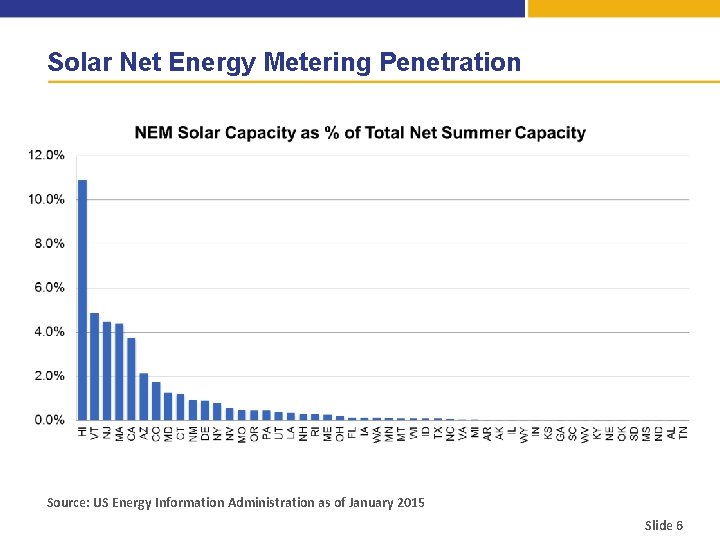
Solar Net Energy Metering Penetration Source: US Energy Information Administration as of January 2015 Slide 6
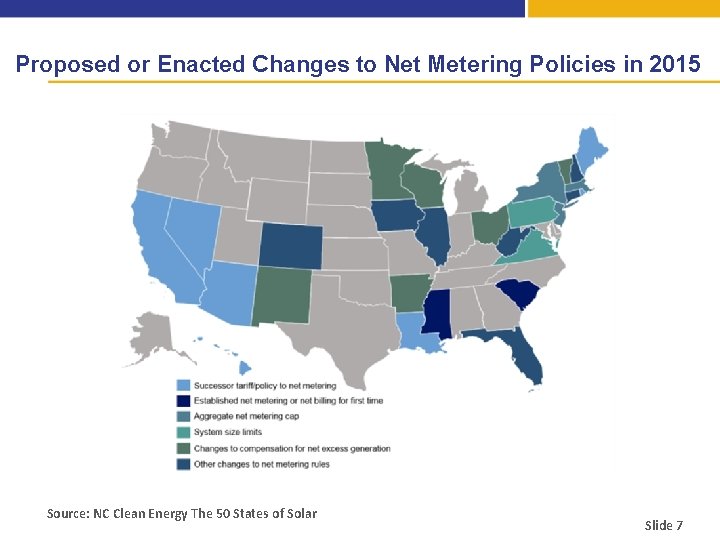
Proposed or Enacted Changes to Net Metering Policies in 2015 Source: NC Clean Energy The 50 States of Solar Slide 7
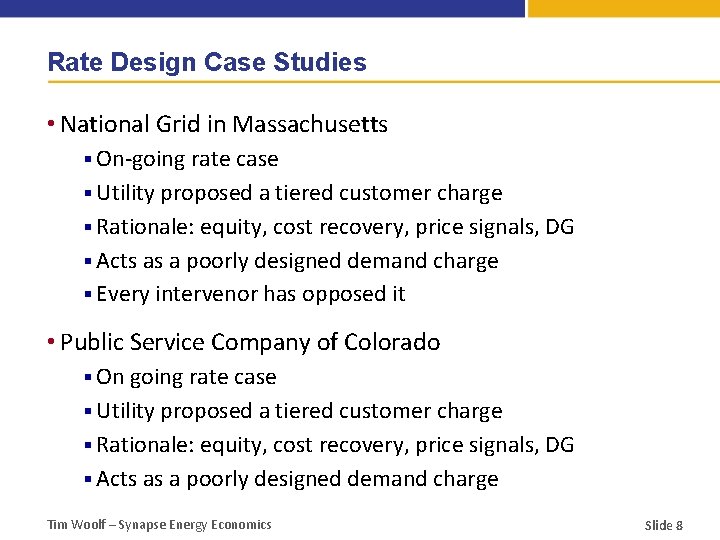
Rate Design Case Studies • National Grid in Massachusetts § On-going rate case § Utility proposed a tiered customer charge § Rationale: equity, cost recovery, price signals, DG § Acts as a poorly designed demand charge § Every intervenor has opposed it • Public Service Company of Colorado § On going rate case § Utility proposed a tiered customer charge § Rationale: equity, cost recovery, price signals, DG § Acts as a poorly designed demand charge Tim Woolf – Synapse Energy Economics Slide 8
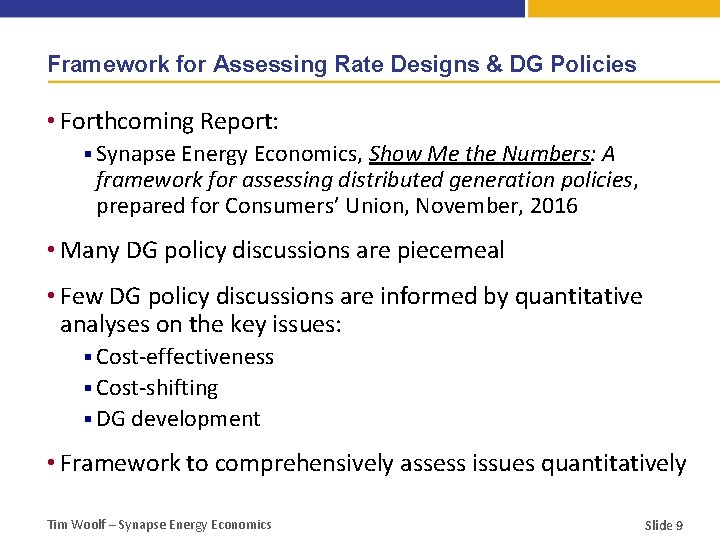
Framework for Assessing Rate Designs & DG Policies • Forthcoming Report: § Synapse Energy Economics, Show Me the Numbers: A framework for assessing distributed generation policies, prepared for Consumers’ Union, November, 2016 • Many DG policy discussions are piecemeal • Few DG policy discussions are informed by quantitative analyses on the key issues: § Cost-effectiveness § Cost-shifting § DG development • Framework to comprehensively assess issues quantitatively Tim Woolf – Synapse Energy Economics Slide 9
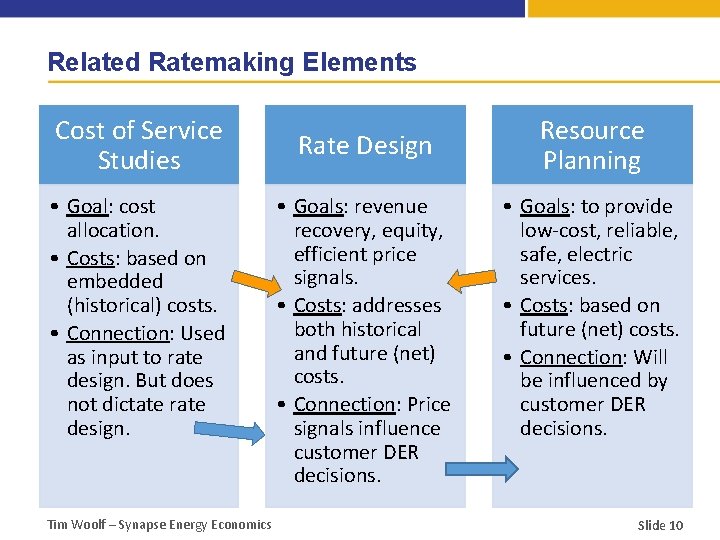
Related Ratemaking Elements Cost of Service Studies • Goal: cost allocation. • Costs: based on embedded (historical) costs. • Connection: Used as input to rate design. But does not dictate rate design. Tim Woolf – Synapse Energy Economics Rate Design • Goals: revenue recovery, equity, efficient price signals. • Costs: addresses both historical and future (net) costs. • Connection: Price signals influence customer DER decisions. Resource Planning • Goals: to provide low-cost, reliable, safe, electric services. • Costs: based on future (net) costs. • Connection: Will be influenced by customer DER decisions. Slide 10
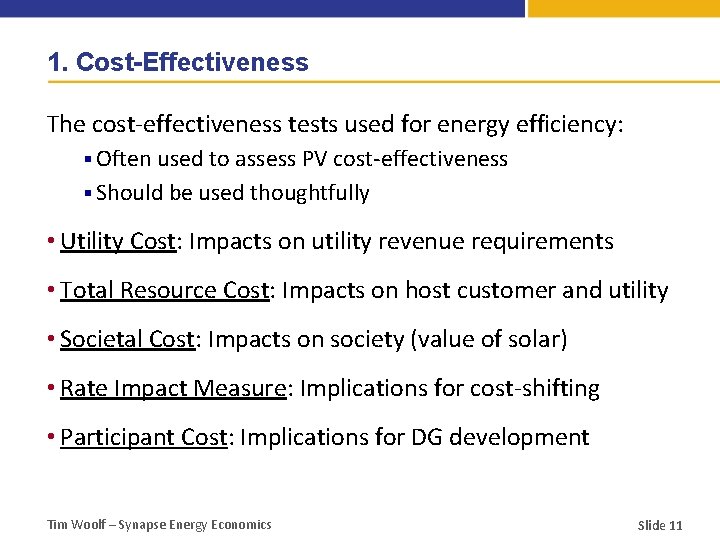
1. Cost-Effectiveness The cost-effectiveness tests used for energy efficiency: § Often used to assess PV cost-effectiveness § Should be used thoughtfully • Utility Cost: Impacts on utility revenue requirements • Total Resource Cost: Impacts on host customer and utility • Societal Cost: Impacts on society (value of solar) • Rate Impact Measure: Implications for cost-shifting • Participant Cost: Implications for DG development Tim Woolf – Synapse Energy Economics Slide 11
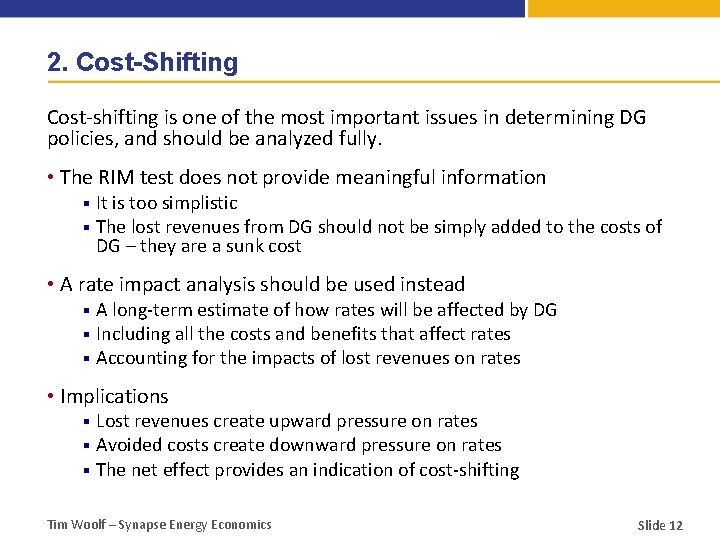
2. Cost-Shifting Cost-shifting is one of the most important issues in determining DG policies, and should be analyzed fully. • The RIM test does not provide meaningful information § § It is too simplistic The lost revenues from DG should not be simply added to the costs of DG – they are a sunk cost • A rate impact analysis should be used instead § § § A long-term estimate of how rates will be affected by DG Including all the costs and benefits that affect rates Accounting for the impacts of lost revenues on rates • Implications § § § Lost revenues create upward pressure on rates Avoided costs create downward pressure on rates The net effect provides an indication of cost-shifting Tim Woolf – Synapse Energy Economics Slide 12
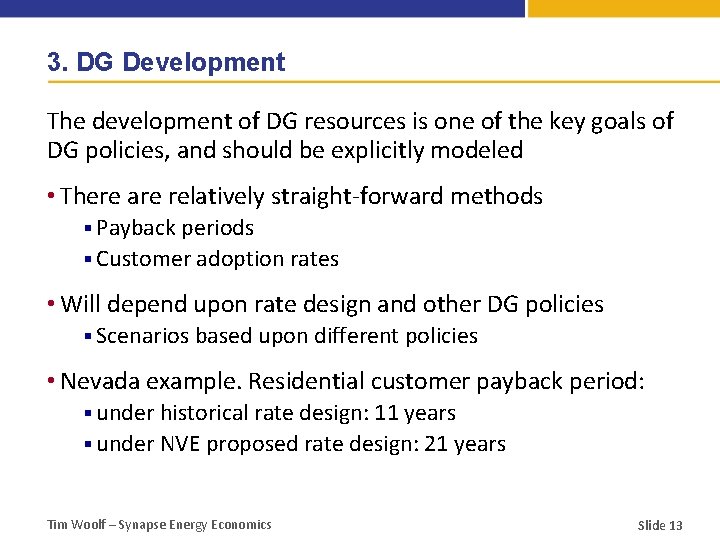
3. DG Development The development of DG resources is one of the key goals of DG policies, and should be explicitly modeled • There are relatively straight-forward methods § Payback periods § Customer adoption rates • Will depend upon rate design and other DG policies § Scenarios based upon different policies • Nevada example. Residential customer payback period: § under historical rate design: 11 years § under NVE proposed rate design: 21 years Tim Woolf – Synapse Energy Economics Slide 13
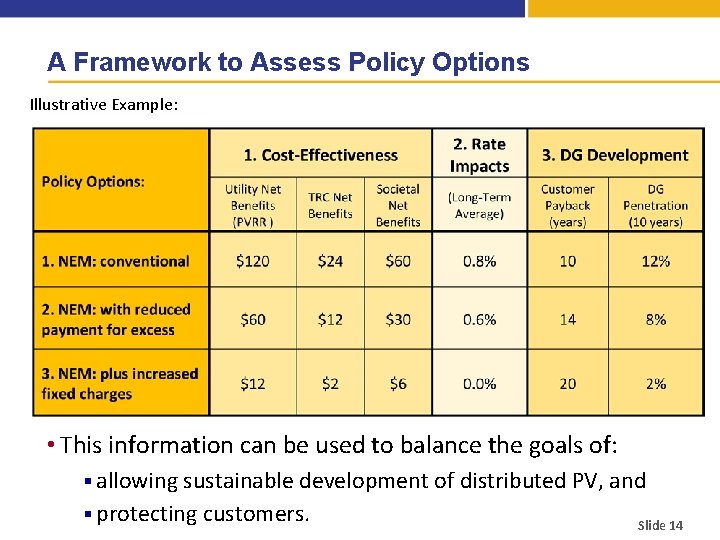
A Framework to Assess Policy Options Illustrative Example: • This information can be used to balance the goals of: § allowing sustainable development of distributed PV, and § protecting customers. Slide 14
Contact Information Tim Woolf Vice President Synapse Energy Economics 617 -453 -7031 twoolf@synapse-energy. com www. synapse. energy. com Tim Woolf – Synapse Energy Economics Slide 15
- Slides: 15