
RAST 90011 New Developments in Radio Spectrum Use
- Slides: 40
RAST 9(00)11 New Developments in Radio Spectrum Use and Standards in Canada RAST-9 Sapporo, Japan August 29 - September 1, 2000 1
Topics n n n n n Highlights of WRC-2000 Fixed Wireless Access Systems Licence Exempt Technology and Services Additional Spectrum for PCS Broadband Wireless Access Systems Terrestrial Digital Radio Broadcasting Wireless IP Networks Intelligent Transportation Systems Some Challenges 2
Highlights of WRC-2000 n n n New spectrum for IMT-2000 Regulatory framework for broadband satellite systems (Ku and Ka bands) New regulations for high density terrestrial and space systems using certain bands in the 30 -70 GHz range Spectrum was identified for new Radionavigation Satellite Service (RNSS) systems (e. g. Galileo) Revised frequency allocations above 71 GHz Extensive agenda for WRC-2003 3
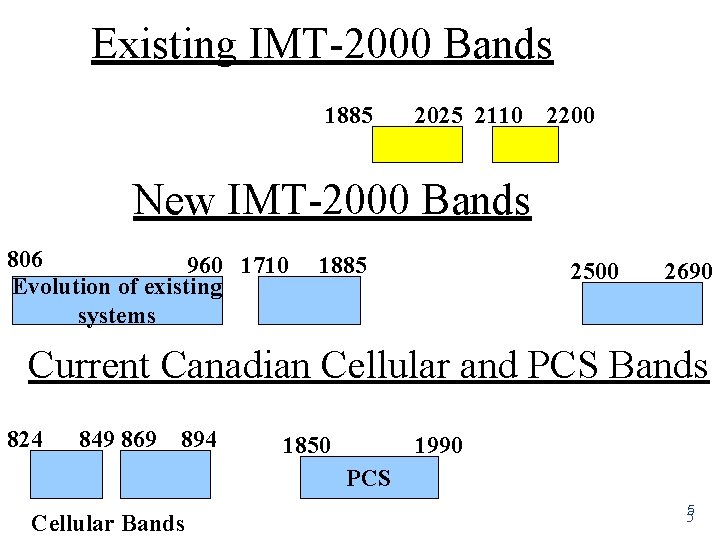
IMT-2000 - Results n n n The bands 1710 -1885 MHz and 2500 -2690 MHz are identified on worldwide basis for IMT-2000 Bands used for cellular systems in the range 806 -960 MHz are available for evolution to IMT 2000 The initial IMT-2000 bands and the new bands have equal priority in the Radio Regulations New bands for the satellite component of IMT 2000 New provisions for high altitude platform stations (HAPS) 4
Existing IMT-2000 Bands 1885 2025 2110 2200 New IMT-2000 Bands 806 960 1710 Evolution of existing systems 1885 2500 2690 Current Canadian Cellular and PCS Bands 824 849 869 894 1850 1990 PCS Cellular Bands 55
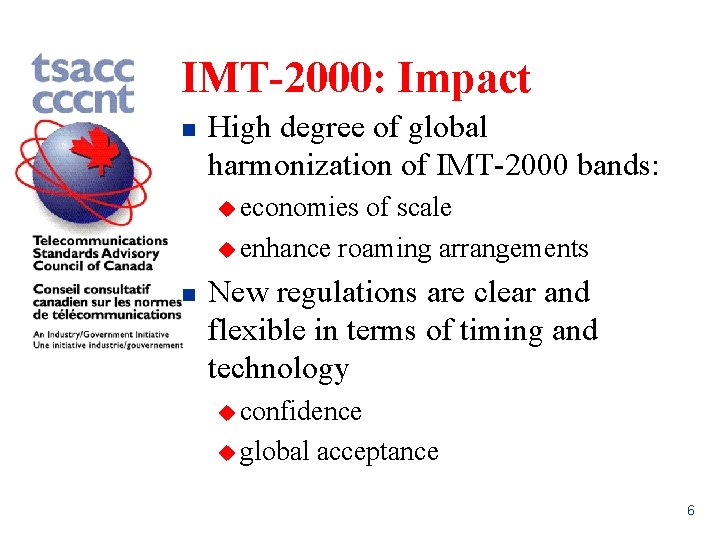
IMT-2000: Impact n High degree of global harmonization of IMT-2000 bands: u economies of scale u enhance roaming arrangements n New regulations are clear and flexible in terms of timing and technology u confidence u global acceptance 6
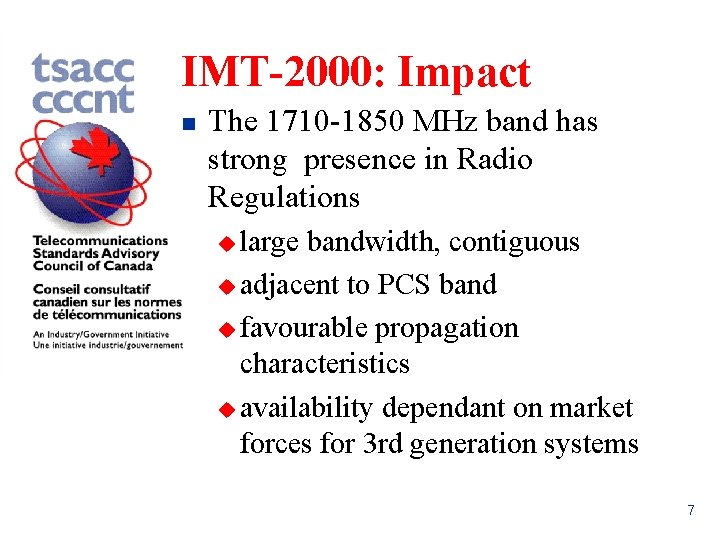
IMT-2000: Impact n The 1710 -1850 MHz band has strong presence in Radio Regulations u large bandwidth, contiguous u adjacent to PCS band u favourable propagation characteristics u availability dependant on market forces for 3 rd generation systems 7
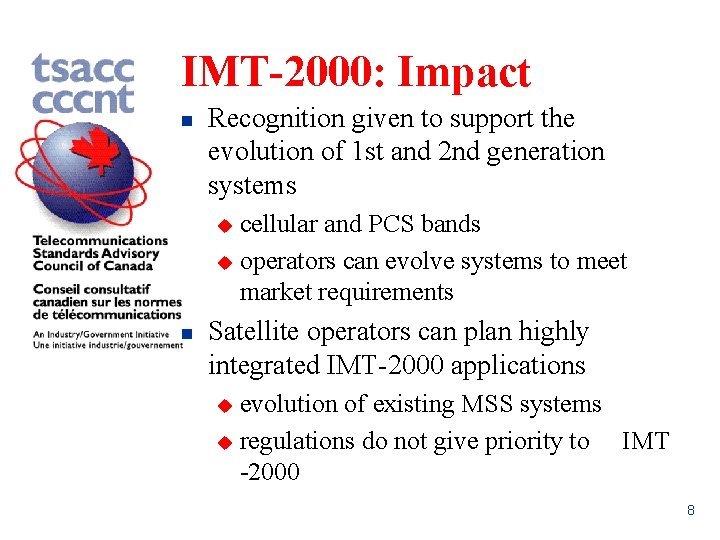
IMT-2000: Impact n Recognition given to support the evolution of 1 st and 2 nd generation systems cellular and PCS bands u operators can evolve systems to meet market requirements u n Satellite operators can plan highly integrated IMT-2000 applications evolution of existing MSS systems u regulations do not give priority to IMT -2000 u 8
High Density Fixed Systems n n New bands identified as available for high density fixed (HDFS) systems at WRC-2000: u 31. 8 -33. 4 GHz (1. 6 GHz) u 37 -40 GHz, 42 -43. 5 GHz (4. 5 GHz) u 51. 4 -52. 6 GHz, 55. 78 -59 GHz, 64 -66 GHz Adopted regulatory provisions which will facilitate HDFSS in the 40 -42 GHz band. u Global allocation to FSS 40. 5 -42. 5 GHz u pfd limits favourable to FSS 40. 5 -42. 5 GHz 9
High Density Fixed Systems n Industry benefits of the new bands: Global spectrum promoting economies of scale in production of common end products u Bands identified for HDFS will facilitate the deployment of FS systems for wireless access (first mile/last mile) applications where ubiquitous deployment on an “ongoing” basis is a fundamental part of the business plan u Traditional constraints imposed by sharing with other services will be reduced u 10
High Density Fixed Systems n Industry benefits of the new bands: u u u At 40 GHz, regulatory limits(pfds) and provisions (footnotes) were adopted at the Conference. This will facilitate the soft segmentation between FS and FSS services and allow both services access to spectrum for high density deployments The 32, 58 and 63 GHz bands are not shared with FSS, other services are easier to share with and are typically not deployed in high density applications Abundance of new spectrum in which to develop and deploy broadband wireless access technologies and applications l l Multimedia Internet 11
Fixed Wireless Access Systems n 4 major developments Multipoint communication/distribution systems in the 2. 5 GHz band u Fixed wireless access systems in the band 3400 -3700 MHz u Wireless local loop in the 953 -960 MHz band u Wireless meter telemetry systems in the bands 1427 -1430 MHz and 1493. 51496. 5 MHz u 12
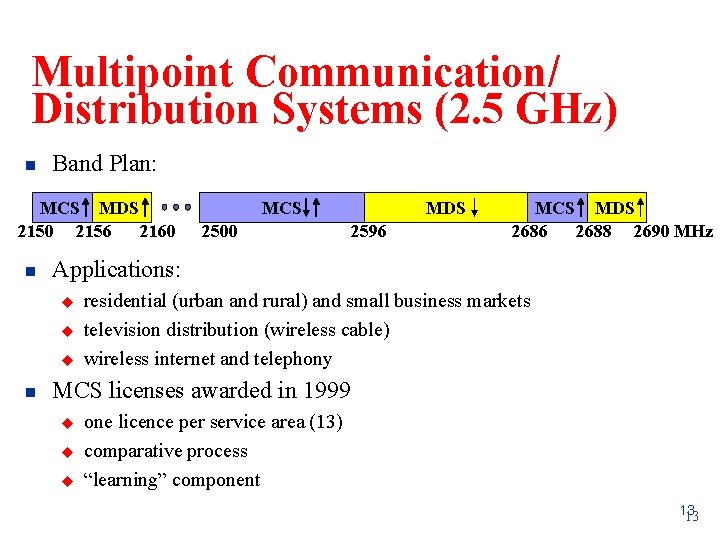
Multipoint Communication/ Distribution Systems (2. 5 GHz) n Band Plan: MCS MDS 2150 2156 2160 n 2500 MDS 2596 MCS MDS 2686 2688 2690 MHz Applications: u u u n MCS residential (urban and rural) and small business markets television distribution (wireless cable) wireless internet and telephony MCS licenses awarded in 1999 u u u one licence per service area (13) comparative process “learning” component 13 13
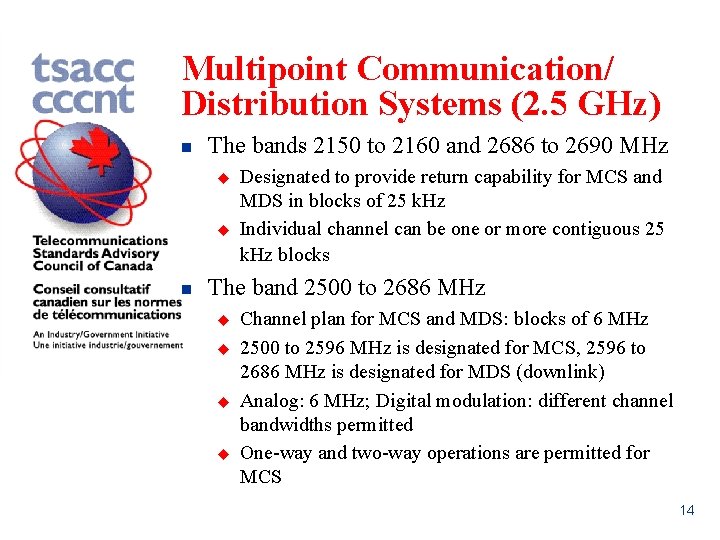
Multipoint Communication/ Distribution Systems (2. 5 GHz) n The bands 2150 to 2160 and 2686 to 2690 MHz u u n Designated to provide return capability for MCS and MDS in blocks of 25 k. Hz Individual channel can be one or more contiguous 25 k. Hz blocks The band 2500 to 2686 MHz u u Channel plan for MCS and MDS: blocks of 6 MHz 2500 to 2596 MHz is designated for MCS, 2596 to 2686 MHz is designated for MDS (downlink) Analog: 6 MHz; Digital modulation: different channel bandwidths permitted One-way and two-way operations are permitted for MCS 14
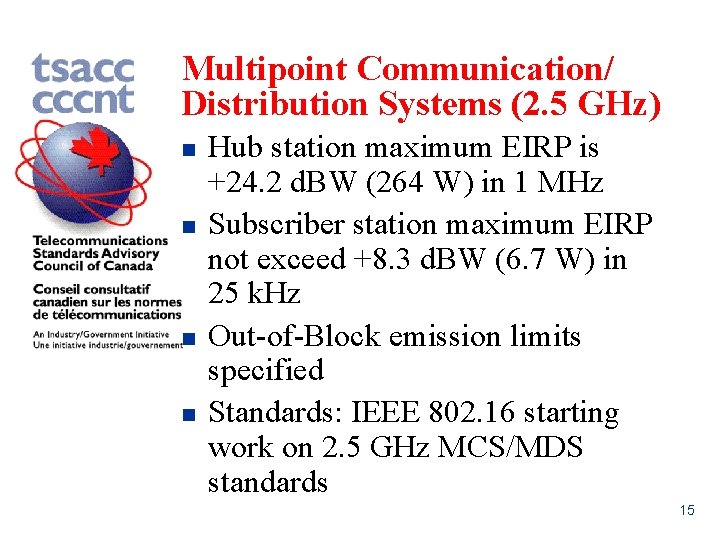
Multipoint Communication/ Distribution Systems (2. 5 GHz) n n Hub station maximum EIRP is +24. 2 d. BW (264 W) in 1 MHz Subscriber station maximum EIRP not exceed +8. 3 d. BW (6. 7 W) in 25 k. Hz Out-of-Block emission limits specified Standards: IEEE 802. 16 starting work on 2. 5 GHz MCS/MDS standards 15
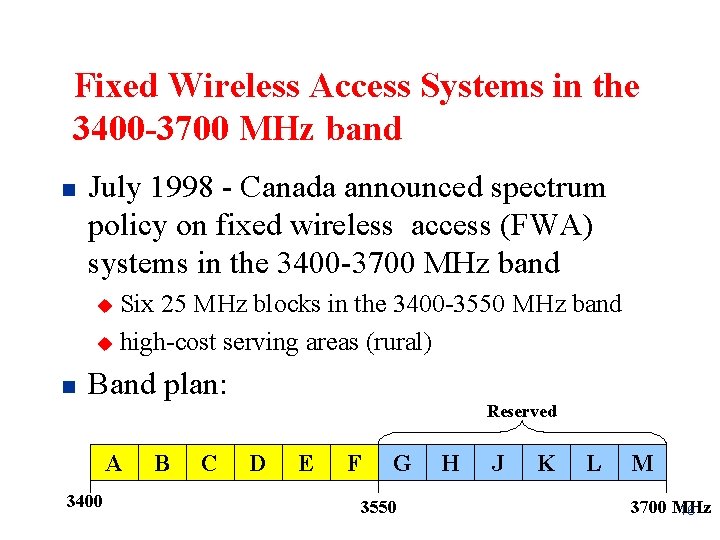
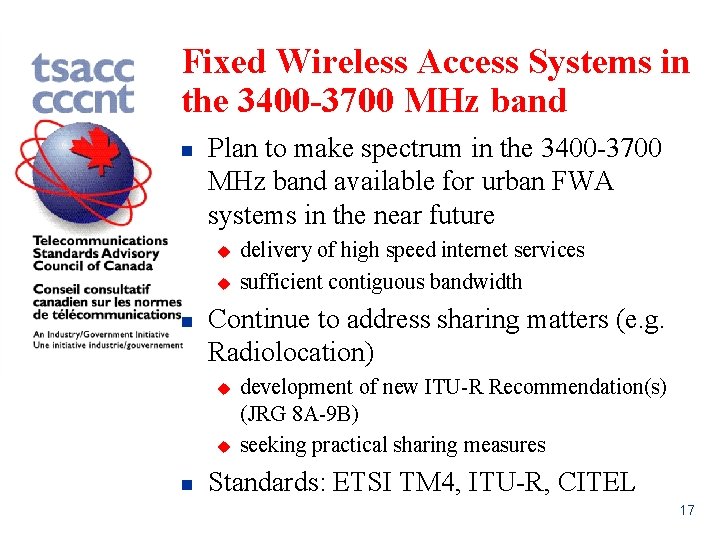
Fixed Wireless Access Systems in the 3400 -3700 MHz band n July 1998 - Canada announced spectrum policy on fixed wireless access (FWA) systems in the 3400 -3700 MHz band Six 25 MHz blocks in the 3400 -3550 MHz band u high-cost serving areas (rural) u n Band plan: A 3400 B C Reserved D E F G 3550 H J K L M 3700 MHz 16
Fixed Wireless Access Systems in the 3400 -3700 MHz band n Plan to make spectrum in the 3400 -3700 MHz band available for urban FWA systems in the near future u u n Continue to address sharing matters (e. g. Radiolocation) u u n delivery of high speed internet services sufficient contiguous bandwidth development of new ITU-R Recommendation(s) (JRG 8 A-9 B) seeking practical sharing measures Standards: ETSI TM 4, ITU-R, CITEL 17
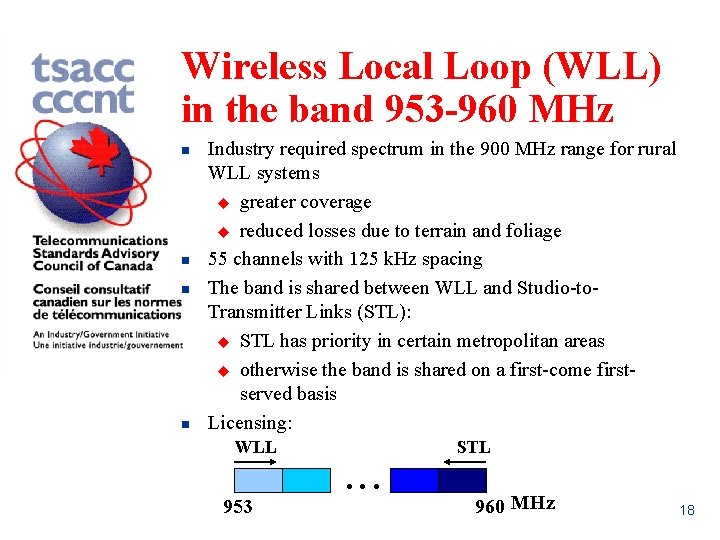
Wireless Local Loop (WLL) in the band 953 -960 MHz n n Industry required spectrum in the 900 MHz range for rural WLL systems u greater coverage u reduced losses due to terrain and foliage 55 channels with 125 k. Hz spacing The band is shared between WLL and Studio-to. Transmitter Links (STL): u STL has priority in certain metropolitan areas u otherwise the band is shared on a first-come firstserved basis Licensing: WLL 953 . . . STL 960 MHz 18
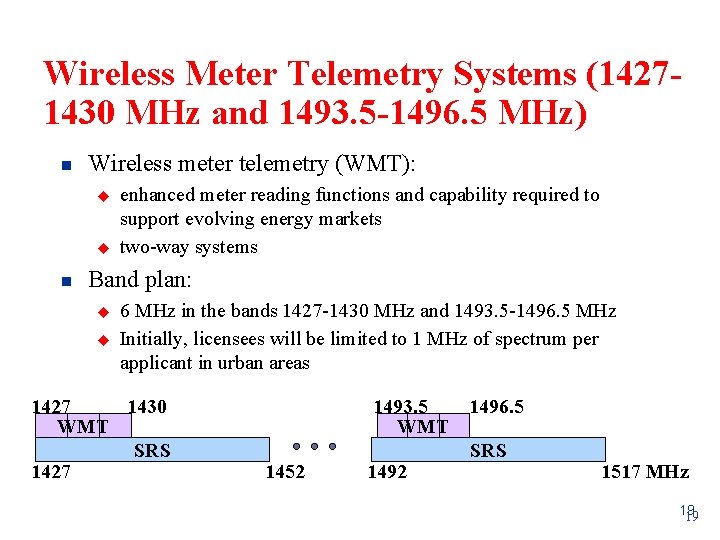
Wireless Meter Telemetry Systems (14271430 MHz and 1493. 5 -1496. 5 MHz) n Wireless meter telemetry (WMT): u u n enhanced meter reading functions and capability required to support evolving energy markets two-way systems Band plan: u u 6 MHz in the bands 1427 -1430 MHz and 1493. 5 -1496. 5 MHz Initially, licensees will be limited to 1 MHz of spectrum per applicant in urban areas 1427 1430 WMT SRS 1427 1452 1493. 5 1496. 5 WMT SRS 1492 1517 MHz 19 19
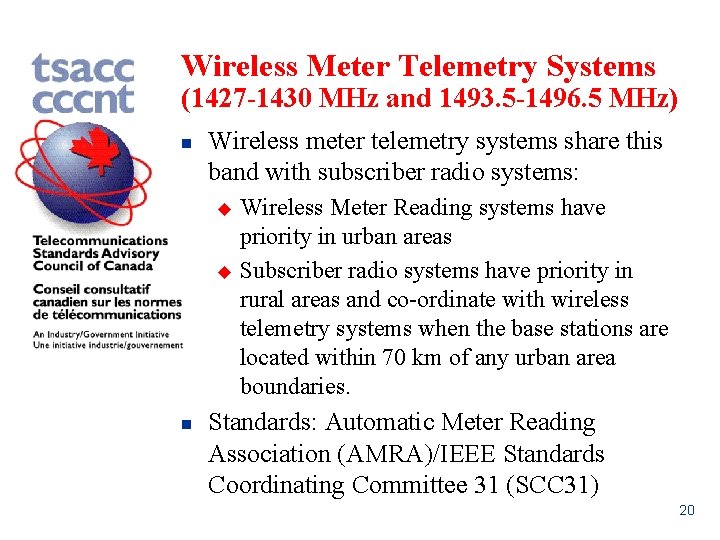
Wireless Meter Telemetry Systems (1427 -1430 MHz and 1493. 5 -1496. 5 MHz) n Wireless meter telemetry systems share this band with subscriber radio systems: Wireless Meter Reading systems have priority in urban areas u Subscriber radio systems have priority in rural areas and co-ordinate with wireless telemetry systems when the base stations are located within 70 km of any urban area boundaries. u n Standards: Automatic Meter Reading Association (AMRA)/IEEE Standards Coordinating Committee 31 (SCC 31) 20
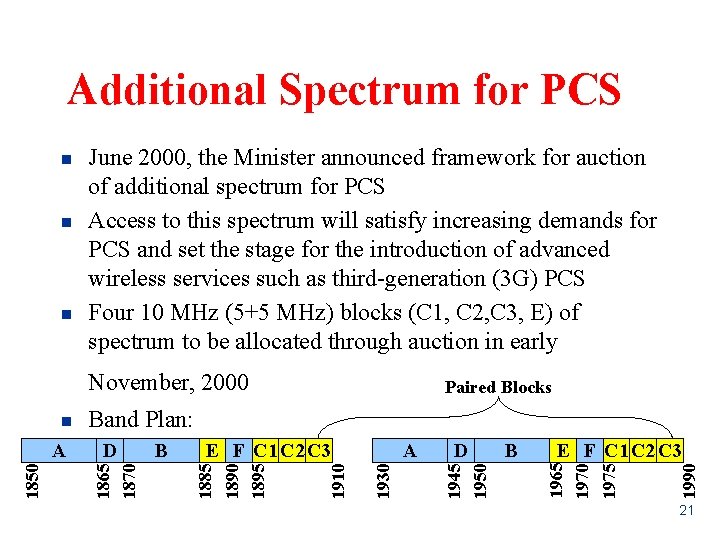
Additional Spectrum for PCS November, 2000 E F C 1 C 2 C 3 A 1930 B 1910 D 1885 1890 1895 1850 A Band Plan: 1865 1870 n Paired Blocks D B E F C 1 C 2 C 3 1990 n 1965 1970 1975 n June 2000, the Minister announced framework for auction of additional spectrum for PCS Access to this spectrum will satisfy increasing demands for PCS and set the stage for the introduction of advanced wireless services such as third-generation (3 G) PCS Four 10 MHz (5+5 MHz) blocks (C 1, C 2, C 3, E) of spectrum to be allocated through auction in early 1945 1950 n 21
Licence Exempt Technology and Services n n Family Radio Service in the Subbands 462 - 467 MHz Licence exempt LANs in bands 5150 -5350 MHz and 5725 -5825 MHz Bluetooth Broadband licence exempt systems in bands above 50 GHz 22
Family Radio Service n n A new policy allowing the deployment of Family Radio Services (FRS) was published March 2000 FRS will operate in the bands: 462. 5225 -462. 7125 MHz u 467. 56. 25 -467. 7125 MHz u n The FRS manufacturers/distributors created an industry fund to assist relocation of incumbent land mobile licensees 23
Family Radio Service n Technical Requirements: u maximum transmitter output power is 0. 5 W u 14 simplex channel carrier frequencies u channel spacing is 25 k. Hz and the nominal bandwidth is 12. 5 k. Hz u cannot be capable of interconnection to the public switched telephone network (PSTN) 24
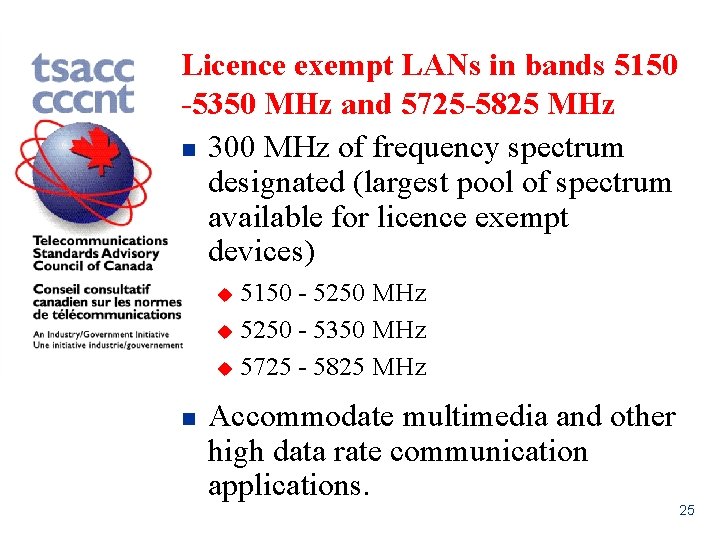
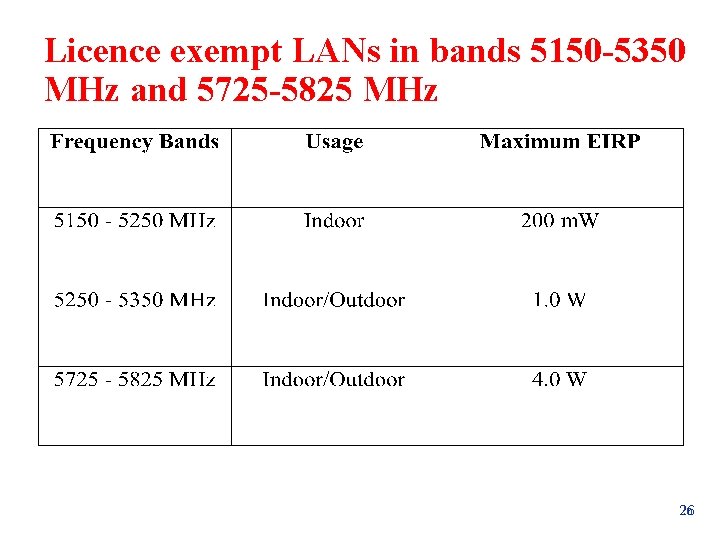
Licence exempt LANs in bands 5150 -5350 MHz and 5725 -5825 MHz n 300 MHz of frequency spectrum designated (largest pool of spectrum available for licence exempt devices) 5150 - 5250 MHz u 5250 - 5350 MHz u 5725 - 5825 MHz u n Accommodate multimedia and other high data rate communication applications. 25
Licence exempt LANs in bands 5150 -5350 MHz and 5725 -5825 MHz 26 26
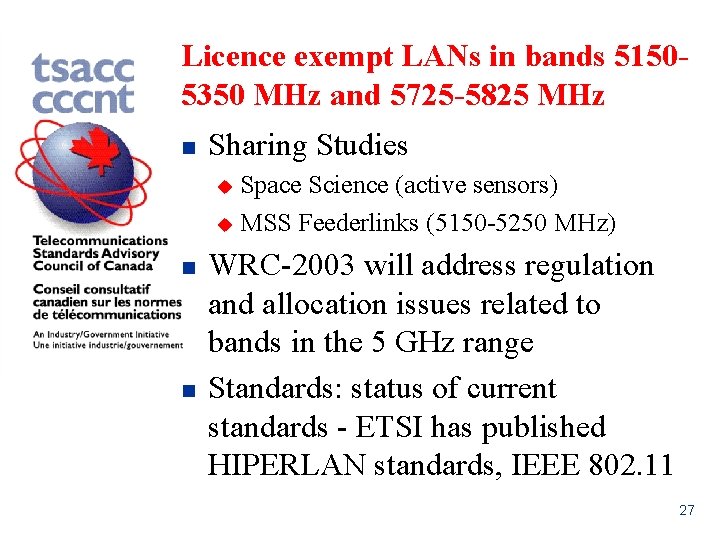
Licence exempt LANs in bands 51505350 MHz and 5725 -5825 MHz n Sharing Studies Space Science (active sensors) u MSS Feederlinks (5150 -5250 MHz) u n n WRC-2003 will address regulation and allocation issues related to bands in the 5 GHz range Standards: status of current standards - ETSI has published HIPERLAN standards, IEEE 802. 11 27
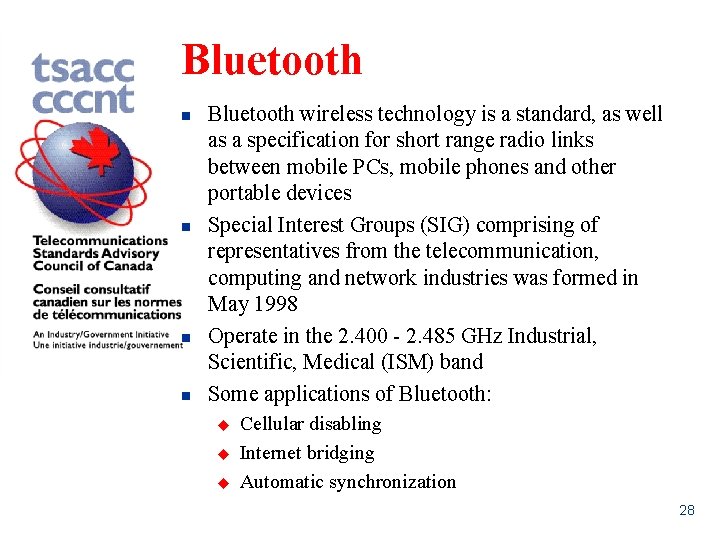
Bluetooth n n Bluetooth wireless technology is a standard, as well as a specification for short range radio links between mobile PCs, mobile phones and other portable devices Special Interest Groups (SIG) comprising of representatives from the telecommunication, computing and network industries was formed in May 1998 Operate in the 2. 400 - 2. 485 GHz Industrial, Scientific, Medical (ISM) band Some applications of Bluetooth: u u u Cellular disabling Internet bridging Automatic synchronization 28
Bluetooth n n Short range (up to 10 m) radio communication of voice and data with RF output signal power of 1 m. W (0 d. Bm) and no power control Range can be extended up to 100 m with maximum RF output signal power of 100 m. W (20 d. Bm) with power control Fast frequency hopping of 79 channels (1600 hops/sec) to avoid interference Standards: IEEE 802. 15 Working Group for Wireless Personal Area Networks (WPAN) formed on March 1999 29
Broadband licence exempt systems in bands above 50 GHz n n n Working with industry to establish spectrum needs and applications New High Density Fixed System (HDFS) bands designated at WRC 2000 Reviewing developments in other administrations (e. g. : Europe and US) 30
Broadband Wireless Access Systems n Completed first auction last fall u n n n 24/38 GHz bands Technical requirements established High flexibility in service offerings and technologies Encourage operator-to-operator coordination 31
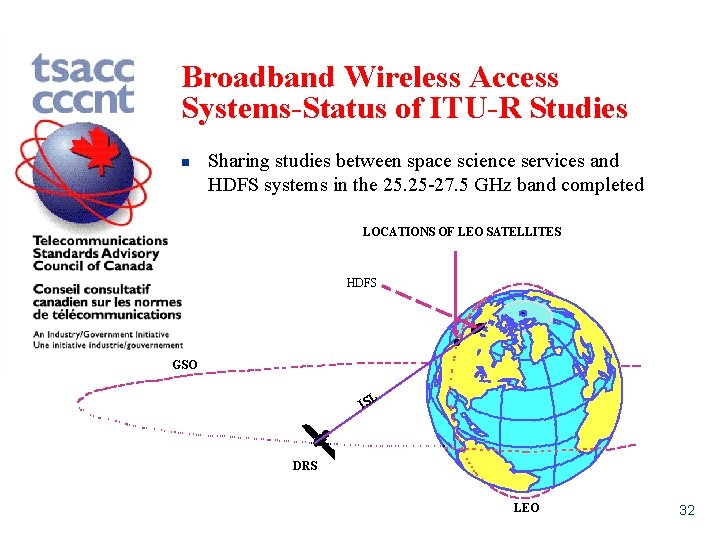
Broadband Wireless Access Systems-Status of ITU-R Studies n Sharing studies between space science services and HDFS systems in the 25. 25 -27. 5 GHz band completed LOCATIONS OF LEO SATELLITES HDFS GSO L IS DRS LEO 32
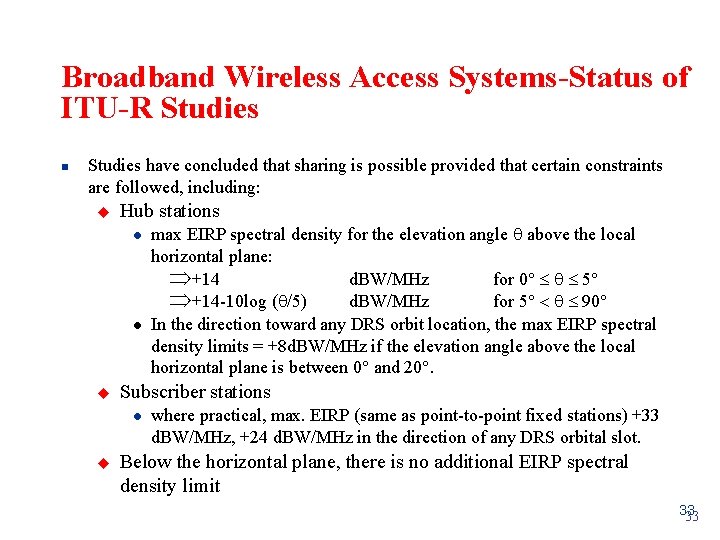
Broadband Wireless Access Systems-Status of ITU-R Studies n Studies have concluded that sharing is possible provided that certain constraints are followed, including: u Hub stations l l u Subscriber stations l u max EIRP spectral density for the elevation angle above the local horizontal plane: Þ+14 d. BW/MHz for 0 5 Þ+14 -10 log ( /5) d. BW/MHz for 5 90 In the direction toward any DRS orbit location, the max EIRP spectral density limits = +8 d. BW/MHz if the elevation angle above the local horizontal plane is between 0 and 20. where practical, max. EIRP (same as point-to-point fixed stations) +33 d. BW/MHz, +24 d. BW/MHz in the direction of any DRS orbital slot. Below the horizontal plane, there is no additional EIRP spectral density limit 33 33
Terrestrial Digital Radio Broadcasting n n n Spectrum for terrestrial digital radio broadcasting (T-DRB) allocated at WRC 1992 in the L-Band (1452 -1492 MHz) T-DRB to eventually replace AM and FM CD quality sound in a mobile reception environment Opportunity to datacast and interact with other media 55 transmitting stations are now operating in certain urban areas in Canada Some T-DRB applications: u u u Car receivers Home receivers Others 34
Wireless IP Networks n n n Internet Protocol (IP) as a networking standard is enabling all data devices everywhere to communicate in one common language (No new radio standard) 29% of Canadian households access the internet 23% of Canadians use wireless phones (Cellular and PCS) 35
Wireless IP Networks n n Wireless access to the internet on WAP phones, WAP radios, Palm or Pocket Computers (PDAs), and pagers. WAP or Wireless IP uses a gateway/ browser/server/web site to exchange between internet data and the Wireless devices PUSH e-mail u PULL service menus to access info on the web u 36
Wireless IP Networks n n n Studies of impact of Wireless IP on spectrum management concluded no need to revise current Radio Standards at this time Symmetry of signals not an issue, capacity will be an issue Standards: WAP Forum (de-facto), Wireless Data Forum, IEEE 802. 11 37
Intelligent Transportation Systems n The Canadian Architecture u u u A strong partnership between Industry and Government continues efforts to develop advanced architecture and standards towards the deployment and integration of ITS in Canada. As a result of these efforts, a Draft of The Canadian Architecture for ITS has been produced. This Architecture defines the functions of ITS, physical entities or subsystems where these functions reside, and the information flows that connect these functions and subsystems 38
Intelligent Transportation Systems n n n Government and Industry are in collaboration with efforts to determine spectrum allocations for use by Dedicated Short Range Communication Systems (DSRC). The Canadian Advisory Committee on ITS Standards has a DSRC Working Group dedicated to the research, development, demonstration and full-scale deployment of DSRC systems. Currently in Canada, the 5. 850 -5. 925 GHz band is being considered for possible allocation to applications of new DSRC systems 39
Some Challenges n n n Start work within CITEL and ITU-R on band structure for 1710 -1850 MHz for IMT-2000 systems Foresee need for equipment standards for fixed wireless access systems in the 3. 4 GHz band Encourage completion of wireless broadband industry(e. g. ETSI, IEEE) standards for 24/28/38 GHz systems Activities started concerning use of Ka band for GSO and for the introduction of Non-GSO systems Others 40