
Rapid Qualitative Inquiry RQI TeamBased Assessment James Beebe
Rapid Qualitative Inquiry (RQI): Team-Based Assessment James Beebe Portland State University and the Center for Rapid Qualitative Inquiry 2017 Workshop
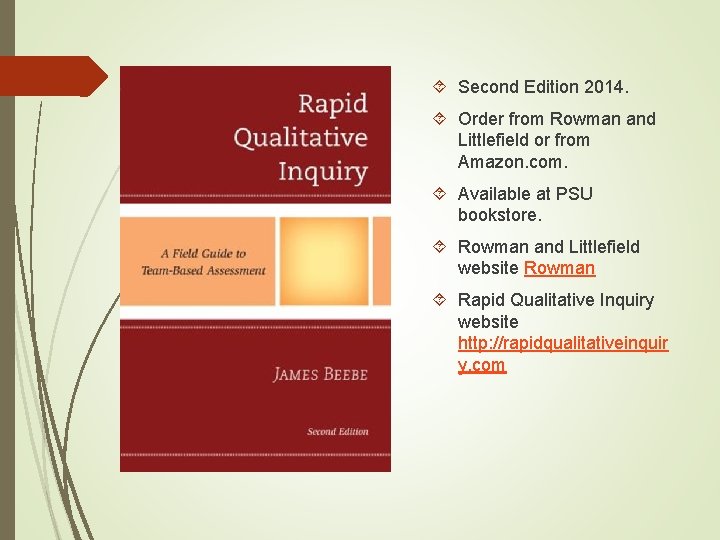
Second Edition 2014. Order from Rowman and Littlefield or from Amazon. com. Available at PSU bookstore. Rowman and Littlefield website Rowman Rapid Qualitative Inquiry website http: //rapidqualitativeinquir y. com

Definition RQI is a team-based, applied research team-based approach that (a) focuses on getting the insider’s or emic perspective, emic perspective (b) uses multiple sources and multiple sources triangulation, and (c) uses iterative data analysis and iterative data analysis additional data collection to quickly, additional data collection usually in less than several weeks, develop a preliminary understanding of a preliminary understanding situation.
Contents (click on links below) Introduction Qualitative Research and RQI and Related Approaches Evolution of Approach and 2 nd Edition Uses of RQI Doing RQI, Data Collection Group Interview—Skill Building Mini-RAP is NOT research Doing RQI, Analysis Ethics and Rigor Future

Introduction
Definitions of rap (as in rap music) that apply to RQI To talk freely and frankly. To communicate with participants using their vocabulary and rhythm.
Qualitative Research
The objective of qualitative research is to develop understanding of complex situations as opposed to finding a single truth.
Qualitative Research is Especially Appropriate Where issues are not yet well defined. For identifying emic categories.
Emic and Etic The goal is to understand the categories the local people use for dividing up their reality and identifying the terms they use for their categories. The categories used by the local people are referred to as “emic. ” The categories used by outsiders including researchers who are not insiders, are “etic” categories. Examples: colors, land “ownership, ” soils, social networks.
Emic and Etic Qualitative research such as RQI can improve quantitative research by identifying the categories used by the insiders.
Qualitative Research and Numbers Qualitative research should not be used for estimating numbers or percents. Quantitative research is the appropriate research methodology when numbers or percents are needed.
Qualitative Research and RQI
Rapid Qualitative Inquiry and Qualitative Research RQI is Qualitative Research. Shares many of the characteristics of case study and ethnography.
Based on a Broad Understanding of Qualitative Research As noted in a recent review in Qualitative Health Research(2016) RQI draws out and navigates the many conflicting perspectives on qualitative research and identifies the implications of these perspectives for RQI. The RQI is described as “more a research design” than an approach to “methods. ”
Differs from traditional qualitative research INSTEAD OF LONG-TERM FIELDWORK Uses teams of 2 to 5 individuals with different discipline backgrounds. When appropriate, includes insiders on the team. Uses intensive, team interaction. Divides time explicitly between data collection and data review/ analysis before additional data collection.
RQI and Related Approaches
RQI, RAP, and Related Approaches RQI-Newest generation of rapid qualitative research. RAP-Rapid Assessment Process is the direct parent of RQI, (see Beebe 2001) but with significant differences. Mini-RAP- Educational activity for learning RQI and qualitative research. NOT a research methodology or approach.
Other Related Approaches Other related research methodologies and approaches- sharing many, but not all, of the characteristics of RQI. Rapid Assessment Procedures, Participatory Rural Appraisal (PRA), Rural Appraisal, Rapid Ethnography, and others.
Evolution of Approach and 2 nd Edition of Book
RQI and RAP The shift from calling the approach Rapid Assessment Process (RAP) to calling it Rapid Qualitative Inquiry (RQI) reflects both a reconceptualization and refinement of the earlier perspective based on extensive feedback from users, reflection on what is unique about the approach, and advances in the field of qualitative research.
Uses of RQI
Rapid Qualitative Inquiry is Most Appropriate Where issues are not yet well defined. Where there is not sufficient time or other resources for long-term, traditional qualitative research.
RQI can be used • To make preliminary decisions about interventions or changes. • To make decisions about additional research. • For monitoring and evaluation. • To investigate intersectionality. • In qualitative research classes to develop expertise and skills.
Examples of the Use of RQI (and very similar approaches) Higher Education New Dean for Student Services—Revealed lack of agreement on who were the students and what were the services. Proposal to convert agricultural cooperatives to for-profit organizations—Revealed tremendous variability with some successes and confusion by managers on difference between productivity and production.
Examples of the Use of RQI (and very similar approaches) Labor as a constraint to increased agricultural production—Revealed many farmers close to urban centers spend increasing time off the farm and need innovations to be part-time farmers. Fish consumption –Revealed consumption varies by culturally distinct communities.
Published Examples of RQI SAMPLES FROM MORE THAN 165 PUBLISHED REPORTS Retention of Fulani Muslim girls in school (Balde 2004) Mobile learning to teach reading to 9 th grade students (Brown, L 2008) Exploring HIV/AIDS knowledge and behavior of university students in Botswana (Brown, M et al. 2008) Education and identity formation in Zimbabwe (Mpondi 2004)
Published Examples of RQI Youth, trash, and work in an African city (Thieme 2010) Adult learning experience in a teacher certification program (Walsh et al. 2005) Evidence-based nursing practice (Angus and O’Brien-Pallas 2003) Computerized clinical decision support (Ash et al. 2013)
Published Examples of RQI Sampling hard-to-reach youth on sexually transmitted diseases (Auerswald et al. 2004) Home delivery in rural Ethiopia (Bedford et al. 2012) Use of prenatal micronutrients supplements by working class Filipino women (Daack. Hirsch and Gamboa 2011) Prescription opioid abuse in an urban setting (Inciardi et al. 2009)
Use of RQI in Qualitative Research Courses Book could be a core reading in an applied research methods course. RQI provides an easily accessible introduction to students in methods classes. RQI makes it possible to conduct one or more complete studies through the course of a term-long class. The Second Edition includes instruction on the use of RQI in research classes.
Doing a RQI, Data Collection
Results can be produced in • as few as about five days, five • but usually requires several weeks • Longer time in the field usually produces better results.
Semi-structured Interviews Relaxed, semi-structured interviewing that provides interviewing respondents with time to think can elicit stories.

Stories NOT Answers The goal is to get the insiders to tell their stories and NOT stories answer the questions of the outsiders
Stories Should be Collected from a Purposeful Sample. This often Requires Seeking Out: • • the poorer, less articulate, more upset, and those least like the members of the RQI team.
RQI cannot be done by one person.
Teamwork RQI is based on interdisciplinary team interaction throughout the research, from question formulation, to research, analysis, and write-up.
Teamwork The success of RQI depends upon the quality of the teamwork.
Intensive teamwork for both the data collection and analysis is an alternative to prolonged fieldwork
Team interviewing RQI uses group discussion involving all members of the team and the local participants (team interviewing), NOT sequential interviewing NOT by individual members of the team.
Mini-RAP Skill Building
Practice Mini-RAP A Mini-RAP is not a research methodology. It is a way to learn to do Qualitative Research and RQI. Groups of 4 or 5 persons. Topic: What would be necessary to improve gender equity in your organizations. Most Mini-Raps are based on two 15 minute interviews, but this can be expanded.
Practice Mini-RAP One member of the group will be the person interviewed during the first interview. A second member of the group will be the person interviewed during the second interview. The other members of the group will be the research team.
Practice Mini-RAP The interview team prepares for the interview by identifying a list of topics (often confused with a list of research questions, but should not be in the form of questions). Importance of getting stories and not answers to questions.
Practice Mini-RAP Round one. Minimum of 15 minutes. STAY RELAXED! Keep up with time. TAKE NOTES. Normally would use a voice recorder-maybe smart phone.
Practice Mini-RAP After the first round. Entire team meets to discuss: (a) what needs to be changed in the way the interview was conducted (speed, interaction between members of the team, leading the witness, focus on getting stories). (b) what was learned in the interview, how does this influence what is asked in the second round. (c) what might be some tentative preliminary conclusions.
Practice Mini-RAP Round two: Different person is interviewed. Builds on lessons learned in round one.
Practice Mini-RAP After the second round, the team reviews lessons learned and continues to work on identifying possible conclusion. May decide qualitative research is not appropriate for the type of questions being investigated. Entire team working together produces the report.
Mini-RAP is NOT research
Mini-RAP vs RQI is the research approach. Mini-RAP is one way to learn qualitative research or RQI requires multiple long interviews over many days. Mini-RAP is based on two short interviews.
Doing RQI, Analysis
Iterative Analysis and Additional Data Collection Time is divided between • blocks used for collecting information and • blocks when the team does data analysis and considers changes in the next round of data collection.
Analysis begins with the first round of data collection. Analysis involves: • Coding the data, • Displaying relationships in the data, and • Drawing conclusions.
Ethics and Rigor
Ethical Issue: Bogus Empowerment In addition to the ethical issues associated with qualitative research RQI encourages people to falsely believe that their input will be acted upon. The RQI team needs to keep their promises and make promises that they can keep. The RQI team needs to avoid the temptation of engaging in hyperbole about the democratic nature of the situation.
Rigorous RQI Members of the RQI team need to recognize: • They don’t know enough to ask questions formulated in advance, • They don’t know enough to provide the answers, but • They do know enough to want to empower others to solve their own problems.
Technology to Improve Rigor and Speed Transcription software Social media Analysis software File collaboration Document capture Video SMART PHONES

Future
The major challenge Confusing rapid with rushed
RQI/RAP is an idea whose time has come. ? Only if not oversold and only if implemented rigorously.
Additional Information Visit the web site: http: //rapidqualitativeinquiry. com Contact me: beebe@gonzaga. edu Blog http: //rapidqualitativeinquiry. blogspot. com/ Book Review, Qualitative Health Research 2016 1 -2, John Brett March 17, 2017
- Slides: 61