
Rapid Predictive Modeling for High Frequency Interconnect on
![Board-level Interconnect in Telecommunication Backplane Interconnect Chip-to-chip Interconnect [1] http: //www. ece. gatech. edu/research/labs/mag/mixed_signal/mixedsig](https://slidetodoc.com/presentation_image/25a0de4efb1dfd035d918b432ed8d8f6/image-5.jpg "Board-level Interconnect in Telecommunication Backplane Interconnect Chip-to-chip Interconnect [1] http: //www. ece. gatech. edu/research/labs/mag/mixed_signal/mixedsig")
![Trend of Board-level Interconnect n [2] http: //public. itrs. net/Files/2003 ITRS/Home 2003. htm 8](https://slidetodoc.com/presentation_image/25a0de4efb1dfd035d918b432ed8d8f6/image-8.jpg "Trend of Board-level Interconnect n [2] http: //public. itrs. net/Files/2003 ITRS/Home 2003. htm 8")
- Slides: 58
Rapid, Predictive Modeling for High Frequency Interconnect on Low Cost Substrates Dissertation Defense Presentation Spring, 2005 Jaemin Shin Advisor: Dr. Martin A. Brooke School of Electrical and Computer Engineering Georgia Institute of Technology, Atlanta, GA 30332 April 2005
Outline n Objective n Limitations of Electrical Board-level Interconnects n Background n Motivation n Proposed Modeling Procedure n Modeling of Straight Microstrip Lines n Modeling of Serpentine Interconnects n Conclusions 2
Objective n Our goal is to develop a rapid, predictive (scalable) measurement-based modeling method for high frequency interconnects on low cost substrates: ¡ Modeling of interconnect structures ¡ Prediction by scalability and interpolation ¡ Evaluation of modeling performance with measured behaviors and a simulation tool. 3
Outline n Objective n Limitations of Electrical Board-level Interconnects ¡ Board-level Interconnect ¡ Geometrical limitations at high frequency n Background n Motivation n Proposed Modeling Procedure n Modeling of Straight Microstrip Lines n Modeling of Serpentine Interconnects n Conclusions 4
Board-level Interconnect in Telecommunication Backplane Interconnect Chip-to-chip Interconnect [1] http: //www. ece. gatech. edu/research/labs/mag/mixed_signal/mixedsig 3. htm 5
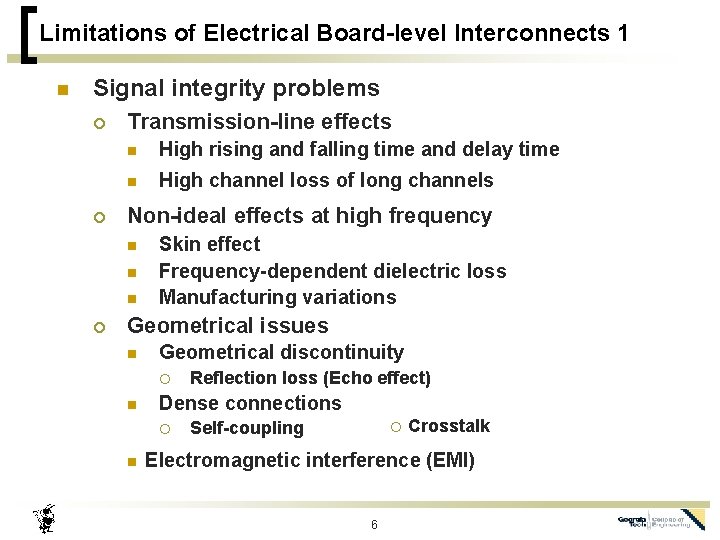
Limitations of Electrical Board-level Interconnects 1 n Signal integrity problems ¡ ¡ Transmission-line effects n High rising and falling time and delay time n High channel loss of long channels Non-ideal effects at high frequency n n n ¡ Skin effect Frequency-dependent dielectric loss Manufacturing variations Geometrical issues n Geometrical discontinuity ¡ n Dense connections ¡ n Reflection loss (Echo effect) Self-coupling ¡ Crosstalk Electromagnetic interference (EMI) 6
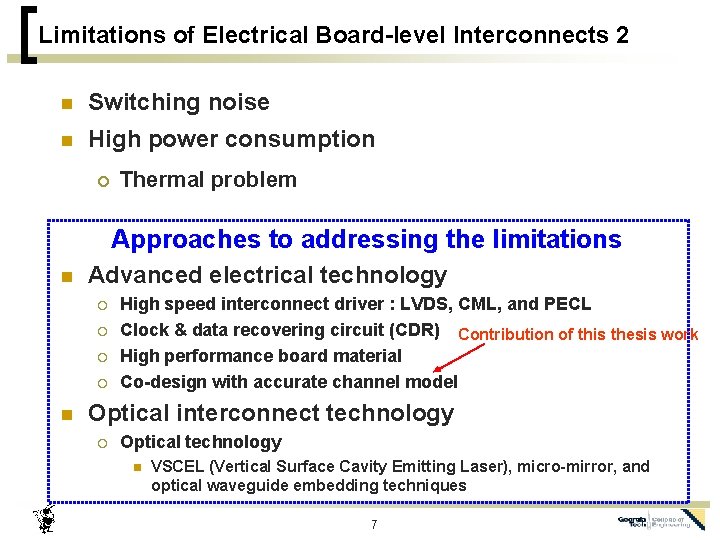
Limitations of Electrical Board-level Interconnects 2 n Switching noise n High power consumption ¡ Thermal problem Approaches to addressing the limitations n Advanced electrical technology ¡ ¡ n High speed interconnect driver : LVDS, CML, and PECL Clock & data recovering circuit (CDR) Contribution of this thesis work High performance board material Co-design with accurate channel model Optical interconnect technology ¡ Optical technology n VSCEL (Vertical Surface Cavity Emitting Laser), micro-mirror, and optical waveguide embedding techniques 7
Trend of Board-level Interconnect n [2] http: //public. itrs. net/Files/2003 ITRS/Home 2003. htm 8 According to 2003 ITRS (International Technology Roadmap of Semiconductor) ¡ In near-term years, off-chip frequency will be to keep its speed lower than 10 GHz. ¡ Most telecommunication companies have preferred the use of low cost FR 4 materials. ¡ Moreover, cost-performance and low-cost products occupy a considerable area of the market ¡ Thus, interconnects on FR 4 are still attractive. ¡ However, at high frequency, FR 4 material needs more design work with an efficient, accurate model to achieve acceptable electrical performance.
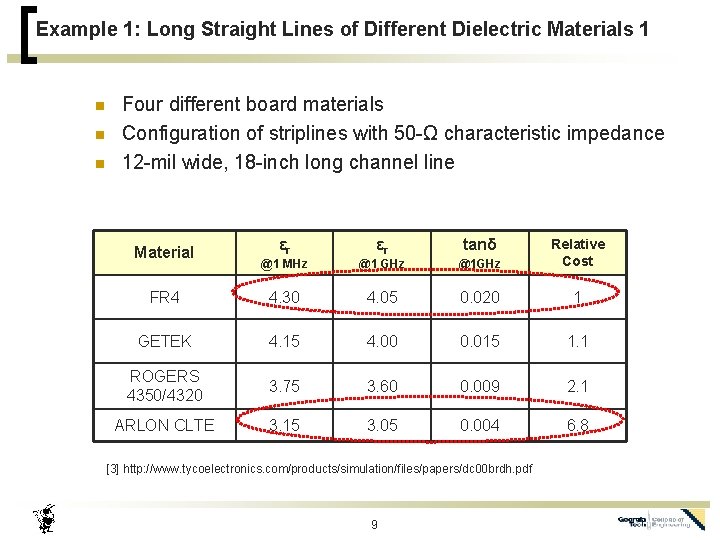
Example 1: Long Straight Lines of Different Dielectric Materials 1 n n n Four different board materials Configuration of striplines with 50 -Ω characteristic impedance 12 -mil wide, 18 -inch long channel line εr εr tanδ @1 MHz @1 GHz @1 GHz Relative Cost FR 4 4. 30 4. 05 0. 020 1 GETEK 4. 15 4. 00 0. 015 1. 1 ROGERS 4350/4320 3. 75 3. 60 0. 009 2. 1 ARLON CLTE 3. 15 3. 05 0. 004 6. 8 Material [3] http: //www. tycoelectronics. com/products/simulation/files/papers/dc 00 brdh. pdf 9
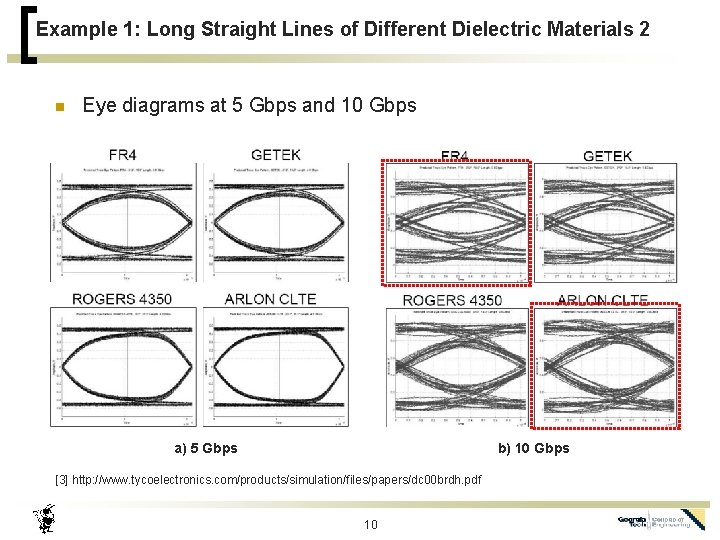
Example 1: Long Straight Lines of Different Dielectric Materials 2 n Eye diagrams at 5 Gbps and 10 Gbps a) 5 Gbps b) 10 Gbps [3] http: //www. tycoelectronics. com/products/simulation/files/papers/dc 00 brdh. pdf 10
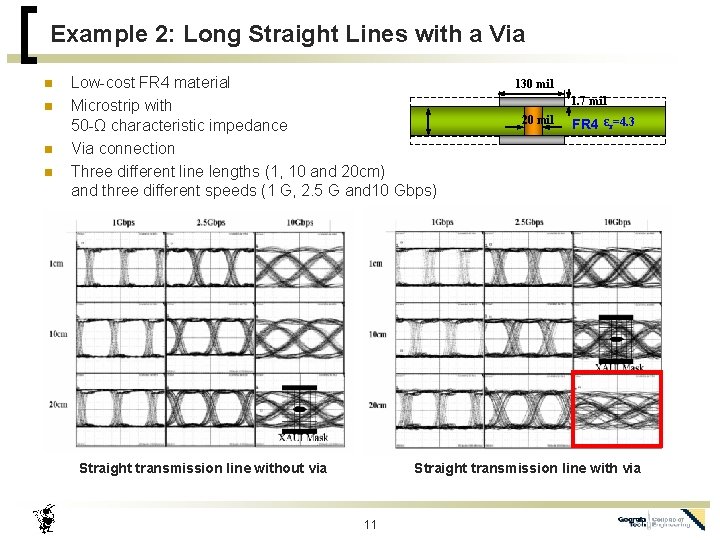
Example 2: Long Straight Lines with a Via n n Low-cost FR 4 material Microstrip with 50 -Ω characteristic impedance Via connection Three different line lengths (1, 10 and 20 cm) and three different speeds (1 G, 2. 5 G and 10 Gbps) Straight transmission line without via 130 mil 1. 7 mil 20 mil FR 4 εr=4. 3 Straight transmission line with via 11
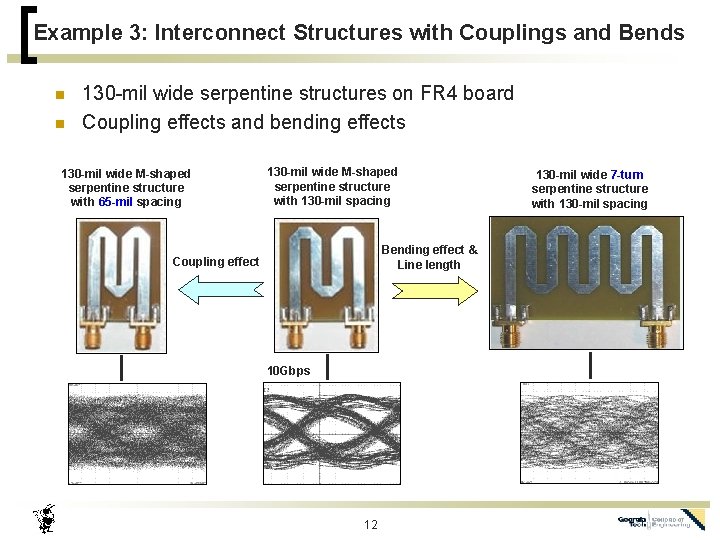
Example 3: Interconnect Structures with Couplings and Bends n n 130 -mil wide serpentine structures on FR 4 board Coupling effects and bending effects 130 -mil wide M-shaped serpentine structure with 65 -mil spacing 130 -mil wide M-shaped serpentine structure with 130 -mil spacing Bending effect & Line length Coupling effect 10 Gbps 12 130 -mil wide 7 -turn serpentine structure with 130 -mil spacing
Outline n Objective n Limitations of Electrical Board-level Interconnects n Background ¡ ¡ Non-ideal Effects Previous Modeling Methods n Motivation n Proposed Modeling Procedure n Modeling of Straight Microstrip Lines n Modeling of Serpentine Interconnects n Conclusions 13
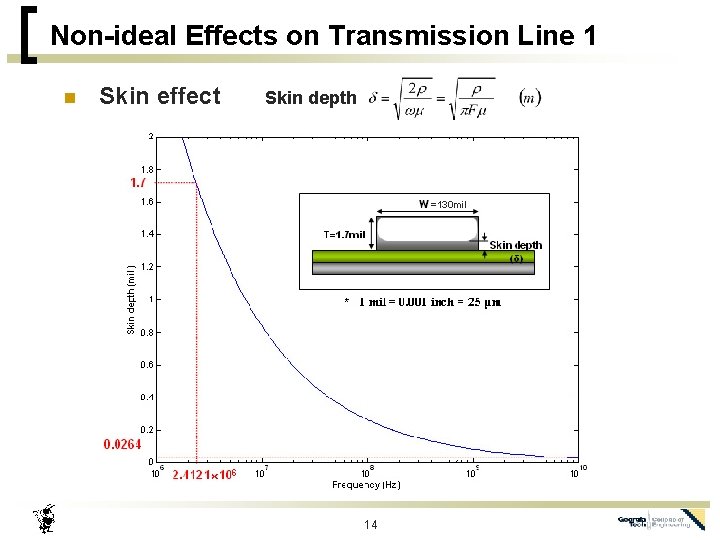
Non-ideal Effects on Transmission Line 1 n Skin effect Skin depth =130 mil 14
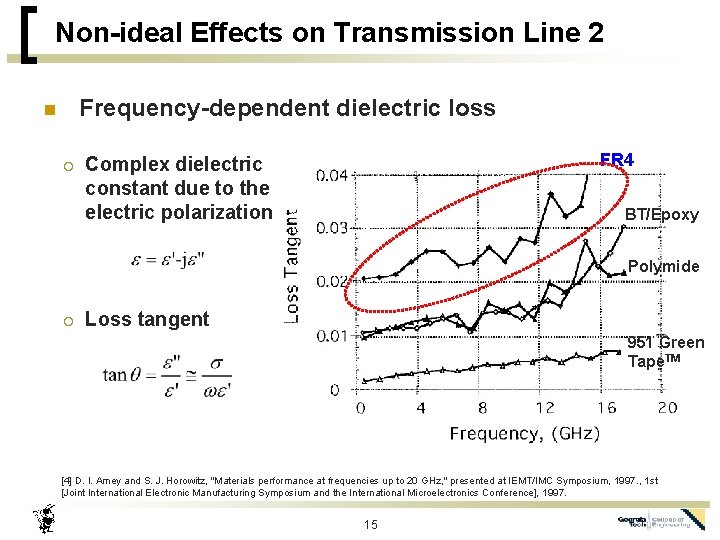
Non-ideal Effects on Transmission Line 2 Frequency-dependent dielectric loss n ¡ FR 4 Complex dielectric constant due to the electric polarization BT/Epoxy Polymide ¡ Loss tangent 951 Green Tape. TM [4] D. I. Amey and S. J. Horowitz, "Materials performance at frequencies up to 20 GHz, " presented at IEMT/IMC Symposium, 1997. , 1 st [Joint International Electronic Manufacturing Symposium and the International Microelectronics Conference], 1997. 15
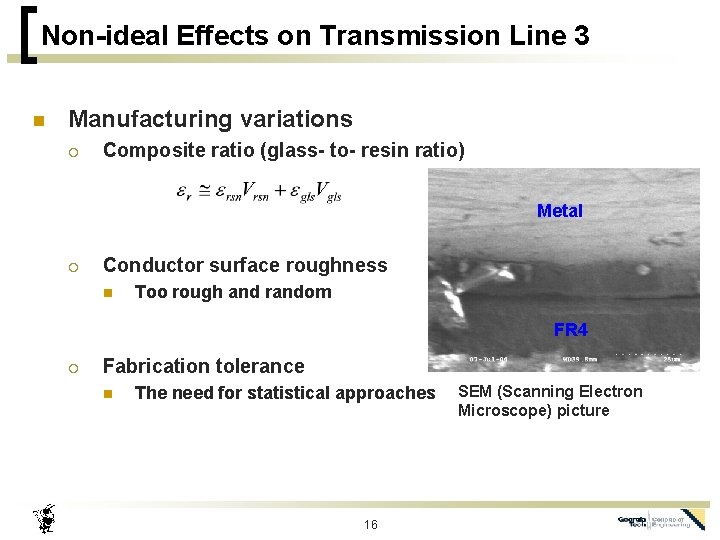
Non-ideal Effects on Transmission Line 3 n Manufacturing variations ¡ Composite ratio (glass- to- resin ratio) Metal ¡ Conductor surface roughness n Too rough and random FR 4 ¡ Fabrication tolerance n The need for statistical approaches 16 SEM (Scanning Electron Microscope) picture
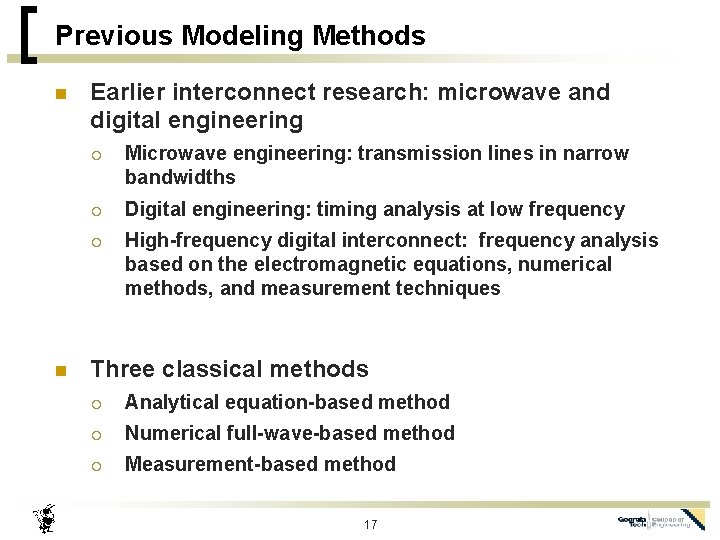
Previous Modeling Methods n n Earlier interconnect research: microwave and digital engineering ¡ Microwave engineering: transmission lines in narrow bandwidths ¡ Digital engineering: timing analysis at low frequency ¡ High-frequency digital interconnect: frequency analysis based on the electromagnetic equations, numerical methods, and measurement techniques Three classical methods ¡ Analytical equation-based method ¡ Numerical full-wave-based method ¡ Measurement-based method 17
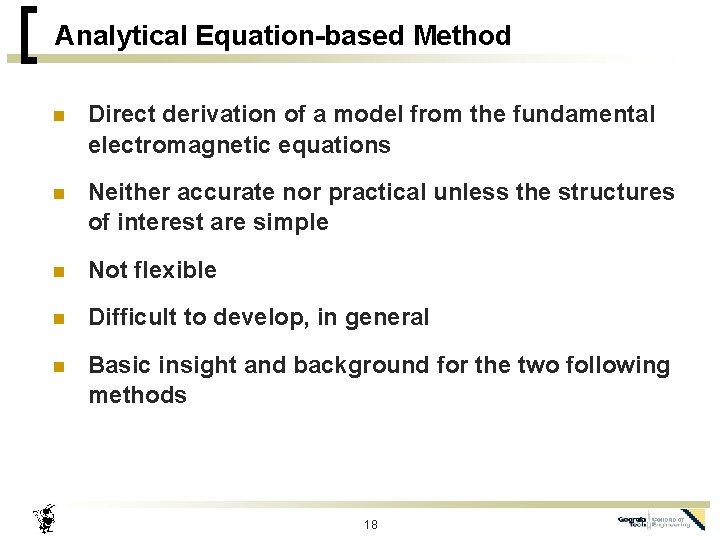
Analytical Equation-based Method n Direct derivation of a model from the fundamental electromagnetic equations n Neither accurate nor practical unless the structures of interest are simple n Not flexible n Difficult to develop, in general n Basic insight and background for the two following methods 18
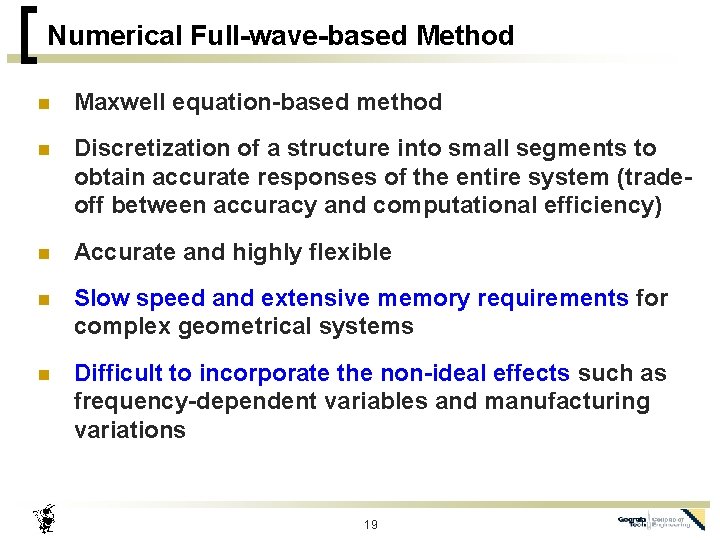
Numerical Full-wave-based Method n Maxwell equation-based method n Discretization of a structure into small segments to obtain accurate responses of the entire system (tradeoff between accuracy and computational efficiency) n Accurate and highly flexible n Slow speed and extensive memory requirements for complex geometrical systems n Difficult to incorporate the non-ideal effects such as frequency-dependent variables and manufacturing variations 19
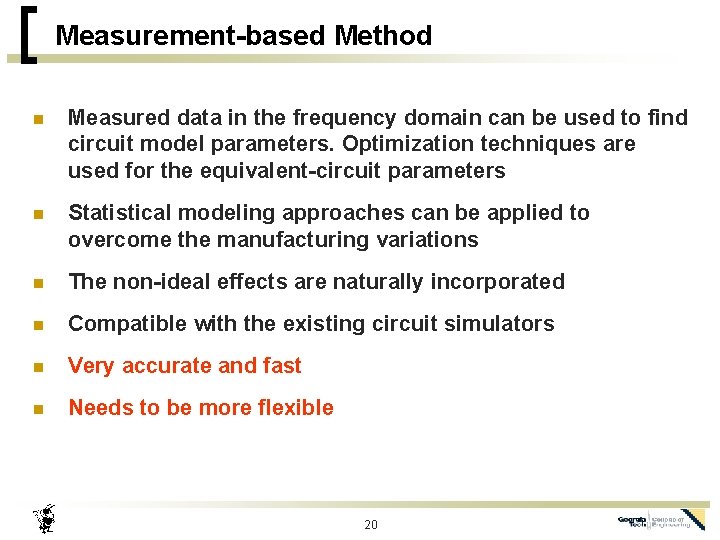
Measurement-based Method n Measured data in the frequency domain can be used to find circuit model parameters. Optimization techniques are used for the equivalent-circuit parameters n Statistical modeling approaches can be applied to overcome the manufacturing variations n The non-ideal effects are naturally incorporated n Compatible with the existing circuit simulators n Very accurate and fast n Needs to be more flexible 20
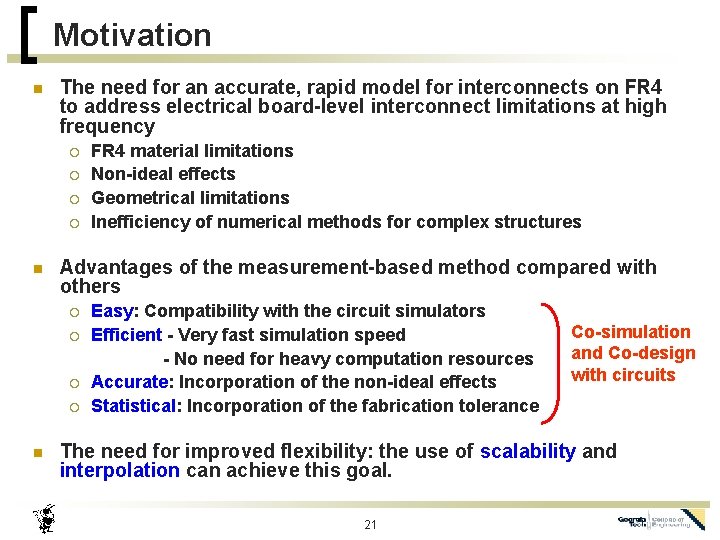
Motivation n The need for an accurate, rapid model for interconnects on FR 4 to address electrical board-level interconnect limitations at high frequency ¡ ¡ n Advantages of the measurement-based method compared with others ¡ ¡ n FR 4 material limitations Non-ideal effects Geometrical limitations Inefficiency of numerical methods for complex structures Easy: Compatibility with the circuit simulators Efficient - Very fast simulation speed - No need for heavy computation resources Accurate: Incorporation of the non-ideal effects Statistical: Incorporation of the fabrication tolerance Co-simulation and Co-design with circuits The need for improved flexibility: the use of scalability and interpolation can achieve this goal. 21
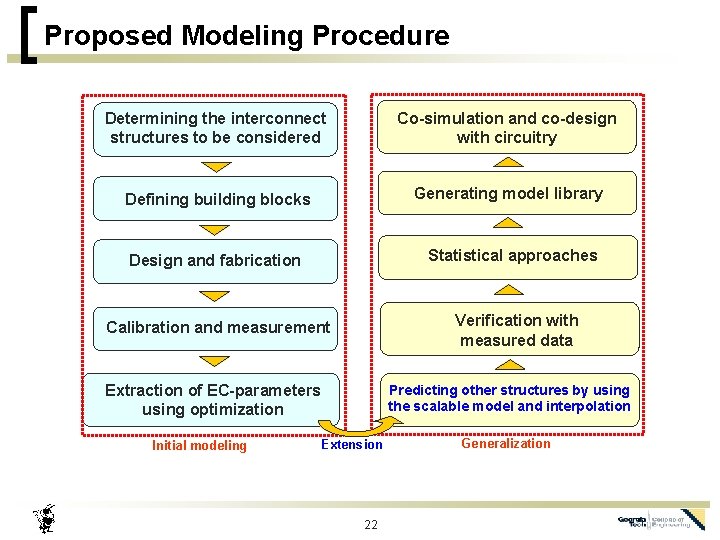
Proposed Modeling Procedure Determining the interconnect structures to be considered Co-simulation and co-design with circuitry Defining building blocks Generating model library Design and fabrication Statistical approaches Calibration and measurement Verification with measured data Extraction of EC-parameters using optimization Initial modeling Predicting other structures by using the scalable model and interpolation Extension 22 Generalization
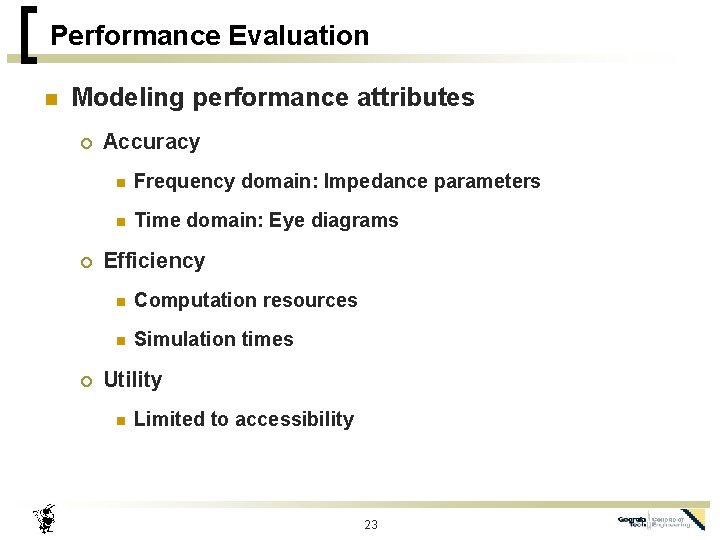
Performance Evaluation n Modeling performance attributes ¡ ¡ ¡ Accuracy n Frequency domain: Impedance parameters n Time domain: Eye diagrams Efficiency n Computation resources n Simulation times Utility n Limited to accessibility 23
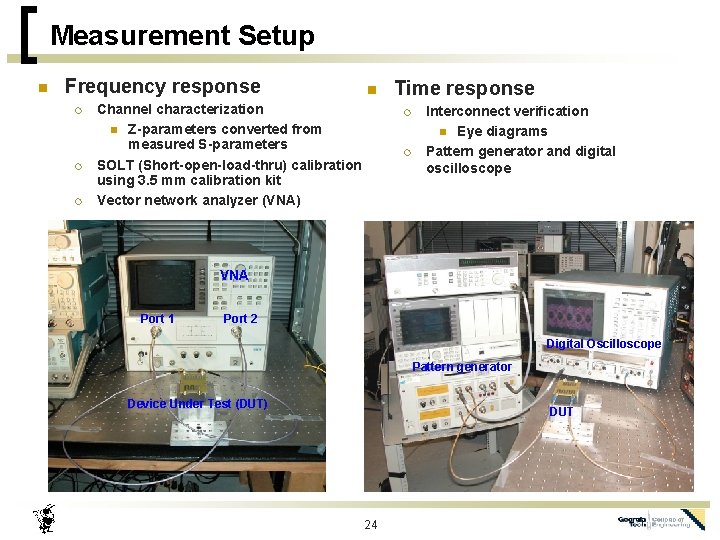
Measurement Setup n Frequency response ¡ ¡ ¡ n Channel characterization n Z-parameters converted from measured S-parameters SOLT (Short-open-load-thru) calibration using 3. 5 mm calibration kit Vector network analyzer (VNA) Time response ¡ ¡ Interconnect verification n Eye diagrams Pattern generator and digital oscilloscope VNA Port 1 Port 2 Digital Oscilloscope Pattern generator Device Under Test (DUT) DUT 24
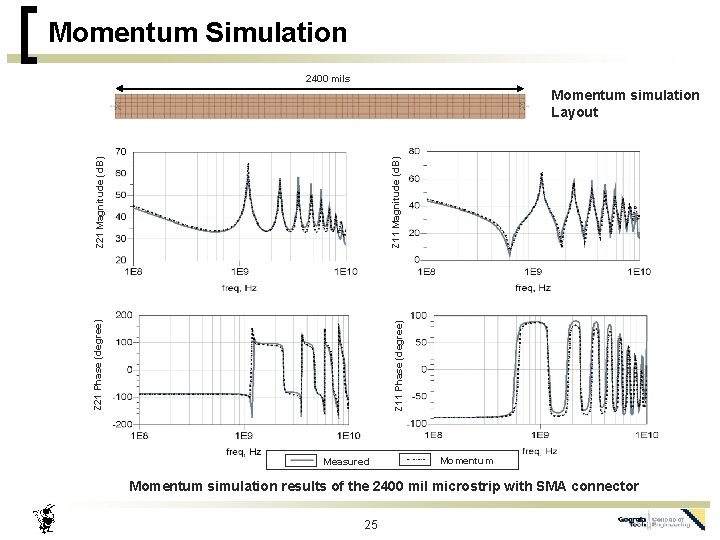
Momentum Simulation 2400 mils Z 11 Phase (degree) Z 21 Magnitude (d. B) Z 11 Magnitude (d. B) Momentum simulation Layout Measured Momentum simulation results of the 2400 mil microstrip with SMA connector 25
Outline n Objective n Limitations of Electrical Board-level Interconnects n Background n Motivation n Modeling Procedure n Modeling of Straight Microstrip Lines ¡ Modeling Description ¡ Results and Performance Comparison n Modeling of Serpentine Interconnects n Conclusions 26
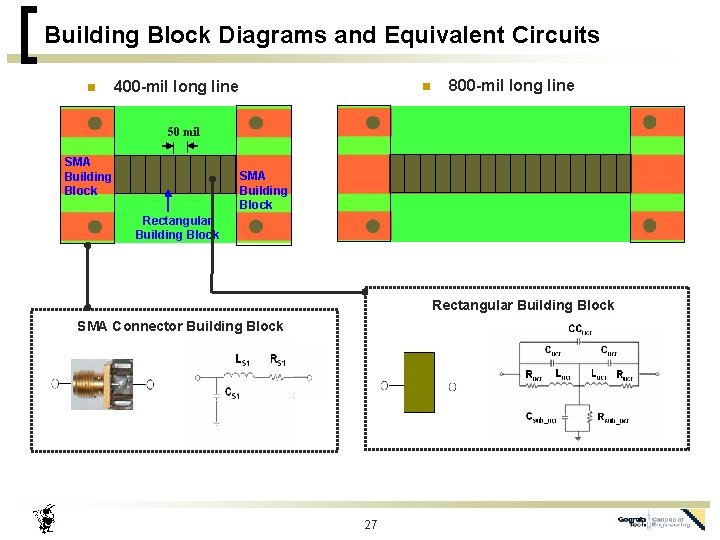
Building Block Diagrams and Equivalent Circuits n 400 -mil long line n 800 -mil long line 50 mil SMA Building Block Rectangular Building Block SMA Connector Building Block 27
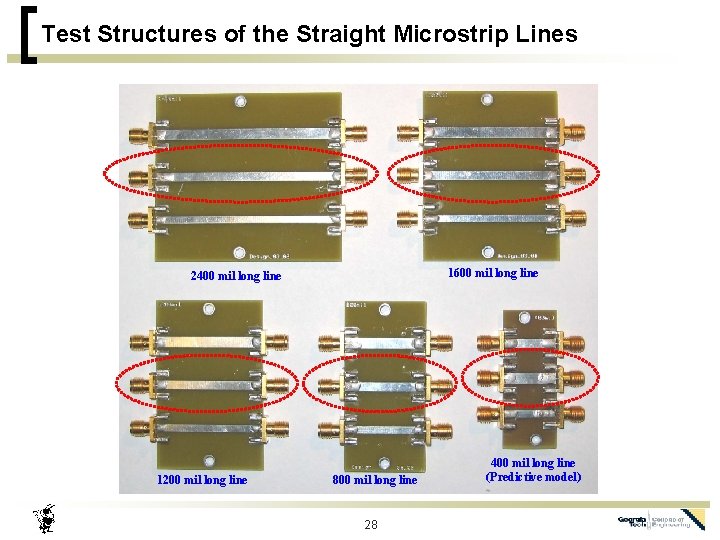
Test Structures of the Straight Microstrip Lines 1600 mil long line 2400 mil long line 1200 mil long line 800 mil long line 28 400 mil long line (Predictive model)
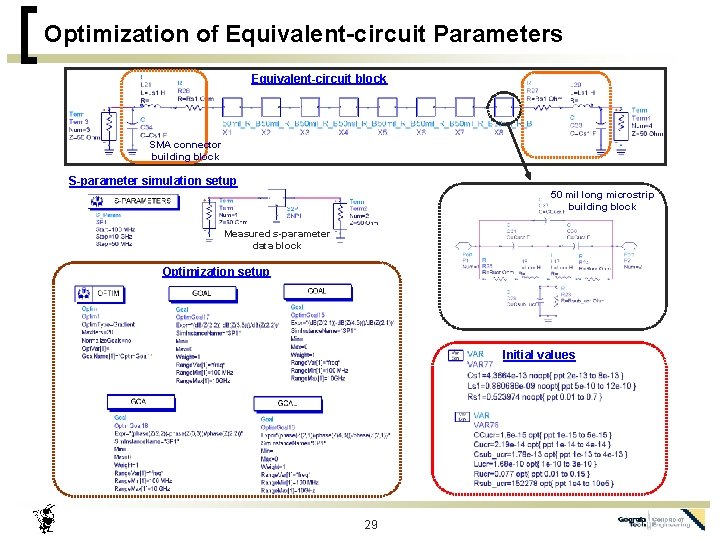
Optimization of Equivalent-circuit Parameters Equivalent-circuit block SMA connector building block S-parameter simulation setup 50 mil long microstrip building block Measured s-parameter data block Optimization setup Initial values 29
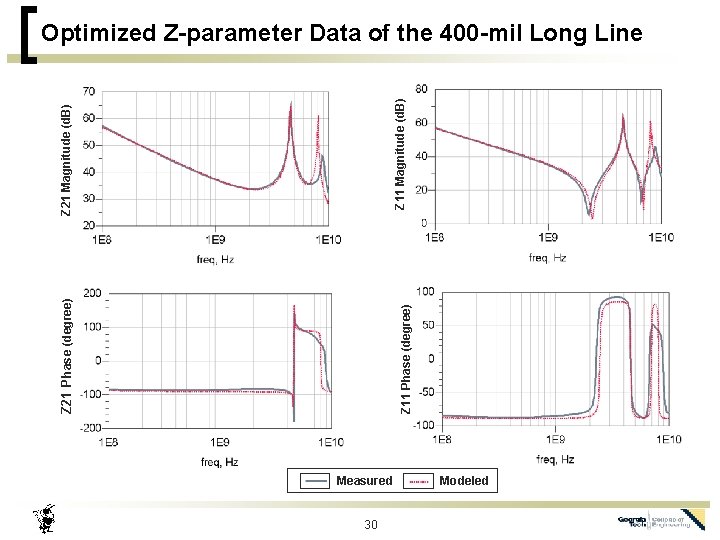
Z 11 Phase (degree) Z 21 Phase (degree) Z 11 Magnitude (d. B) Z 21 Magnitude (d. B) Optimized Z-parameter Data of the 400 -mil Long Line Measured 30 Modeled
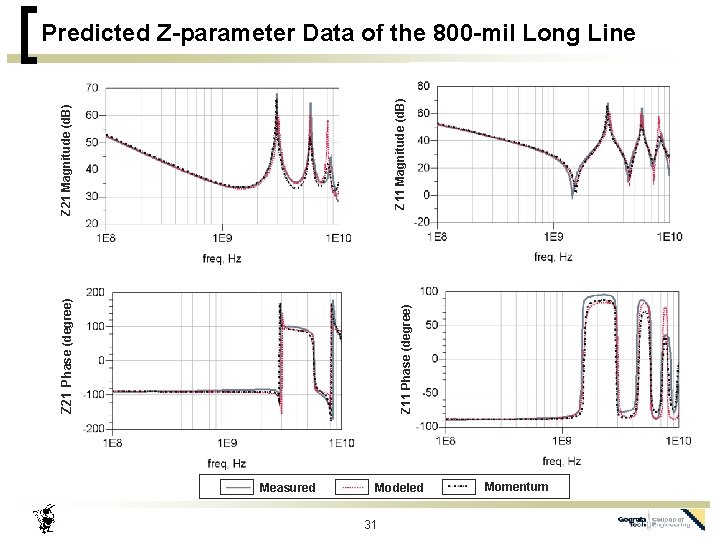
Z 11 Phase (degree) Z 21 Magnitude (d. B) Z 11 Magnitude (d. B) Predicted Z-parameter Data of the 800 -mil Long Line Measured Modeled 31 Momentum
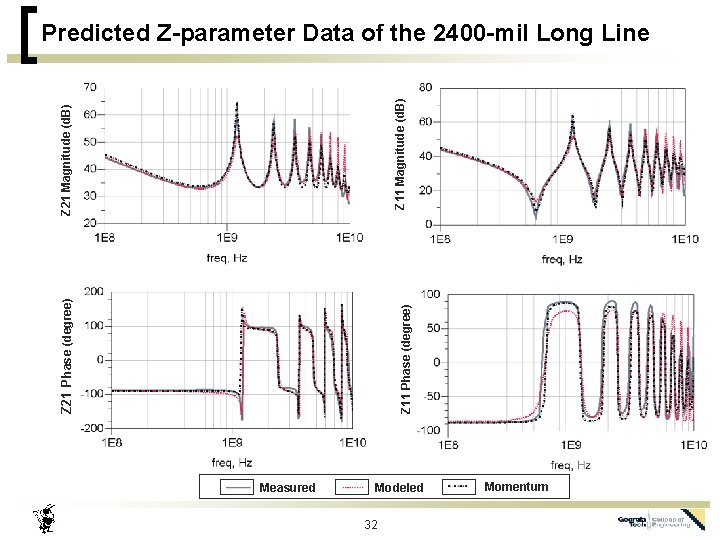
Z 11 Phase (degree) Z 21 Magnitude (d. B) Z 11 Magnitude (d. B) Predicted Z-parameter Data of the 2400 -mil Long Line Measured Modeled 32 Momentum
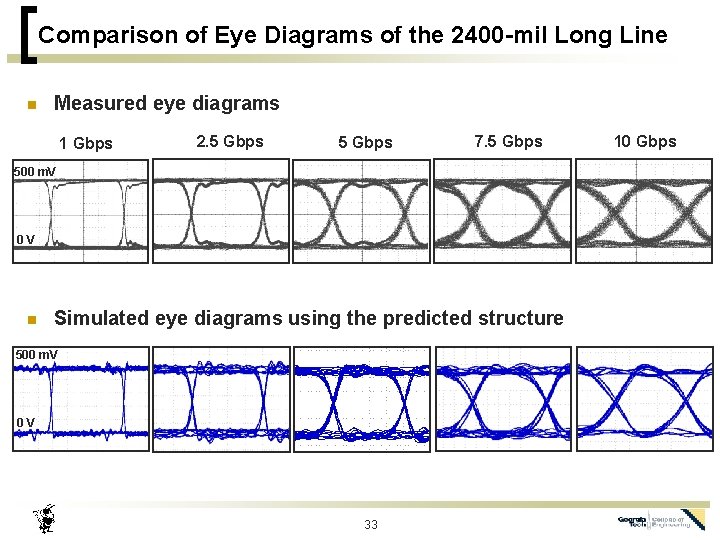
Comparison of Eye Diagrams of the 2400 -mil Long Line n Measured eye diagrams 1 Gbps 2. 5 Gbps 7. 5 Gbps 500 m. V 0 V n Simulated eye diagrams using the predicted structure 500 m. V 0 V 33 10 Gbps
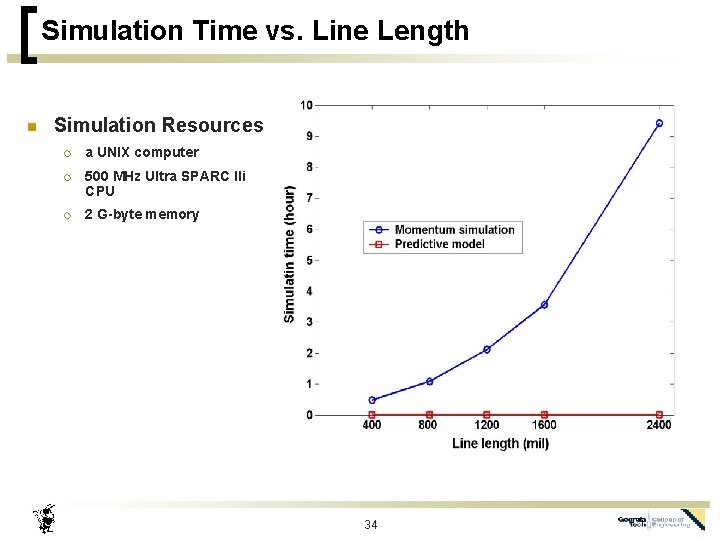
Simulation Time vs. Line Length n Simulation Resources ¡ a UNIX computer ¡ 500 MHz Ultra SPARC IIi CPU ¡ 2 G-byte memory 34
Outline n Objective n Limitations of Electrical board-level Interconnects n Background n Motivation n Modeling Procedure n Modeling of Straight Microstrip Lines n Modeling of Serpentine Interconnects n ¡ Modeling Description ¡ Results and Performance Comparison ¡ Interpolation Conclusions 35
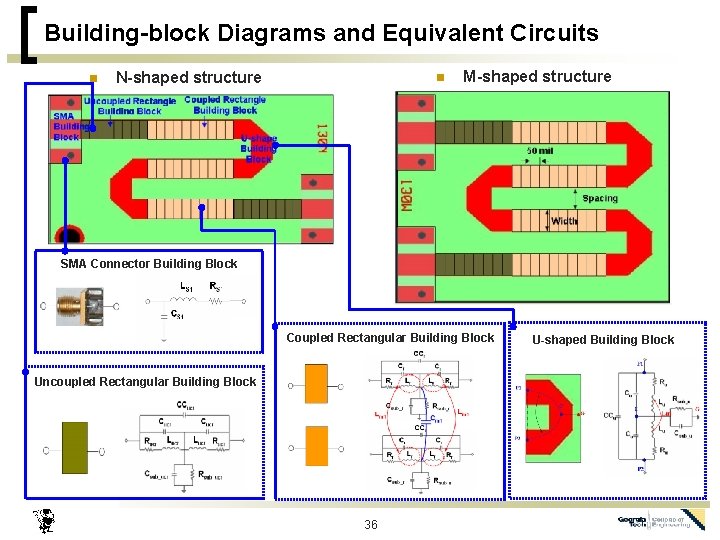
Building-block Diagrams and Equivalent Circuits n N-shaped structure n M-shaped structure SMA Connector Building Block Coupled Rectangular Building Block Uncoupled Rectangular Building Block 36 U-shaped Building Block
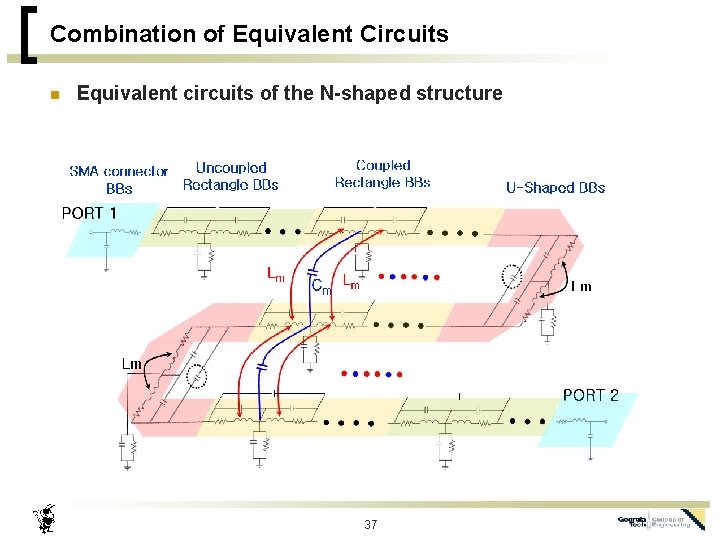
Combination of Equivalent Circuits n Equivalent circuits of the N-shaped structure 37
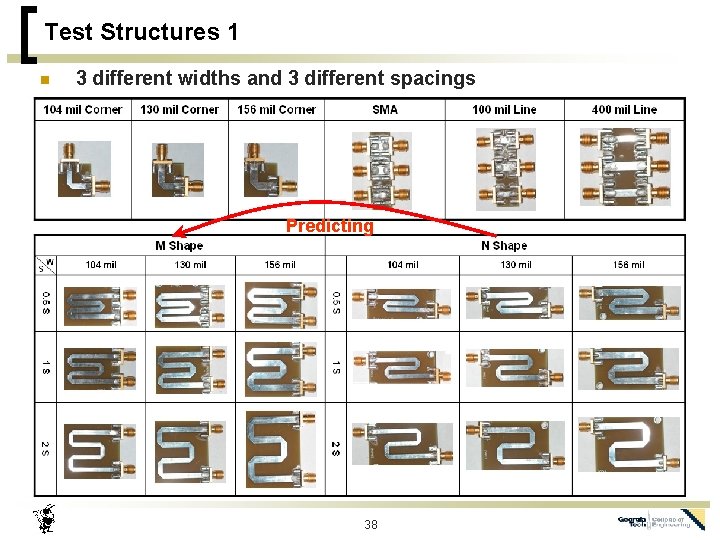
Test Structures 1 n 3 different widths and 3 different spacings Predicting 38
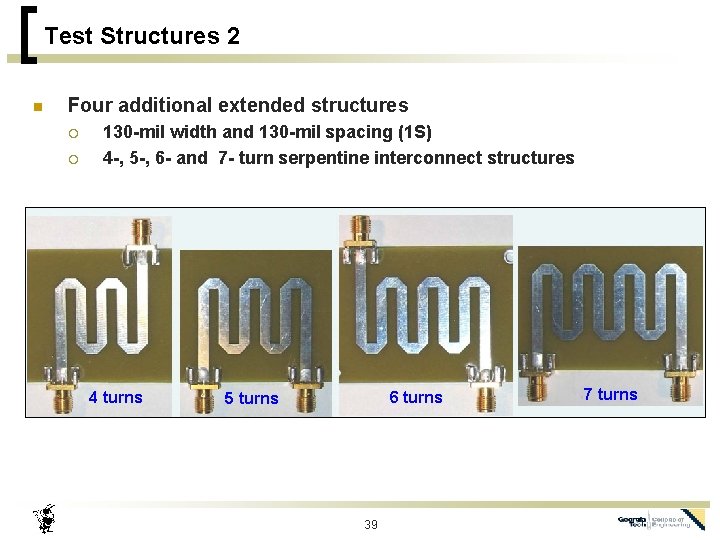
Test Structures 2 n Four additional extended structures ¡ ¡ 130 -mil width and 130 -mil spacing (1 S) 4 -, 5 -, 6 - and 7 - turn serpentine interconnect structures 4 turns 6 turns 5 turns 39 7 turns
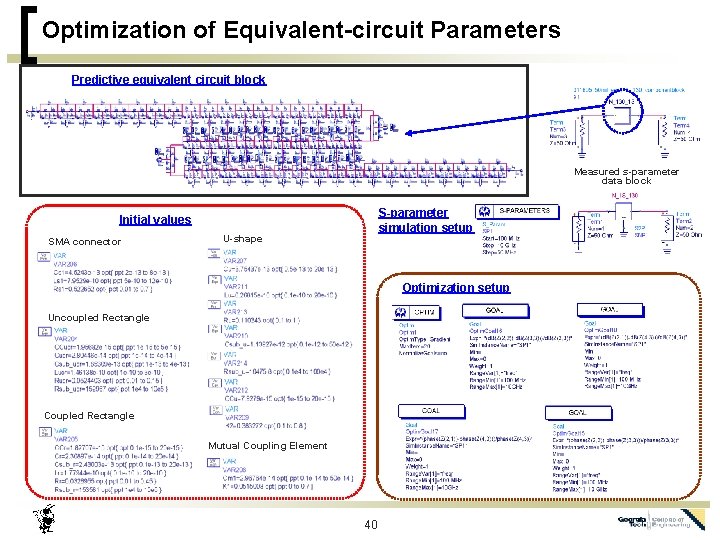
Optimization of Equivalent-circuit Parameters Predictive equivalent circuit block Measured s-parameter data block S-parameter simulation setup Initial values SMA connector U-shape Uncoupled Rectangle Optimization setup Uncoupled Rectangle Coupled Rectangle Mutual Coupling Element 40
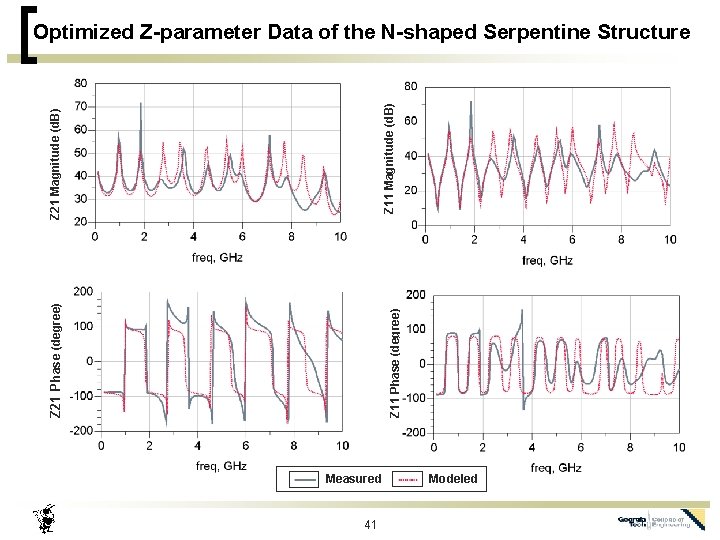
Z 11 Phase (degree) Z 21 Magnitude (d. B) Z 11 Magnitude (d. B) Optimized Z-parameter Data of the N-shaped Serpentine Structure Measured 41 Modeled
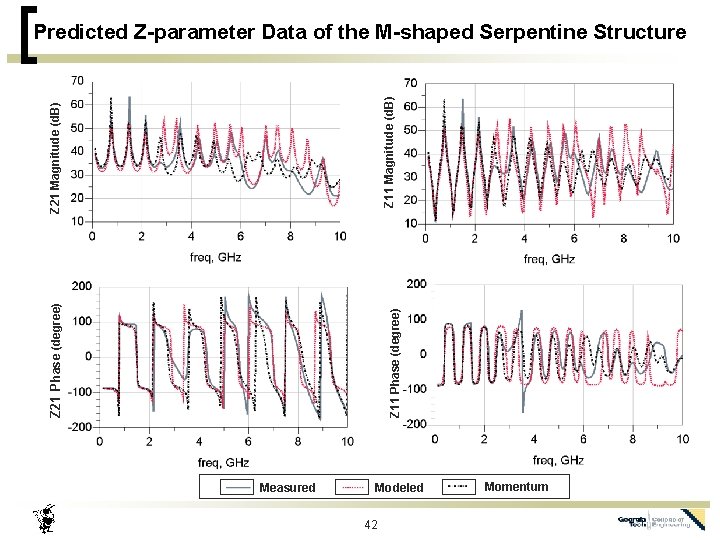
Z 11 Phase (degree) Z 21 Magnitude (d. B) Z 11 Magnitude (d. B) Predicted Z-parameter Data of the M-shaped Serpentine Structure Measured Modeled 42 Momentum
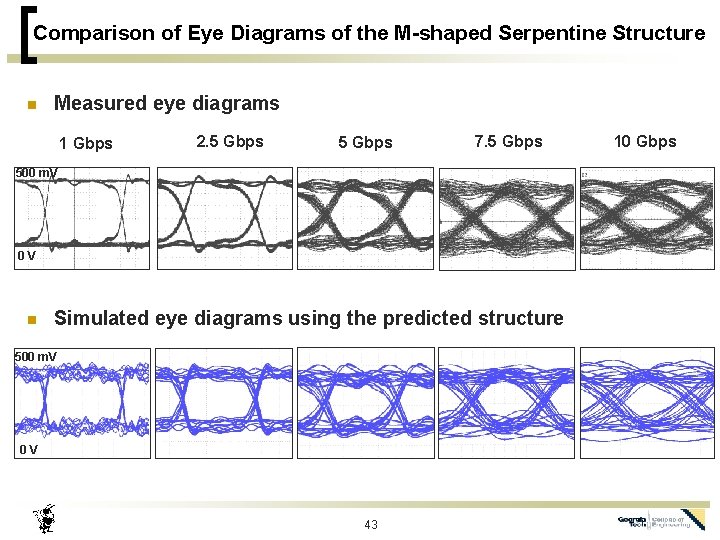
Comparison of Eye Diagrams of the M-shaped Serpentine Structure n Measured eye diagrams 1 Gbps 2. 5 Gbps 7. 5 Gbps 500 m. V 0 V n Simulated eye diagrams using the predicted structure 500 m. V 0 V 43 10 Gbps
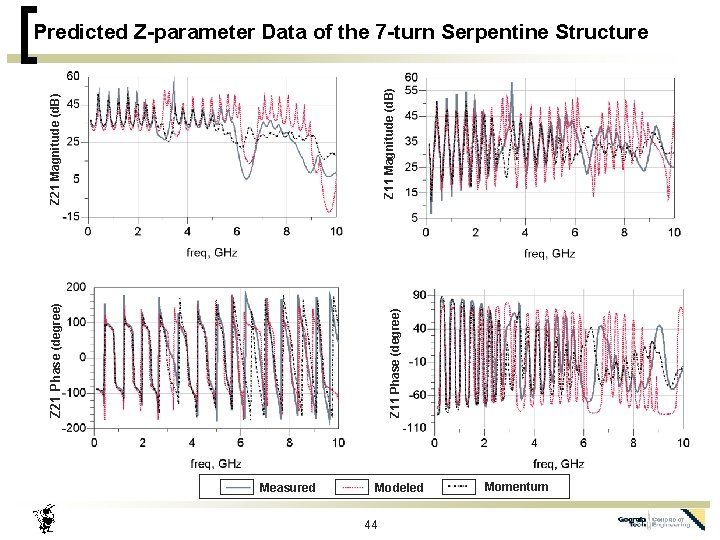
Z 11 Phase (degree) Z 21 Magnitude (d. B) Z 11 Magnitude (d. B) Predicted Z-parameter Data of the 7 -turn Serpentine Structure Measured Modeled 44 Momentum
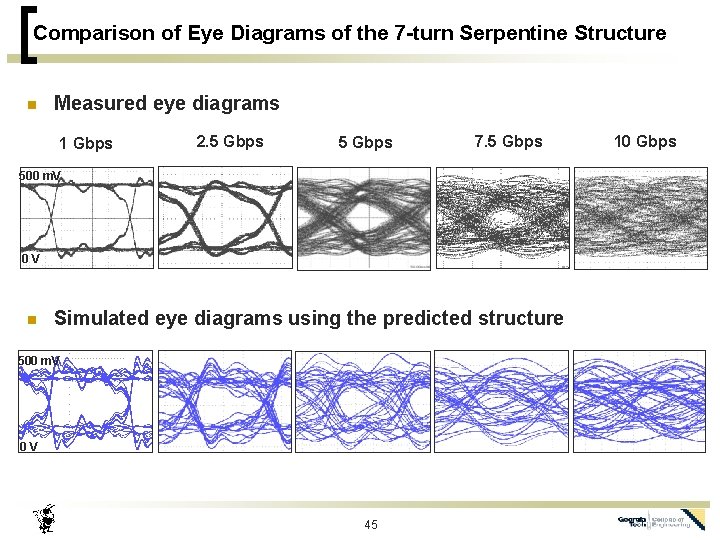
Comparison of Eye Diagrams of the 7 -turn Serpentine Structure n Measured eye diagrams 1 Gbps 2. 5 Gbps 7. 5 Gbps 500 m. V 0 V n Simulated eye diagrams using the predicted structure 500 m. V 0 V 45 10 Gbps
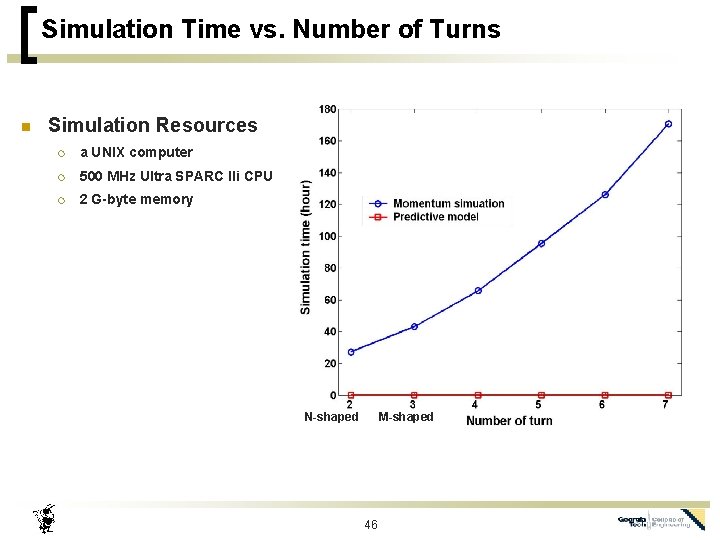
Simulation Time vs. Number of Turns n Simulation Resources ¡ a UNIX computer ¡ 500 MHz Ultra SPARC IIi CPU ¡ 2 G-byte memory N-shaped M-shaped 46
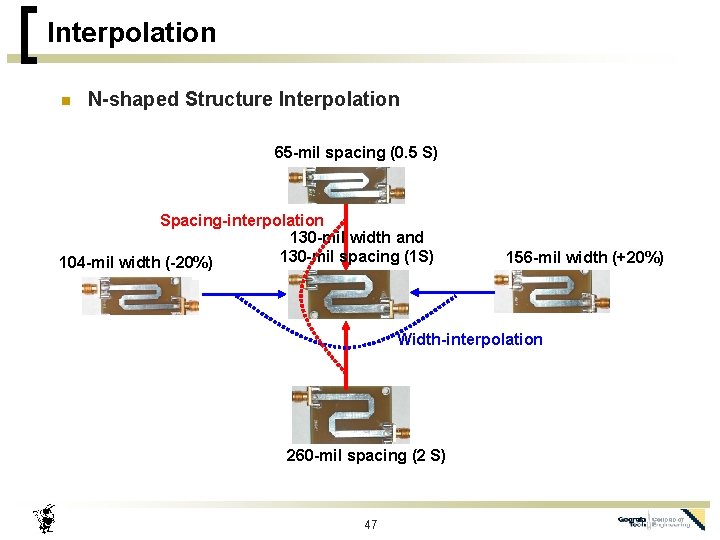
Interpolation n N-shaped Structure Interpolation 65 -mil spacing (0. 5 S) Spacing-interpolation 130 -mil width and 130 -mil spacing (1 S) 104 -mil width (-20%) 156 -mil width (+20%) Width-interpolation 260 -mil spacing (2 S) 47
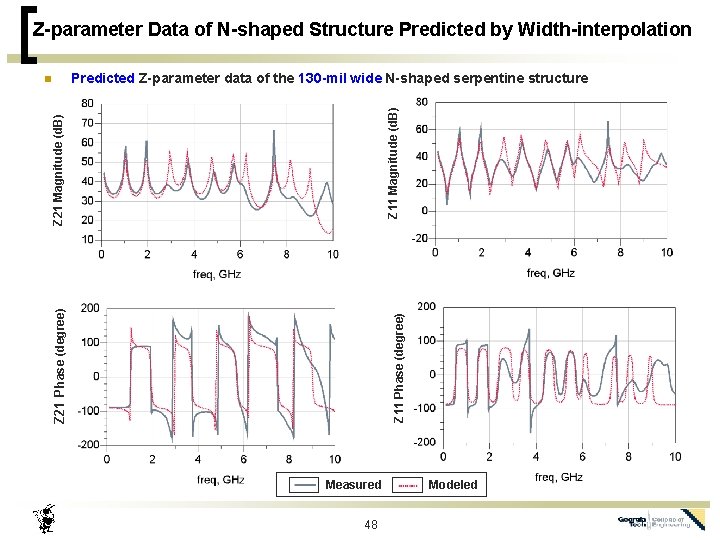
Z-parameter Data of N-shaped Structure Predicted by Width-interpolation Z 11 Phase (degree) Z 21 Magnitude (d. B) Z 11 Magnitude (d. B) Predicted Z-parameter data of the 130 -mil wide N-shaped serpentine structure n Measured 48 Modeled
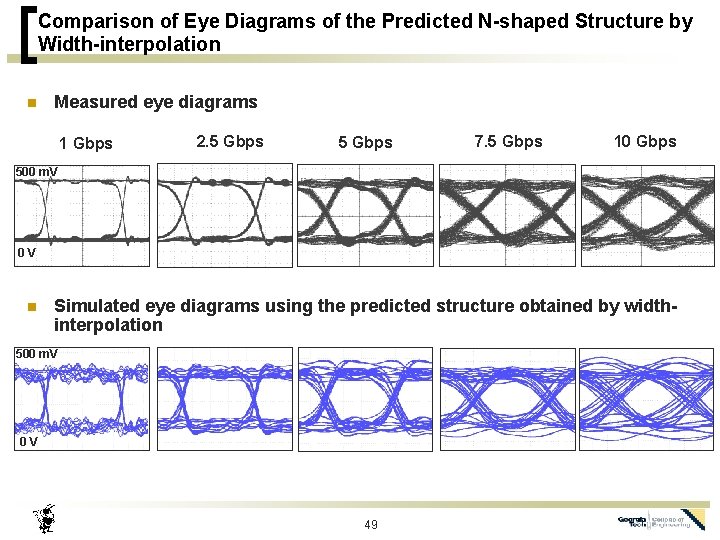
Comparison of Eye Diagrams of the Predicted N-shaped Structure by Width-interpolation n Measured eye diagrams 1 Gbps 2. 5 Gbps 7. 5 Gbps 10 Gbps 500 m. V 0 V n Simulated eye diagrams using the predicted structure obtained by widthinterpolation 500 m. V 0 V 49
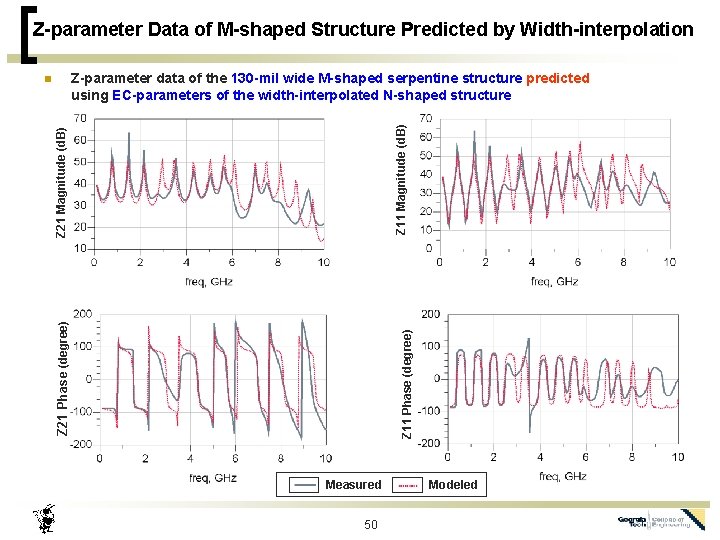
Z-parameter Data of M-shaped Structure Predicted by Width-interpolation Z 11 Phase (degree) Z 21 Magnitude (d. B) Z 11 Magnitude (d. B) Z-parameter data of the 130 -mil wide M-shaped serpentine structure predicted using EC-parameters of the width-interpolated N-shaped structure n Measured 50 Modeled
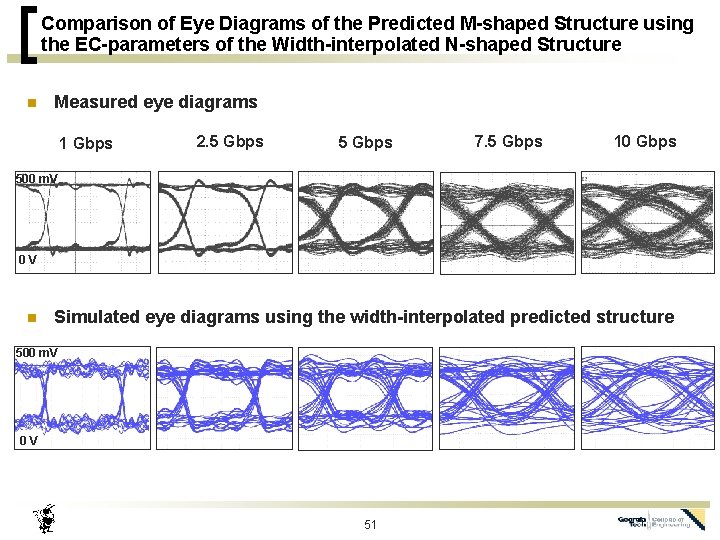
Comparison of Eye Diagrams of the Predicted M-shaped Structure using the EC-parameters of the Width-interpolated N-shaped Structure n Measured eye diagrams 1 Gbps 2. 5 Gbps 7. 5 Gbps 10 Gbps 500 m. V 0 V n Simulated eye diagrams using the width-interpolated predicted structure 500 m. V 0 V 51
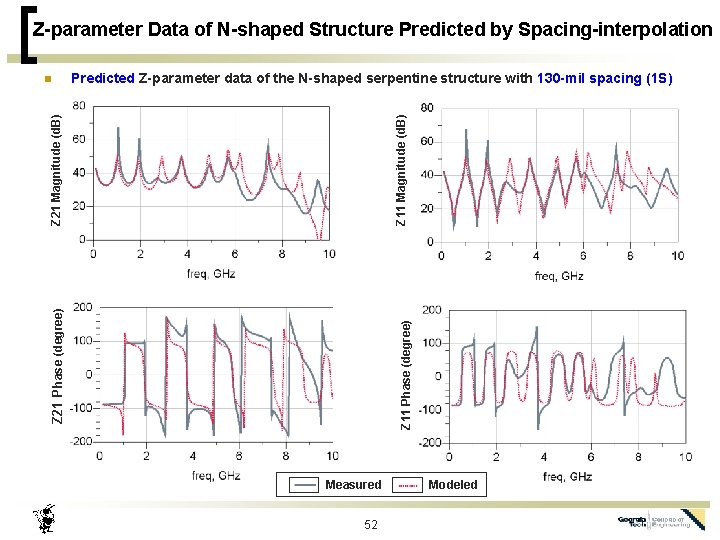
Z-parameter Data of N-shaped Structure Predicted by Spacing-interpolation Z 11 Phase (degree) Z 21 Phase (degree) Z 11 Magnitude (d. B) Predicted Z-parameter data of the N-shaped serpentine structure with 130 -mil spacing (1 S) Z 21 Magnitude (d. B) n Measured 52 Modeled
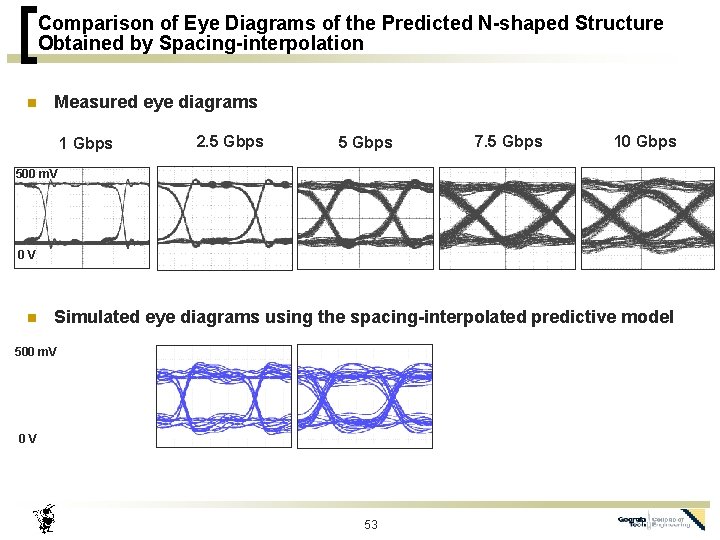
Comparison of Eye Diagrams of the Predicted N-shaped Structure Obtained by Spacing-interpolation n Measured eye diagrams 1 Gbps 2. 5 Gbps 7. 5 Gbps 10 Gbps 500 m. V 0 V n Simulated eye diagrams using the spacing-interpolated predictive model 500 m. V 0 V 53
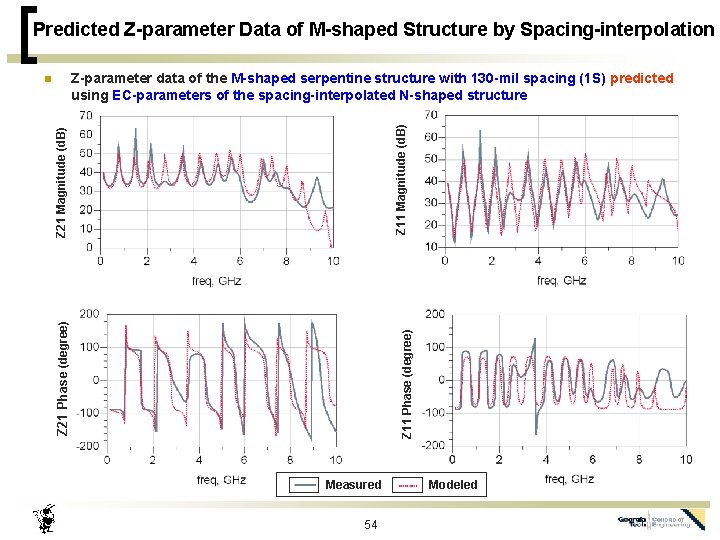
Predicted Z-parameter Data of M-shaped Structure by Spacing-interpolation Z 11 Phase (degree) Z 21 Magnitude (d. B) Z 11 Magnitude (d. B) Z-parameter data of the M-shaped serpentine structure with 130 -mil spacing (1 S) predicted using EC-parameters of the spacing-interpolated N-shaped structure n Measured 54 Modeled
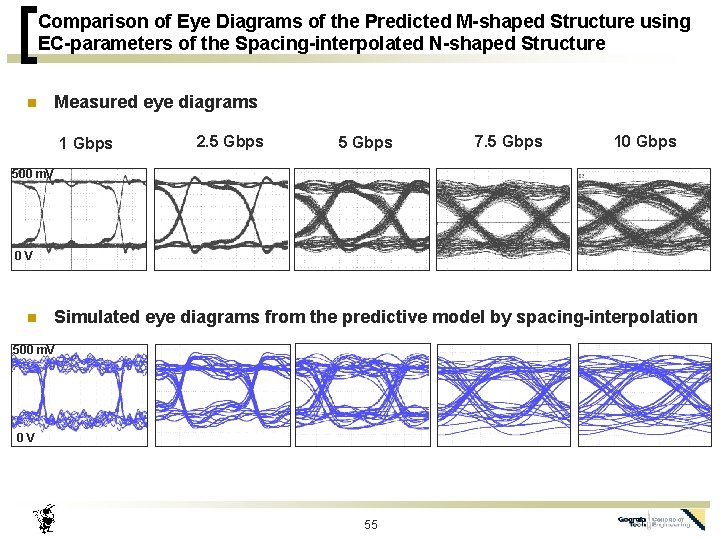
Comparison of Eye Diagrams of the Predicted M-shaped Structure using EC-parameters of the Spacing-interpolated N-shaped Structure n Measured eye diagrams 1 Gbps 2. 5 Gbps 7. 5 Gbps 10 Gbps 500 m. V 0 V n Simulated eye diagrams from the predictive model by spacing-interpolation 500 m. V 0 V 55
Conclusions n A rapid, predictive measurement-based modeling method was developed for high-frequency interconnects on FR 4. n Our method was applied to the modeling of straight microstrip lines and serpentine interconnect structures. n The predictive power of the developed scalable models was demonstrated in several extended interconnect structures, and the ability to use interpolation to predict the high frequency performance of structures with differently sized building blocks was demonstrated. n The usefulness of this predictive method was validated by comparing our predictions with measurements both in the frequency and time domains and by comparing our predictions with the ADS momentum simulations in terms of efficiency and accuracy. n Therefore, this proposed high-frequency interconnect modeling method is not only efficient but accurate as well, compared with the measured behaviors and the momentum simulation. Furthermore, the interpolation enable fast accurate predictions for variations of interconnects in width and spacing. 56
Publications Generated 1) 2) 3) 4) 5) 6) 7) 8) 9) J. Shin, C. -S. Seo, A. Chellappa, M. Brooke, A. Chattejce and N. M. Jokerst, "Comparison of electrical and optical interconnect, " Electronic Components and Technology Conference, 2003. O. Bourdreaux, S. -Y. Cho, J. Shin, A. Chellappa, D. Schimmel, M. Brooke and N. M. Jokerst, "Optical chip-to-chip interconnects for memory systems, " presented at Lasers and Electro-Optics Society, LEOS, the 16 th Annual Meeting of the IEEE, 2003. C. Cha, J. Shin, Z. huang, N. M. Jokerst and M. Brooke, “High-Frequency Equivalent Circuit-Level Model of MSM PD for Optical Front-end Receiver Applications, ” presented at Asia Pacific Microwave conference, APMC 2003. N. M. Jokerst, T. K. Gaylord, E. Glytsis, M. A. Brooke, S. Cho, T. Nonaka, T. Suzuki, D. L. Geddis, J. Shin, R. Villalaz, J. Hall, A. Chellapa and M. Vrazel, "Planar lightwave integrated circuits with embedded actives for board and substrate level optical signal distribution, " Advanced Packaging, IEEE Transactions on [see also Components, Packaging and Manufacturing Technology, Part B: Advanced Packaging, IEEE Transactions on], vol. 27, pp. 376 -385, 2004. J. Shin, C. Cha, S. Cho, J. Kim, N. M. Jokerst and M. Brooke, "FR 4 printed circuit board design for Giga -bits embedded optical interconnect applications, " presented at Electronic Components and Technology, ECTC '04. Proceedings, 2004. J. Shin, S. -W. Seo, S. -Y. Cho, J. H. Kim, M. Brook and N. M. Jokerst, "Embedded photodetectors in polymer waveguides for optical interconnect integrated with a Si-Ge transimpedance amplifier circuit operating at 2. 5 Gbit/s, "presented at Biophotonics/Optical Interconnects and VLSI Photonics/WBM Microcavities, Digest of the LEOS Summer Topical Meetings, 2004. J. H. Kim, J. Shin, C. Cha, N. Jokerst and M. Brooke, “Wideband multiple resonance small-signal laser diode model for the co-design of laser drive circuits, ” presented at the 47 th Midwest Symposium, 2004. J. Shin, J. H. Kim, C. Cha, N. M. Jokerst and M. Brooke, ”Rapid, Predictive Measurement-based Modeling for High Frequency Interconnect on FR 4 Substrate, ” accepted at Electronic Components and Technology, 2005. J. H. Kim, J. Shin, C. Cha, N. M. Jokerst, and M. A. Brooke, “An Improved Wideband Laser Diode Lumped Element Equivalent Circuit Model for the Optoelectronic Circuit Design, ” submitted at Information and Communication Engineers (IEICE) Transactions on Information and Systems, 2005 57
Question Thank You 58