
Rapid Development of the Tropical Cyclone Warm Core
- Slides: 20
Rapid Development of the Tropical Cyclone Warm Core Jonathan L. Vigh and Wayne H. Schubert January 16, 2008
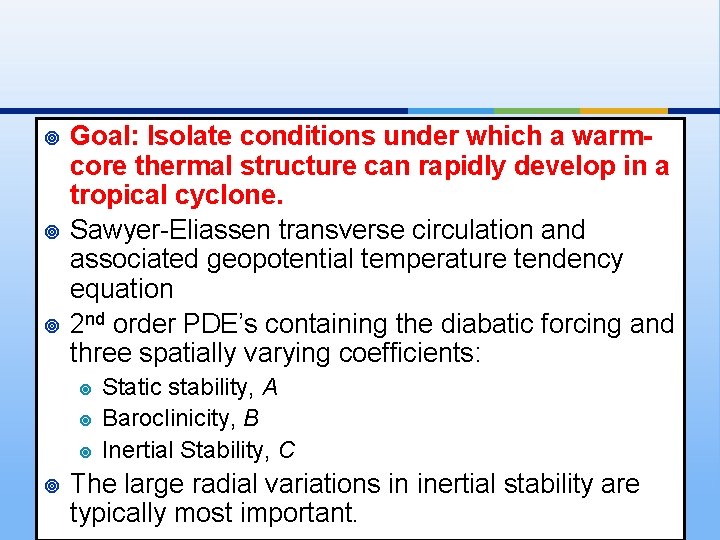
¥ ¥ ¥ Goal: Isolate conditions under which a warmcore thermal structure can rapidly develop in a tropical cyclone. Sawyer-Eliassen transverse circulation and associated geopotential temperature tendency equation 2 nd order PDE’s containing the diabatic forcing and three spatially varying coefficients: ¥ ¥ Static stability, A Baroclinicity, B Inertial Stability, C The large radial variations in inertial stability are typically most important.
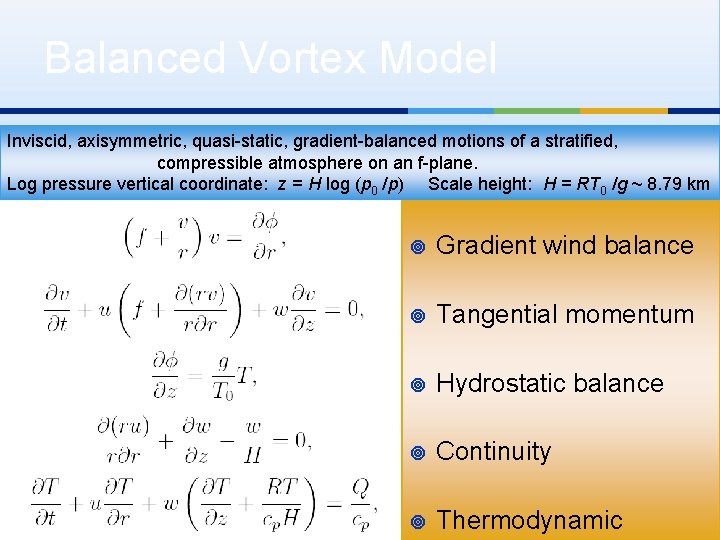
Balanced Vortex Model Inviscid, axisymmetric, quasi-static, gradient-balanced motions of a stratified, compressible atmosphere on an f-plane. Log pressure vertical coordinate: z = H log (p 0 /p) Scale height: H = RT 0 /g ~ 8. 79 km ¥ Gradient wind balance ¥ Tangential momentum ¥ Hydrostatic balance ¥ Continuity ¥ Thermodynamic
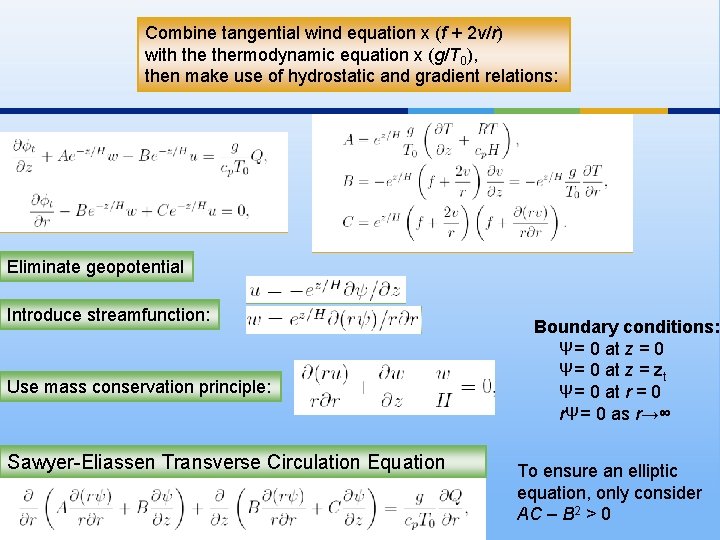
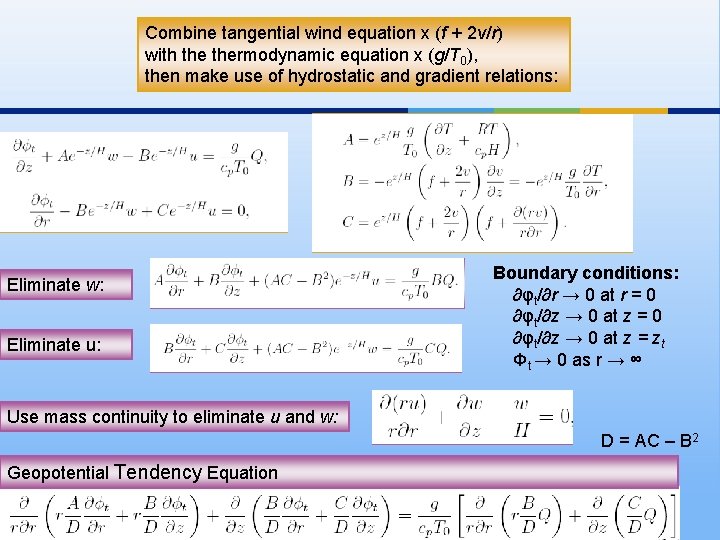
Combine tangential wind equation x (f + 2 v/r) with thermodynamic equation x (g/T 0), then make use of hydrostatic and gradient relations: Eliminate geopotential Introduce streamfunction: Use mass conservation principle: Sawyer-Eliassen Transverse Circulation Equation Boundary conditions: Ψ= 0 at z = 0 Ψ= 0 at z = zt Ψ= 0 at r = 0 rΨ= 0 as r→∞ To ensure an elliptic equation, only consider AC – B 2 > 0
Combine tangential wind equation x (f + 2 v/r) with thermodynamic equation x (g/T 0), then make use of hydrostatic and gradient relations: Eliminate w: Eliminate u: Boundary conditions: ∂φt/∂r → 0 at r = 0 ∂φt/∂z → 0 at z = zt Φt → 0 as r → ∞ Use mass continuity to eliminate u and w: D = AC – B 2 Geopotential Tendency Equation
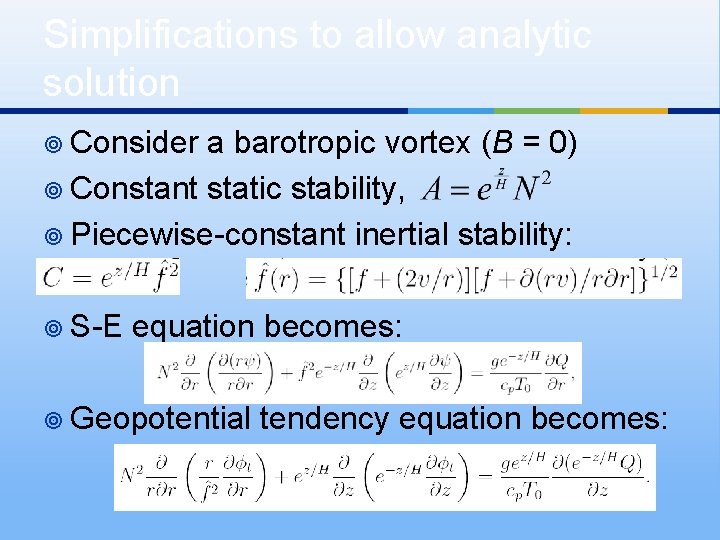
Simplifications to allow analytic solution ¥ Consider a barotropic vortex (B = 0) ¥ Constant static stability, ¥ Piecewise-constant inertial stability: ¥ S-E equation becomes: ¥ Geopotential tendency equation becomes:
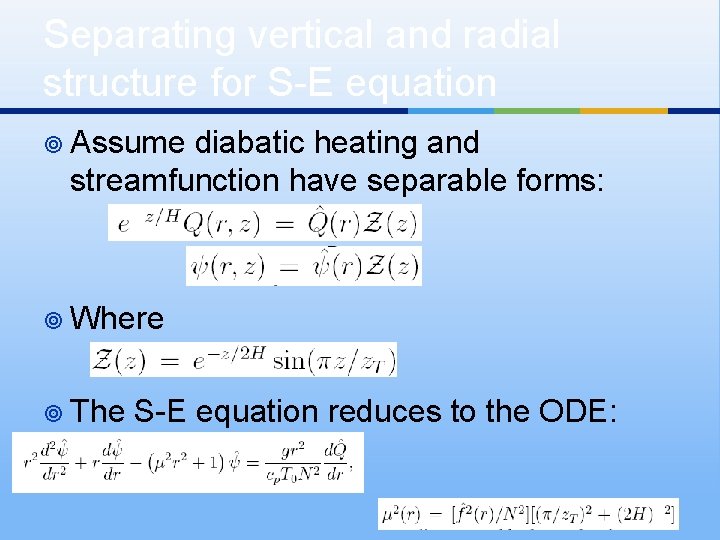
Separating vertical and radial structure for S-E equation ¥ Assume diabatic heating and streamfunction have separable forms: ¥ Where ¥ The S-E equation reduces to the ODE:
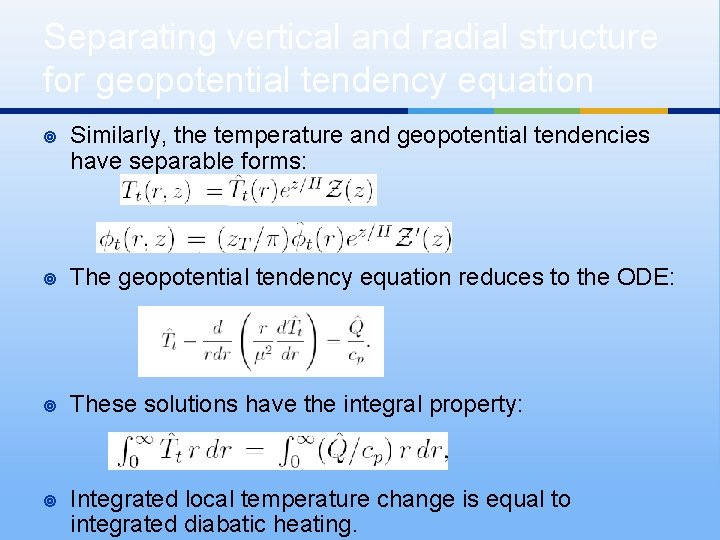
Separating vertical and radial structure for geopotential tendency equation ¥ Similarly, the temperature and geopotential tendencies have separable forms: ¥ The geopotential tendency equation reduces to the ODE: ¥ These solutions have the integral property: ¥ Integrated local temperature change is equal to integrated diabatic heating.
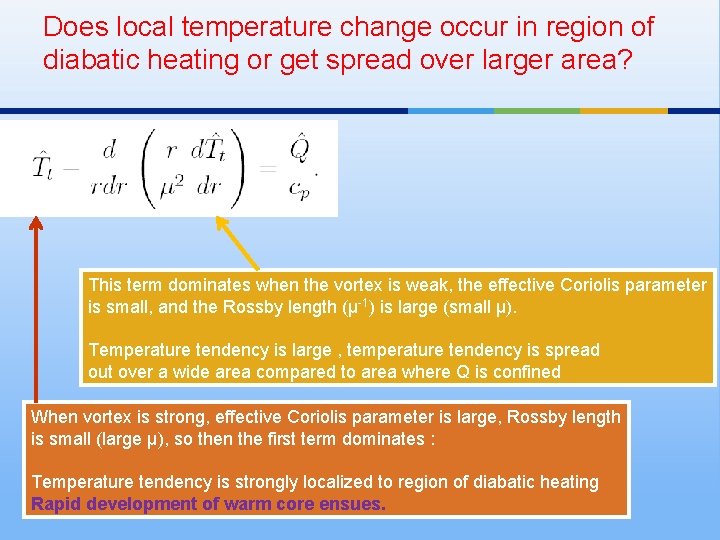
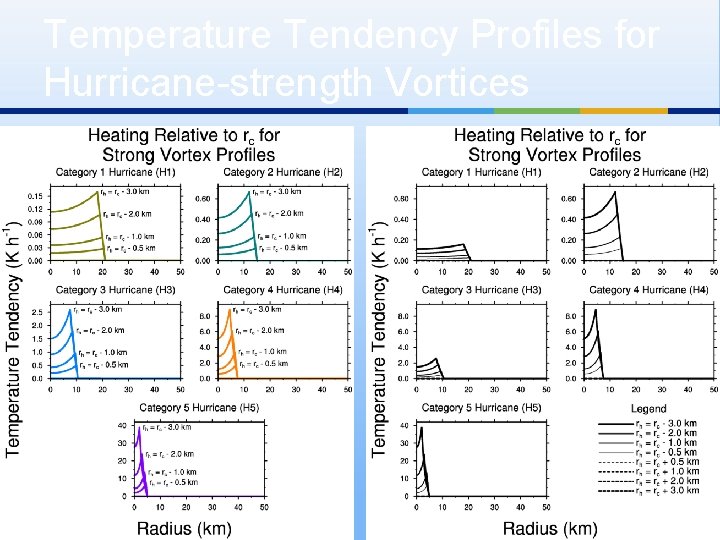
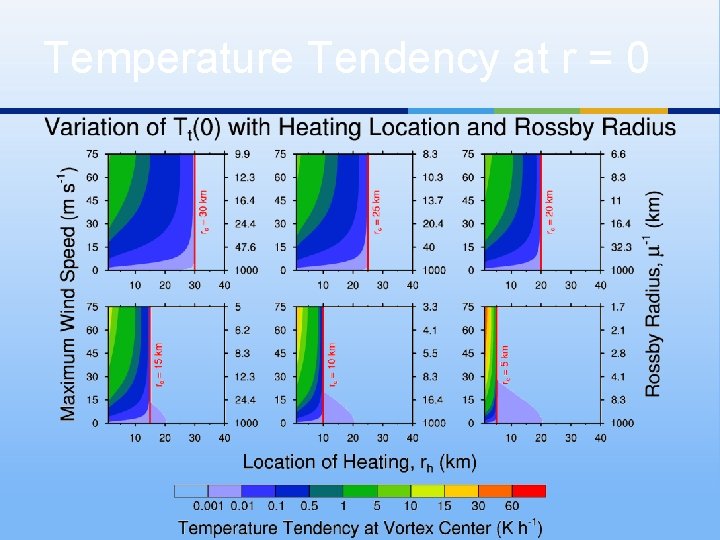
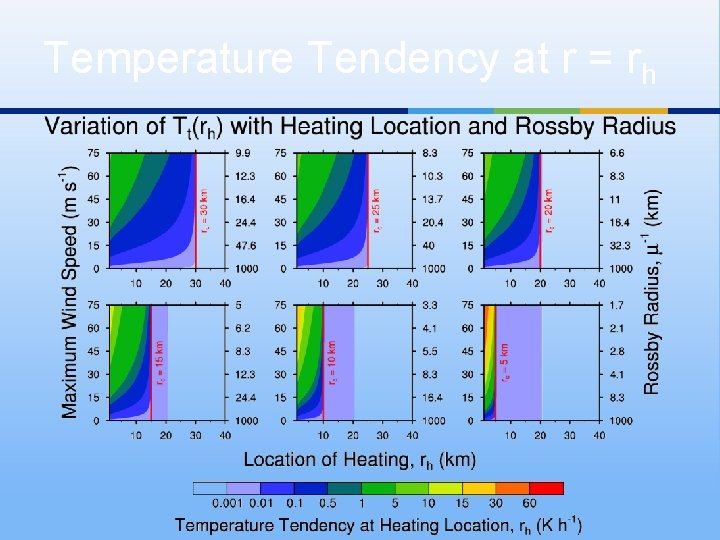
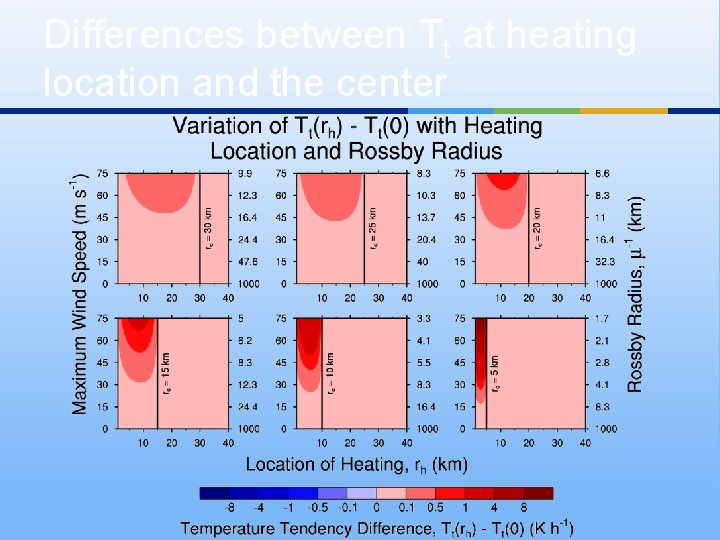
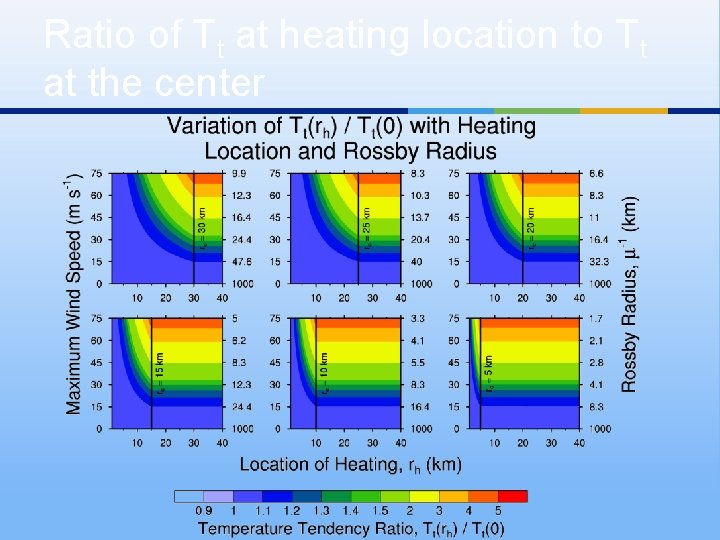
Does local temperature change occur in region of diabatic heating or get spread over larger area? This term dominates when the vortex is weak, the effective Coriolis parameter is small, and the Rossby length (μ-1) is large (small μ). Temperature tendency is large , temperature tendency is spread out over a wide area compared to area where Q is confined When vortex is strong, effective Coriolis parameter is large, Rossby length is small (large μ), so then the first term dominates : Temperature tendency is strongly localized to region of diabatic heating Rapid development of warm core ensues.
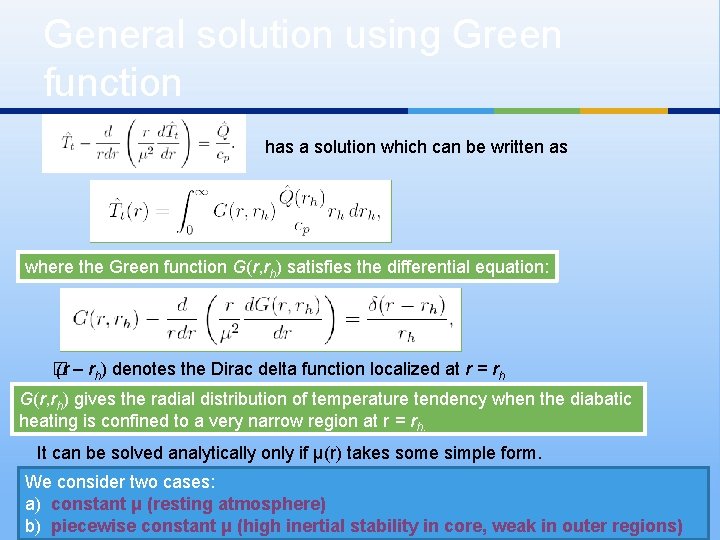
General solution using Green function has a solution which can be written as where the Green function G(r, rh) satisfies the differential equation: � (r – rh) denotes the Dirac delta function localized at r = rh G(r, rh) gives the radial distribution of temperature tendency when the diabatic heating is confined to a very narrow region at r = rh. It can be solved analytically only if μ(r) takes some simple form. We consider two cases: a) constant μ (resting atmosphere) b) piecewise constant μ (high inertial stability in core, weak in outer regions)
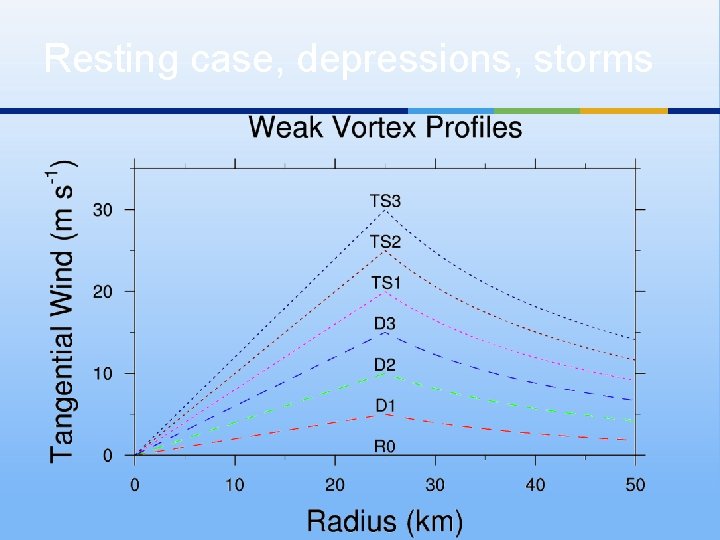
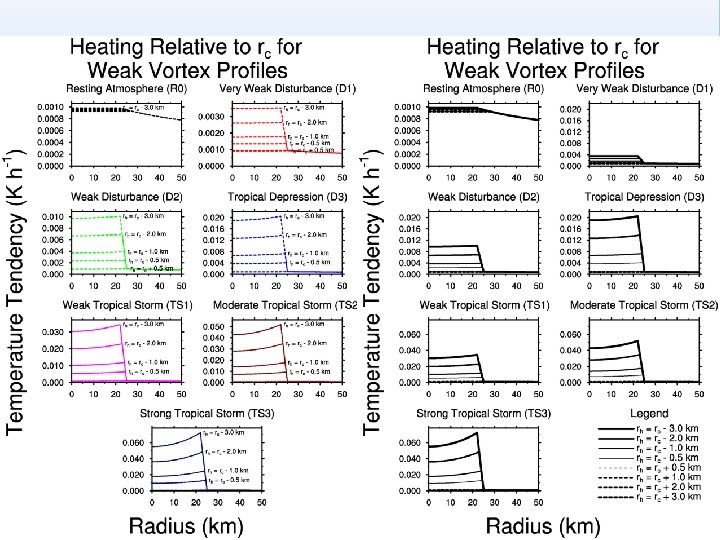
Resting case, depressions, storms
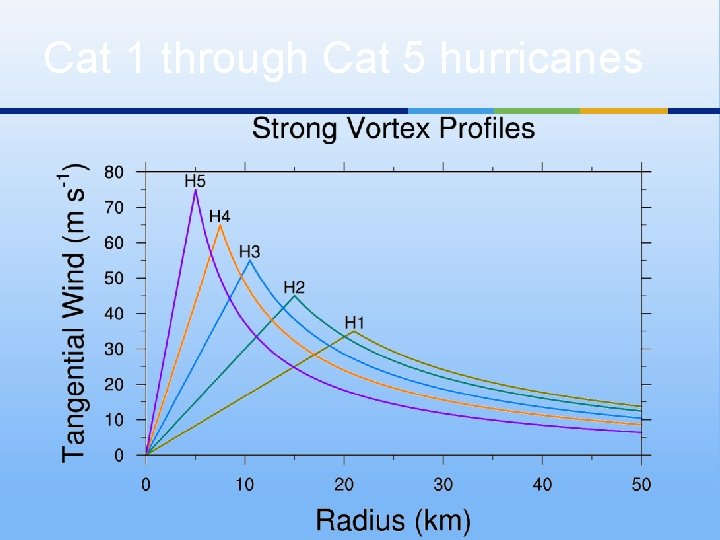
Cat 1 through Cat 5 hurricanes
Temperature Tendency Profiles for Hurricane-strength Vortices
Temperature Tendency at r = 0
Temperature Tendency at r = rh
Differences between Tt at heating location and the center
Ratio of Tt at heating location to Tt at the center
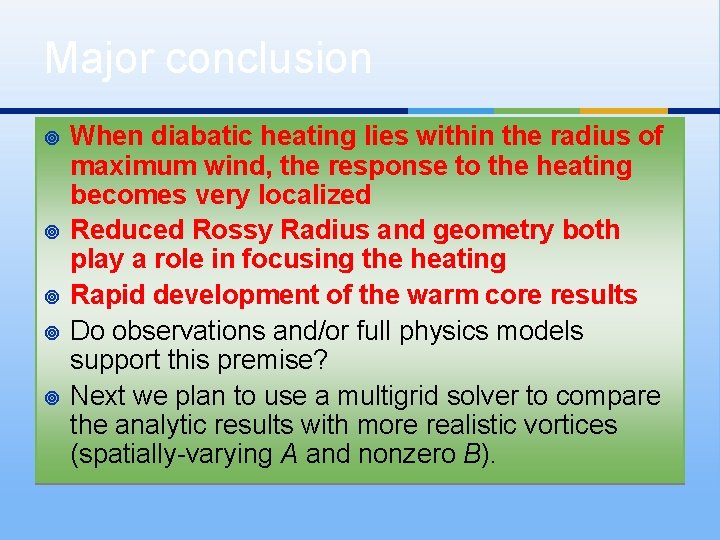
Major conclusion ¥ ¥ ¥ When diabatic heating lies within the radius of maximum wind, the response to the heating becomes very localized Reduced Rossy Radius and geometry both play a role in focusing the heating Rapid development of the warm core results Do observations and/or full physics models support this premise? Next we plan to use a multigrid solver to compare the analytic results with more realistic vortices (spatially-varying A and nonzero B).
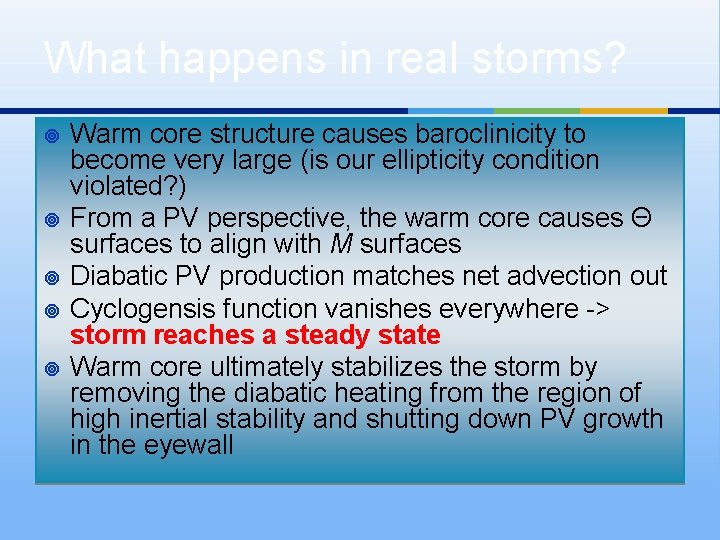
What happens in real storms? ¥ ¥ ¥ Warm core structure causes baroclinicity to become very large (is our ellipticity condition violated? ) From a PV perspective, the warm core causes Θ surfaces to align with M surfaces Diabatic PV production matches net advection out Cyclogensis function vanishes everywhere -> storm reaches a steady state Warm core ultimately stabilizes the storm by removing the diabatic heating from the region of high inertial stability and shutting down PV growth in the eyewall