
RAP An EndtoEnd RateBased Congestion Control Mechanism for
RAP: An End-to-End Rate-Based Congestion Control Mechanism for Realtime Streams in the Internet Reza Rejai, Mark Handley, Deborah Estrin U of Southern California Marina Del Rey, CA 90292, USA IEEE Infocom, 1999
Outline • Introduction • Approach • Evaluation • Conclusions
Introduction • MM is delay sensitive, semi-reliable, ratebased – Not in Internet • Still MM apps have grown – Those typically allow larger delay (ex: Vo. D) – So can do buffering to remove variance • Must react to congestion in TCP-Friendly fashion

Research Approach • Separate congestion control from error and • quality control RAP module – Congestion control via AIMD (converges to fair) – Congestion detection vial loss (ECN possible) – Order of RTT • Layer manager – Quality control – Layer manager (maximum layers to fit bwidth) – Less than RTT by buffering • (RAP module primary in this paper)

RAP Architecture This paper concentrates on RAP module

Related Work • MM could use special services or resource reservation – Diff. Serv or Int. Serv – But would still be need for low-cost mm traffic • TCP without retransmission – Still window-based, fluctuating • Some work adaptively encodes based on feedback from network – CPU intensive for all – Not shown to work for large range of environs • Netshow and Real. Player claim to be adaptive – No scientific evaluation
The RAP Protocol • RAP “machinery” mainly at source – Receiver acks each packet – Sender calculates stuff (loss and RTT) • Sender must have: – Decision function – Increase/Decrease algorithm – Decision frequency
Decision Function • No congestion then periodically increase rate • Congestion then immediately decrease rate – Gaps and timeouts • Acks have more than just last sequence – Can send back ‘holes’ to avoid responding to single loss events
Increase/Decrease Algorithm • Uses AIMD • Change inter-packet gap (IPG) – – Smaller gap then higher rate Larger gap then lower rate Step-wise decrease on no congestion Double on congestion
Decision Frequency • Change rate no more than 1 per RTT – Step “length” is RTT • Then, if “height” is 1 packet – Emulate TCP during congestion avoidance • (Hint at startup phase, but since ‘long-lived’, startup is not crucial) – (Me, but what about sudden changes in bandwidth? Can be ‘like’ startup phase!) • Special cases: – Clustered losses – Fine-grain rate adaptation – RED gateways
Clustered Losses • Packets lost together are part of same • • • congestion signal Seqfirst. Loss is first packet lost Seqlast. Sent is last one sent Ignore – Seqlast. Sent > seq > Seqfirst. Loss • Similar to TCP SACK
Fine-Grain Rate Adaptation • Keep long term RTT and short-term RTT • IPG is based on short-term RTT • IPG’ is based on ratio of long-term to shortterm – Use it to adjust rate
Random Early Detection Gateways • TCP has trouble with multiple losses in a row in one window – Drop Tail queues – TCP times-out to window size of 1 – RAP goes down exponentially • RED distributes losses – Also smaller queue sizes (hopefully) – Wants 1 loss for each flow for each RTT • With RED, RAP should be totally fair to TCP • Configuring RED still difficult – Major topic of CC meetings
Outline • Introduction • Approach • Evaluation • Conclusions
Evaluation by Simulation (NS) • TCP-friendliness • Ability to cope with background traffic • Interaction with RED gateways • Fine-grain rate adaptation
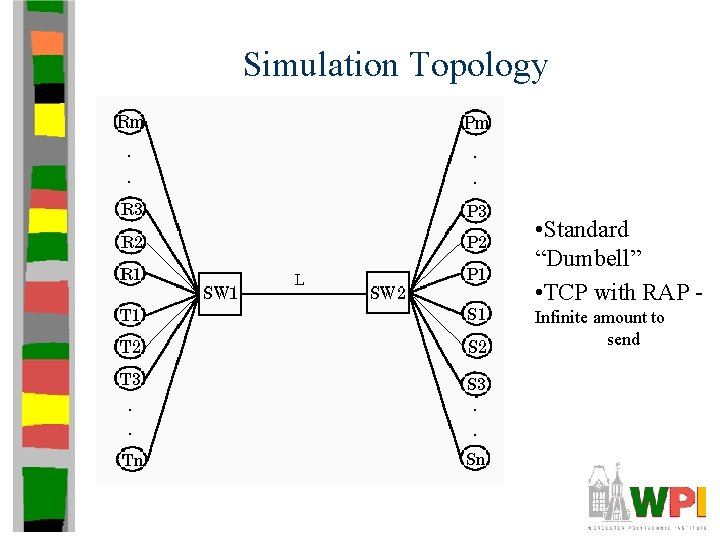
Simulation Topology • Standard “Dumbell” • TCP with RAP Infinite amount to send
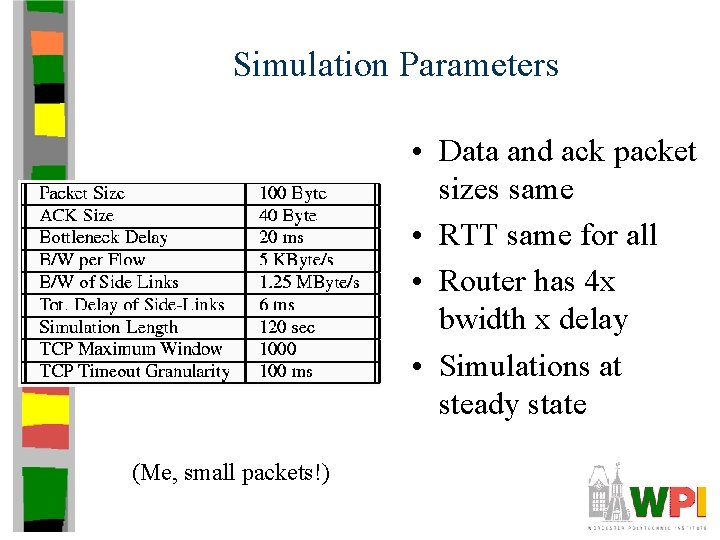
Simulation Parameters • Data and ack packet sizes same • RTT same for all • Router has 4 x bwidth x delay • Simulations at steady state (Me, small packets!)
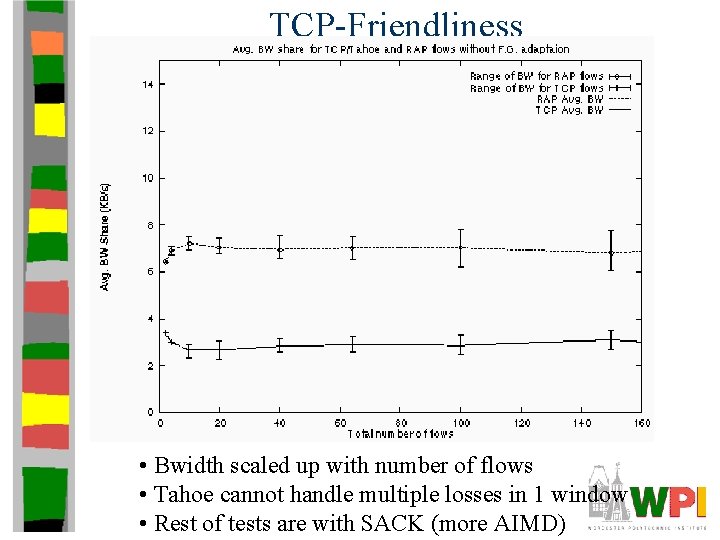
TCP-Friendliness • Bwidth scaled up with number of flows • Tahoe cannot handle multiple losses in 1 window • Rest of tests are with SACK (more AIMD)
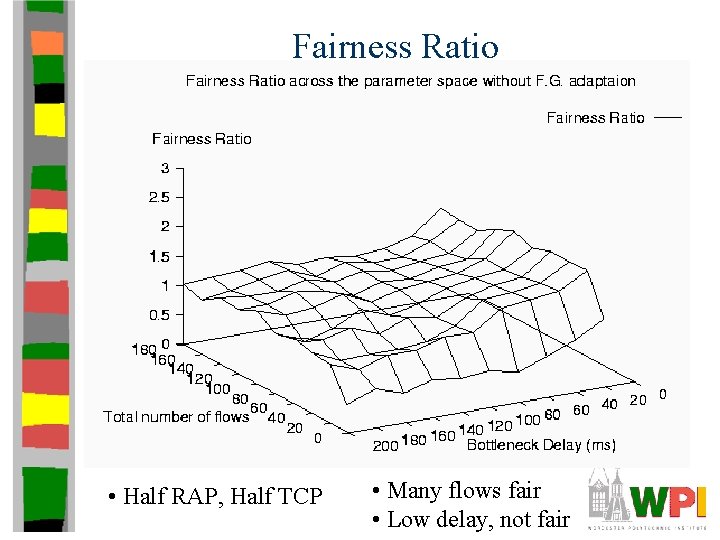
Fairness Ratio • Half RAP, Half TCP • Many flows fair • Low delay, not fair
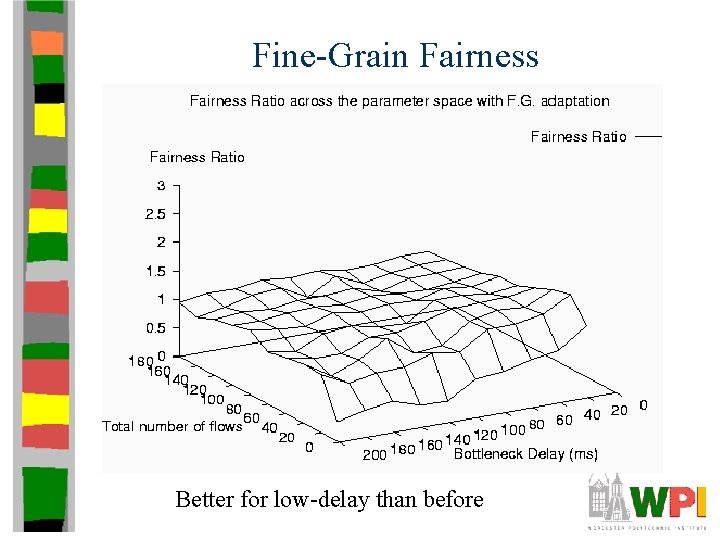
Fine-Grain Fairness Better for low-delay than before
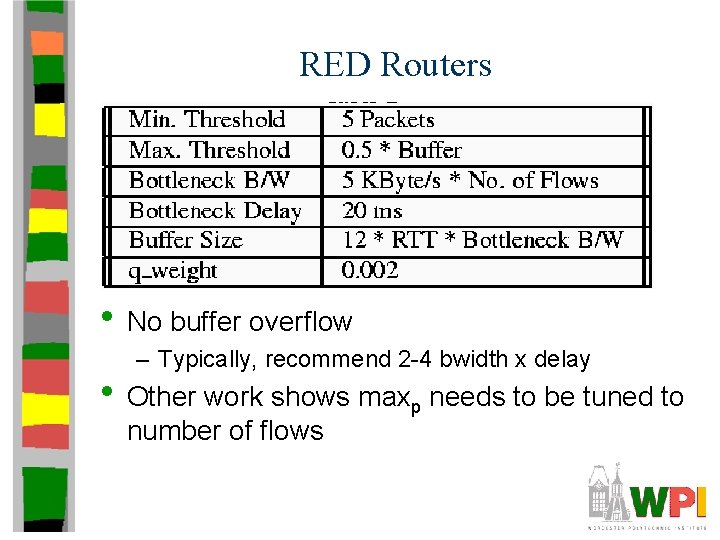
RED Routers • No buffer overflow – Typically, recommend 2 -4 bwidth x delay • Other work shows maxp needs to be tuned to number of flows
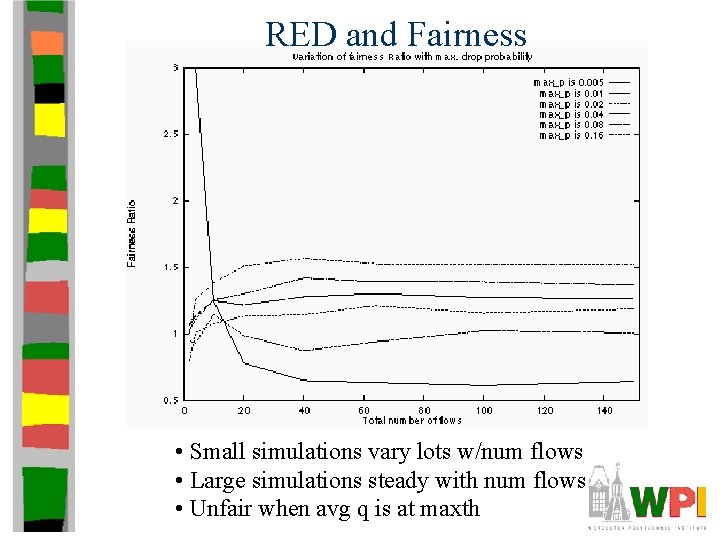
RED and Fairness • Small simulations vary lots w/num flows • Large simulations steady with num flows • Unfair when avg q is at maxth
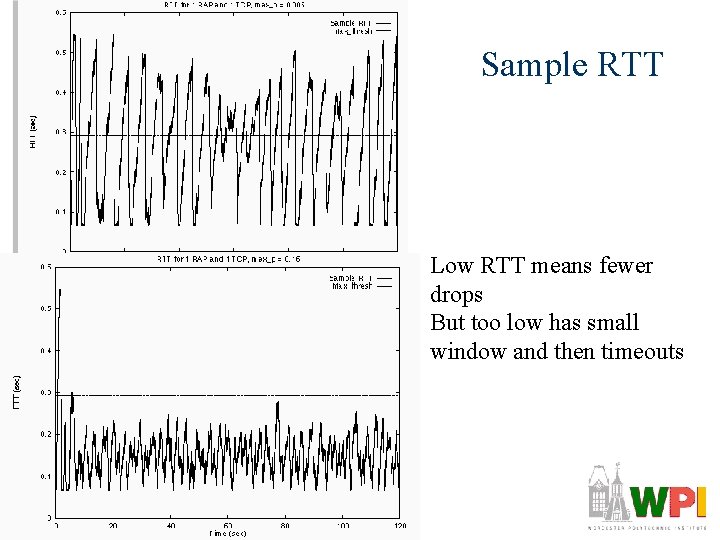
Sample RTT Low RTT means fewer drops But too low has small window and then timeouts
Conclusion • Rate-based • Reasonably Fair to TCP – Unfair when TCP not AIMD (timeout) • More Fair when RED gateway • Future – Build it and run on Internet – Applications on top (Layered adaptation)
Winner? • MM-Flow • TFRC • RAP • Debate?
Evaluation of Science? • Category of Paper • Science Evaluation (1 -10)? • Space devoted to Experiments?
- Slides: 26