
RANKS AND MEDAL RIBBONS OF THE FIGHTING SERVICES
RANKS AND MEDAL RIBBONS OF THE FIGHTING SERVICES Published by the Daily Mirror It is believed that the booklet was issued during the Second World War, possibly as far back as 1940. The information contained in the ‘booklet’ covers all three services. Understandably the Royal Navy is the focus of this presentation. INFORMATION CIRCA WORLD WAR 2 AUTOMATED WITH MUSIC WHICH STARTS ON THE NEXT SLIDE
R. N. OFFICER RANKS AT THE TIME OF THE PUBLICATION Admiral of the Fleet Admiral Vice-Admiral Rear-Admiral Captain Commander Lieutenant-Commander Sub-Lieutenant and Commissioned Warrant Officer Midshipman and Warrant Officer

INDICATIONS OF RANK ON SHOULDER STRAPS AND SLEEVES OF ROYAL NAVAL OFFICERS The rank of a Naval Officer is shown by the gold stripes he wears on his sleeves, and the branch to which he belongs is shown by the strip of coloured cloth between the gold stripes: - ADMIRAL OF THE FLEET (G. R. INDICATES A. D. C. TO KING) Executive No coloured cloth Engineer Purple Surgeon Scarlet Dental Orange Paymaster White Instructor Light Blue Shipwright Silver Grey Electrical Dark Green Ordnance Dark Blue Wardmaster Maroon ADMIRAL
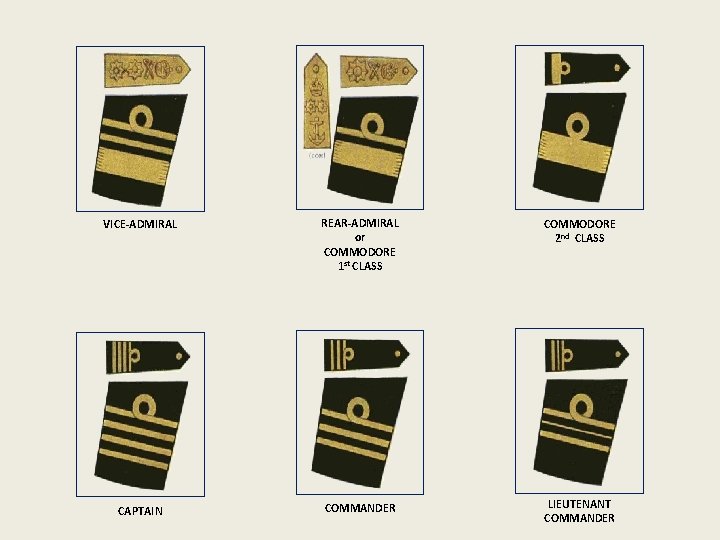
VICE-ADMIRAL REAR-ADMIRAL or COMMODORE 1 st CLASS COMMODORE 2 nd CLASS CAPTAIN COMMANDER LIEUTENANT COMMANDER
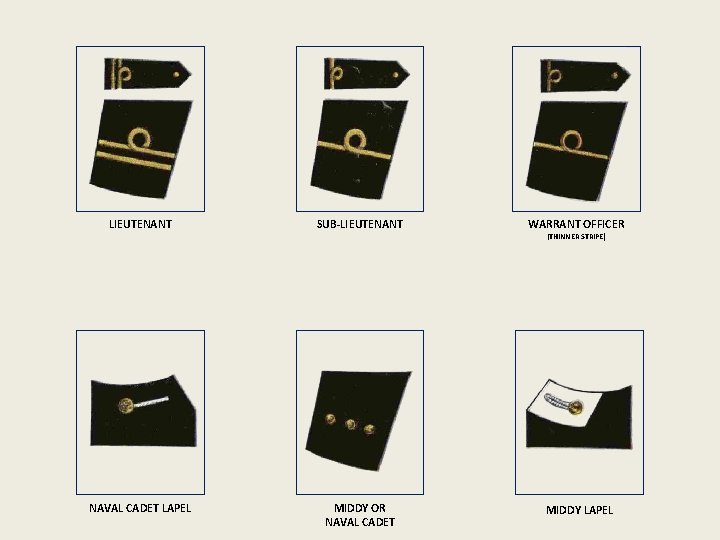
LIEUTENANT SUB-LIEUTENANT NAVAL CADET LAPEL MIDDY OR NAVAL CADET WARRANT OFFICER (THINNER STRIPE) MIDDY LAPEL
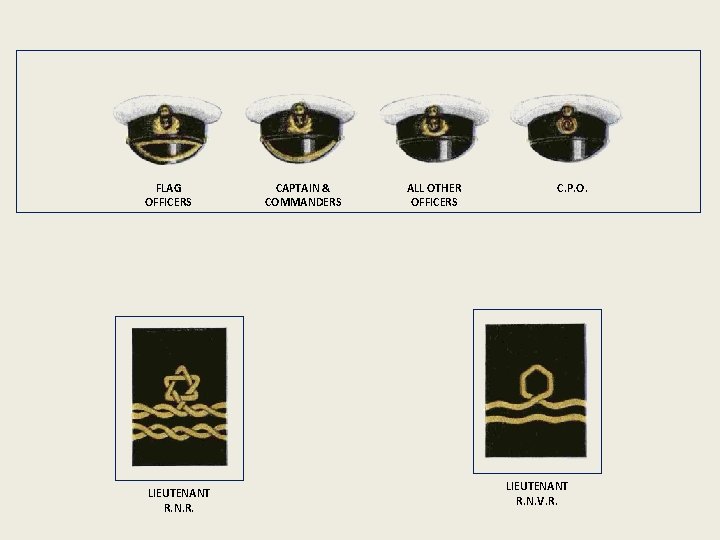
FLAG OFFICERS LIEUTENANT R. N. R. CAPTAIN & COMMANDERS ALL OTHER OFFICERS C. P. O. LIEUTENANT R. N. V. R.

SLEEVE BADGES PETTY OFFICERS AND MEN GUNNER’S MATE GUNLAYER 1 ST CLASS QUARTER’S RATING 1 ST CLASS GUNNERY BRANCH GUNLAYER 2 ND CLASS RANGETAKER 1 ST CLASS RANGETAKER 2 ND CLASS TORPEDO GUNNER’S MATE TORPEDO COXSWAIN
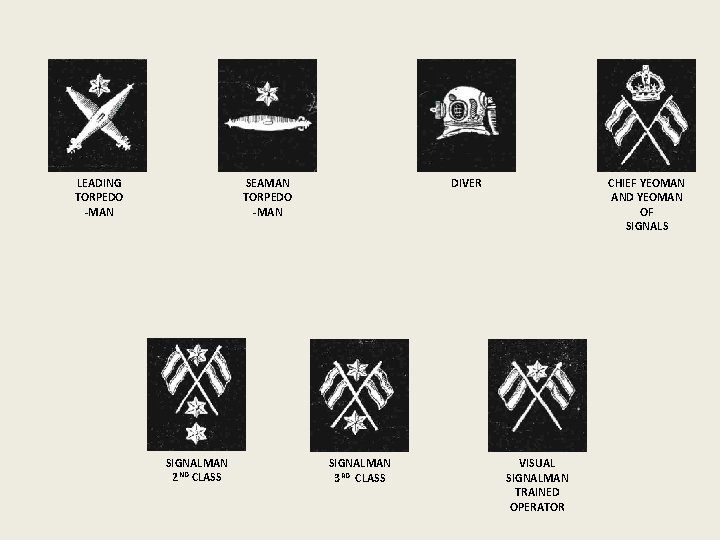
LEADING TORPEDO -MAN SEAMAN TORPEDO -MAN SIGNALMAN 2 ND CLASS DIVER SIGNALMAN 3 RD CLASS CHIEF YEOMAN AND YEOMAN OF SIGNALS VISUAL SIGNALMAN TRAINED OPERATOR
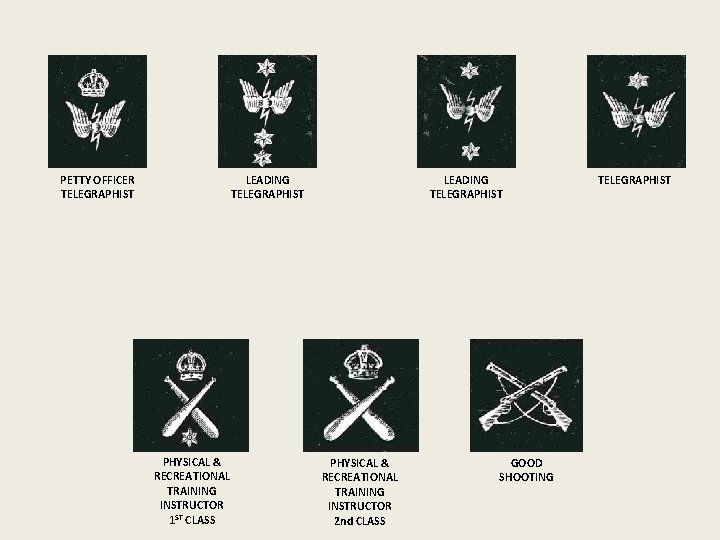
PETTY OFFICER TELEGRAPHIST LEADING TELEGRAPHIST PHYSICAL & RECREATIONAL TRAINING INSTRUCTOR 1 ST CLASS LEADING TELEGRAPHIST PHYSICAL & RECREATIONAL TRAINING INSTRUCTOR 2 nd CLASS GOOD SHOOTING TELEGRAPHIST
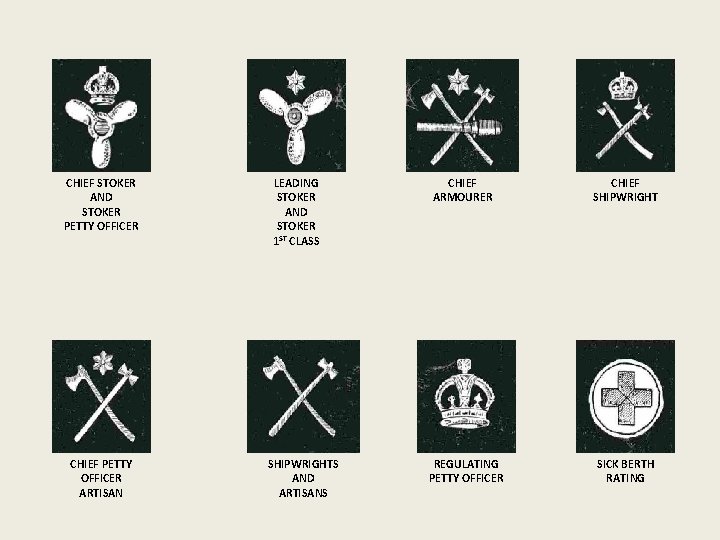
CHIEF STOKER AND STOKER PETTY OFFICER CHIEF PETTY OFFICER ARTISAN LEADING STOKER AND STOKER 1 ST CLASS SHIPWRIGHTS AND ARTISANS CHIEF ARMOURER CHIEF SHIPWRIGHT REGULATING PETTY OFFICER SICK BERTH RATING

SUBMARINE DETECTOR INSTRUCTOR WRITER OFFICER’S STEWARD OFFICER’S COOK SUPPLY RATING TELEGRAPHIST AIR GUNNER COOK LEADING SEAMAN
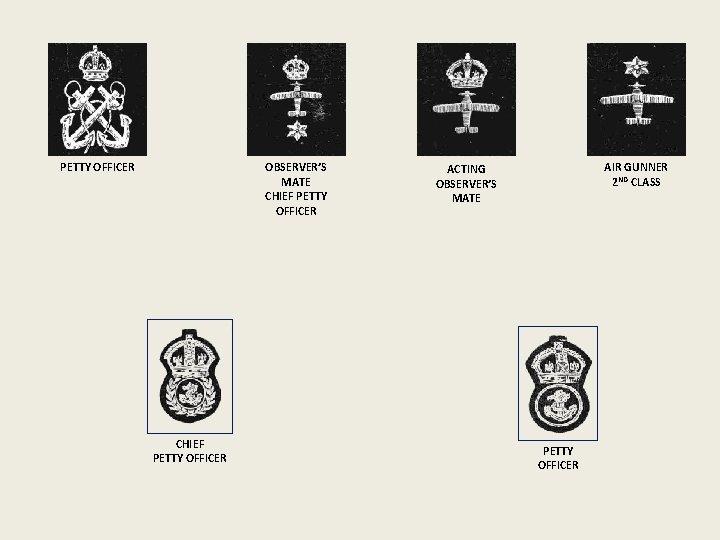
OBSERVER’S MATE CHIEF PETTY OFFICER AIR GUNNER 2 ND CLASS ACTING OBSERVER’S MATE PETTY OFFICER
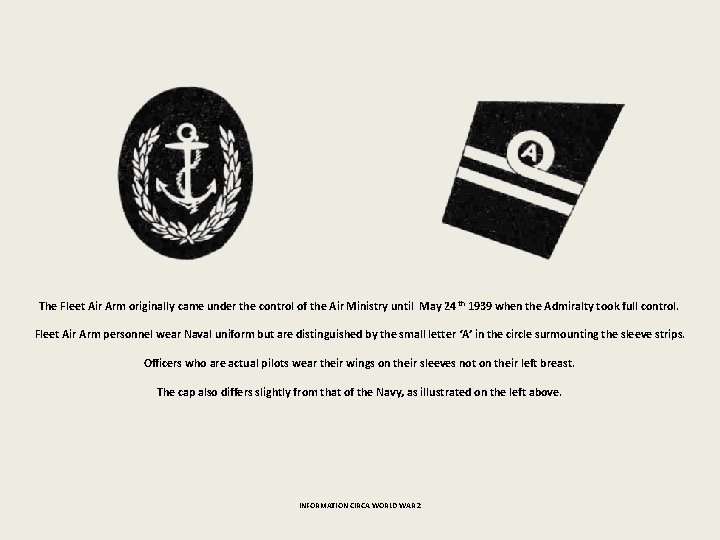
The Fleet Air Arm originally came under the control of the Air Ministry until May 24 th 1939 when the Admiralty took full control. Fleet Air Arm personnel wear Naval uniform but are distinguished by the small letter ‘A’ in the circle surmounting the sleeve strips. Officers who are actual pilots wear their wings on their sleeves not on their left breast. The cap also differs slightly from that of the Navy, as illustrated on the left above. INFORMATION CIRCA WORLD WAR 2
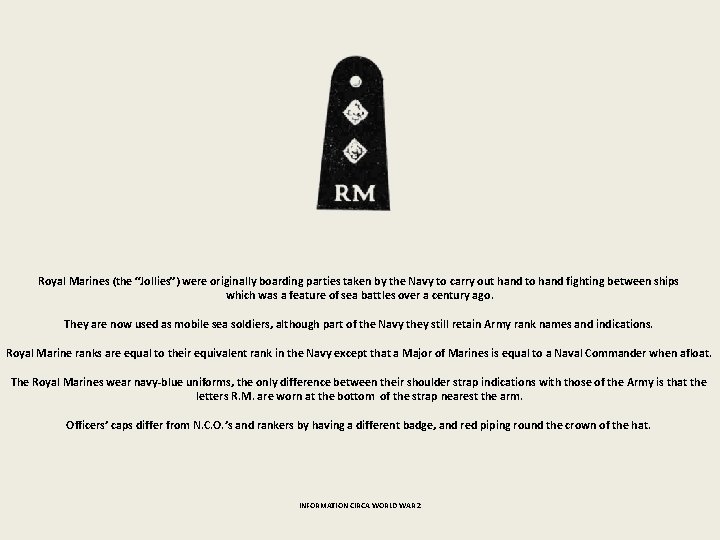
Royal Marines (the “Jollies”) were originally boarding parties taken by the Navy to carry out hand to hand fighting between ships which was a feature of sea battles over a century ago. They are now used as mobile sea soldiers, although part of the Navy they still retain Army rank names and indications. Royal Marine ranks are equal to their equivalent rank in the Navy except that a Major of Marines is equal to a Naval Commander when afloat. The Royal Marines wear navy-blue uniforms, the only difference between their shoulder strap indications with those of the Army is that the letters R. M. are worn at the bottom of the strap nearest the arm. Officers’ caps differ from N. C. O. ’s and rankers by having a different badge, and red piping round the crown of the hat. INFORMATION CIRCA WORLD WAR 2

MEDALS & RIBBONS ASSOCIATED MAINLY WITH THE ROYAL NAVY
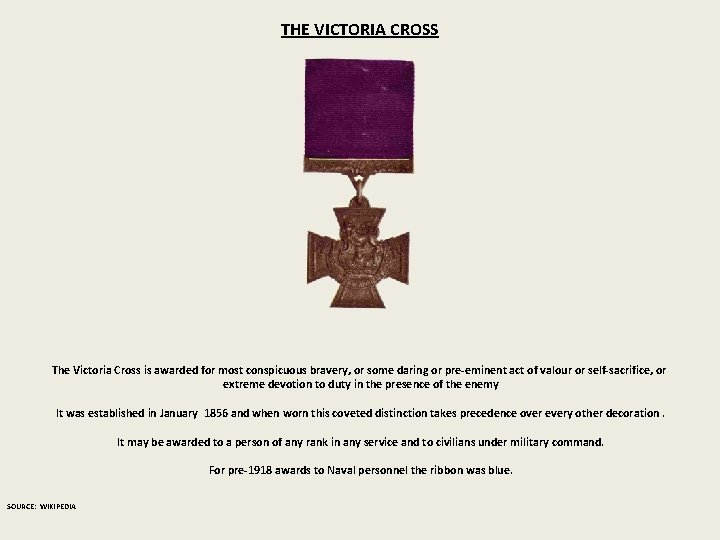
THE VICTORIA CROSS The Victoria Cross is awarded for most conspicuous bravery, or some daring or pre-eminent act of valour or self-sacrifice, or extreme devotion to duty in the presence of the enemy It was established in January 1856 and when worn this coveted distinction takes precedence over every other decoration. It may be awarded to a person of any rank in any service and to civilians under military command. For pre-1918 awards to Naval personnel the ribbon was blue. SOURCE: WIKIPEDIA
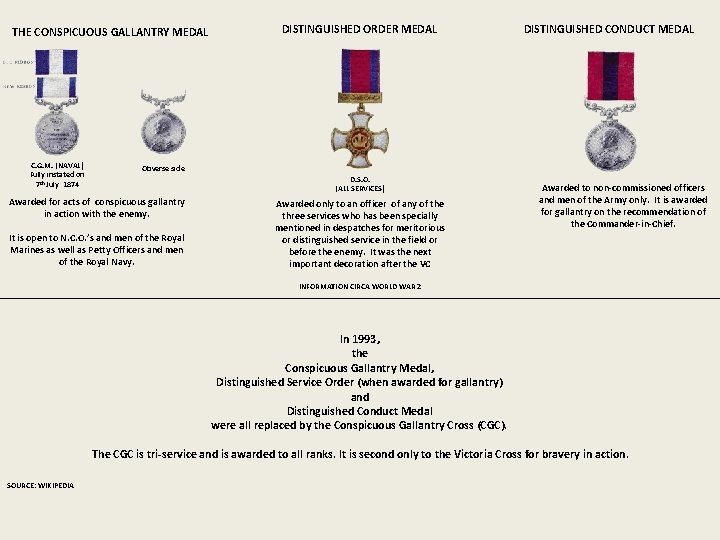
THE CONSPICUOUS GALLANTRY MEDAL C. G. M. (NAVAL) Fully instated on 7 th July 1874 DISTINGUISHED ORDER MEDAL DISTINGUISHED CONDUCT MEDAL Obverse side D. S. O. (ALL SERVICES) Awarded for acts of conspicuous gallantry in action with the enemy. It is open to N. C. O. ’s and men of the Royal Marines as well as Petty Officers and men of the Royal Navy. Awarded only to an officer of any of the three services who has been specially mentioned in despatches for meritorious or distinguished service in the field or before the enemy. It was the next important decoration after the VC Awarded to non-commissioned officers and men of the Army only. It is awarded for gallantry on the recommendation of the Commander-in-Chief. INFORMATION CIRCA WORLD WAR 2 In 1993, the Conspicuous Gallantry Medal, Distinguished Service Order (when awarded for gallantry) and Distinguished Conduct Medal were all replaced by the Conspicuous Gallantry Cross (CGC). The CGC is tri-service and is awarded to all ranks. It is second only to the Victoria Cross for bravery in action. SOURCE: WIKIPEDIA
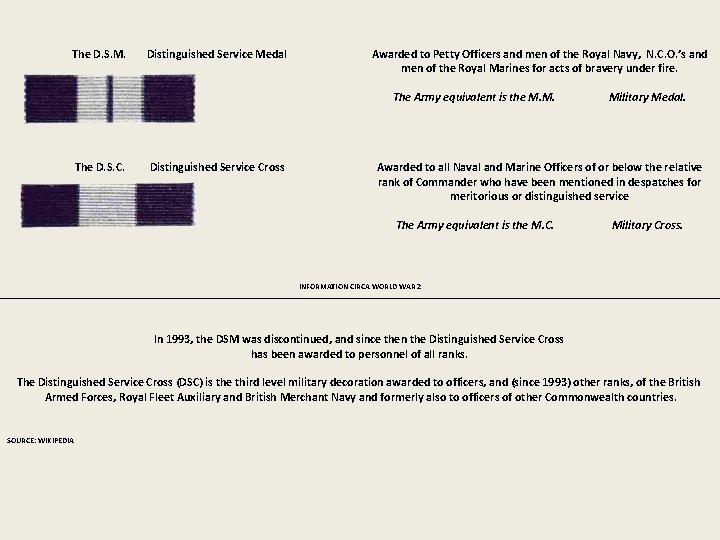
The D. S. M. Distinguished Service Medal Awarded to Petty Officers and men of the Royal Navy, N. C. O. ’s and men of the Royal Marines for acts of bravery under fire. The Army equivalent is the M. M. The D. S. C. Distinguished Service Cross Military Medal. Awarded to all Naval and Marine Officers of or below the relative rank of Commander who have been mentioned in despatches for meritorious or distinguished service The Army equivalent is the M. C. Military Cross. INFORMATION CIRCA WORLD WAR 2 In 1993, the DSM was discontinued, and since then the Distinguished Service Cross has been awarded to personnel of all ranks. The Distinguished Service Cross (DSC) is the third level military decoration awarded to officers, and (since 1993) other ranks, of the British Armed Forces, Royal Fleet Auxiliary and British Merchant Navy and formerly also to officers of other Commonwealth countries. SOURCE: WIKIPEDIA
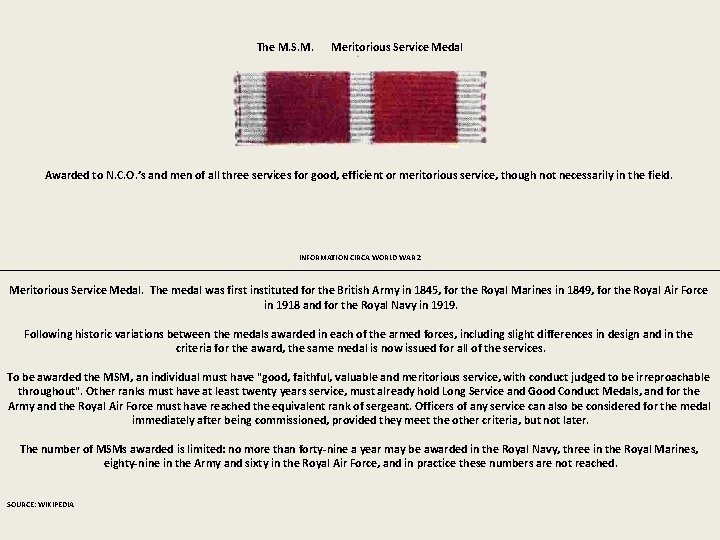
The M. S. M. Meritorious Service Medal Awarded to N. C. O. ’s and men of all three services for good, efficient or meritorious service, though not necessarily in the field. INFORMATION CIRCA WORLD WAR 2 Meritorious Service Medal. The medal was first instituted for the British Army in 1845, for the Royal Marines in 1849, for the Royal Air Force in 1918 and for the Royal Navy in 1919. Following historic variations between the medals awarded in each of the armed forces, including slight differences in design and in the criteria for the award, the same medal is now issued for all of the services. To be awarded the MSM, an individual must have "good, faithful, valuable and meritorious service, with conduct judged to be irreproachable throughout". Other ranks must have at least twenty years service, must already hold Long Service and Good Conduct Medals, and for the Army and the Royal Air Force must have reached the equivalent rank of sergeant. Officers of any service can also be considered for the medal immediately after being commissioned, provided they meet the other criteria, but not later. The number of MSMs awarded is limited: no more than forty-nine a year may be awarded in the Royal Navy, three in the Royal Marines, eighty-nine in the Army and sixty in the Royal Air Force, and in practice these numbers are not reached. SOURCE: WIKIPEDIA
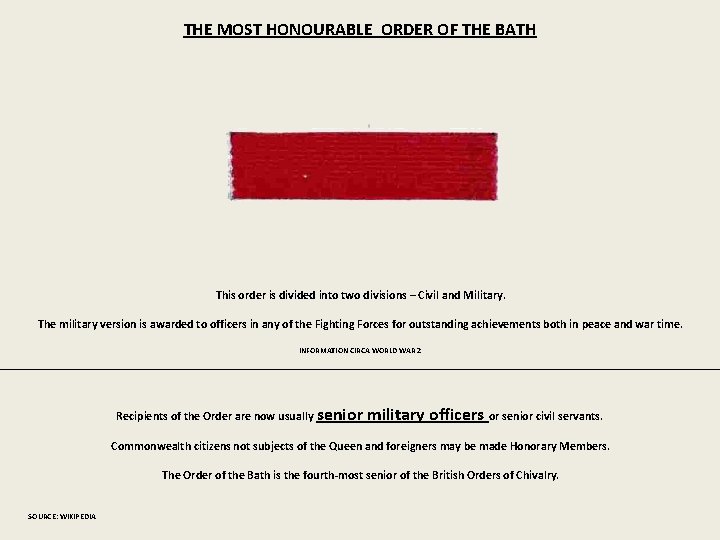
THE MOST HONOURABLE ORDER OF THE BATH This order is divided into two divisions – Civil and Military. The military version is awarded to officers in any of the Fighting Forces for outstanding achievements both in peace and war time. INFORMATION CIRCA WORLD WAR 2 Recipients of the Order are now usually senior military officers or senior civil servants. Commonwealth citizens not subjects of the Queen and foreigners may be made Honorary Members. The Order of the Bath is the fourth-most senior of the British Orders of Chivalry. SOURCE: WIKIPEDIA
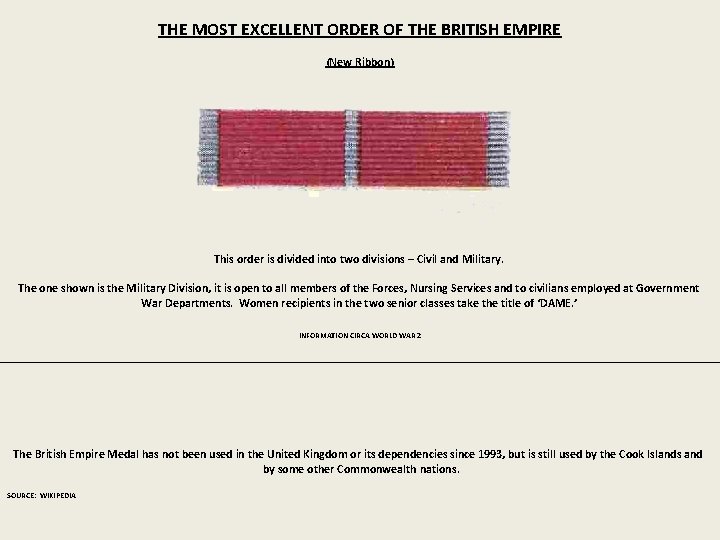
THE MOST EXCELLENT ORDER OF THE BRITISH EMPIRE (New Ribbon) This order is divided into two divisions – Civil and Military. The one shown is the Military Division, it is open to all members of the Forces, Nursing Services and to civilians employed at Government War Departments. Women recipients in the two senior classes take the title of ‘DAME. ’ INFORMATION CIRCA WORLD WAR 2 The British Empire Medal has not been used in the United Kingdom or its dependencies since 1993, but is still used by the Cook Islands and by some other Commonwealth nations. SOURCE: WIKIPEDIA
ACKNOWLEDGEMENT Presentation compiled by MIS on behalf of Cloud Observers 2011
- Slides: 22