
Ranking the Web Frontier Nadav Eiron Kevin S

Ranking the Web Frontier Nadav Eiron, Kevin S. Mc. Curley, Joh. A. Tomlin IBM Almaden Research Center WWW’ 04 CSE 450 Web Mining Presented by Zaihan Yang
Introduction & Contribution �Propose algorithmic innovations for the basic Page. Rank paradigm. �Problem of Web Frontier ( Dangling Nodes) �Distinguish different types of Dangling Nodes �Propose four techniques for penalty pages �Problem of computing pagerank and rank manipulation �Explore Web hierarchical structure �Host. Rank & Dir. Rank algorithms
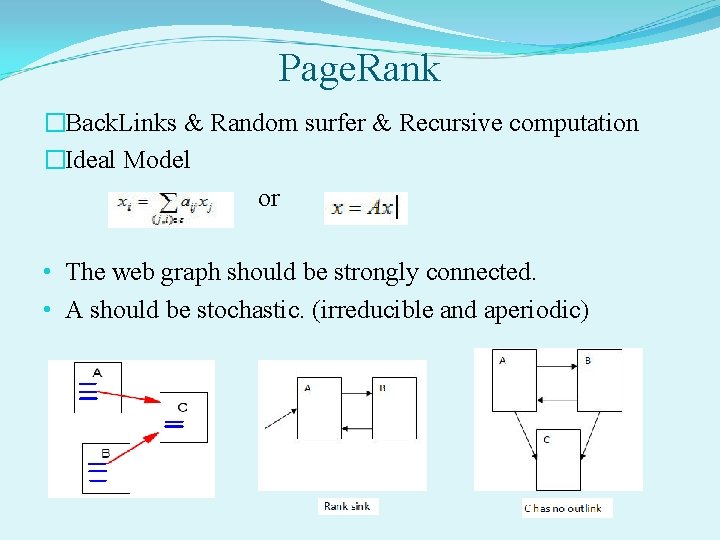
Page. Rank �Back. Links & Random surfer & Recursive computation �Ideal Model or • The web graph should be strongly connected. • A should be stochastic. (irreducible and aperiodic)
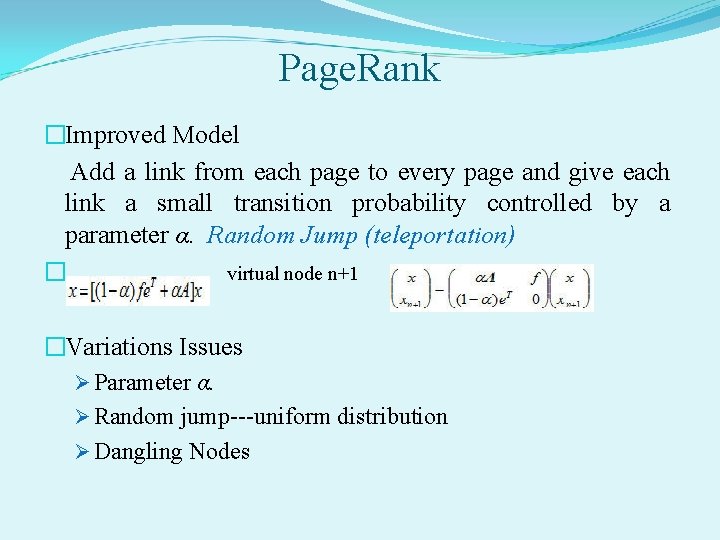
Page. Rank �Improved Model Add a link from each page to every page and give each link a small transition probability controlled by a parameter α. Random Jump (teleportation) � virtual node n+1 �Variations Issues Ø Parameter α. Ø Random jump---uniform distribution Ø Dangling Nodes
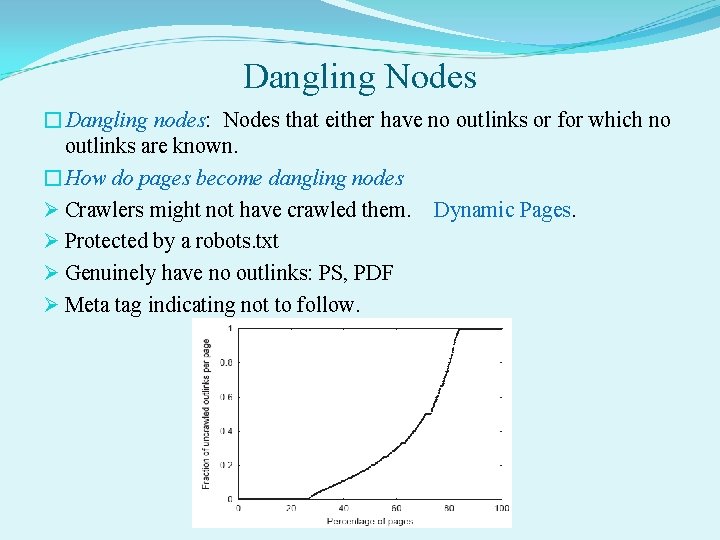
Dangling Nodes �Dangling nodes: Nodes that either have no outlinks or for which no outlinks are known. �How do pages become dangling nodes Ø Crawlers might not have crawled them. Dynamic Pages. Ø Protected by a robots. txt Ø Genuinely have no outlinks: PS, PDF Ø Meta tag indicating not to follow.
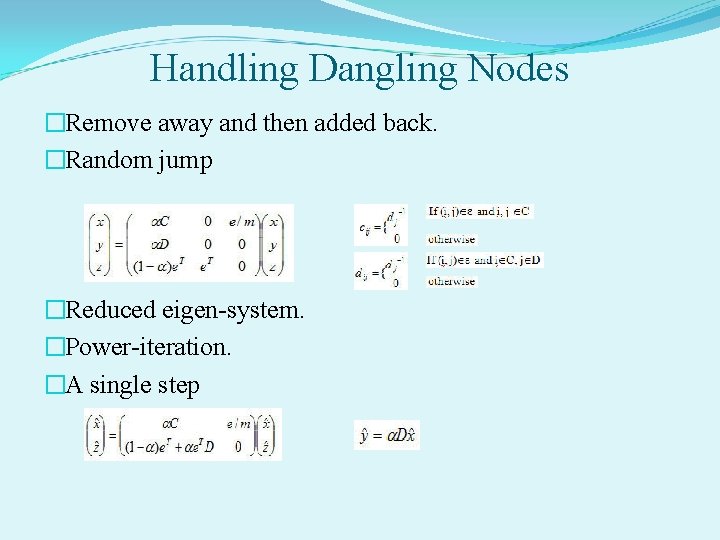
Handling Dangling Nodes �Remove away and then added back. �Random jump �Reduced eigen-system. �Power-iteration. �A single step
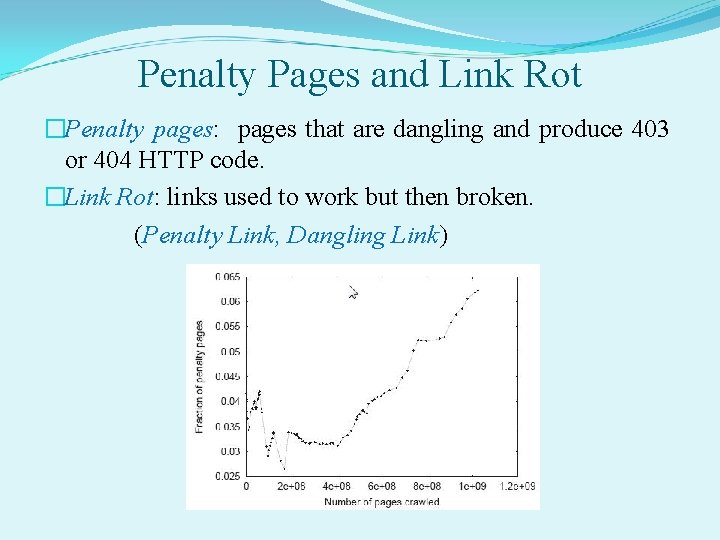
Penalty Pages and Link Rot �Penalty pages: pages that are dangling and produce 403 or 404 HTTP code. �Link Rot: links used to work but then broken. (Penalty Link, Dangling Link)
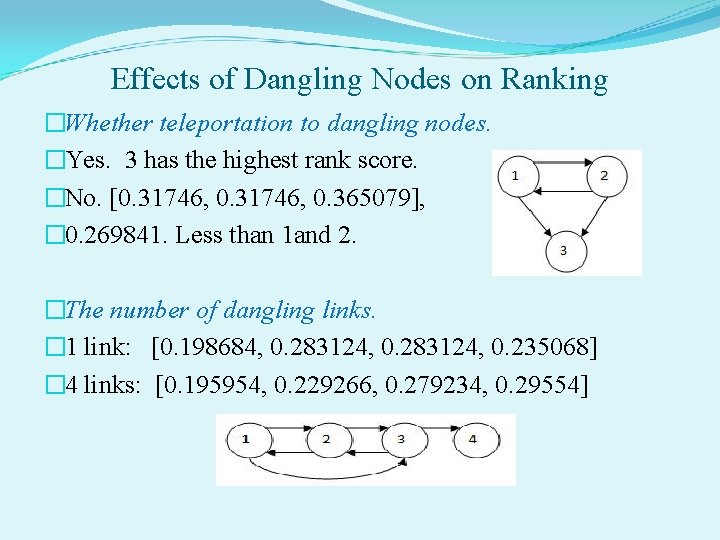
Effects of Dangling Nodes on Ranking �Whether teleportation to dangling nodes. �Yes. 3 has the highest rank score. �No. [0. 31746, 0. 365079], � 0. 269841. Less than 1 and 2. �The number of dangling links. � 1 link: [0. 198684, 0. 283124, 0. 235068] � 4 links: [0. 195954, 0. 229266, 0. 279234, 0. 29554]
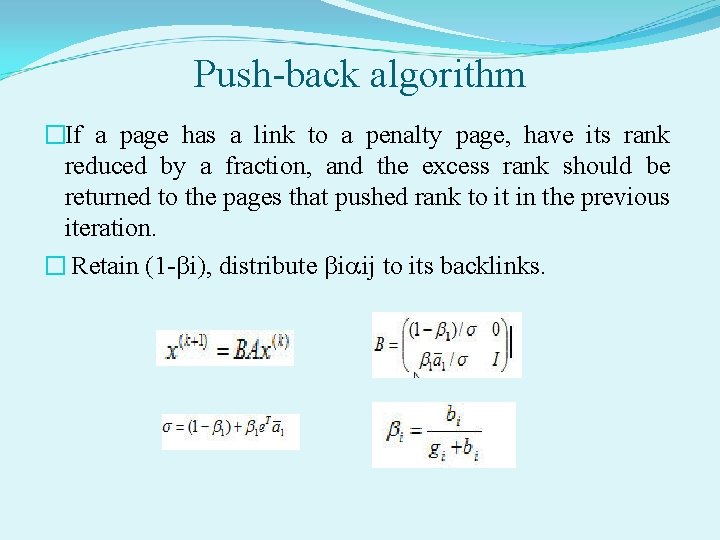
Push-back algorithm �If a page has a link to a penalty page, have its rank reduced by a fraction, and the excess rank should be returned to the pages that pushed rank to it in the previous iteration. � Retain (1 - i), distribute i ij to its backlinks.
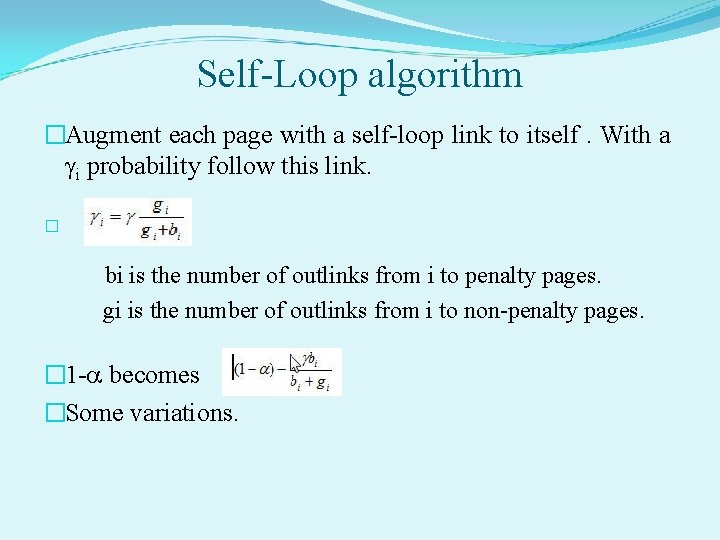
Self-Loop algorithm �Augment each page with a self-loop link to itself. With a i probability follow this link. � bi is the number of outlinks from i to penalty pages. gi is the number of outlinks from i to non-penalty pages. � 1 - becomes �Some variations.
Jump-weighting algorithm �Instead of evenly redistribution, biasing the redistribution so that penalized pages receive less rank. �A straight-forward method Ø Weight the link from virtual node Ø to an unpenalized node in C (strongly connected node set) by Ø to a penalized node by gi/(gi+bi)
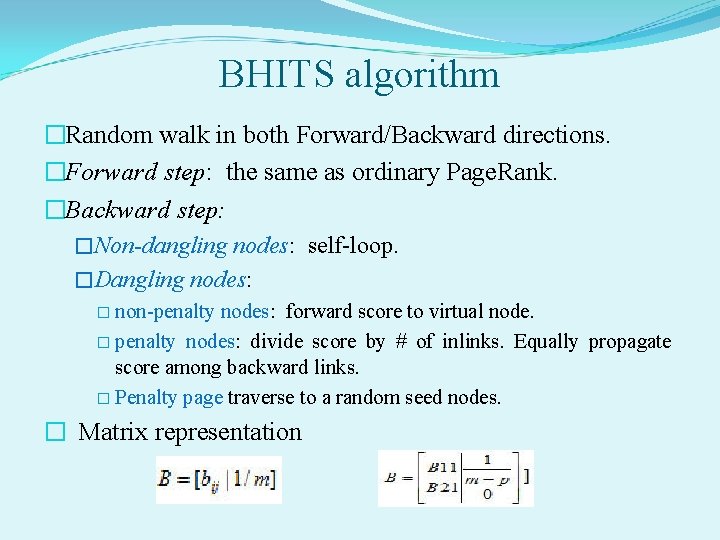
BHITS algorithm �Random walk in both Forward/Backward directions. �Forward step: the same as ordinary Page. Rank. �Backward step: �Non-dangling nodes: self-loop. �Dangling nodes: � non-penalty nodes: forward score to virtual node. � penalty nodes: divide score by # of inlinks. Equally propagate score among backward links. � Penalty page traverse to a random seed nodes. � Matrix representation
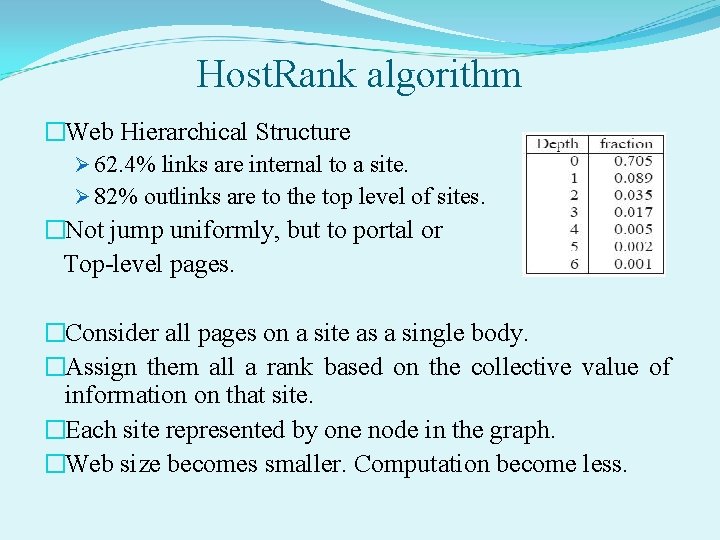
Host. Rank algorithm �Web Hierarchical Structure Ø 62. 4% links are internal to a site. Ø 82% outlinks are to the top level of sites. �Not jump uniformly, but to portal or Top-level pages. �Consider all pages on a site as a single body. �Assign them all a rank based on the collective value of information on that site. �Each site represented by one node in the graph. �Web size becomes smaller. Computation become less.
Dir. Rank algorithm �Host. Rank too coarse a level of granularity & heavy tail distribution. �Dir. Rank graph Ø Node: groups of URLS with prefixes up to the last “/” or “? ”. Virtual directory. Ø Edges: if there is a link from a URL in the source virtual directory to a URL in the destination virtual directory.
Experiments Results �Setup: Ø Crawling on IBM Almaden Ø More than 1 billion pages; 37 billion links; 4. 75 billion URLS. �Results: �Reduce computation. Ø Dir. Rank: 114 million nodes/15 billion edges Ø Host. Rank: 19. 7 billion hosts(nodes)/1. 1 billion edges �Enhance resistance to link manipulation. Ø 11/20 in 100 million pages. vs 14/100 hostnames Ø Virtual node probability : 0. 82 vs 0. 17
Conclusions �Page. Rank with uniform teleportation are easily subject to link manipulation. �Host. Rank and Dir. Rank algorithm are both cheaper to compute and less subject to link manipulation. �The proposed 4 techniques for penalty pages can reduce bias and improve ranking performance. �In the future, hope can place the problem of web page ranking on a firmer scientific foundation besides on trade or economic domains.
- Slides: 16