
Rank SQL Query Algebra and Optimization for Relational

Rank. SQL: Query Algebra and Optimization for Relational Top-k Queries Chengkai Li (UIUC) joint work with Kevin Chen-Chuan Chang (UIUC) Ihab F. Ilyas (U. of Waterloo) Sumin Song (UIUC) 1
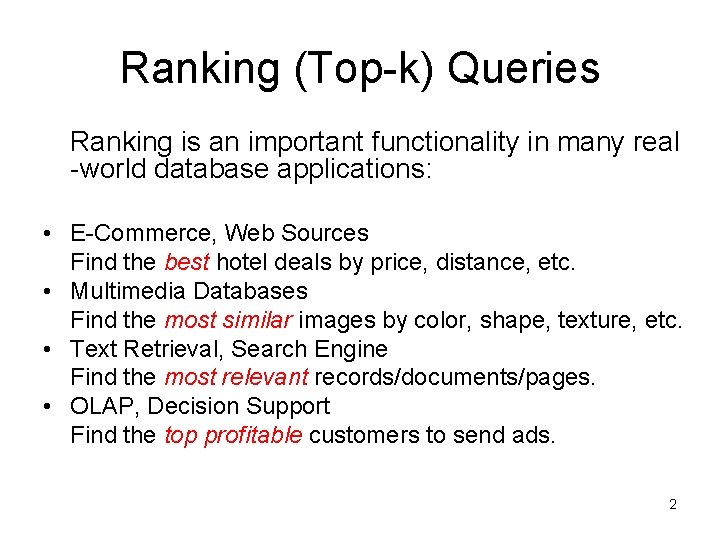
Ranking (Top-k) Queries Ranking is an important functionality in many real -world database applications: • E-Commerce, Web Sources Find the best hotel deals by price, distance, etc. • Multimedia Databases Find the most similar images by color, shape, texture, etc. • Text Retrieval, Search Engine Find the most relevant records/documents/pages. • OLAP, Decision Support Find the top profitable customers to send ads. 2
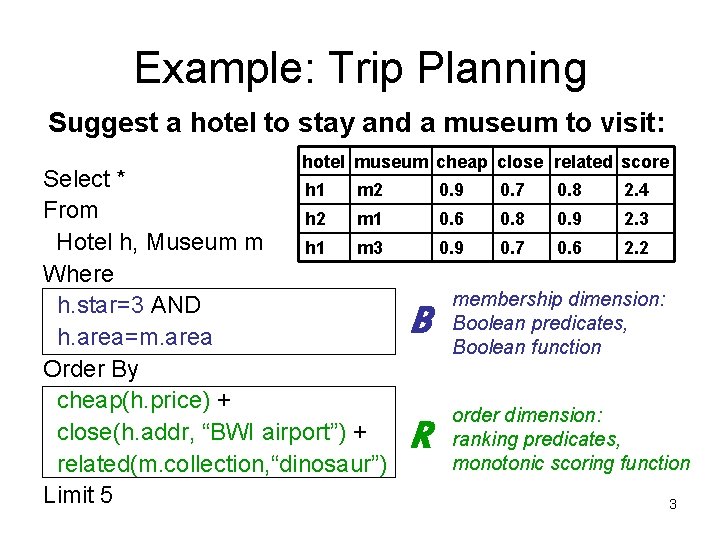
Example: Trip Planning Suggest a hotel to stay and a museum to visit: hotel museum cheap close related score Select * h 1 m 2 From h 2 m 1 Hotel h, Museum m h 1 m 3 Where h. star=3 AND h. area=m. area Order By cheap(h. price) + close(h. addr, “BWI airport”) + related(m. collection, “dinosaur”) Limit 5 0. 9 0. 7 0. 8 2. 4 0. 6 0. 8 0. 9 2. 3 0. 9 0. 7 0. 6 2. 2 B membership dimension: Boolean predicates, Boolean function R order dimension: ranking predicates, monotonic scoring function 3
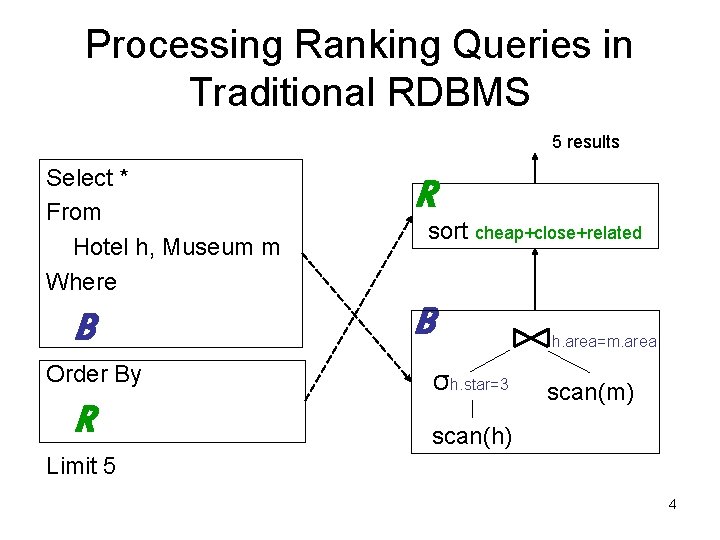
Processing Ranking Queries in Traditional RDBMS 5 results Select * From Hotel h, Museum m Where B Order By R R sort cheap+close+related B σh. star=3 h. area=m. area scan(m) scan(h) Limit 5 4
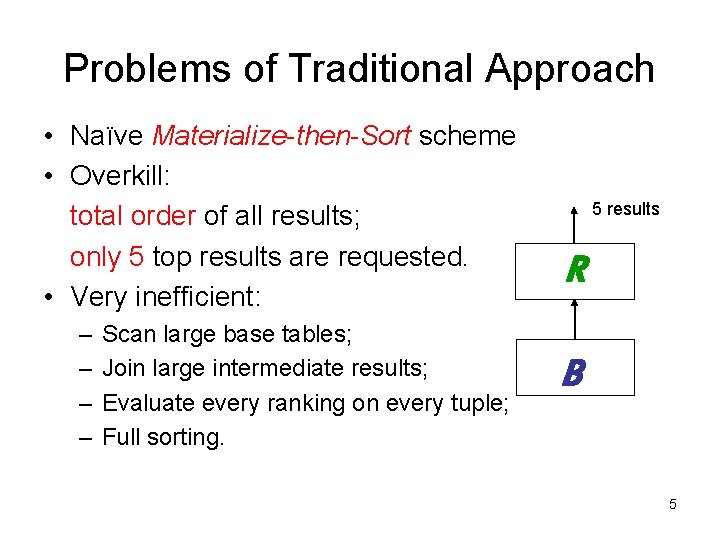
Problems of Traditional Approach • Naïve Materialize-then-Sort scheme • Overkill: total order of all results; only 5 top results are requested. • Very inefficient: – – Scan large base tables; Join large intermediate results; Evaluate every ranking on every tuple; Full sorting. 5 results R B 5
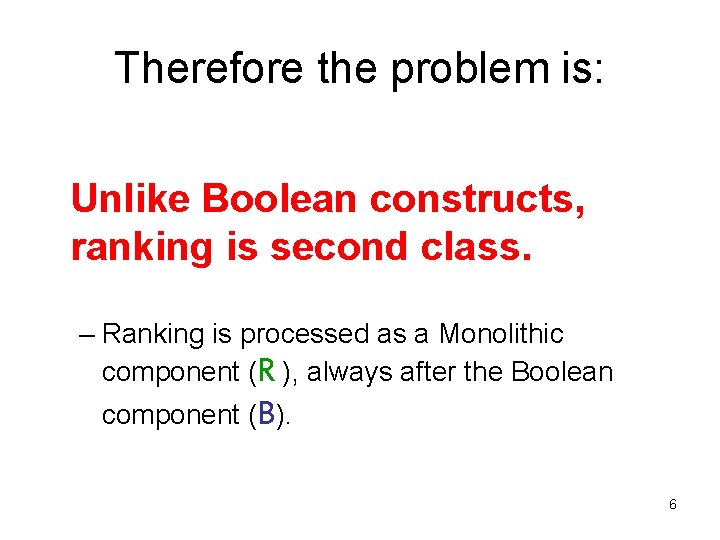
Therefore the problem is: Unlike Boolean constructs, ranking is second class. – Ranking is processed as a Monolithic component (R ), always after the Boolean component (B). 6
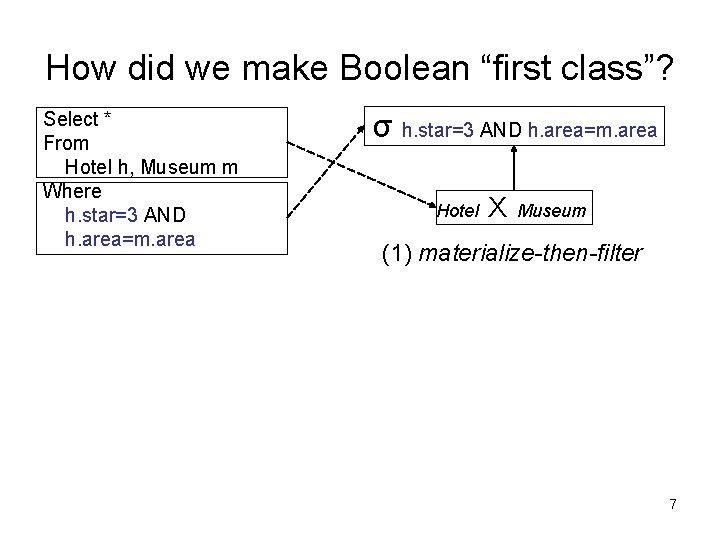
How did we make Boolean “first class”? Select * From Hotel h, Museum m Where h. star=3 AND h. area=m. area σ h. star=3 AND h. area=m. area Hotel X Museum (1) materialize-then-filter 7
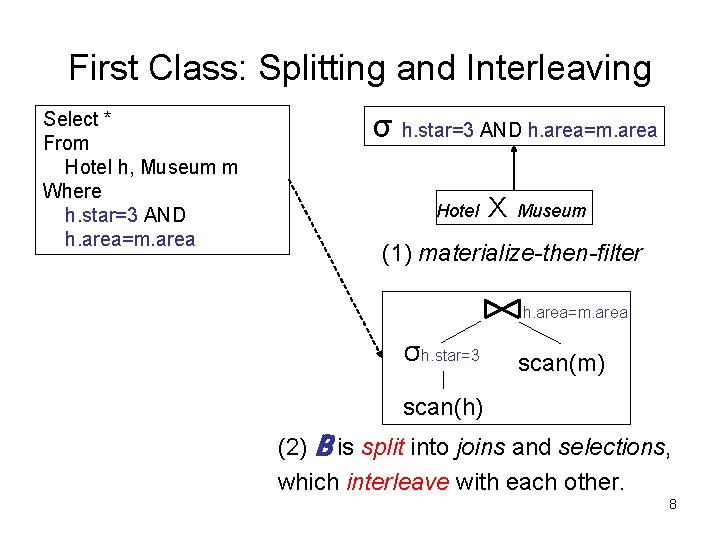
First Class: Splitting and Interleaving Select * From Hotel h, Museum m Where h. star=3 AND h. area=m. area σ h. star=3 AND h. area=m. area Hotel X Museum (1) materialize-then-filter h. area=m. area σh. star=3 scan(m) scan(h) (2) B is split into joins and selections, which interleave with each other. 8
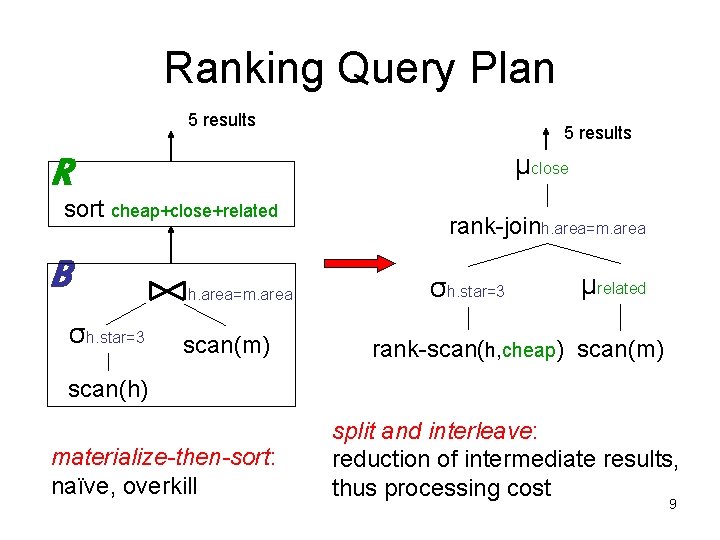
Ranking Query Plan 5 results μclose R sort cheap+close+related B σh. star=3 h. area=m. area scan(m) rank-joinh. area=m. area σh. star=3 μrelated rank-scan(h, cheap) scan(m) scan(h) materialize-then-sort: naïve, overkill split and interleave: reduction of intermediate results, thus processing cost 9
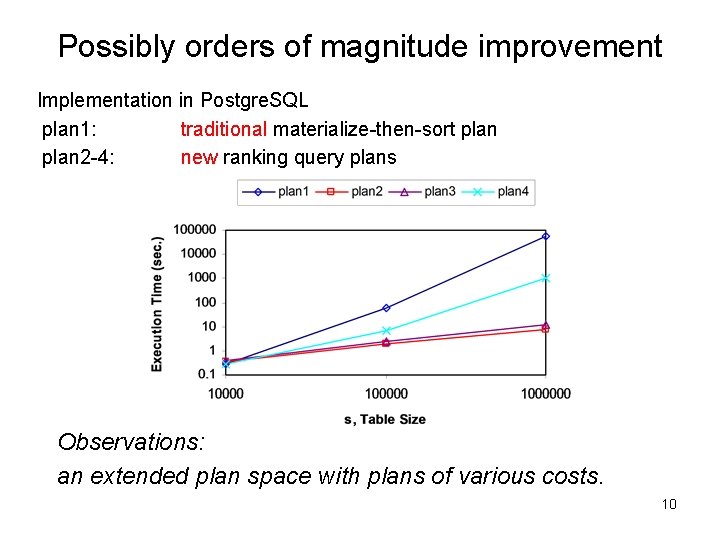
Possibly orders of magnitude improvement Implementation in Postgre. SQL plan 1: traditional materialize-then-sort plan 2 -4: new ranking query plans Observations: an extended plan space with plans of various costs. 10
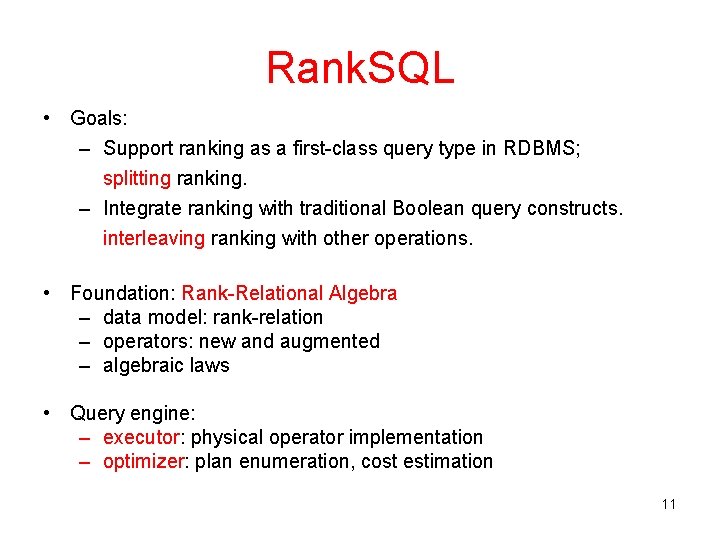
Rank. SQL • Goals: – Support ranking as a first-class query type in RDBMS; splitting ranking. – Integrate ranking with traditional Boolean query constructs. interleaving ranking with other operations. • Foundation: Rank-Relational Algebra – data model: rank-relation – operators: new and augmented – algebraic laws • Query engine: – executor: physical operator implementation – optimizer: plan enumeration, cost estimation 11
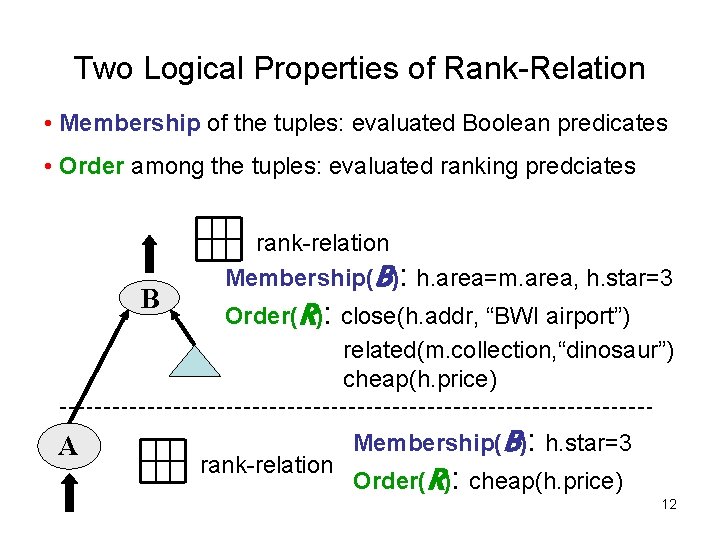
Two Logical Properties of Rank-Relation • Membership of the tuples: evaluated Boolean predicates • Order among the tuples: evaluated ranking predciates B A rank-relation Membership(B): h. area=m. area, h. star=3 Order(R): close(h. addr, “BWI airport”) related(m. collection, “dinosaur”) cheap(h. price) rank-relation Membership(B): h. star=3 Order(R): cheap(h. price) 12
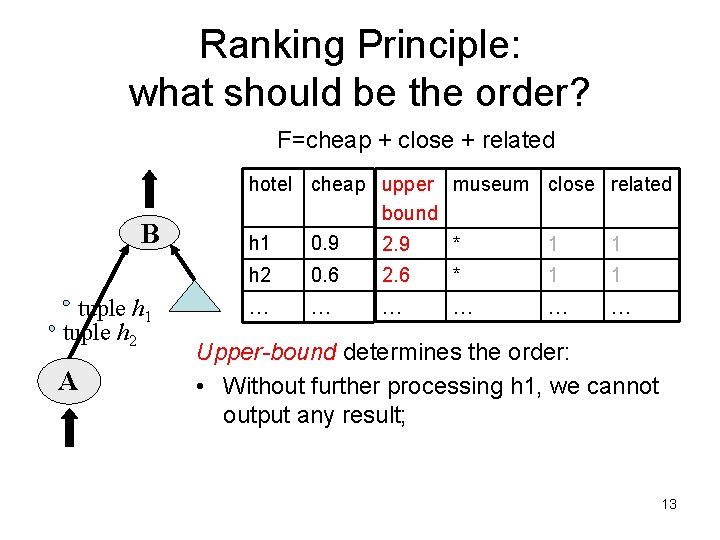
Ranking Principle: what should be the order? F=cheap + close + related B tuple h 1 tuple h 2 A hotel cheap upper museum close related bound h 1 0. 9 2. 9 * 1 1 h 2 0. 6 2. 6 * 1 1 … … … Upper-bound determines the order: • Without further processing h 1, we cannot output any result; 13
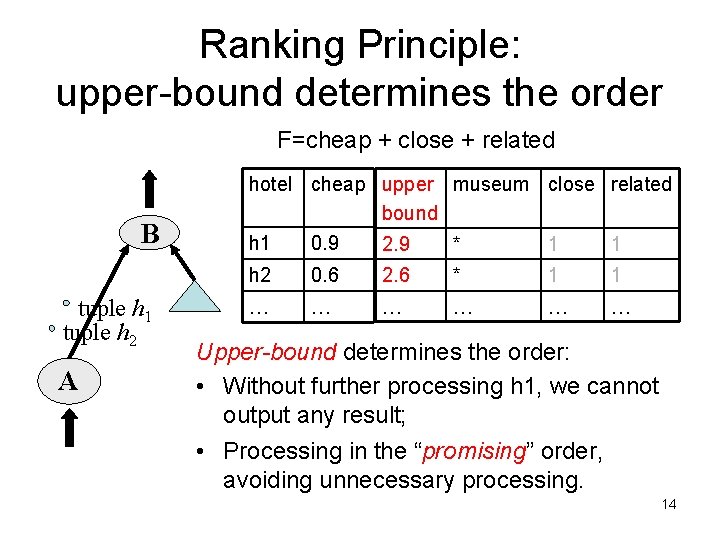
Ranking Principle: upper-bound determines the order F=cheap + close + related B tuple h 1 tuple h 2 A hotel cheap upper museum close related bound h 1 0. 9 2. 9 * 1 1 h 2 0. 6 2. 6 * 1 1 … … … Upper-bound determines the order: • Without further processing h 1, we cannot output any result; • Processing in the “promising” order, avoiding unnecessary processing. 14
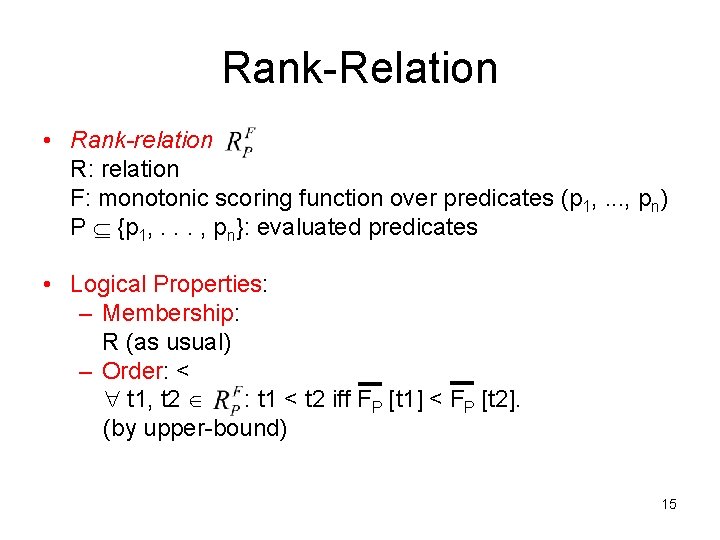
Rank-Relation • Rank-relation R: relation F: monotonic scoring function over predicates (p 1, . . . , pn) P {p 1, . . . , pn}: evaluated predicates • Logical Properties: – Membership: R (as usual) – Order: < t 1, t 2 : t 1 < t 2 iff FP [t 1] < FP [t 2]. (by upper-bound) 15
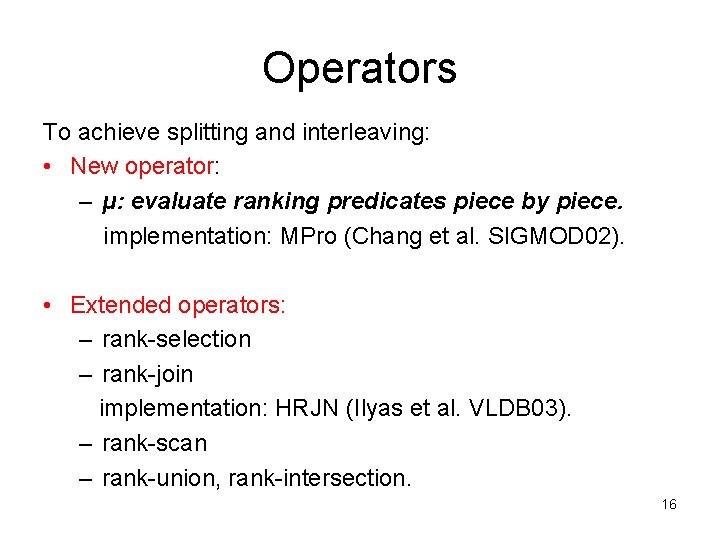
Operators To achieve splitting and interleaving: • New operator: – μ: evaluate ranking predicates piece by piece. implementation: MPro (Chang et al. SIGMOD 02). • Extended operators: – rank-selection – rank-join implementation: HRJN (Ilyas et al. VLDB 03). – rank-scan – rank-union, rank-intersection. 16
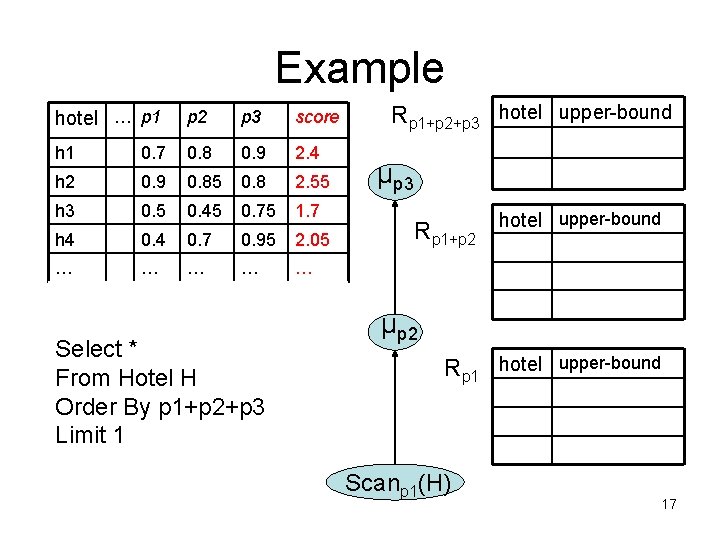
Example hotel … p 1 p 2 p 3 score h 1 0. 7 0. 8 0. 9 2. 4 h 2 0. 9 0. 85 0. 8 2. 55 h 3 0. 5 0. 45 0. 75 1. 7 h 4 0. 7 0. 95 2. 05 … … … Select * From Hotel H Order By p 1+p 2+p 3 Limit 1 Rp 1+p 2+p 3 hotel upper-bound μp 3 Rp 1+p 2 hotel upper-bound μp 2 Rp 1 hotel Scanp 1(H) upper-bound 17
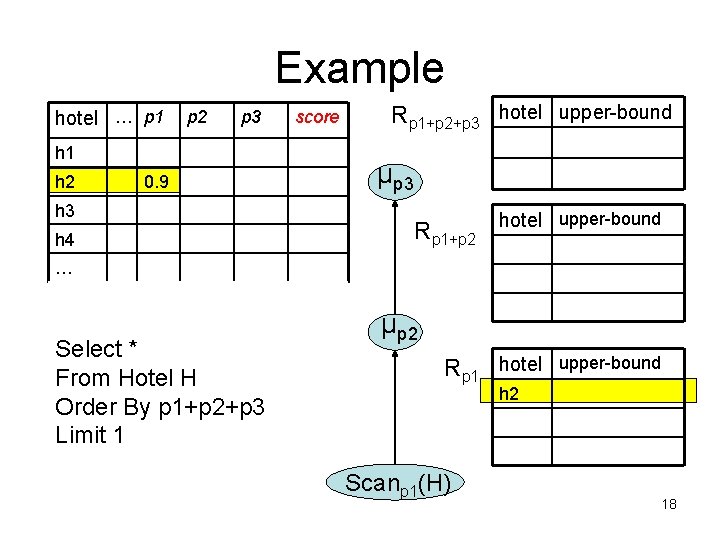
Example hotel … p 1 p 2 p 3 h 1 h 2 0. 9 h 3 h 4 score Rp 1+p 2+p 3 hotel upper-bound μp 3 Rp 1+p 2 hotel upper-bound … Select * From Hotel H Order By p 1+p 2+p 3 Limit 1 μp 2 Rp 1 hotel upper-bound h 2 Scanp 1(H) 18
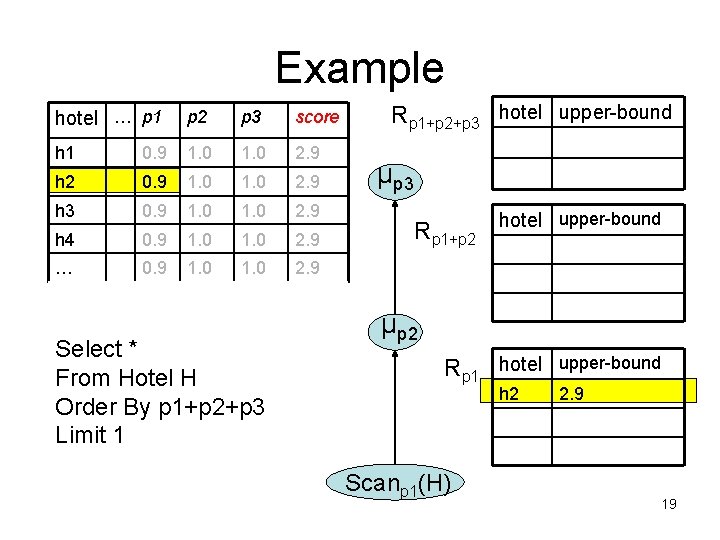
Example hotel … p 1 p 2 p 3 score h 1 0. 9 1. 0 2. 9 h 2 0. 9 1. 0 2. 9 h 3 0. 9 1. 0 2. 9 h 4 0. 9 1. 0 2. 9 … 0. 9 1. 0 2. 9 Select * From Hotel H Order By p 1+p 2+p 3 Limit 1 Rp 1+p 2+p 3 hotel upper-bound μp 3 Rp 1+p 2 hotel upper-bound μp 2 Rp 1 hotel h 2 Scanp 1(H) upper-bound 2. 9 19
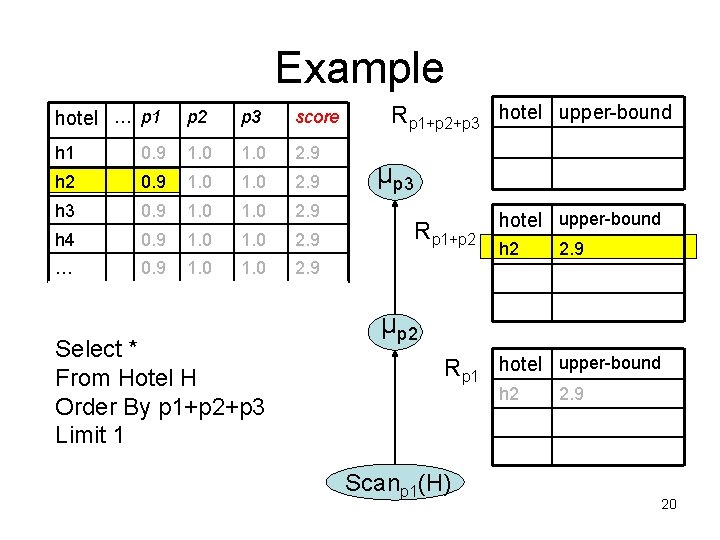
Example hotel … p 1 p 2 p 3 score h 1 0. 9 1. 0 2. 9 h 2 0. 9 1. 0 2. 9 h 3 0. 9 1. 0 2. 9 h 4 0. 9 1. 0 2. 9 … 0. 9 1. 0 2. 9 Select * From Hotel H Order By p 1+p 2+p 3 Limit 1 Rp 1+p 2+p 3 hotel upper-bound μp 3 Rp 1+p 2 hotel h 2 upper-bound 2. 9 μp 2 Rp 1 hotel h 2 Scanp 1(H) upper-bound 2. 9 20
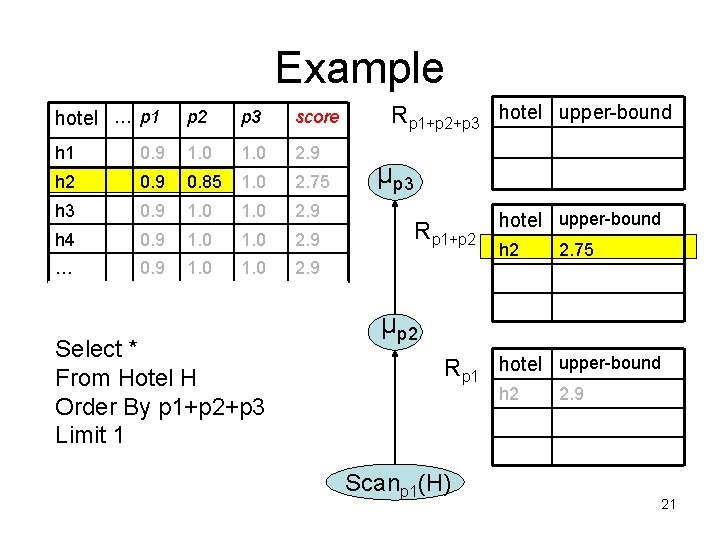
Example hotel … p 1 p 2 p 3 score h 1 0. 9 1. 0 2. 9 h 2 0. 9 0. 85 1. 0 2. 75 h 3 0. 9 1. 0 2. 9 h 4 0. 9 1. 0 2. 9 … 0. 9 1. 0 2. 9 Select * From Hotel H Order By p 1+p 2+p 3 Limit 1 Rp 1+p 2+p 3 hotel upper-bound μp 3 Rp 1+p 2 hotel h 2 upper-bound 2. 75 μp 2 Rp 1 hotel h 2 Scanp 1(H) upper-bound 2. 9 21
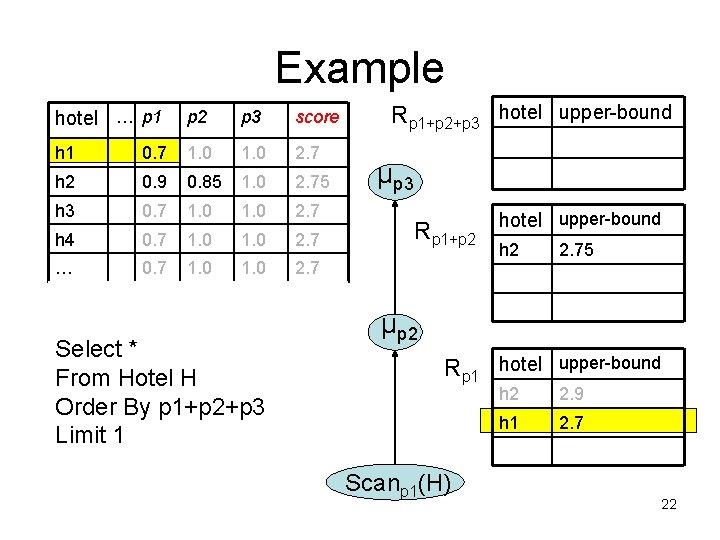
Example hotel … p 1 p 2 p 3 score h 1 0. 7 1. 0 2. 7 h 2 0. 9 0. 85 1. 0 2. 75 h 3 0. 7 1. 0 2. 7 h 4 0. 7 1. 0 2. 7 … 0. 7 1. 0 2. 7 Select * From Hotel H Order By p 1+p 2+p 3 Limit 1 Rp 1+p 2+p 3 hotel upper-bound μp 3 Rp 1+p 2 hotel h 2 upper-bound 2. 75 μp 2 Rp 1 hotel Scanp 1(H) upper-bound h 2 2. 9 h 1 2. 7 22
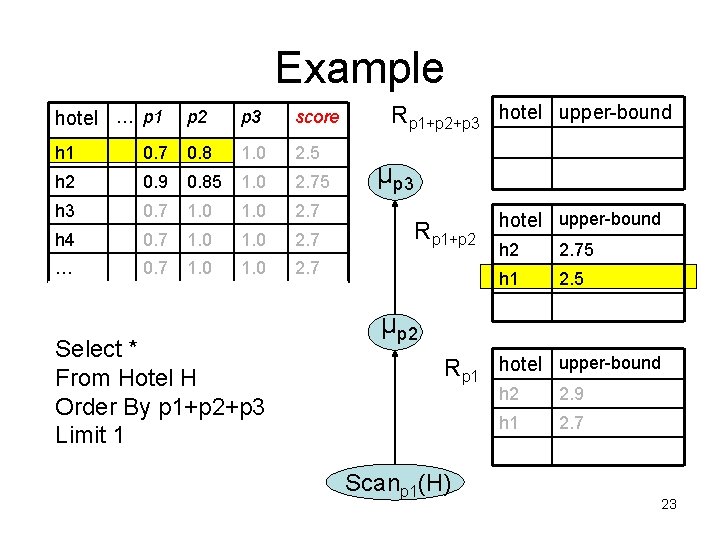
Example hotel … p 1 p 2 p 3 score h 1 0. 7 0. 8 1. 0 2. 5 h 2 0. 9 0. 85 1. 0 2. 75 h 3 0. 7 1. 0 2. 7 h 4 0. 7 1. 0 2. 7 … 0. 7 1. 0 2. 7 Select * From Hotel H Order By p 1+p 2+p 3 Limit 1 Rp 1+p 2+p 3 hotel upper-bound μp 3 Rp 1+p 2 hotel upper-bound h 2 2. 75 h 1 2. 5 μp 2 Rp 1 hotel Scanp 1(H) upper-bound h 2 2. 9 h 1 2. 7 23
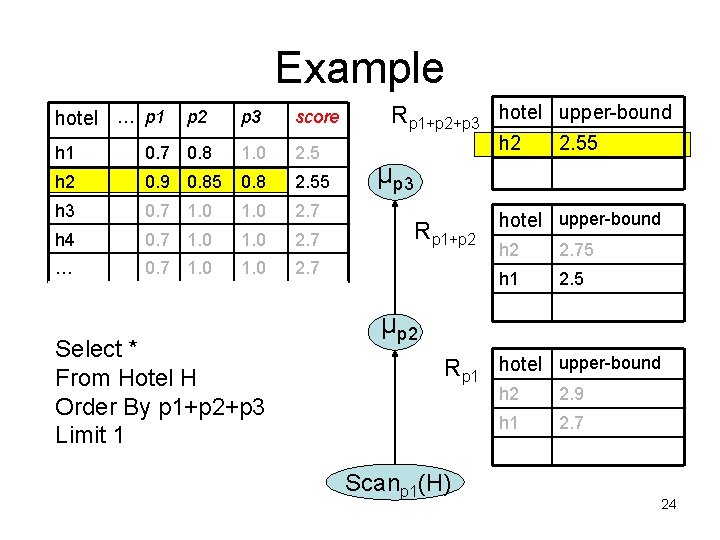
Example hotel … p 1 p 2 p 3 score h 1 0. 7 0. 8 1. 0 2. 5 h 2 0. 9 0. 85 0. 8 2. 55 h 3 0. 7 1. 0 2. 7 h 4 0. 7 1. 0 2. 7 … 0. 7 1. 0 2. 7 Select * From Hotel H Order By p 1+p 2+p 3 Limit 1 Rp 1+p 2+p 3 hotel upper-bound h 2 2. 55 μp 3 Rp 1+p 2 hotel upper-bound h 2 2. 75 h 1 2. 5 μp 2 Rp 1 hotel Scanp 1(H) upper-bound h 2 2. 9 h 1 2. 7 24
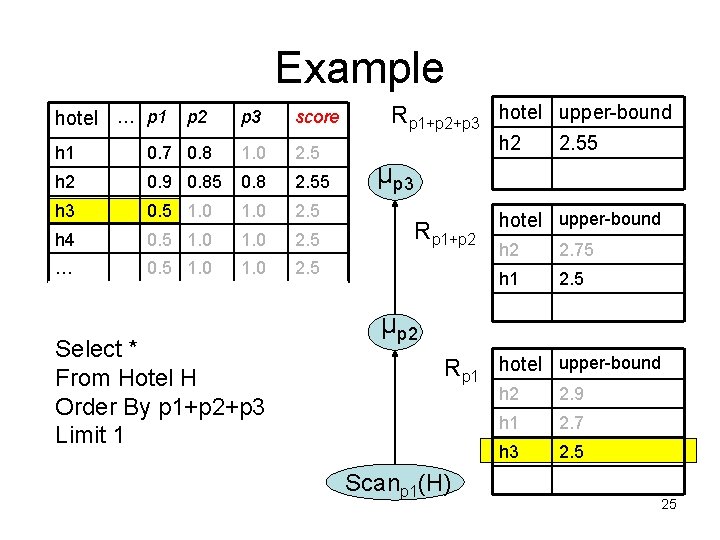
Example hotel … p 1 p 2 p 3 score h 1 0. 7 0. 8 1. 0 2. 5 h 2 0. 9 0. 85 0. 8 2. 55 h 3 0. 5 1. 0 2. 5 h 4 0. 5 1. 0 2. 5 … 0. 5 1. 0 2. 5 Select * From Hotel H Order By p 1+p 2+p 3 Limit 1 Rp 1+p 2+p 3 hotel upper-bound h 2 2. 55 μp 3 Rp 1+p 2 hotel upper-bound h 2 2. 75 h 1 2. 5 μp 2 Rp 1 hotel Scanp 1(H) upper-bound h 2 2. 9 h 1 2. 7 h 3 2. 5 25
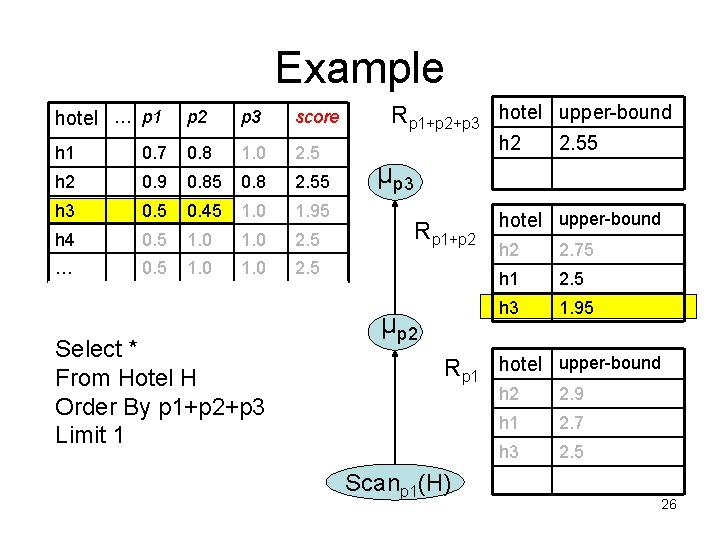
Example hotel … p 1 p 2 p 3 score h 1 0. 7 0. 8 1. 0 2. 5 h 2 0. 9 0. 85 0. 8 2. 55 h 3 0. 5 0. 45 1. 0 1. 95 h 4 0. 5 1. 0 2. 5 … 0. 5 1. 0 2. 5 Select * From Hotel H Order By p 1+p 2+p 3 Limit 1 Rp 1+p 2+p 3 hotel upper-bound h 2 2. 55 μp 3 Rp 1+p 2 hotel μp 2 h 2 2. 75 h 1 2. 5 h 3 1. 95 Rp 1 hotel Scanp 1(H) upper-bound h 2 2. 9 h 1 2. 7 h 3 2. 5 26
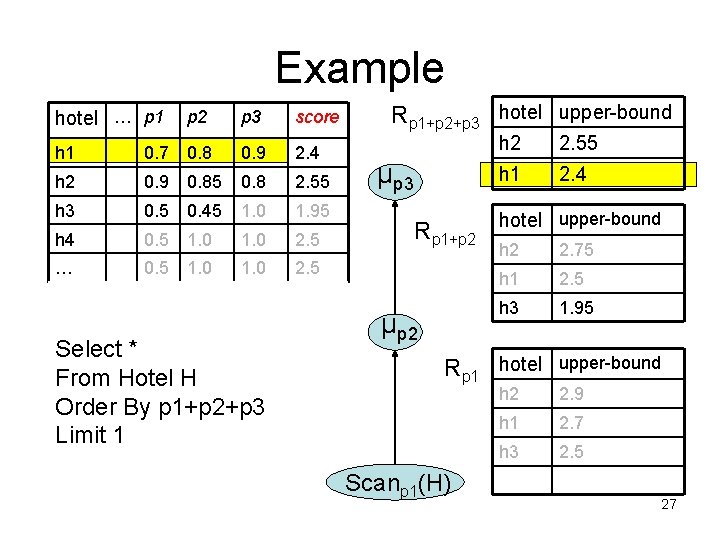
Example hotel … p 1 p 2 p 3 score h 1 0. 7 0. 8 0. 9 2. 4 h 2 0. 9 0. 85 0. 8 2. 55 h 3 0. 5 0. 45 1. 0 1. 95 h 4 0. 5 1. 0 2. 5 … 0. 5 1. 0 2. 5 Select * From Hotel H Order By p 1+p 2+p 3 Limit 1 Rp 1+p 2+p 3 hotel upper-bound μp 3 h 2 2. 55 h 1 2. 4 Rp 1+p 2 hotel μp 2 h 2 2. 75 h 1 2. 5 h 3 1. 95 Rp 1 hotel Scanp 1(H) upper-bound h 2 2. 9 h 1 2. 7 h 3 2. 5 27
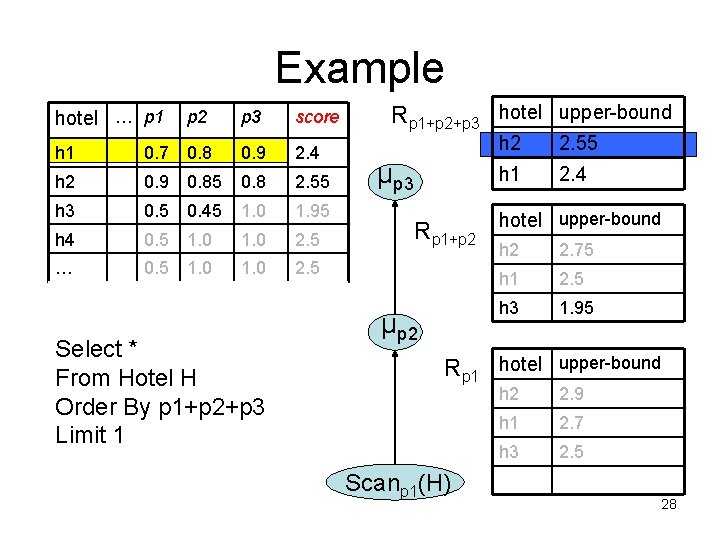
Example hotel … p 1 p 2 p 3 score h 1 0. 7 0. 8 0. 9 2. 4 h 2 0. 9 0. 85 0. 8 2. 55 h 3 0. 5 0. 45 1. 0 1. 95 h 4 0. 5 1. 0 2. 5 … 0. 5 1. 0 2. 5 Select * From Hotel H Order By p 1+p 2+p 3 Limit 1 Rp 1+p 2+p 3 hotel upper-bound μp 3 h 2 2. 55 h 1 2. 4 Rp 1+p 2 hotel μp 2 h 2 2. 75 h 1 2. 5 h 3 1. 95 Rp 1 hotel Scanp 1(H) upper-bound h 2 2. 9 h 1 2. 7 h 3 2. 5 28
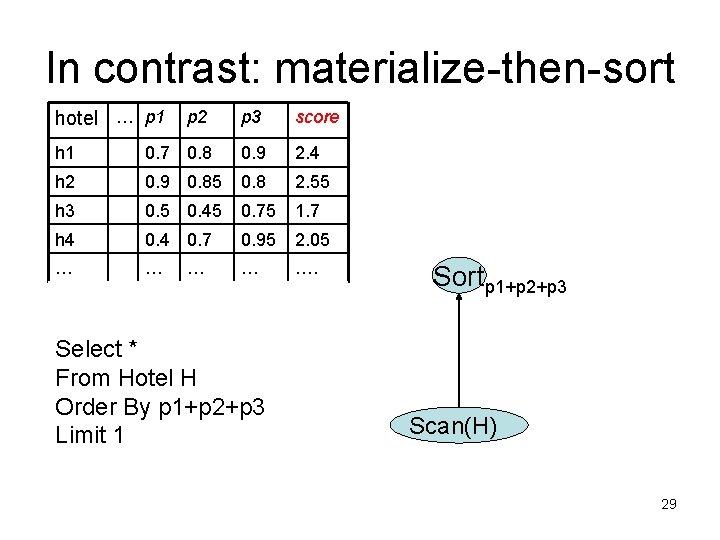
In contrast: materialize-then-sort hotel … p 1 p 2 p 3 score h 1 0. 7 0. 8 0. 9 2. 4 h 2 0. 9 0. 85 0. 8 2. 55 h 3 0. 5 0. 45 0. 75 1. 7 h 4 0. 7 0. 95 2. 05 … …. … Select * From Hotel H Order By p 1+p 2+p 3 Limit 1 Sortp 1+p 2+p 3 Scan(H) 29
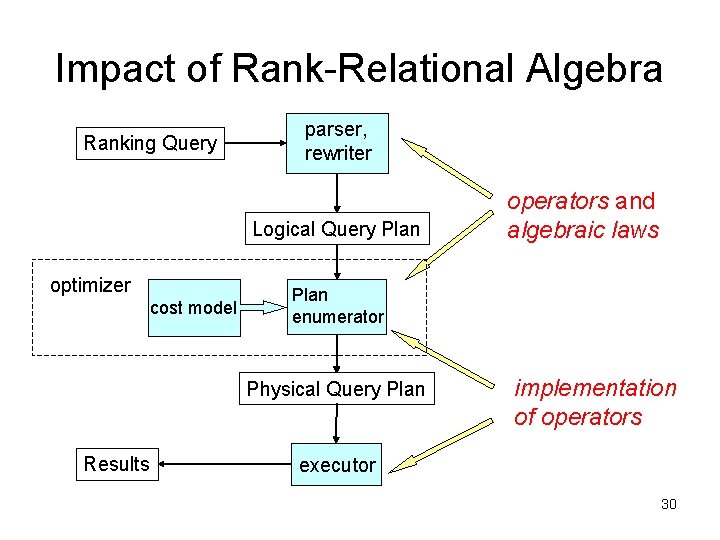
Impact of Rank-Relational Algebra Ranking Query parser, rewriter Logical Query Plan optimizer cost model Plan enumerator Physical Query Plan Results operators and algebraic laws implementation of operators executor 30
Optimization • Two-dimensional enumeration: ranking (ranking predicate scheduling) and filtering (join order selection) • Sampling-based cardinality estimation 31
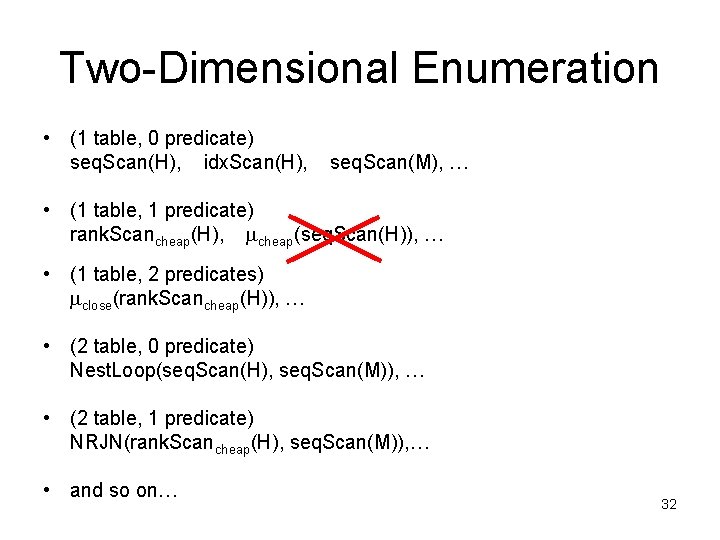
Two-Dimensional Enumeration • (1 table, 0 predicate) seq. Scan(H), idx. Scan(H), seq. Scan(M), … • (1 table, 1 predicate) rank. Scancheap(H), cheap(seq. Scan(H)), … • (1 table, 2 predicates) close(rank. Scancheap(H)), … • (2 table, 0 predicate) Nest. Loop(seq. Scan(H), seq. Scan(M)), … • (2 table, 1 predicate) NRJN(rank. Scancheap(H), seq. Scan(M)), … • and so on… 32
Related Work • Middleware Fagin et al. (PODS 96, 01), Nepal et al. (ICDE 99), Günter et al. (VLDB 00), Bruno et al. (ICDE 02), Chang et al. (SIGMOD 02) • RDBMS, outside the core Chaudhuri et al. (VLDB 99), Chang et al. (SIGMOD 00), Hristidis et al. (SIGMOD 01), Tsaparas et al. (ICDE 03), Yi et al. (ICDE 03) • RDBMS, in the query engine – Physical operators and physical properties Carey et al. (SIGMOD 97), Ilyas et al. (VLDB 02, 03, SIGMOD 04), Natsev et al. (VLDB 01) – Algebra framework Chaudhuri et al. (CIDR 05) 33

Conclusion: Rank. SQL System • Goal: Support ranking as a first-class query type; Integrate ranking with Boolean query constructs. • Our approach: – Algebra: rank-relation, new and augmented rank-aware operators, algebraic laws – Optimizer: two-dimensional enumeration, sampling-based cost estimation • Implementation: in Postgre. SQL Welcome to our demo in VLDB 05! 34
- Slides: 34