
RANGING RANGING The process of establishing intermediate points

RANGING

RANGING • The process of establishing intermediate points on a survey line joining end stations is known is called ranging. Ranging can be of two types: • Direct Ranging • Indirect Ranging
Direct Ranging § Process of establishing intermediate stations along a chain line by direct observation from either end stations is called direct ranging. Direct ranging can be done by: 1. Eye 2. Line ranger

Direct Ranging- Eye Signals by surveyor Action by assistant Slow sweeps with right hand Move slowly to the right Slow sweeps with left hand Move slowly to the left Rapid sweeps with right hand Move considerably to the right Rapid sweeps with left hand Move considerably to the left Right arm extended Go on moving to the right Left arm extended Go on moving to the left Right arm up and moved to the right Make the rod vertical by moving its top to the right left arm up and moved to the left Make the rod vertical by moving its top to the left Both arms above head and then brought down Position of rod is correct Both arms extended forward horizontally and brought down Fix the rod.
Indirect Ranging- Reciprocal ranging § When the end stations are not intervisible due to a hill or a valley, the intermediate ranging rods are fixed by reciprocal ranging, then the process is called indirect ranging or reciprocal ranging.
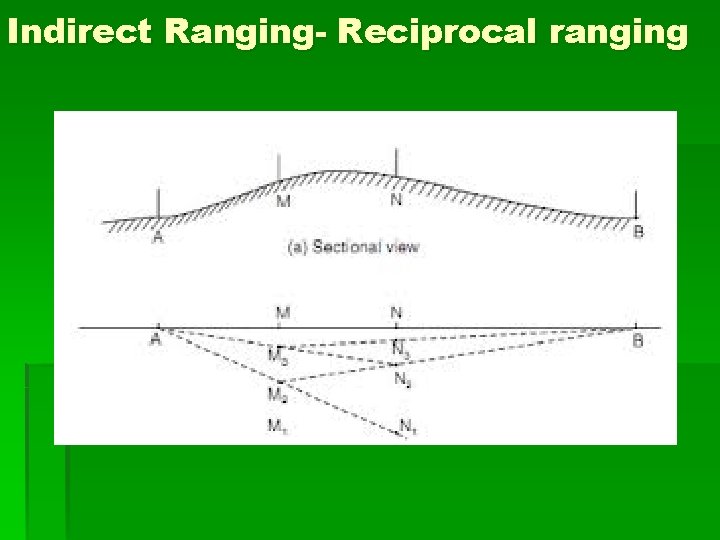
Indirect Ranging- Reciprocal ranging
- Slides: 6