
RandomNumber Generators RNGs Algorithm to generate independent identically
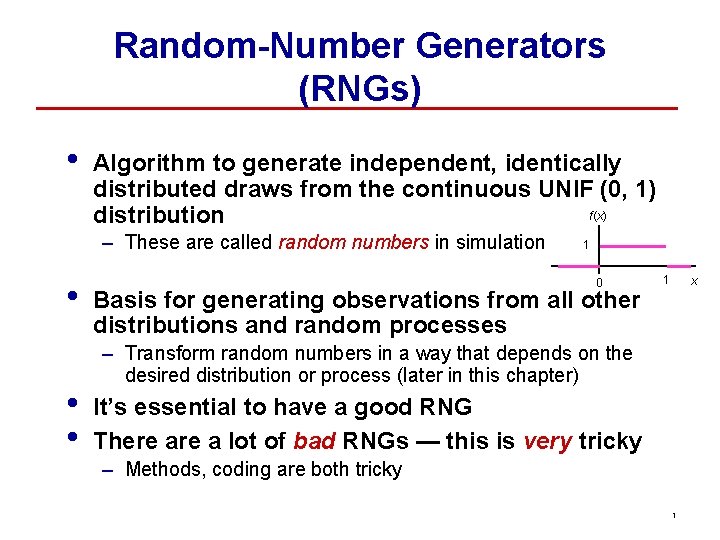
Random-Number Generators (RNGs) • Algorithm to generate independent, identically distributed draws from the continuous UNIF (0, 1) f(x) distribution – These are called random numbers in simulation • • • 1 0 Basis for generating observations from all other distributions and random processes 1 x – Transform random numbers in a way that depends on the desired distribution or process (later in this chapter) It’s essential to have a good RNG There a lot of bad RNGs — this is very tricky – Methods, coding are both tricky 1
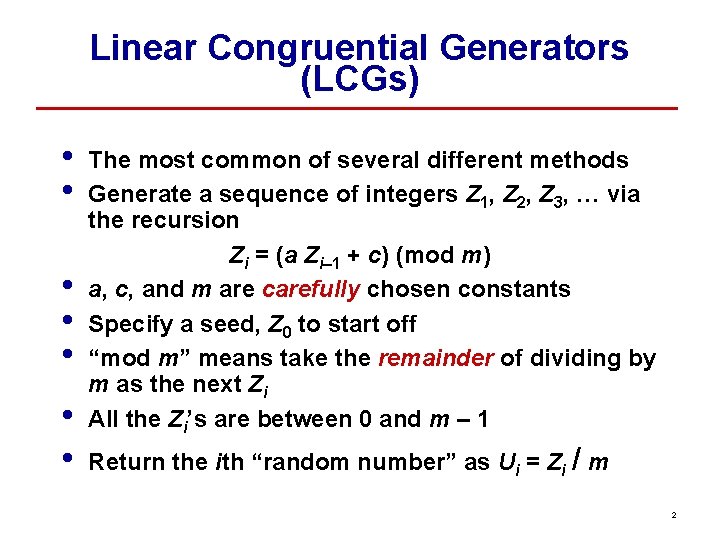
Linear Congruential Generators (LCGs) • • The most common of several different methods Generate a sequence of integers Z 1, Z 2, Z 3, … via the recursion Zi = (a Zi– 1 + c) (mod m) a, c, and m are carefully chosen constants Specify a seed, Z 0 to start off “mod m” means take the remainder of dividing by m as the next Zi All the Zi’s are between 0 and m – 1 Return the ith “random number” as Ui = Zi / m 2
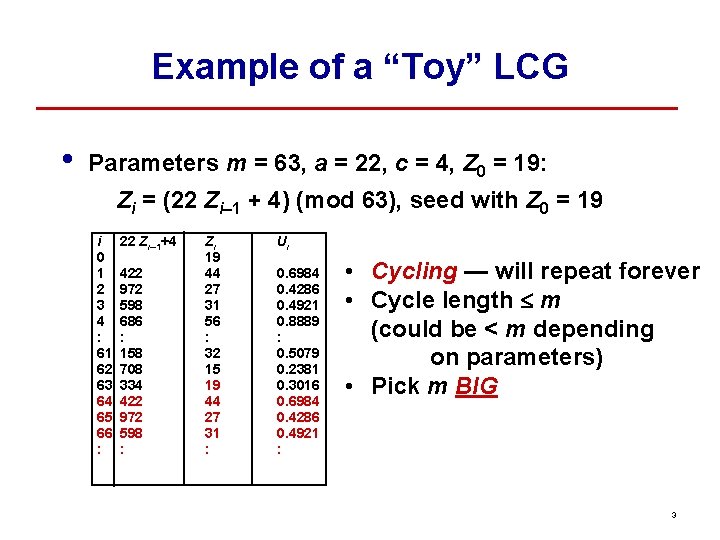
Example of a “Toy” LCG • Parameters m = 63, a = 22, c = 4, Z 0 = 19: Zi = (22 Zi– 1 + 4) (mod 63), seed with Z 0 = 19 i 0 1 2 3 4 : 61 62 63 64 65 66 : 22 Zi– 1+4 422 972 598 686 : 158 708 334 422 972 598 : Zi 19 44 27 31 56 : 32 15 19 44 27 31 : Ui 0. 6984 0. 4286 0. 4921 0. 8889 : 0. 5079 0. 2381 0. 3016 0. 6984 0. 4286 0. 4921 : • Cycling — will repeat forever • Cycle length £ m (could be < m depending on parameters) • Pick m BIG 3
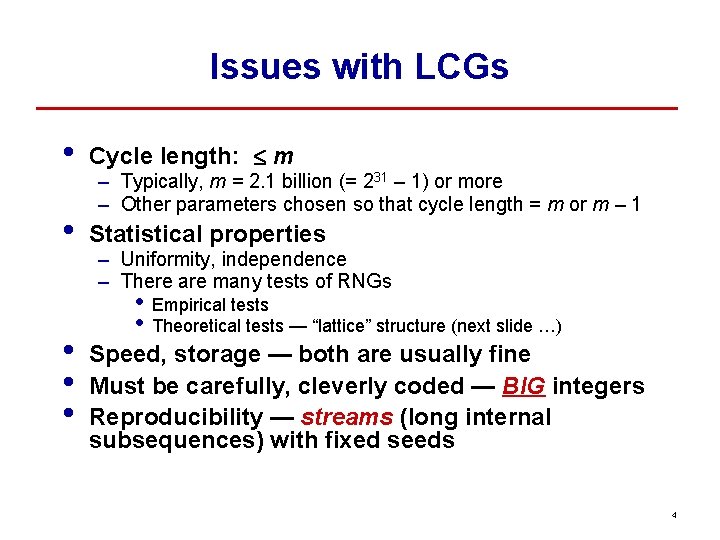
Issues with LCGs • Cycle length: £ m • Statistical properties • • • – Typically, m = 2. 1 billion (= 231 – 1) or more – Other parameters chosen so that cycle length = m or m – 1 – Uniformity, independence – There are many tests of RNGs • • Empirical tests Theoretical tests — “lattice” structure (next slide …) Speed, storage — both are usually fine Must be carefully, cleverly coded — BIG integers Reproducibility — streams (long internal subsequences) with fixed seeds 4

The Arena RNG • • LCG with: m = 231 – 1 = 2, 147, 483, 647 A well-tested generator in an a = 75 = 16, 807 efficient code. c=0 Cycle length = m – 1 Ten different automatic streams with fixed seeds – Default stream number is 10 – Can access other streams after distributional parameters, e. g. , EXPO (6. 7, 4) for stream 4 – Good idea to use separate streams for separate purposes SEEDS module (Elements panel) to get > the 10 automatic streams, specify seeds, name streams 5
Generating Random Variates • • Have: Desired input distribution for model (fitted or specified in some way), and RNG (UNIF (0, 1)) Want: Transform UNIF (0, 1) random numbers into “draws” from the desired input distribution Method: Mathematical transformations of random numbers to “deform” them to the desired distribution – Specific transform depends on desired distribution – Details in online Help about methods for all distributions Do discrete, continuous distributions separately 6
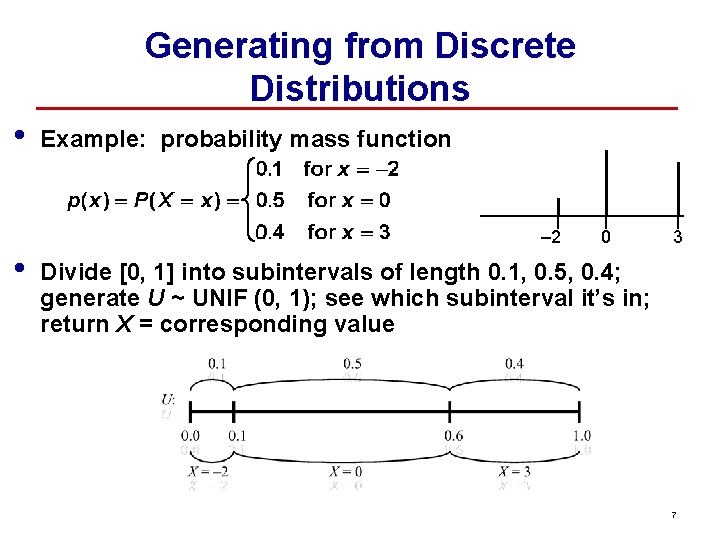
Generating from Discrete Distributions • Example: probability mass function – 2 • 0 3 Divide [0, 1] into subintervals of length 0. 1, 0. 5, 0. 4; generate U ~ UNIF (0, 1); see which subinterval it’s in; return X = corresponding value 7
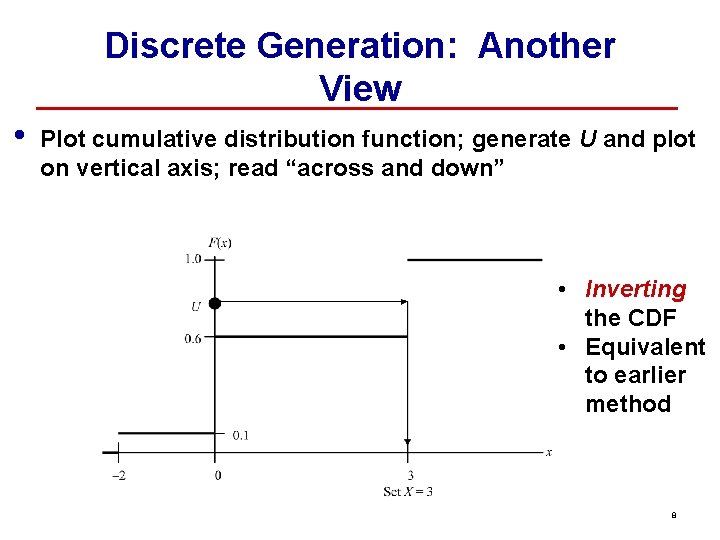
Discrete Generation: Another View • Plot cumulative distribution function; generate U and plot on vertical axis; read “across and down” • Inverting the CDF • Equivalent to earlier method 8
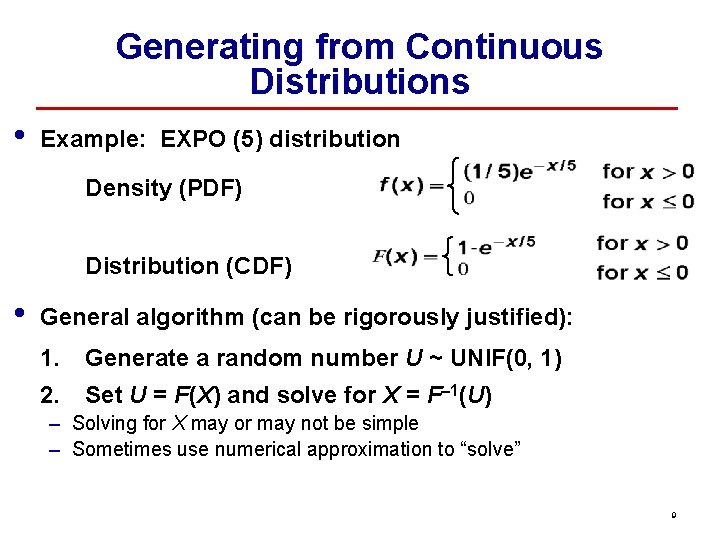
Generating from Continuous Distributions • Example: EXPO (5) distribution Density (PDF) Distribution (CDF) • General algorithm (can be rigorously justified): 1. Generate a random number U ~ UNIF(0, 1) 2. Set U = F(X) and solve for X = F– 1(U) – Solving for X may or may not be simple – Sometimes use numerical approximation to “solve” 9
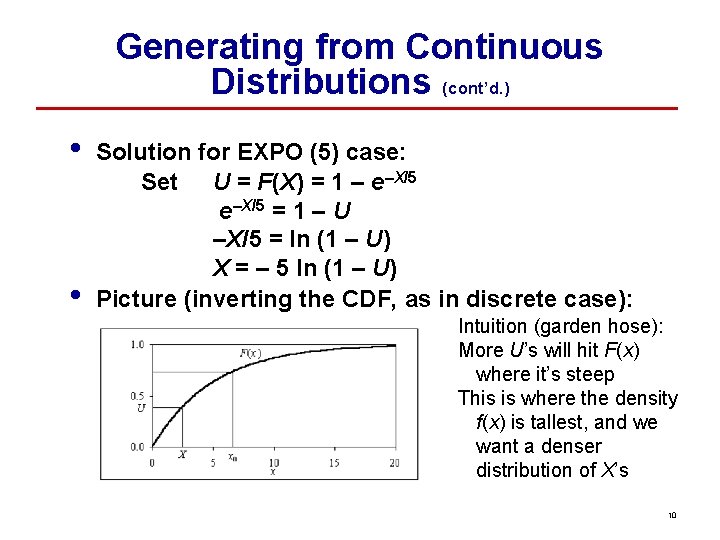
Generating from Continuous Distributions (cont’d. ) • • Solution for EXPO (5) case: Set U = F(X) = 1 – e–X/5 = 1 – U –X/5 = ln (1 – U) X = – 5 ln (1 – U) Picture (inverting the CDF, as in discrete case): Intuition (garden hose): More U’s will hit F(x) where it’s steep This is where the density f(x) is tallest, and we want a denser distribution of X’s 10
Designing and Executing Simulation Experiments • • Think of a simulation model as a convenient “testbed” or laboratory for experimentation – Look at different output responses – Look at effects, interaction of different input factors Apply classical experimental-design techniques – – – Factorial experiments — main effects, interactions Fractional-factorial experiments Factor-screening designs Response-surface methods, “metamodels” CRN is “blocking” in experimental-design terminology 11
- Slides: 11