
Randomized Concurrent Algorithms Based on slides by Dan
Randomized Concurrent Algorithms Based on slides by Dan Alistarh Giuliano Losa 1
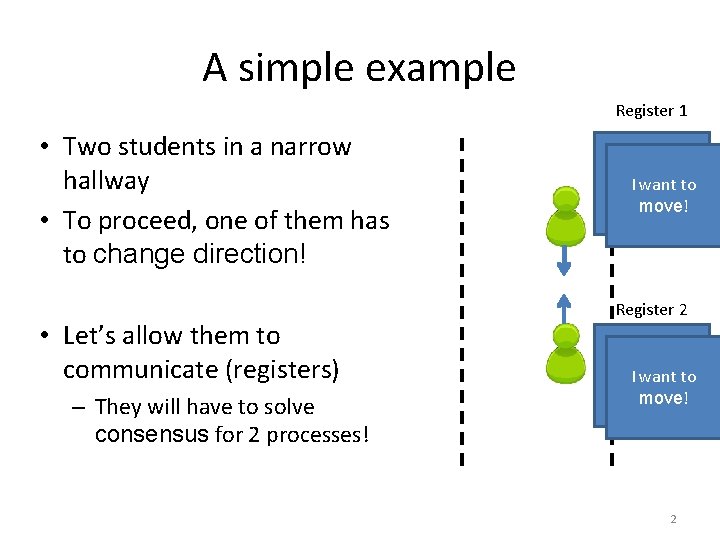
A simple example Register 1 • Two students in a narrow hallway • To proceed, one of them has to change direction! • Let’s allow them to communicate (registers) – They will have to solve consensus for 2 processes! I want to go forward! move! Register 2 I want to go forward! move! 2
![A simple example Register 1 • [FLP] : there exists an execution in which](http://slidetodoc.com/presentation_image/4f87f4c903fa54c4b809f75a15440108/image-3.jpg "A simple example Register 1 • [FLP] : there exists an execution in which")
A simple example Register 1 • [FLP] : there exists an execution in which processes get stuck forever, or they run into each other! • Does this happen in real life? ! • Is this possible in real life? • It is unlikely that two people will continue choosing exactly the same thing! • What does unlikely mean? I want to go I want to forward! move! Register 2 I want to go I want to forward! move! 3
Analysis • Always finishes in practice! • Does there still exist an execution in which they do not finish? – Do we contradict FLP? • Yes, the infinite execution is still there – We do not contradict FLP! • What is the probability of that infinite execution? 5
The problem has changed! • By allowing processes to make random choices, we give probability to executions • Bad executions (like in FLP) should happen with extremely low probability (in this case, 0) • We ensure safety in all executions, but termination is ensured with probability 1 6
The plan for today • Intro – Motivation • The randomized model • A Randomized Test-and-Set algorithm – From 2 to N processes • Randomized Consensus – Shared Coins • Randomized Renaming 7
Semantics of deterministic algorithms, correctness, limitations. • An algorithm denotes a set of histories • Solving consensus means solving it in all possible histories. • FLP: consensus is impossible in an asynchronous systems if a single process may crash. 8
Solving problems with good probability • We need to assign probabilities to histories – Probability distribution on scheduling? – Probability distribution on inputs? • No, we don’t have control over these in practice • Instead: – Processes make independent random choices (they flip coins). – Schedule and inputs determined by a deterministic adversary (a function of the history so far). – We look at the worst possible adversary 9
Semantics of randomized protocols • A protocol and an adversary (P, A) denote a set of histories and an associated probability distribution. • A pair (P, A) and a sequence of bits s uniquely determine a history of the algorithm P. • The probability of a given execution is the probability of the sequence of bits that corresponds to it. 10
Correctness Properties for Randomized Algorithms • We define the class of adversaries we consider. • Usually, we keep the safety condition of the deterministic problem and relax liveness: “The algorithm should terminate with probability 1 for all adversary in the class” 11
Example: Consensus • Validity: if all processes propose the same value v, then every correct process decides v. • Integrity: every correct process decides at most one value, and if it decides some value v, then v must have been proposed by some process. • Agreement: if a correct process decides v, then every correct process decides v. • Termination: every correct process decides some value. 12
Randomized Consensus • Adversary: any deterministic adversary. • Validity: if all processes propose the same value v, then every correct process decides v. • Integrity: every correct process decides at most one value, and if it decides some value v, then v must have been proposed by some process. • Agreement: if a correct process decides v, then every correct process decides v. • (Probabilistic) Termination: with probability 1, every correct process decides some value. 13
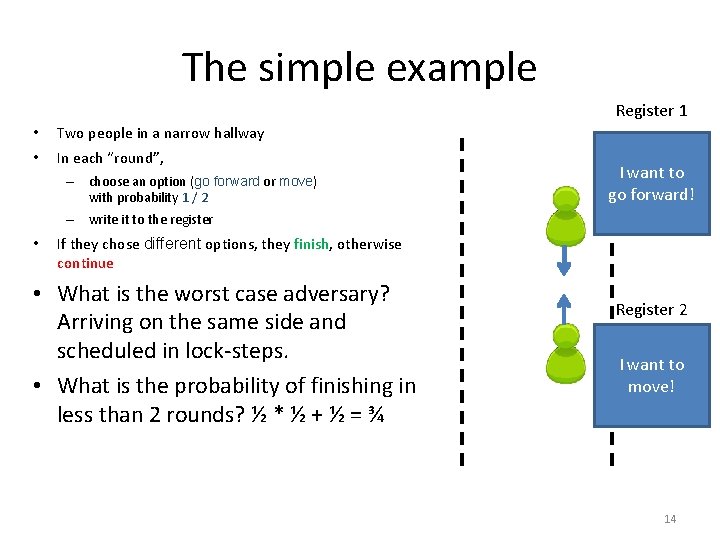
The simple example Register 1 • Two people in a narrow hallway • In each “round”, – choose an option (go forward or move) with probability 1 / 2 I want to go forward! – write it to the register • If they chose different options, they finish, otherwise continue • What is the worst case adversary? Arriving on the same side and scheduled in lock-steps. • What is the probability of finishing in less than 2 rounds? ½ * ½ + ½ = ¾ Register 2 I want to move! 14
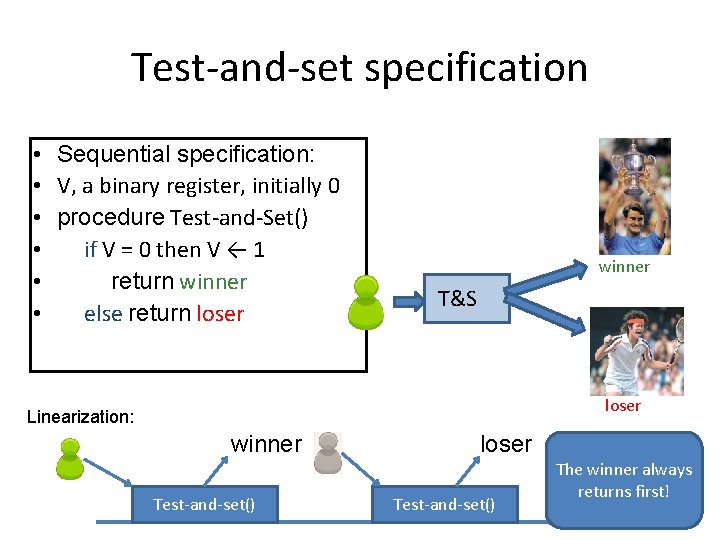
Test-and-set specification • Sequential specification: • V, a binary register, initially 0 • procedure Test-and-Set() • if V = 0 then V ← 1 • return winner • else return loser winner T&S loser Linearization: winner Test-and-set() loser Test-and-set() The winner always returns first!
2 -process test-and-set • Based on the previous “hallway” example • Two SWMR registers R[1], R[2] – Each owned by a process • A register R[p] can have one of 2 possible values: – Mine, Yours • Processes express their choices through the registers • Adapted from an algorithm by Tromp and Vitanyi (see references at the end). 16
![2 -process test-and-set Shared: Registers R[p], R[p’], initially Yours Local: Registers last_read[p], last_read[p’] procedure](http://slidetodoc.com/presentation_image/4f87f4c903fa54c4b809f75a15440108/image-16.jpg "2 -process test-and-set Shared: Registers R[p], R[p’], initially Yours Local: Registers last_read[p], last_read[p’] procedure")
2 -process test-and-set Shared: Registers R[p], R[p’], initially Yours Local: Registers last_read[p], last_read[p’] procedure test-and-setp() //at process p 1. R[p] <- Mine 2. Loop 3. last_read[p] <- R[p’] 4. If (R[p] = last_read[p]) 5. R[p] <- Random(Yours, Mine) 6. Else break; 7. End. Loop 8. If R[p] = Mine then return 1 9. Else return 0 17
Correctness (rough sketch) • Worst case adversary: lock-step scheduling. • Unique Winner: Inductive invariants: – If both processes are at lines 4, 8, or 9, then one of them has a accurate last_read value. – If process p is at lines 8 or 9, then last_read[p] is different from R[p]. • Termination: – Every time processes execute the coin flip in line 5, the probability that the while loop terminates in the next iteration is ½. Hence, the probability that the algorithm executes more than r coin flips is (1/2)r. Therefore, the probability that the algorithm goes on forever is 0. 18
Performance • What is the expected number of steps that a process performs in an execution? • We need to consider the worst case adversary: the lock-steps schedule. • Consider the random var T counting the number of rounds before termination. • T counts the number of trials before first success in a series of independent binary trials with probability p = ½. • T has geometric distribution. • The expected number of rounds is 1/p = 2! 19
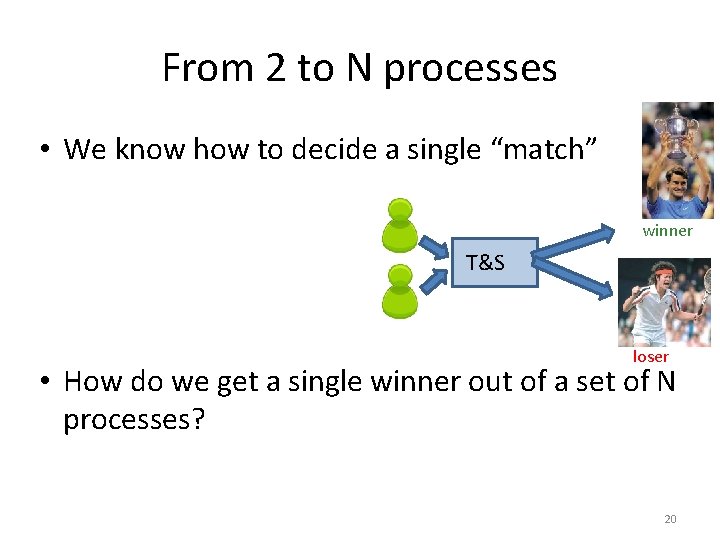
From 2 to N processes • We know how to decide a single “match” winner T&S loser • How do we get a single winner out of a set of N processes? 20
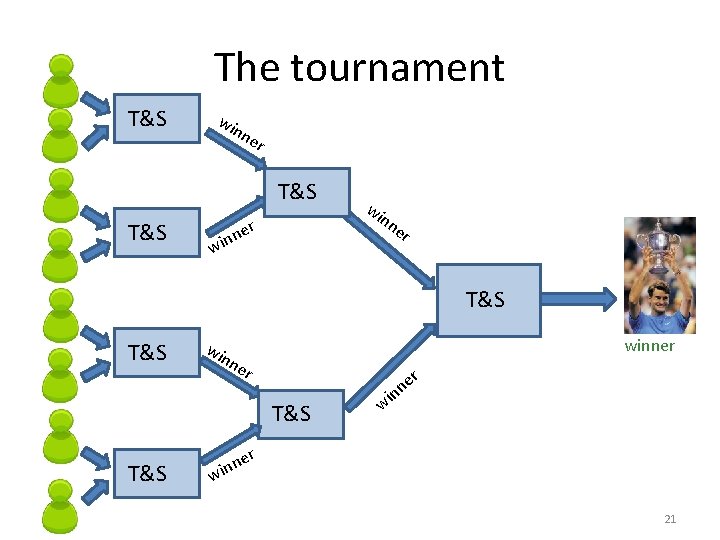
The tournament T&S win ne r T&S ner win wi nn e r T&S winner ne r r T&S ne n i w er n win 21
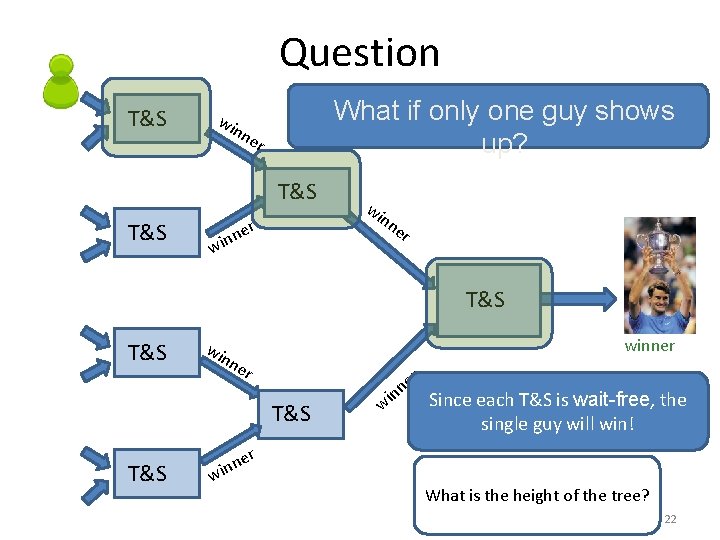
Question T&S win What if only one guy shows up? ne r T&S ner win wi nn e r T&S winner ne r T&S er n n Since each T&S is wait-free, the wi single guy will win! er n win What is the height of the tree? 22
Correctness • Unique winner: Suppose there are two winners. Then both would have to win the root test-and-set, contradiction • Termination (with probability 1!): Follows from the termination of 2 -process test-andset • Winner: Eithere exists a process that returns winner, or there is at least a failure Is this it? 23
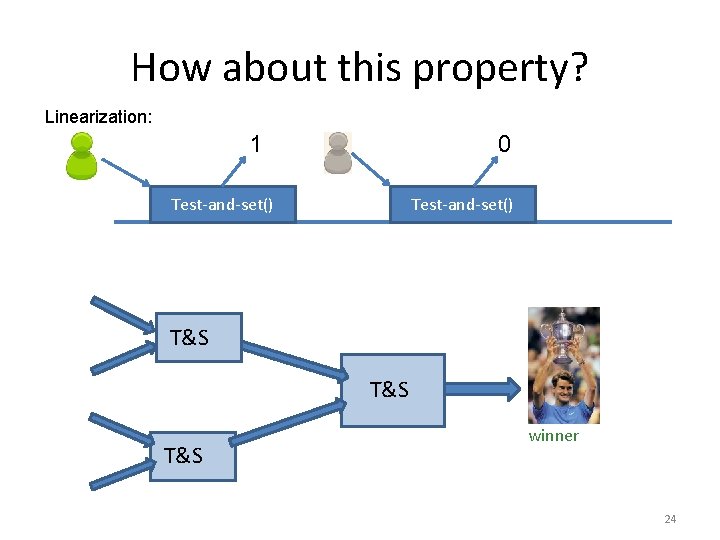
How about this property? Linearization: 1 0 Test-and-set() T&S T&S winner 24
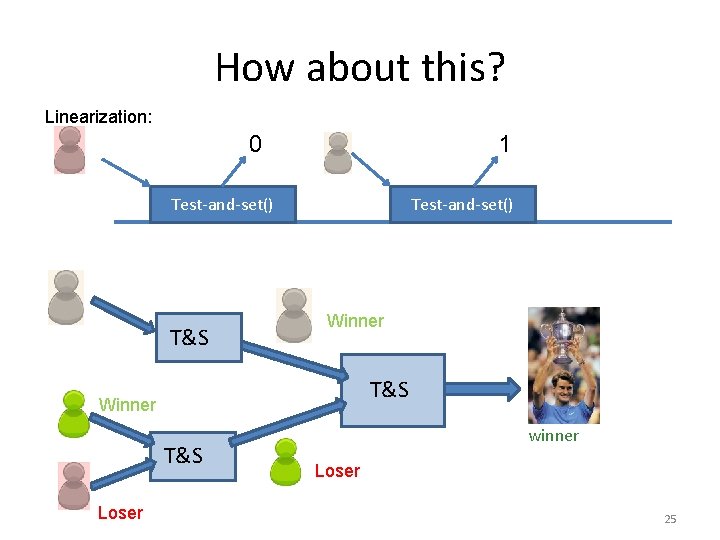
How about this? Linearization: 0 1 Test-and-set() T&S Test-and-set() Winner T&S Loser winner Loser 25
Homework • Fix the N-process test-and-set implementation so that it is linearizable • Hint: you only need to add one register 26
Wrap up • We have a test-and-set algorithm for N processes • Always safe • Terminates with probability 1 • Worst-case local cost O( log N ) per process • Expected total cost O( N ) 27
The plan for today • Intro – Motivation • Some Basic Probability • A Randomized Test-and-Set algorithm – From 2 to N processes • Randomized Consensus – Shared Coins • Randomized Renaming 28
Randomized Consensus • Can we implement Consensus with the same properties? 29
Randomized Consensus • Algorithms based on a Shared Coin • A Shared coin with parameter ρ, SC(ρ) is an algorithm without inputs, which has probability ρ that all outputs are 0, and probability ρ that all outputs are 1. • Example: – Every process flips a local coin, and returns 1 for Heads, 0 for Tails – ρ = Pr[ all outputs are 1 ] = Pr[ all outputs are 0 ] = (1/2)N – Usually, we look for higher output parameters The higher the parameter, the faster the algorithm 30
Shared Coin -> Binary Consensus • The algorithm will progress in rounds • Processes share a doubly-indexed vectors Proposed[r][i], Check[r][i] (r = round number, i = process id) • Proposed[][] stores values, Check[][] indicates whether a process finished • At each round r > 0, process pi places its vote (0 or 1) in Proposed[r][i] 31
![Shared Coin->Binary Consensus Shared: Matrices Proposed[r][i]; Check[r][i], init. to null. procedure proposei( v )](http://slidetodoc.com/presentation_image/4f87f4c903fa54c4b809f75a15440108/image-31.jpg "Shared Coin->Binary Consensus Shared: Matrices Proposed[r][i]; Check[r][i], init. to null. procedure proposei( v )")
Shared Coin->Binary Consensus Shared: Matrices Proposed[r][i]; Check[r][i], init. to null. procedure proposei( v ) //at process i 1. decide = false, r = 0 2. While( decide == false ) 3. r=r+1 4. Proposed[r][i] = v 5. view = Collect( Proposed[r] […]) 6. if (both 0 and 1 appear in view ) 7. Check[r][i] = disagree 8. else Check[r][i] = agree 9. check-view = Collect( Check[r] […]) 10. if( disagree appears in check-view ) 11. if (for some j, check-view[j] = agree) 12. v = Proposed[r][j] 13. else v = flip_coin() 14. else decide = true 15. return v 16. In each round r, the process writes its value in Proposed[r][i] It then checks to see if there is disagreement, and marks it to Check[r][i] If there is disagreement, then processes flip a shared coin to agree, and post the results If no-one disagrees, then return! 32
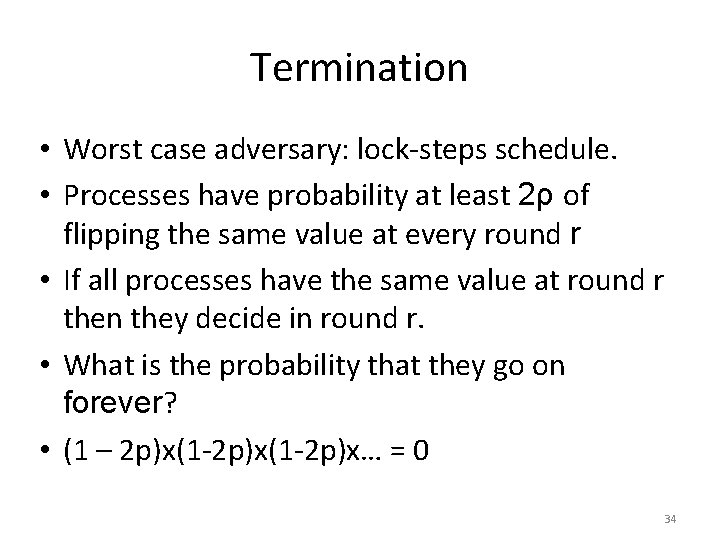
Termination • Worst case adversary: lock-steps schedule. • Processes have probability at least 2ρ of flipping the same value at every round r • If all processes have the same value at round r then they decide in round r. • What is the probability that they go on forever? • (1 – 2 p)x(1 -2 p)x… = 0 34
What does this mean? • We can implement consensus ensuring – safety in all executions – termination with probability 1. • By the universal construction, we can implement anything with these properties • So…are we done with this class? • The limit is no longer impossibility, but performance! 35
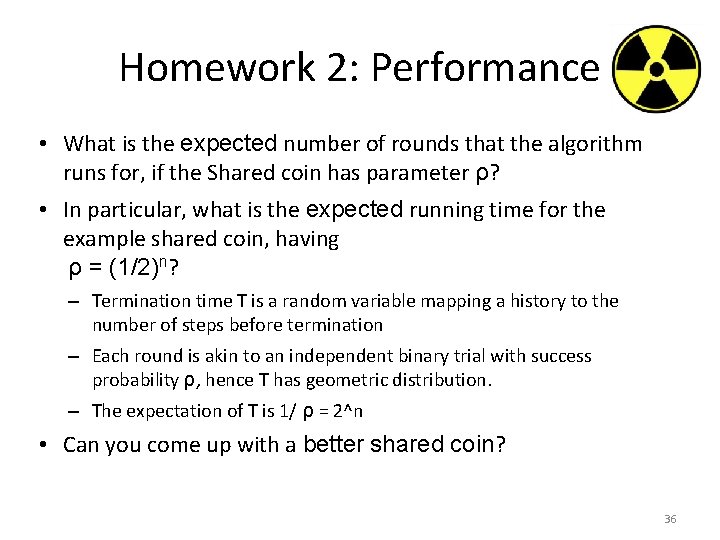
Homework 2: Performance • What is the expected number of rounds that the algorithm runs for, if the Shared coin has parameter ρ? • In particular, what is the expected running time for the example shared coin, having ρ = (1/2)n? – Termination time T is a random variable mapping a history to the number of steps before termination – Each round is akin to an independent binary trial with success probability ρ, hence T has geometric distribution. – The expectation of T is 1/ ρ = 2^n • Can you come up with a better shared coin? 36
The plan for today • Intro – Motivation • Some Basic Probability • A Randomized Test-and-Set algorithm – From 2 to N processes • Randomized Consensus – Shared Coins • Randomized Renaming 37
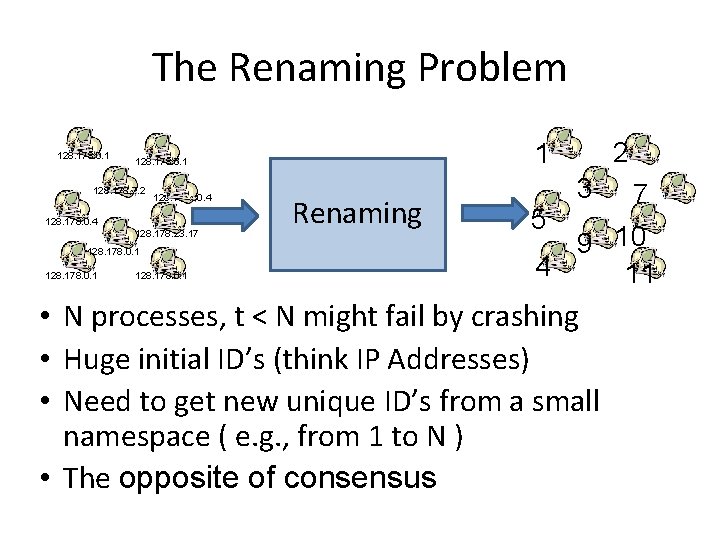
The Renaming Problem 128. 178. 0. 1 128. 178. 7. 2 128. 178. 80. 4 128. 178. 23. 17 128. 178. 0. 1 2 1 128. 178. 5. 1 Renaming 3 7 5 9 10 4 11 • N processes, t < N might fail by crashing • Huge initial ID’s (think IP Addresses) • Need to get new unique ID’s from a small namespace ( e. g. , from 1 to N ) • The opposite of consensus
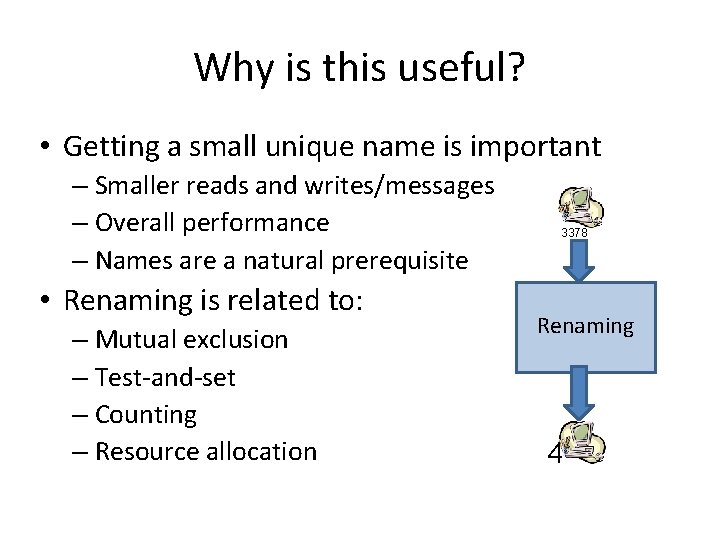
Why is this useful? • Getting a small unique name is important – Smaller reads and writes/messages – Overall performance – Names are a natural prerequisite • Renaming is related to: – Mutual exclusion – Test-and-set – Counting – Resource allocation 3378 Renaming 4
![What is known Theorem [HS, RC] In an asynchronous system with t < N](http://slidetodoc.com/presentation_image/4f87f4c903fa54c4b809f75a15440108/image-38.jpg "What is known Theorem [HS, RC] In an asynchronous system with t < N")
What is known Theorem [HS, RC] In an asynchronous system with t < N crashes, Deterministic Renaming is impossible in N + t - 1 or less names. • • Both Shared-Memory and Message-Passing Analogous to FLP, much more complicated Uses Algebraic Topology! Gödel Prize 2004
How can randomization help? • It will allow us to get a tight namespace (of N names), even in an asynchronous system • It will give us better performance • Idea: derive renaming from test-and-set • We now know how to implement test-and-set in an asynchronous system 41
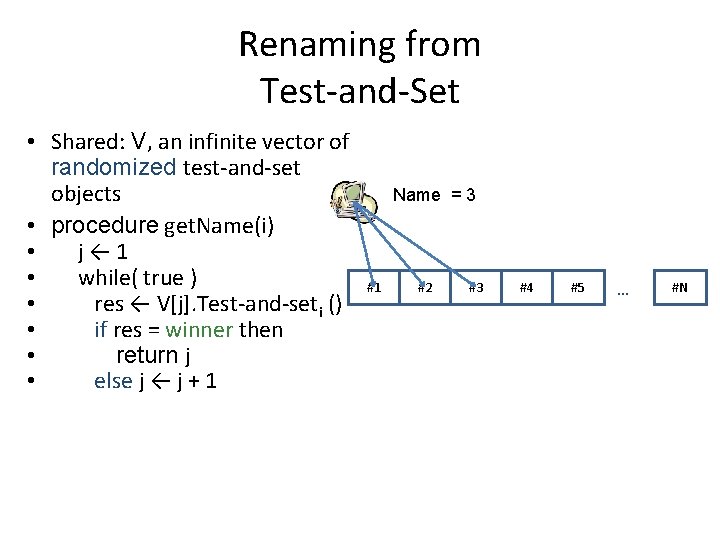
Renaming from Test-and-Set • Shared: V, an infinite vector of randomized test-and-set objects • procedure get. Name(i) • j← 1 • while( true ) • res ← V[j]. Test-and-seti () • if res = winner then • return j • else j ← j + 1 Name = 3 #1 #2 #3 #4 #5 … #N
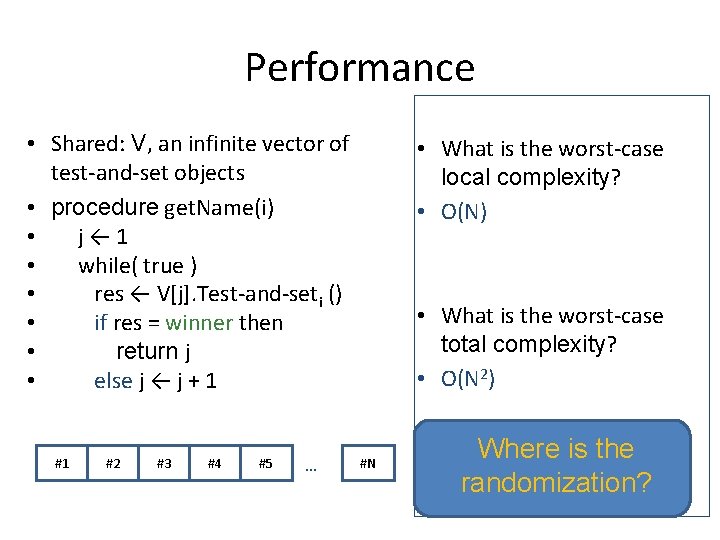
Performance • Shared: V, an infinite vector of test-and-set objects • procedure get. Name(i) • j← 1 • while( true ) • res ← V[j]. Test-and-seti () • if res = winner then • return j • else j ← j + 1 #1 #2 #3 #4 #5 … • What is the worst-case local complexity? • O(N) • What is the worst-case total complexity? • O(N 2) #N Where is the randomization?
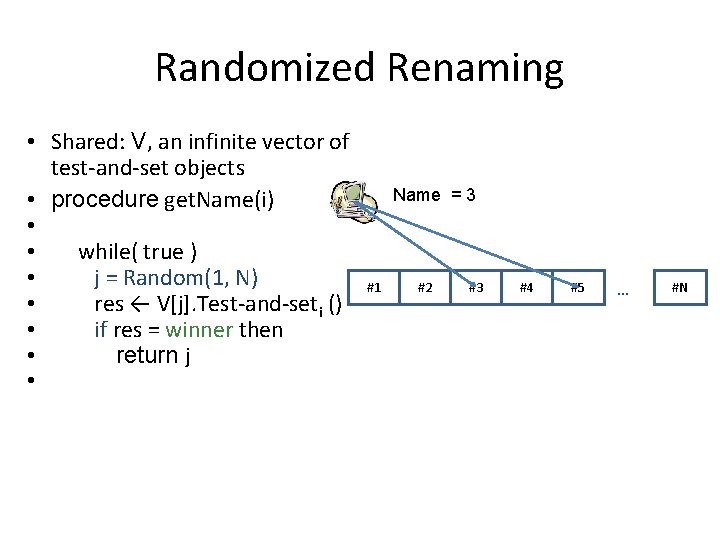
Randomized Renaming • Shared: V, an infinite vector of test-and-set objects • procedure get. Name(i) • • while( true ) • j = Random(1, N) • res ← V[j]. Test-and-seti () • if res = winner then • return j • Name = 3 #1 #2 #3 #4 #5 … #N
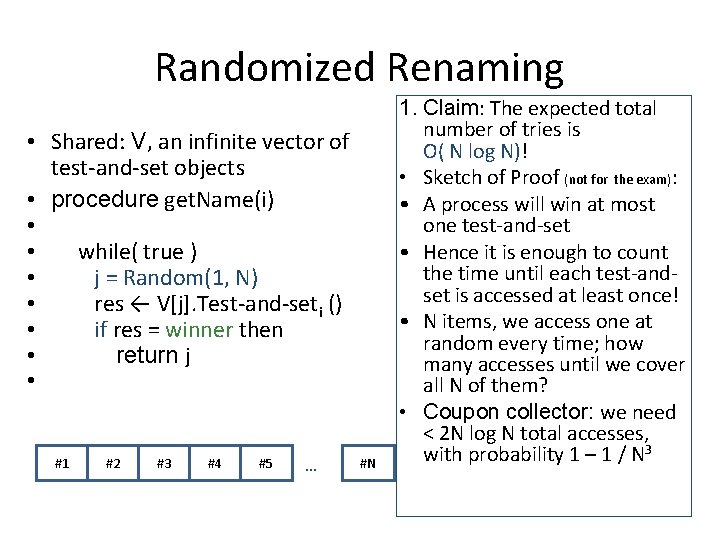
Randomized Renaming • Shared: V, an infinite vector of test-and-set objects • procedure get. Name(i) • • while( true ) • j = Random(1, N) • res ← V[j]. Test-and-seti () • if res = winner then • return j • #1 #2 #3 #4 #5 … #N 1. Claim: The expected total number of tries is O( N log N)! • Sketch of Proof (not for the exam): • A process will win at most one test-and-set • Hence it is enough to count the time until each test-andset is accessed at least once! • N items, we access one at random every time; how many accesses until we cover all N of them? • Coupon collector: we need < 2 N log N total accesses, with probability 1 – 1 / N 3
Wrap-up • Termination ensured with probability 1 • Total complexity: O( N log N ) total operations in expectation 46
Conclusion • Randomization “avoids” the deterministic impossibility results (FLP, HS) – The results still hold, the bad executions still exist – We give bad executions vanishing probability, ensuring termination with probability 1 • The algorithms always preserve safety • Usually we can get better performance by using randomization 47
References (use Google Scholar) • For randomization in general: – Chapter 14 of “Distributed Computing: Fundamentals, Simulations, and Advanced Topics”, by Hagit Attiya and Jennifer Welch • For the test-and-set example: – “Randomized two-process wait-free test-and-set” by John Tromp and Paul Vitányi. – “Wait-free test-and-set” by Afek et al. • For the randomized consensus example: – “Optimal time randomized consensus”by Saks, Shavit, Woll. – “Randomized Protocols for Asynchronous Consensus” by Aspnes. • For the renaming example: – “Fast Randomized Test-and-Set and Renaming” by Alistarh, Guerraoui et al. 48
- Slides: 46