
Randomized Algorithms Lecturer Moni Naor Lecture 11 Recap

- Slides: 21
Randomized Algorithms Lecturer: Moni Naor Lecture 11
Recap and Today Recap • Algorithmic Local Lemma Today • Cuckoo Hashing
The Setting • Dynamic dictionary: – Lookups, insertions and deletions – Dynamic vs. static • Performance: – Lookup time – Update time – Memory utilization – Related problems: § Approximate set membership (Bloom Filter) § Retrieval 3
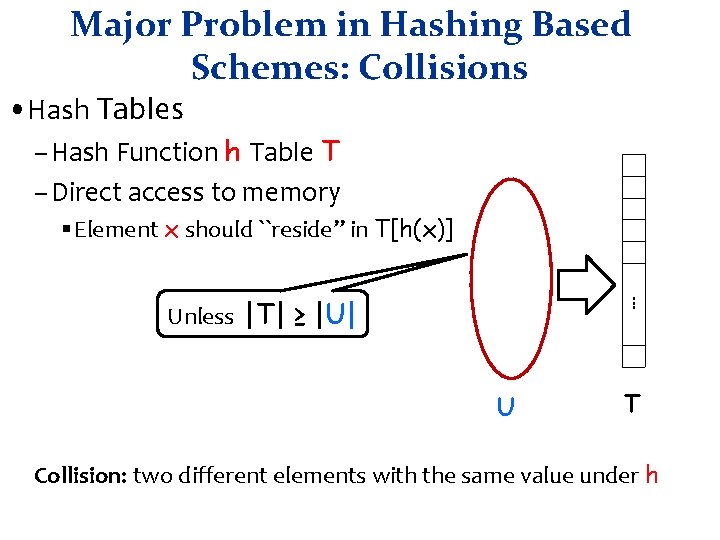
Major Problem in Hashing Based Schemes: Collisions • Hash Tables – Hash Function h Table T – Direct access to memory § Element x should ``reside” in T[h(x)]. . . Unless |T| ≥ |U| U T Collision: two different elements with the same value under h
Dealing with Collisions • Lots of methods • Common one: Linear Probing – Proposed by Amdahl – Analyzed by Donald Knuth 1963 • “Birth” of analysis of algorithms – Probabilistic analysis 5
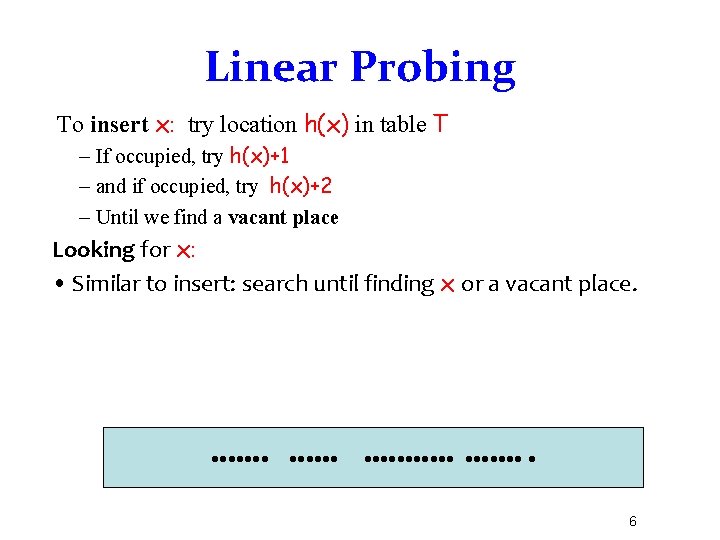
Linear Probing To insert x: try location h(x) in table T – If occupied, try h(x)+1 – and if occupied, try h(x)+2 – Until we find a vacant place Looking for x: • Similar to insert: search until finding x or a vacant place. 6
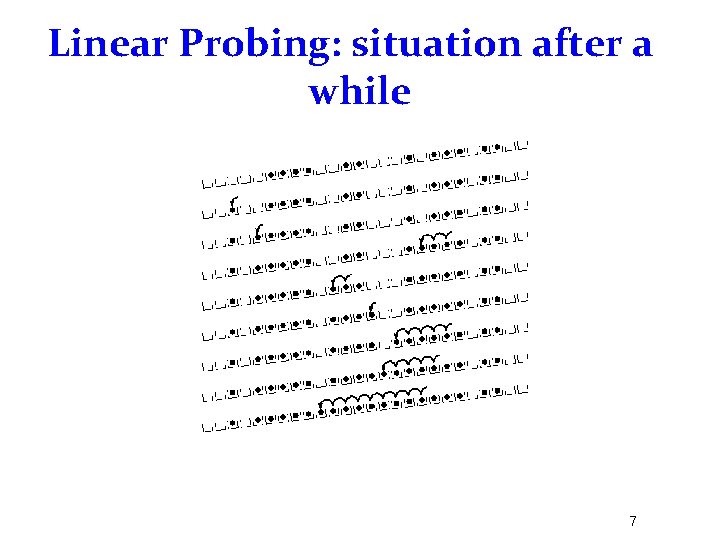
Linear Probing: situation after a while 7
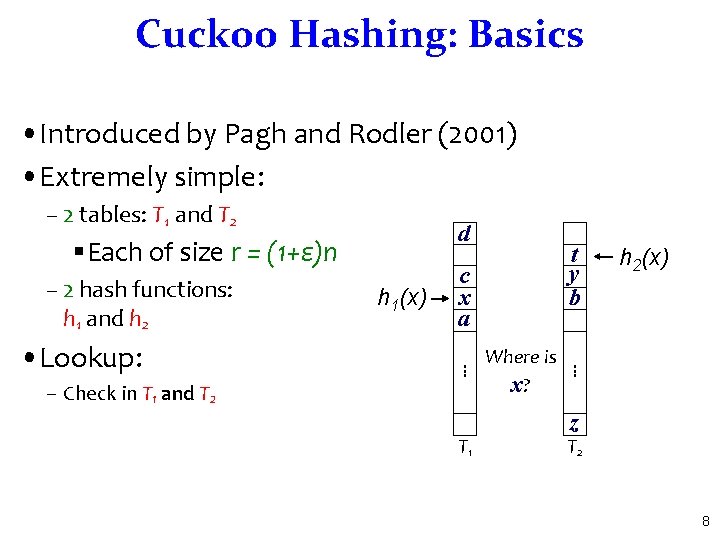
Cuckoo Hashing: Basics • Introduced by Pagh and Rodler (2001) • Extremely simple: – 2 tables: T 1 and T 2 d §Each of size r = (1+ε)n – 2 hash functions: h 1 and h 2 c x a – Check in T 1 and T 2 T 1 Where is x? h 2(x) . . . • Lookup: h 1(x) t y b z T 2 8
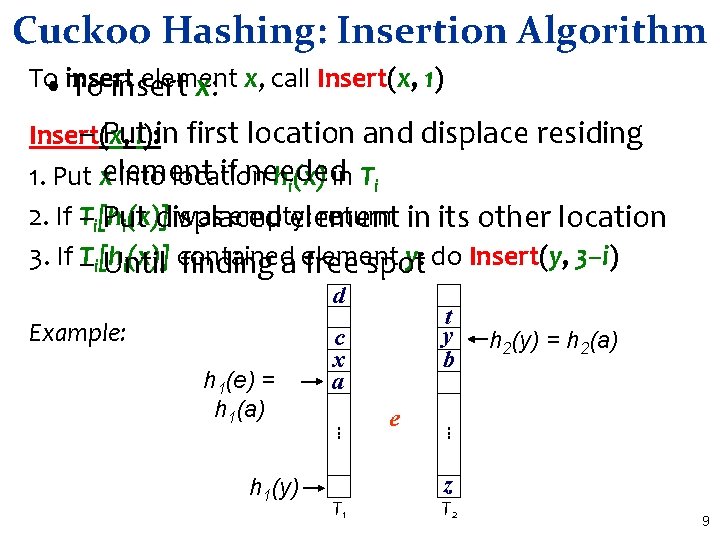
Cuckoo Hashing: Insertion Algorithm To element • insert To insert x: x, call Insert(x, 1) – Puti): in first location and displace residing Insert(x, if needed 1. Put xelement into location hi(x) in Ti 2. If T–i[h was empty: return in its other location Put displaced element i(x)] 3. If – Ti[h y: do Insert(y, 3–i) i(x)] contained Until finding a element free spot d Example: T 1 e h 2(y) = h 2(a) . . . h 1(y) c x a. . . h 1(e) = h 1(a) t y b z T 2 9
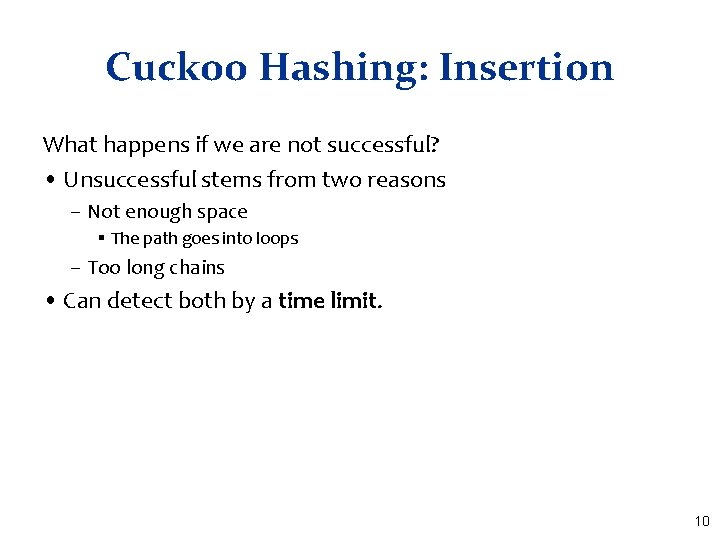
Cuckoo Hashing: Insertion What happens if we are not successful? • Unsuccessful stems from two reasons – Not enough space § The path goes into loops – Too long chains • Can detect both by a time limit. 10
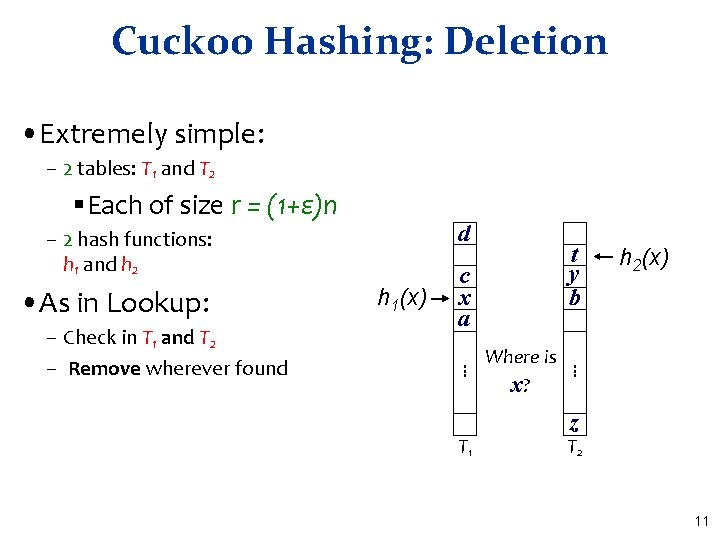
Cuckoo Hashing: Deletion • Extremely simple: – 2 tables: T 1 and T 2 §Each of size r = (1+ε)n d – 2 hash functions: h 1 and h 2 • As in Lookup: c x a T 1 Where is x? h 2(x) . . . – Check in T 1 and T 2 – Remove wherever found h 1(x) t y b z T 2 11
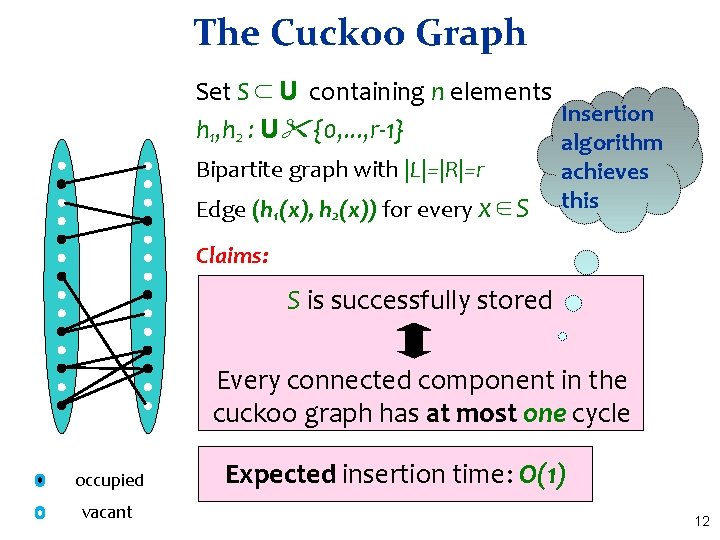
The Cuckoo Graph Set S ⊂ U containing n elements Insertion h 1, h 2 : U {0, . . . , r-1} algorithm Bipartite graph with |L|=|R|=r Edge (h 1(x), h 2(x)) for every x∈S achieves this Claims: S is successfully stored Every connected component in the cuckoo graph has at most one cycle occupied vacant Expected insertion time: O(1) 12
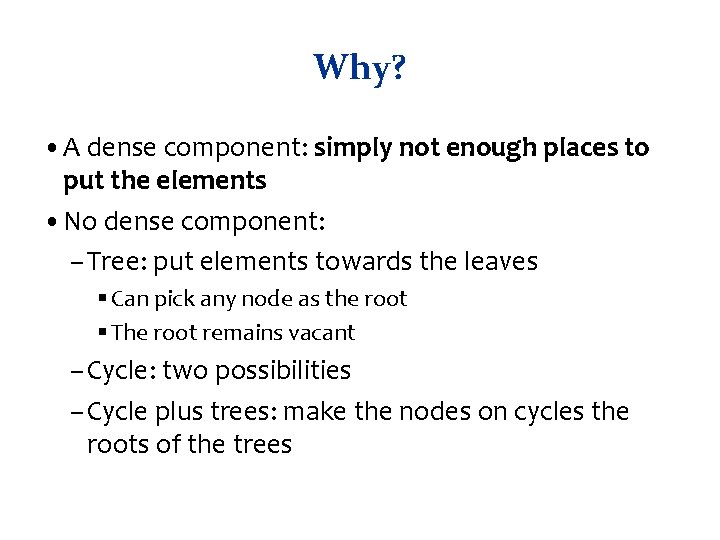
Why? • A dense component: simply not enough places to put the elements • No dense component: – Tree: put elements towards the leaves § Can pick any node as the root § The root remains vacant – Cycle: two possibilities – Cycle plus trees: make the nodes on cycles the roots of the trees
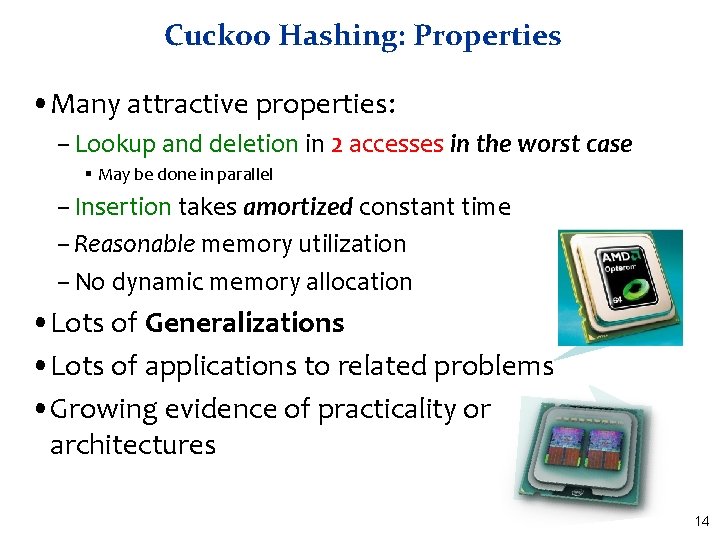
Cuckoo Hashing: Properties • Many attractive properties: – Lookup and deletion in 2 accesses in the worst case § May be done in parallel – Insertion takes amortized constant time – Reasonable memory utilization – No dynamic memory allocation • Lots of Generalizations • Lots of applications to related problems • Growing evidence of practicality on current architectures 14
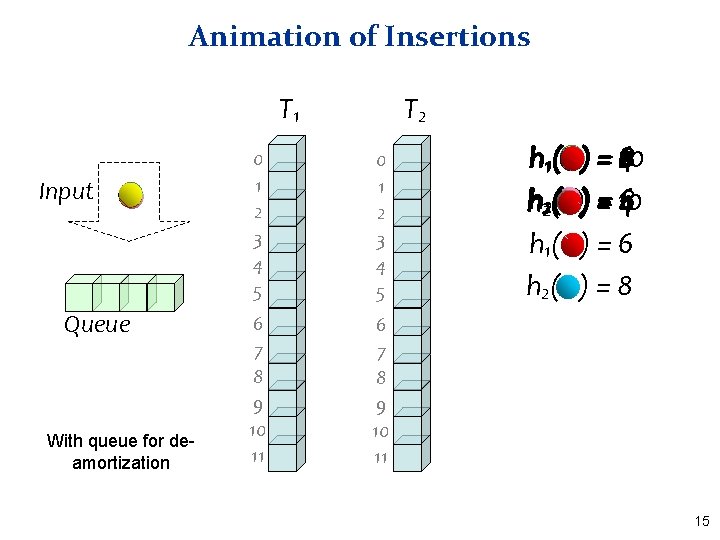
Animation of Insertions T 1 Input Queue With queue for deamortization T 2 0 1 2 3 4 5 6 7 8 9 10 11 h 11( h 22( h 1( h 2( 8 6 2 ) = 410 ) = 10 4168 )=6 )=8 15
More than One Cycle • With probability Θ(1/n) Cuckoo Hashing fails – Recall: connected component with more than one cycle – Standard solution: rehashing §Meaning: insertion worst case may be O(n) • [KMW 08] suggested stash Kirsch, Mitzenmacher, – Saves rehashing Wieder §Actually reduces insertion worst case to O(log n) – Constant-sized stash is sufficient whp Prob of more than k: 1/nk+1 16
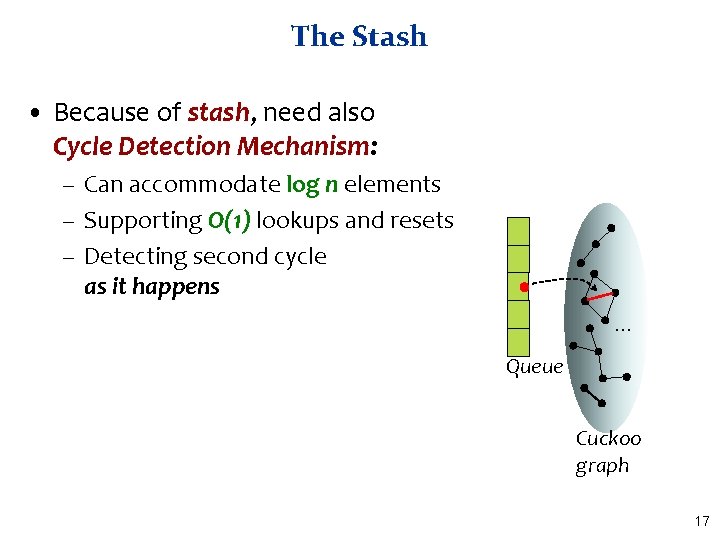
The Stash • Because of stash, need also Cycle Detection Mechanism: – Can accommodate log n elements – Supporting O(1) lookups and resets – Detecting second cycle as it happens. . . Queue Cuckoo graph 17
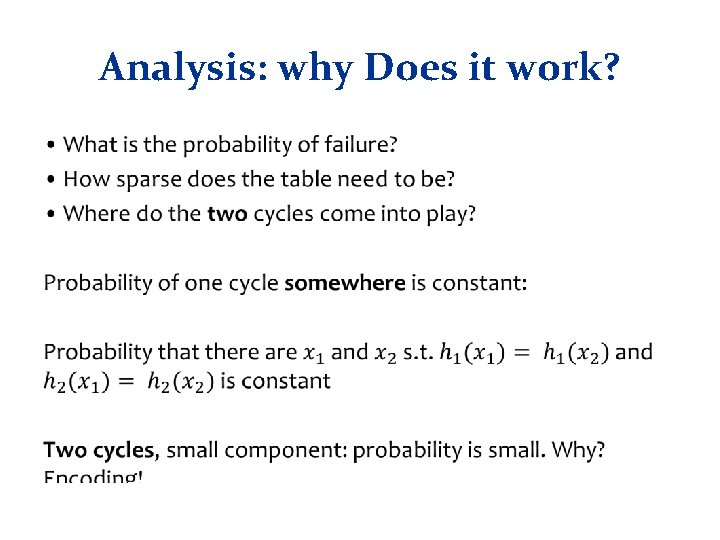
Analysis: why Does it work? •
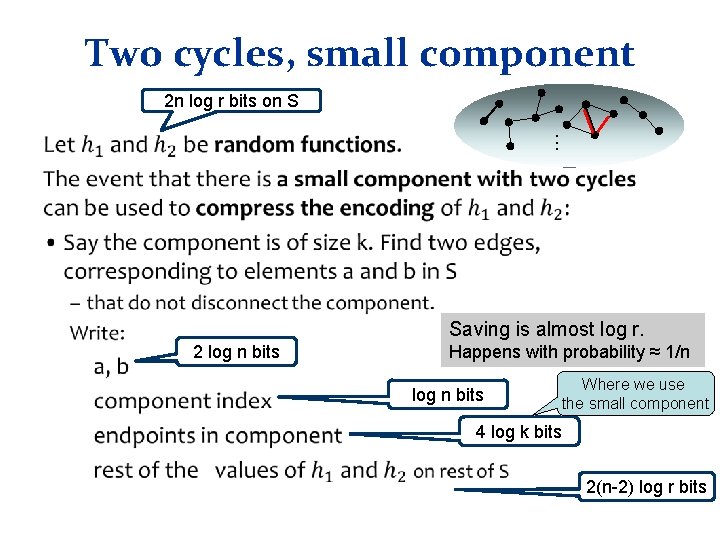
Two cycles, small component 2 n log r bits on S . . . • Saving is almost log r. 2 log n bits Happens with probability ≈ 1/n log n bits Where we use the small component 4 log k bits 2(n-2) log r bits
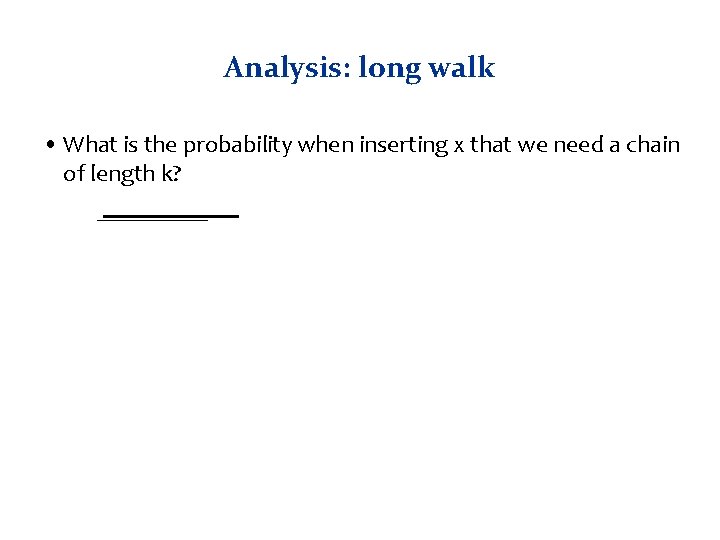
Analysis: long walk • What is the probability when inserting x that we need a chain of length k?
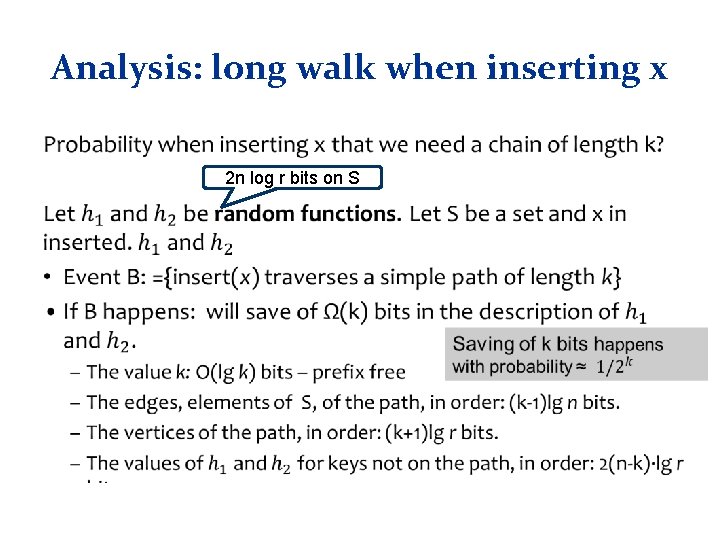
Analysis: long walk when inserting x • 2 n log r bits on S