
Randomized Algorithms Introductory Lecturers Robert Robi Krauthghamer First
Randomized Algorithms Introductory Lecturers: • Robert (Robi) Krauthghamer First Assignment: • Moni Naor learn to spell Robi’s name

Administrivia • Meetings: Mondays 14: 15 -17: 00 • It is expected that all students attend all lectures and actively participate in classes – Read material before class – Present in class – hw solutions etc. – Interact during lectures – Test Lectures are recorded (please remind the speaker to start)
Course: Sources: • Mitzenmacher and Upfal Probability and Computing • Motwani and Raghavan Randomized Algorithms • A few lectures from Ryan O'Donnell's course ``A Theorist's Toolkit"
Today • Why? • Min Cut • 2 -SAT • Randomized Complexity Classes Next time
Why Randomized Algorithms? • May solve problems faster than deterministic ones • May be essential in some settings: Example: PCP Theorem – Sublinear time complexity realm – Distributed algorithms, e. g. for breaking symmetry Example: Differential Privacy – Cryptography and privacy • Yield construction of desirable objects that we do not know how to build explicitly. • Beyond worst case analysis: analyze algorithms when assuming some distribution on the input, – or some mixture of worst case and then a
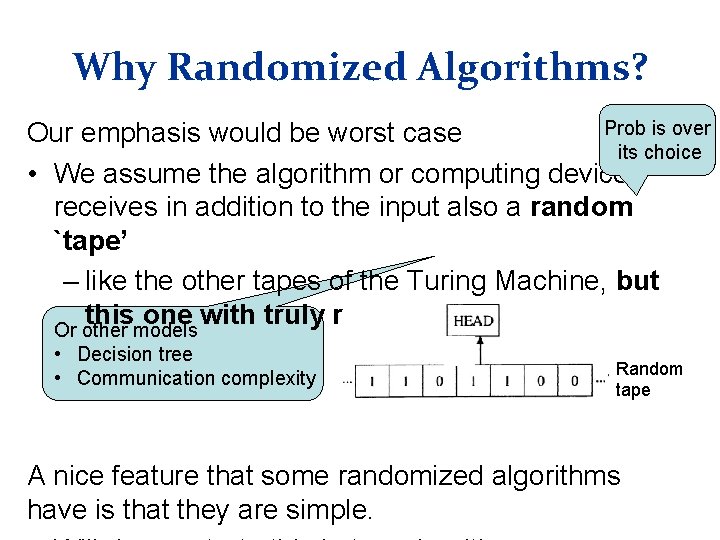
Why Randomized Algorithms? Prob is over Our emphasis would be worst case its choice • We assume the algorithm or computing device receives in addition to the input also a random `tape’ – like the other tapes of the Turing Machine, but this one with truly random symbols. Or other models • Decision tree • Communication complexity Random tape A nice feature that some randomized algorithms have is that they are simple.
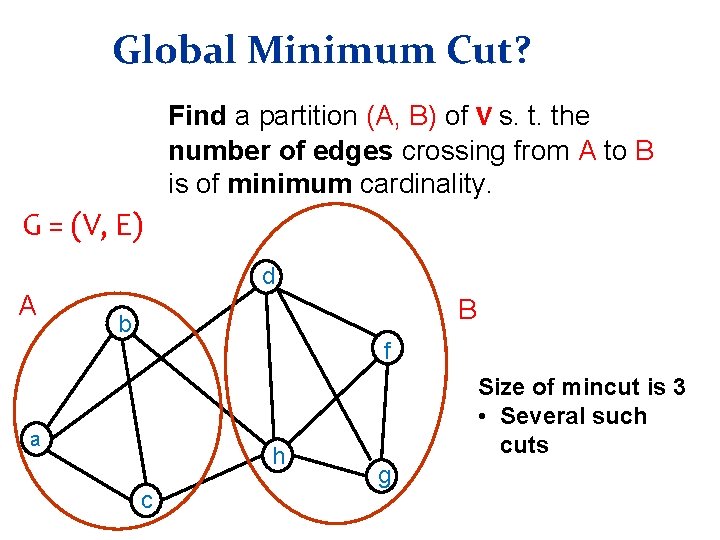
Global Minimum Cut? Find a partition (A, B) of V s. t. the number of edges crossing from A to B is of minimum cardinality. G = (V, E) d A B b f a h c Size of mincut is 3 • Several such cuts g

Global Minimum Cut • Global min cut: Given a connected, undirected graph G = (V, E) find a cut (A, B) of minimum cardinality. • Applications: Partition items in a database, cluster documents, network reliability, network design, TSP solvers. • Network flow approach: run (n-1) s-t min cut (flow) Which is harder: Global min-cut or min s-t cut?
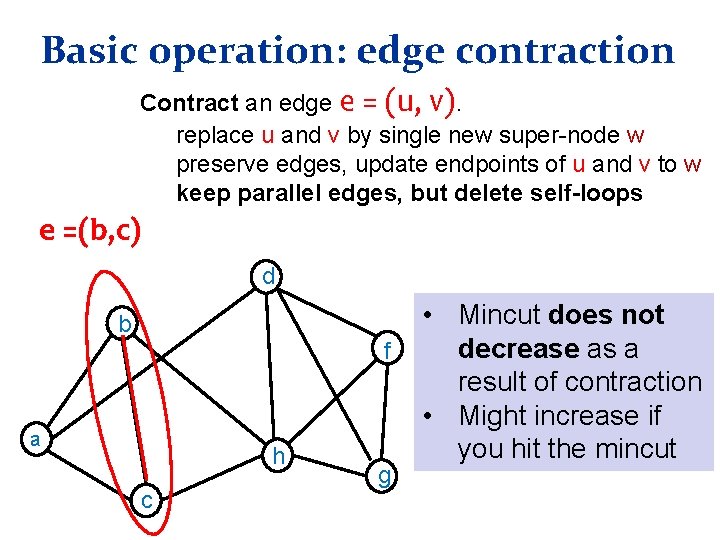
Basic operation: edge contraction Contract an edge e = (u, v). replace u and v by single new super-node w preserve edges, update endpoints of u and v to w keep parallel edges, but delete self-loops e =(b, c) d b f a h c g • Mincut does not decrease as a result of contraction • Might increase if you hit the mincut
![Contraction algorithm [Karger 1995] • Pick an edge e = (u, v) uniformly at](http://slidetodoc.com/presentation_image_h2/a4fb07a9dd265d6eb8b5080a19ac8d0d/image-10.jpg "Contraction algorithm [Karger 1995] • Pick an edge e = (u, v) uniformly at")
Contraction algorithm [Karger 1995] • Pick an edge e = (u, v) uniformly at random. • Contract the edge e. – replace u and v by single new super-node w – preserve edges, update endpoints of u and v to w – keep parallel edges, but delete self-loops • Repeat until only two nodes v 1 and v 2 left. • Return the cut (A, B) A = all nodes that were contracted to form v 1 B = all nodes that were contracted to form v 2
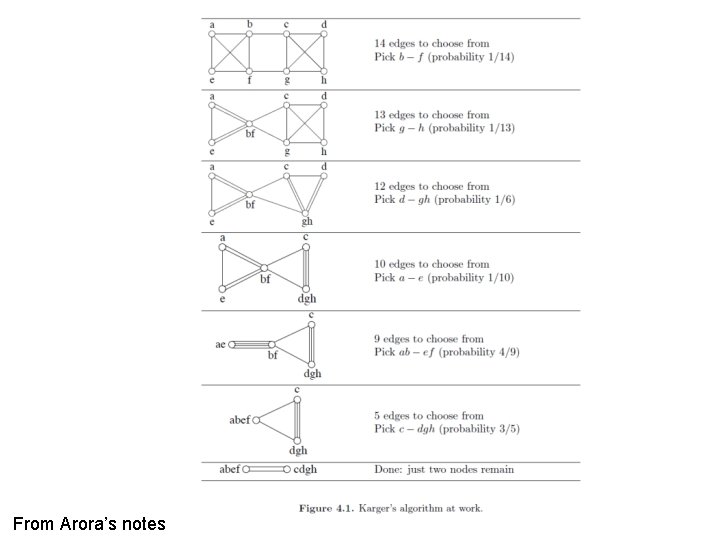
From Arora’s notes
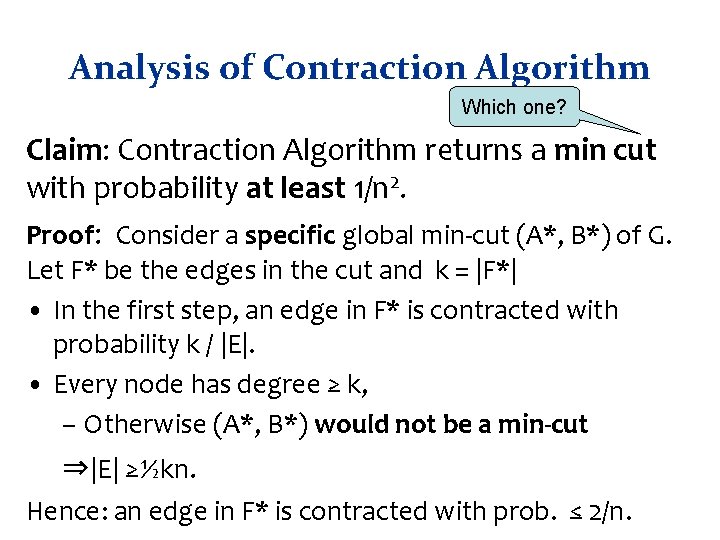
Analysis of Contraction Algorithm Which one? Claim: Contraction Algorithm returns a min cut with probability at least 1/n 2. Proof: Consider a specific global min-cut (A*, B*) of G. Let F* be the edges in the cut and k = |F*| • In the first step, an edge in F* is contracted with probability k / |E|. • Every node has degree ≥ k, – Otherwise (A*, B*) would not be a min-cut ⇒|E| ≥½kn. Hence: an edge in F* is contracted with prob. ≤ 2/n.
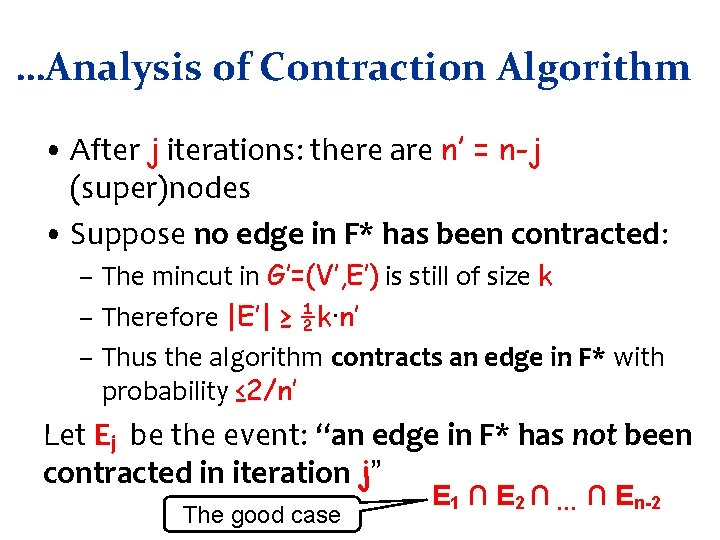
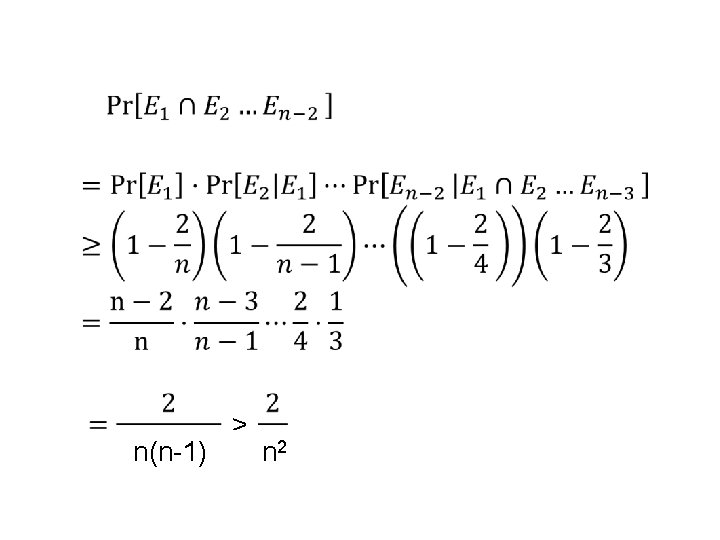
…Analysis of Contraction Algorithm • After j iterations: there are n’ = n-j (super)nodes • Suppose no edge in F* has been contracted: – The mincut in G’=(V’, E’) is still of size k – Therefore |E’| ≥ ½k∙n’ – Thus the algorithm contracts an edge in F* with probability ≤ 2/n’ Let Ej be the event: “an edge in F* has not been contracted in iteration j” The good case E 1 ∩ E 2 ∩ … ∩ En-2
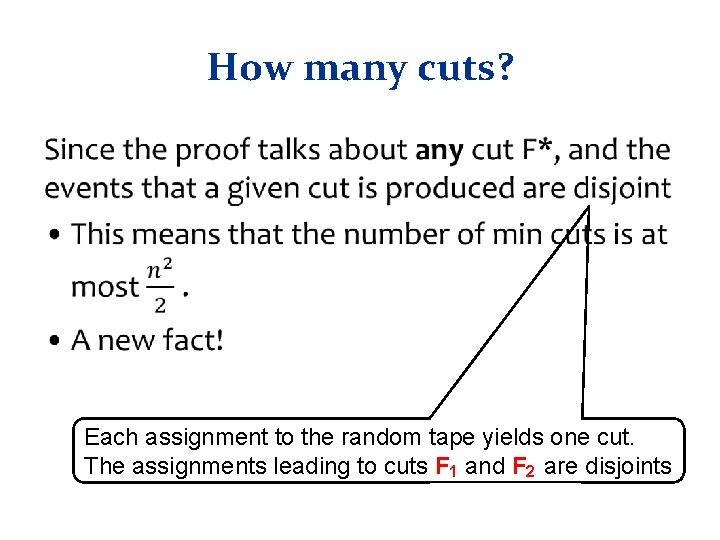
How many cuts? • Each assignment to the random tape yields one cut. The assignments leading to cuts F 1 and F 2 are disjoints
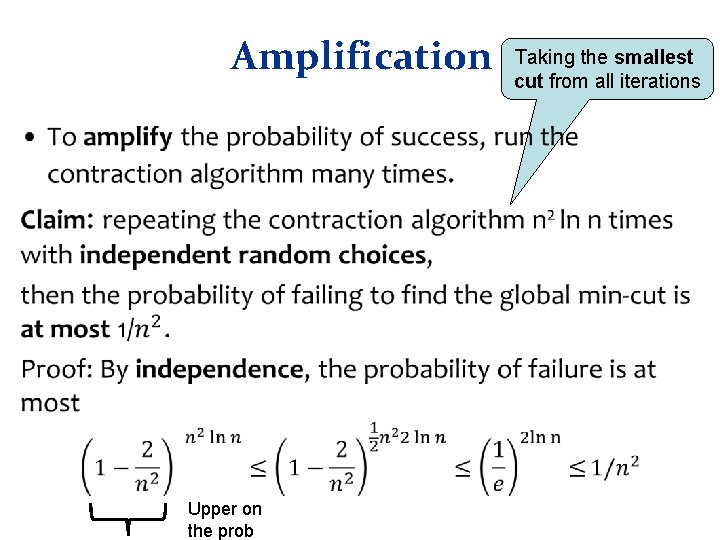
Amplification • Upper on the prob Taking the smallest cut from all iterations
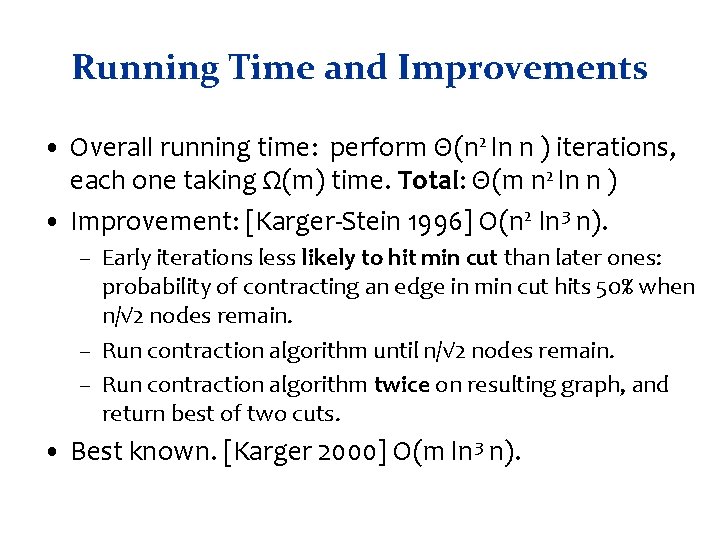
Running Time and Improvements • Overall running time: perform Θ(n 2 ln n ) iterations, each one taking Ω(m) time. Total: Θ(m n 2 ln n ) • Improvement: [Karger-Stein 1996] O(n 2 ln 3 n). – Early iterations less likely to hit min cut than later ones: probability of contracting an edge in min cut hits 50% when n/√ 2 nodes remain. – Run contraction algorithm until n/√ 2 nodes remain. – Run contraction algorithm twice on resulting graph, and return best of two cuts. • Best known. [Karger 2000] O(m ln 3 n).
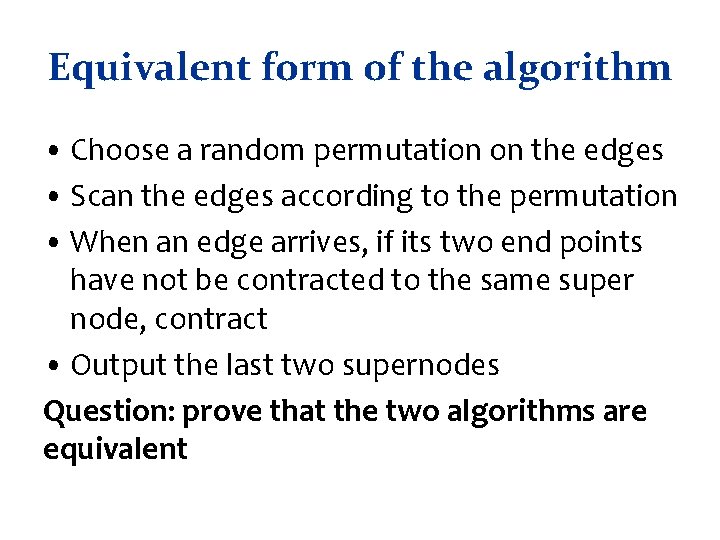
Equivalent form of the algorithm • Choose a random permutation on the edges • Scan the edges according to the permutation • When an edge arrives, if its two end points have not be contracted to the same super node, contract • Output the last two supernodes Question: prove that the two algorithms are equivalent
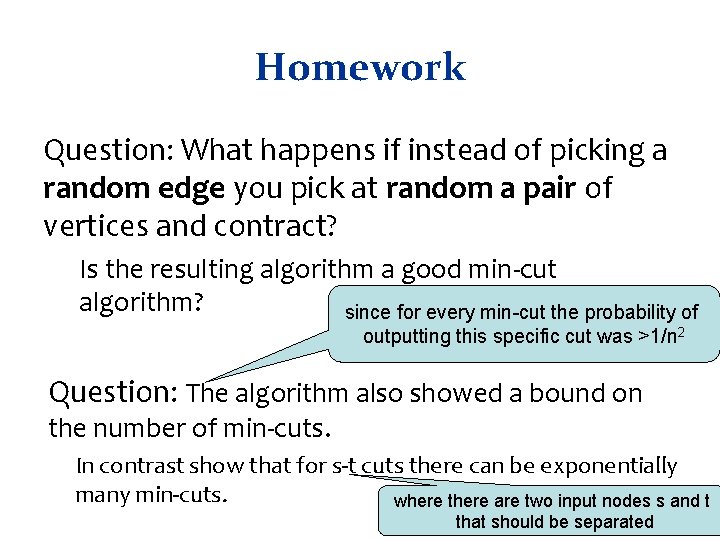
Homework Question: What happens if instead of picking a random edge you pick at random a pair of vertices and contract? Is the resulting algorithm a good min-cut algorithm? since for every min-cut the probability of outputting this specific cut was >1/n 2 Question: The algorithm also showed a bound on the number of min-cuts. In contrast show that for s-t cuts there can be exponentially many min-cuts. where there are two input nodes s and t that should be separated
Question Suppose you choose an edge by • Picking a random node u • Pick a random neighbor v of u • The result is edge (u, v) 1. Show that this is not the same as picking a random edge (u, v) among all edges. 2. Analyze the Karger cut algorithm with this way of picking an edge.
Watch Lecture on Entropy • Entropy || @ CMU || Lecture 24 a and 24 b of CS Theory Toolkit • https: //www. youtube. com/watch? v=b 6 x 4 A mjdvv. Y
- Slides: 21