
RandomAccessible Compressed Triangle Meshes Sungeui Yoon Korea Advanced
Random-Accessible Compressed Triangle Meshes Sung-eui Yoon Korea Advanced Institute of Sci. and Tech. (KAIST) Peter Lindstrom Lawrence Livermore National Laboratory
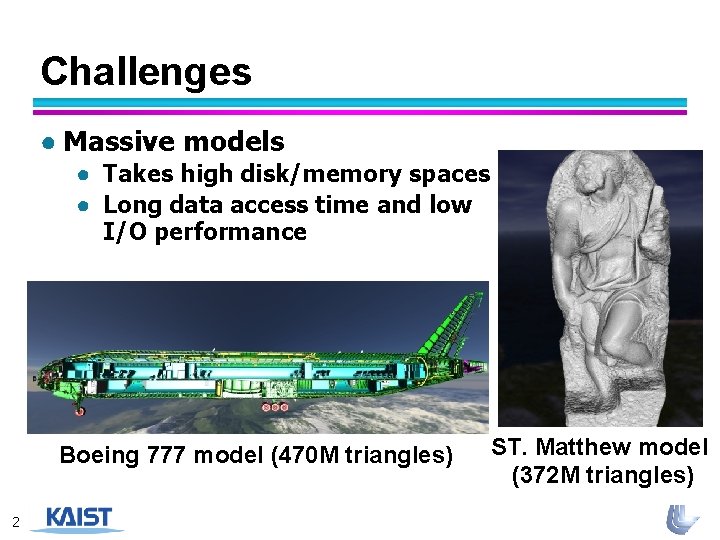
Challenges ● Massive models ● Takes high disk/memory spaces ● Long data access time and low I/O performance Boeing 777 model (470 M triangles) 2 ST. Matthew model (372 M triangles)
Goal ● Provide a compact mesh representation of a massive model for various applications ● Supports random access ● Provides various mesh access including connectivity (adjacency and incidence) queries ● Possibly, improves the performance of applications 3
Existing Mesh Representations ● Uncompressed indexed file format (e. g. , ply or obj files) ● Provides random access for various applications ● But, does not support connectivity (adjacency and incidence) queries ● Require large data space (e. g. , 3 GB for 100 M triangles) ● Have low I/O performance 4
External Mesh Representations ● Provides random and connectivity queries ● [Silva et al. 02, Cignoni et al. 03, Isenburg and Gumhold 03] ● But, takes more disk space and higher data access time 5
Cache-Coherent Mesh Layouts ● Store a mesh in a layout that closely matches runtime access patterns of applications [Yoon et al. 05 and 06] ● Reduces the number of cache misses during random accesses ● Achieve high I/O performance ● But, still require lots of space (e. g. , 3 GB for 100 M triangles) 6
Mesh Compression ● Apply compression techniques to reduce the data size [Alliez and Gotsman 05] ● Mainly focus on efficient transmission or archival of data ● Limited to sequential accesses ● Impose one particular data layout maximizing the compression ratio ● Can lead to poor I/O performance 7
Compression Methods Supporting Random Accesses ● Quite common in video & audio encoding ● E. g. , MPEG video ● [Choe et al. 04, Kim et al. 06] ● Support random accesses ● Target rendering applications Do not support general mesh access queries Also, unclear on I/O performance 8
Main Contributions ● Propose novel order-preserving compression method and runtime data access framework ● Serves as an compact out-of-core data access framework ● Provide random access and various mesh access queries ● Achieve high compression ratio and high I/O performance for massive models 9
Outline ● Overview ● Compression at preprocessing ● Runtime data access framework ● Results 10
Outline ● Overview ● Compression at preprocessing ● Runtime data access framework ● Results 11
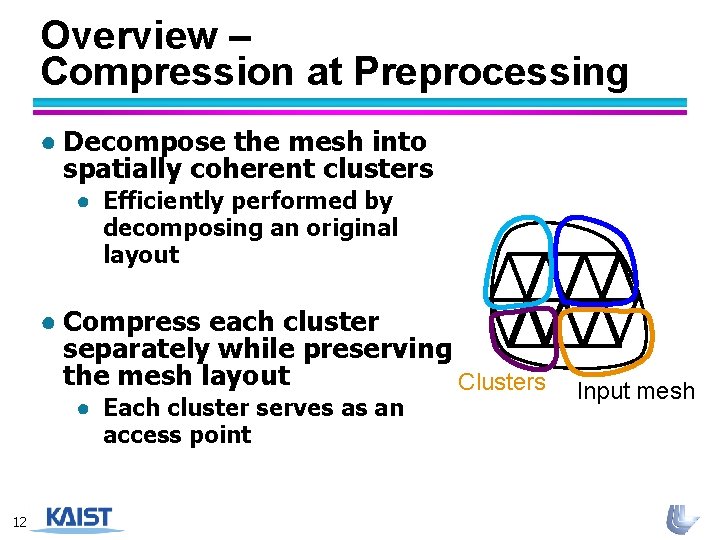
Overview – Compression at Preprocessing ● Decompose the mesh into spatially coherent clusters ● Efficiently performed by decomposing an original layout ● Compress each cluster separately while preserving the mesh layout Clusters ● Each cluster serves as an access point 12 Input mesh
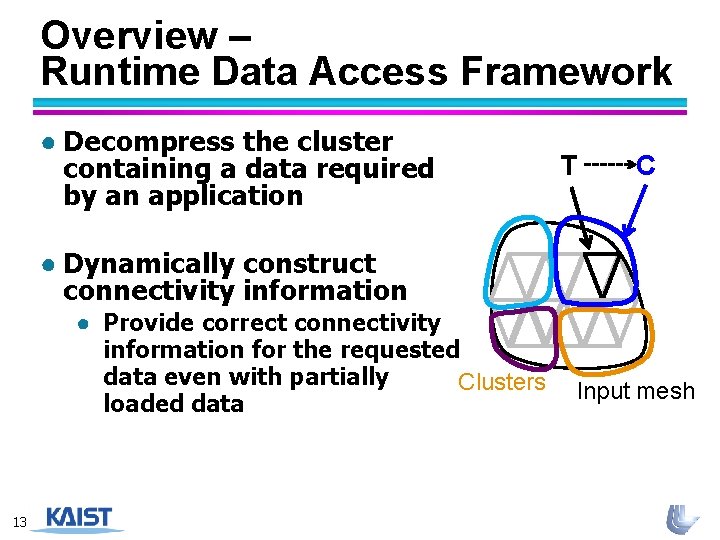
Overview – Runtime Data Access Framework ● Decompress the cluster containing a data required by an application T C ● Dynamically construct connectivity information ● Provide correct connectivity information for the requested data even with partially Clusters loaded data 13 Input mesh
Outline ● Overview ● Compression at preprocessing ● Runtime data access framework ● Results 14
Order-Preserving Cluster-Based Compression ● Built on top of streaming mesh compression [Isenburg et al. 05] ● Cluster has: ● Fixed number of consecutive triangles in the layout (e. g. , 4 k triangles) ● Vertices introduced by those triangles ● Our method encodes an triangle layout of the mesh ● Also, encodes cluster information (e. g. , neighboring clusters) 15
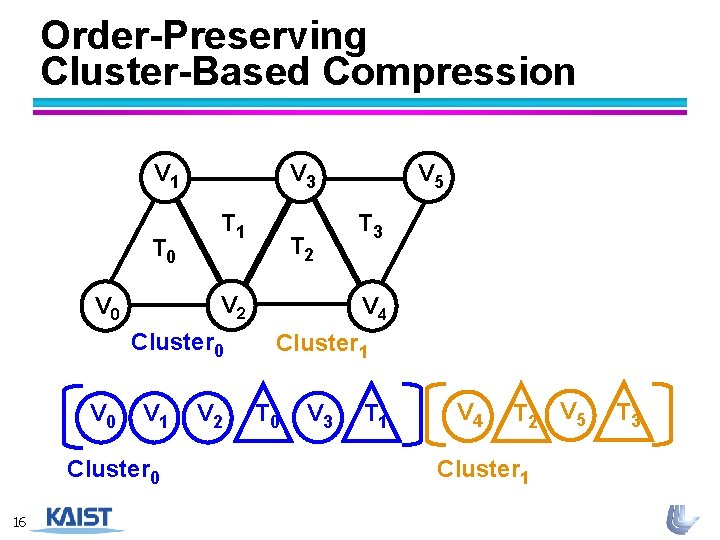
Order-Preserving Cluster-Based Compression T 0 T 1 Cluster 0 V 1 Cluster 0 16 T 2 V 0 V 5 V 3 V 1 V 2 T 3 V 4 Cluster 1 T 0 V 3 T 1 V 4 T 2 V 5 Cluster 1 T 3
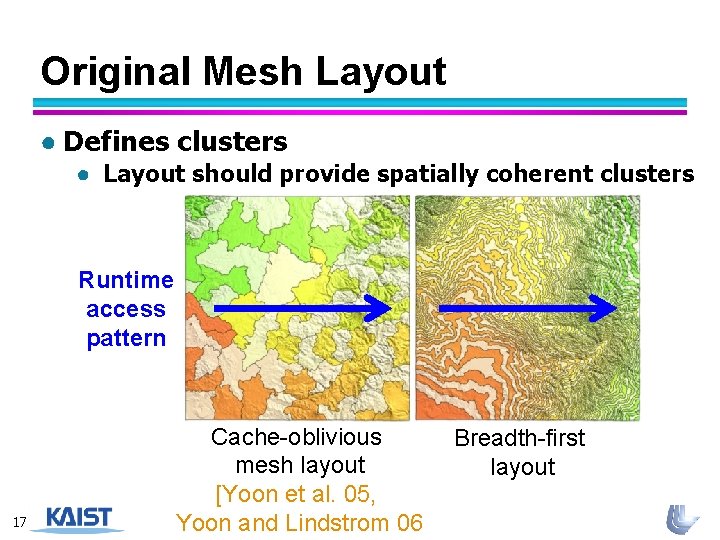
Original Mesh Layout ● Defines clusters ● Layout should provide spatially coherent clusters Runtime access pattern 17 Cache-oblivious mesh layout [Yoon et al. 05, Yoon and Lindstrom 06 Breadth-first layout
Outline ● Overview ● Compression at preprocessing ● Runtime mesh access framework ● Results 18
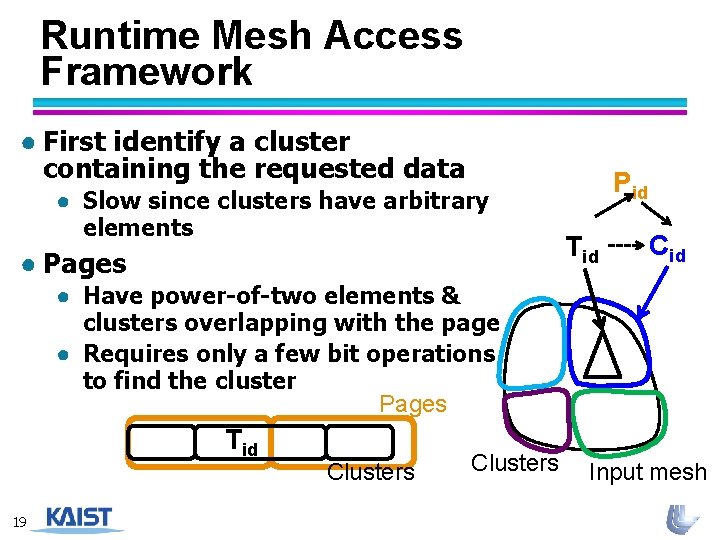
Runtime Mesh Access Framework ● First identify a cluster containing the requested data ● Slow since clusters have arbitrary elements ● Pages Pid Tid Cid ● Have power-of-two elements & clusters overlapping with the page ● Requires only a few bit operations to find the cluster Pages Tid 19 Clusters Input mesh

In-Core Mesh Representation ● Similar to the corner tables [Rossignac 01, Joy et al. 03] ● Supports connectivity queries All the pointers associated with V 1 T 1 Compactly represented in the corner table T 0 V 0 20 V 3 V 1 V 2
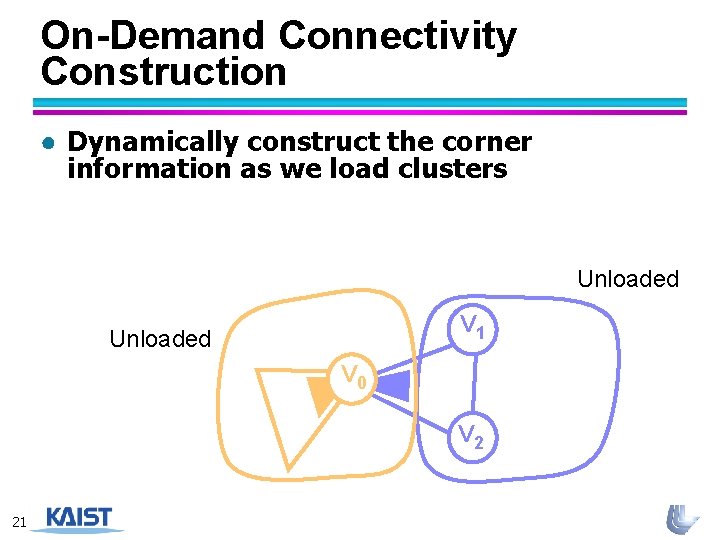
On-Demand Connectivity Construction ● Dynamically construct the corner information as we load clusters Unloaded V 1 Unloaded V 0 V 2 21
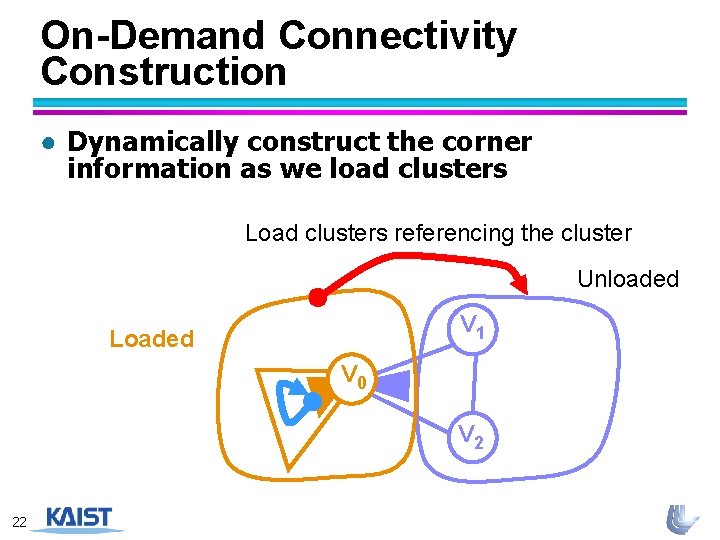
On-Demand Connectivity Construction ● Dynamically construct the corner information as we load clusters Load clusters referencing the cluster Unloaded V 1 Loaded V 0 V 2 22
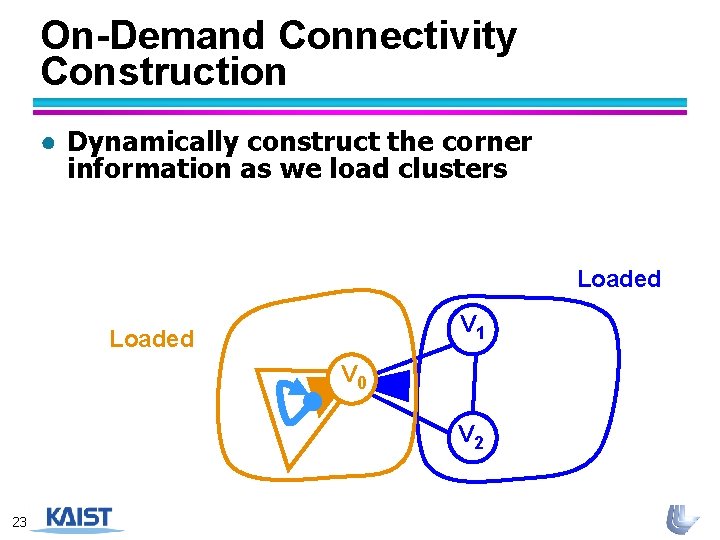
On-Demand Connectivity Construction ● Dynamically construct the corner information as we load clusters Loaded V 1 Loaded V 0 V 2 23
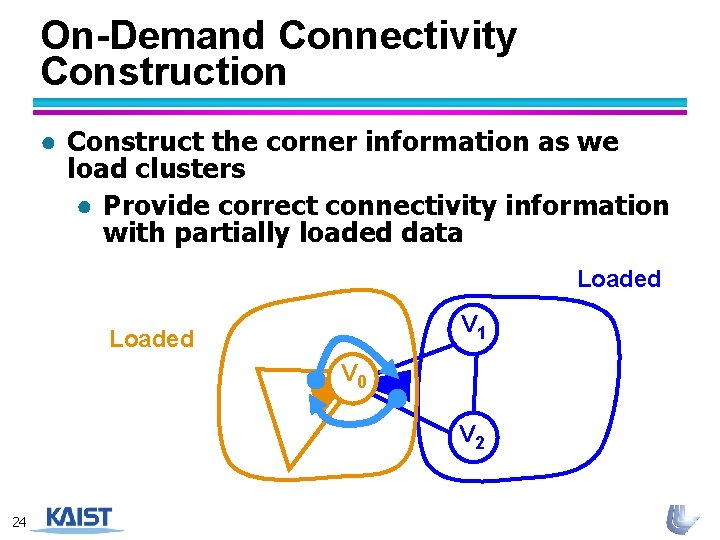
On-Demand Connectivity Construction ● Construct the corner information as we load clusters ● Provide correct connectivity information with partially loaded data Loaded V 1 Loaded V 0 V 2 24
Outline ● Overview ● Compression at preprocessing ● Runtime data access framework ● Results 25
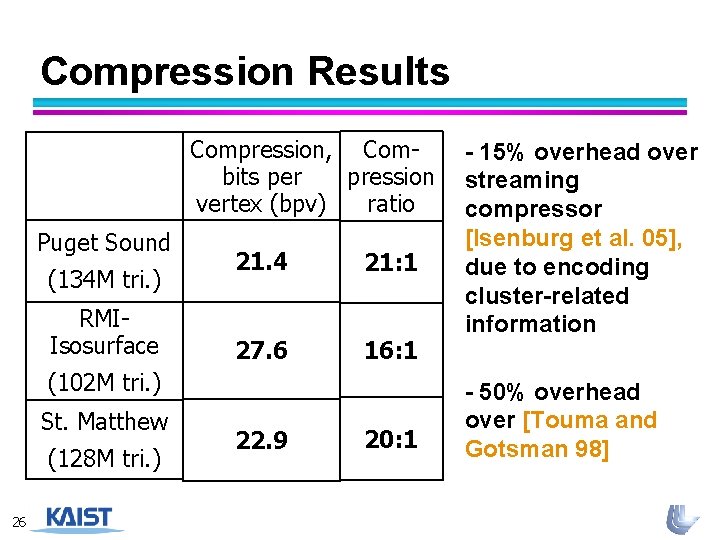
Compression Results Compression, Combits per pression vertex (bpv) ratio Puget Sound (134 M tri. ) RMIIsosurface 21. 4 21: 1 27. 6 16: 1 (102 M tri. ) St. Matthew (128 M tri. ) 26 22. 9 20: 1 - 15% overhead over streaming compressor [Isenburg et al. 05], due to encoding cluster-related information - 50% overhead over [Touma and Gotsman 98]
Runtime Benchmarks ● Iso-contouring ● Accesses sub-sets of the mesh ● Mesh re-ordering ● Accesses the whole mesh Require mesh traversal in a random order 27
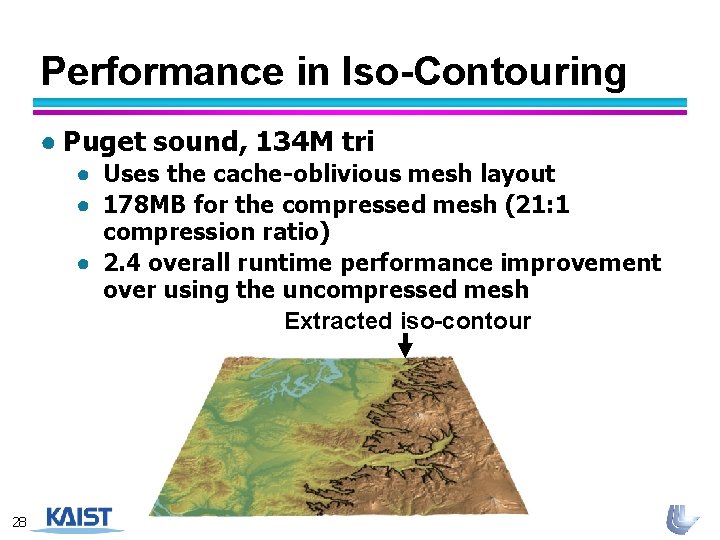
Performance in Iso-Contouring ● Puget sound, 134 M tri ● Uses the cache-oblivious mesh layout ● 178 MB for the compressed mesh (21: 1 compression ratio) ● 2. 4 overall runtime performance improvement over using the uncompressed mesh Extracted iso-contour 28
Mesh Re-Ordering ● Re-order vertices and triangles of the mesh ● Achieve up to 6. 4 times performance improvement over using un-compressed meshes 29
Performance Improvement ● Mainly due to higher I/O performance ● Reduce disk I/O time by using compression ● Use CPU power to efficiently decompress the data 30
Conclusions ● Novel order-preserving compression and runtime data access framework ● Provide random accesses and connectivity queries without decompressing the whole mesh ● Serve as an out-of-core data access framework ● Support a wideare variety of applications Source codes available as Open. RACM ● Achieve up to 20: 1 compression ratio ● Achieve high I/O performance and, thus, able to observe up to 6: 1 performance improvement 31

Acknowledgements ● Martin Isenburg ● Anonymous reviewers ● Members of KAIST theory of computation lab. and LLNL data analysis ● Funding sources ● Lawrence Livermore National Lab. ● KAIST seed grant 32
Any Questions? ● Thank you! 33
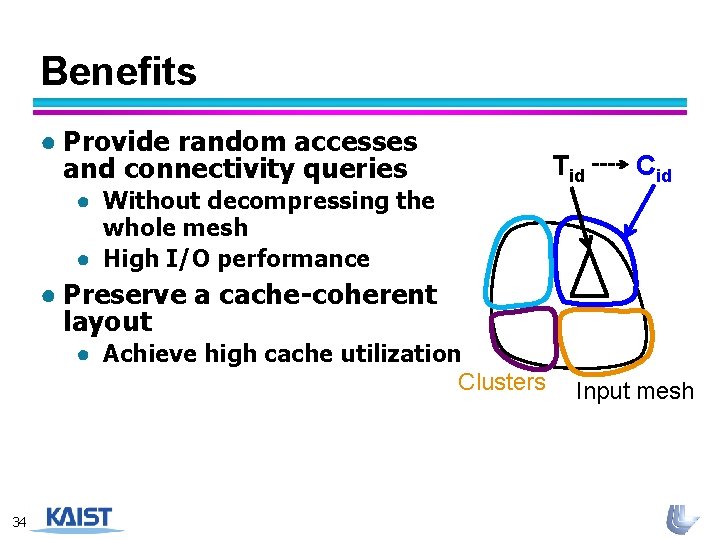
Benefits ● Provide random accesses and connectivity queries ● Without decompressing the whole mesh ● High I/O performance Tid Cid ● Preserve a cache-coherent layout ● Achieve high cache utilization Clusters 34 Input mesh
Encoding Vertex Indices ● Provides three layers of compression contexts ● 1) three vertices of a previous triangle ● 2) active vertices in the current cluster ● 3) vertices in the neighboring clusters: two indices (cluster index, local index) 35
Mesh API ● Get. Vertex (…) ● Get. Triangle (…) ● Get. Corner (…) ● Get. Next. Vertex. Corner (…) ● Get. Next. Triangle. Corner (…), etc Build more complex mesh access functions from the API 36
Ongoing and Future Work ● Efficiently handle modifications to the mesh ● Further optimize for parallel data access ● Extend it to hierarchies and apply to ray tracing and collision detection 37
- Slides: 37