
RANDOM VARIABLES What is random variable Suppose you

RANDOM VARIABLES
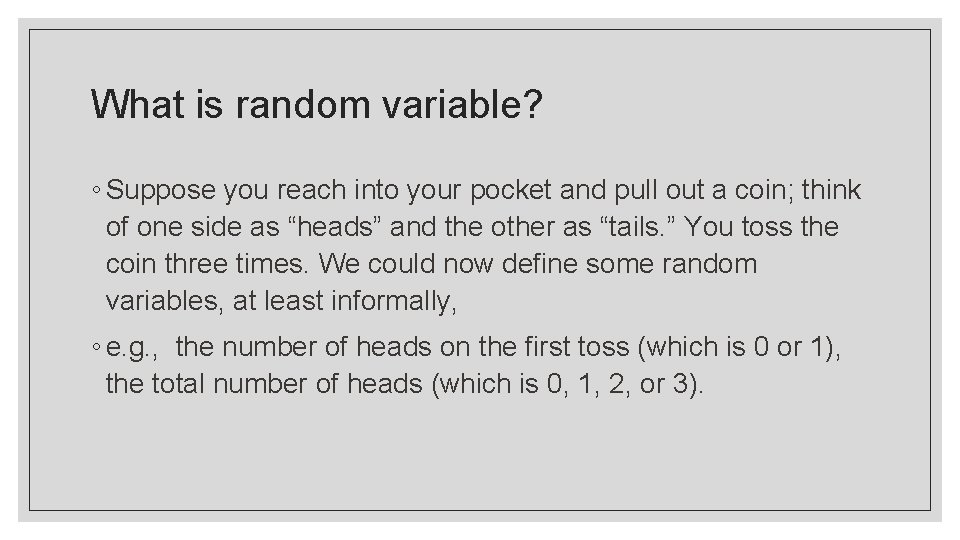
What is random variable? ◦ Suppose you reach into your pocket and pull out a coin; think of one side as “heads” and the other as “tails. ” You toss the coin three times. We could now define some random variables, at least informally, ◦ e. g. , the number of heads on the first toss (which is 0 or 1), the total number of heads (which is 0, 1, 2, or 3).
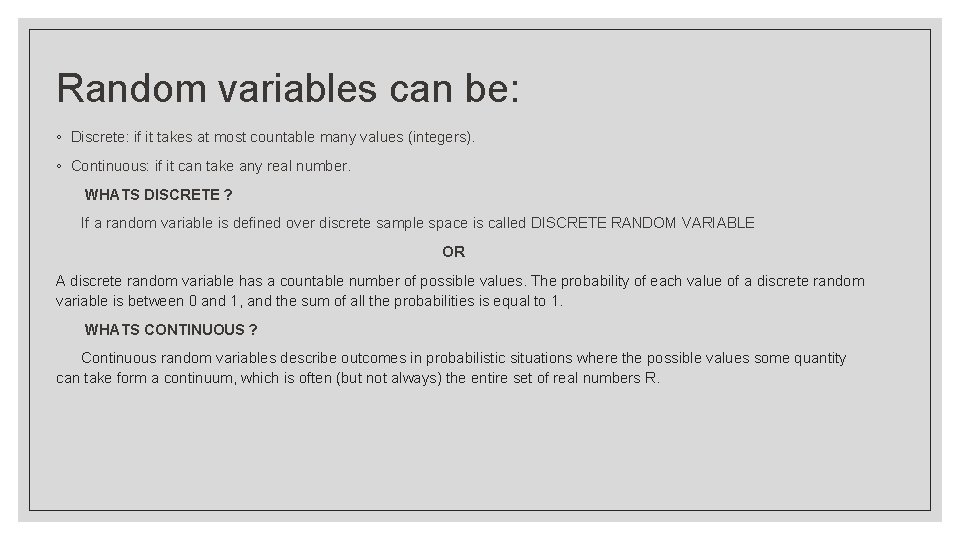
Random variables can be: ◦ Discrete: if it takes at most countable many values (integers). ◦ Continuous: if it can take any real number. WHATS DISCRETE ? If a random variable is defined over discrete sample space is called DISCRETE RANDOM VARIABLE OR A discrete random variable has a countable number of possible values. The probability of each value of a discrete random variable is between 0 and 1, and the sum of all the probabilities is equal to 1. WHATS CONTINUOUS ? Continuous random variables describe outcomes in probabilistic situations where the possible values some quantity can take form a continuum, which is often (but not always) the entire set of real numbers R.
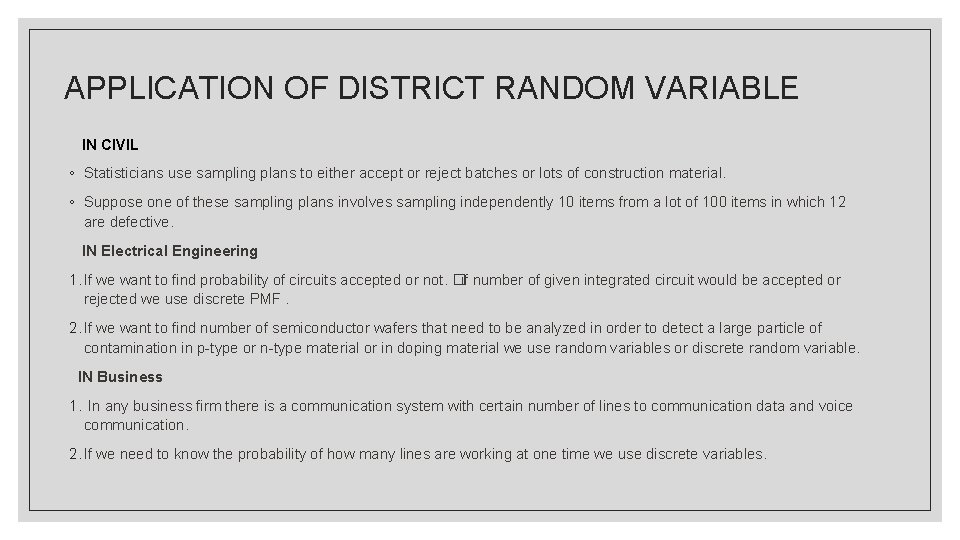
APPLICATION OF DISTRICT RANDOM VARIABLE IN CIVIL ◦ Statisticians use sampling plans to either accept or reject batches or lots of construction material. ◦ Suppose one of these sampling plans involves sampling independently 10 items from a lot of 100 items in which 12 are defective. IN Electrical Engineering 1. If we want to find probability of circuits accepted or not. �if number of given integrated circuit would be accepted or rejected we use discrete PMF. 2. If we want to find number of semiconductor wafers that need to be analyzed in order to detect a large particle of contamination in p-type or n-type material or in doping material we use random variables or discrete random variable. IN Business 1. In any business firm there is a communication system with certain number of lines to communication data and voice communication. 2. If we need to know the probability of how many lines are working at one time we use discrete variables.
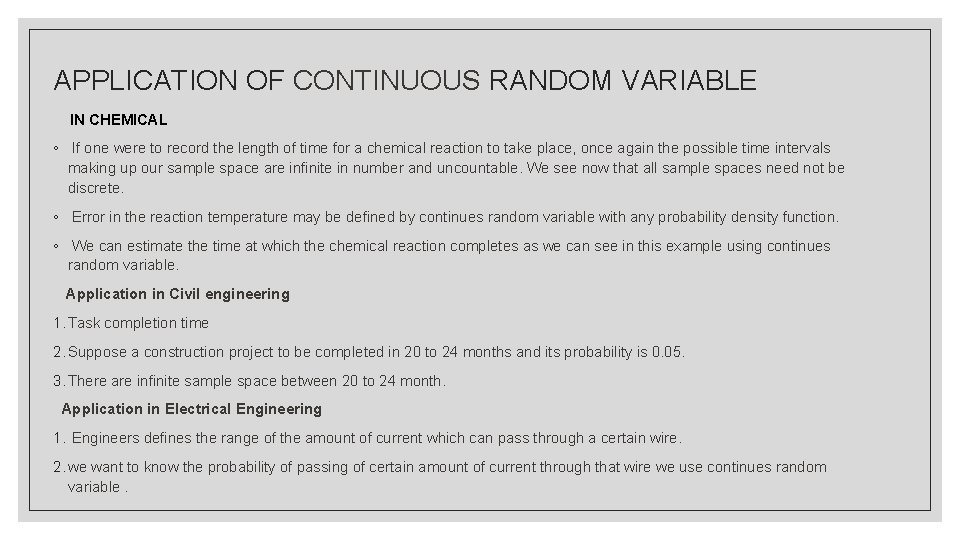
APPLICATION OF CONTINUOUS RANDOM VARIABLE IN CHEMICAL ◦ If one were to record the length of time for a chemical reaction to take place, once again the possible time intervals making up our sample space are infinite in number and uncountable. We see now that all sample spaces need not be discrete. ◦ Error in the reaction temperature may be defined by continues random variable with any probability density function. ◦ We can estimate the time at which the chemical reaction completes as we can see in this example using continues random variable. Application in Civil engineering 1. Task completion time 2. Suppose a construction project to be completed in 20 to 24 months and its probability is 0. 05. 3. There are infinite sample space between 20 to 24 month. Application in Electrical Engineering 1. Engineers defines the range of the amount of current which can pass through a certain wire. 2. we want to know the probability of passing of certain amount of current through that wire we use continues random variable.

THANKS
- Slides: 6