
Random Sequence Generator Issue AWD15 3 8 IEEE
- Slides: 13
Random Sequence Generator Issue (AWD-15. 3. 8) IEEE 802. 16 Presentation Submission Template (Rev. 9) Document Number: IEEE C 80216 m-09/1311 r 2 Date Submitted: 2009 -07 -15 Source: Alexei Davydov, Jong-kae (JK) Fwu, Yang Rongzhen, Hujun Yin Intel Corporation Yu-Tao Hsieh, Pang-An Ting, Zheng Yan-Xiu ITRI alexei. davydov@intel. com ythsieh@itri. org. tw Taeyoung Kim, Jeongho Park Samsung Electronics Venue: IEEE 802. 16 m Session#62, San Francisco, USA Category: AWD comments / Area: Chapter 15. 3. 8 UL-PHY) “Comments on AWD 15. 3. 8 (UL-PHY)” Base Contribution: IEEE C 80216 m-09/1311 Purpose: Discussion Notice: This document does not represent the agreed views of the IEEE 802. 16 Working Group or any of its subgroups. It represents only the views of the participants listed in the “Source(s)” field above. It is offered as a basis for discussion. It is not binding on the contributor(s), who reserve(s) the right to add, amend or withdraw material contained herein. Release: The contributor grants a free, irrevocable license to the IEEE to incorporate material contained in this contribution, and any modifications thereof, in the creation of an IEEE Standards publication; to copyright in the IEEE’s name any IEEE Standards publication even though it may include portions of this contribution; and at the IEEE’s sole discretion to permit others to reproduce in whole or in part the resulting IEEE Standards publication. The contributor also acknowledges and accepts that this contribution may be made public by IEEE 802. 16. Patent Policy: The contributor is familiar with the IEEE-SA Patent Policy and Procedures: <http: //standards. ieee. org/guides/bylaws/sect 6 -7. html#6> and <http: //standards. ieee. org/guides/opman/sect 6. html#6. 3>. 1
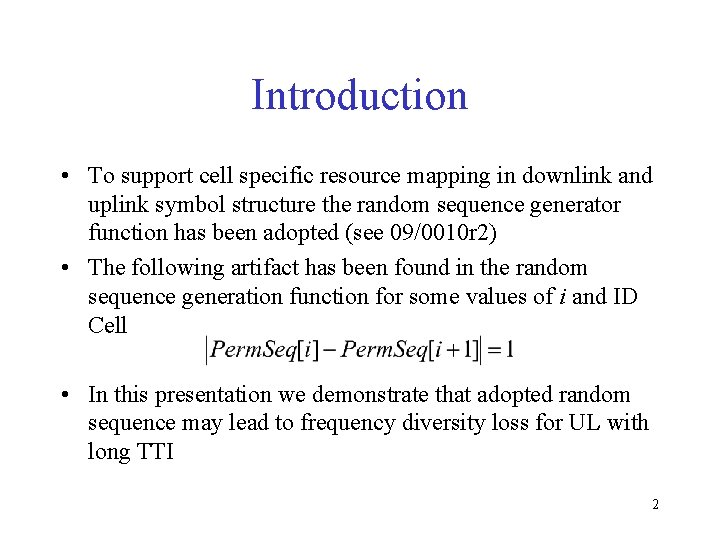
Introduction • To support cell specific resource mapping in downlink and uplink symbol structure the random sequence generator function has been adopted (see 09/0010 r 2) • The following artifact has been found in the random sequence generation function for some values of i and ID Cell • In this presentation we demonstrate that adopted random sequence may lead to frequency diversity loss for UL with long TTI 2
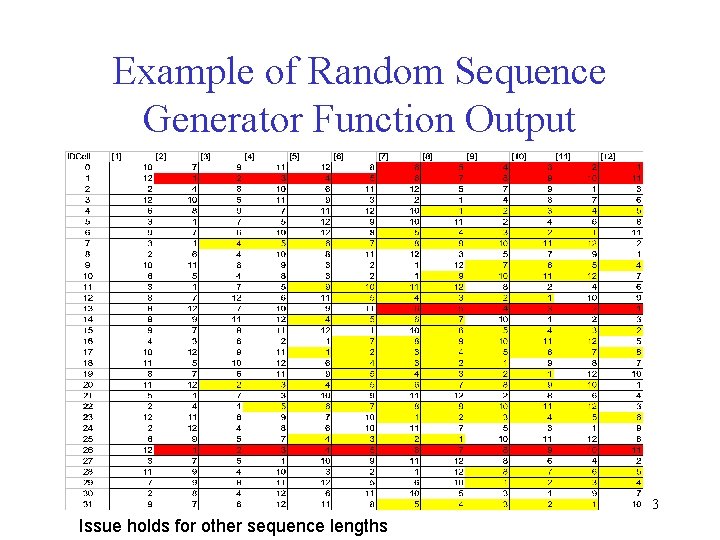
Example of Random Sequence Generator Function Output 3 Issue holds for other sequence lengths
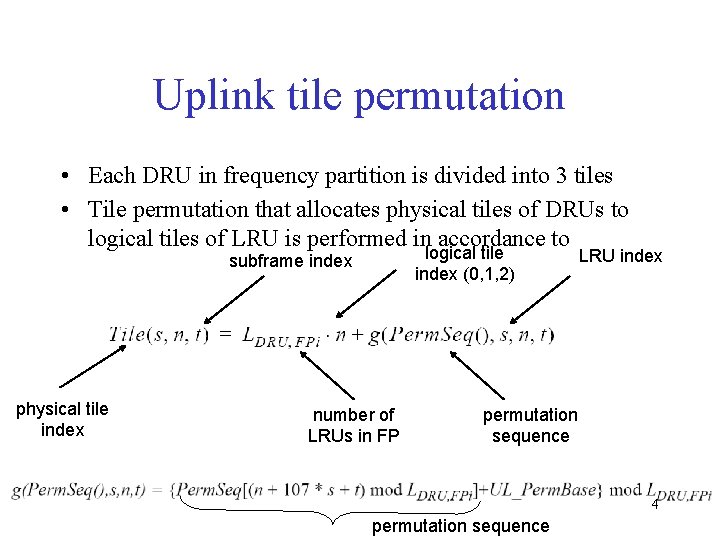
Uplink tile permutation • Each DRU in frequency partition is divided into 3 tiles • Tile permutation that allocates physical tiles of DRUs to logical tiles of LRU is performed in accordance to logical tile index (0, 1, 2) subframe index physical tile index number of LRUs in FP LRU index permutation sequence 4 permutation sequence
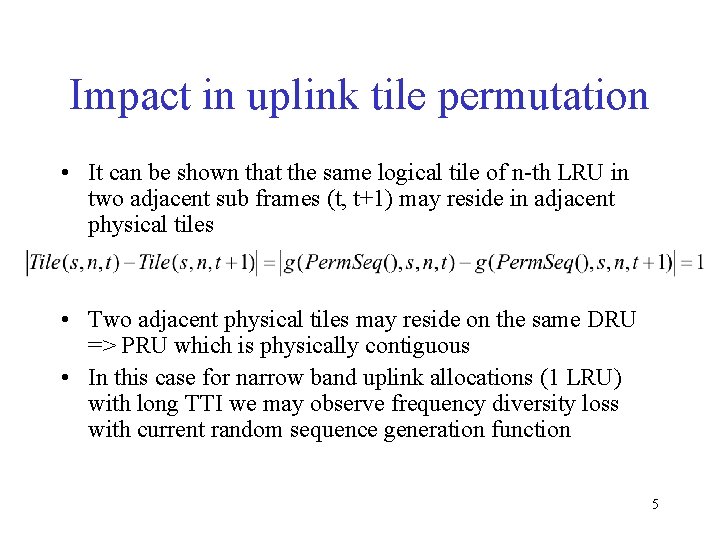
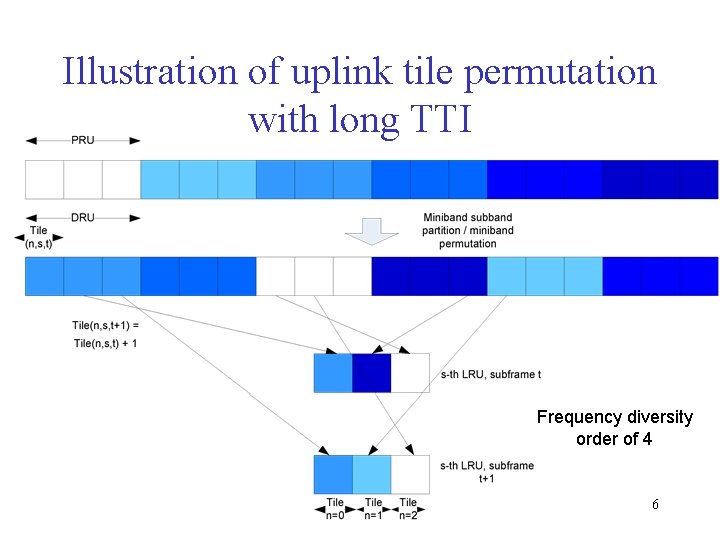
Impact in uplink tile permutation • It can be shown that the same logical tile of n-th LRU in two adjacent sub frames (t, t+1) may reside in adjacent physical tiles • Two adjacent physical tiles may reside on the same DRU => PRU which is physically contiguous • In this case for narrow band uplink allocations (1 LRU) with long TTI we may observe frequency diversity loss with current random sequence generation function 5
Illustration of uplink tile permutation with long TTI Frequency diversity order of 4 6
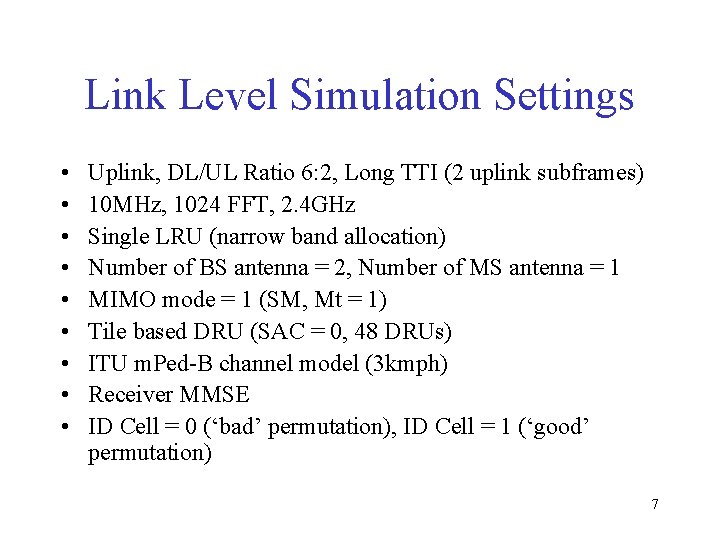
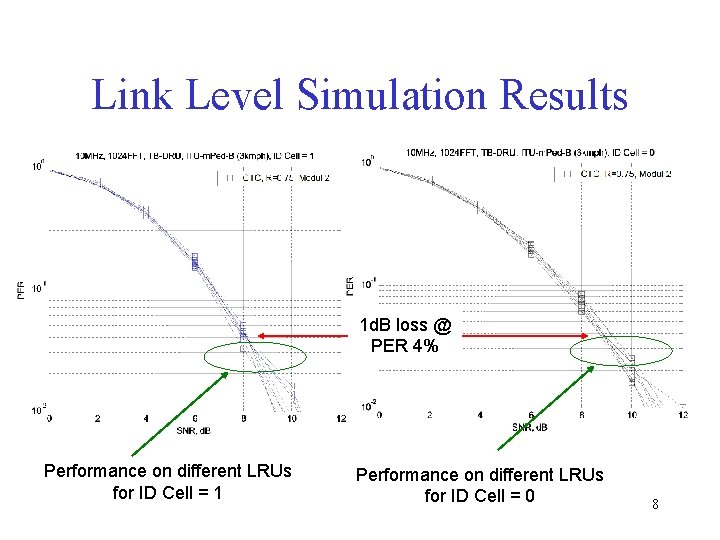
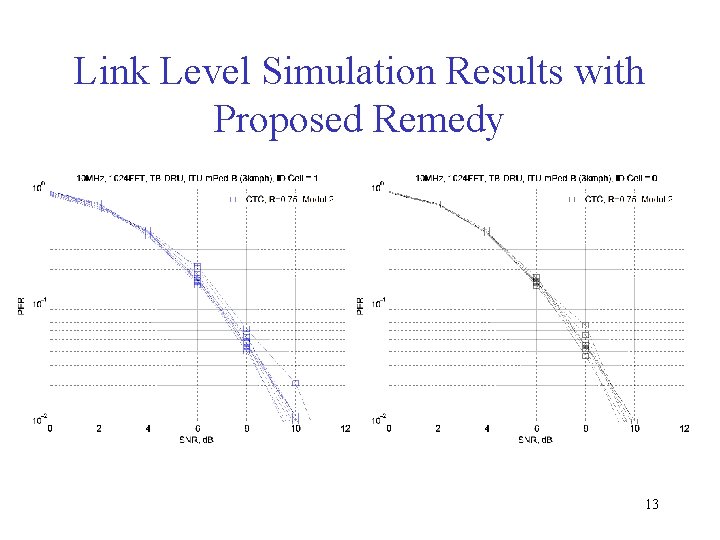
Link Level Simulation Settings • • • Uplink, DL/UL Ratio 6: 2, Long TTI (2 uplink subframes) 10 MHz, 1024 FFT, 2. 4 GHz Single LRU (narrow band allocation) Number of BS antenna = 2, Number of MS antenna = 1 MIMO mode = 1 (SM, Mt = 1) Tile based DRU (SAC = 0, 48 DRUs) ITU m. Ped-B channel model (3 kmph) Receiver MMSE ID Cell = 0 (‘bad’ permutation), ID Cell = 1 (‘good’ permutation) 7
Link Level Simulation Results 1 d. B loss @ PER 4% Performance on different LRUs for ID Cell = 1 Performance on different LRUs for ID Cell = 0 8
Suggested Remedy • To reduce impact of non random behavior of random sequence generator function we propose – Further randomize the of the UL tile permutation function – Modify the random sequence generator function 9
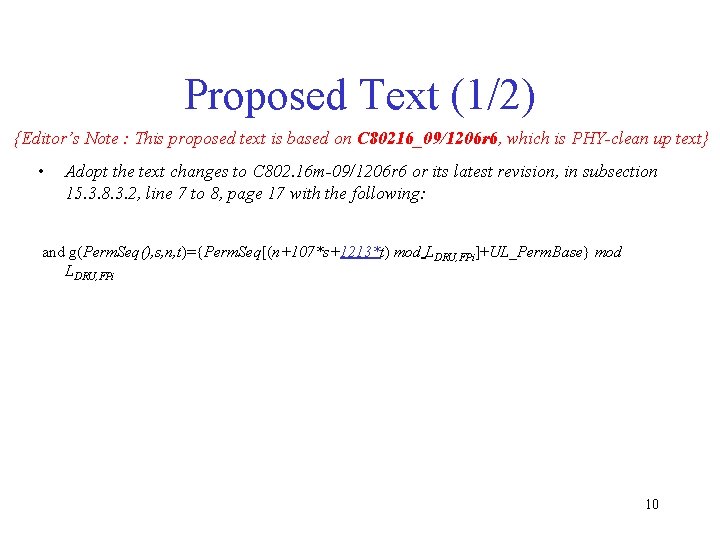
Proposed Text (1/2) {Editor’s Note : This proposed text is based on C 80216_09/1206 r 6, which is PHY-clean up text} • Adopt the text changes to C 802. 16 m-09/1206 r 6 or its latest revision, in subsection 15. 3. 8. 3. 2, line 7 to 8, page 17 with the following: and g(Perm. Seq(), s, n, t)={Perm. Seq[(n+107*s+1213*t) mod LDRU, FPi]+UL_Perm. Base} mod LDRU, FPi 10
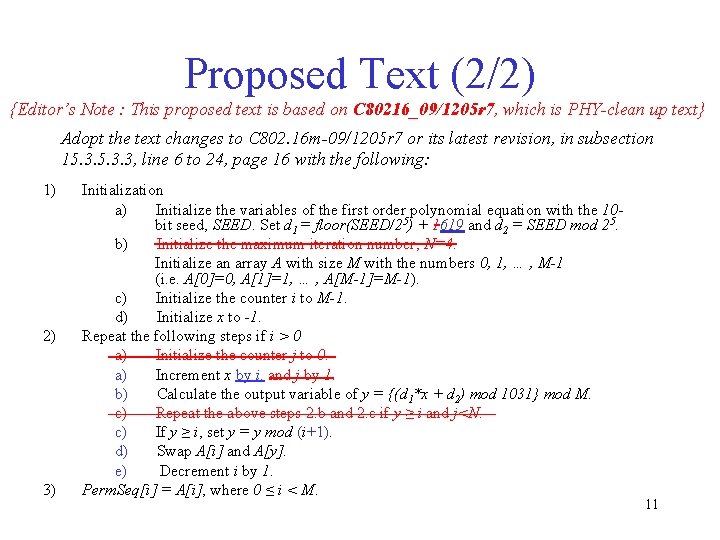
Proposed Text (2/2) {Editor’s Note : This proposed text is based on C 80216_09/1205 r 7, which is PHY-clean up text} Adopt the text changes to C 802. 16 m-09/1205 r 7 or its latest revision, in subsection 15. 3. 3, line 6 to 24, page 16 with the following: 1) 2) 3) Initialization a) Initialize the variables of the first order polynomial equation with the 10 bit seed, SEED. Set d 1 = floor(SEED/25) + 1619 and d 2 = SEED mod 25. b) Initialize the maximum iteration number, N=4. Initialize an array A with size M with the numbers 0, 1, … , M-1 (i. e. A[0]=0, A[1]=1, … , A[M-1]=M-1). c) Initialize the counter i to M-1. d) Initialize x to -1. Repeat the following steps if i > 0 a) Initialize the counter j to 0. a) Increment x by i. and j by 1. b) Calculate the output variable of y = {(d 1*x + d 2) mod 1031} mod M. c) Repeat the above steps 2. b and 2. c if y ≥ i and j<N. c) If y ≥ i, set y = y mod (i+1). d) Swap A[i] and A[y]. e) Decrement i by 1. Perm. Seq[i] = A[i], where 0 ≤ i < M. 11
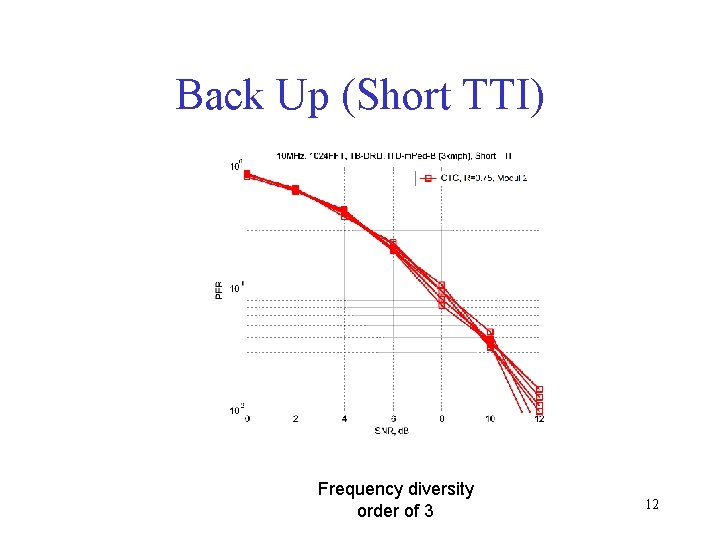
Back Up (Short TTI) Frequency diversity order of 3 12
Link Level Simulation Results with Proposed Remedy 13