
Random Numbers Zachary Neyland Definitions Random number a
Random Numbers Zachary Neyland
Definitions • Random number – a random number is a number that is generated by a process whose outcome is unpredictable and typically cannot be reproduced • Seed – starts the process for generating random numbers • Period – the length a given series of random numbers has before repeating a number
Types of Random Number Generators • Pseudo-Random Number Generators – Not truly random • True Random Number Generators – Extract randomness from physical phenomena
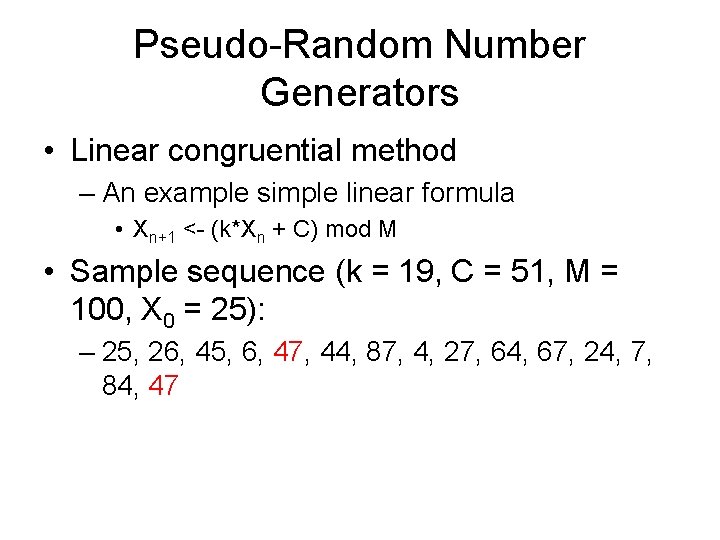
Pseudo-Random Number Generators • Linear congruential method – An example simple linear formula • Xn+1 <- (k*Xn + C) mod M • Sample sequence (k = 19, C = 51, M = 100, X 0 = 25): – 25, 26, 45, 6, 47, 44, 87, 4, 27, 64, 67, 24, 7, 84, 47
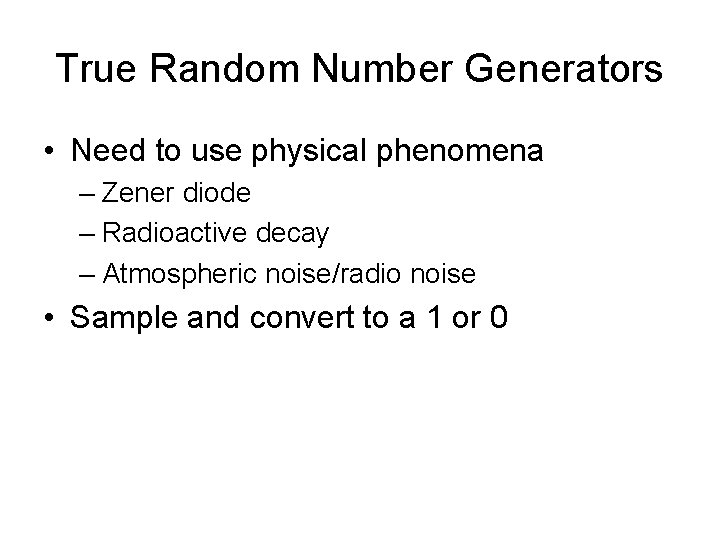
True Random Number Generators • Need to use physical phenomena – Zener diode – Radioactive decay – Atmospheric noise/radio noise • Sample and convert to a 1 or 0
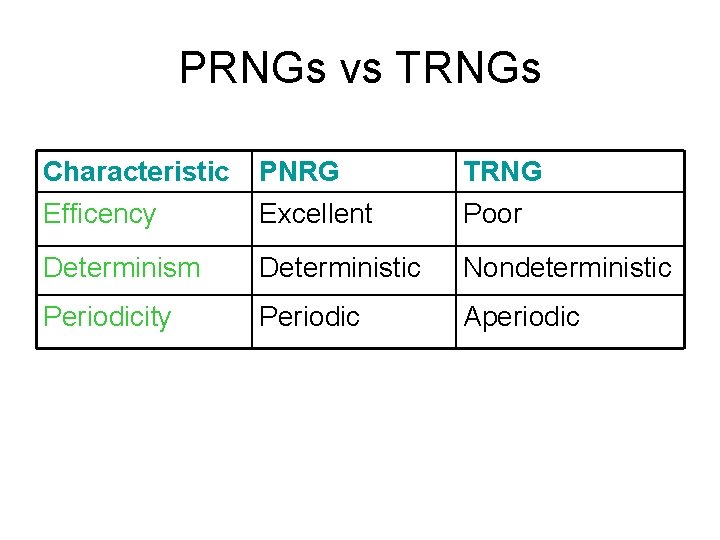
PRNGs vs TRNGs Characteristic Efficency PNRG Excellent TRNG Poor Determinism Deterministic Nondeterministic Periodicity Periodic Aperiodic
OH GOD MY BRAIN • Impossible to verify that a given number was produced randomly • Very easy to determine if a sequence of infinite length is random • Random if quantity of information it contains is also infinite
Applications of Random Numbers • Cryptology/Security • Game and gambling • Random Sampling (drug screening, exam questions) • Lotteries
References • http: //www. random. org • A. K. Dewdney The (new) Turing omnibus, New York Henry Holt and Company
- Slides: 9