
Random numbers and the central limit theorem Alberto
Random numbers and the central limit theorem Alberto García Javier Junquera

Bibliography Cambridge University Press, Cambridge, 2002 ISBN 0 521 65314 2
Physical processes with probabilistic character Certain physical processes do have a probabilistic character Desintegration of atomic nuclei: The dynamic (based on Quantum Mechanics) is strictly probabilistic Brownian movement of a particle in a liquid: We do not know in detail the dynamical variables of all the particles involved in the problem We need to base our knowledge in new laws that do not rely on dynamical variables with determined values, but with probabilistic distributions Starting from the probabilistic distribution, it is possible to obtain well defined averages of physical magnitudes, especially if we deal with very large number of particles
The stochastic oracle Computers are (or at least should be) totally predictible Given some data and a program to operate with them, the results could be exactly reproduced But imagine, that we couple our code with a special module that generates randomness program randomness real : : x do call random_number(x) print "(f 10. 6)" , x enddo end program randomness $<your compiler> -o randomness. x randomness. f 90 $. /randomness The output of the subroutine randomness is a real number, uniformly distributed in the interval "Anyone who considers arithmetical methods of producing random digits is, of course, in a state of sin. ” (John von Neumann)
Probability distribution The subroutine “random number” generates a uniform distribution of real numbers in The probability of occurrence is given by This is a continuous probability distribution. It has to be used as a “density”, i. e. , The probability of having a number in is The probability of obtaining a predefined exact number is 0
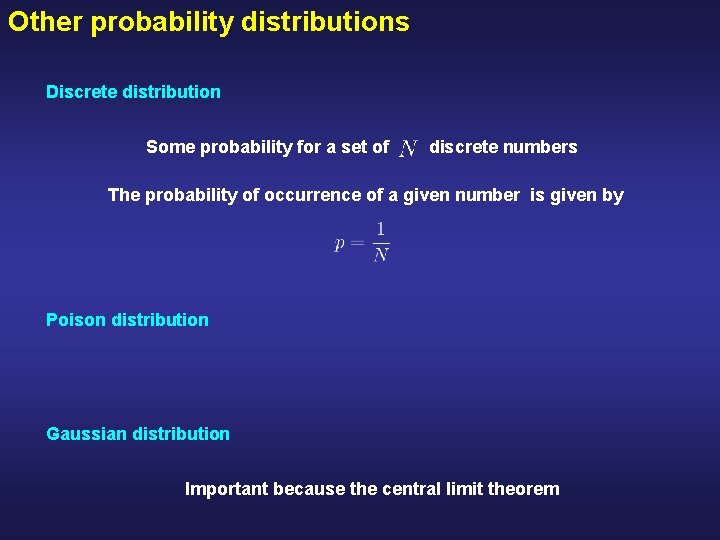
Other probability distributions Discrete distribution Some probability for a set of discrete numbers The probability of occurrence of a given number is given by Poison distribution Gaussian distribution Important because the central limit theorem

Reproduced with permission of Cedric Weber, from King’s College London http: //nms. kcl. ac. uk/cedric. weber/index. html

Reproduced with permission of Cedric Weber, from King’s College London http: //nms. kcl. ac. uk/cedric. weber/index. html

Reproduced with permission of Cedric Weber, from King’s College London http: //nms. kcl. ac. uk/cedric. weber/index. html

Reproduced with permission of Cedric Weber, from King’s College London http: //nms. kcl. ac. uk/cedric. weber/index. html

Reproduced with permission of Cedric Weber, from King’s College London http: //nms. kcl. ac. uk/cedric. weber/index. html

Reproduced with permission of Cedric Weber, from King’s College London http: //nms. kcl. ac. uk/cedric. weber/index. html
Reproduced with permission of Cedric Weber, from King’s College London http: //nms. kcl. ac. uk/cedric. weber/index. html

Reproduced with permission of Cedric Weber, from King’s College London http: //nms. kcl. ac. uk/cedric. weber/index. html

Reproduced with permission of Cedric Weber, from King’s College London http: //nms. kcl. ac. uk/cedric. weber/index. html

Reproduced with permission of Cedric Weber, from King’s College London http: //nms. kcl. ac. uk/cedric. weber/index. html
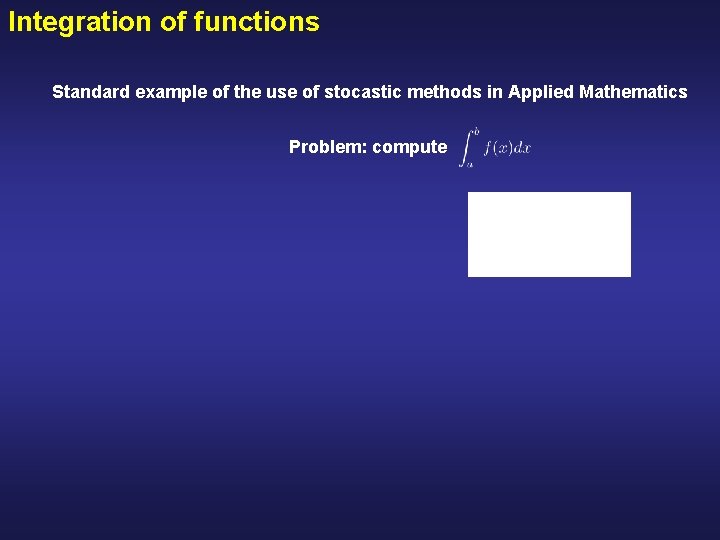
Integration of functions Standard example of the use of stocastic methods in Applied Mathematics Problem: compute
Integration of functions Reproduced with permission of Cedric Weber, from King’s College London http: //nms. kcl. ac. uk/cedric. weber/index. html

Integration of functions Reproduced with permission of Cedric Weber, from King’s College London http: //nms. kcl. ac. uk/cedric. weber/index. html
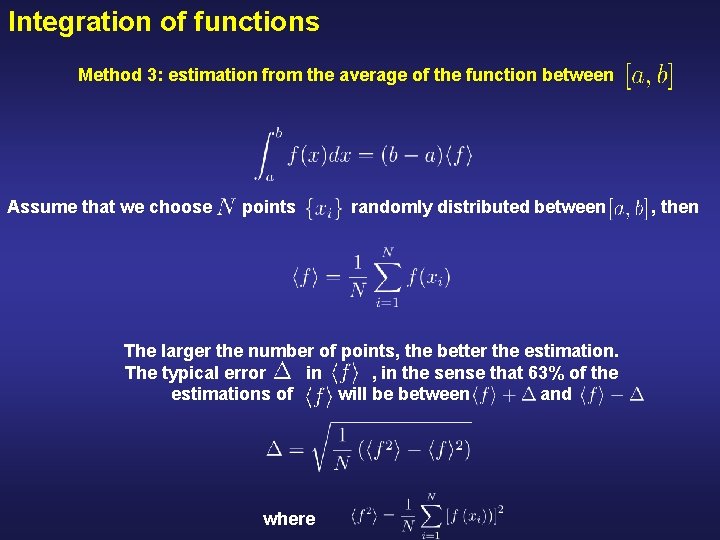
Integration of functions Method 3: estimation from the average of the function between Assume that we choose points randomly distributed between The larger the number of points, the better the estimation. The typical error in , in the sense that 63% of the estimations of will be between and where , then
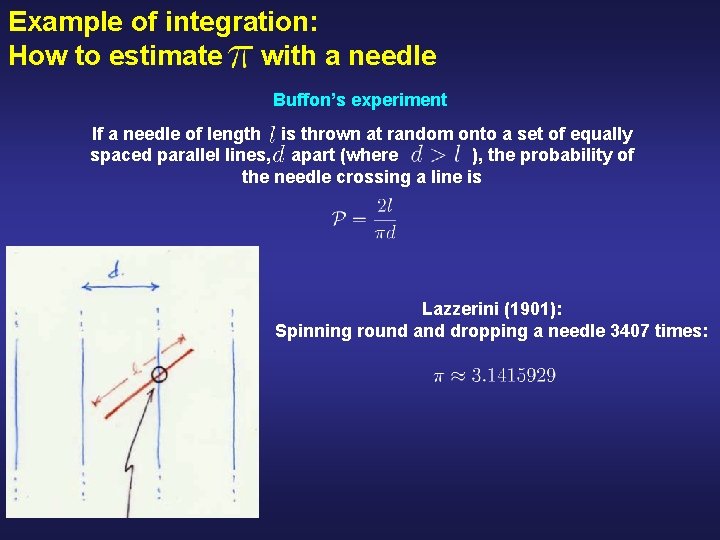
Example of integration: How to estimate with a needle Buffon’s experiment If a needle of length is thrown at random onto a set of equally spaced parallel lines, apart (where ), the probability of the needle crossing a line is Lazzerini (1901): Spinning round and dropping a needle 3407 times:
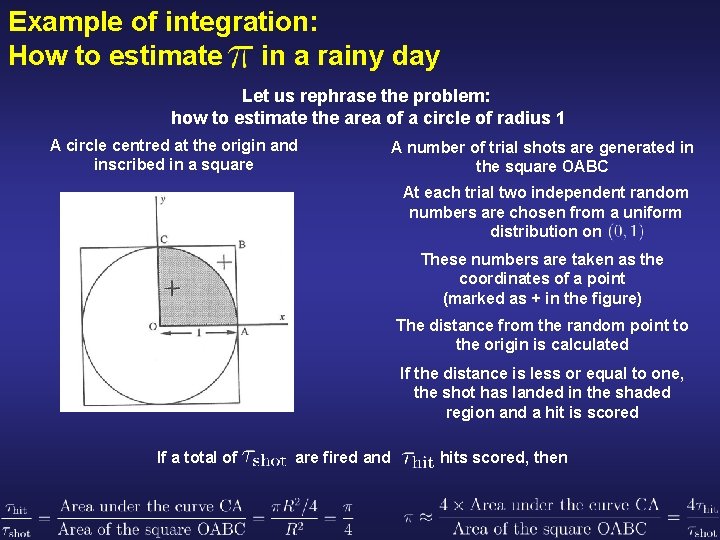
Example of integration: How to estimate in a rainy day Let us rephrase the problem: how to estimate the area of a circle of radius 1 A circle centred at the origin and inscribed in a square A number of trial shots are generated in the square OABC At each trial two independent random numbers are chosen from a uniform distribution on These numbers are taken as the coordinates of a point (marked as + in the figure) The distance from the random point to the origin is calculated If the distance is less or equal to one, the shot has landed in the shaded region and a hit is scored If a total of are fired and hits scored, then
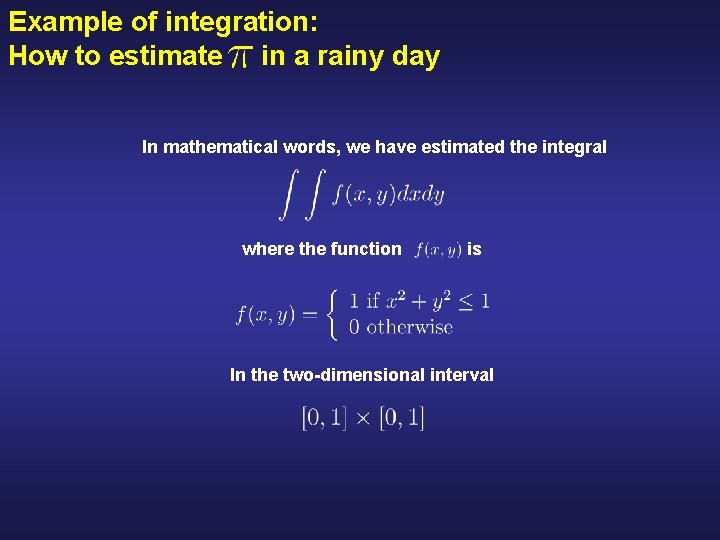
Example of integration: How to estimate in a rainy day In mathematical words, we have estimated the integral where the function is In the two-dimensional interval
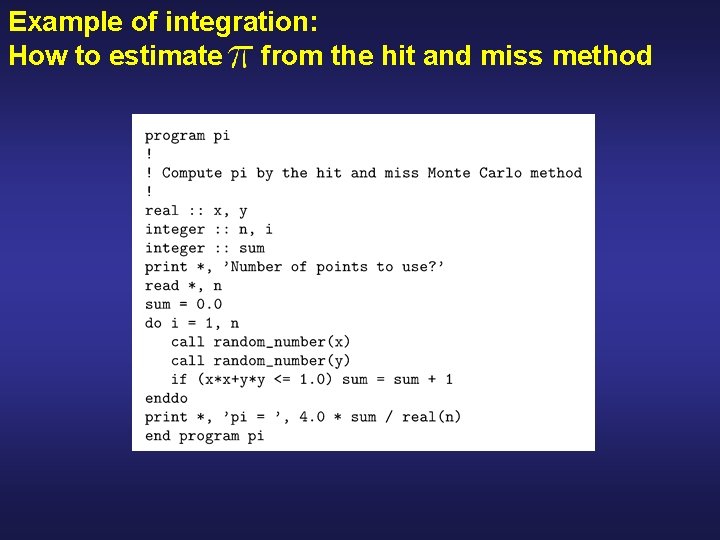
Example of integration: How to estimate from the hit and miss method
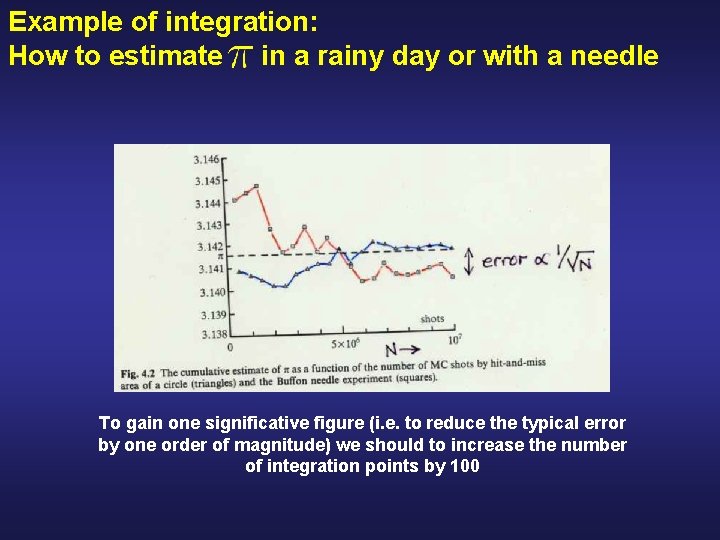
Example of integration: How to estimate in a rainy day or with a needle To gain one significative figure (i. e. to reduce the typical error by one order of magnitude) we should to increase the number of integration points by 100

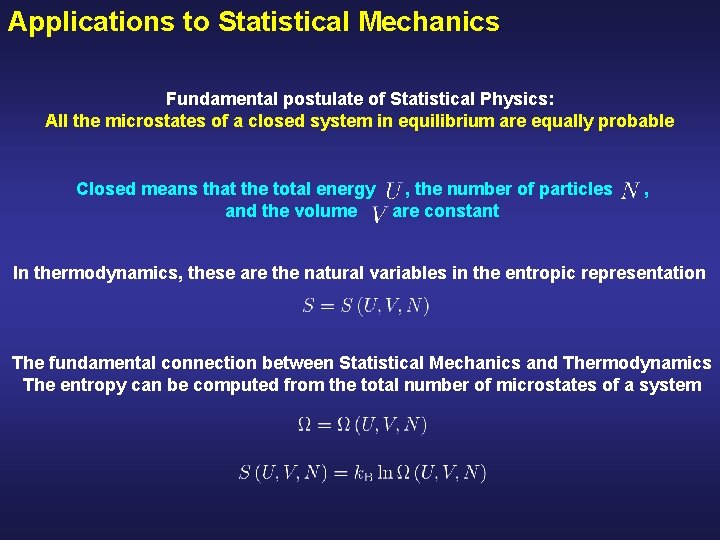
Applications to Statistical Mechanics Fundamental postulate of Statistical Physics: All the microstates of a closed system in equilibrium are equally probable Closed means that the total energy , the number of particles and the volume are constant , In thermodynamics, these are the natural variables in the entropic representation The fundamental connection between Statistical Mechanics and Thermodynamics The entropy can be computed from the total number of microstates of a system
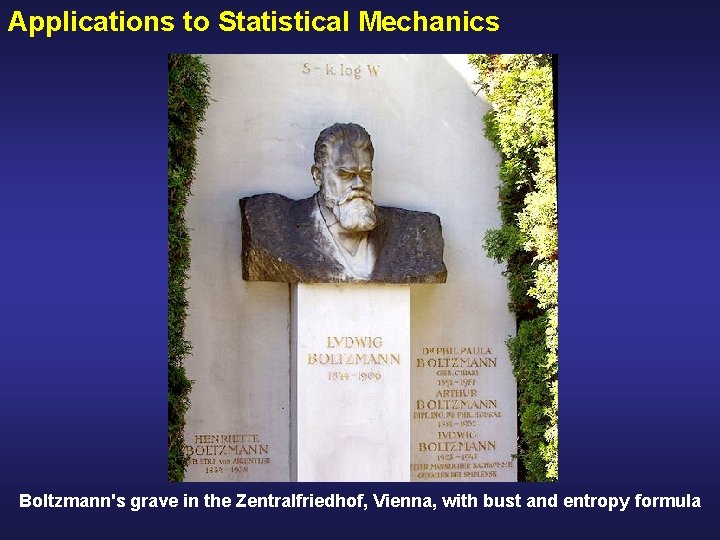
Applications to Statistical Mechanics Boltzmann's grave in the Zentralfriedhof, Vienna, with bust and entropy formula
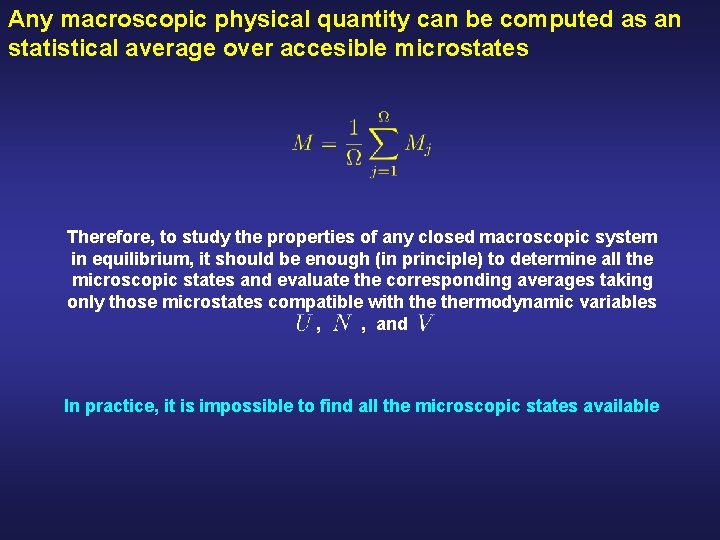
Any macroscopic physical quantity can be computed as an statistical average over accesible microstates Therefore, to study the properties of any closed macroscopic system in equilibrium, it should be enough (in principle) to determine all the microscopic states and evaluate the corresponding averages taking only those microstates compatible with thermodynamic variables , , and In practice, it is impossible to find all the microscopic states available
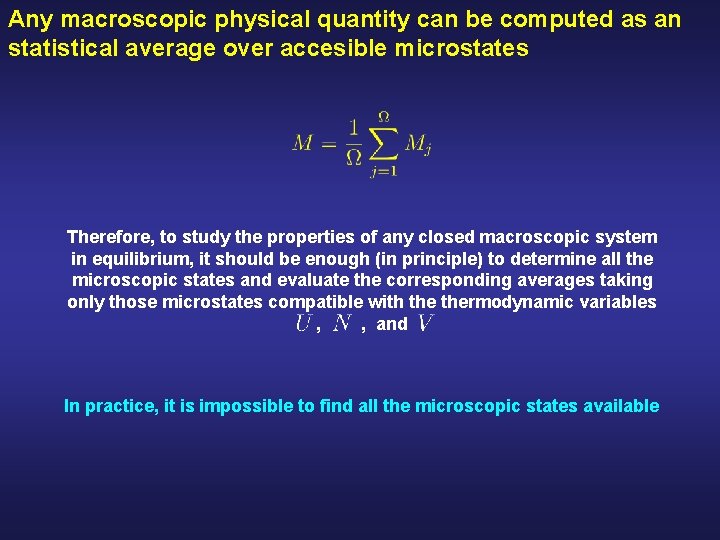
Any macroscopic physical quantity can be computed as an statistical average over accesible microstates Therefore, to study the properties of any closed macroscopic system in equilibrium, it should be enough (in principle) to determine all the microscopic states and evaluate the corresponding averages taking only those microstates compatible with thermodynamic variables , , and In practice, it is impossible to find all the microscopic states available
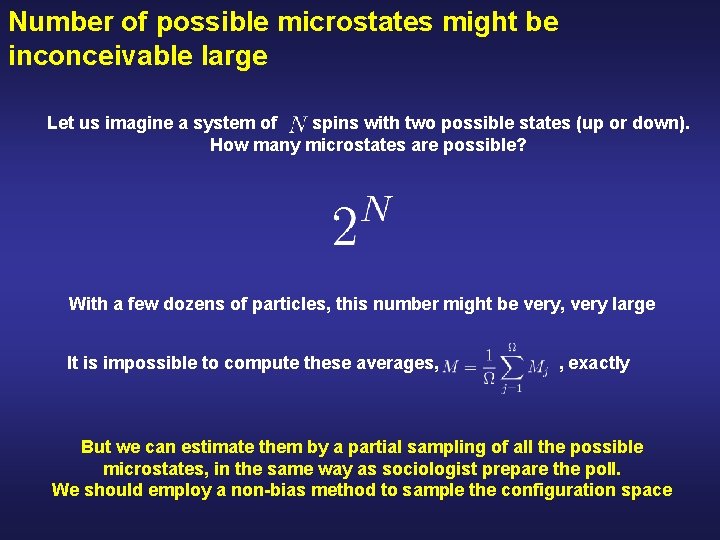
Number of possible microstates might be inconceivable large Let us imagine a system of spins with two possible states (up or down). How many microstates are possible? With a few dozens of particles, this number might be very, very large It is impossible to compute these averages, , exactly But we can estimate them by a partial sampling of all the possible microstates, in the same way as sociologist prepare the poll. We should employ a non-bias method to sample the configuration space
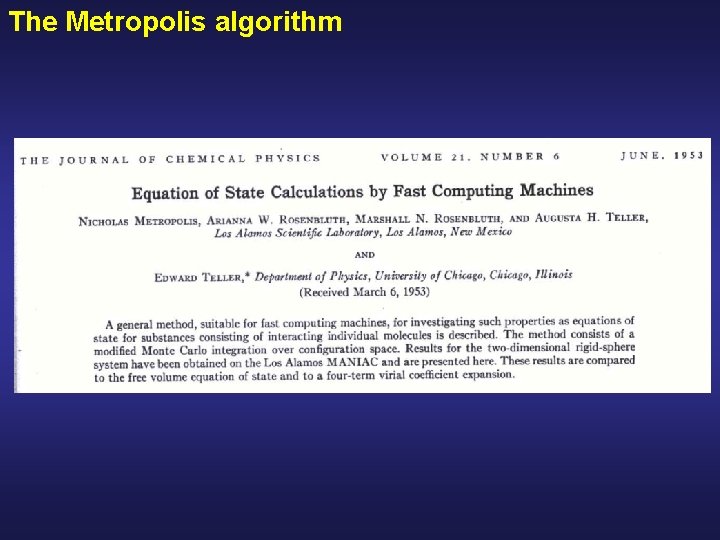
The Metropolis algorithm
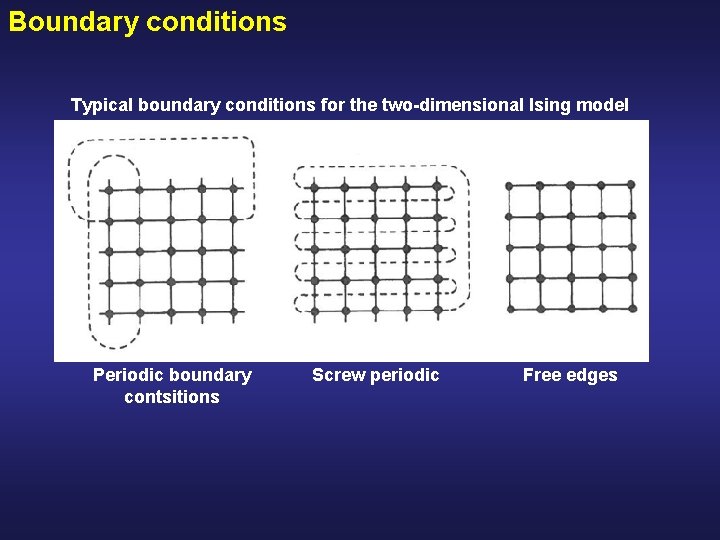
Boundary conditions Typical boundary conditions for the two-dimensional Ising model Periodic boundary contsitions Screw periodic Free edges
- Slides: 33