
Random Number Generation l Desirable Attributes Uniformity Independence
Random Number Generation l Desirable Attributes: – Uniformity – Independence – Efficiency – Replicability – Long Cycle Length Random Numbers 1

Random Number Generation (cont. ) Each random number Rt is an independent sample drawn from a continuous uniform distribution between 0 and 1 ì 1 , 0 £ x £ 1 pdf: f(x) = í î 0 , otherwise Random Numbers 2

Random Number Generation (cont. ) PDF: f(x) 1 0 x Random Numbers 3
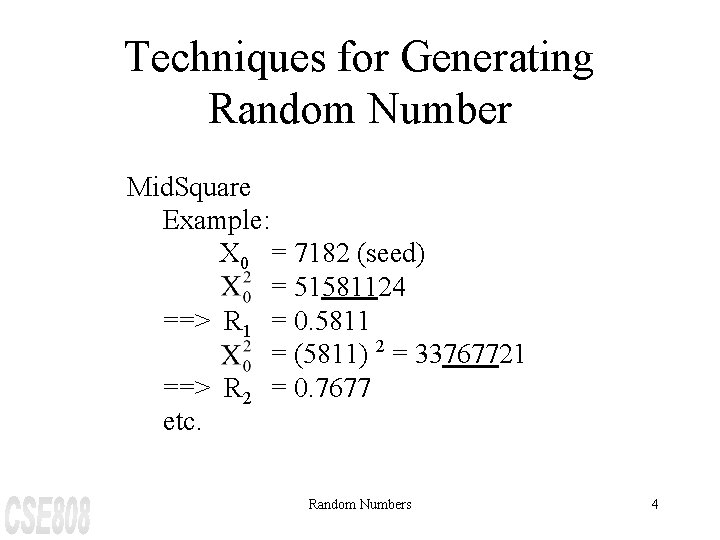
Techniques for Generating Random Number Mid. Square Example: X 0 = 7182 (seed) = 51581124 ==> R 1 = 0. 5811 = (5811) 2 = 33767721 ==> R 2 = 0. 7677 etc. Random Numbers 4
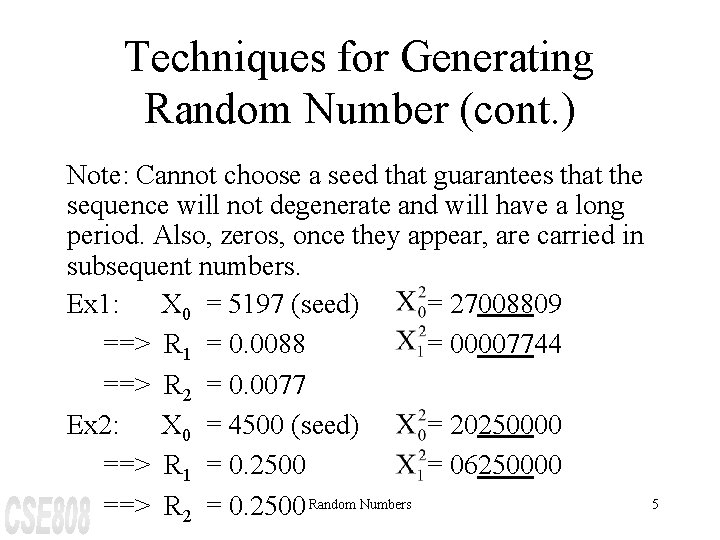
Techniques for Generating Random Number (cont. ) Note: Cannot choose a seed that guarantees that the sequence will not degenerate and will have a long period. Also, zeros, once they appear, are carried in subsequent numbers. Ex 1: X 0 = 5197 (seed) = 27008809 ==> R 1 = 0. 0088 = 00007744 ==> R 2 = 0. 0077 Ex 2: X 0 = 4500 (seed) = 20250000 ==> R 1 = 0. 2500 = 06250000 5 ==> R 2 = 0. 2500 Random Numbers

Techniques for Generating Random Number (cont. ) l Multiplicative Congruential Method: Basic Relationship Xi+1 = a Xi (mod m), where a ³ 0 and m ³ 0 Most natural choice for m is one that equals to the capacity of a computer word. m = 2 b (binary machine), where b is the number of bits in the computer word. m = 10 d (decimal machine), where d is the number of digits in the computer word. Random Numbers 6
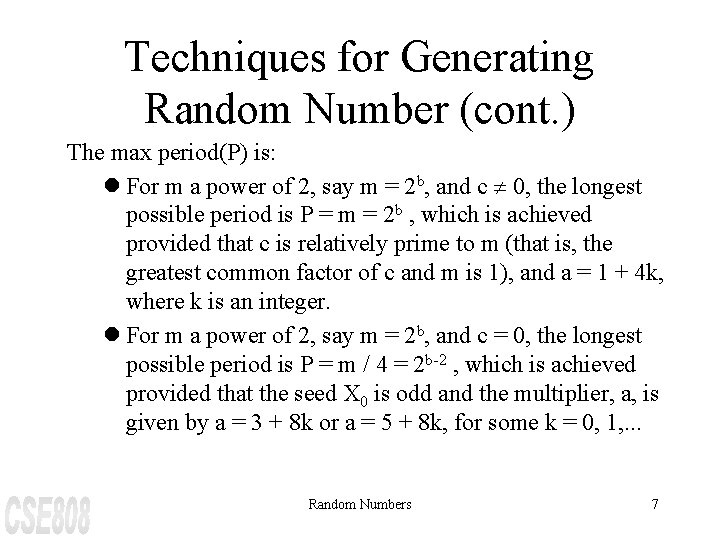
Techniques for Generating Random Number (cont. ) The max period(P) is: l For m a power of 2, say m = 2 b, and c ¹ 0, the longest possible period is P = m = 2 b , which is achieved provided that c is relatively prime to m (that is, the greatest common factor of c and m is 1), and a = 1 + 4 k, where k is an integer. l For m a power of 2, say m = 2 b, and c = 0, the longest possible period is P = m / 4 = 2 b-2 , which is achieved provided that the seed X 0 is odd and the multiplier, a, is given by a = 3 + 8 k or a = 5 + 8 k, for some k = 0, 1, . . . Random Numbers 7

Techniques for Generating Random Number (cont. ) l For m a prime number and c = 0, the longest possible period is P = m - 1, which is achieved provided that the multiplier, a, has the property that the smallest integer k such that ak - 1 is divisible by m is k = m - 1, Random Numbers 8

Techniques for Generating Random Number (cont. ) (Example) Using the multiplicative congruential method, find the period of the generator for a = 13, m = 26, and X 0 = 1, 2, 3, and 4. The solution is given in next slide. When the seed is 1 and 3, the sequence has period 16. However, a period of length eight is achieved when the seed is 2 and a period of length four occurs when the seed is 4. Random Numbers 9
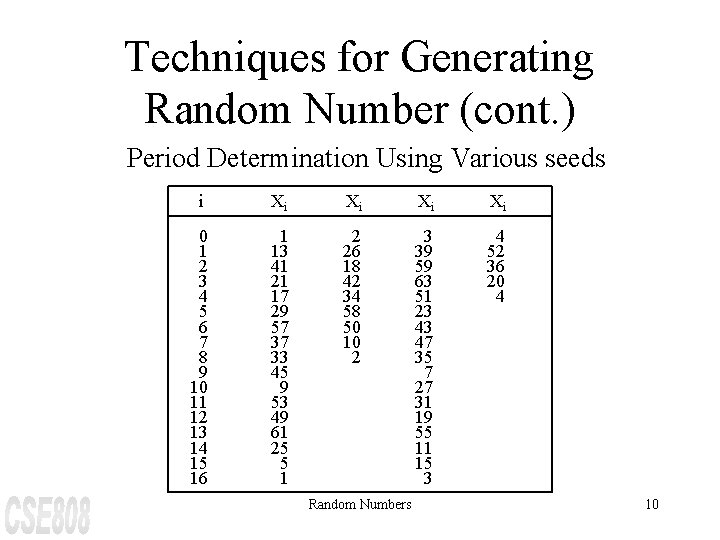
Techniques for Generating Random Number (cont. ) Period Determination Using Various seeds i Xi Xi 0 1 2 3 4 5 6 7 8 9 10 11 12 13 14 15 16 1 13 41 21 17 29 57 37 33 45 9 53 49 61 25 5 1 2 26 18 42 34 58 50 10 2 3 39 59 63 51 23 43 47 35 7 27 31 19 55 11 15 3 4 52 36 20 4 Random Numbers 10
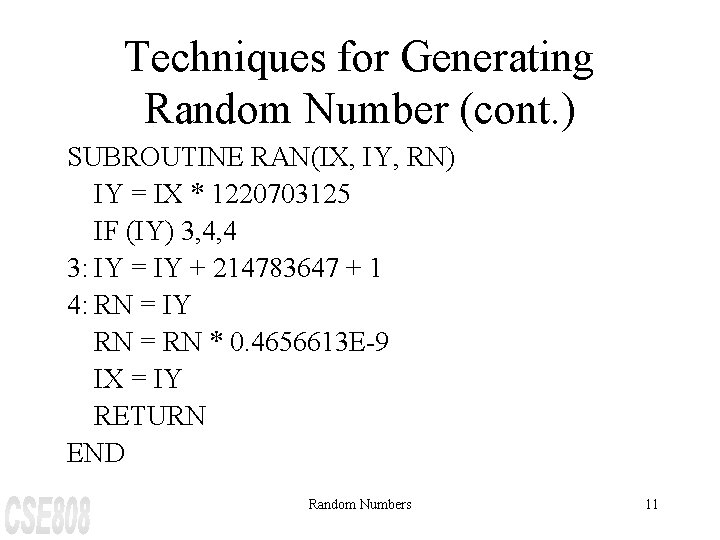
Techniques for Generating Random Number (cont. ) SUBROUTINE RAN(IX, IY, RN) IY = IX * 1220703125 IF (IY) 3, 4, 4 3: IY = IY + 214783647 + 1 4: RN = IY RN = RN * 0. 4656613 E-9 IX = IY RETURN END Random Numbers 11

Techniques for Generating Random Number (cont. ) l Linear Congruential Method: Xi+1 = (a. Xi + c) mod m, i = 0, 1, 2. . (Example) let X 0 = 27, a = 17, c = 43, and m = 100, then X 1 = (17*27 + 43) mod 100 = 2 R 1 = 2 / 100 = 0. 02 X 2 = (17*2 + 43) mod 100 = 77 R 2 = 77 / 100 = 0. 77. . Random Numbers 12
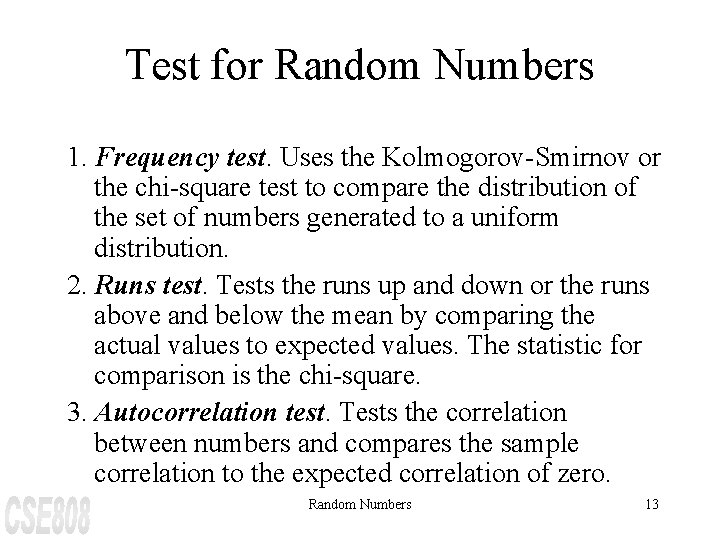
Test for Random Numbers 1. Frequency test. Uses the Kolmogorov-Smirnov or the chi-square test to compare the distribution of the set of numbers generated to a uniform distribution. 2. Runs test. Tests the runs up and down or the runs above and below the mean by comparing the actual values to expected values. The statistic for comparison is the chi-square. 3. Autocorrelation test. Tests the correlation between numbers and compares the sample correlation to the expected correlation of zero. Random Numbers 13
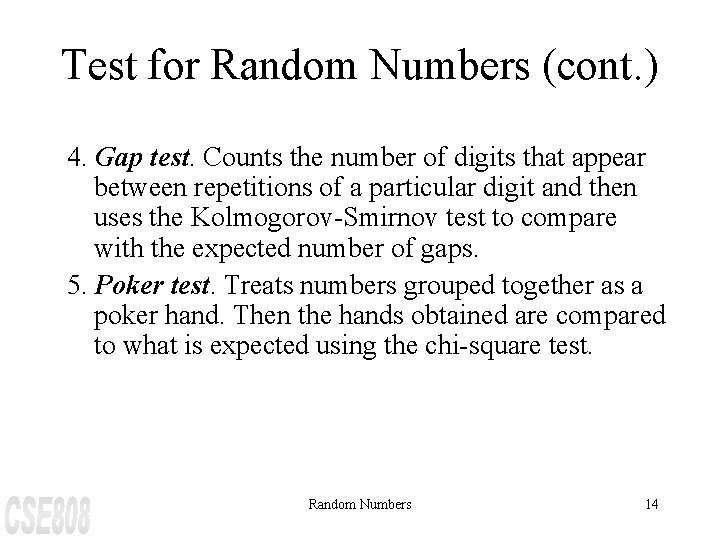
Test for Random Numbers (cont. ) 4. Gap test. Counts the number of digits that appear between repetitions of a particular digit and then uses the Kolmogorov-Smirnov test to compare with the expected number of gaps. 5. Poker test. Treats numbers grouped together as a poker hand. Then the hands obtained are compared to what is expected using the chi-square test. Random Numbers 14
Test for Random Numbers (cont. ) In testing for uniformity, the hypotheses are as follows: H 0: Ri ~ U[0, 1] H 1: Ri ¹ U[0, 1] The null hypothesis, H 0, reads that the numbers are distributed uniformly on the interval [0, 1]. Random Numbers 15
Test for Random Numbers (cont. ) In testing for independence, the hypotheses are as follows; H 0: Ri ~ independently H 1: Ri ¹ independently This null hypothesis, H 0, reads that the numbers are independent. Failure to reject the null hypothesis means that no evidence of dependence has been detected on the basis of this test. This does not imply that further testing of the generator for independence is unnecessary. Random Numbers 16

Test for Random Numbers (cont. ) l. Level of significance a a = P(reject H 0 | H 0 true) Frequently, a is set to 0. 01 or 0. 05 (Hypothesis) Actually True Actually False Accept 1 -a b (Type II error) Reject a (Type I error) Random Numbers 1 -b 17
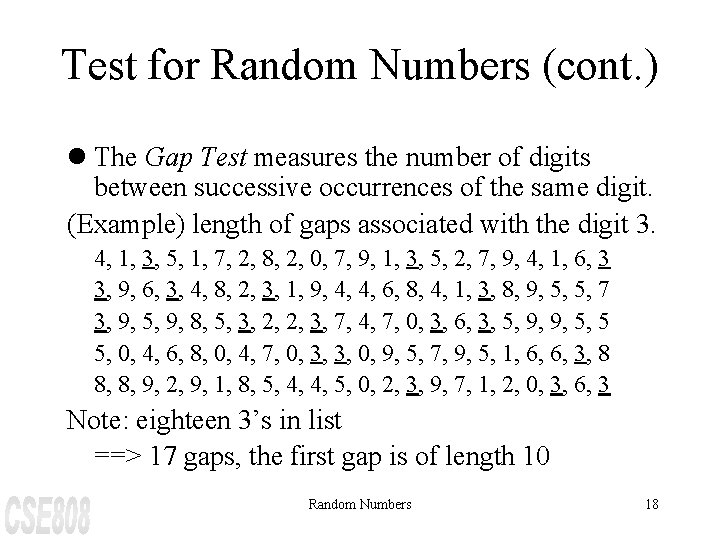
Test for Random Numbers (cont. ) l The Gap Test measures the number of digits between successive occurrences of the same digit. (Example) length of gaps associated with the digit 3. 4, 1, 3, 5, 1, 7, 2, 8, 2, 0, 7, 9, 1, 3, 5, 2, 7, 9, 4, 1, 6, 3 3, 9, 6, 3, 4, 8, 2, 3, 1, 9, 4, 4, 6, 8, 4, 1, 3, 8, 9, 5, 5, 7 3, 9, 5, 9, 8, 5, 3, 2, 2, 3, 7, 4, 7, 0, 3, 6, 3, 5, 9, 9, 5, 5 5, 0, 4, 6, 8, 0, 4, 7, 0, 3, 3, 0, 9, 5, 7, 9, 5, 1, 6, 6, 3, 8 8, 8, 9, 2, 9, 1, 8, 5, 4, 4, 5, 0, 2, 3, 9, 7, 1, 2, 0, 3, 6, 3 Note: eighteen 3’s in list ==> 17 gaps, the first gap is of length 10 Random Numbers 18
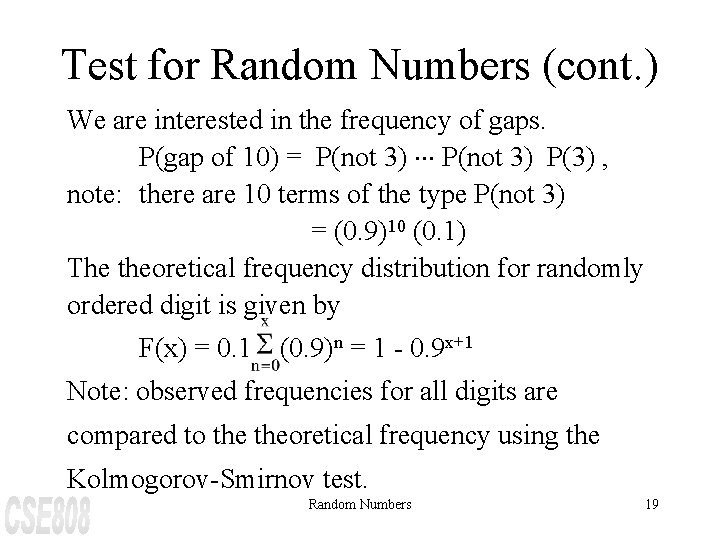
Test for Random Numbers (cont. ) We are interested in the frequency of gaps. P(gap of 10) = P(not 3) ××× P(not 3) P(3) , note: there are 10 terms of the type P(not 3) = (0. 9)10 (0. 1) The theoretical frequency distribution for randomly ordered digit is given by F(x) = 0. 1 (0. 9)n = 1 - 0. 9 x+1 Note: observed frequencies for all digits are compared to theoretical frequency using the Kolmogorov-Smirnov test. Random Numbers 19
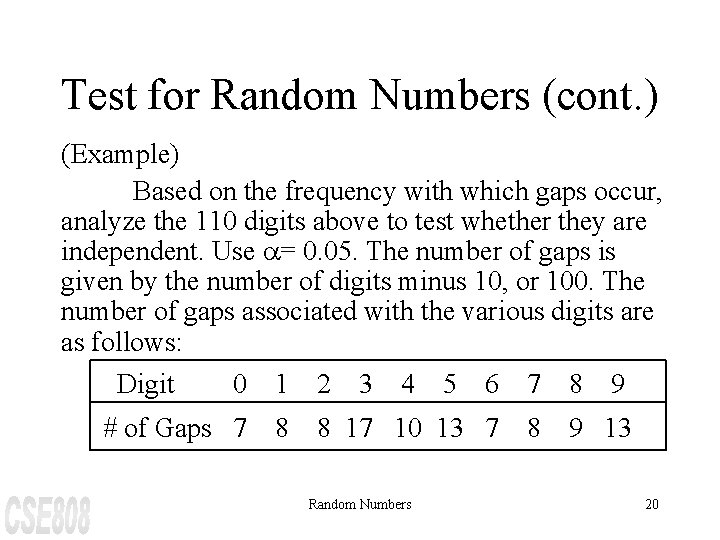
Test for Random Numbers (cont. ) (Example) Based on the frequency with which gaps occur, analyze the 110 digits above to test whether they are independent. Use a= 0. 05. The number of gaps is given by the number of digits minus 10, or 100. The number of gaps associated with the various digits are as follows: Digit 0 1 2 3 4 6 7 8 # of Gaps 7 8 8 17 10 13 7 8 9 13 Random Numbers 5 9 20

Test for Random Numbers (cont. ) Gap Test Example Gap Length Frequency 0 -3 4 -7 8 -11 12 -15 16 -19 20 -23 24 -27 28 -31 32 -35 36 -39 40 -43 44 -47 35 22 17 9 5 6 3 0 0 2 0 1 Relative Cum. Relative Frequency F(x) |F(x) - SN(x)| 0. 35 0. 22 0. 17 0. 09 0. 05 0. 06 0. 03 0. 00 0. 02 0. 00 0. 01 0. 35 0. 57 0. 74 0. 83 0. 88 0. 94 0. 97 0. 99 1. 00 Random Numbers 0. 3439 0. 5695 0. 7176 0. 8147 0. 8784 0. 9202 0. 9497 0. 9657 0. 9775 0. 9852 0. 9903 0. 9936 0. 0061 0. 0005 0. 0224 0. 0153 0. 0016 0. 0198 0. 0223 0. 0043 0. 0075 0. 0043 0. 0003 0. 0064 21

Test for Random Numbers (cont. ) The critical value of D is given by D 0. 05 = 1. 36 / Ö 100 = 0. 136 Since D = max |F(x) - SN(x)| = 0. 0224 is less than D 0. 05, do not reject the hypothesis of independence on the basis of this test. Random Numbers 22

Test for Random Numbers (cont. ) l Run Tests (Up and Down) Consider the 40 numbers; both the Kolmogorov. Smirnov and Chi-square would indicate that the numbers are uniformly distributed. But, not so. 0. 08 0. 11 0. 02 0. 12 0. 09 0. 16 0. 09 0. 13 0. 23 0. 18 0. 30 0. 29 0. 31 0. 32 0. 36 0. 42 0. 41 0. 45 0. 38 0. 55 0. 53 0. 47 0. 54 Random Numbers 0. 58 0. 71 0. 69 0. 68 0. 72 0. 73 0. 74 0. 86 0. 89 0. 74 0. 91 0. 88 0. 91 0. 84 0. 95 0. 91 23
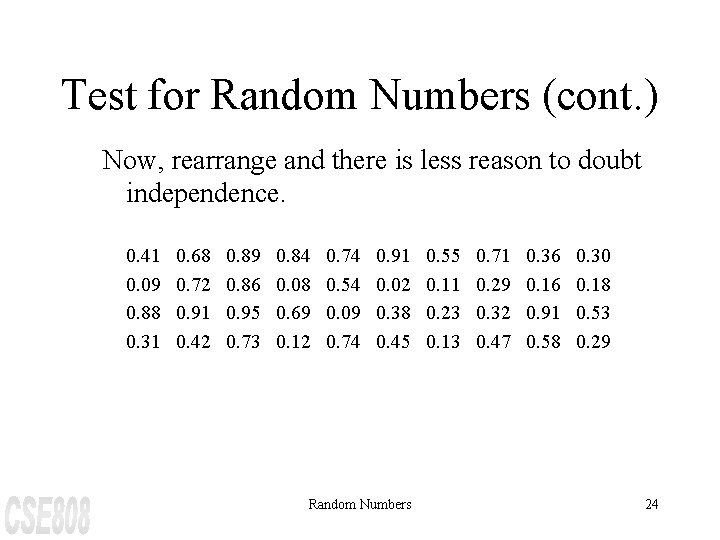
Test for Random Numbers (cont. ) Now, rearrange and there is less reason to doubt independence. 0. 41 0. 09 0. 88 0. 31 0. 68 0. 72 0. 91 0. 42 0. 89 0. 86 0. 95 0. 73 0. 84 0. 08 0. 69 0. 12 0. 74 0. 54 0. 09 0. 74 0. 91 0. 02 0. 38 0. 45 Random Numbers 0. 55 0. 11 0. 23 0. 13 0. 71 0. 29 0. 32 0. 47 0. 36 0. 16 0. 91 0. 58 0. 30 0. 18 0. 53 0. 29 24

Test for Random Numbers (cont. ) Concerns: l Number of runs l. Length of runs Note: If N is the number of numbers in a sequence, the maximum number of runs is N-1, and the minimum number of runs is one. If “a” is the total number of runs in a sequence, the mean and variance of “a” is given by Random Numbers 25
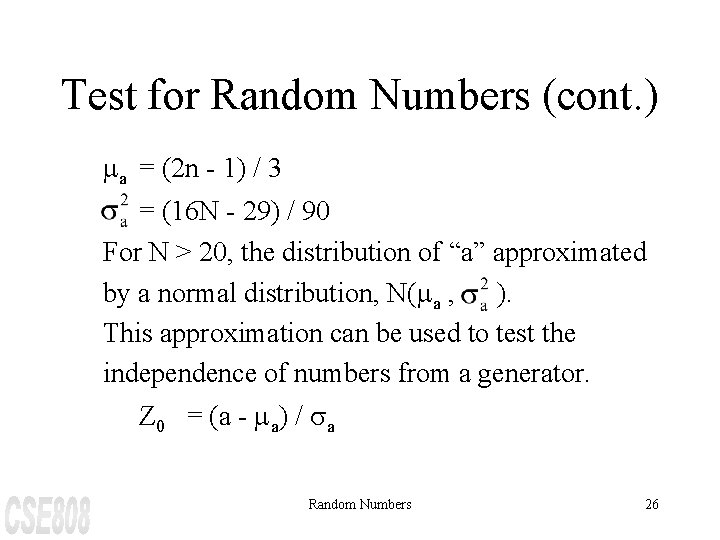
Test for Random Numbers (cont. ) ma = (2 n - 1) / 3 = (16 N - 29) / 90 For N > 20, the distribution of “a” approximated by a normal distribution, N(ma , ). This approximation can be used to test the independence of numbers from a generator. Z 0 = (a - ma) / sa Random Numbers 26
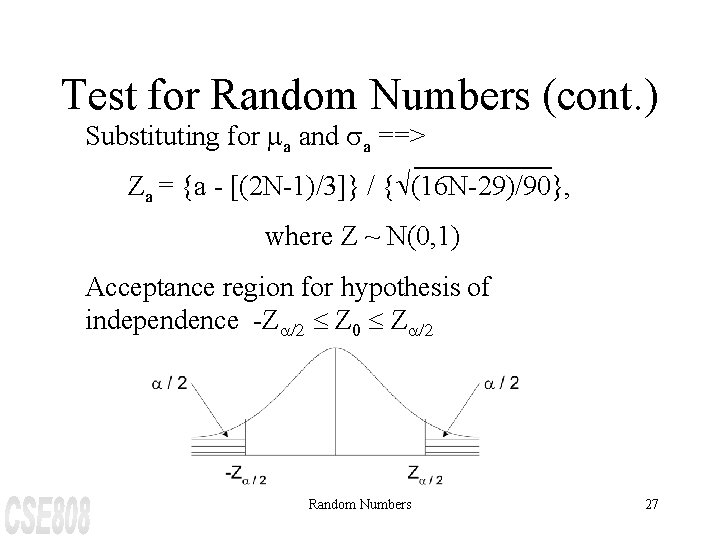
Test for Random Numbers (cont. ) Substituting for ma and sa ==> Za = {a - [(2 N-1)/3]} / {Ö(16 N-29)/90}, where Z ~ N(0, 1) Acceptance region for hypothesis of independence -Za/2 £ Z 0 £ Za/2 Random Numbers 27
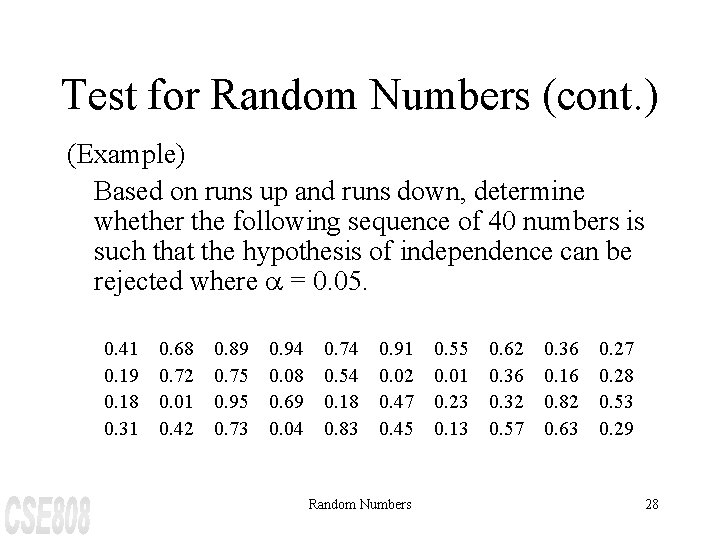
Test for Random Numbers (cont. ) (Example) Based on runs up and runs down, determine whether the following sequence of 40 numbers is such that the hypothesis of independence can be rejected where a = 0. 05. 0. 41 0. 19 0. 18 0. 31 0. 68 0. 72 0. 01 0. 42 0. 89 0. 75 0. 95 0. 73 0. 94 0. 08 0. 69 0. 04 0. 74 0. 54 0. 18 0. 83 0. 91 0. 02 0. 47 0. 45 Random Numbers 0. 55 0. 01 0. 23 0. 13 0. 62 0. 36 0. 32 0. 57 0. 36 0. 16 0. 82 0. 63 0. 27 0. 28 0. 53 0. 29 28
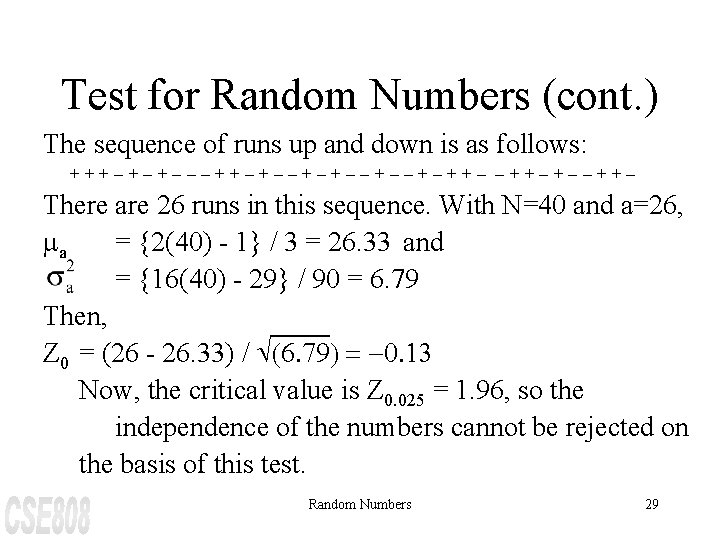
Test for Random Numbers (cont. ) The sequence of runs up and down is as follows: +++-+-+---++-+--+--+-++-+--++- There are 26 runs in this sequence. With N=40 and a=26, ma = {2(40) - 1} / 3 = 26. 33 and = {16(40) - 29} / 90 = 6. 79 Then, Z 0 = (26 - 26. 33) / Ö(6. 79) = -0. 13 Now, the critical value is Z 0. 025 = 1. 96, so the independence of the numbers cannot be rejected on the basis of this test. Random Numbers 29
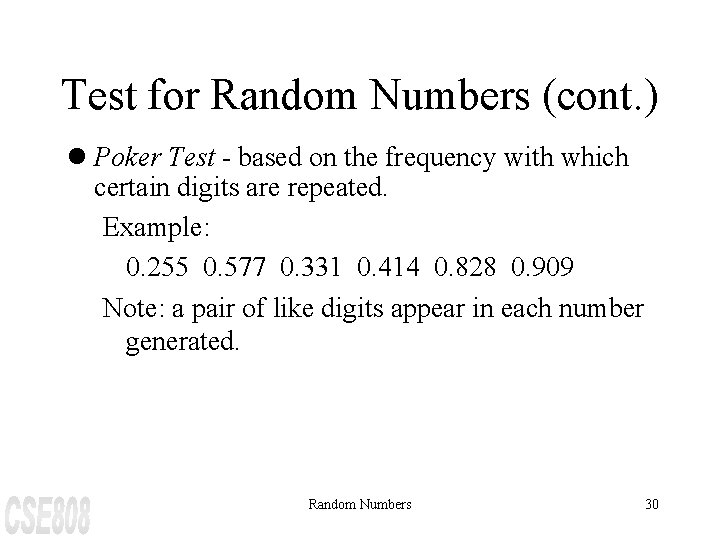
Test for Random Numbers (cont. ) l Poker Test - based on the frequency with which certain digits are repeated. Example: 0. 255 0. 577 0. 331 0. 414 0. 828 0. 909 Note: a pair of like digits appear in each number generated. Random Numbers 30
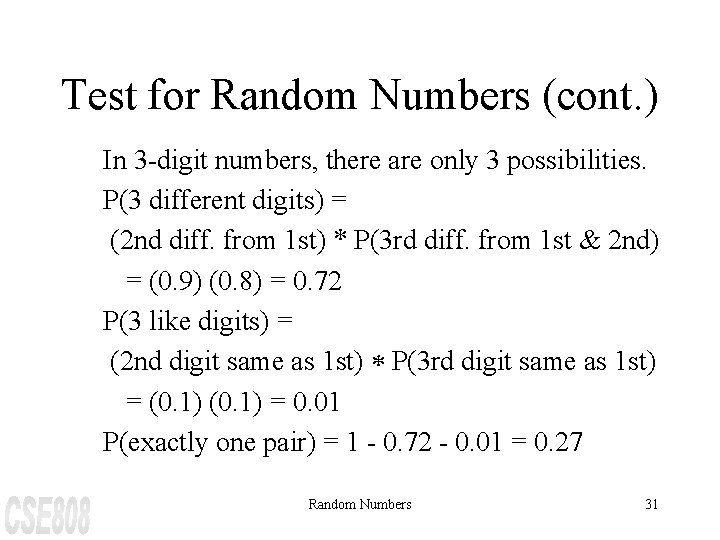
Test for Random Numbers (cont. ) In 3 -digit numbers, there are only 3 possibilities. P(3 different digits) = (2 nd diff. from 1 st) * P(3 rd diff. from 1 st & 2 nd) = (0. 9) (0. 8) = 0. 72 P(3 like digits) = (2 nd digit same as 1 st) * P(3 rd digit same as 1 st) = (0. 1) = 0. 01 P(exactly one pair) = 1 - 0. 72 - 0. 01 = 0. 27 Random Numbers 31
Test for Random Numbers (cont. ) (Example) A sequence of 1000 three-digit numbers has been generated an analysis indicates that 680 have three different digits, 289 contain exactly one pair of like digits, and 31 contain three like digits. Based on the poker test, are these numbers independent? Let a = 0. 05. The test is summarized in next table. Random Numbers 32
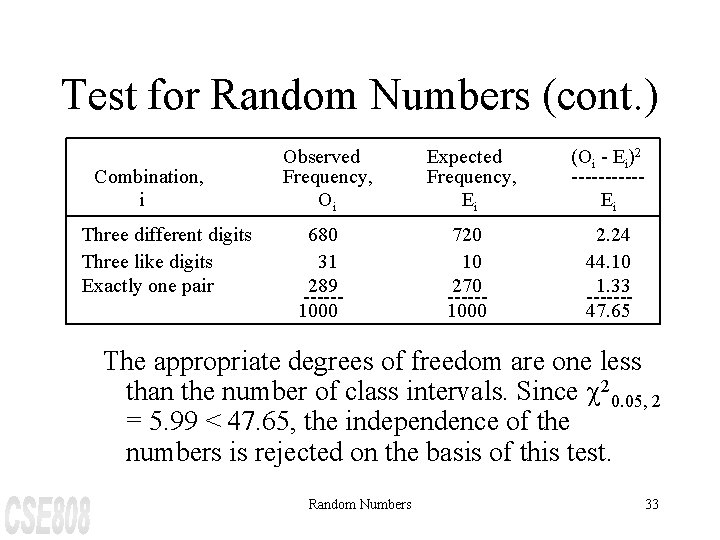
Test for Random Numbers (cont. ) Combination, i Three different digits Three like digits Exactly one pair Observed Frequency, Oi 680 31 289 -----1000 Expected Frequency, Ei (Oi - Ei)2 -----Ei 720 10 270 -----1000 2. 24 44. 10 1. 33 ------47. 65 The appropriate degrees of freedom are one less than the number of class intervals. Since c 20. 05, 2 = 5. 99 < 47. 65, the independence of the numbers is rejected on the basis of this test. Random Numbers 33
- Slides: 33