
Random Geometric Graph Diameter in the Unit Disk
- Slides: 13
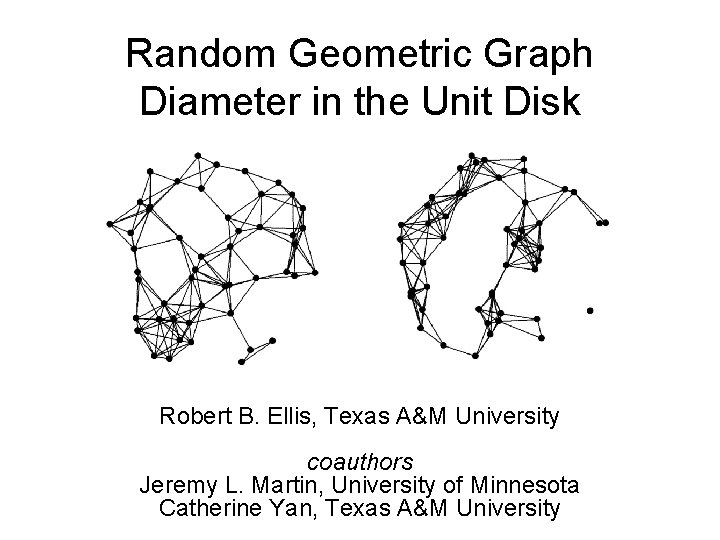
Random Geometric Graph Diameter in the Unit Disk Robert B. Ellis, Texas A&M University coauthors Jeremy L. Martin, University of Minnesota Catherine Yan, Texas A&M University
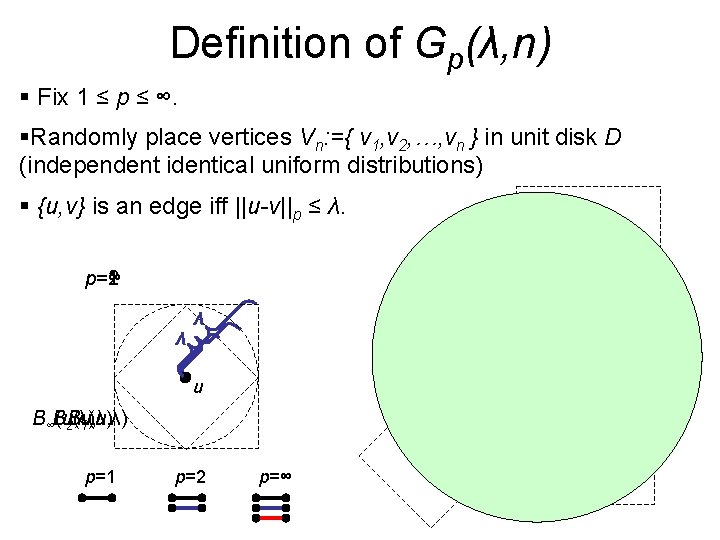
Definition of Gp(λ, n) § Fix 1 ≤ p ≤ ∞. §Randomly place vertices Vn: ={ v 1, v 2, …, vn } in unit disk D (independent identical uniform distributions) § {u, v} is an edge iff ||u-v||p ≤ λ. p=1 p=∞ p=2 λ λ u B∞B (u, λ) 2 B 1(u, λ) p=1 p=2 p=∞
Motivation • Simulate wireless multi-hop networks, Mobile ad hoc networks • Provide an alternative to the Erdős-Rényi model for testing heuristics: Traveling salesman, minimal matching, minimal spanning tree, partitioning, clustering, etc. • Model systems with intrinsic spatial relationships
Sample of History • Clark, Colbourn, Johnson (1990): independent set (NPC), maximum clique (P), case p=2 and non-random • Appel, Russo (1997): distribution of max/min vertex degree • Penrose (1999): k-connectivity min degree k. • Diaz, Penrose, Petit, Serna (2000 -01): asymptotic optimal cost in minimum bisection, minimum vertex separation, other layout problems • An authority: Random Geometric Graphs, Penrose (2003)
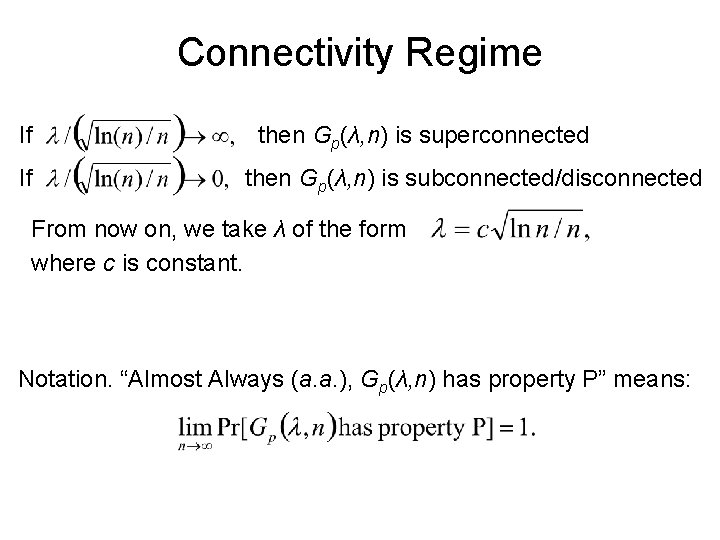
Connectivity Regime If If then Gp(λ, n) is superconnected then Gp(λ, n) is subconnected/disconnected From now on, we take λ of the form where c is constant. Notation. “Almost Always (a. a. ), Gp(λ, n) has property P” means:
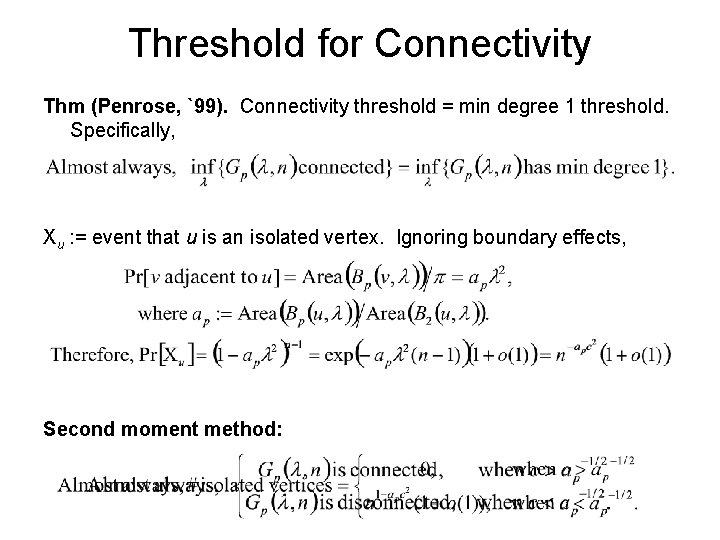
Threshold for Connectivity Thm (Penrose, `99). Connectivity threshold = min degree 1 threshold. Specifically, Xu : = event that u is an isolated vertex. Ignoring boundary effects, Second moment method:
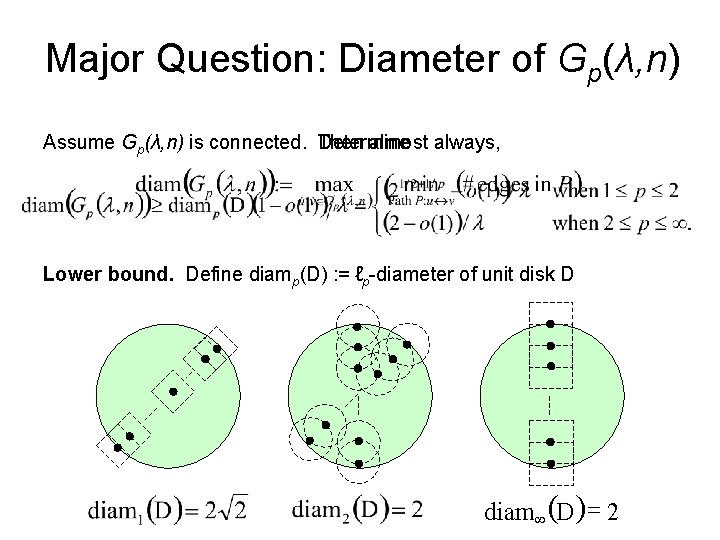
Major Question: Diameter of Gp(λ, n) Assume Gp(λ, n) is connected. Then Determine almost always, Lower bound. Define diamp(D) : = ℓp-diameter of unit disk D diam ¥ (D ) = 2
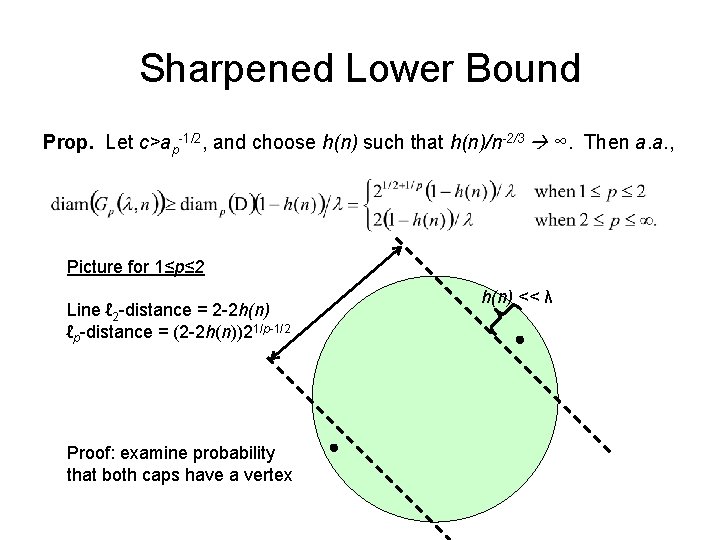
Sharpened Lower Bound Prop. Let c>ap-1/2, and choose h(n) such that h(n)/n-2/3 ∞. Then a. a. , Picture for 1≤p≤ 2 Line ℓ 2 -distance = 2 -2 h(n) ℓp-distance = (2 -2 h(n))21/p-1/2 Proof: examine probability that both caps have a vertex h(n) << λ
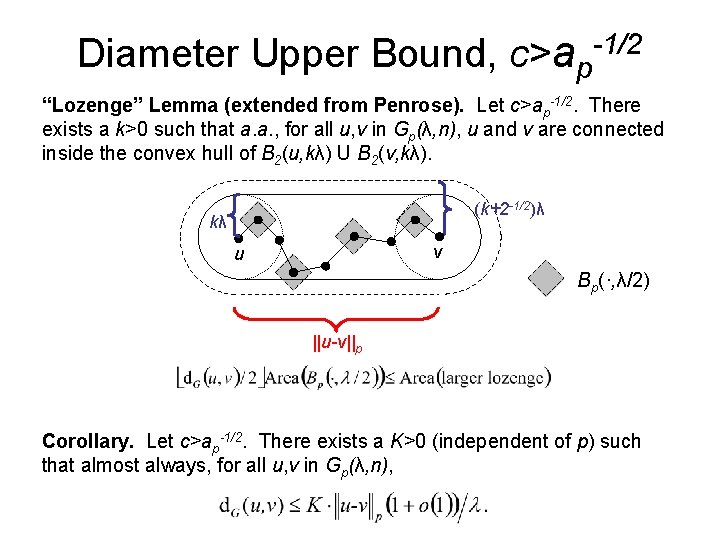
Diameter Upper Bound, c>ap-1/2 “Lozenge” Lemma (extended from Penrose). Let c>ap-1/2. There exists a k>0 such that a. a. , for all u, v in Gp(λ, n), u and v are connected inside the convex hull of B 2(u, kλ) U B 2(v, kλ). (k+2 -1/2)λ kλ v u Bp(·, λ/2) ||u-v||p Corollary. Let c>ap-1/2. There exists a K>0 (independent of p) such that almost always, for all u, v in Gp(λ, n),
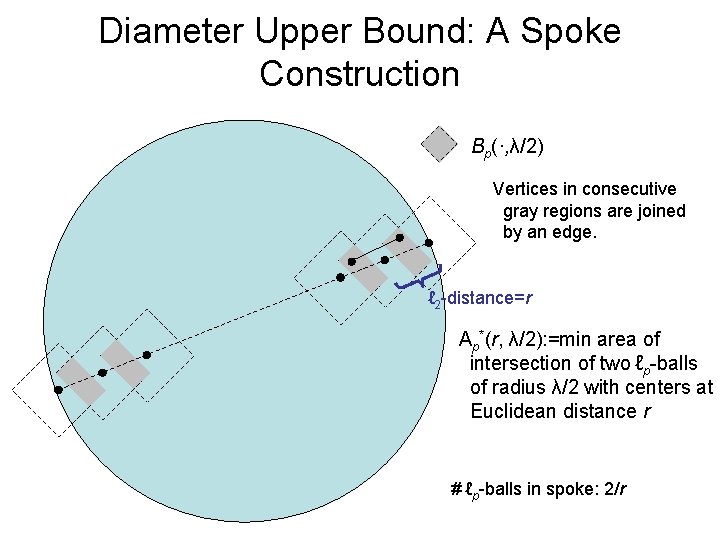
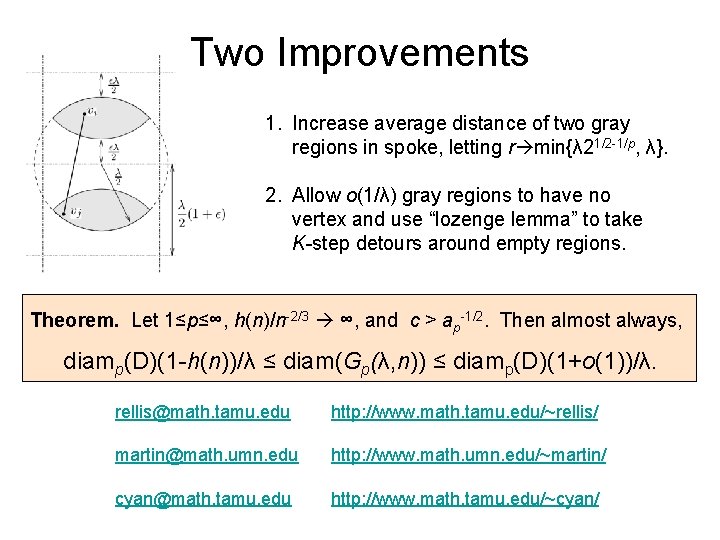
Diameter Upper Bound: A Spoke Construction Bp(·, λ/2) Vertices in consecutive gray regions are joined by an edge. ℓ 2 -distance=r Ap*(r, λ/2): =min area of intersection of two ℓp-balls of radius λ/2 with centers at Euclidean distance r # ℓp-balls in spoke: 2/r
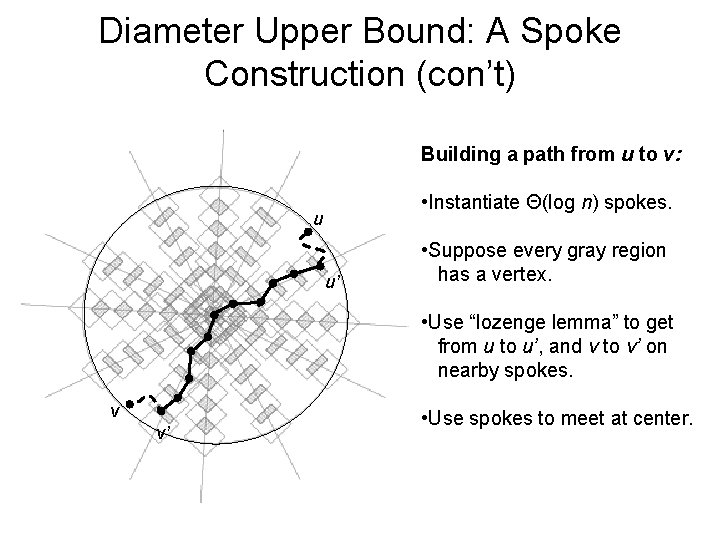
Diameter Upper Bound: A Spoke Construction (con’t) Building a path from u to v: • Instantiate Θ(log n) spokes. u u’ • Suppose every gray region has a vertex. • Use “lozenge lemma” to get from u to u’, and v to v’ on nearby spokes. v v’ • Use spokes to meet at center.
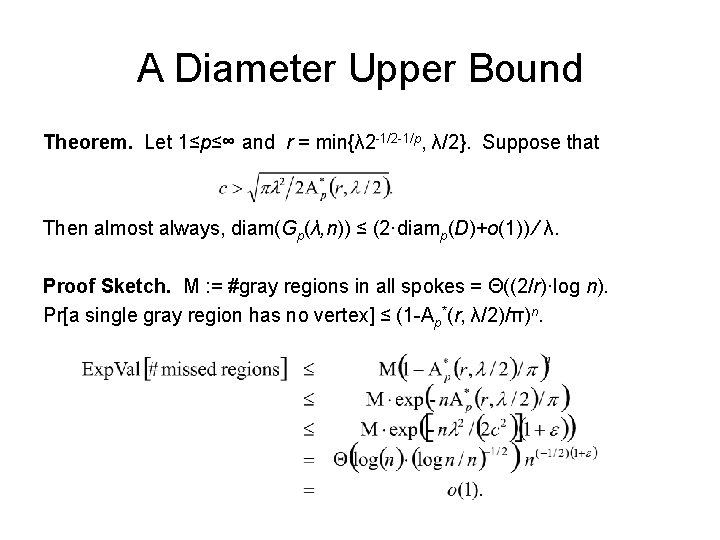
A Diameter Upper Bound Theorem. Let 1≤p≤∞ and r = min{λ 2 -1/p, λ/2}. Suppose that Then almost always, diam(Gp(λ, n)) ≤ (2·diamp(D)+o(1)) ∕ λ. Proof Sketch. M : = #gray regions in all spokes = Θ((2/r)·log n). Pr[a single gray region has no vertex] ≤ (1 -Ap*(r, λ/2)/π)n.
Two Improvements 1. Increase average distance of two gray regions in spoke, letting r min{λ 21/2 -1/p, λ}. 2. Allow o(1/λ) gray regions to have no vertex and use “lozenge lemma” to take K-step detours around empty regions. Theorem. Let 1≤p≤∞, h(n)/n-2/3 ∞, and c > ap-1/2. Then almost always, diamp(D)(1 -h(n))/λ ≤ diam(Gp(λ, n)) ≤ diamp(D)(1+o(1))/λ. rellis@math. tamu. edu http: //www. math. tamu. edu/~rellis/ martin@math. umn. edu http: //www. math. umn. edu/~martin/ cyan@math. tamu. edu http: //www. math. tamu. edu/~cyan/