
Random Early Detection RED 15 744 Computer Networks

- Slides: 5
Random Early Detection (RED) 15 -744 Computer Networks Gunhee Kim September 24, 2010
Why We Need it? • We learned TCP congestion control last week! – Sent, ACKed, congestion window, AIMD, etc. • Issues – TCP needs to create losses to find the available bandwidth of the connection. – Who’s the best to detect congestion and resolve it? – Full queue of a gateway significantly increases the average delay. – Congestion avoidance by Gateway !
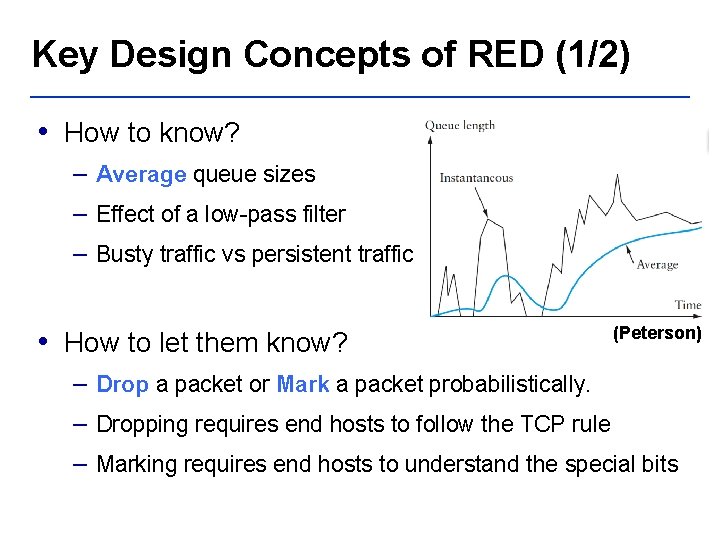
Key Design Concepts of RED (1/2) • How to know? – Average queue sizes – Effect of a low-pass filter – Busty traffic vs persistent traffic • How to let them know? (Peterson) – Drop a packet or Mark a packet probabilistically. – Dropping requires end hosts to follow the TCP rule – Marking requires end hosts to understand the special bits
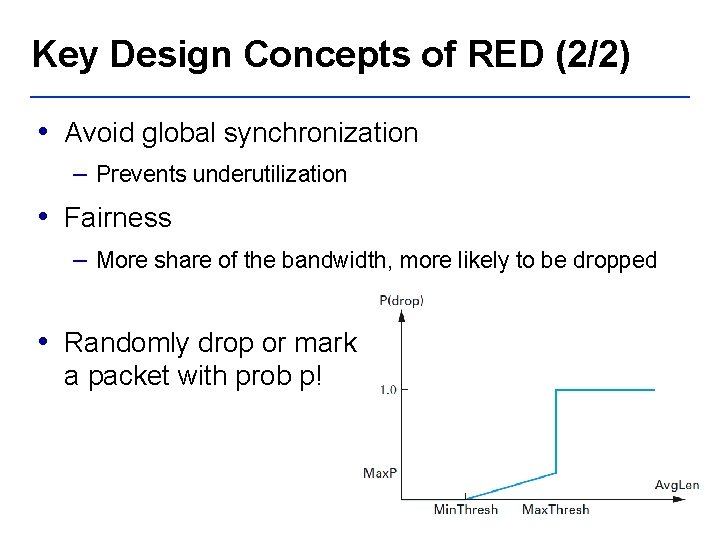
Key Design Concepts of RED (2/2) • Avoid global synchronization – Prevents underutilization • Fairness – More share of the bandwidth, more likely to be dropped • Randomly drop or mark a packet with prob p!
Discussion • Based on other literature and Class Discussion Pages • Dropping or Marking a packet ? – Understandable in the TCP context, may not be in other protocols or to ignorant users. – In ATM network, if one cell is dropped, then all the others are useless. • Queue? – Largely rely on FIFO – How to determine optimum average queue size for max throughput and min delay for various configurations? – Scheduling or multi-level queue?