
Random Early Detection Gateways for Congestion Avoidance Sally







- Slides: 27
Random Early Detection Gateways for Congestion Avoidance Sally Floyd and Van Jacobson, IEEE Transactions on Networking, Vol. 1, No. 4, (Aug 1993), pp. 397 -413. ACN: RED paper 1
Outline • • • Introduction Background: Definitions and Previous Work The RED Algorithm RED parameters Evaluation of RED Conclusions and Future Work ACN: RED paper 2
Introduction • Main idea: to provide congestion control at the router for TCP flows. • Goals of RED – [primary goal] is to provide congestion avoidance by controlling the average queue size such that the router stays in a region of low delay and high throughput. – To avoid global synchronization (e. g. , in Tahoe TCP). – To control misbehaving users (this is from a fairness context). – To seek a mechanism that is not biased against bursty traffic. ACN: RED paper 3
Definitions • congestion avoidance – when impending congestion is indicated take action to avoid congestion • incipient congestion – congestion that is beginning to be apparent. • need to notify connections of congestion at the router by either marking the packet [ECN] or dropping the packet {This assumes a drop is an implied signal to the source host. } ACN: RED paper 4
Previous Work • • • Drop Tail Random Drop Early Random Drop Source Quench messages DECbit scheme ACN: RED paper 5
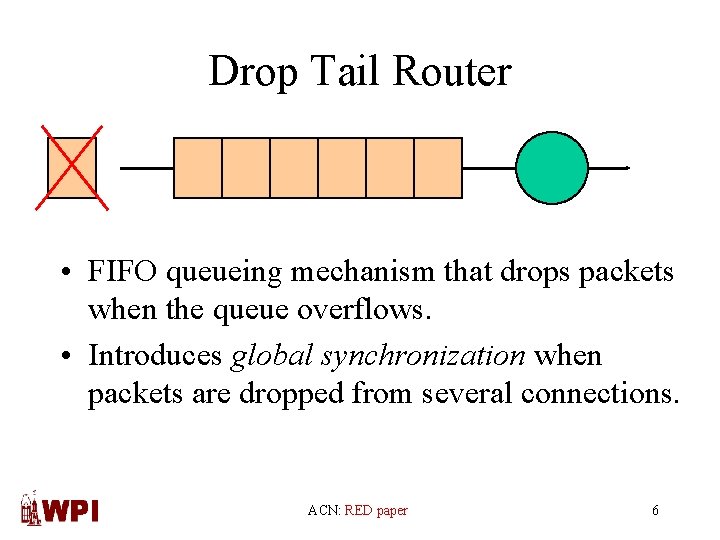
Drop Tail Router • FIFO queueing mechanism that drops packets when the queue overflows. • Introduces global synchronization when packets are dropped from several connections. ACN: RED paper 6
Random Drop Router • When a packet arrives and the queue is full, randomly choose a packet from the queue to drop. ACN: RED paper 7
Early Random Drop Router ? Drop level • If the queue length exceeds a drop level, then the router drops each arriving packet with a fixed drop probability. • Reduces global synchronization • Did not control misbehaving users (UDP) ACN: RED paper 8
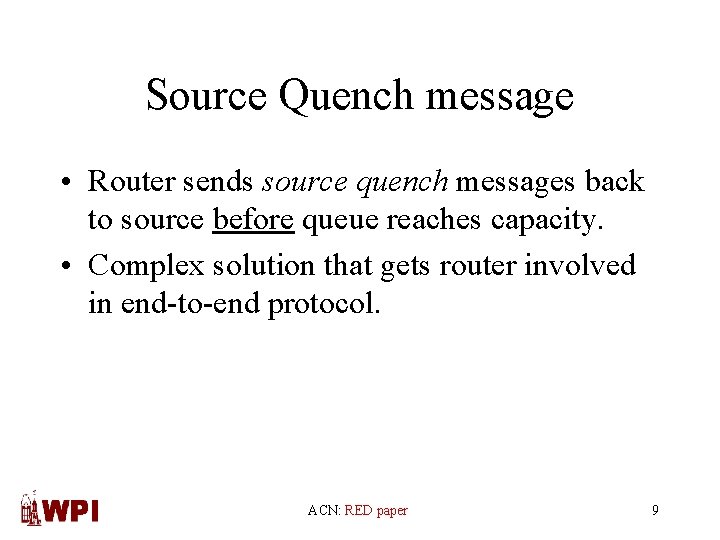
Source Quench message • Router sends source quench messages back to source before queue reaches capacity. • Complex solution that gets router involved in end-to-end protocol. ACN: RED paper 9
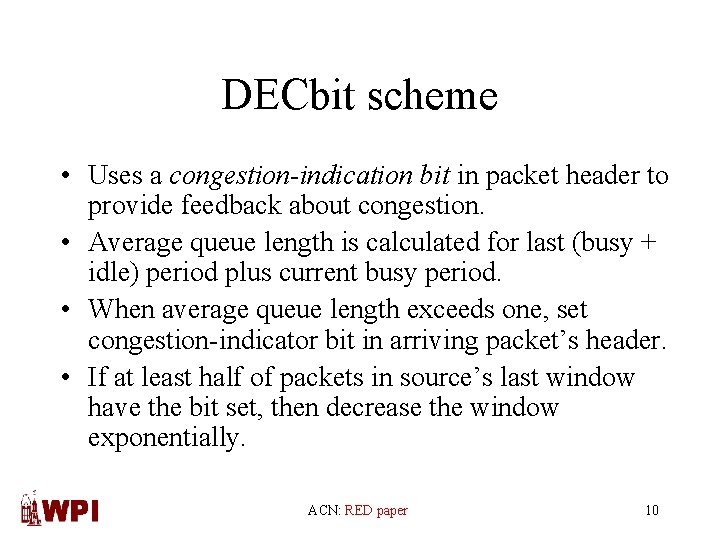
DECbit scheme • Uses a congestion-indication bit in packet header to provide feedback about congestion. • Average queue length is calculated for last (busy + idle) period plus current busy period. • When average queue length exceeds one, set congestion-indicator bit in arriving packet’s header. • If at least half of packets in source’s last window have the bit set, then decrease the window exponentially. ACN: RED paper 10
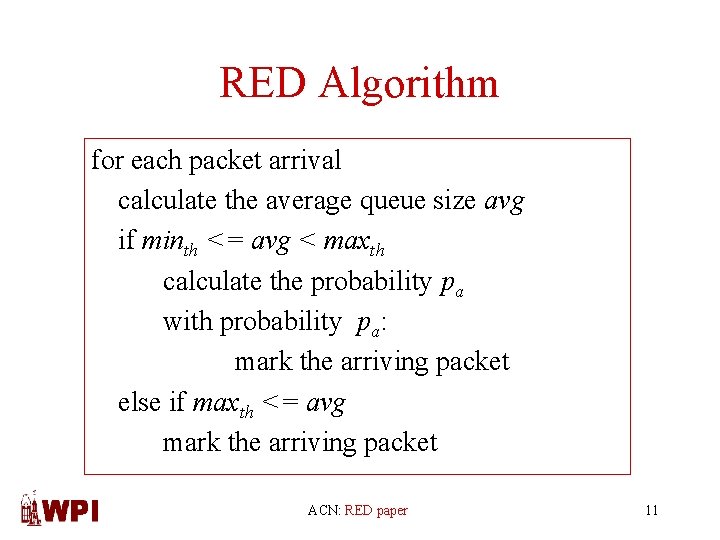
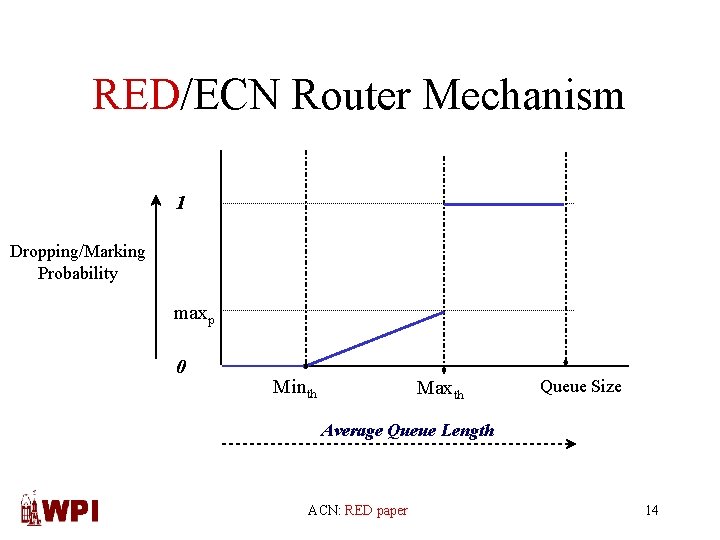
RED Algorithm for each packet arrival calculate the average queue size avg if minth <= avg < maxth calculate the probability pa with probability pa: mark the arriving packet else if maxth <= avg mark the arriving packet ACN: RED paper 11
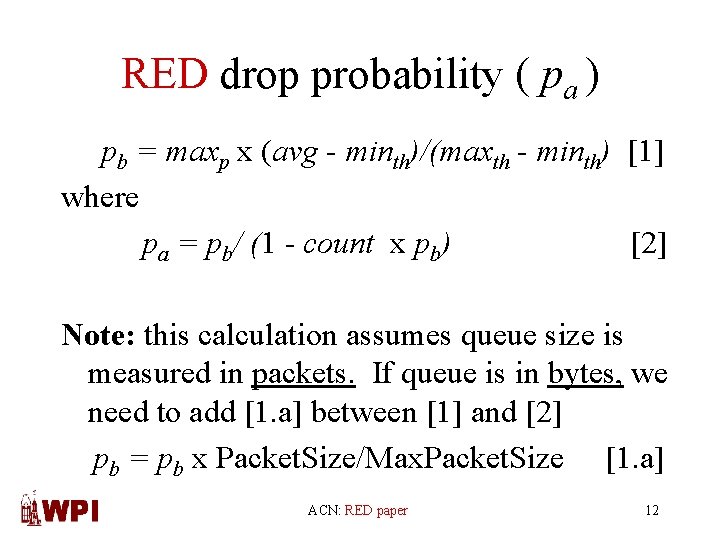
RED drop probability ( pa ) pb = maxp x (avg - minth)/(maxth - minth) [1] where pa = pb/ (1 - count x pb) [2] Note: this calculation assumes queue size is measured in packets. If queue is in bytes, we need to add [1. a] between [1] and [2] pb = pb x Packet. Size/Max. Packet. Size [1. a] ACN: RED paper 12
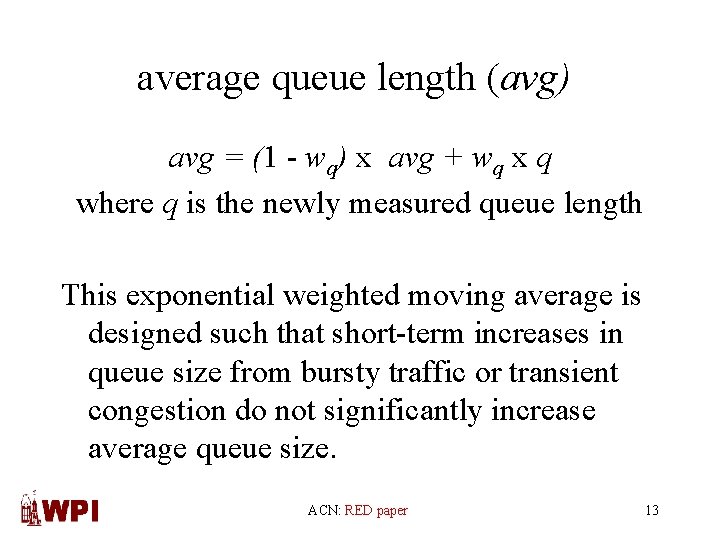
average queue length (avg) avg = (1 - wq) x avg + wq x q where q is the newly measured queue length This exponential weighted moving average is designed such that short-term increases in queue size from bursty traffic or transient congestion do not significantly increase average queue size. ACN: RED paper 13
RED/ECN Router Mechanism 1 Dropping/Marking Probability maxp 0 Minth Maxth Queue Size Average Queue Length ACN: RED paper 14
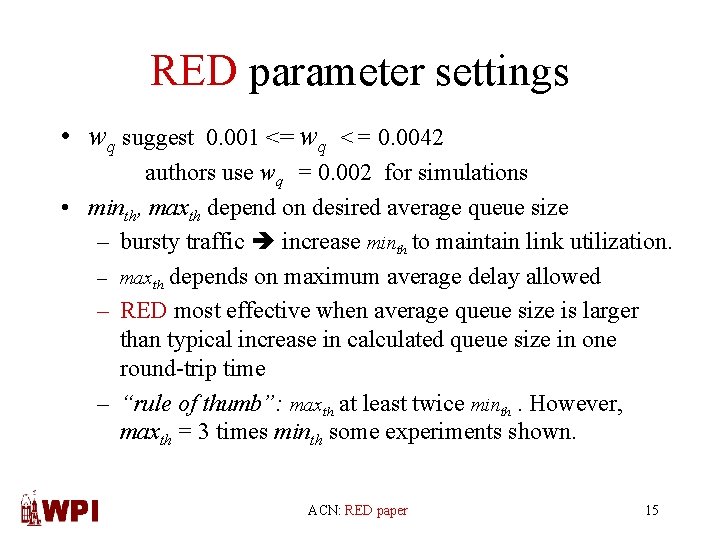
RED parameter settings • wq suggest 0. 001 <= wq <= 0. 0042 authors use wq = 0. 002 for simulations • minth, maxth depend on desired average queue size – bursty traffic increase minth to maintain link utilization. – maxth depends on maximum average delay allowed – RED most effective when average queue size is larger than typical increase in calculated queue size in one round-trip time – “rule of thumb”: maxth at least twice minth. However, maxth = 3 times minth some experiments shown. ACN: RED paper 15
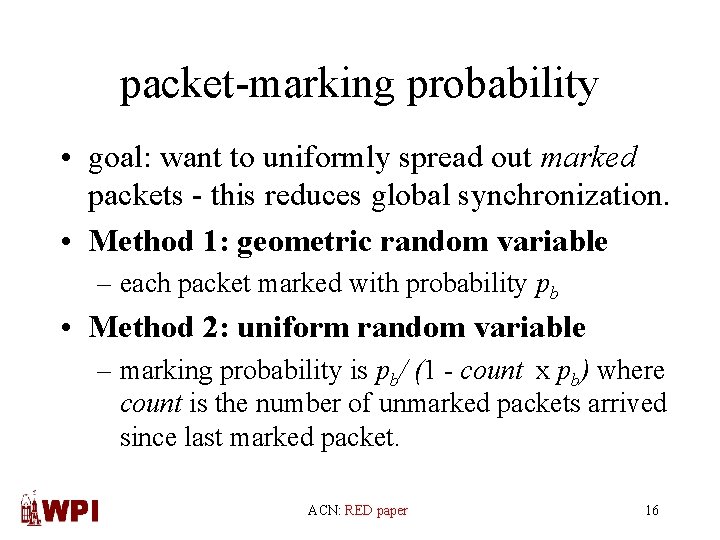
packet-marking probability • goal: want to uniformly spread out marked packets - this reduces global synchronization. • Method 1: geometric random variable – each packet marked with probability pb • Method 2: uniform random variable – marking probability is pb/ (1 - count x pb) where count is the number of unmarked packets arrived since last marked packet. ACN: RED paper 16
Figure 8 Here ACN: RED paper 17
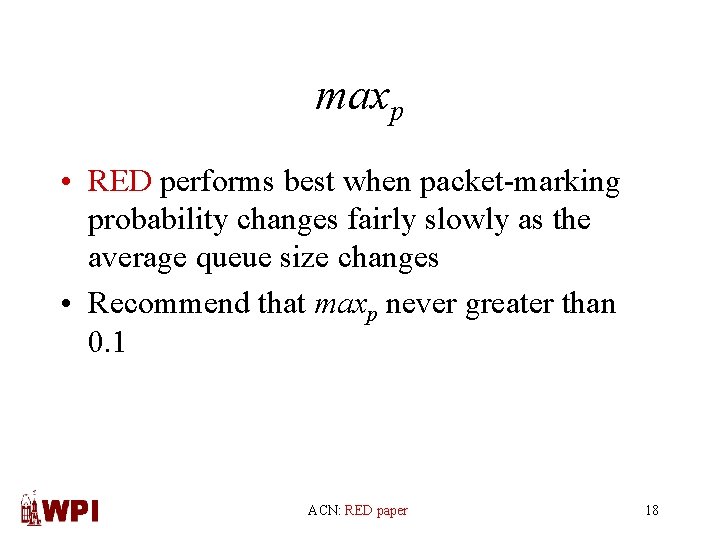
maxp • RED performs best when packet-marking probability changes fairly slowly as the average queue size changes • Recommend that maxp never greater than 0. 1 ACN: RED paper 18
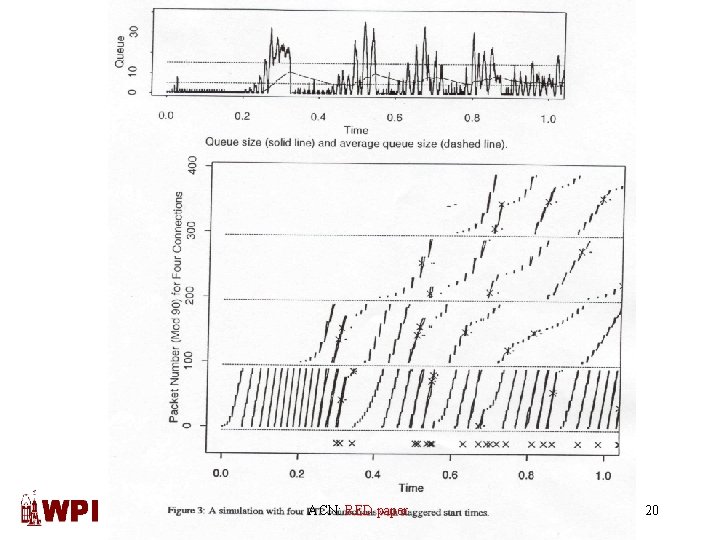
Figure 4 and 5 Here ACN: RED paper 19
ACN: RED paper 20
Figure 6 -13 Here ACN: RED paper 21
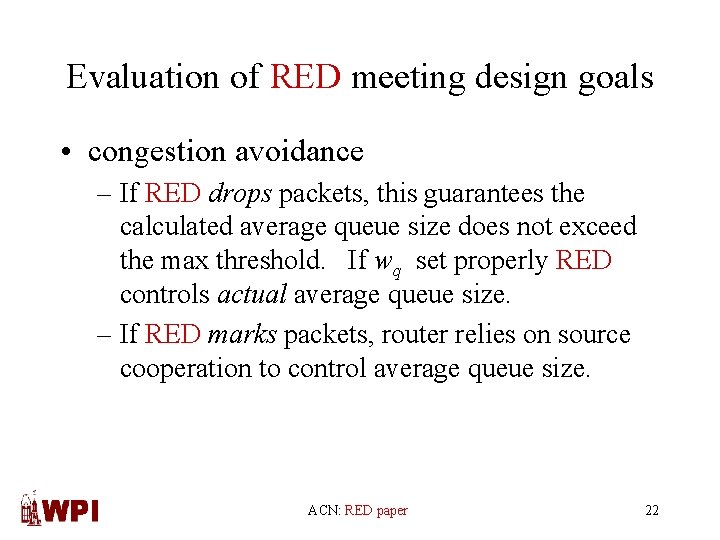
Evaluation of RED meeting design goals • congestion avoidance – If RED drops packets, this guarantees the calculated average queue size does not exceed the max threshold. If wq set properly RED controls actual average queue size. – If RED marks packets, router relies on source cooperation to control average queue size. ACN: RED paper 22
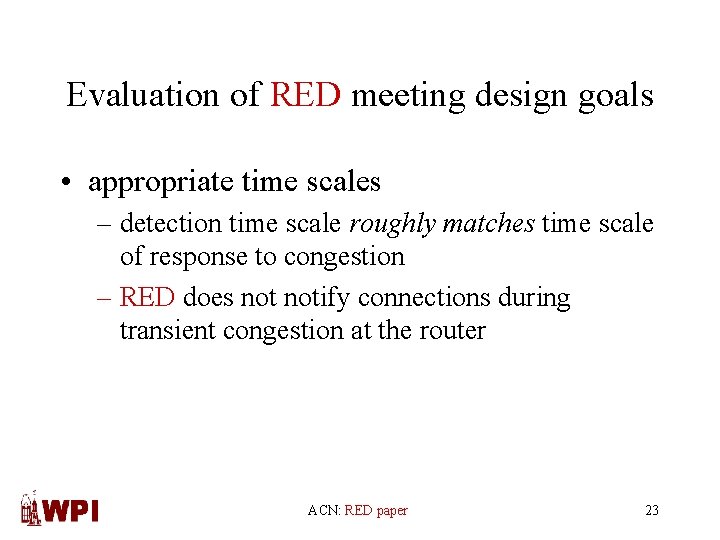
Evaluation of RED meeting design goals • appropriate time scales – detection time scale roughly matches time scale of response to congestion – RED does notify connections during transient congestion at the router ACN: RED paper 23
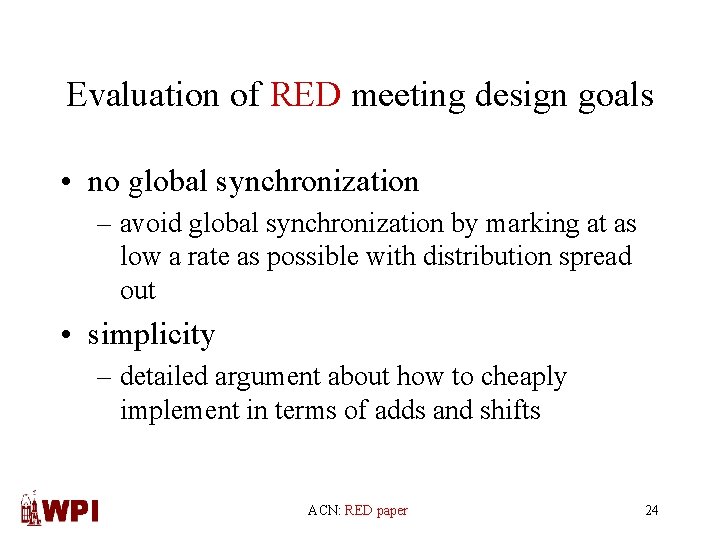
Evaluation of RED meeting design goals • no global synchronization – avoid global synchronization by marking at as low a rate as possible with distribution spread out • simplicity – detailed argument about how to cheaply implement in terms of adds and shifts ACN: RED paper 24
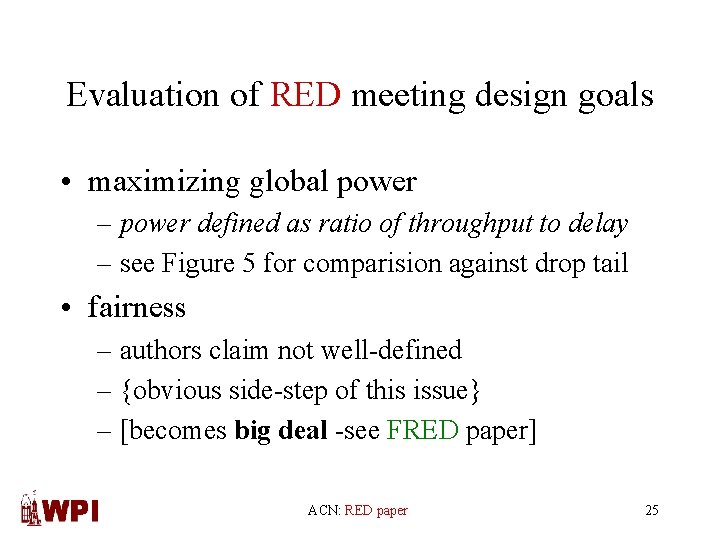
Evaluation of RED meeting design goals • maximizing global power – power defined as ratio of throughput to delay – see Figure 5 for comparision against drop tail • fairness – authors claim not well-defined – {obvious side-step of this issue} – [becomes big deal -see FRED paper] ACN: RED paper 25
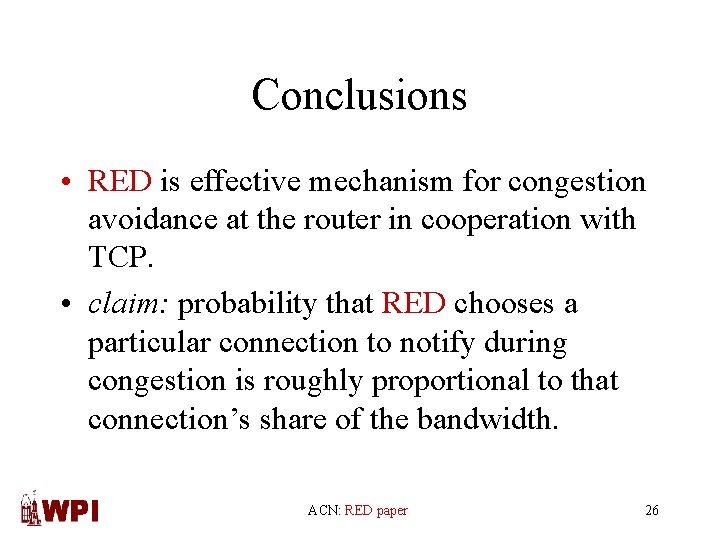
Conclusions • RED is effective mechanism for congestion avoidance at the router in cooperation with TCP. • claim: probability that RED chooses a particular connection to notify during congestion is roughly proportional to that connection’s share of the bandwidth. ACN: RED paper 26
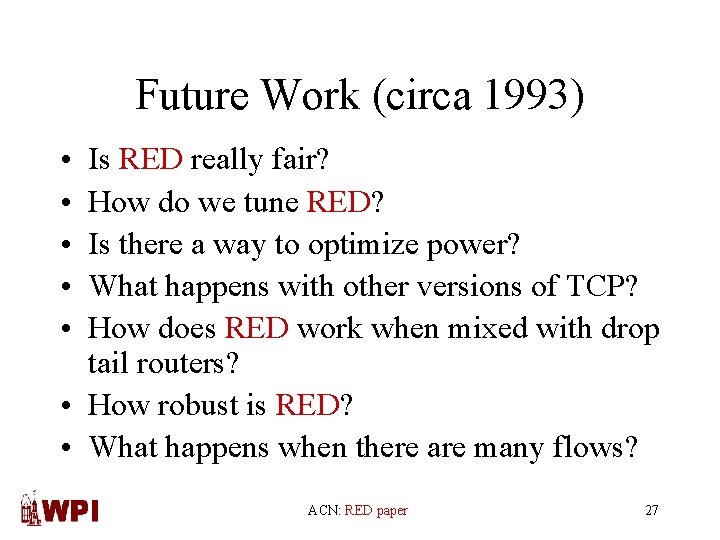
Future Work (circa 1993) • • • Is RED really fair? How do we tune RED? Is there a way to optimize power? What happens with other versions of TCP? How does RED work when mixed with drop tail routers? • How robust is RED? • What happens when there are many flows? ACN: RED paper 27