
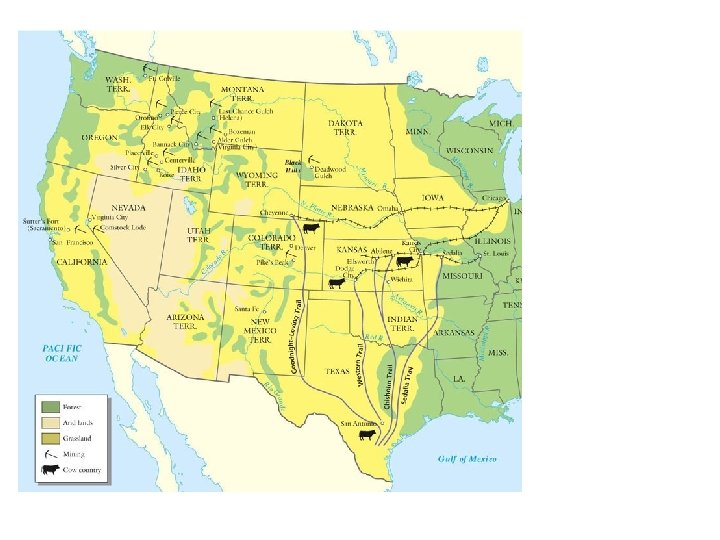
Ranching n Heyday of cattle driving in 1880
- Slides: 23
Ranching n Heyday of cattle driving in 1880 s n n Realities of frontier very different from popular images n n example: Chisholm Trail Decline in open range led to rise in industrial ranching n n Railroads helped shorten routes many Americans fled further west in search of jobs. Mexican Americans & American Indians n further displacement
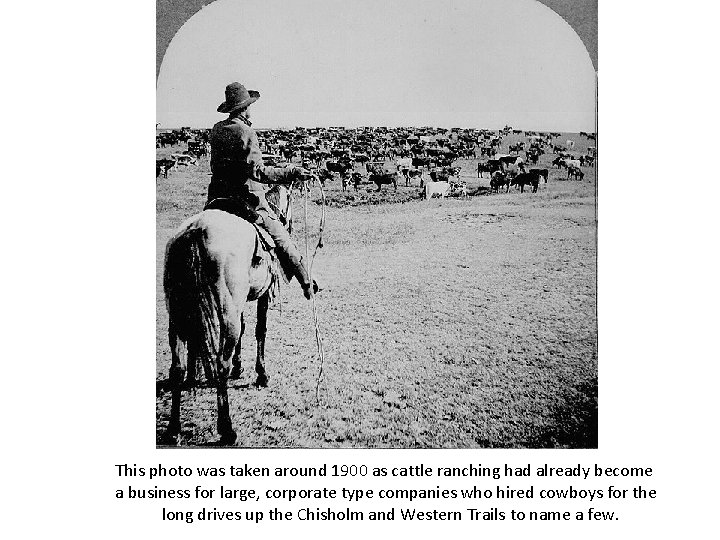
This photo was taken around 1900 as cattle ranching had already become a business for large, corporate type companies who hired cowboys for the long drives up the Chisholm and Western Trails to name a few.
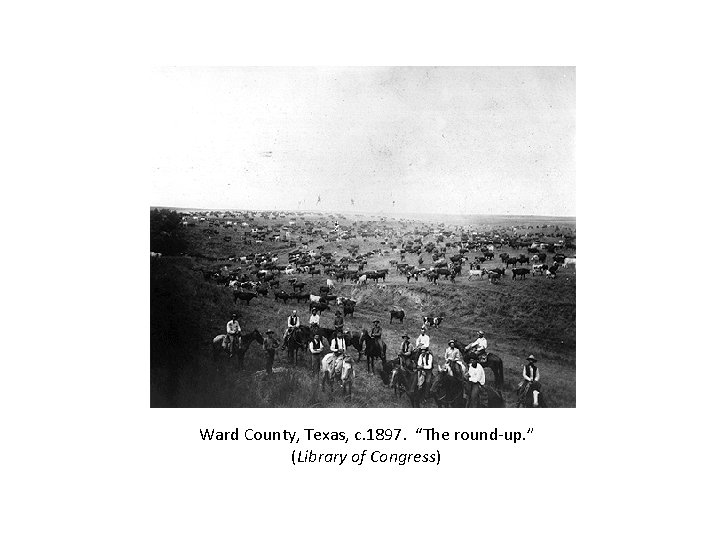
Ward County, Texas, c. 1897. “The round-up. ” (Library of Congress)
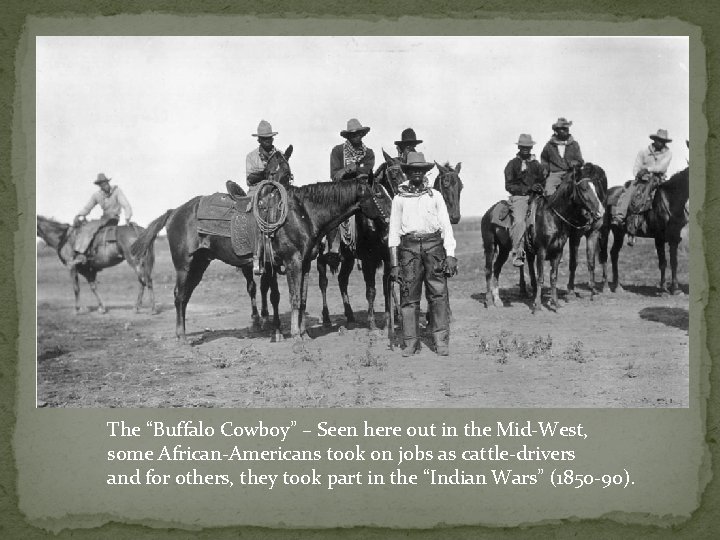
The “Buffalo Cowboy” – Seen here out in the Mid-West, some African-Americans took on jobs as cattle-drivers and for others, they took part in the “Indian Wars” (1850 -90).
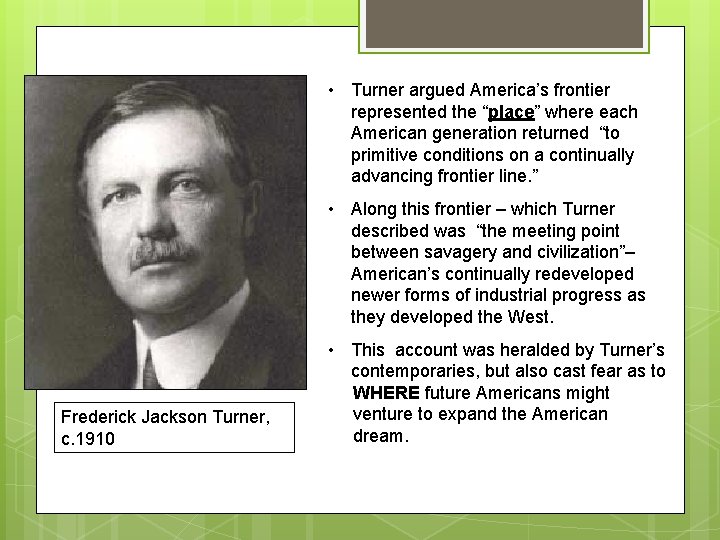
• Turner argued America’s frontier represented the “place” where each American generation returned “to primitive conditions on a continually advancing frontier line. ” • Along this frontier – which Turner described was “the meeting point between savagery and civilization”– American’s continually redeveloped newer forms of industrial progress as they developed the West. Frederick Jackson Turner, c. 1910 • This account was heralded by Turner’s contemporaries, but also cast fear as to WHERE future Americans might venture to expand the American dream.
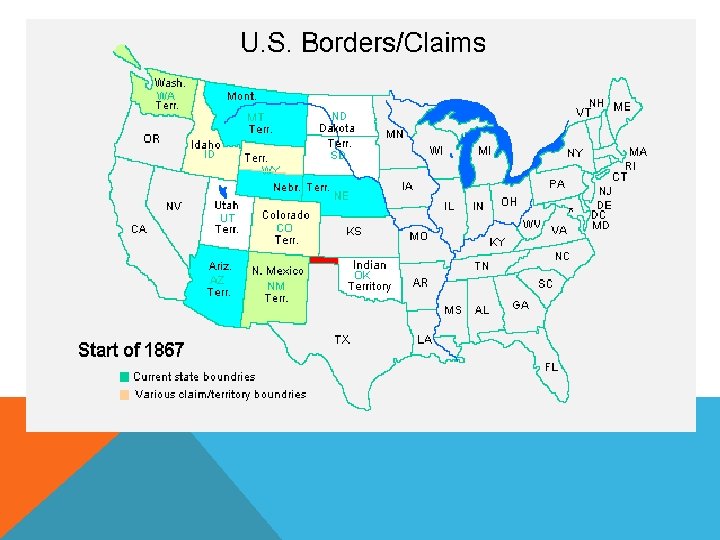
Conflict and Resistance n Westward expansion had encroached on Indian territory n Concentrated Indian population onto tiny reservations n n 1. 5 million acres Oklahoma Land Rush • Boomers • Sooners n Origins in wartime disagreements and violent clashes
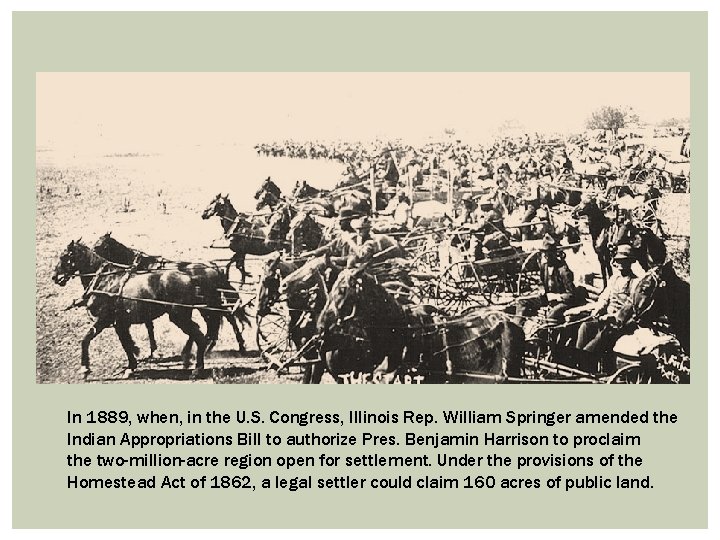
In 1889, when, in the U. S. Congress, Illinois Rep. William Springer amended the Indian Appropriations Bill to authorize Pres. Benjamin Harrison to proclaim the two-million-acre region open for settlement. Under the provisions of the Homestead Act of 1862, a legal settler could claim 160 acres of public land.
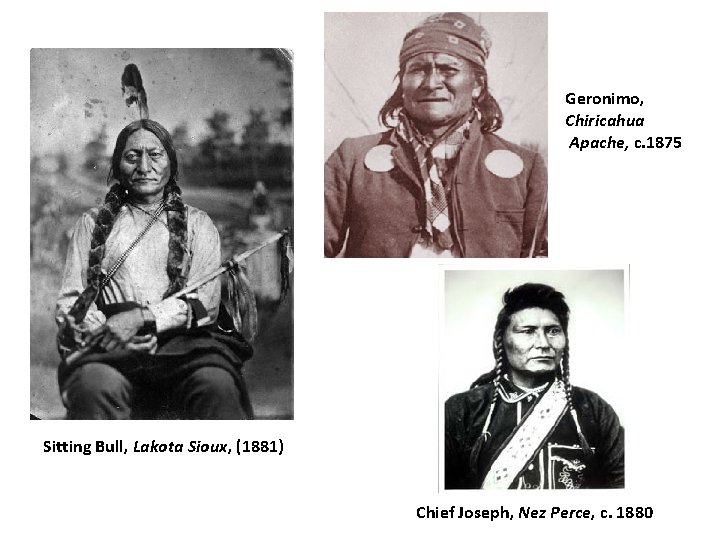
Geronimo, Chiricahua Apache, c. 1875 Sitting Bull, Lakota Sioux, (1881) Chief Joseph, Nez Perce, c. 1880
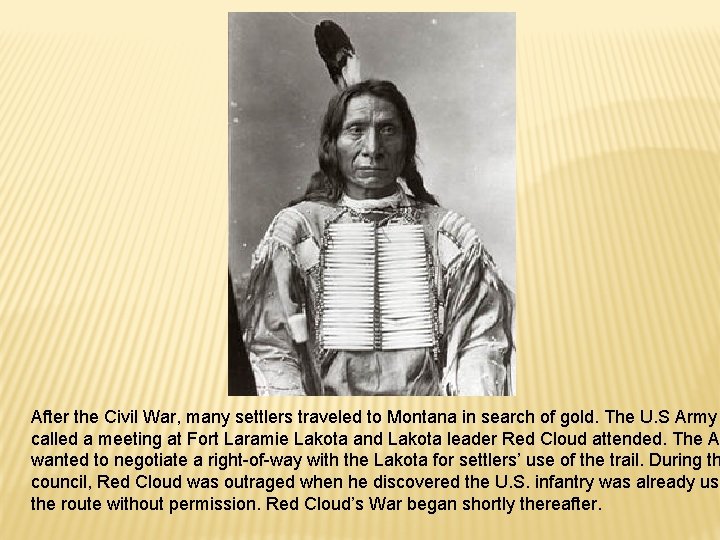
After the Civil War, many settlers traveled to Montana in search of gold. The U. S Army called a meeting at Fort Laramie Lakota and Lakota leader Red Cloud attended. The A wanted to negotiate a right-of-way with the Lakota for settlers’ use of the trail. During th council, Red Cloud was outraged when he discovered the U. S. infantry was already usi the route without permission. Red Cloud’s War began shortly thereafter.
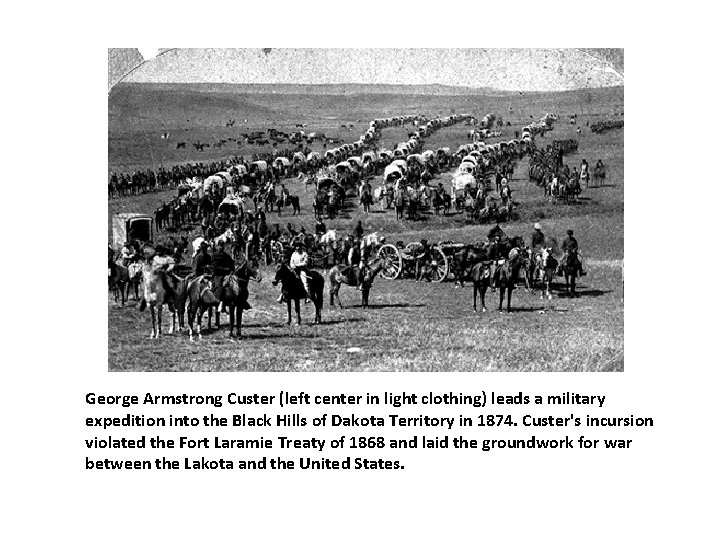
George Armstrong Custer (left center in light clothing) leads a military expedition into the Black Hills of Dakota Territory in 1874. Custer's incursion violated the Fort Laramie Treaty of 1868 and laid the groundwork for war between the Lakota and the United States.
Suppression of Other Plains Peoples n Sand Creek massacre against Cheyenne, 1864 n Black Kettle n 200 Cheyenne massacred n Set pattern for similar attacks on Indian villages in subsequent years n Systematic destruction of buffalo herds n Most extreme example of environmental degradation caused by westward expansion n Chief Joseph of the Nez Percé
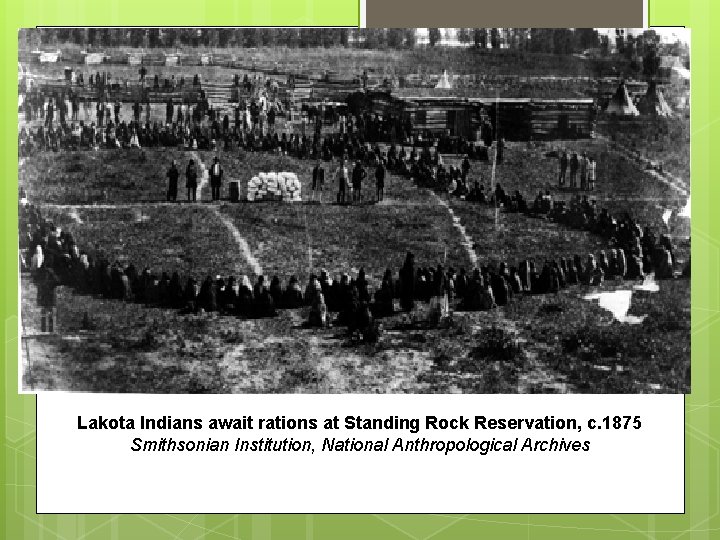
Lakota Indians await rations at Standing Rock Reservation, c. 1875 Smithsonian Institution, National Anthropological Archives
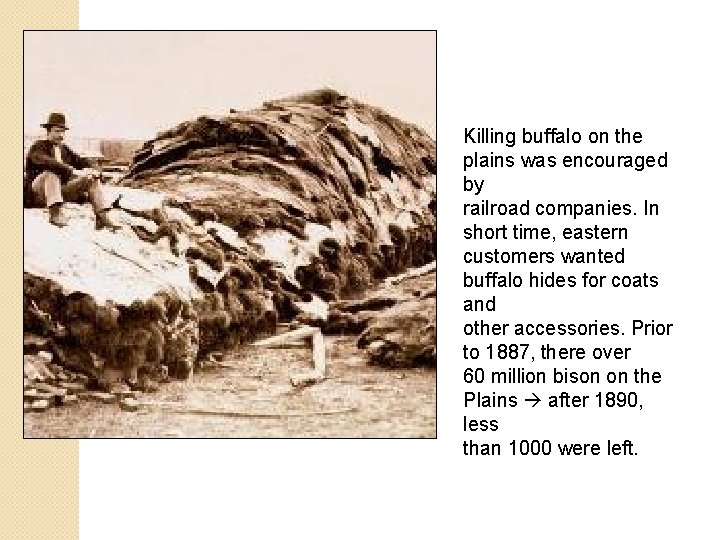
Killing buffalo on the plains was encouraged by railroad companies. In short time, eastern customers wanted buffalo hides for coats and other accessories. Prior to 1887, there over 60 million bison on the Plains after 1890, less than 1000 were left.
The “Peace Policy” n Balanced iron fist of repression with n n velvet hand of reform Restructured Indian society along white lines Board of Indian Commissioners, 1871 Dawes Severalty Act, 1887 Ghost Dance n Wovoka
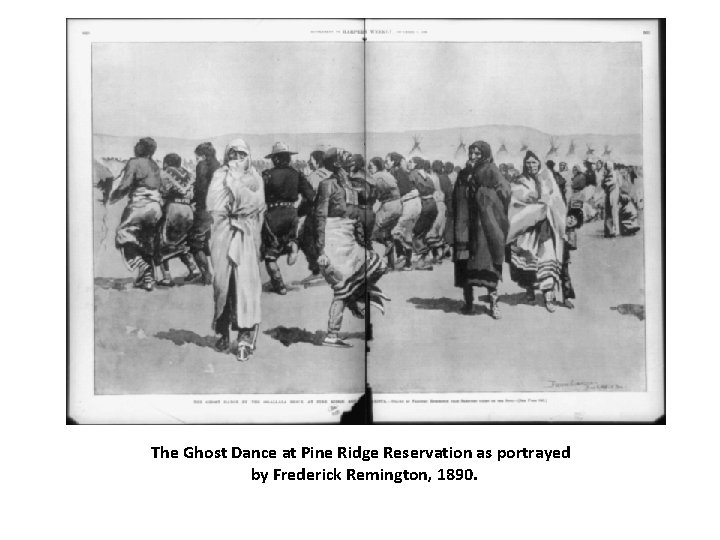
The Ghost Dance at Pine Ridge Reservation as portrayed by Frederick Remington, 1890.
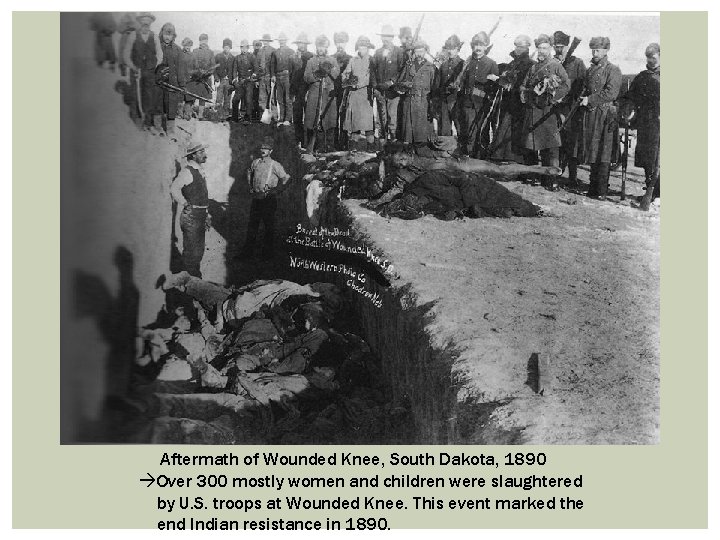
Aftermath of Wounded Knee, South Dakota, 1890 Over 300 mostly women and children were slaughtered by U. S. troops at Wounded Knee. This event marked the end Indian resistance in 1890.
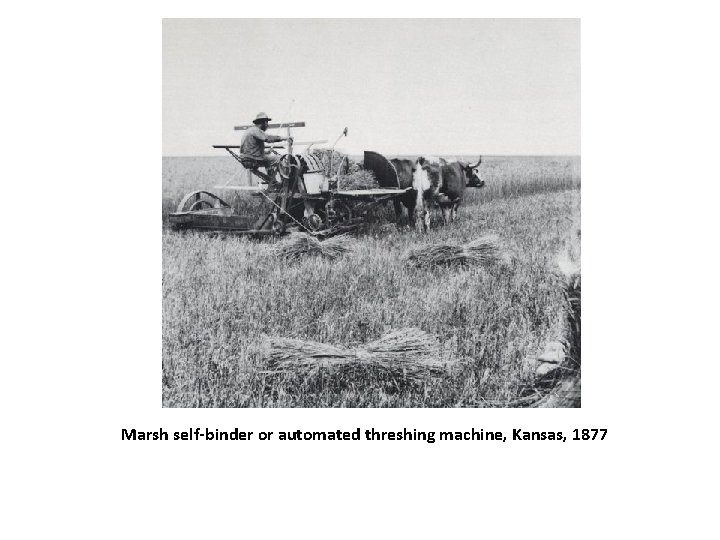
Marsh self-binder or automated threshing machine, Kansas, 1877
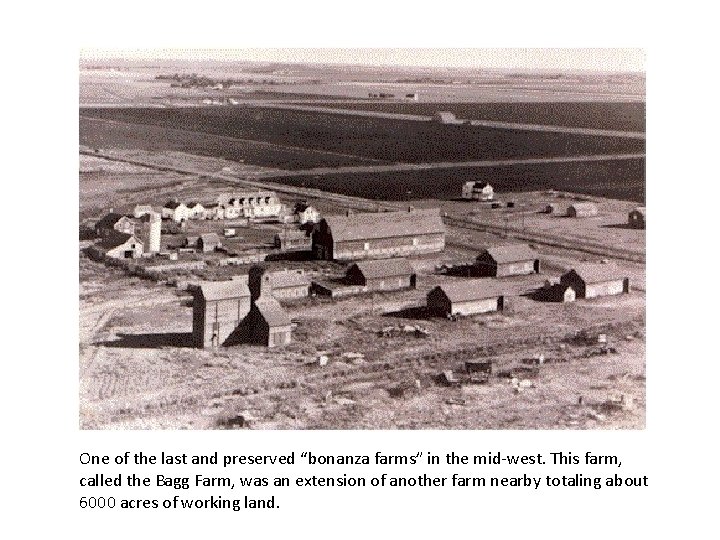
One of the last and preserved “bonanza farms” in the mid-west. This farm, called the Bagg Farm, was an extension of another farm nearby totaling about 6000 acres of working land.
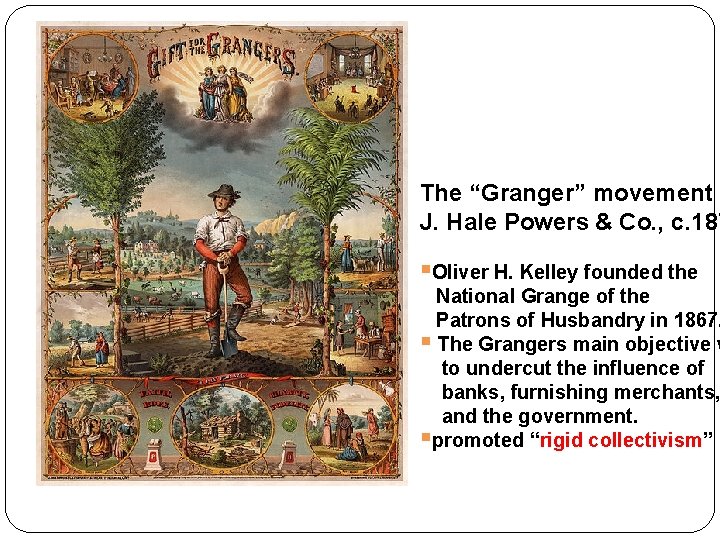
The “Granger” movement J. Hale Powers & Co. , c. 187 §Oliver H. Kelley founded the National Grange of the Patrons of Husbandry in 1867. § The Grangers main objective w to undercut the influence of banks, furnishing merchants, and the government. §promoted “rigid collectivism”
The Alliances • These farmers were located: -some parts of the South, incl. Texas • 4 million at their peak. • They truly disliked the “middlemen. ” Most important: : --They advocated “cooperation” over rigid collectivism --Diverse membership.
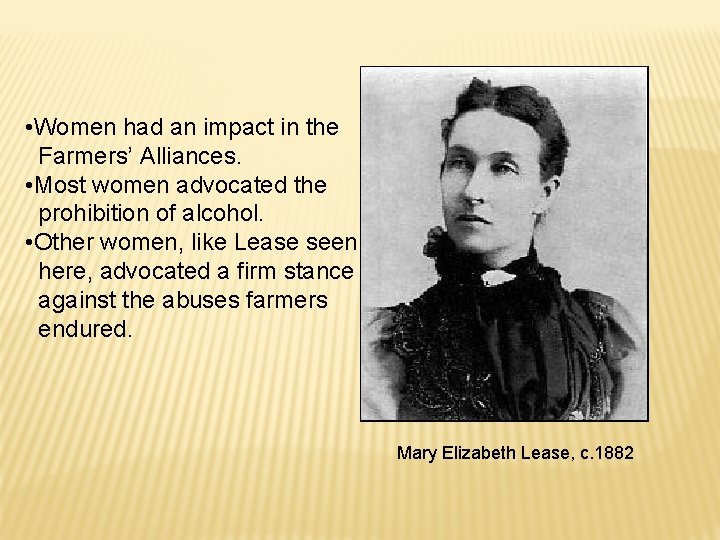
• Women had an impact in the Farmers’ Alliances. • Most women advocated the prohibition of alcohol. • Other women, like Lease seen here, advocated a firm stance against the abuses farmers endured. Mary Elizabeth Lease, c. 1882