
Ramps 1 Ramps Ramps 3 Ramps 4 Ramps

- Slides: 29
Ramps 1 Ramps
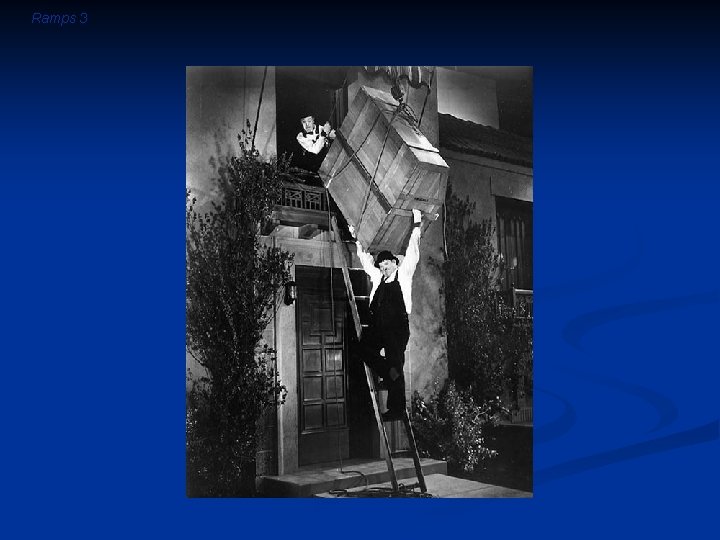
Ramps 3
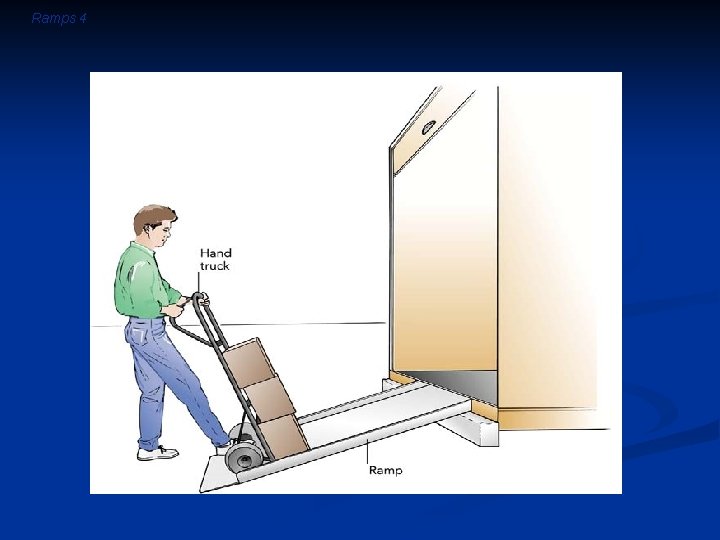
Ramps 4
Ramps 5 Observations About Ramps It’s difficult to lift a heavy cart straight up n It’s easer to push a heavy cart up a ramp n The ease depends on the ramp’s steepness n Gradual ramps involve gentler pushes n Gradual ramps involve longer distances n
Ramps 6 4 Questions about Ramps Why doesn’t the cart fall through the ramp? n Are both cart and ramp pushing on each other? n Why is it easier to push the cart up a ramp? n Is there a physical quantity that’s the same for any trip up the ramp, regardless of its steepness? n
Ramps 7 Question 1 n Why doesn’t the cart fall through the ramp? Why doesn’t a ball fall through a table? n Is the table pushing up on the ball? n
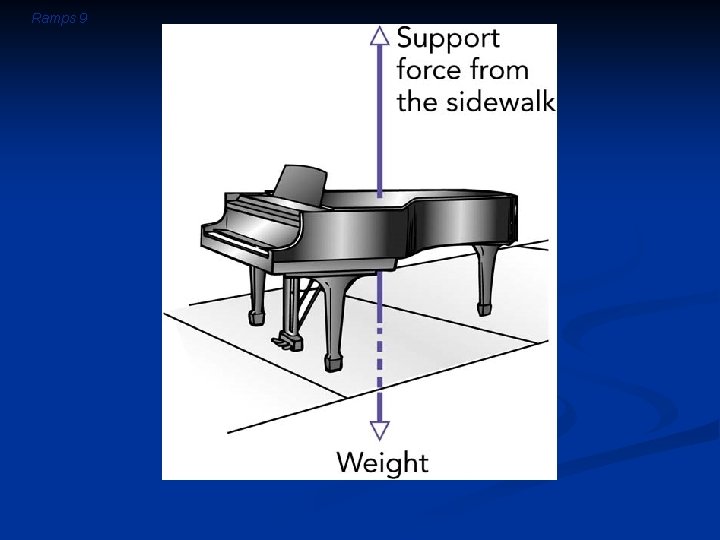
Ramps 8 Support Forces n A support force prevents the ball from penetrating the table’s surface n points directly away from the table’s surface n n Forces along surface are friction (ignore for now)
Ramps 9
Ramps 10 Net Force n The net force on the ball is the sum of all forces on that ball n responsible for the ball’s acceleration n
Ramps 11 Adding up the Forces n As it sits on the table, the ball experiences its weight downward n a support from the table upward n n Since the ball isn’t accelerating, the sum of forces (i. e. , net force) on the ball is zero n the support force must balance ball’s weight! n n Since cart isn’t accelerating into ramp, n the ramp’s support force must keep cart on surface
Ramps 12 Question 2 n Are both cart and ramp pushing on each other? Are both ball and table pushing on each other? n Is the table pushing on the ball? n Is the ball pushing on the table? n Which is pushing harder? n
Ramps 13 An Experiment n If you push on a friend, will that friend always push back on you? A. Yes No B.
Ramps 14 Newton’s Third Law n For every force that one object exerts on a second object, there is an equal but oppositely directed force that the second object exerts on the first object.
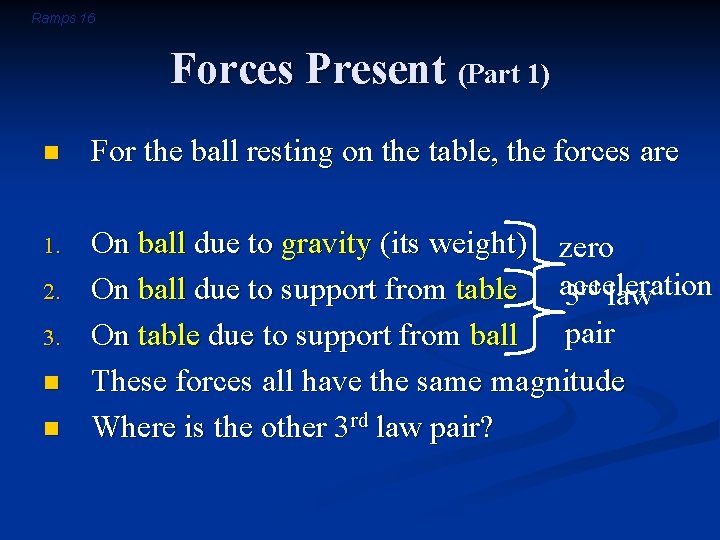
Ramps 16 Forces Present (Part 1) n For the ball resting on the table, the forces are 1. On ball due to gravity (its weight) zero On ball due to support from table acceleration 3 rd law On table due to support from ball pair These forces all have the same magnitude Where is the other 3 rd law pair? 2. 3. n n
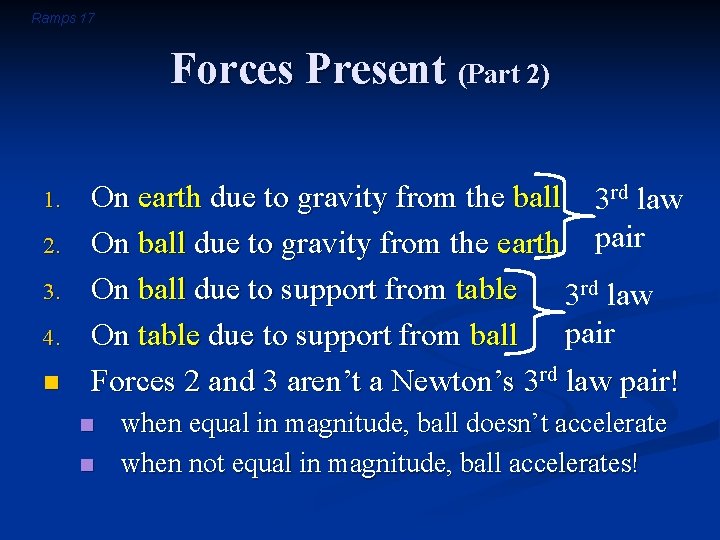
Ramps 17 Forces Present (Part 2) 1. 2. 3. 4. n On earth due to gravity from the ball 3 rd law On ball due to gravity from the earth pair On ball due to support from table 3 rd law On table due to support from ball pair Forces 2 and 3 aren’t a Newton’s 3 rd law pair! n n when equal in magnitude, ball doesn’t accelerate when not equal in magnitude, ball accelerates!
Ramps 19 Two Crucial Notes: While the forces two objects exert on one another must be equal and opposite, the net force on each object can be anything. n Each force within an equal-but-opposite pair is exerted on a different object, so they don’t cancel directly. n
Ramps 20 Question 3 n Why is it easier to push the cart up a ramp? n How hard must you push on the cart?
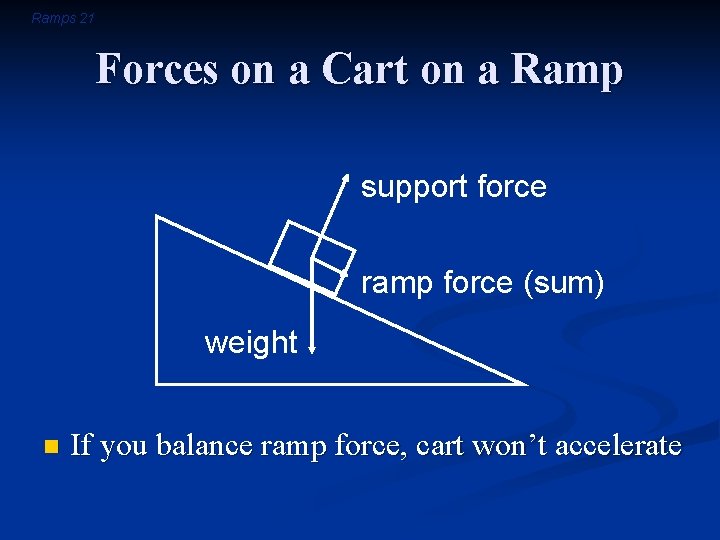
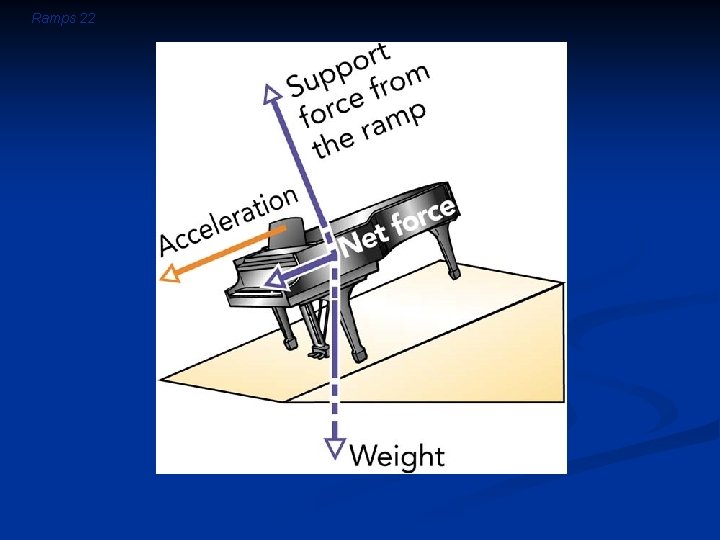
Ramps 21 Forces on a Cart on a Ramp support force ramp force (sum) weight n If you balance ramp force, cart won’t accelerate
Ramps 22
Ramps 23 Balanced Cart on Ramp n If you balance the ramp force, the cart won’t accelerate n the cart will coast – at rest, uphill, or downhill n n The more gradual the ramp, the more nearly weight and support balance n the smaller the ramp force on the cart n the easier it is to balance the ramp force! n
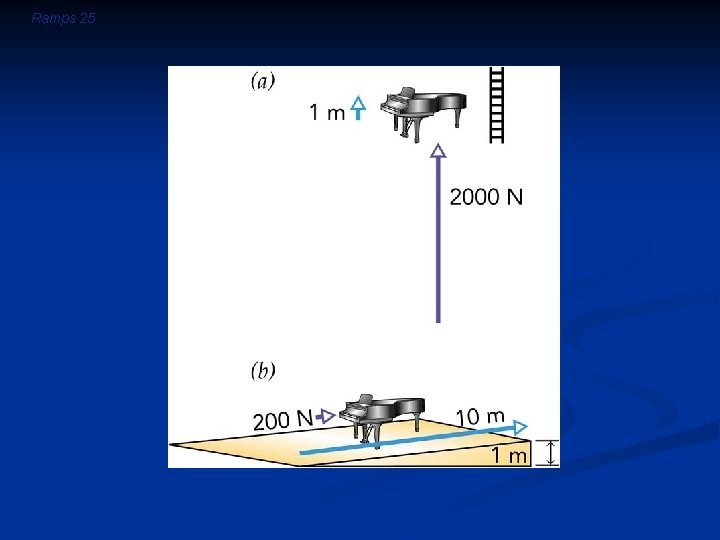
Ramps 24 Question 4 n Is there a physical quantity that’s the same for any trip up the ramp, regardless of its steepness? n What physical quantity is the same for n a long trip up a gradual ramp n a medium-long trip up a steep ramp n a short trip straight up a vertical ramp
Ramps 25
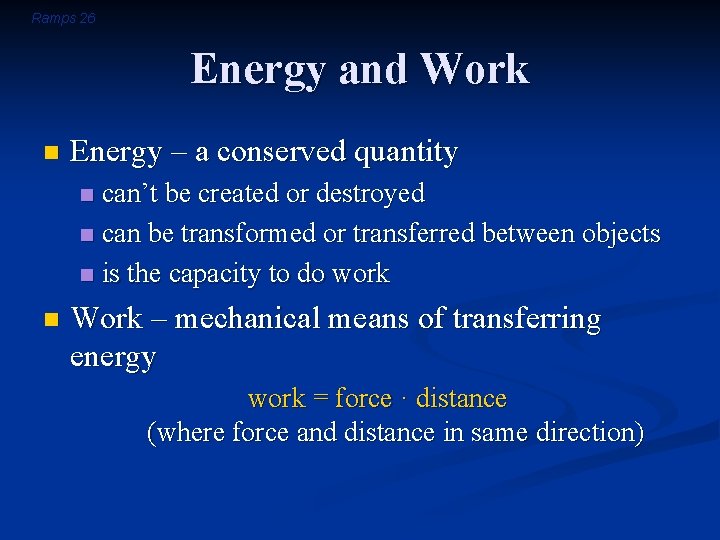
Ramps 26 Energy and Work n Energy – a conserved quantity can’t be created or destroyed n can be transformed or transferred between objects n is the capacity to do work n n Work – mechanical means of transferring energy work = force · distance (where force and distance in same direction)
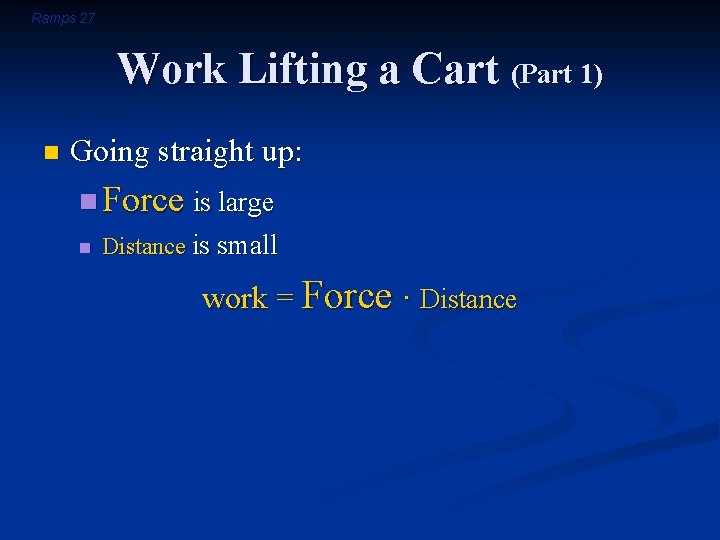
Ramps 27 Work Lifting a Cart (Part 1) n Going straight up: n Force is large n Distance is small work = Force · Distance
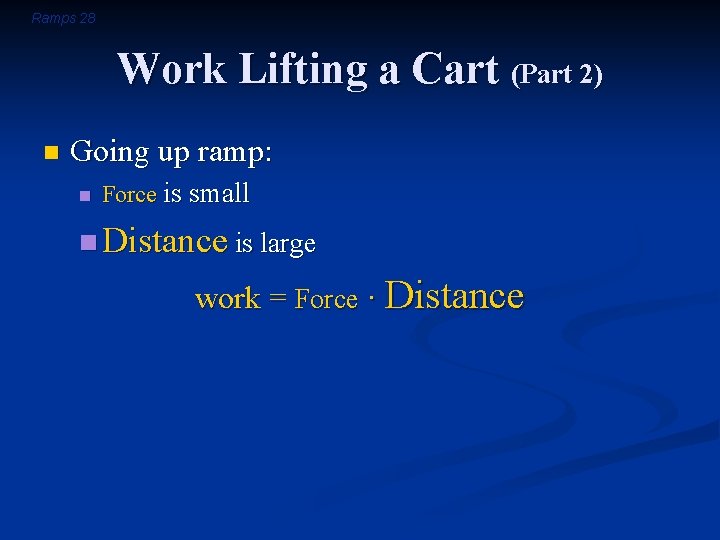
Ramps 28 Work Lifting a Cart (Part 2) n Going up ramp: n Force is small n Distance is large work = Force · Distance
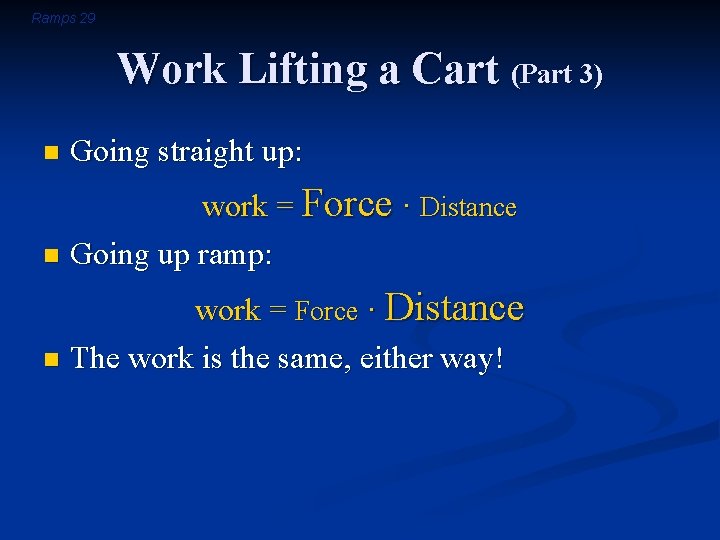
Ramps 29 Work Lifting a Cart (Part 3) n Going straight up: work = Force · Distance n Going up ramp: work = Force · Distance n The work is the same, either way!
Ramps 30 Mechanical Advantage n Mechanical advantage Doing the same amount of work n Redistributing force and distance n n A ramp provides mechanical advantage You can raise a heavy cart with a modest force n You must push that cart a long distance n Your work is independent of the ramp’s steepness n
Ramps 31 The Transfer of Energy n Energy has two principal forms Kinetic energy – energy of motion n Potential energy – energy stored in forces n n Your work transfers energy from you to the cart You do work on the cart n Your chemical potential energy decreases n The cart’s gravitational potential energy increases n
Ramps 32 Summary about Ramps Ramp supports most of the cart’s weight n You can easily balance the remaining ramp force n You do work pushing the cart up the ramp n Your work is independent of ramp’s steepness n The ramp provides mechanical advantage n It allows you to push less hard n but you must push for a longer distance n