
RAMCloud Scalable HighPerformance Storage Entirely in DRAM John
RAMCloud: Scalable High-Performance Storage Entirely in DRAM John Ousterhout Stanford University (with Nandu Jayakumar, Diego Ongaro, Mendel Rosenblum, Stephen Rumble, and Ryan Stutsman)
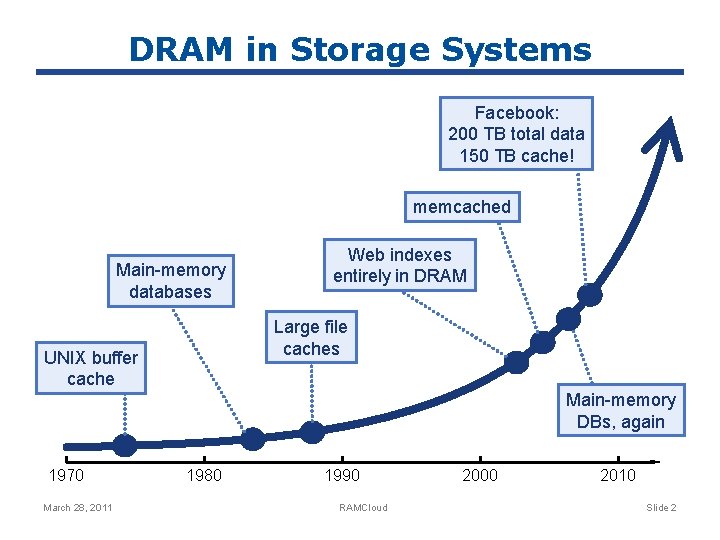
DRAM in Storage Systems Facebook: 200 TB total data 150 TB cache! memcached Main-memory databases Web indexes entirely in DRAM Large file caches UNIX buffer cache Main-memory DBs, again 1970 March 28, 2011 1980 1990 RAMCloud 2000 2010 Slide 2
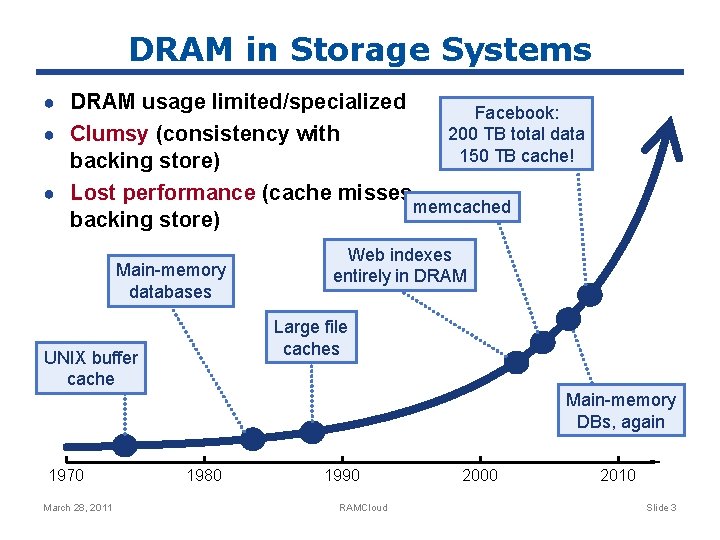
DRAM in Storage Systems ● DRAM usage limited/specialized ● Clumsy (consistency with Facebook: 200 TB total data 150 TB cache! backing store) ● Lost performance (cache misses, memcached backing store) Main-memory databases Web indexes entirely in DRAM Large file caches UNIX buffer cache Main-memory DBs, again 1970 March 28, 2011 1980 1990 RAMCloud 2000 2010 Slide 3
RAMCloud Harness full performance potential of large-scale DRAM storage: ● General-purpose storage system ● All data always in DRAM (no cache misses) ● Durable and available (no backing store) ● Scale: 1000+ servers, 100+ TB ● Low latency: 5 -10µs remote access Potential impact: enable new class of applications March 28, 2011 RAMCloud Slide 4
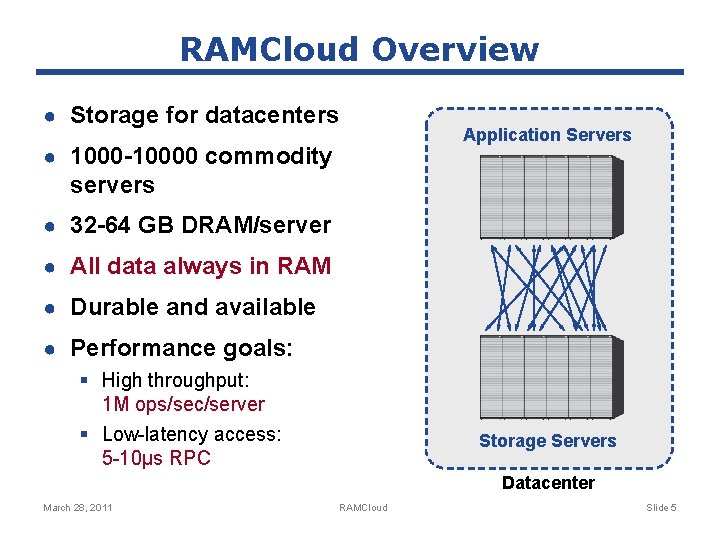
RAMCloud Overview ● Storage for datacenters ● 1000 -10000 commodity Application Servers servers ● 32 -64 GB DRAM/server ● All data always in RAM ● Durable and available ● Performance goals: § High throughput: 1 M ops/sec/server § Low-latency access: 5 -10µs RPC Storage Servers Datacenter March 28, 2011 RAMCloud Slide 5

Example Configurations Today 5 -10 years # servers 2000 4000 GB/server 24 GB 256 GB Total capacity 48 TB 1 PB Total server cost $3. 1 M $6 M $/GB $65 $6 For $100 -200 K today: § One year of Amazon customer orders § One year of United flight reservations March 28, 2011 RAMCloud Slide 6
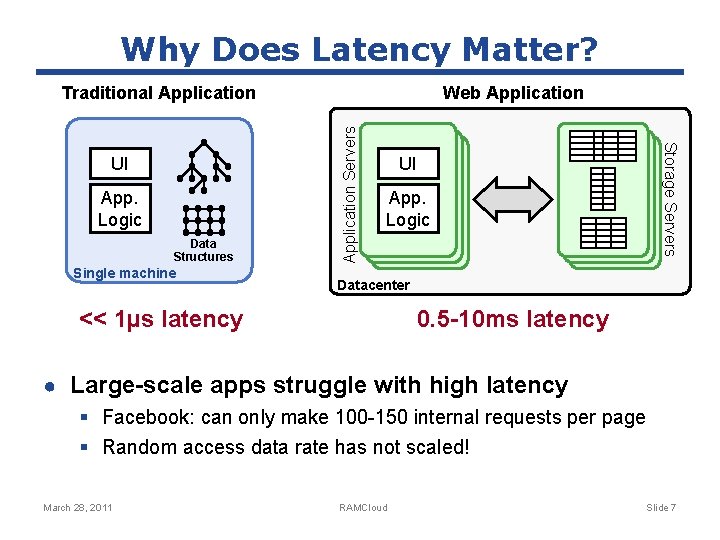
Why Does Latency Matter? App. Logic Data Structures Single machine UI App. Logic Storage Servers UI Web Application Servers Traditional Application Datacenter << 1µs latency 0. 5 -10 ms latency ● Large-scale apps struggle with high latency § Facebook: can only make 100 -150 internal requests per page § Random access data rate has not scaled! March 28, 2011 RAMCloud Slide 7
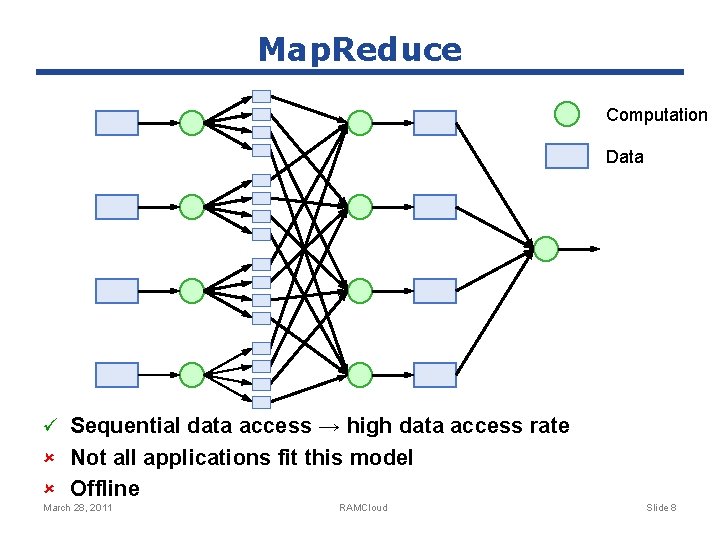
Map. Reduce Computation Data ü Sequential data access → high data access rate û Not all applications fit this model û Offline March 28, 2011 RAMCloud Slide 8
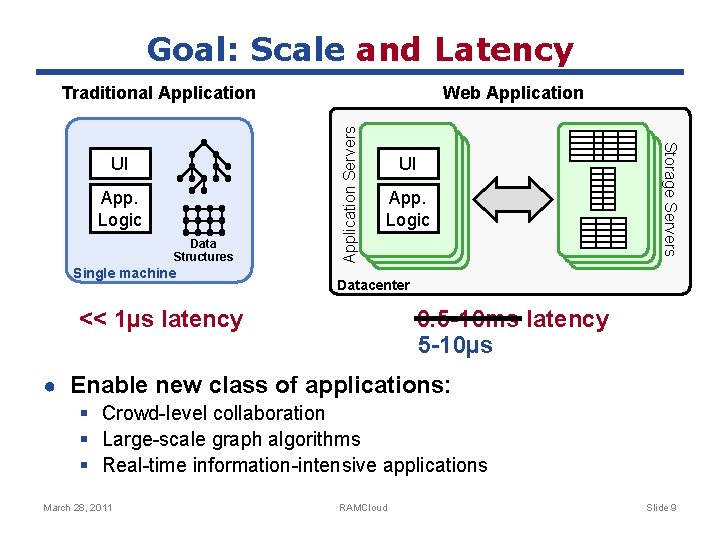
Goal: Scale and Latency App. Logic Data Structures Single machine UI App. Logic Storage Servers UI Web Application Servers Traditional Application Datacenter 0. 5 -10 ms latency 5 -10µs << 1µs latency ● Enable new class of applications: § Crowd-level collaboration § Large-scale graph algorithms § Real-time information-intensive applications March 28, 2011 RAMCloud Slide 9
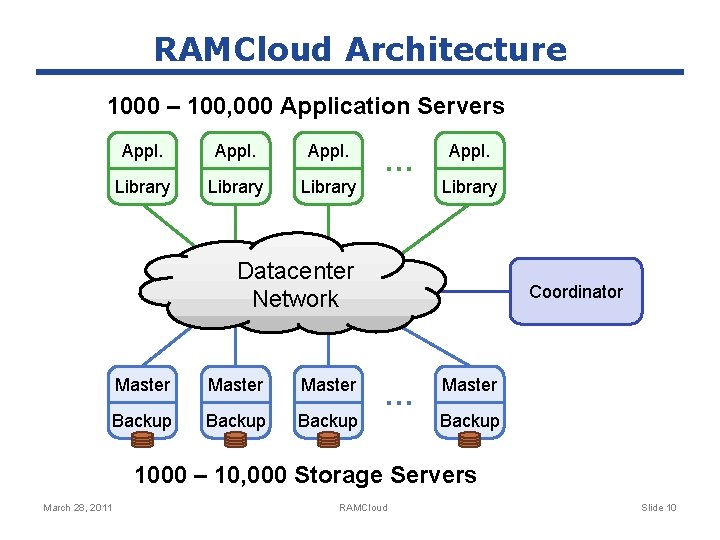
RAMCloud Architecture 1000 – 100, 000 Application Servers Appl. Library … Appl. Library Datacenter Network Master Backup Coordinator … Master Backup 1000 – 10, 000 Storage Servers March 28, 2011 RAMCloud Slide 10
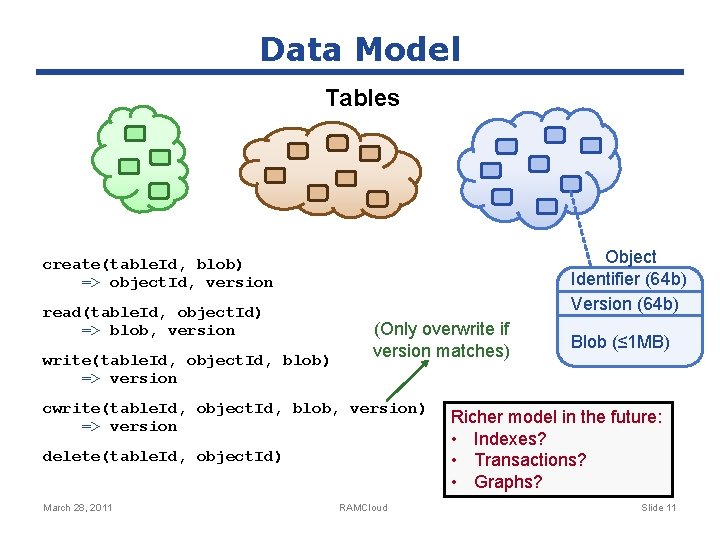
Data Model Tables Object Identifier (64 b) Version (64 b) create(table. Id, blob) => object. Id, version read(table. Id, object. Id) => blob, version write(table. Id, object. Id, blob) => version (Only overwrite if version matches) cwrite(table. Id, object. Id, blob, version) => version delete(table. Id, object. Id) March 28, 2011 RAMCloud Blob (≤ 1 MB) Richer model in the future: • Indexes? • Transactions? • Graphs? Slide 11
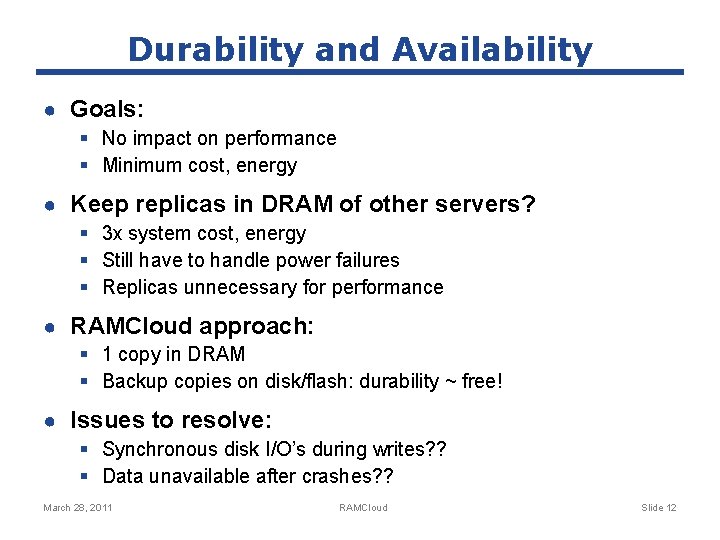
Durability and Availability ● Goals: § No impact on performance § Minimum cost, energy ● Keep replicas in DRAM of other servers? § 3 x system cost, energy § Still have to handle power failures § Replicas unnecessary for performance ● RAMCloud approach: § 1 copy in DRAM § Backup copies on disk/flash: durability ~ free! ● Issues to resolve: § Synchronous disk I/O’s during writes? ? § Data unavailable after crashes? ? March 28, 2011 RAMCloud Slide 12

Buffered Logging Write request Buffered Segment Disk Hash Table Backup Buffered Segment Disk In-Memory Log Master Backup ● No disk I/O during write requests ● Master’s memory also log-structured ● Log cleaning ~ generational garbage collection March 28, 2011 RAMCloud Slide 13
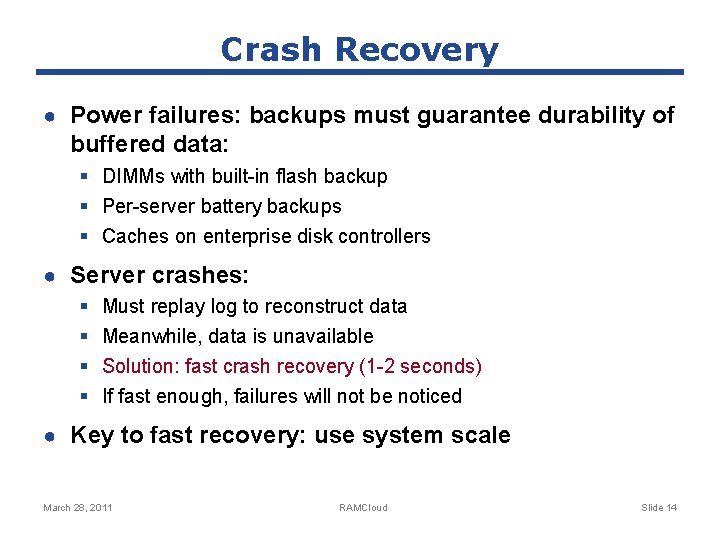
Crash Recovery ● Power failures: backups must guarantee durability of buffered data: § DIMMs with built-in flash backup § Per-server battery backups § Caches on enterprise disk controllers ● Server crashes: § § Must replay log to reconstruct data Meanwhile, data is unavailable Solution: fast crash recovery (1 -2 seconds) If fast enough, failures will not be noticed ● Key to fast recovery: use system scale March 28, 2011 RAMCloud Slide 14
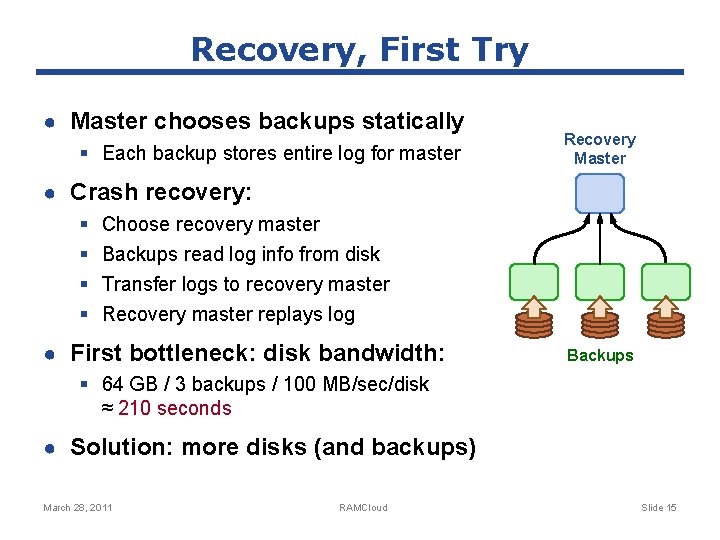
Recovery, First Try ● Master chooses backups statically § Each backup stores entire log for master Recovery Master ● Crash recovery: § § Choose recovery master Backups read log info from disk Transfer logs to recovery master Recovery master replays log ● First bottleneck: disk bandwidth: Backups § 64 GB / 3 backups / 100 MB/sec/disk ≈ 210 seconds ● Solution: more disks (and backups) March 28, 2011 RAMCloud Slide 15
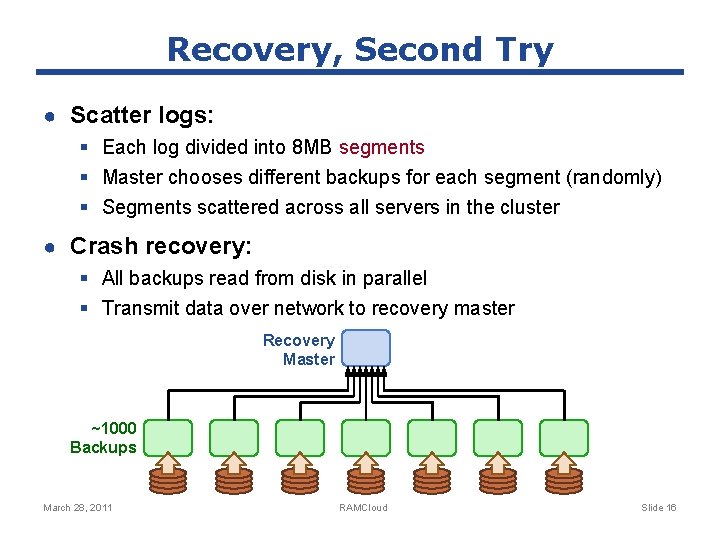
Recovery, Second Try ● Scatter logs: § Each log divided into 8 MB segments § Master chooses different backups for each segment (randomly) § Segments scattered across all servers in the cluster ● Crash recovery: § All backups read from disk in parallel § Transmit data over network to recovery master Recovery Master ~1000 Backups March 28, 2011 RAMCloud Slide 16
Scattered Logs, cont’d ● Disk no longer a bottleneck: § 64 GB / 8 MB/segment / 1000 backups ≈ 8 segments/backup § 100 ms/segment to read from disk § 0. 8 second to read all segments in parallel ● Second bottleneck: NIC on recovery master § 64 GB / 10 Gbits/second ≈ 60 seconds § Recovery master CPU is also a bottleneck ● Solution: more recovery masters § Spread work over 100 recovery masters § 64 GB / 10 Gbits/second / 100 masters ≈ 0. 6 second March 28, 2011 RAMCloud Slide 17
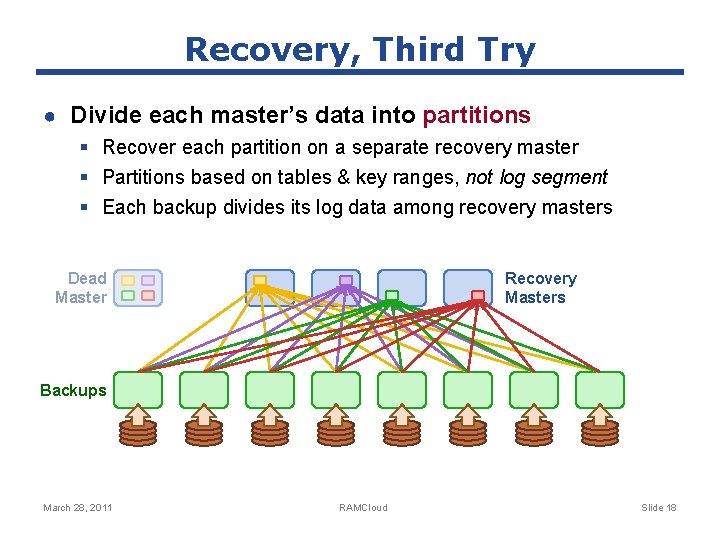
Recovery, Third Try ● Divide each master’s data into partitions § Recover each partition on a separate recovery master § Partitions based on tables & key ranges, not log segment § Each backup divides its log data among recovery masters Dead Master Recovery Masters Backups March 28, 2011 RAMCloud Slide 18
Other Research Issues ● Fast communication (RPC) § New datacenter network protocol? ● Data model ● Concurrency, consistency, transactions ● Data distribution, scaling ● Multi-tenancy ● Client-server functional distribution ● Node architecture March 28, 2011 RAMCloud Slide 19
Project Status ● Goal: build production-quality implementation ● Started coding Spring 2010 ● Major pieces coming together: § RPC subsystem ● Supports many different transport layers ● Using Mellanox Infiniband for high performance § Basic data model § Simple cluster coordinator § Fast recovery ● Performance (40 -node cluster): § Read small object: 5µs § Throughput: > 1 M small reads/second/server March 28, 2011 RAMCloud Slide 20
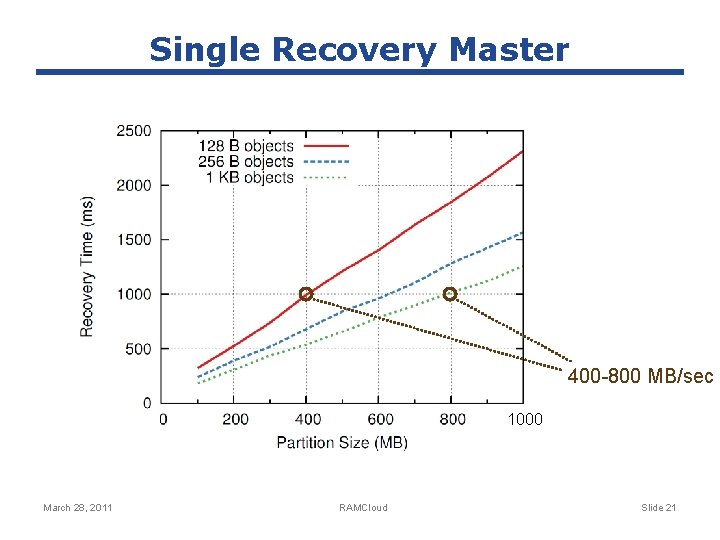
Single Recovery Master 400 -800 MB/sec 1000 March 28, 2011 RAMCloud Slide 21
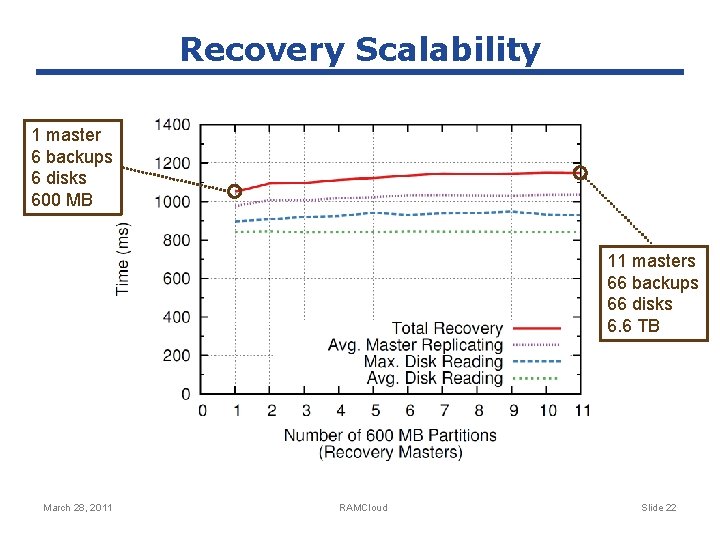
Recovery Scalability 1 master 6 backups 6 disks 600 MB 11 masters 66 backups 66 disks 6. 6 TB March 28, 2011 RAMCloud Slide 22
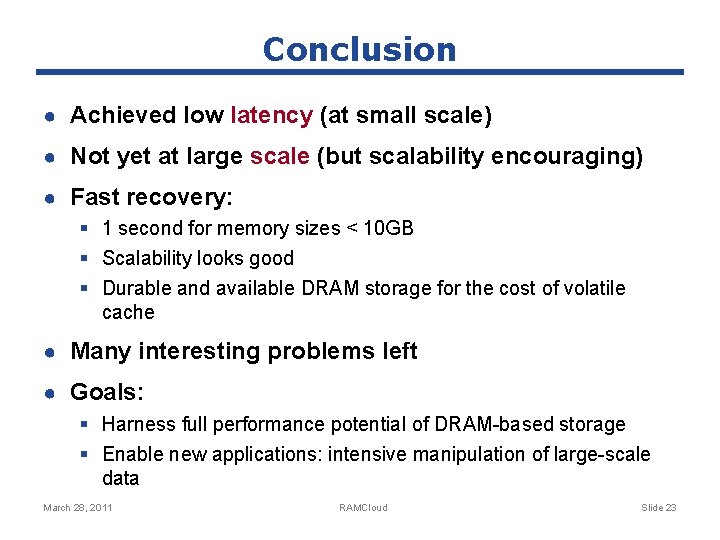
Conclusion ● Achieved low latency (at small scale) ● Not yet at large scale (but scalability encouraging) ● Fast recovery: § 1 second for memory sizes < 10 GB § Scalability looks good § Durable and available DRAM storage for the cost of volatile cache ● Many interesting problems left ● Goals: § Harness full performance potential of DRAM-based storage § Enable new applications: intensive manipulation of large-scale data March 28, 2011 RAMCloud Slide 23
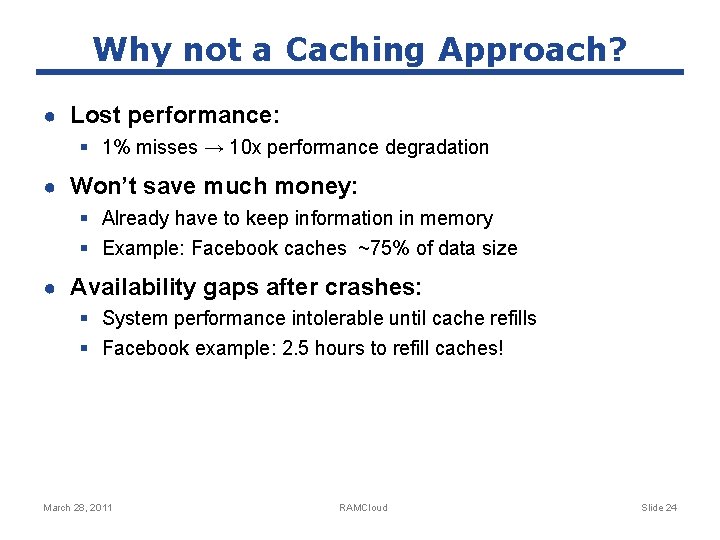
Why not a Caching Approach? ● Lost performance: § 1% misses → 10 x performance degradation ● Won’t save much money: § Already have to keep information in memory § Example: Facebook caches ~75% of data size ● Availability gaps after crashes: § System performance intolerable until cache refills § Facebook example: 2. 5 hours to refill caches! March 28, 2011 RAMCloud Slide 24
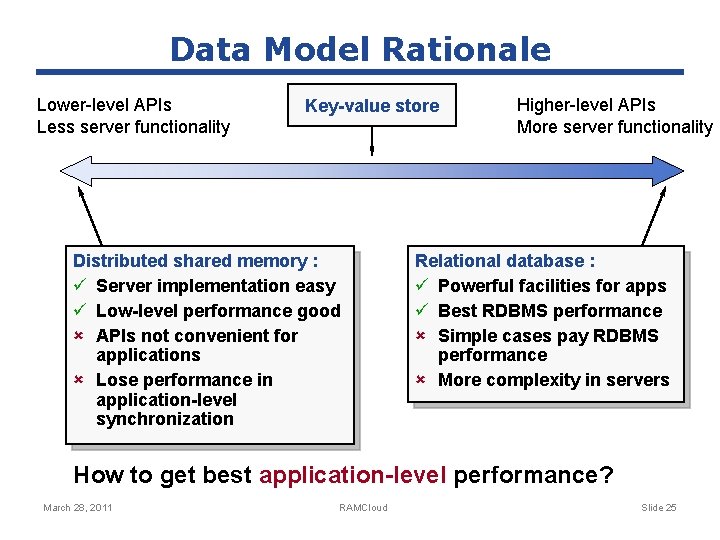
Data Model Rationale Lower-level APIs Less server functionality Key-value store Distributed shared memory : ü Server implementation easy ü Low-level performance good û APIs not convenient for applications û Lose performance in application-level synchronization Higher-level APIs More server functionality Relational database : ü Powerful facilities for apps ü Best RDBMS performance û Simple cases pay RDBMS performance û More complexity in servers How to get best application-level performance? March 28, 2011 RAMCloud Slide 25
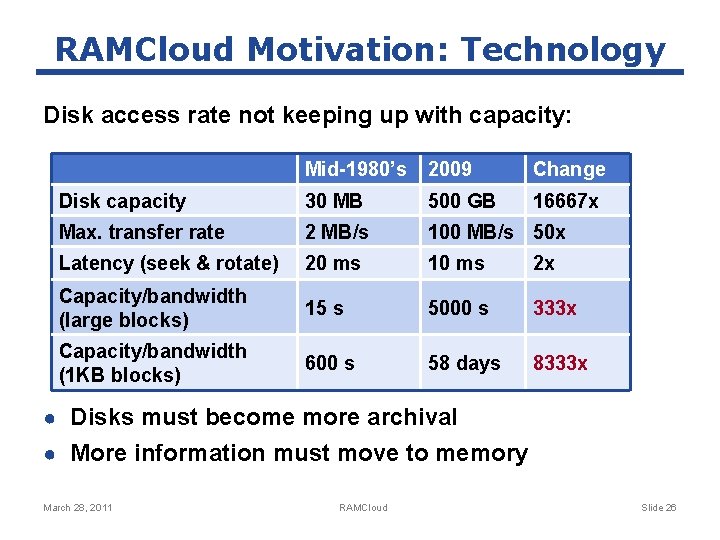
RAMCloud Motivation: Technology Disk access rate not keeping up with capacity: Mid-1980’s 2009 Change Disk capacity 30 MB 500 GB 16667 x Max. transfer rate 2 MB/s 100 MB/s 50 x Latency (seek & rotate) 20 ms 10 ms 2 x Capacity/bandwidth (large blocks) 15 s 5000 s 333 x Capacity/bandwidth (1 KB blocks) 600 s 58 days 8333 x ● Disks must become more archival ● More information must move to memory March 28, 2011 RAMCloud Slide 26
- Slides: 26