
Raman and Parametric mediated amplification and all optical
![[d. Bm] Pump Comparison with results using sinusoidal pump modulation with phase modulation @](https://slidetodoc.com/presentation_image/dbf7bb862380bd588d5f86c25a5dcd24/image-44.jpg "[d. Bm] Pump Comparison with results using sinusoidal pump modulation with phase modulation @")
![Timing Jitter estimations Timing Jitter [fs] 150 100 Hz – 15 k. Hz 500](https://slidetodoc.com/presentation_image/dbf7bb862380bd588d5f86c25a5dcd24/image-55.jpg "Timing Jitter estimations Timing Jitter [fs] 150 100 Hz – 15 k. Hz 500")
- Slides: 56
Raman and Parametric mediated amplification and all optical processing for high speed fiber optics communication systems David Dahan Electrical Engineering Department Technion 27/06/2005 1
Acknowledgements n My supervisor : Prof. Gadi Eisenstein n Former and current students ¨ ¨ ¨ n Dr. Kobi Lasri Dr. Alberto Bilenca Evgeny Shumakher Robert Alizon Din Hadass Ido Ben-Aroya n Laboratory staff Dr. Mark Sogolov ¨ Dr. Boris Levit ¨ Dr. Alex Bekker ¨ Vladimir Smulakovsky ¨ Scholarships and prices ¨ Technion: Martin Prosserman fellowship Ministry of Science: Levy Eskhol scholarship ¨ IEEE/LEOS: Graduate student fellowship award (2005) ¨ 2
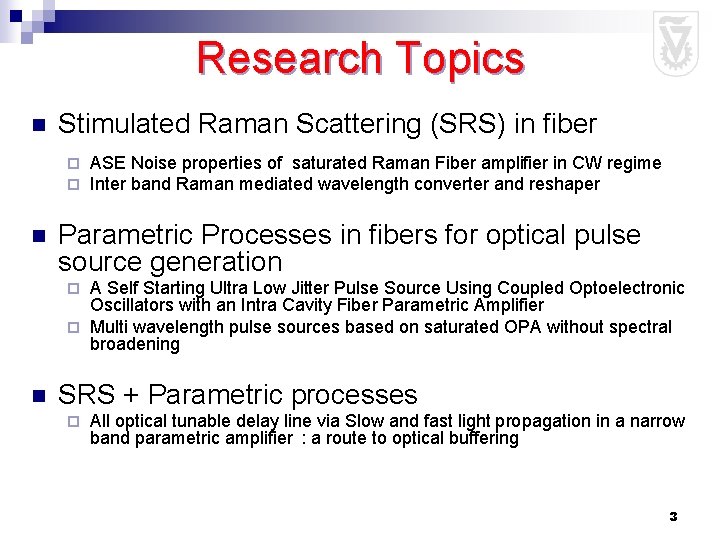
Research Topics n Stimulated Raman Scattering (SRS) in fiber ¨ ¨ n ASE Noise properties of saturated Raman Fiber amplifier in CW regime Inter band Raman mediated wavelength converter and reshaper Parametric Processes in fibers for optical pulse source generation A Self Starting Ultra Low Jitter Pulse Source Using Coupled Optoelectronic Oscillators with an Intra Cavity Fiber Parametric Amplifier ¨ Multi wavelength pulse sources based on saturated OPA without spectral broadening ¨ n SRS + Parametric processes ¨ All optical tunable delay line via Slow and fast light propagation in a narrow band parametric amplifier : a route to optical buffering 3
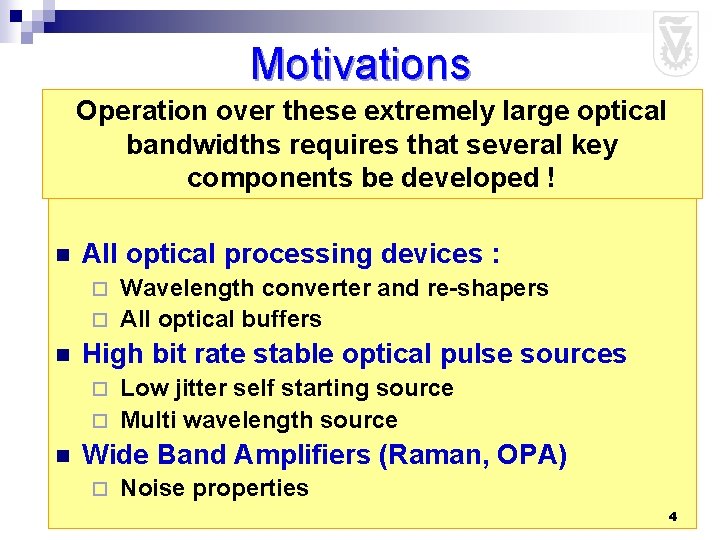
Motivations Operation over these extremely large optical How can we cope with the increasing demand in bandwidths requires that several key information capacity? components be developed ! Fiber Loss (d. B/km) n All 0. 35 optical S C L U Fiber Type processing devices : Wavelength converter and re-shapers Raman, ¨ All optical buffers OPA ¨ 0. 25 n High n S+ Standard All. Wave GS-EDFA bit rate stable optical pulse sources EDFA Low jitter self starting source ¨ Multi wavelength source 0. 15 ¨ GS-TDFA Wide Band Amplifiers (Raman, OPA) ¨ 1300 Noise 1400 properties 1500 1600 Optical Wavelength (nm) 4
Inter band Raman - Mediated Wavelength Converter with Noise Reduction Capabilities 5
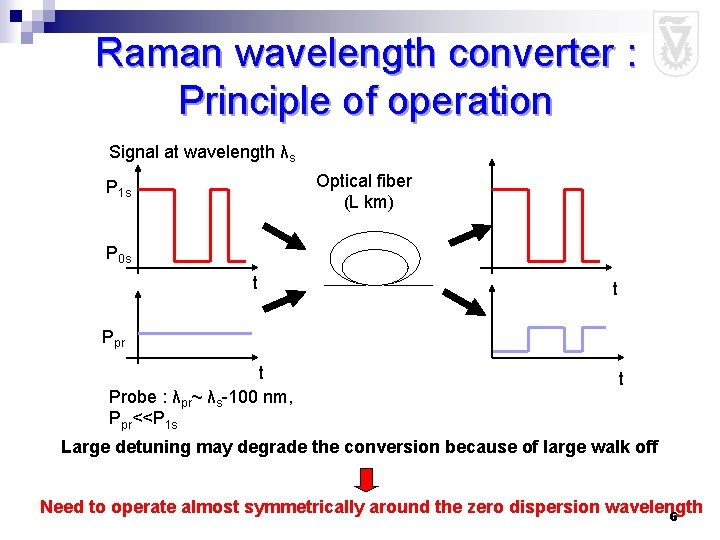
Raman wavelength converter : Principle of operation Signal at wavelength λs Optical fiber (L km) P 1 s P 0 s t t Ppr t Probe : λpr~ λs-100 nm, Ppr<<P 1 s t Large detuning may degrade the conversion because of large walk off Need to operate almost symmetrically around the zero dispersion wavelength 6
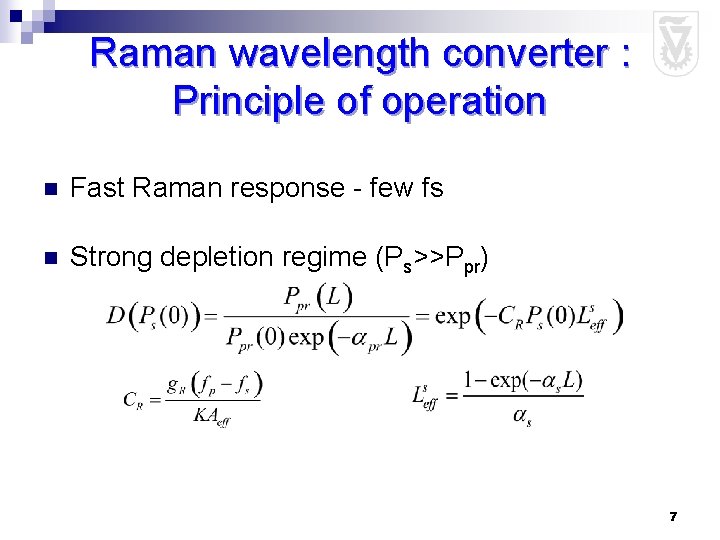
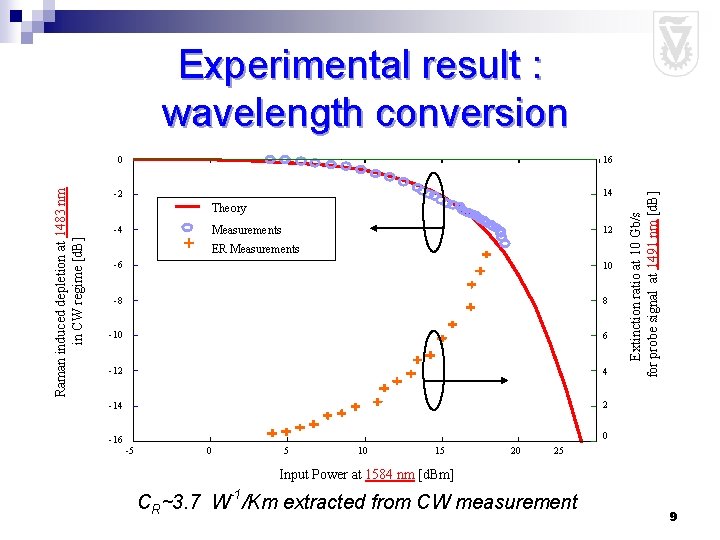
Raman wavelength converter : Principle of operation n Fast Raman response - few fs n Strong depletion regime (Ps>>Ppr) 7
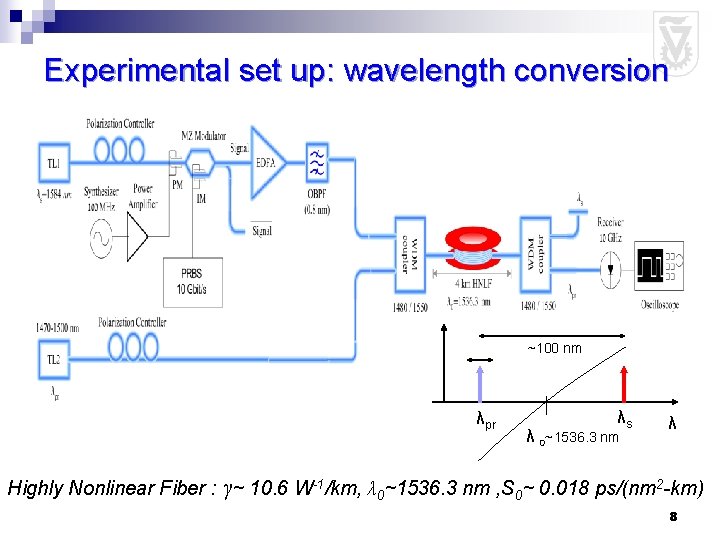
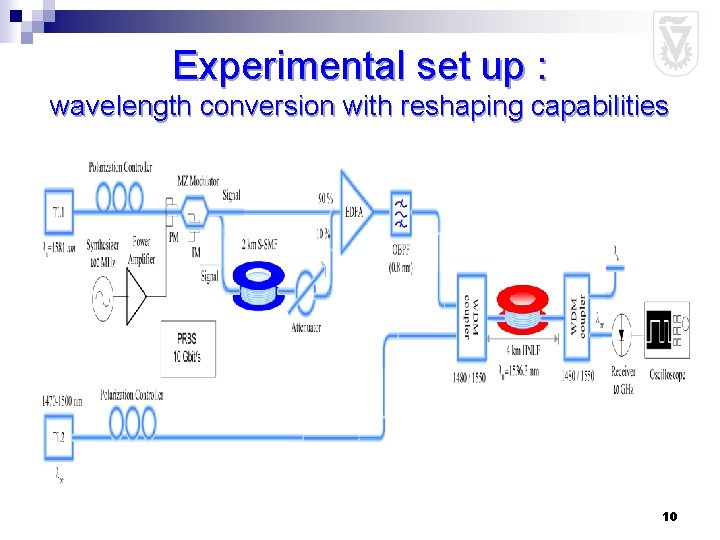
Experimental set up: wavelength conversion ~100 nm λpr λs λ 0~1536. 3 nm λ Highly Nonlinear Fiber : γ~ 10. 6 W-1/km, λ 0~1536. 3 nm , S 0~ 0. 018 ps/(nm 2 -km) 8
0 16 -2 14 Theory -4 + Measurements 12 ER Measurements -6 10 -8 8 -10 6 -12 4 -14 2 -16 0 -5 0 5 10 15 20 Extinction ratio at 10 Gb/s for probe signal at 1491 nm [d. B] Raman induced depletion at 1483 nm in CW regime [d. B] Experimental result : wavelength conversion 25 Input Power at 1584 nm [d. Bm] CR~3. 7 W-1/Km extracted from CW measurement 9
Experimental set up : wavelength conversion with reshaping capabilities 10
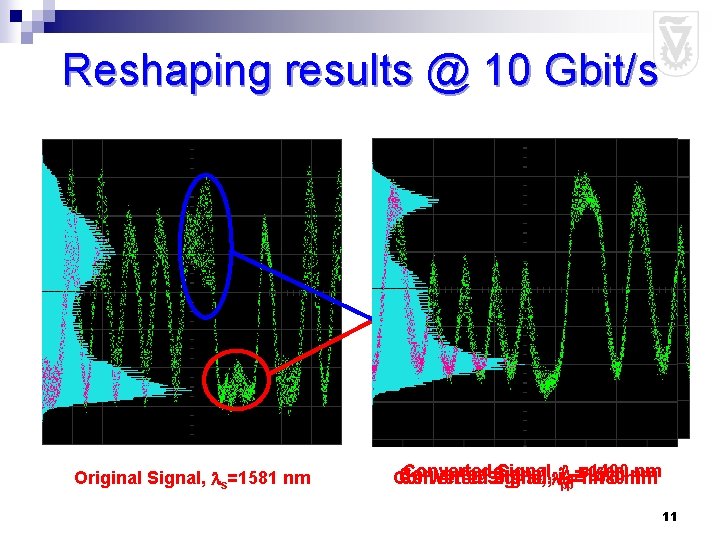
Reshaping results @ 10 Gbit/s Original Signal, s=1581 nm Converted. Signal, =1490 nm nm Converted Signal, nm p=1500 Converted Signal, p pp=1470 =1480 nm 11
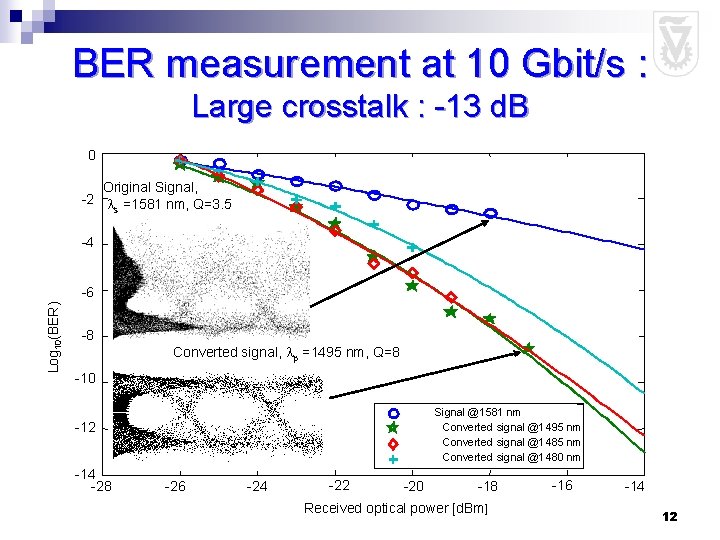
BER measurement at 10 Gbit/s : Large crosstalk : -13 d. B 0 Original Signal, -2 =1581 nm, Q=3. 5 s -4 Log 10(BER) -6 -8 Converted signal, p =1495 nm, Q=8 -10 Signal @1581 nm Converted signal @1495 nm Converted signal @1480 nm -12 -14 -28 -26 -24 -22 -20 -18 Received optical power [d. Bm] -16 -14 12
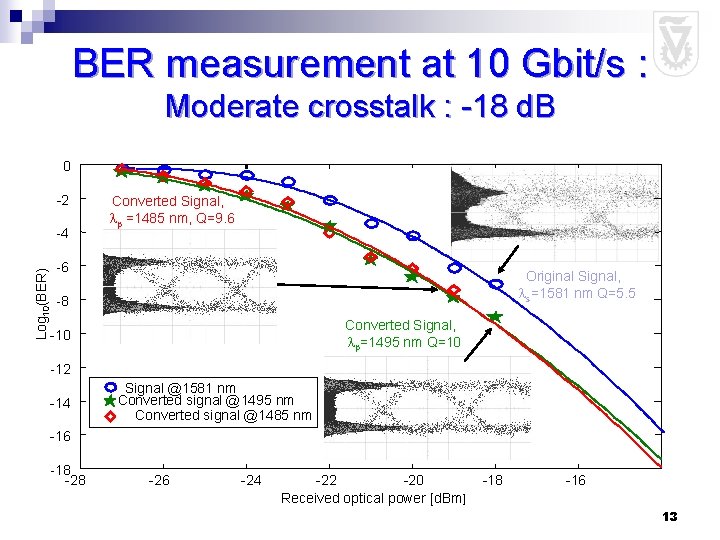
BER measurement at 10 Gbit/s : Moderate crosstalk : -18 d. B 0 -2 Log 10(BER) -4 Converted Signal, p =1485 nm, Q=9. 6 -6 Original Signal, s=1581 nm Q=5. 5 -8 Converted Signal, p=1495 nm Q=10 -12 -14 Signal @1581 nm Converted signal @1495 nm Converted signal @1485 nm -16 -18 -26 -24 -22 -20 Received optical power [d. Bm] -18 -16 13
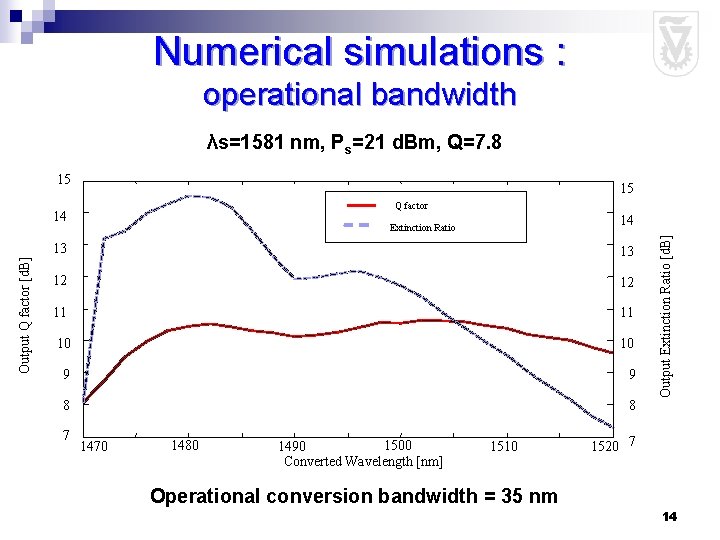
Numerical simulations : operational bandwidth λs=1581 nm, Ps=21 d. Bm, Q=7. 8 15 15 Q factor 14 Extinction Ratio 13 13 12 12 11 11 10 10 9 9 8 8 7 1470 1480 1500 1490 Converted Wavelength [nm] 1510 Output Extinction Ratio [d. B] Output Q factor [d. B] 14 1520 7 Operational conversion bandwidth = 35 nm 14
Slow and fast light propagation via narrow band optical parametric amplifier : a route to optical buffering 15
Motivations n Tunable optical pulse delays are of central importance to numerous fields including optical coherence tomography, ultra-fast pulse metrology, and optical communications. n Next Internet Router generation will be based on all optical packet switching : Need to develop all optical buffering devices. n Promising approach : controlling the velocity of optical pulses through dispersive media, a concept termed as slow and fast light 16
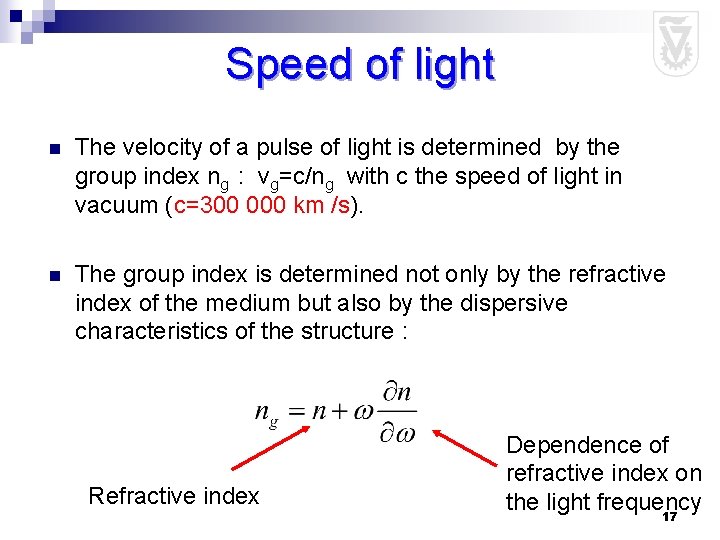
Speed of light n The velocity of a pulse of light is determined by the group index ng : vg=c/ng with c the speed of light in vacuum (c=300 000 km /s). n The group index is determined not only by the refractive index of the medium but also by the dispersive characteristics of the structure : Refractive index Dependence of refractive index on the light frequency 17
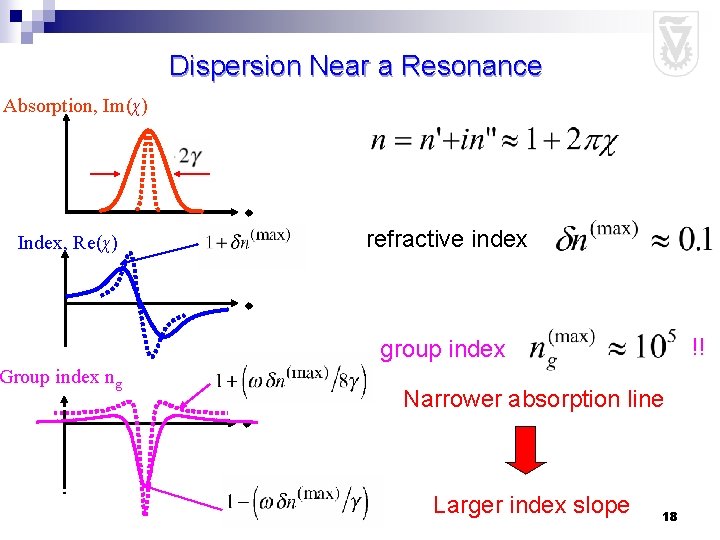
Dispersion Near a Resonance Absorption, Im(χ) refractive index Index, Re(χ) !! group index Group index ng Narrower absorption line Larger index slope 18
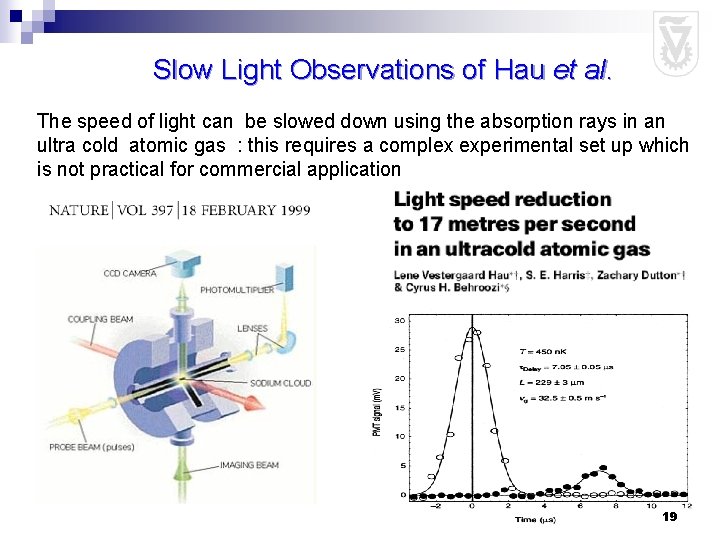
Slow Light Observations of Hau et al. The speed of light can be slowed down using the absorption rays in an ultra cold atomic gas : this requires a complex experimental set up which is not practical for commercial application 19
Other media n SC Waveguide (Passive and active) – Limited by carrier life time. Maximum delay one bit. n Ruby Crystal – large delay narrow bandwidth n Rubidium vapor – Large delays ultra narrow bandwidth and large attenuation n Nonlinearities in optical fibers may, on the other hand, offer optical gain in addition to other advantages such as a broad range of operating wavelengths, operation at room temperature and flexible length 20
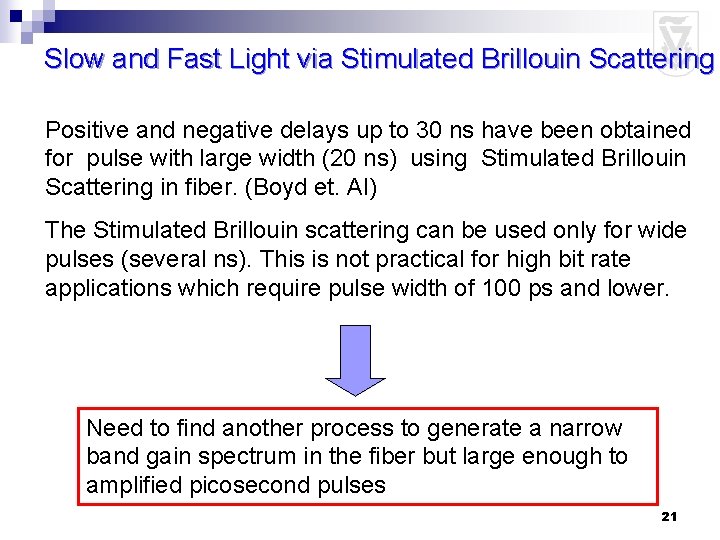
Slow and Fast Light via Stimulated Brillouin Scattering Positive and negative delays up to 30 ns have been obtained for pulse with large width (20 ns) using Stimulated Brillouin Scattering in fiber. (Boyd et. Al) The Stimulated Brillouin scattering can be used only for wide pulses (several ns). This is not practical for high bit rate applications which require pulse width of 100 ps and lower. Need to find another process to generate a narrow band gain spectrum in the fiber but large enough to amplified picosecond pulses 21
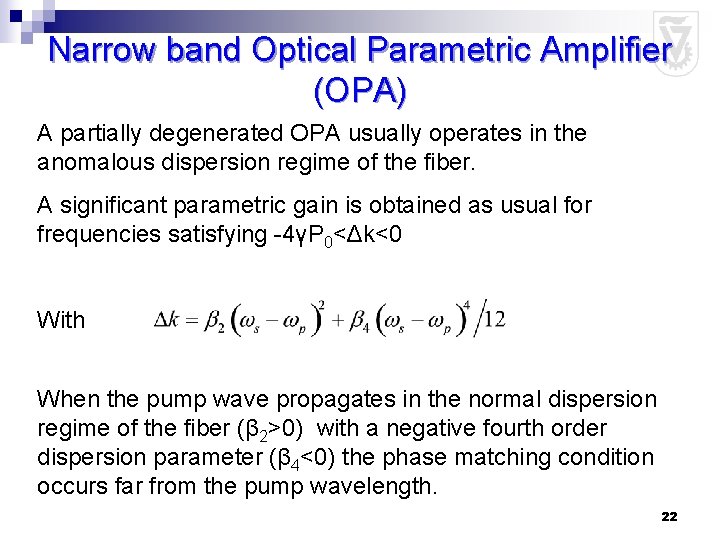
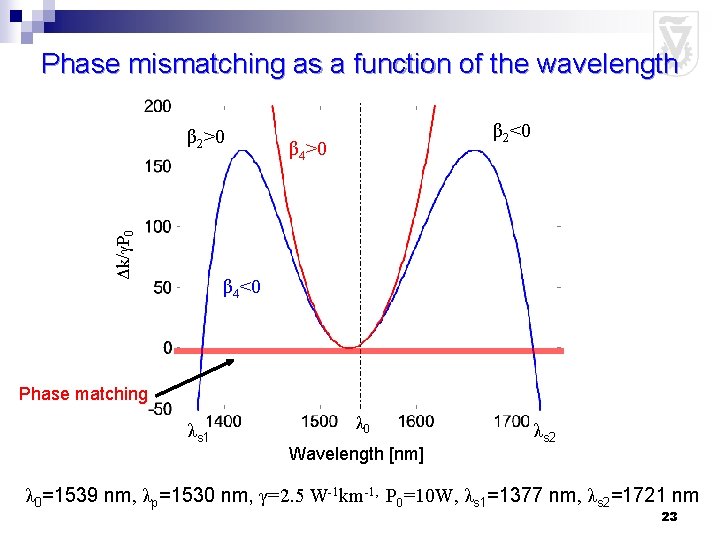
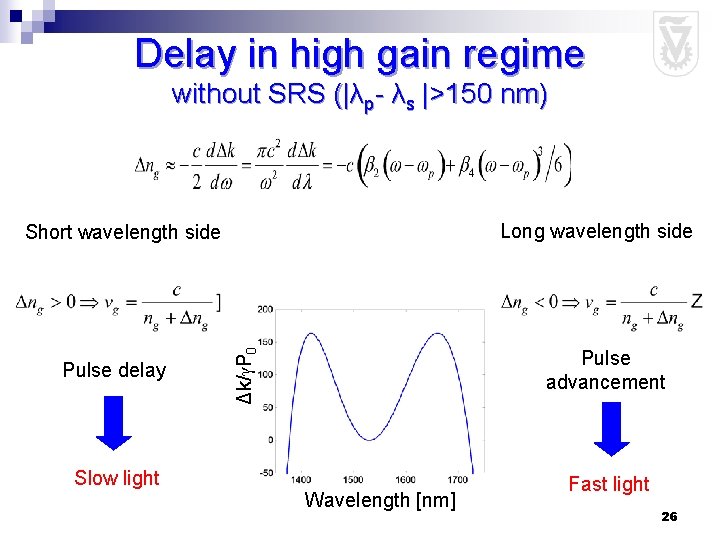
Narrow band Optical Parametric Amplifier (OPA) A partially degenerated OPA usually operates in the anomalous dispersion regime of the fiber. A significant parametric gain is obtained as usual for frequencies satisfying -4γP 0<Δk<0 With When the pump wave propagates in the normal dispersion regime of the fiber (β 2>0) with a negative fourth order dispersion parameter (β 4<0) the phase matching condition occurs far from the pump wavelength. 22
Phase mismatching as a function of the wavelength Δk/γP 0 β 2>0 β 2<0 β 4>0 β 4<0 Phase matching λs 1 λ 0 Wavelength [nm] λs 2 λ 0=1539 nm, λp=1530 nm, γ=2. 5 W-1 km-1, P 0=10 W, λs 1=1377 nm, λs 2=1721 nm 23
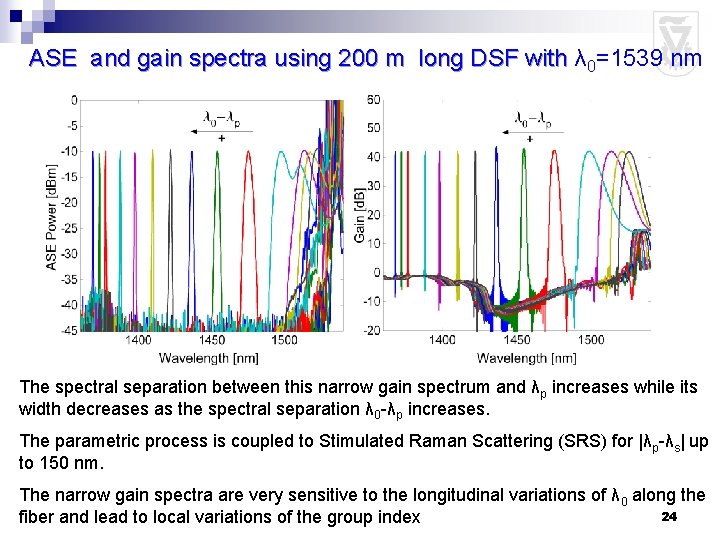
ASE and gain spectra using 200 m long DSF with λ 0=1539 nm The spectral separation between this narrow gain spectrum and λp increases while its width decreases as the spectral separation λ 0 -λp increases. The parametric process is coupled to Stimulated Raman Scattering (SRS) for |λp-λs| up to 150 nm. The narrow gain spectra are very sensitive to the longitudinal variations of λ 0 along the 24 fiber and lead to local variations of the group index
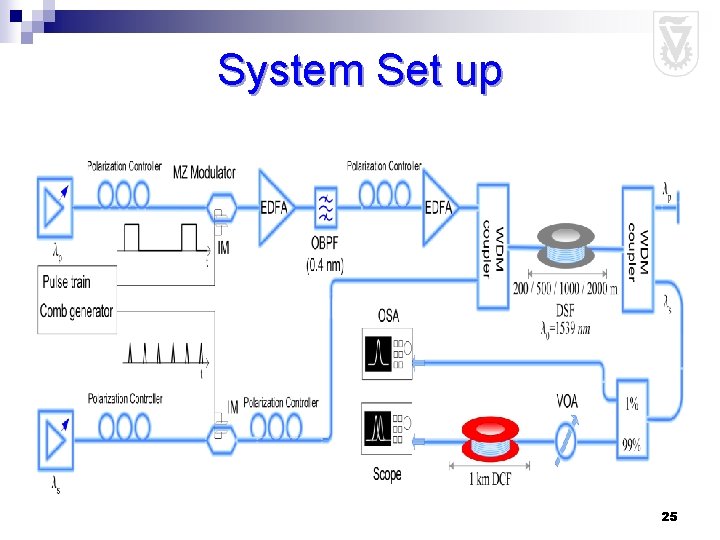
System Set up 25
Delay in high gain regime without SRS (|λp- λs |>150 nm) Long wavelength side Pulse delay Δk/γP 0 Short wavelength side Pulse advancement Slow light Wavelength [nm] Fast light 26
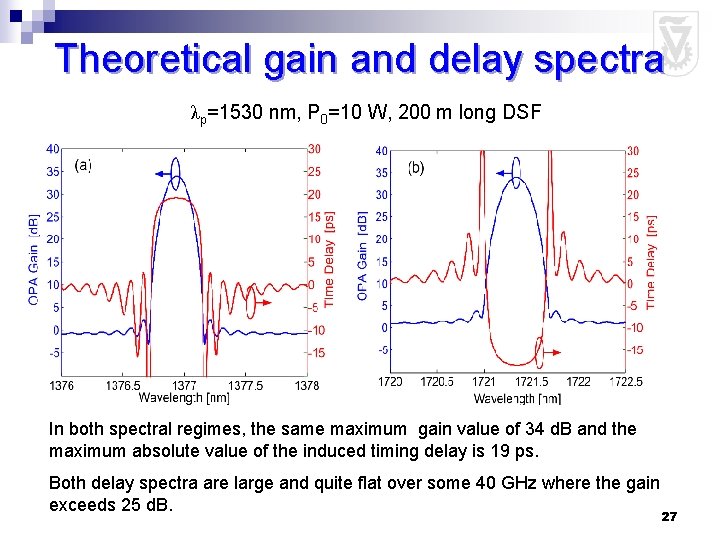
Theoretical gain and delay spectra λp=1530 nm, P 0=10 W, 200 m long DSF In both spectral regimes, the same maximum gain value of 34 d. B and the maximum absolute value of the induced timing delay is 19 ps. Both delay spectra are large and quite flat over some 40 GHz where the gain exceeds 25 d. B. 27
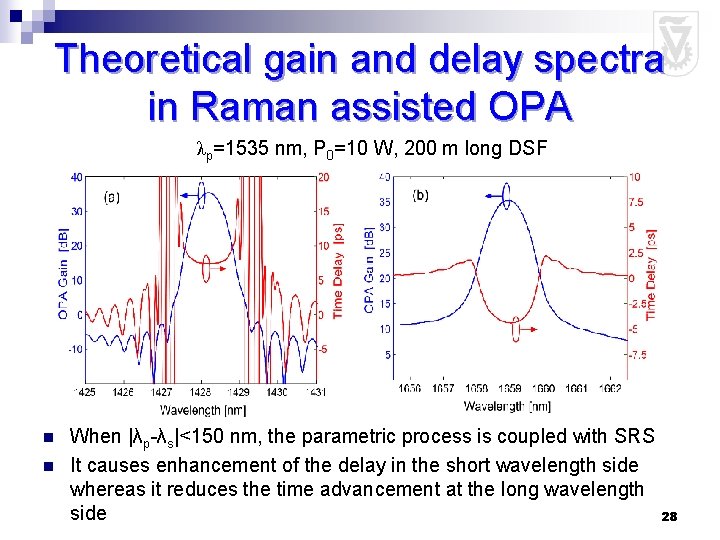
Theoretical gain and delay spectra in Raman assisted OPA λp=1535 nm, P 0=10 W, 200 m long DSF n n When |λp-λs|<150 nm, the parametric process is coupled with SRS It causes enhancement of the delay in the short wavelength side whereas it reduces the time advancement at the long wavelength side 28
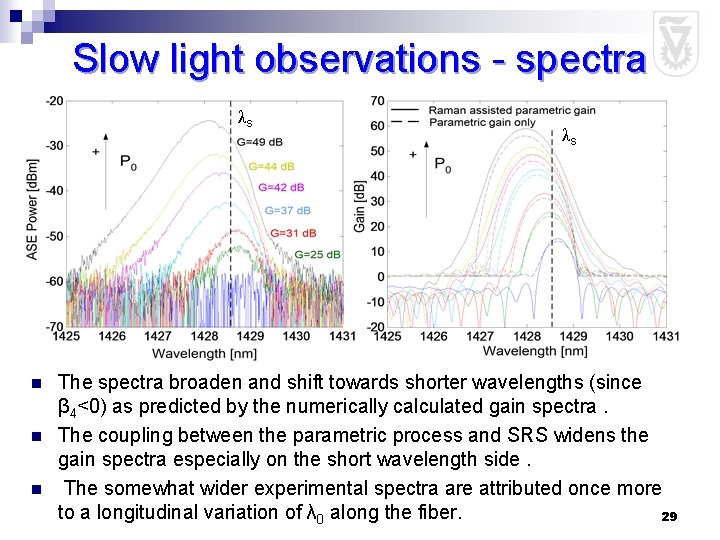
Slow light observations - spectra λs n n n λs The spectra broaden and shift towards shorter wavelengths (since β 4<0) as predicted by the numerically calculated gain spectra. The coupling between the parametric process and SRS widens the gain spectra especially on the short wavelength side. The somewhat wider experimental spectra are attributed once more to a longitudinal variation of λ 0 along the fiber. 29
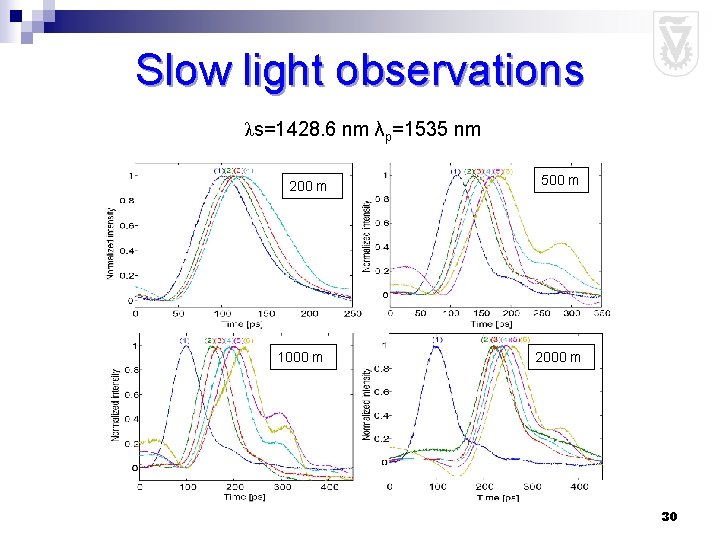
Slow light observations λs=1428. 6 nm λp=1535 nm 200 m 1000 m 500 m 2000 m 30
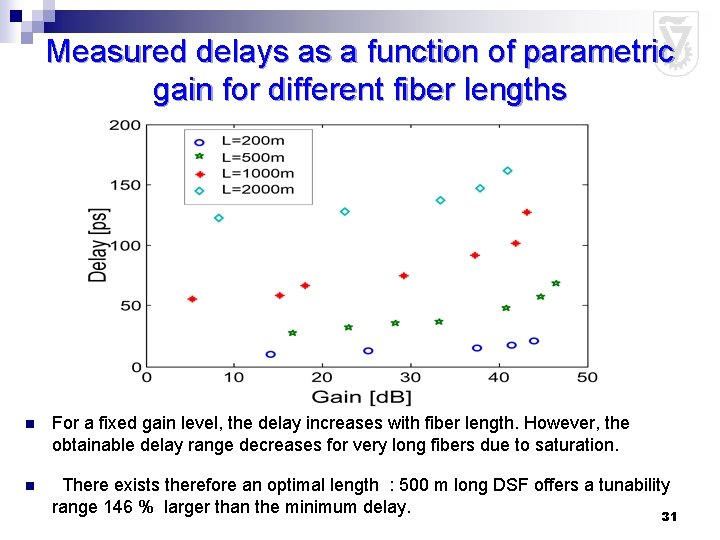
Measured delays as a function of parametric gain for different fiber lengths n For a fixed gain level, the delay increases with fiber length. However, the obtainable delay range decreases for very long fibers due to saturation. n There exists therefore an optimal length : 500 m long DSF offers a tunability range 146 % larger than the minimum delay. 31
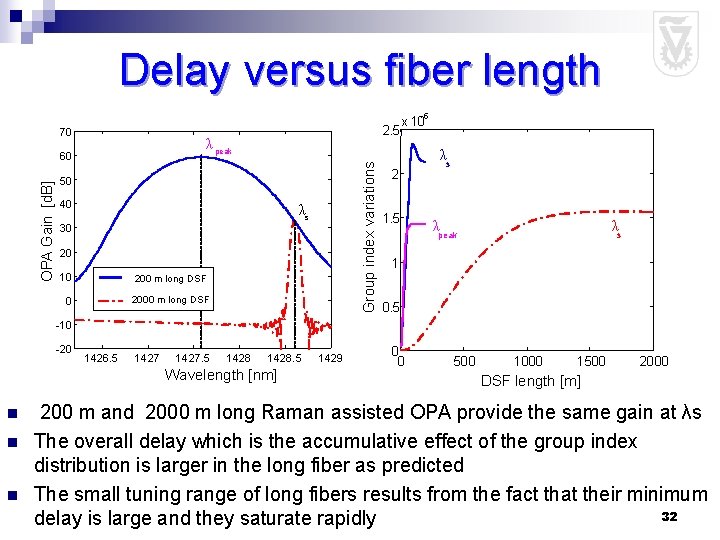
Delay versus fiber length -5 70 Group index variations λ peak 60 OPA Gain [d. B] 2. 5 50 40 λs 30 20 10 200 m long DSF 0 2000 m long DSF x 10 2 1. 5 λs λpeak λs 1 0. 5 -10 -20 1426. 5 -5 n n n 1427. 5 1428. 5 Wavelength [nm] 1429 0 0 500 1000 1500 2000 DSF length [m] 200 m and 2000 m long Raman assisted OPA provide the same gain at λs The overall delay which is the accumulative effect of the group index distribution is larger in the long fiber as predicted The small tuning range of long fibers results from the fact that their minimum 32 delay is large and they saturate rapidly
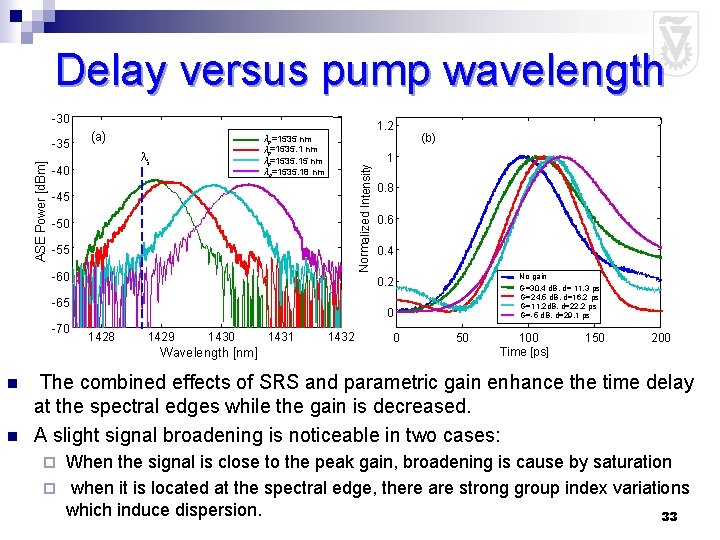
Delay versus pump wavelength -30 λs -40 1. 2 λp=1535 nm λp=1535. 15 nm λp=1535. 18 nm Normalized Intensity ASE Power [d. Bm] -35 (a) -45 -50 -55 -60 n 0. 8 0. 6 0. 4 No gain G=30. 4 d. B, d= 11. 3 ps G=24. 5 d. B, d=16. 2 ps G=11. 2 d. B, d=22. 2 ps G=-5 d. B, d=29. 1 ps 0 1428 1429 1430 Wavelength [nm] n 1 0. 2 -65 -70 (b) 1431 1432 0 50 100 Time [ps] 150 200 The combined effects of SRS and parametric gain enhance the time delay at the spectral edges while the gain is decreased. A slight signal broadening is noticeable in two cases: When the signal is close to the peak gain, broadening is cause by saturation ¨ when it is located at the spectral edge, there are strong group index variations which induce dispersion. 33 ¨
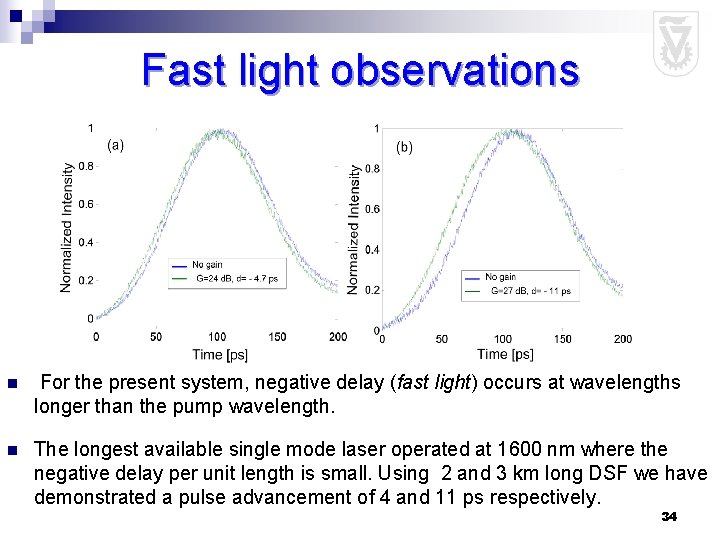
Fast light observations n For the present system, negative delay (fast light) occurs at wavelengths longer than the pump wavelength. n The longest available single mode laser operated at 1600 nm where the negative delay per unit length is small. Using 2 and 3 km long DSF we have demonstrated a pulse advancement of 4 and 11 ps respectively. 34
Parametric Processes in fibers for optical pulse source generation 35
A Self Starting Ultra Low Jitter Pulse Source Using Coupled Optoelectronic Oscillators with an Intra Cavity Fiber Parametric Amplifier 36
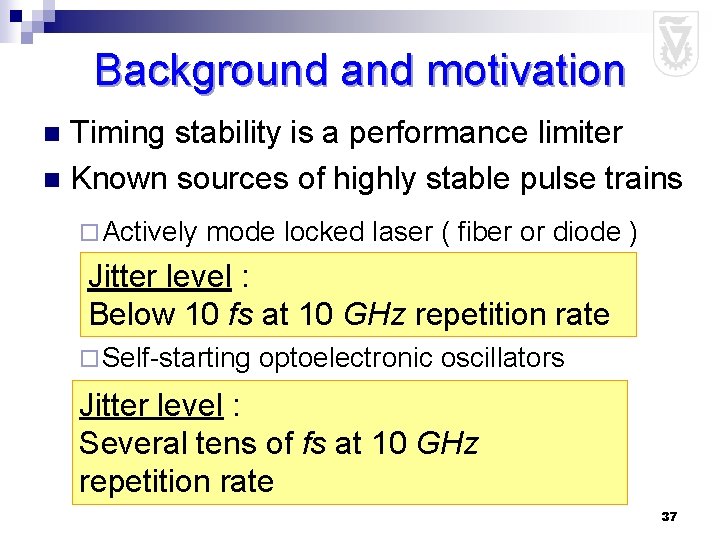
Background and motivation Timing stability is a performance limiter n Known sources of highly stable pulse trains n ¨ Actively mode locked laser ( fiber or diode ) n Jitter level is dictated by high quality external Jitter level : drive microwave source Below 10 fs at 10 GHz repetition rate ¨ Self-starting optoelectronic oscillators n Optoelectronic oscillator with an EO modulator Jitter level : n Interlocked microwave and mode locked diode Several fs at 10 GHz laserstens basedof optoelectronic oscillators repetition rate 37
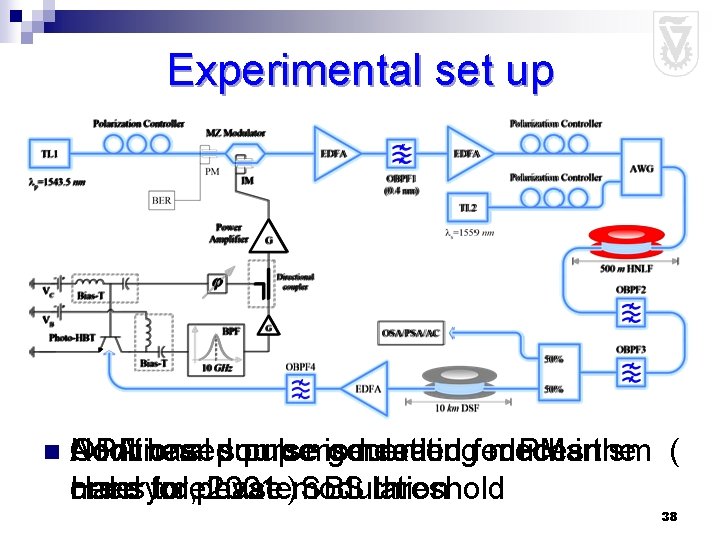
Experimental set up n Additional Nonlinear OPA based pump source pulsemodulation is generating needed reduces for mechanism PM inthe ( need for Hansyrd, order to elevate phase 2001 )modulation SBS threshold 38
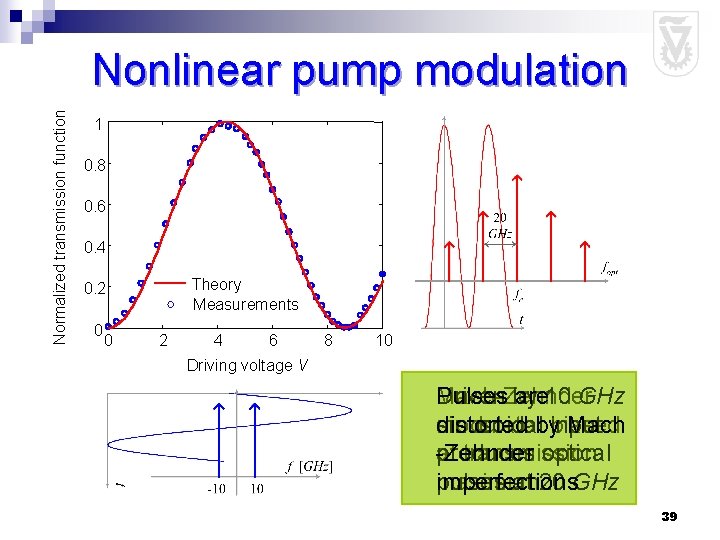
Normalized transmission function Nonlinear pump modulation 1 0. 8 0. 6 0. 4 Theory Measurements 0. 2 0 0 2 4 6 8 10 Driving voltage V Pulses by Mach-Zehnder Driven are 10 GHz modulatorbybiased sinusoidal distorted input Mach at transmission produces -Zehnder optical maximum pulses imperfections at 20 GHz 39
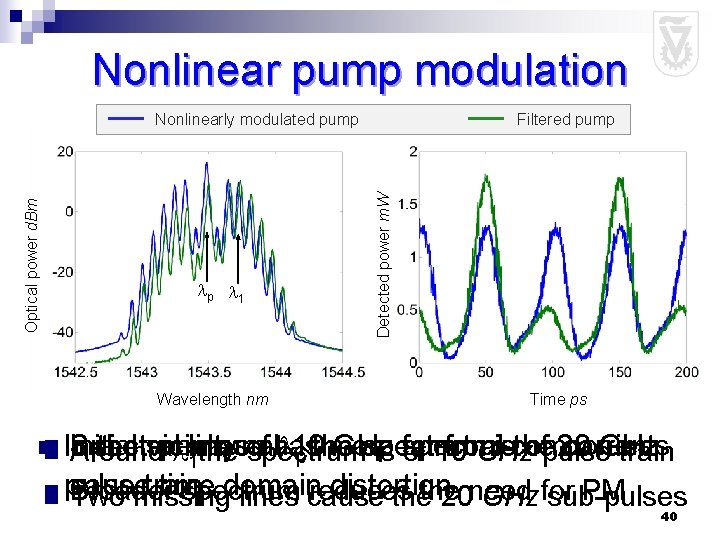
Nonlinear pump modulation p 1 Wavelength nm Filtered pump Detected power m. W Optical power d. Bm Nonlinearly modulated pump Time ps Initial more spectral nn Spectral the spectrum vicinity athas 10 GHz spectrum from iscomponents the ofpulse 20 carrier GHz n In Around 1 lines the of spectrum is far of 10 GHz train p the cause train time domain distortion n Broader spectrum reduces PM n pulse Two missing lines cause thethe 20 need GHz for sub-pulses 40
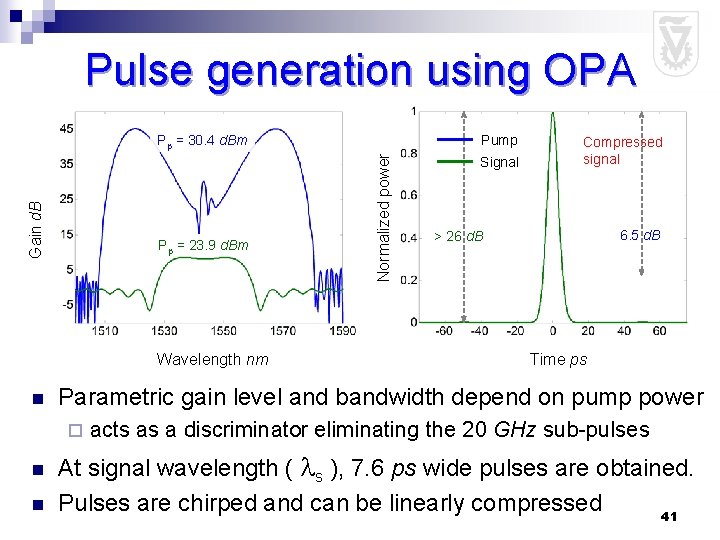
Pulse generation using OPA Pp = 23. 9 d. Bm Wavelength nm n n Signal Compressed signal 6. 5 d. B > 26 d. B Time ps Parametric gain level and bandwidth depend on pump power ¨ n Pump Normalized power Gain d. B Pp = 30. 4 d. Bm acts as a discriminator eliminating the 20 GHz sub-pulses At signal wavelength ( s ), 7. 6 ps wide pulses are obtained. Pulses are chirped and can be linearly compressed 41
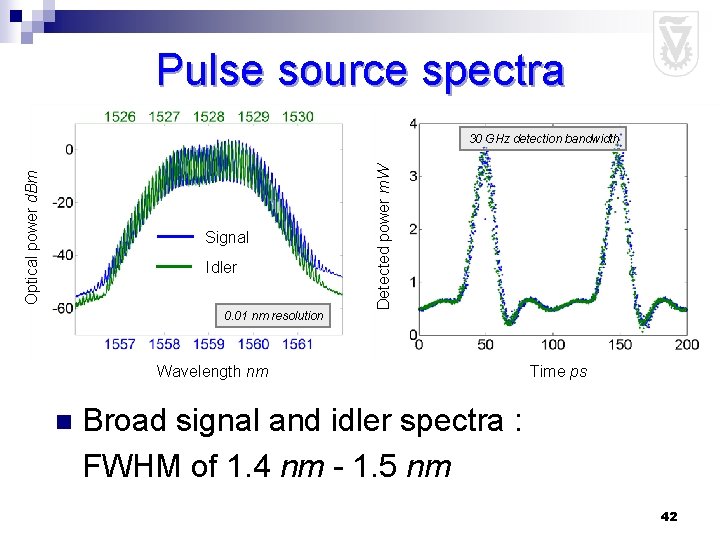
Pulse source spectra Signal Idler 0. 01 nm resolution Detected power m. W Optical power d. Bm 30 GHz detection bandwidth Wavelength nm n Time ps Broad signal and idler spectra : FWHM of 1. 4 nm - 1. 5 nm 42
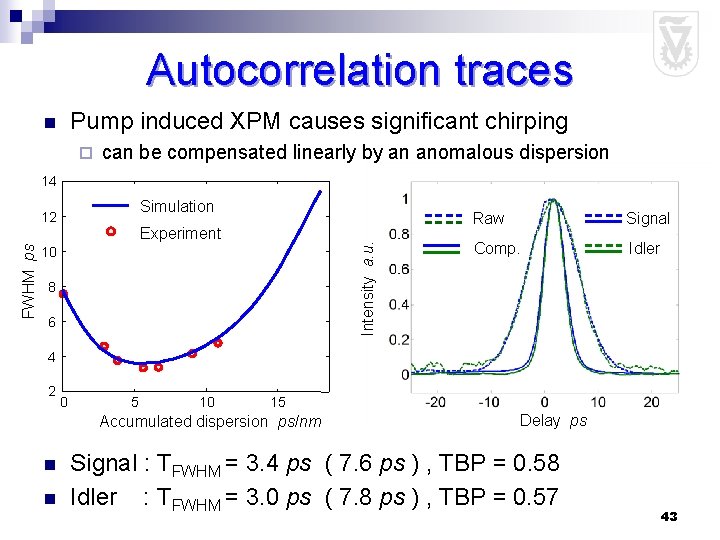
Autocorrelation traces Pump induced XPM causes significant chirping n ¨ can be compensated linearly by an anomalous dispersion 14 Simulation Experiment Intensity a. u. FWHM ps 12 10 8 6 Raw Signal Comp. Idler 4 2 0 5 10 15 Accumulated dispersion ps/nm n n Delay ps Signal : TFWHM = 3. 4 ps ( 7. 6 ps ) , TBP = 0. 58 Idler : TFWHM = 3. 0 ps ( 7. 8 ps ) , TBP = 0. 57 43
[d. Bm] Pump Comparison with results using sinusoidal pump modulation with phase modulation @ 500 Mbps 0 Δλs=0. 16 nm -20 TFWHM=37 ps -40 -60 1542 1543 1544 [d. Bm] Signal 10 Δλs=0. 41 nm -10 TFWHM=9. 5 ps (after compression) -30 -50 -70 1557 TBP=0. 45 1558 1559 1560 10 Δλs=0. 39 nm Idler [d. Bm] -10 TFWHM=9 ps (after compression) -30 -50 -70 100 ps 1526 1527 1528 Wavelength [nm] TBP=0. 47 44
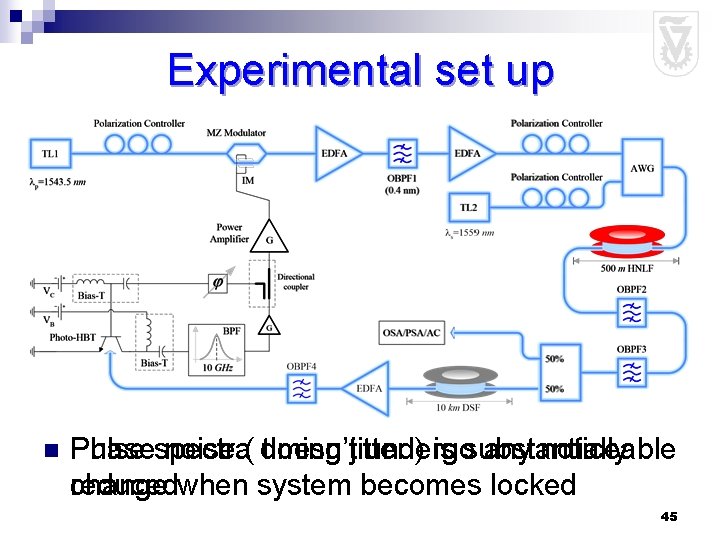
Experimental set up n Pulse spectra Phase noise ( doesn’t timing jitter undergo ) is substantially any noticeable reducedwhen system becomes locked change 45
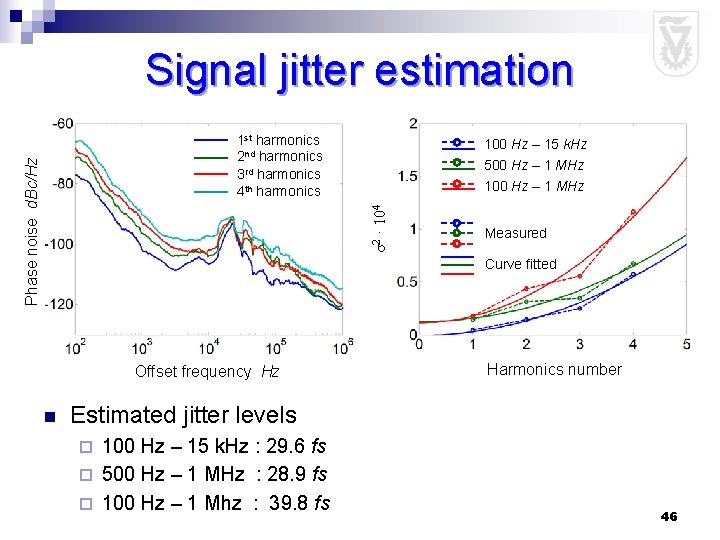
Signal jitter estimation 100 Hz – 15 k. Hz 500 Hz – 1 MHz 100 Hz – 1 MHz σ2 · 104 Phase noise d. Bc/Hz 1 st harmonics 2 nd harmonics 3 rd harmonics 4 th harmonics Measured Curve fitted Offset frequency Hz n Harmonics number Estimated jitter levels 100 Hz – 15 k. Hz : 29. 6 fs ¨ 500 Hz – 1 MHz : 28. 9 fs ¨ 100 Hz – 1 Mhz : 39. 8 fs ¨ 46
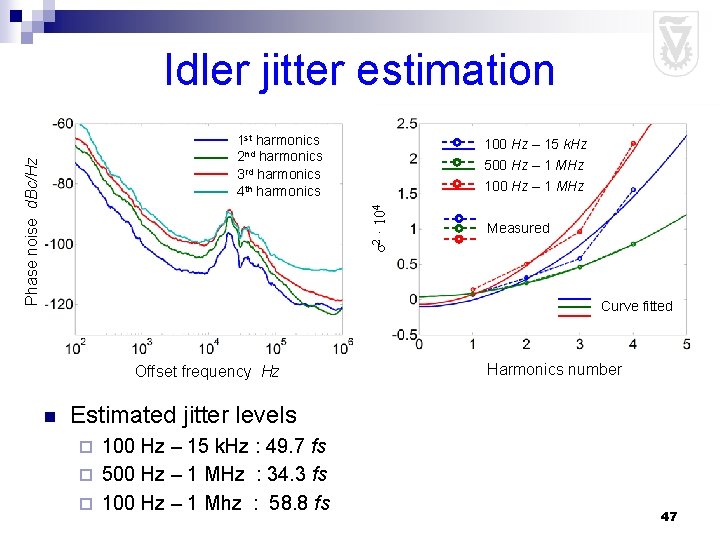
Idler jitter estimation 100 Hz – 15 k. Hz 500 Hz – 1 MHz 100 Hz – 1 MHz σ2 · 104 Phase noise d. Bc/Hz 1 st harmonics 2 nd harmonics 3 rd harmonics 4 th harmonics Measured Curve fitted Offset frequency Hz n Harmonics number Estimated jitter levels 100 Hz – 15 k. Hz : 49. 7 fs ¨ 500 Hz – 1 MHz : 34. 3 fs ¨ 100 Hz – 1 Mhz : 58. 8 fs ¨ 47
Multi wavelength pulse sources based on saturated OPA without spectral broadening 48
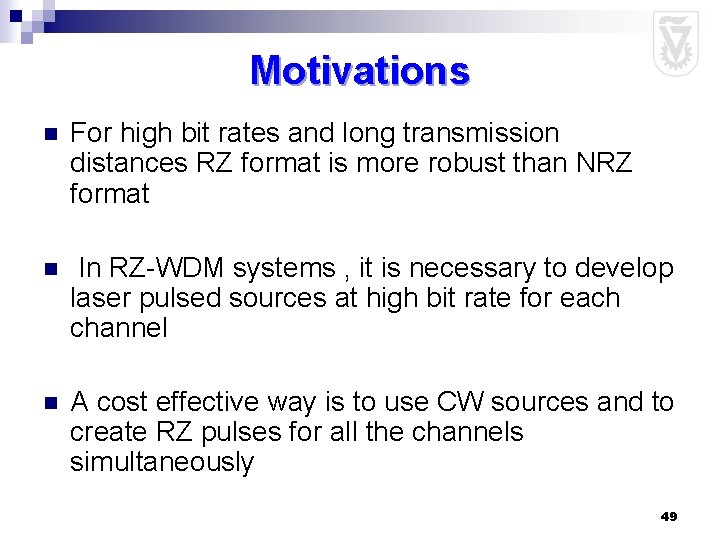
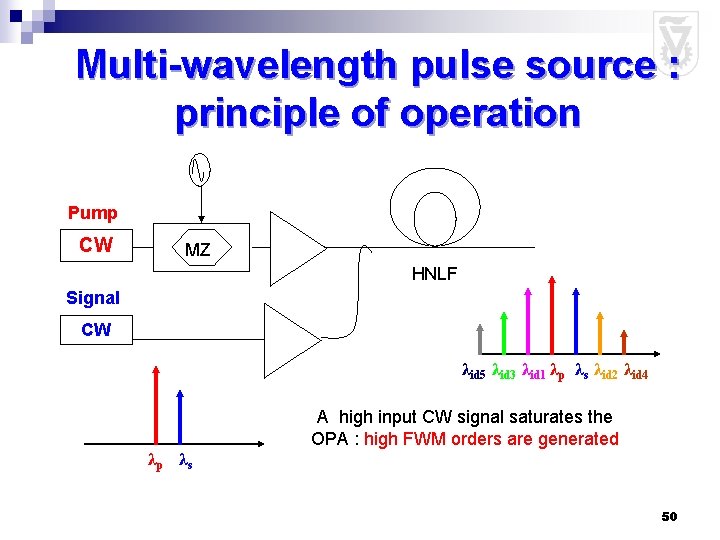
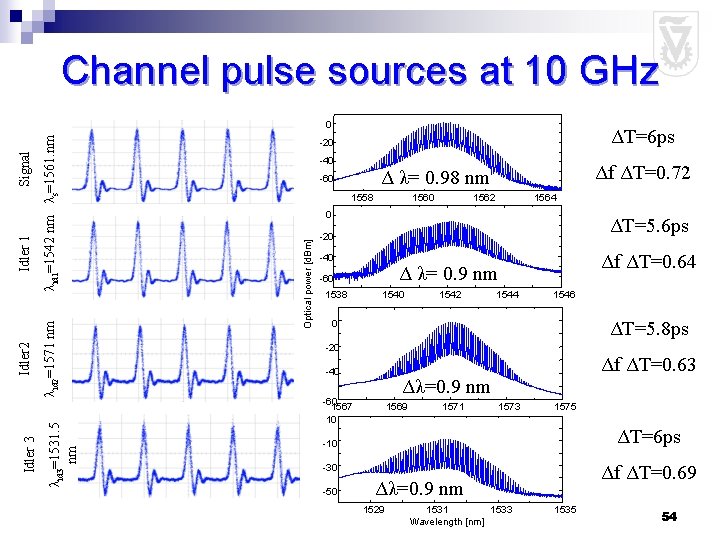
Motivations n For high bit rates and long transmission distances RZ format is more robust than NRZ format n In RZ-WDM systems , it is necessary to develop laser pulsed sources at high bit rate for each channel n A cost effective way is to use CW sources and to create RZ pulses for all the channels simultaneously 49
Multi-wavelength pulse source : principle of operation Pump CW MZ HNLF Signal CW λid 5 λid 3 λid 1 λp λs λid 2 λid 4 A high input CW signal saturates the OPA : high FWM orders are generated λp λs 50
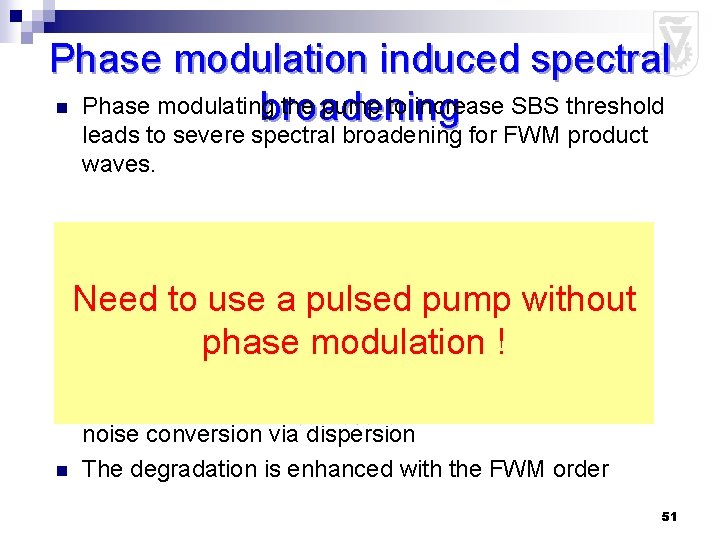
Phase modulation induced spectral n Phase modulating the pump to increase SBS threshold broadening leads to severe spectral broadening for FWM product waves. λid 3 λid 1 λp λs λid 2 Need to use a pulsed pump without phase modulation ! n n 3Δf Δfthrough phase to intensity Channel quality 2Δdegraded f Δf noise conversion via dispersion The degradation is enhanced with the FWM order 51
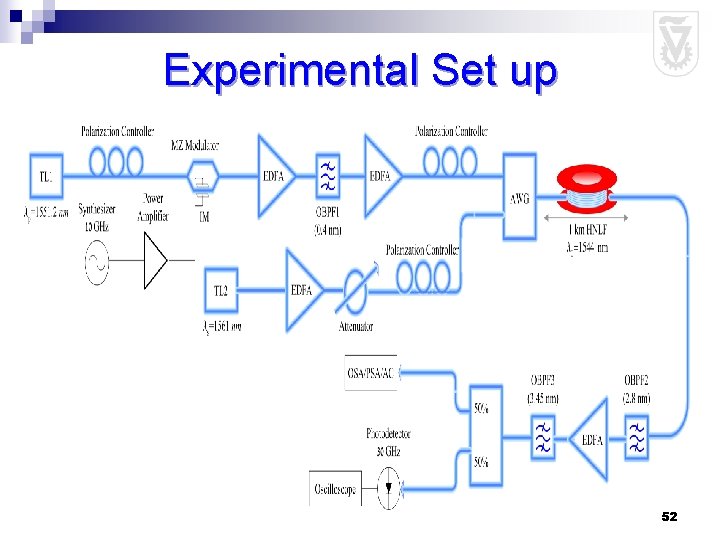
Experimental Set up 52
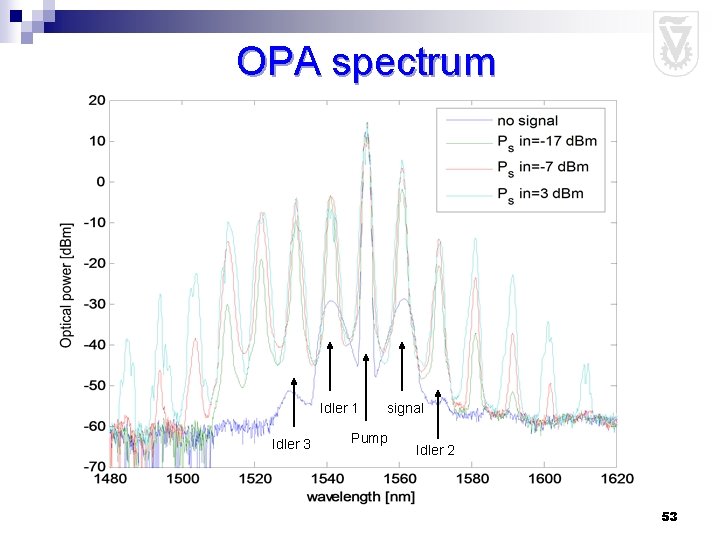
OPA spectrum Idler 1 Idler 3 signal Pump Idler 2 53
Channel pulse sources at 10 GHz ΔT=6 ps -20 -40 Δf ΔT=0. 72 Δ λ= 0. 98 nm -60 1558 1560 1562 1564 0 Optical power [d. Bm] λid 1=1542 nm λs=1561. nm λid 2=1571 nm λid 3=1531. 5 nm Idler 3 Idler 2 Idler 1 Signal 0 ΔT=5. 6 ps -20 -40 -60 1538 Δf ΔT=0. 64 Δ λ= 0. 9 nm 1540 1542 1544 1546 ΔT=5. 8 ps 0 -20 -40 Δf ΔT=0. 63 Δλ=0. 9 nm -60 1567 10 1569 1571 1573 1575 ΔT=6 ps -10 Δf ΔT=0. 69 -30 -50 Δλ=0. 9 nm 1529 1531 1533 Wavelength [nm] 1535 54
Timing Jitter estimations Timing Jitter [fs] 150 100 Hz – 15 k. Hz 500 Hz – 1 MHz 100 Hz – 1 MHz 0 Signal Idler 1 Idler 2 Idler 3 55
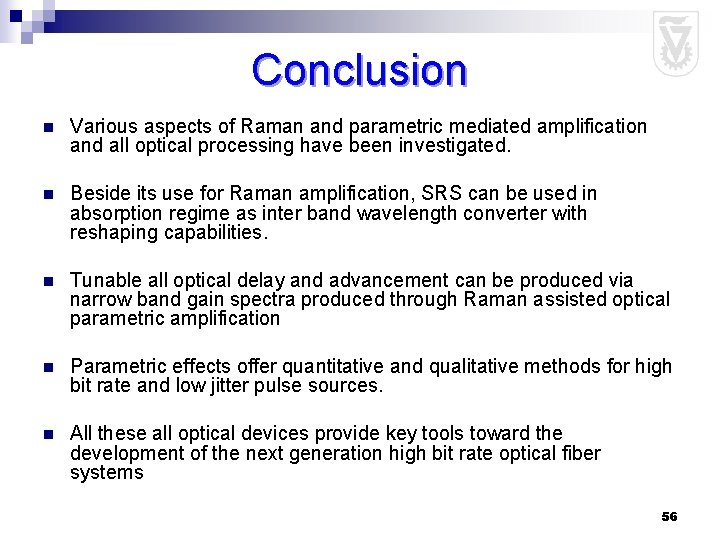
Conclusion n Various aspects of Raman and parametric mediated amplification and all optical processing have been investigated. n Beside its use for Raman amplification, SRS can be used in absorption regime as inter band wavelength converter with reshaping capabilities. n Tunable all optical delay and advancement can be produced via narrow band gain spectra produced through Raman assisted optical parametric amplification n Parametric effects offer quantitative and qualitative methods for high bit rate and low jitter pulse sources. n All these all optical devices provide key tools toward the development of the next generation high bit rate optical fiber systems 56