
Rajmohan M M A Nivedita Asst Professor School
- Slides: 21
Rajmohan. M & M. A. Nivedita Asst. Professor School of media and Communication A. M. Jain College, Chennai. TELEVISION PRODUCTION
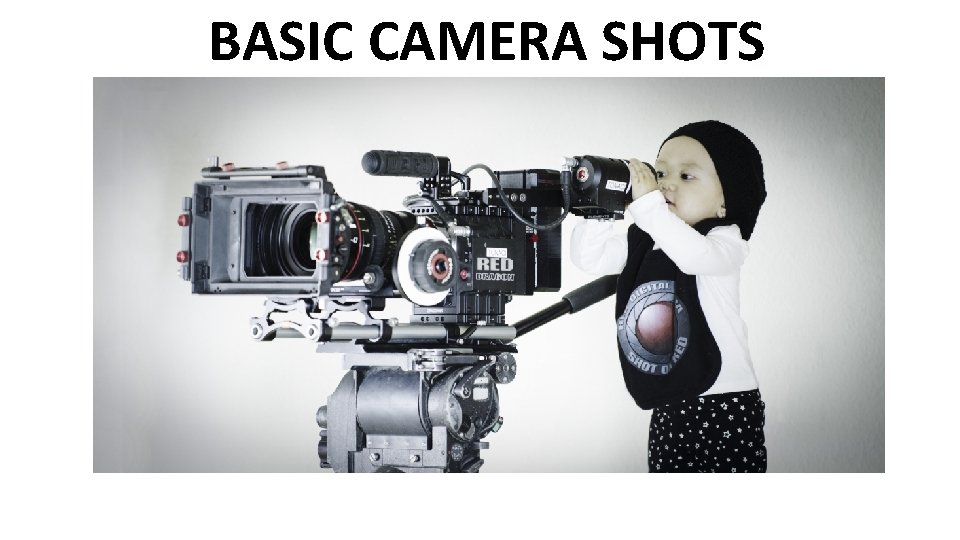
BASIC CAMERA SHOTS
• A SHOT is a continuous view filmed by one camera without interruption. • A SCENE is a location where the action takes place. A scene may consist of one shot or series of shots depicting a continuous event.
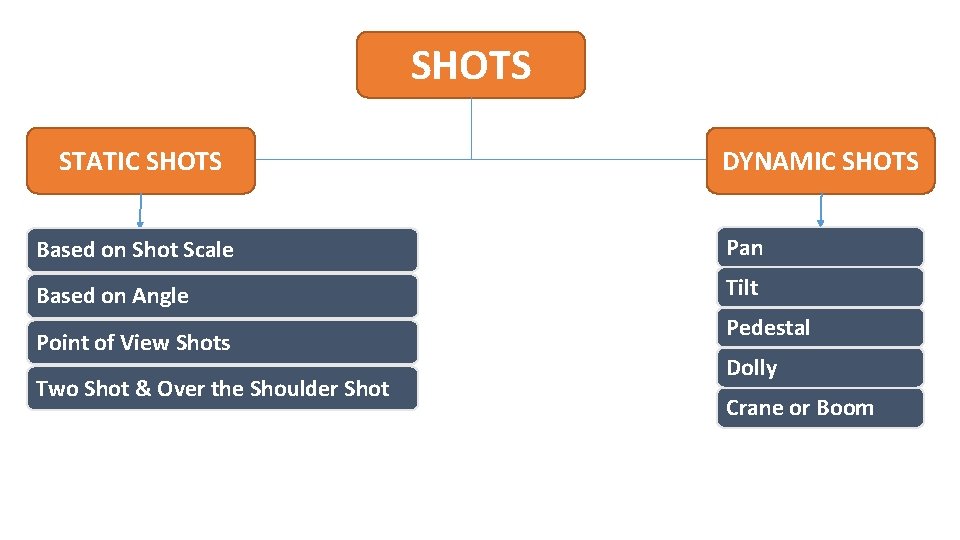
SHOTS STATIC SHOTS DYNAMIC SHOTS Based on Shot Scale Pan Based on Angle Tilt Point of View Shots Two Shot & Over the Shoulder Shot Pedestal Dolly Crane or Boom
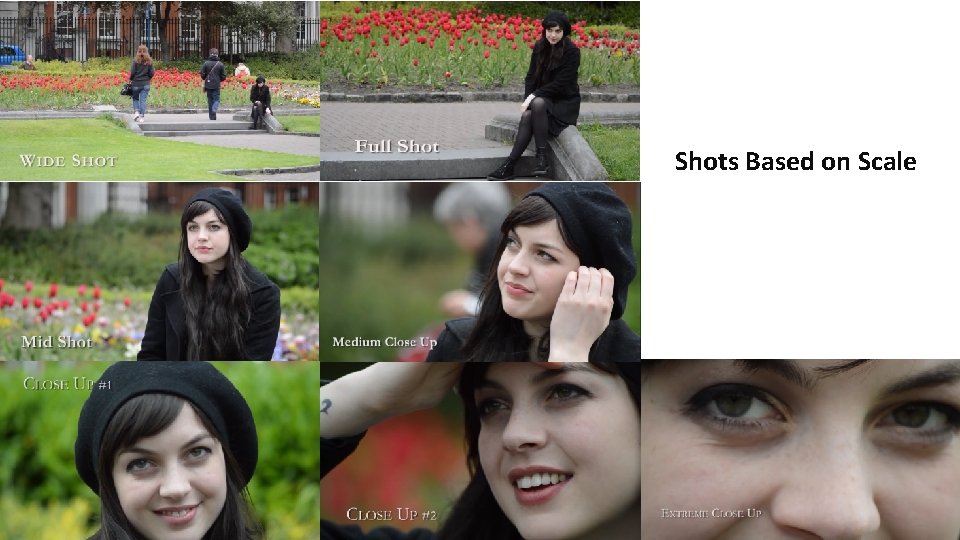
Shots Based on Scale
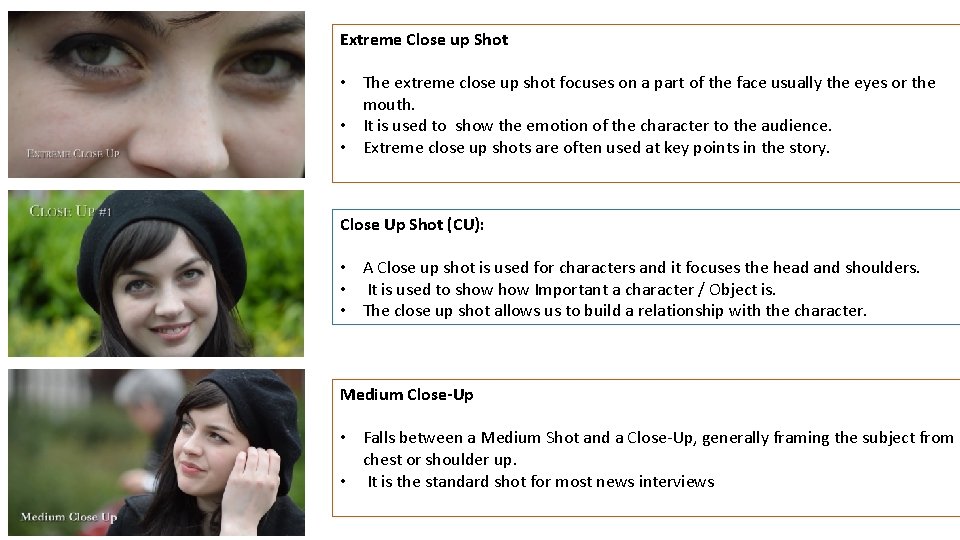
Extreme Close up Shot • The extreme close up shot focuses on a part of the face usually the eyes or the mouth. • It is used to show the emotion of the character to the audience. • Extreme close up shots are often used at key points in the story. Close Up Shot (CU): • A Close up shot is used for characters and it focuses the head and shoulders. • It is used to show Important a character / Object is. • The close up shot allows us to build a relationship with the character. Medium Close-Up • Falls between a Medium Shot and a Close-Up, generally framing the subject from chest or shoulder up. • It is the standard shot for most news interviews
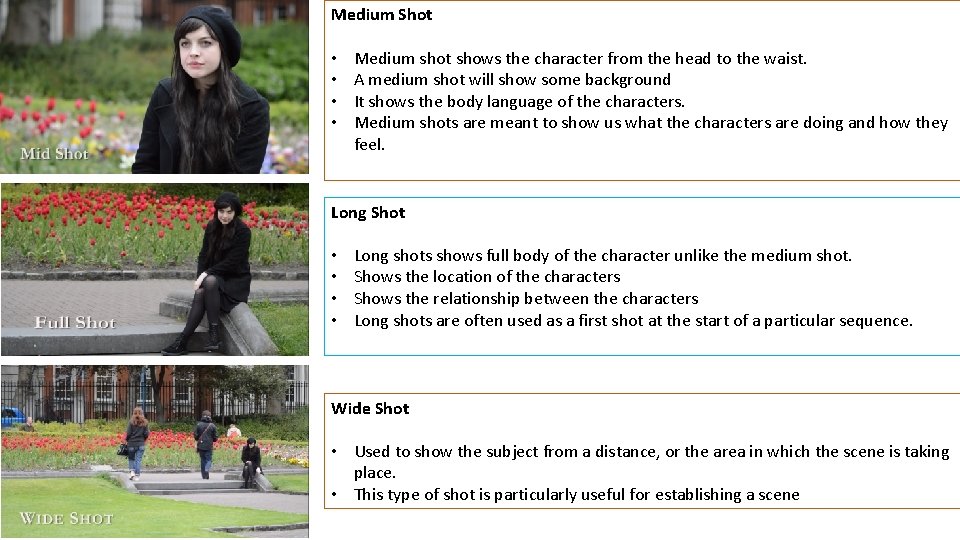
Medium Shot • • Medium shot shows the character from the head to the waist. A medium shot will show some background It shows the body language of the characters. Medium shots are meant to show us what the characters are doing and how they feel. Long Shot • • Long shots shows full body of the character unlike the medium shot. Shows the location of the characters Shows the relationship between the characters Long shots are often used as a first shot at the start of a particular sequence. Wide Shot • Used to show the subject from a distance, or the area in which the scene is taking place. • This type of shot is particularly useful for establishing a scene
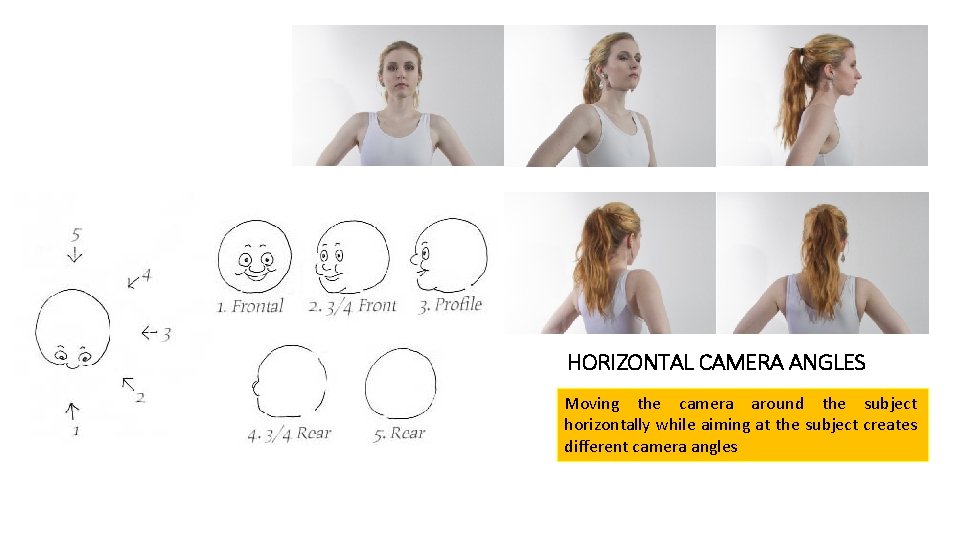
HORIZONTAL CAMERA ANGLES Moving the camera around the subject horizontally while aiming at the subject creates different camera angles
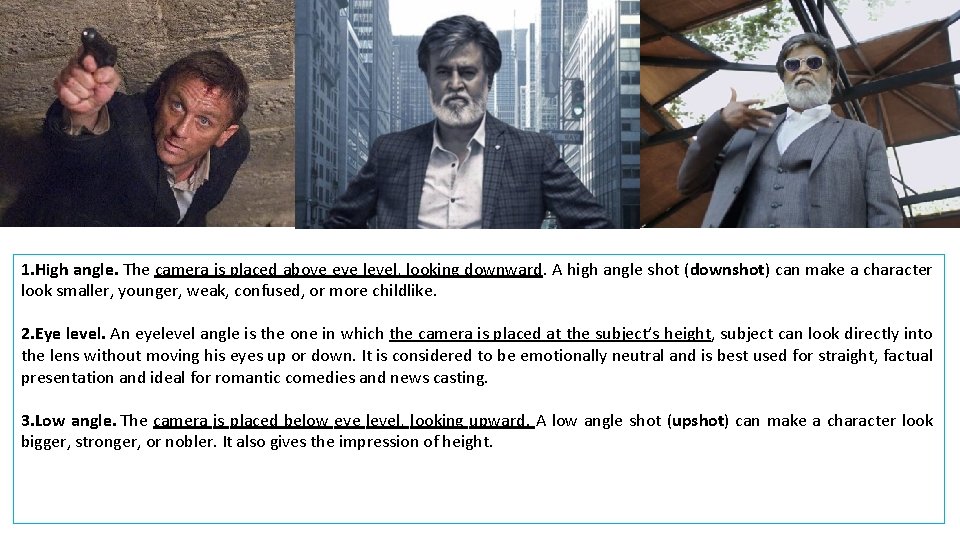
1. High angle. The camera is placed above eye level, looking downward. A high angle shot (downshot) can make a character look smaller, younger, weak, confused, or more childlike. 2. Eye level. An eyelevel angle is the one in which the camera is placed at the subject’s height, subject can look directly into the lens without moving his eyes up or down. It is considered to be emotionally neutral and is best used for straight, factual presentation and ideal for romantic comedies and news casting. 3. Low angle. The camera is placed below eye level, looking upward. A low angle shot (upshot) can make a character look bigger, stronger, or nobler. It also gives the impression of height.
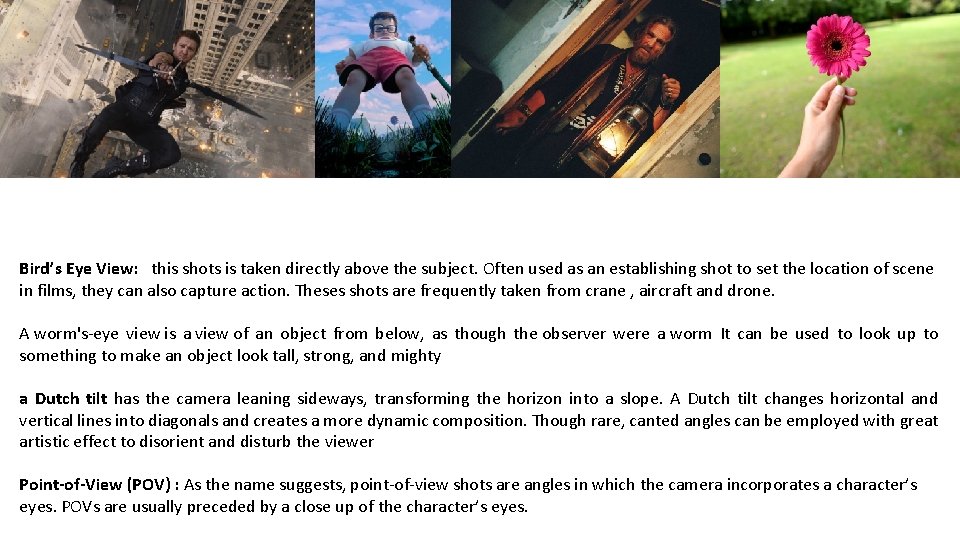
Bird’s Eye View: this shots is taken directly above the subject. Often used as an establishing shot to set the location of scene in films, they can also capture action. Theses shots are frequently taken from crane , aircraft and drone. A worm's-eye view is a view of an object from below, as though the observer were a worm It can be used to look up to something to make an object look tall, strong, and mighty a Dutch tilt has the camera leaning sideways, transforming the horizon into a slope. A Dutch tilt changes horizontal and vertical lines into diagonals and creates a more dynamic composition. Though rare, canted angles can be employed with great artistic effect to disorient and disturb the viewer Point-of-View (POV) : As the name suggests, point-of-view shots are angles in which the camera incorporates a character’s eyes. POVs are usually preceded by a close up of the character’s eyes.
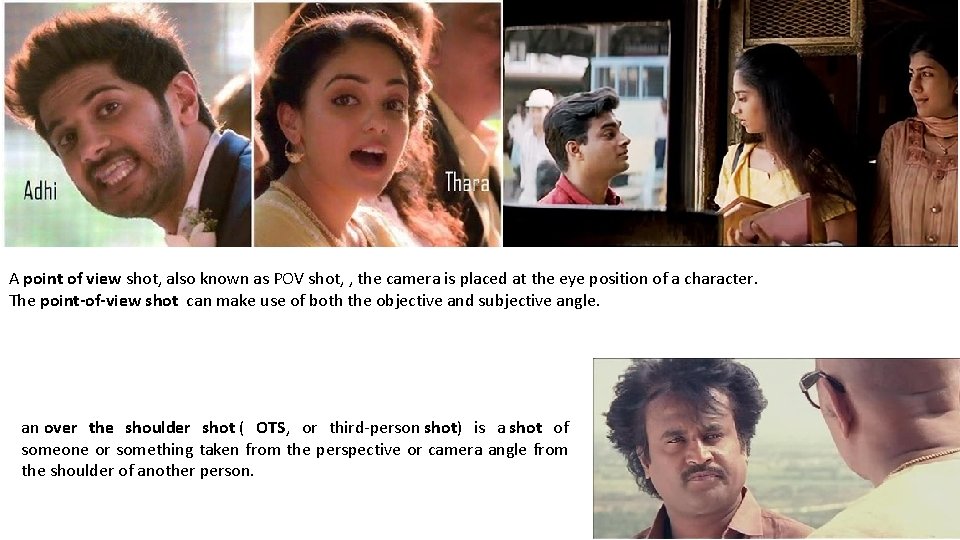
A point of view shot, also known as POV shot, , the camera is placed at the eye position of a character. The point-of-view shot can make use of both the objective and subjective angle. an over the shoulder shot ( OTS, or third-person shot) is a shot of someone or something taken from the perspective or camera angle from the shoulder of another person.
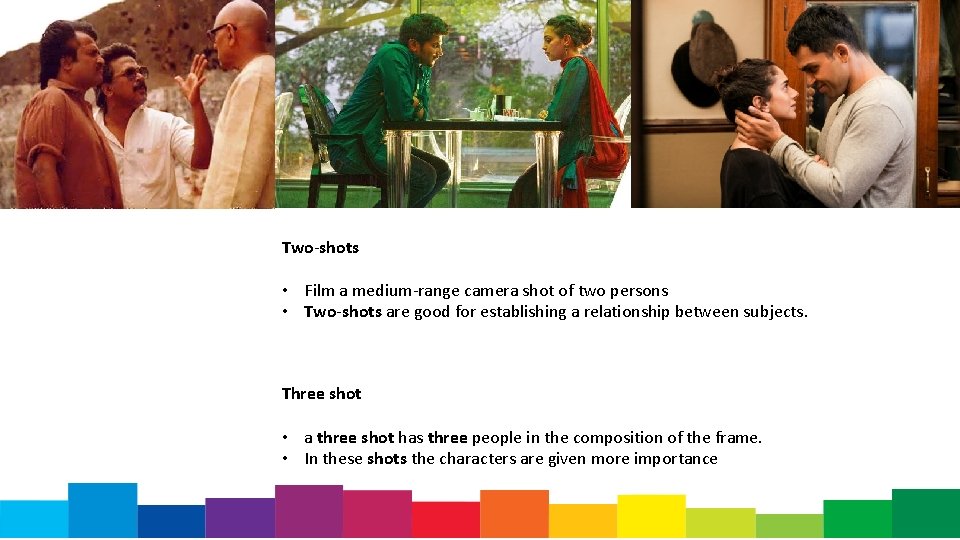
Two-shots • Film a medium-range camera shot of two persons • Two-shots are good for establishing a relationship between subjects. Three shot • a three shot has three people in the composition of the frame. • In these shots the characters are given more importance
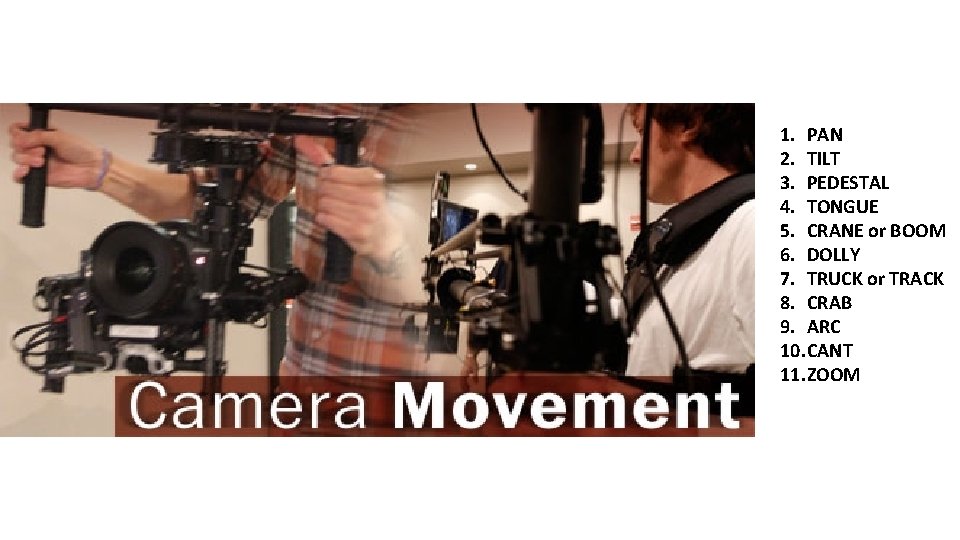
1. PAN 2. TILT 3. PEDESTAL 4. TONGUE 5. CRANE or BOOM 6. DOLLY 7. TRUCK or TRACK 8. CRAB 9. ARC 10. CANT 11. ZOOM
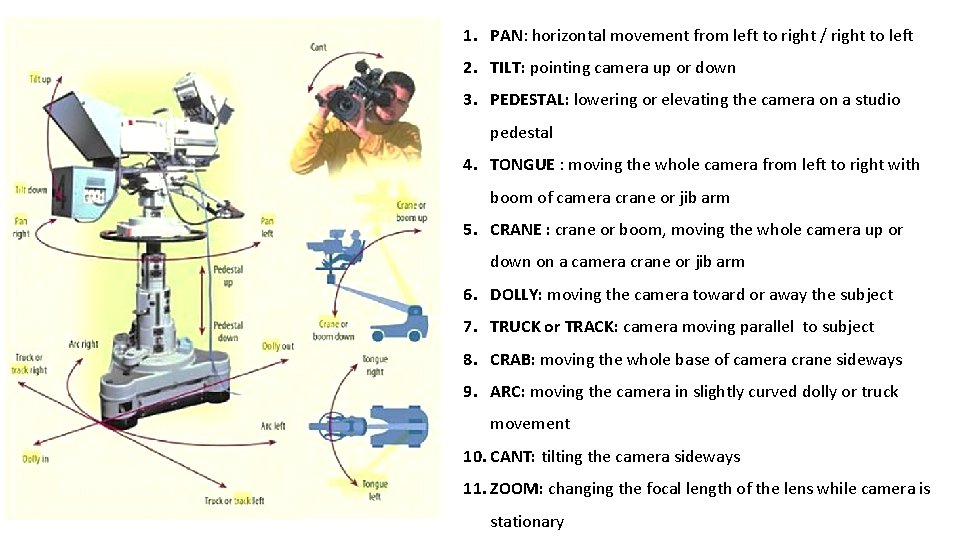
1. PAN: horizontal movement from left to right / right to left 2. TILT: pointing camera up or down 3. PEDESTAL: lowering or elevating the camera on a studio pedestal 4. TONGUE : moving the whole camera from left to right with boom of camera crane or jib arm 5. CRANE : crane or boom, moving the whole camera up or down on a camera crane or jib arm 6. DOLLY: moving the camera toward or away the subject 7. TRUCK or TRACK: camera moving parallel to subject 8. CRAB: moving the whole base of camera crane sideways 9. ARC: moving the camera in slightly curved dolly or truck movement 10. CANT: tilting the camera sideways 11. ZOOM: changing the focal length of the lens while camera is stationary
TYPES OF MICROPHONES A microphone (mic) is a transducer that converts acoustical sound energy into electrical energy.
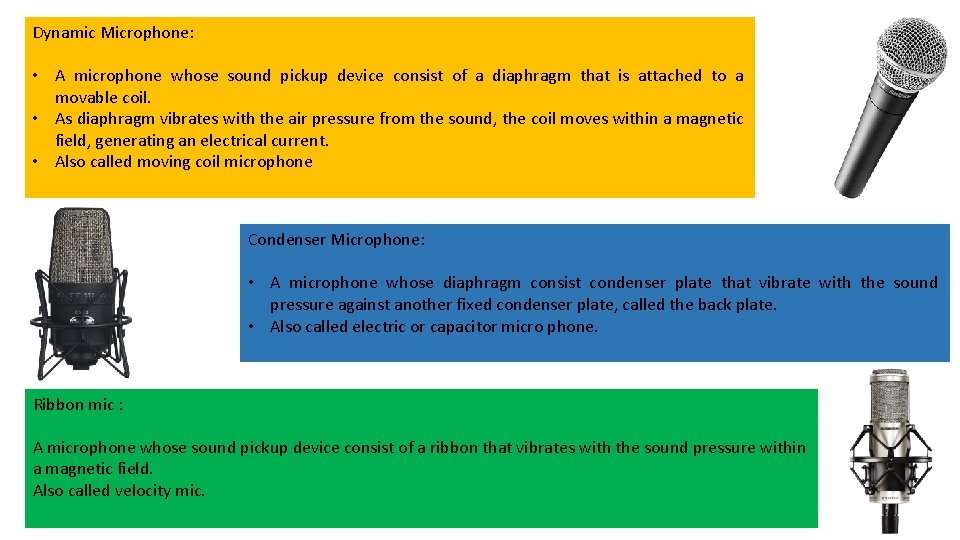
Dynamic Microphone: • A microphone whose sound pickup device consist of a diaphragm that is attached to a movable coil. • As diaphragm vibrates with the air pressure from the sound, the coil moves within a magnetic field, generating an electrical current. • Also called moving coil microphone Condenser Microphone: • A microphone whose diaphragm consist condenser plate that vibrate with the sound pressure against another fixed condenser plate, called the back plate. • Also called electric or capacitor micro phone. Ribbon mic : A microphone whose sound pickup device consist of a ribbon that vibrates with the sound pressure within a magnetic field. Also called velocity mic.
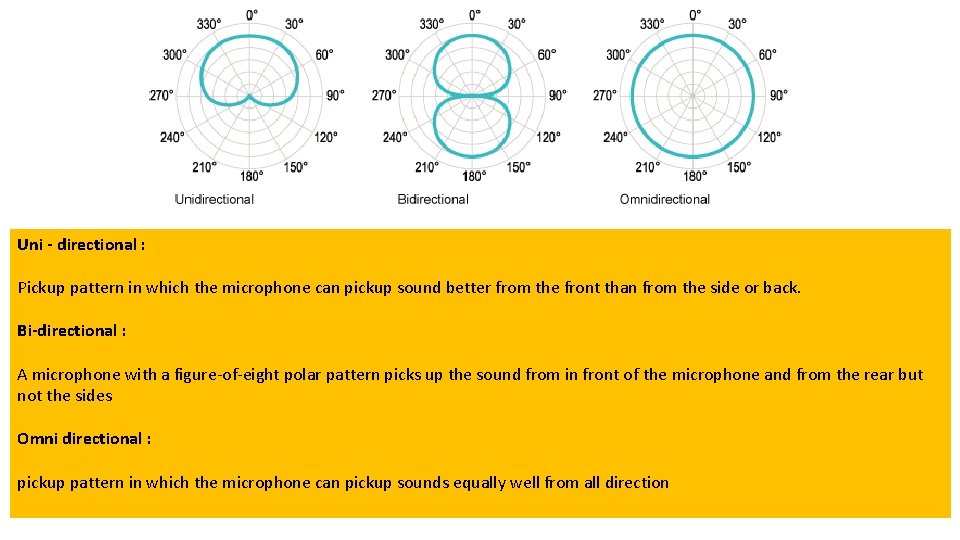
Uni - directional : Pickup pattern in which the microphone can pickup sound better from the front than from the side or back. Bi-directional : A microphone with a figure-of-eight polar pattern picks up the sound from in front of the microphone and from the rear but not the sides Omni directional : pickup pattern in which the microphone can pickup sounds equally well from all direction
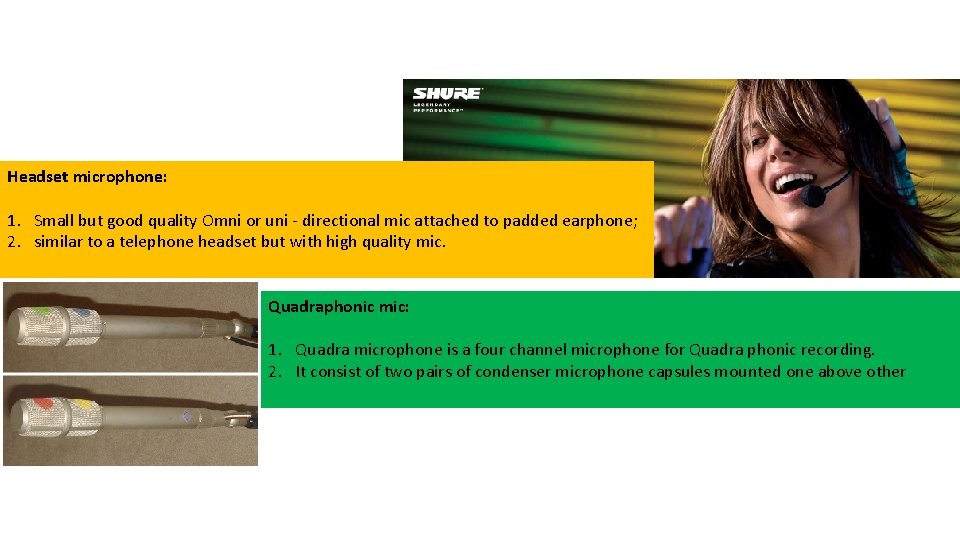
Headset microphone: 1. Small but good quality Omni or uni - directional mic attached to padded earphone; 2. similar to a telephone headset but with high quality mic. Quadraphonic mic: 1. Quadra microphone is a four channel microphone for Quadra phonic recording. 2. It consist of two pairs of condenser microphone capsules mounted one above other
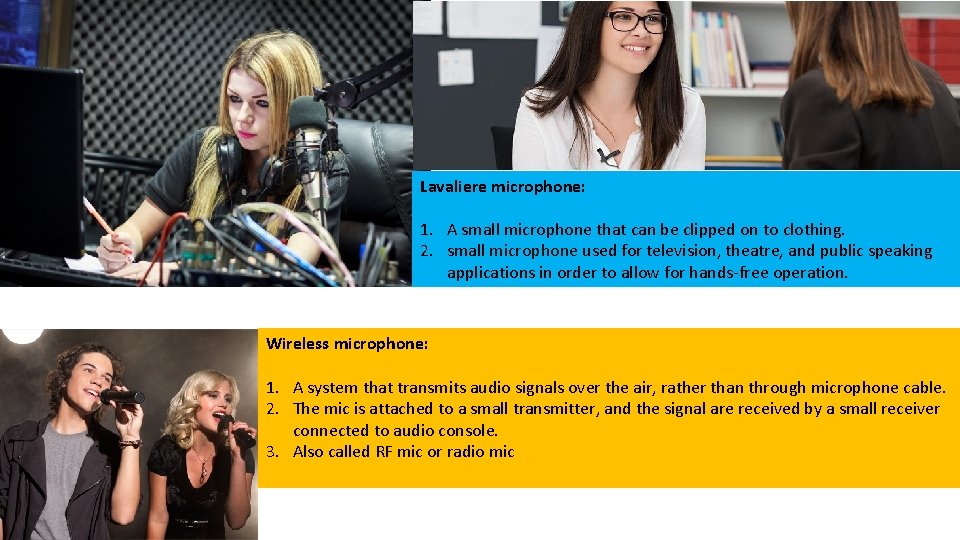
Lavaliere microphone: 1. A small microphone that can be clipped on to clothing. 2. small microphone used for television, theatre, and public speaking applications in order to allow for hands-free operation. Wireless microphone: 1. A system that transmits audio signals over the air, rather than through microphone cable. 2. The mic is attached to a small transmitter, and the signal are received by a small receiver connected to audio console. 3. Also called RF mic or radio mic
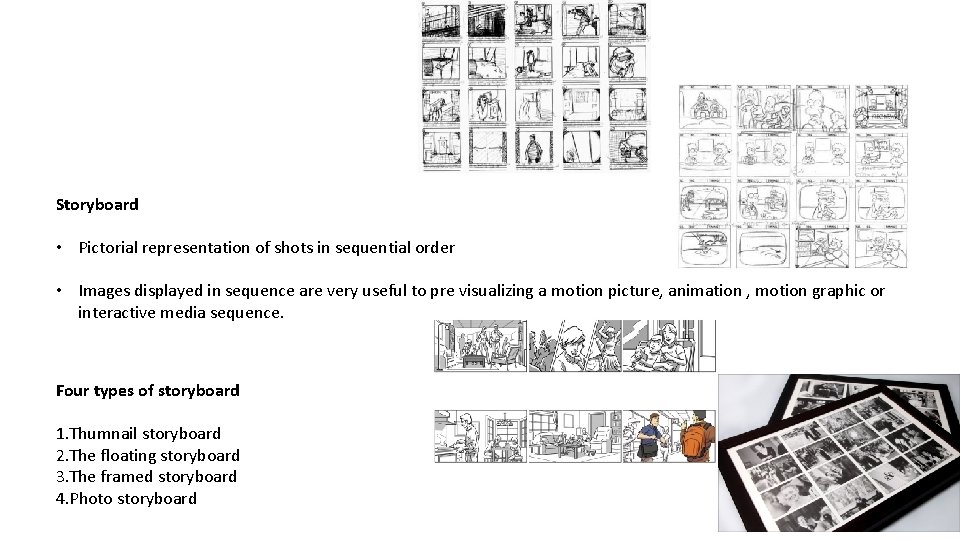
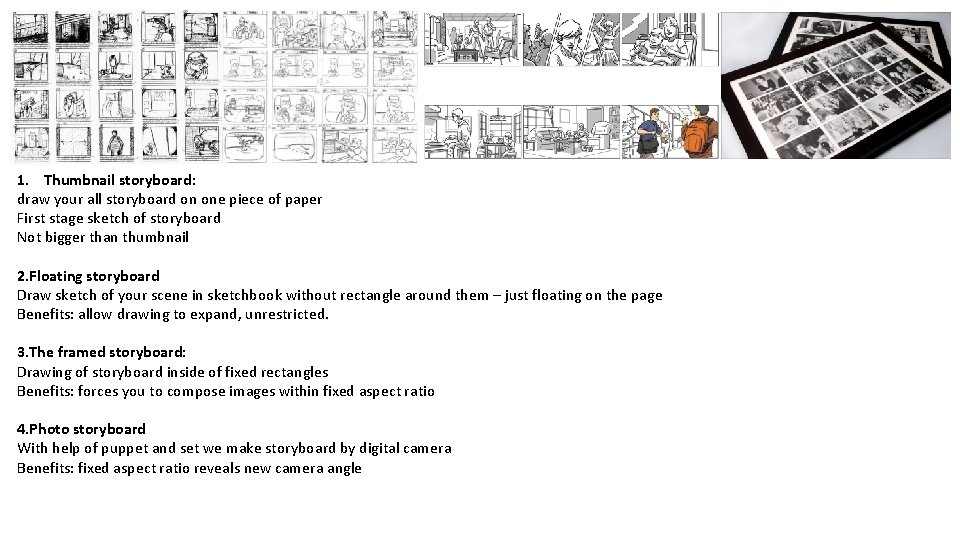
Storyboard • Pictorial representation of shots in sequential order • Images displayed in sequence are very useful to pre visualizing a motion picture, animation , motion graphic or interactive media sequence. Four types of storyboard 1. Thumnail storyboard 2. The floating storyboard 3. The framed storyboard 4. Photo storyboard
1. Thumbnail storyboard: draw your all storyboard on one piece of paper First stage sketch of storyboard Not bigger than thumbnail 2. Floating storyboard Draw sketch of your scene in sketchbook without rectangle around them – just floating on the page Benefits: allow drawing to expand, unrestricted. 3. The framed storyboard: Drawing of storyboard inside of fixed rectangles Benefits: forces you to compose images within fixed aspect ratio 4. Photo storyboard With help of puppet and set we make storyboard by digital camera Benefits: fixed aspect ratio reveals new camera angle