
Rajkot Branch of WIRC of ICAI Subject GST
Rajkot Branch of WIRC of ICAI Subject : GST Audit - Statutory provisions, Broad/Other framework, Scope and Coverage with reference to ICAI Technical Guide Date & Day : Saturday, 29 th December, 2018 Venue : ICAI Bhawan, Giriraj Nagar Main Road, Near Raiya Circle, Off 150 Feet Ring Road, Rajkot - 360007 Faculty December 29, 2018 : CA Naresh Sheth 1

Preamble December 29, 2018 CA Naresh Sheth 2
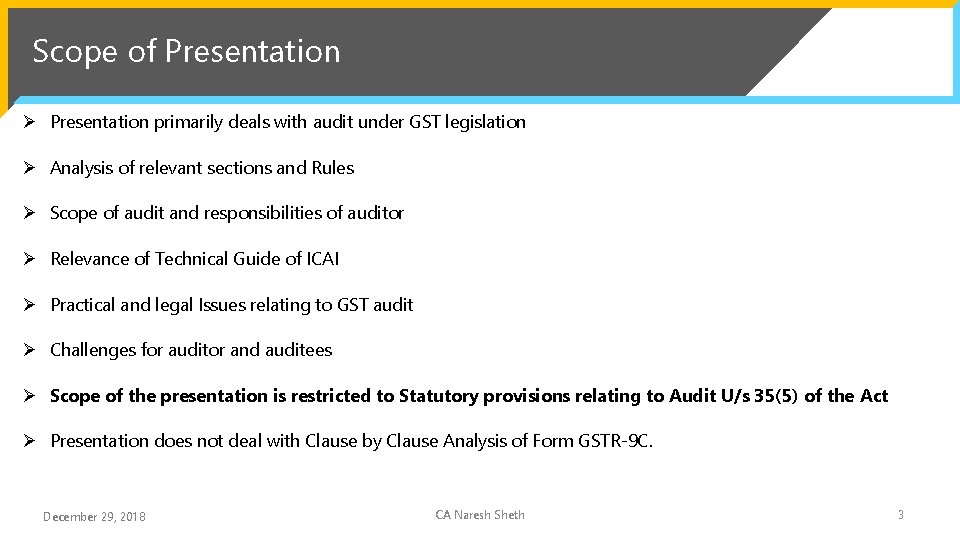
Scope of Presentation Ø Presentation primarily deals with audit under GST legislation Ø Analysis of relevant sections and Rules Ø Scope of audit and responsibilities of auditor Ø Relevance of Technical Guide of ICAI Ø Practical and legal Issues relating to GST audit Ø Challenges for auditor and auditees Ø Scope of the presentation is restricted to Statutory provisions relating to Audit U/s 35(5) of the Act Ø Presentation does not deal with Clause by Clause Analysis of Form GSTR-9 C. December 29, 2018 CA Naresh Sheth 3
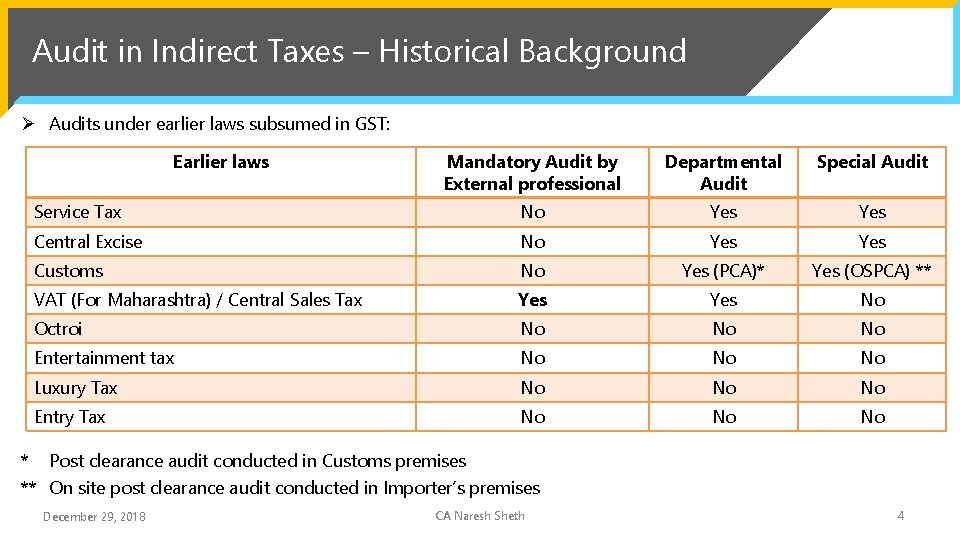
Audit in Indirect Taxes – Historical Background Ø Audits under earlier laws subsumed in GST: Earlier laws * Mandatory Audit by External professional Departmental Audit Special Audit Service Tax No Yes Central Excise No Yes Customs No Yes (PCA)* Yes (OSPCA) ** VAT (For Maharashtra) / Central Sales Tax Yes No Octroi No No No Entertainment tax No No No Luxury Tax No No No Entry Tax No No No Post clearance audit conducted in Customs premises ** On site post clearance audit conducted in Importer’s premises December 29, 2018 CA Naresh Sheth 4
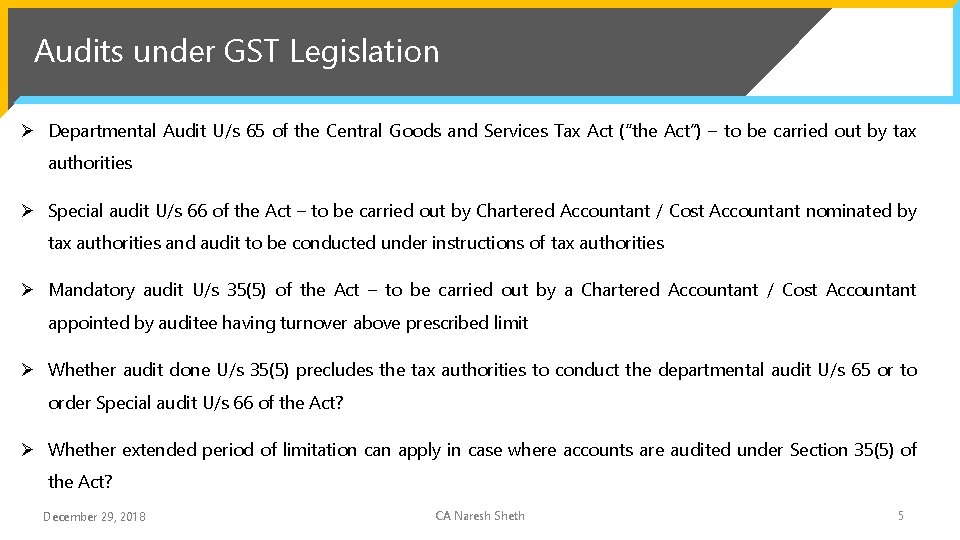
Audits under GST Legislation Ø Departmental Audit U/s 65 of the Central Goods and Services Tax Act (“the Act”) – to be carried out by tax authorities Ø Special audit U/s 66 of the Act – to be carried out by Chartered Accountant / Cost Accountant nominated by tax authorities and audit to be conducted under instructions of tax authorities Ø Mandatory audit U/s 35(5) of the Act – to be carried out by a Chartered Accountant / Cost Accountant appointed by auditee having turnover above prescribed limit Ø Whether audit done U/s 35(5) precludes the tax authorities to conduct the departmental audit U/s 65 or to order Special audit U/s 66 of the Act? Ø Whether extended period of limitation can apply in case where accounts are audited under Section 35(5) of the Act? December 29, 2018 CA Naresh Sheth 5
Statutory Provisions Mandating GST Audit December 29, 2018 CA Naresh Sheth 6
Section 35(5) – Provision Mandating GST Audit Ø Every registered person whose turnover during a financial year exceeds the prescribed limit shall get his accounts audited Ø by a chartered accountant or a cost accountant; and Ø Shall submit a copy of: § Audited annual accounts § Reconciliation statement u/s 44(2); and § Other documents In prescribed form and manner Ø It is the registered person’s (auditee’s) responsibility to submit above documents and not that of the auditor December 29, 2018 CA Naresh Sheth 7
Rule 80(3) – Relevant Rule for GST Audit Ø Every registered person whose “aggregate turnover” during a financial year exceeds Rupees Two Crores shall get his accounts audited as specified in Section 35(5) of the Act Ø He shall furnish copy of : • Audited annual accounts; and • A reconciliation statement duly certified in Form GSTR – 9 C - Electronically through the common portal either directly or through Facilitation Centre notified by the Commissioner December 29, 2018 CA Naresh Sheth 8
Form GSTR-9 C –Is it an report of audit contemplated u/s 2(13)? Ø Section 35(5) and Rule 80(3) requires; • Audit of accounts; and • submission of duly certified reconciliation statement prescribed in Form GSTR-9 C Ø Does this mean that: • Certificate in Form GSTR-9 C (Part-B) itself is an audit report? Or • Audit of accounts and Certification in Form GSTR-9 C are two independent assignments? Ø Part B of the Form GSTR-9 C is similar to Form 3 CA/3 CB issued after conducting audit u/s 44 AB of Income Tax Act, 1961. Form 3 CA/3 CB uses the term ‘Audit report’ while, Form GSTR 9 C uses the term ‘Certification’. Ø In both the Income tax and GST law, the auditor is responsible to give his opinion on True and Correctness of particulars of Form 3 CD and Form GSTR-9 C respectively. December 29, 2018 CA Naresh Sheth 9
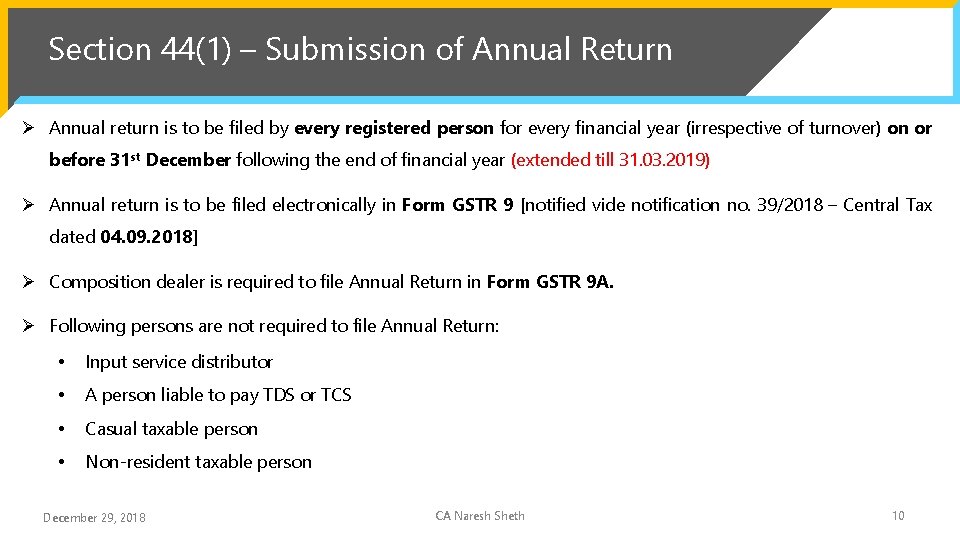
Section 44(1) – Submission of Annual Return Ø Annual return is to be filed by every registered person for every financial year (irrespective of turnover) on or before 31 st December following the end of financial year (extended till 31. 03. 2019) Ø Annual return is to be filed electronically in Form GSTR 9 [notified vide notification no. 39/2018 – Central Tax dated 04. 09. 2018] Ø Composition dealer is required to file Annual Return in Form GSTR 9 A. Ø Following persons are not required to file Annual Return: • Input service distributor • A person liable to pay TDS or TCS • Casual taxable person • Non-resident taxable person December 29, 2018 CA Naresh Sheth 10
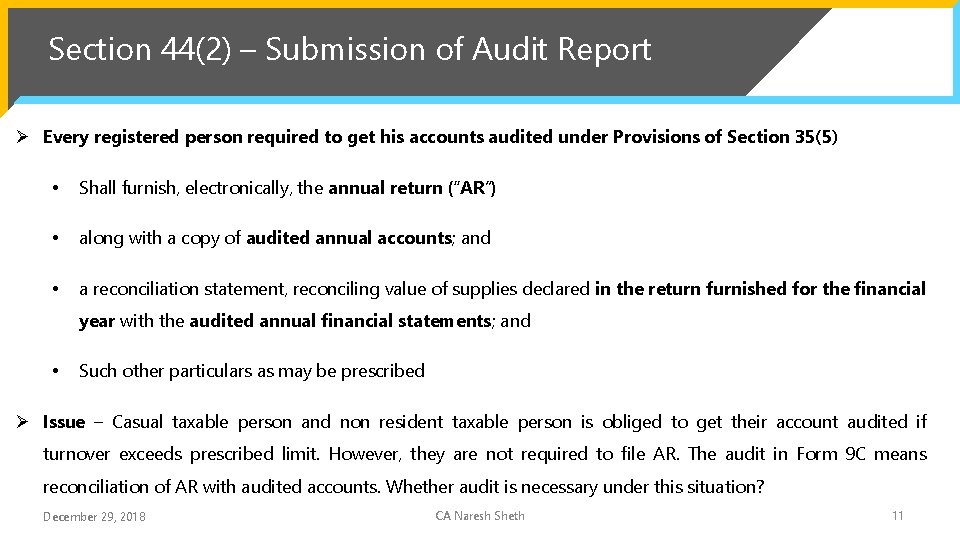
Section 44(2) – Submission of Audit Report Ø Every registered person required to get his accounts audited under Provisions of Section 35(5) • Shall furnish, electronically, the annual return (“AR”) • along with a copy of audited annual accounts; and • a reconciliation statement, reconciling value of supplies declared in the return furnished for the financial year with the audited annual financial statements; and • Such other particulars as may be prescribed Ø Issue – Casual taxable person and non resident taxable person is obliged to get their account audited if turnover exceeds prescribed limit. However, they are not required to file AR. The audit in Form 9 C means reconciliation of AR with audited accounts. Whether audit is necessary under this situation? December 29, 2018 CA Naresh Sheth 11
GST Audit and Form 9 C – Basics December 29, 2018 CA Naresh Sheth 12
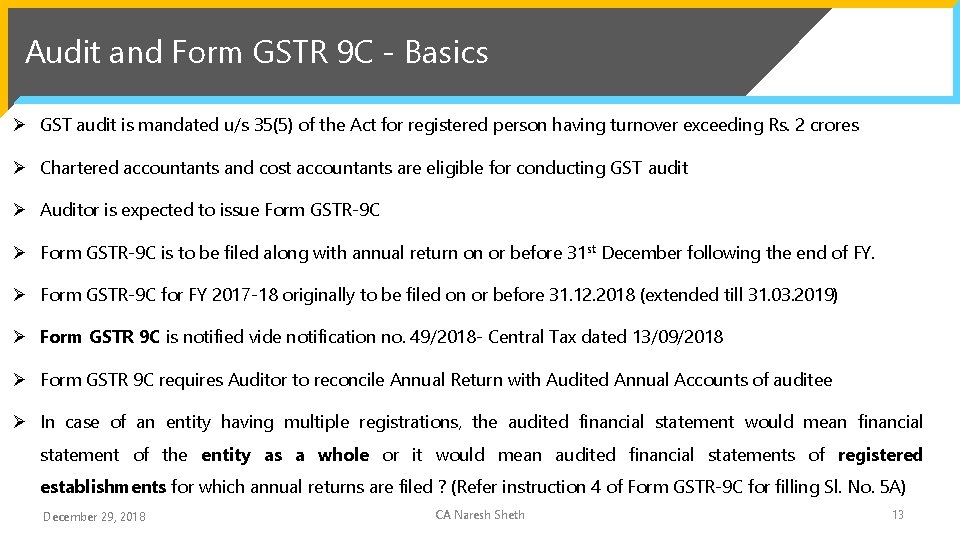
Audit and Form GSTR 9 C - Basics Ø GST audit is mandated u/s 35(5) of the Act for registered person having turnover exceeding Rs. 2 crores Ø Chartered accountants and cost accountants are eligible for conducting GST audit Ø Auditor is expected to issue Form GSTR-9 C Ø Form GSTR-9 C is to be filed along with annual return on or before 31 st December following the end of FY. Ø Form GSTR-9 C for FY 2017 -18 originally to be filed on or before 31. 12. 2018 (extended till 31. 03. 2019) Ø Form GSTR 9 C is notified vide notification no. 49/2018 - Central Tax dated 13/09/2018 F 9/2018 -Cen Ø Form GSTR 9 C requires Auditor to reconcile Annual Return with Audited Annual Accounts of auditee Ø In case of an entity having multiple registrations, the audited financial statement would mean financial statement of the entity as a whole or it would mean audited financial statements of registered establishments for which annual returns are filed ? (Refer instruction 4 of Form GSTR-9 C for filling Sl. No. 5 A) December 29, 2018 CA Naresh Sheth 13
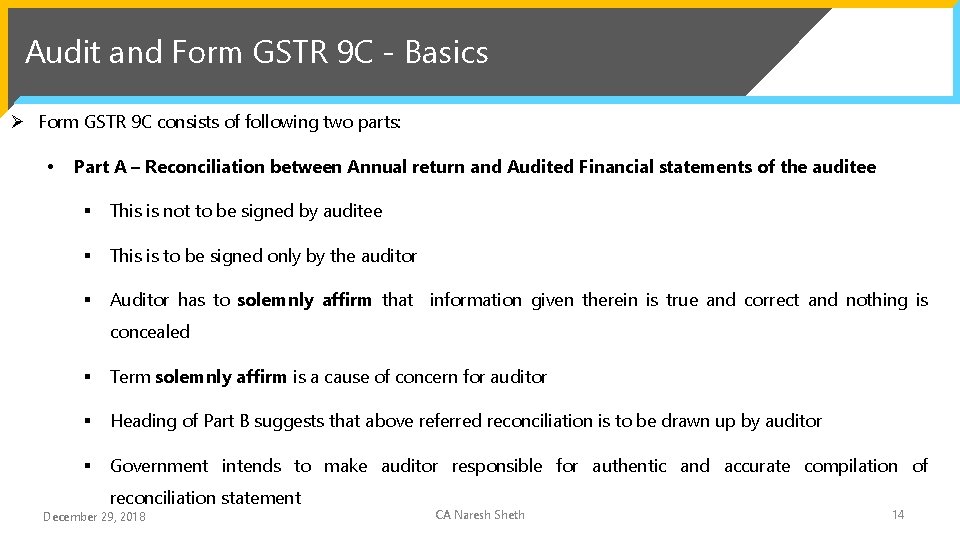
Audit and Form GSTR 9 C - Basics Ø Form GSTR 9 C consists of following two parts: • Part A – Reconciliation between Annual return and Audited Financial statements of the auditee § This is not to be signed by auditee § This is to be signed only by the auditor § Auditor has to solemnly affirm that information given therein is true and correct and nothing is concealed § Term solemnly affirm is a cause of concern for auditor § Heading of Part B suggests that above referred reconciliation is to be drawn up by auditor § Government intends to make auditor responsible for authentic and accurate compilation of reconciliation statement December 29, 2018 CA Naresh Sheth 14
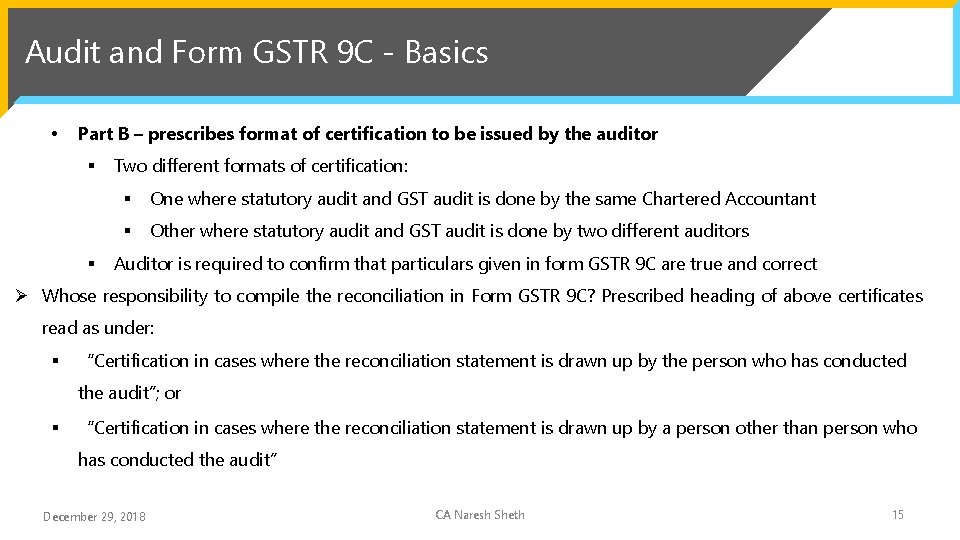
Audit and Form GSTR 9 C - Basics • Part B – prescribes format of certification to be issued by the auditor § § Two different formats of certification: § One where statutory audit and GST audit is done by the same Chartered Accountant § Other where statutory audit and GST audit is done by two different auditors Auditor is required to confirm that particulars given in form GSTR 9 C are true and correct Ø Whose responsibility to compile the reconciliation in Form GSTR 9 C? Prescribed heading of above certificates read as under: § “Certification in cases where the reconciliation statement is drawn up by the person who has conducted the audit”; or § “Certification in cases where the reconciliation statement is drawn up by a person other than person who has conducted the audit” December 29, 2018 CA Naresh Sheth 15
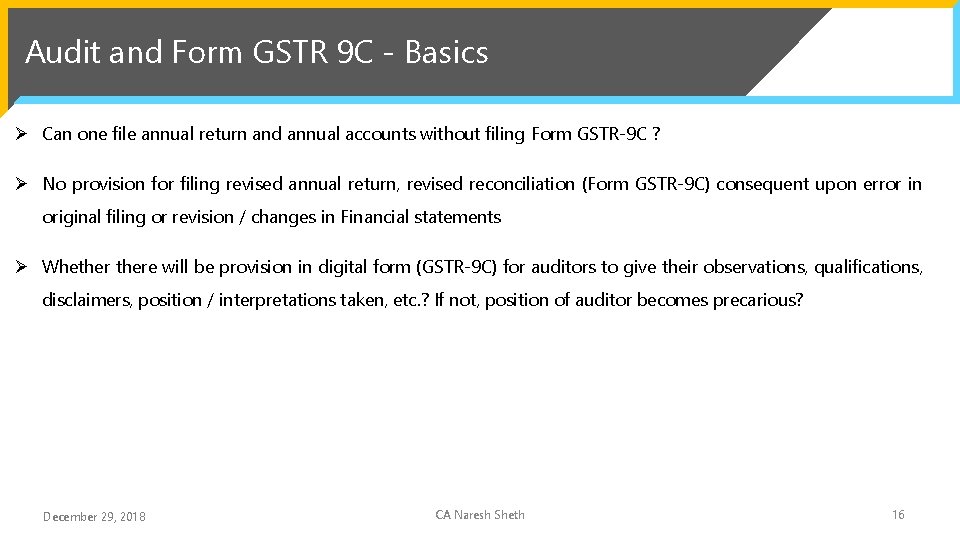
Audit and Form GSTR 9 C - Basics Ø Can one file annual return and annual accounts without filing Form GSTR-9 C ? Ø No provision for filing revised annual return, revised reconciliation (Form GSTR-9 C) consequent upon error in original filing or revision / changes in Financial statements Ø Whethere will be provision in digital form (GSTR-9 C) for auditors to give their observations, qualifications, disclaimers, position / interpretations taken, etc. ? If not, position of auditor becomes precarious? December 29, 2018 CA Naresh Sheth 16
Pronouncements and Technical guide of ICAI and its relevance December 29, 2018 CA Naresh Sheth 17
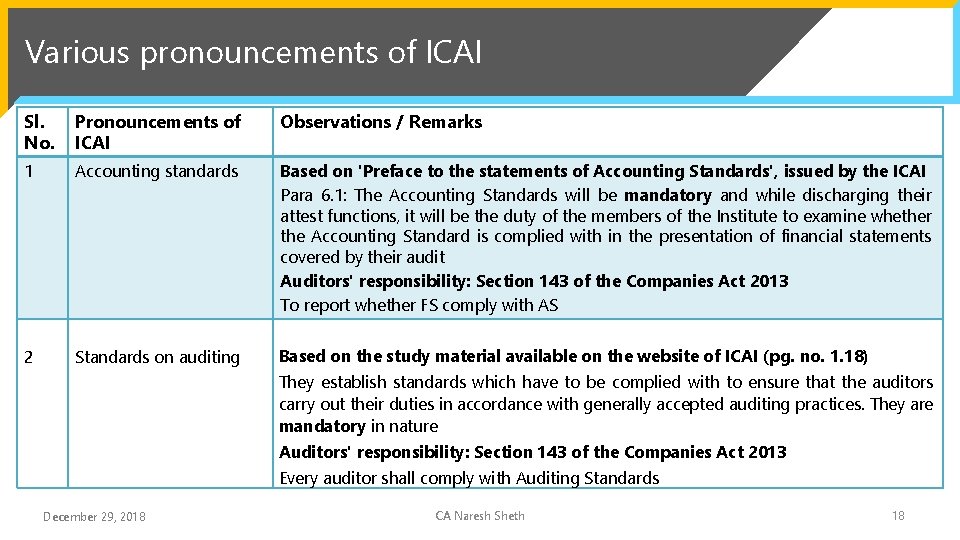
Various pronouncements of ICAI Sl. No. Pronouncements of ICAI Observations / Remarks 1 Accounting standards Based on 'Preface to the statements of Accounting Standards', issued by the ICAI Para 6. 1: The Accounting Standards will be mandatory and while discharging their attest functions, it will be the duty of the members of the Institute to examine whether the Accounting Standard is complied with in the presentation of financial statements covered by their audit Auditors' responsibility: Section 143 of the Companies Act 2013 To report whether FS comply with AS 2 Standards on auditing Based on the study material available on the website of ICAI (pg. no. 1. 18) They establish standards which have to be complied with to ensure that the auditors carry out their duties in accordance with generally accepted auditing practices. They are mandatory in nature Auditors' responsibility: Section 143 of the Companies Act 2013 Every auditor shall comply with Auditing Standards December 29, 2018 CA Naresh Sheth 18
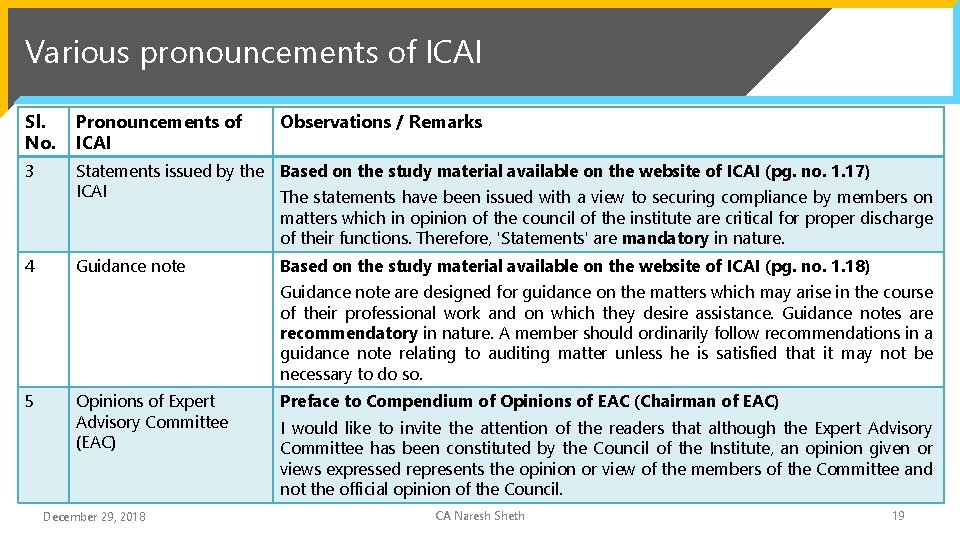
Various pronouncements of ICAI Sl. No. Pronouncements of ICAI Observations / Remarks 3 Statements issued by the Based on the study material available on the website of ICAI (pg. no. 1. 17) ICAI The statements have been issued with a view to securing compliance by members on matters which in opinion of the council of the institute are critical for proper discharge of their functions. Therefore, 'Statements' are mandatory in nature. 4 Guidance note Based on the study material available on the website of ICAI (pg. no. 1. 18) Guidance note are designed for guidance on the matters which may arise in the course of their professional work and on which they desire assistance. Guidance notes are recommendatory in nature. A member should ordinarily follow recommendations in a guidance note relating to auditing matter unless he is satisfied that it may not be necessary to do so. 5 Opinions of Expert Advisory Committee (EAC) December 29, 2018 Preface to Compendium of Opinions of EAC (Chairman of EAC) I would like to invite the attention of the readers that although the Expert Advisory Committee has been constituted by the Council of the Institute, an opinion given or views expressed represents the opinion or view of the members of the Committee and not the official opinion of the Council. CA Naresh Sheth 19
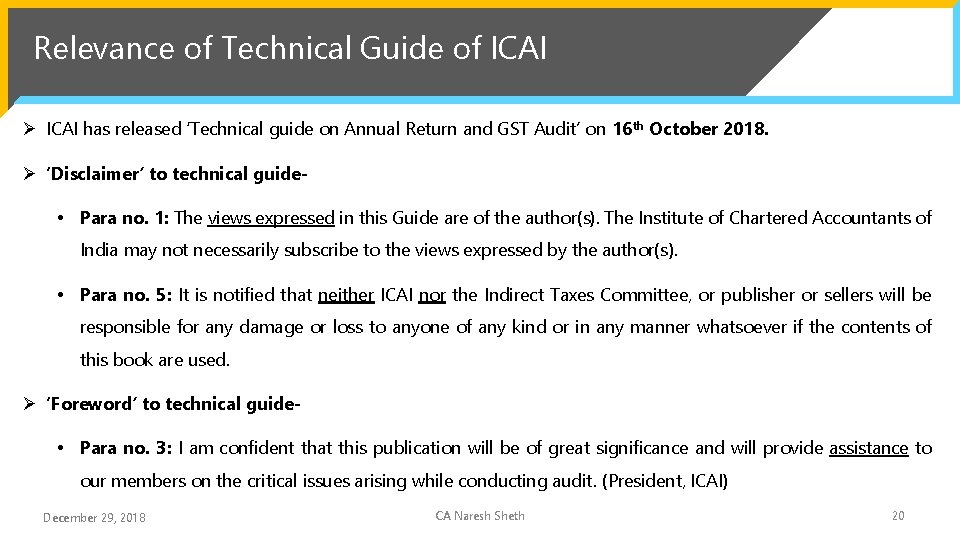
Relevance of Technical Guide of ICAI Ø ICAI has released ‘Technical guide on Annual Return and GST Audit’ on 16 th October 2018. Ø ‘Disclaimer’ to technical guide- • Para no. 1: The views expressed in this Guide are of the author(s). The Institute of Chartered Accountants of India may not necessarily subscribe to the views expressed by the author(s). • Para no. 5: It is notified that neither ICAI nor the Indirect Taxes Committee, or publisher or sellers will be responsible for any damage or loss to anyone of any kind or in any manner whatsoever if the contents of this book are used. Ø ‘Foreword’ to technical guide- • Para no. 3: I am confident that this publication will be of great significance and will provide assistance to our members on the critical issues arising while conducting audit. (President, ICAI) December 29, 2018 CA Naresh Sheth 20
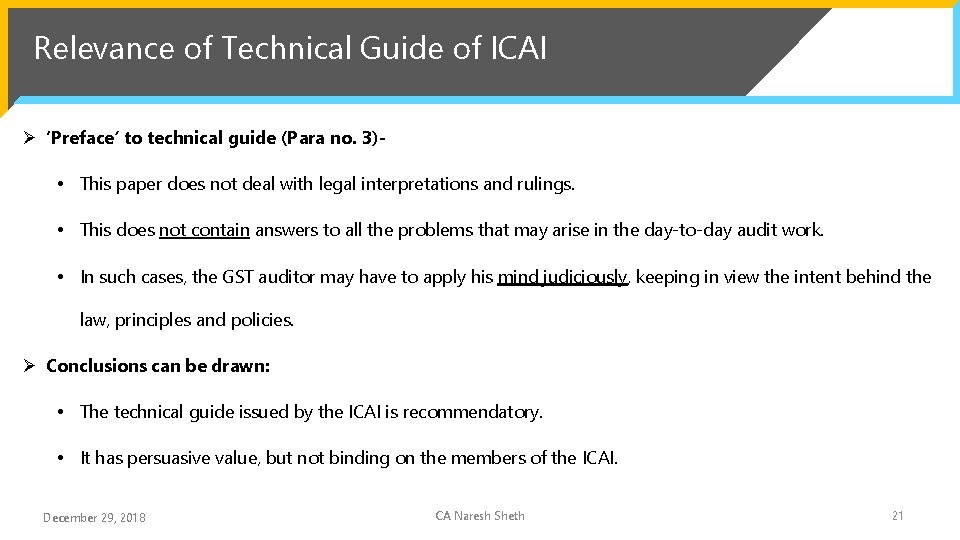
Relevance of Technical Guide of ICAI Ø ‘Preface’ to technical guide (Para no. 3)- • This paper does not deal with legal interpretations and rulings. • This does not contain answers to all the problems that may arise in the day-to-day audit work. • In such cases, the GST auditor may have to apply his mind judiciously, keeping in view the intent behind the law, principles and policies. Ø Conclusions can be drawn: • The technical guide issued by the ICAI is recommendatory. • It has persuasive value, but not binding on the members of the ICAI. December 29, 2018 CA Naresh Sheth 21
Meaning of Term “Audit” and Scope of “Audit” December 29, 2018 CA Naresh Sheth 22
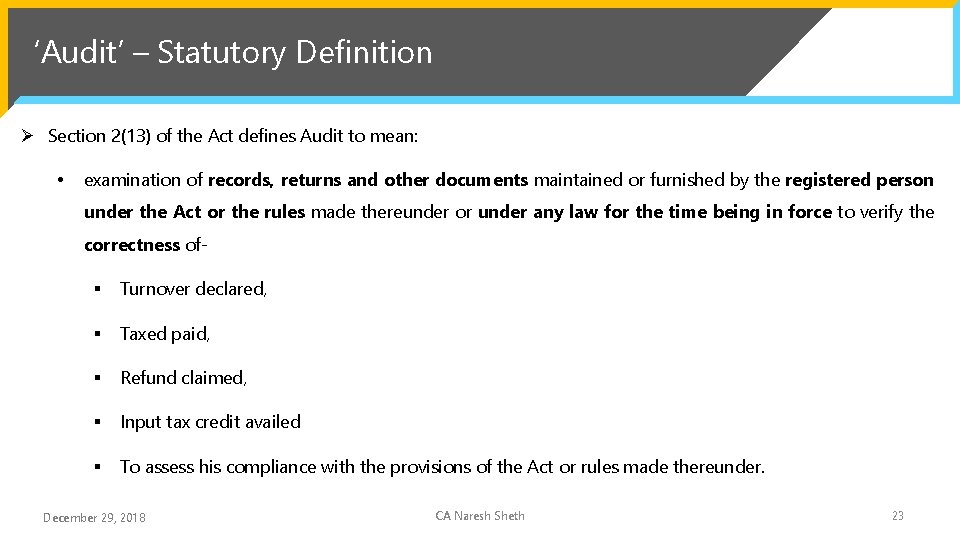
‘Audit’ – Statutory Definition Ø Section 2(13) of the Act defines Audit to mean: • examination of records, returns and other documents maintained or furnished by the registered person under the Act or the rules made thereunder or under any law for the time being in force to verify the correctness of- § Turnover declared, § Taxed paid, § Refund claimed, § Input tax credit availed § To assess his compliance with the provisions of the Act or rules made thereunder. December 29, 2018 CA Naresh Sheth 23
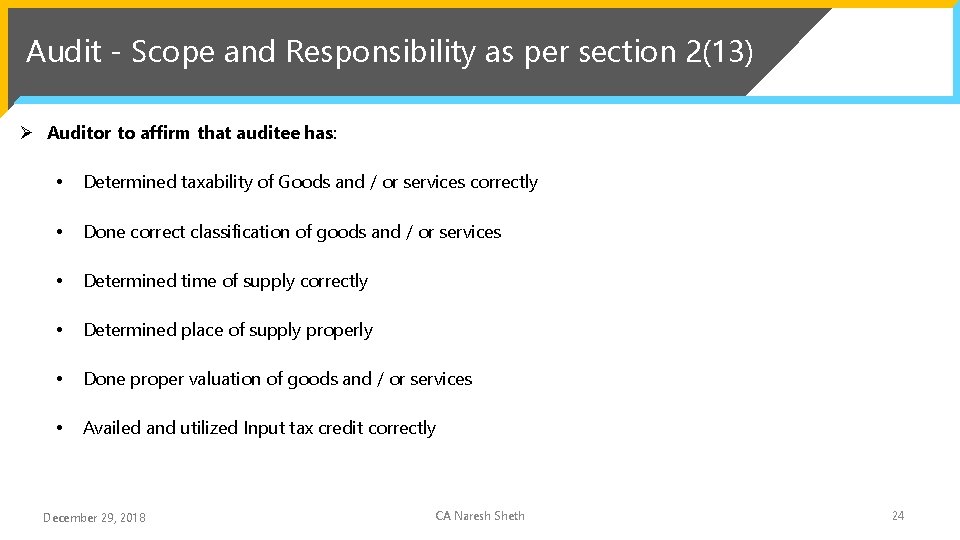
Audit - Scope and Responsibility as per section 2(13) Ø Auditor to affirm that auditee has: • Determined taxability of Goods and / or services correctly • Done correct classification of goods and / or services • Determined time of supply correctly • Determined place of supply properly • Done proper valuation of goods and / or services • Availed and utilized Input tax credit correctly December 29, 2018 CA Naresh Sheth 24
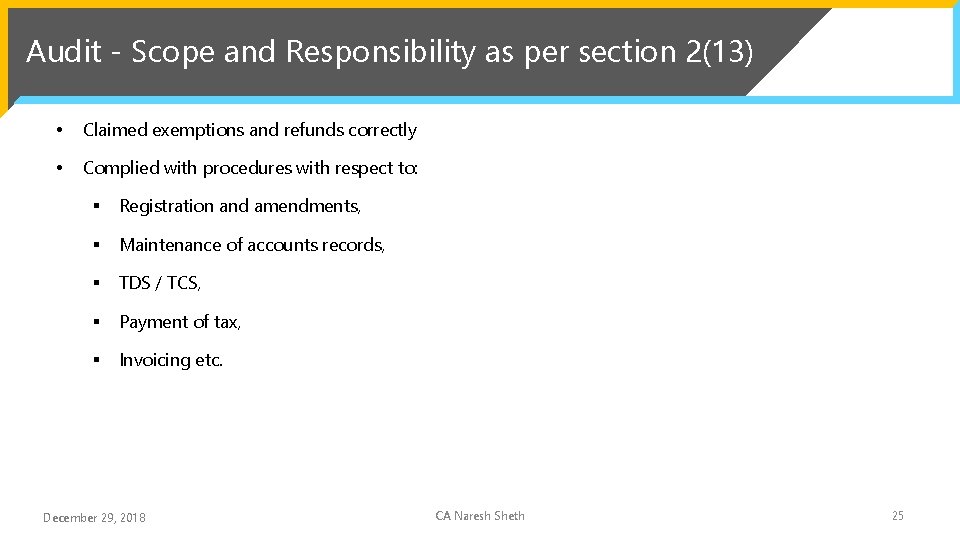
Audit - Scope and Responsibility as per section 2(13) • Claimed exemptions and refunds correctly • Complied with procedures with respect to: § Registration and amendments, § Maintenance of accounts records, § TDS / TCS, § Payment of tax, § Invoicing etc. December 29, 2018 CA Naresh Sheth 25
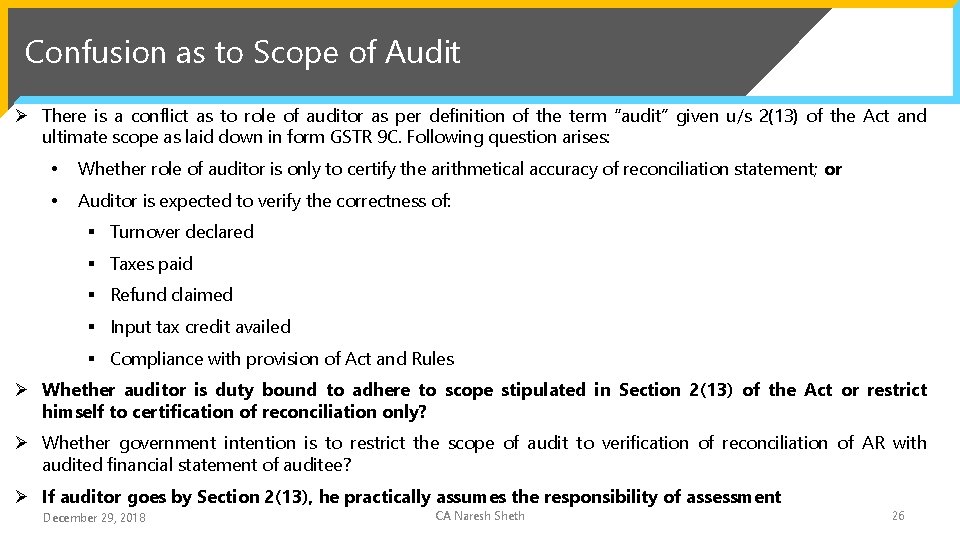
Confusion as to Scope of Audit Ø There is a conflict as to role of auditor as per definition of the term “audit” given u/s 2(13) of the Act and ultimate scope as laid down in form GSTR 9 C. Following question arises: • Whether role of auditor is only to certify the arithmetical accuracy of reconciliation statement; or • Auditor is expected to verify the correctness of: § Turnover declared § Taxes paid § Refund claimed § Input tax credit availed § Compliance with provision of Act and Rules Ø Whether auditor is duty bound to adhere to scope stipulated in Section 2(13) of the Act or restrict himself to certification of reconciliation only? Ø Whether government intention is to restrict the scope of audit to verification of reconciliation of AR with audited financial statement of auditee? Ø If auditor goes by Section 2(13), he practically assumes the responsibility of assessment December 29, 2018 CA Naresh Sheth 26
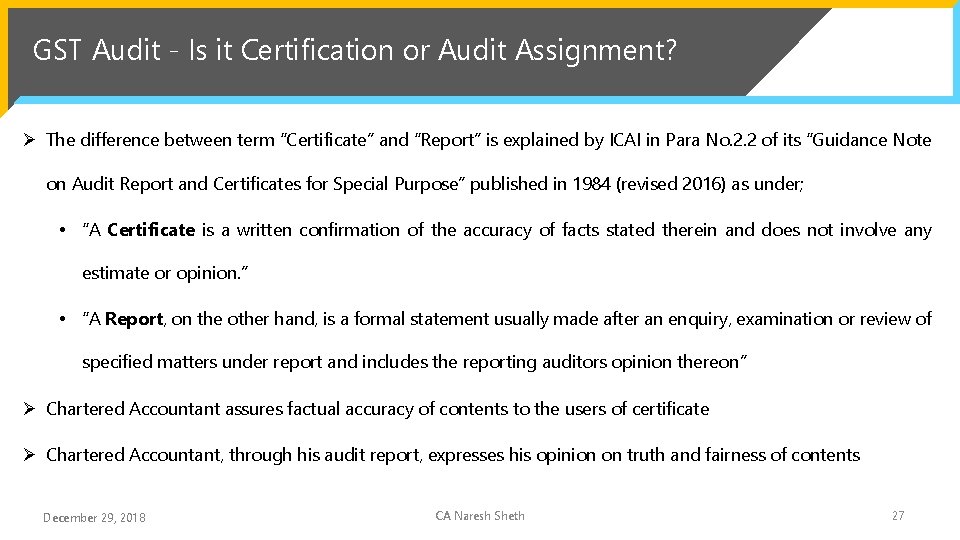
GST Audit - Is it Certification or Audit Assignment? Ø The difference between term “Certificate” and “Report” is explained by ICAI in Para No. 2. 2 of its “Guidance Note on Audit Report and Certificates for Special Purpose” published in 1984 (revised 2016) as under; • “A Certificate is a written confirmation of the accuracy of facts stated therein and does not involve any estimate or opinion. ” • “A Report, on the other hand, is a formal statement usually made after an enquiry, examination or review of specified matters under report and includes the reporting auditors opinion thereon” Ø Chartered Accountant assures factual accuracy of contents to the users of certificate Ø Chartered Accountant, through his audit report, expresses his opinion on truth and fairness of contents December 29, 2018 CA Naresh Sheth 27
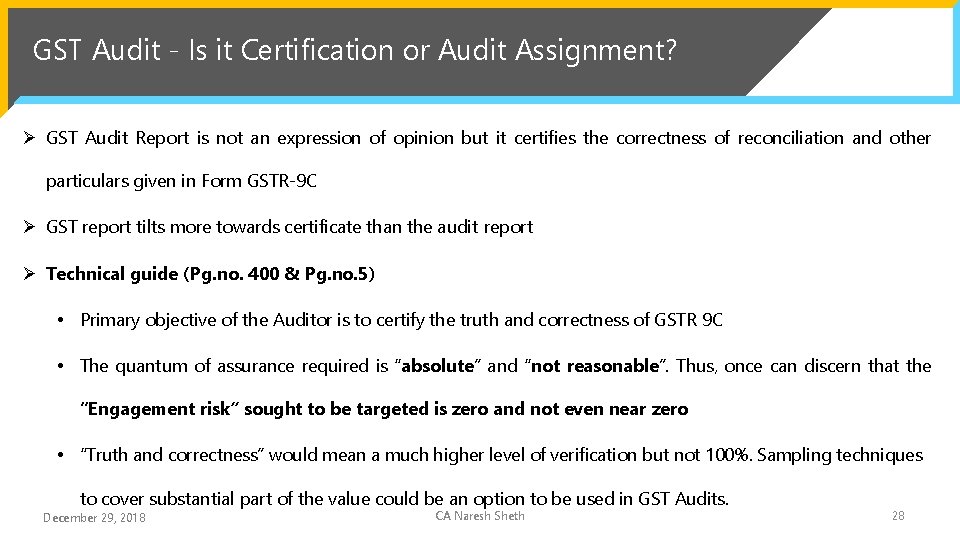
GST Audit - Is it Certification or Audit Assignment? Ø GST Audit Report is not an expression of opinion but it certifies the correctness of reconciliation and other particulars given in Form GSTR-9 C Ø GST report tilts more towards certificate than the audit report Ø Technical guide (Pg. no. 400 & Pg. no. 5) • Primary objective of the Auditor is to certify the truth and correctness of GSTR 9 C • The quantum of assurance required is “absolute” and “not reasonable”. Thus, once can discern that the “Engagement risk” sought to be targeted is zero and not even near zero • “Truth and correctness” would mean a much higher level of verification but not 100%. Sampling techniques to cover substantial part of the value could be an option to be used in GST Audits. December 29, 2018 CA Naresh Sheth 28
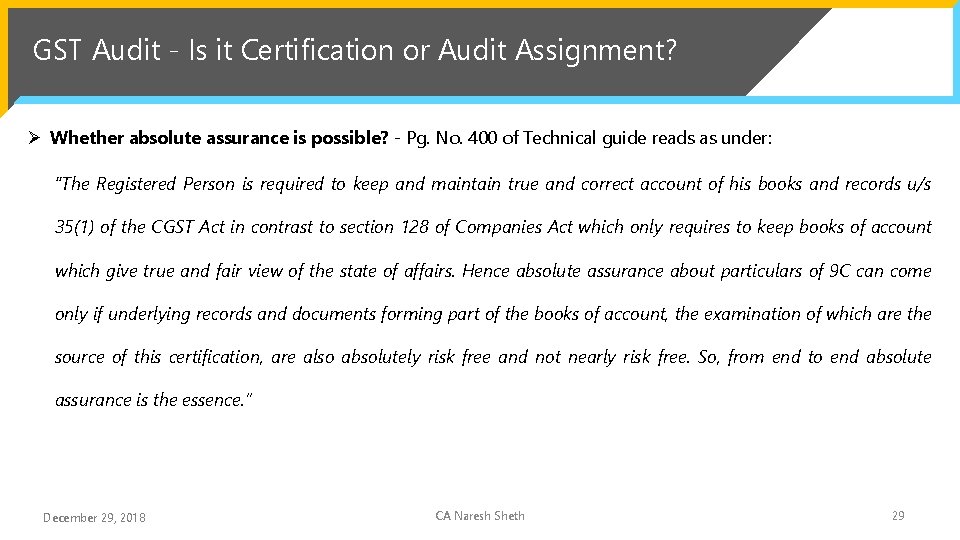
GST Audit - Is it Certification or Audit Assignment? Ø Whether absolute assurance is possible? - Pg. No. 400 of Technical guide reads as under: “The Registered Person is required to keep and maintain true and correct account of his books and records u/s 35(1) of the CGST Act in contrast to section 128 of Companies Act which only requires to keep books of account which give true and fair view of the state of affairs. Hence absolute assurance about particulars of 9 C can come only if underlying records and documents forming part of the books of account, the examination of which are the source of this certification, are also absolutely risk free and not nearly risk free. So, from end to end absolute assurance is the essence. ” December 29, 2018 CA Naresh Sheth 29
Probable Reconciliation Points Reportable in GSTR 9 C December 29, 2018 CA Naresh Sheth 30
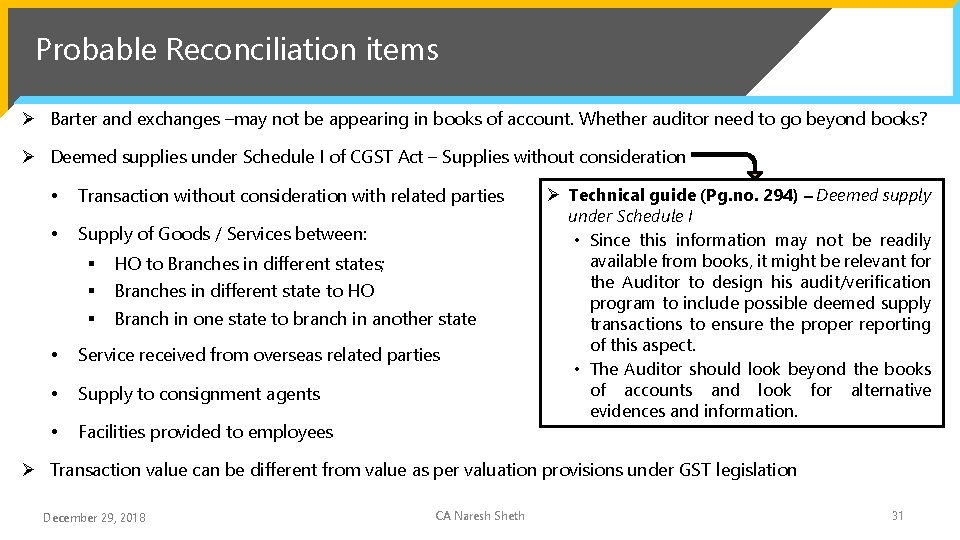
Probable Reconciliation items Ø Barter and exchanges –may not be appearing in books of account. Whether auditor need to go beyond books? Ø Deemed supplies under Schedule I of CGST Act – Supplies without consideration • Transaction without consideration with related parties • Supply of Goods / Services between: § § § HO to Branches in different states; Branches in different state to HO Branch in one state to branch in another state • Service received from overseas related parties • Supply to consignment agents • Facilities provided to employees Ø Technical guide (Pg. no. 294) – Deemed supply under Schedule I • Since this information may not be readily available from books, it might be relevant for the Auditor to design his audit/verification program to include possible deemed supply transactions to ensure the proper reporting of this aspect. • The Auditor should look beyond the books of accounts and look for alternative evidences and information. Ø Transaction value can be different from value as per valuation provisions under GST legislation December 29, 2018 CA Naresh Sheth 31
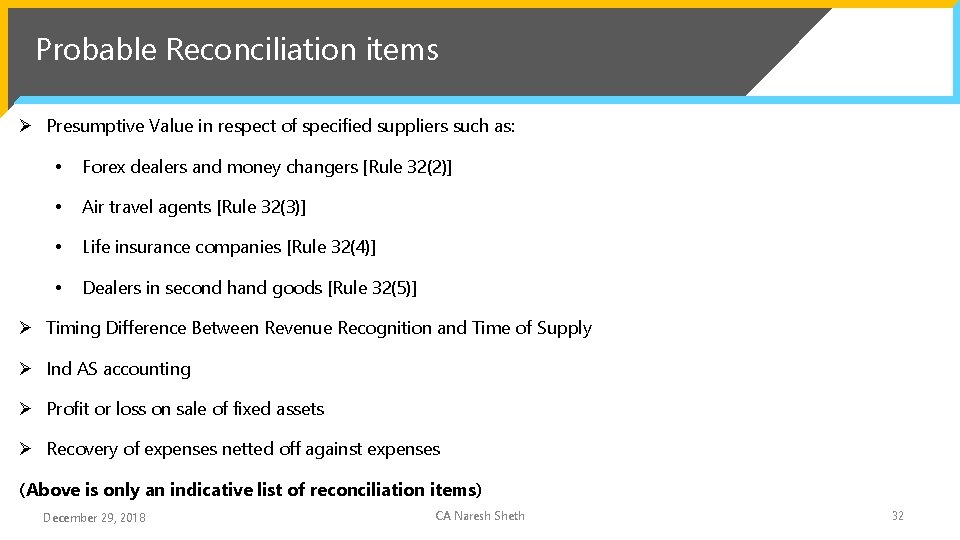
Probable Reconciliation items Ø Presumptive Value in respect of specified suppliers such as: • Forex dealers and money changers [Rule 32(2)] • Air travel agents [Rule 32(3)] • Life insurance companies [Rule 32(4)] • Dealers in second hand goods [Rule 32(5)] Ø Timing Difference Between Revenue Recognition and Time of Supply Ø Ind AS accounting Ø Profit or loss on sale of fixed assets Ø Recovery of expenses netted off against expenses (Above is only an indicative list of reconciliation items) December 29, 2018 CA Naresh Sheth 32
Concerns in Audit Report (GSTR 9 C) December 29, 2018 CA Naresh Sheth 33
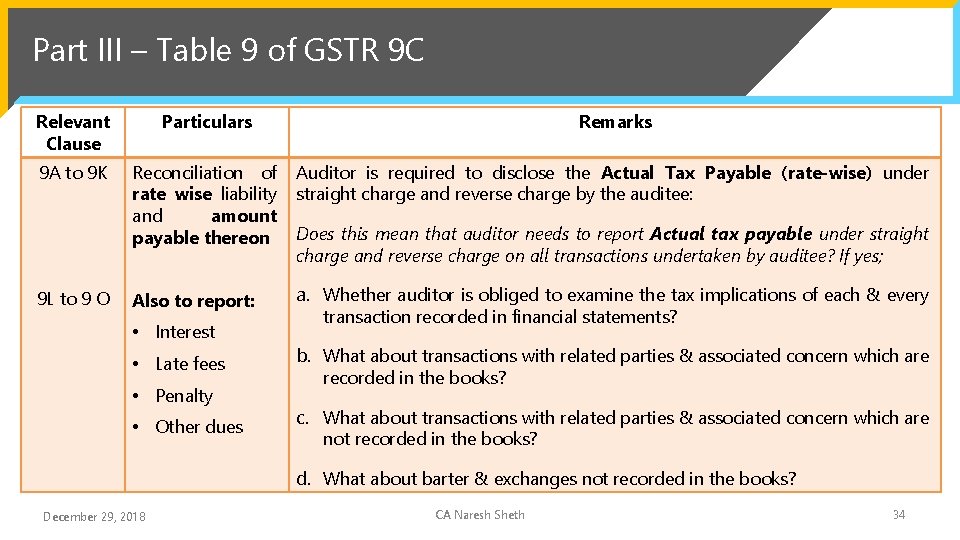
Part III – Table 9 of GSTR 9 C Relevant Clause Particulars Remarks 9 A to 9 K Reconciliation of rate wise liability and amount payable thereon Auditor is required to disclose the Actual Tax Payable (rate-wise) under straight charge and reverse charge by the auditee: Also to report: a. Whether auditor is obliged to examine the tax implications of each & every transaction recorded in financial statements? 9 L to 9 O • Interest • Late fees • Penalty • Other dues Does this mean that auditor needs to report Actual tax payable under straight charge and reverse charge on all transactions undertaken by auditee? If yes; b. What about transactions with related parties & associated concern which are recorded in the books? c. What about transactions with related parties & associated concern which are not recorded in the books? d. What about barter & exchanges not recorded in the books? December 29, 2018 CA Naresh Sheth 34
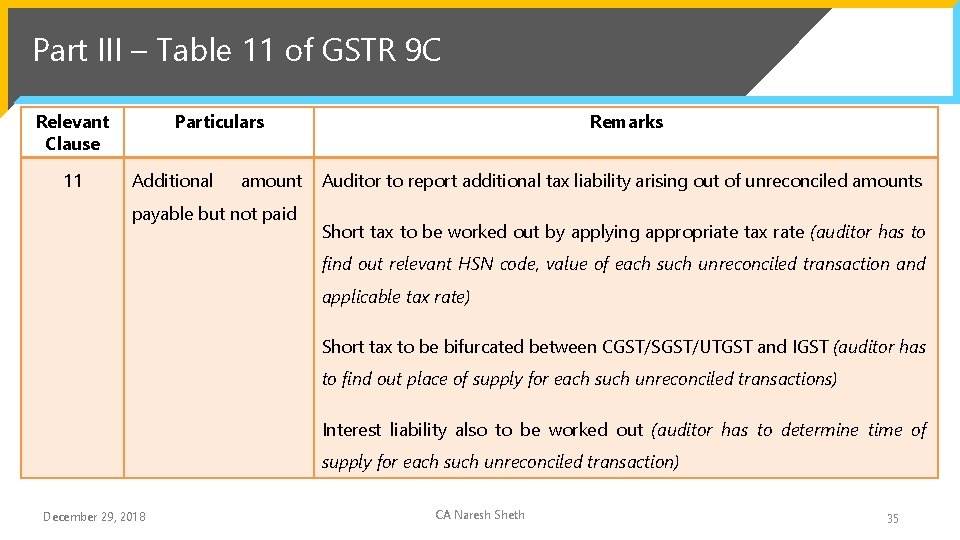
Part III – Table 11 of GSTR 9 C Relevant Clause 11 Particulars Additional amount payable but not paid Remarks Auditor to report additional tax liability arising out of unreconciled amounts Short tax to be worked out by applying appropriate tax rate (auditor has to find out relevant HSN code, value of each such unreconciled transaction and applicable tax rate) Short tax to be bifurcated between CGST/SGST/UTGST and IGST (auditor has to find out place of supply for each such unreconciled transactions) Interest liability also to be worked out (auditor has to determine time of supply for each such unreconciled transaction) December 29, 2018 CA Naresh Sheth 35
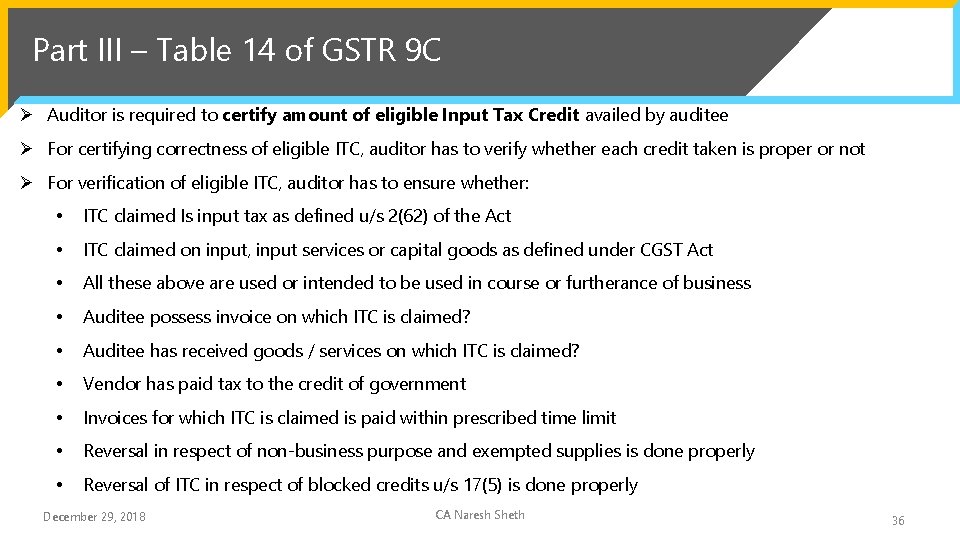
Part III – Table 14 of GSTR 9 C Ø Auditor is required to certify amount of eligible Input Tax Credit availed by auditee Ø For certifying correctness of eligible ITC, auditor has to verify whether each credit taken is proper or not Ø For verification of eligible ITC, auditor has to ensure whether: • ITC claimed Is input tax as defined u/s 2(62) of the Act • ITC claimed on input, input services or capital goods as defined under CGST Act • All these above are used or intended to be used in course or furtherance of business • Auditee possess invoice on which ITC is claimed? • Auditee has received goods / services on which ITC is claimed? • Vendor has paid tax to the credit of government • Invoices for which ITC is claimed is paid within prescribed time limit • Reversal in respect of non-business purpose and exempted supplies is done properly • Reversal of ITC in respect of blocked credits u/s 17(5) is done properly December 29, 2018 CA Naresh Sheth 36
Prescribed Turnover Limit for Audit & Some issues December 29, 2018 CA Naresh Sheth 37
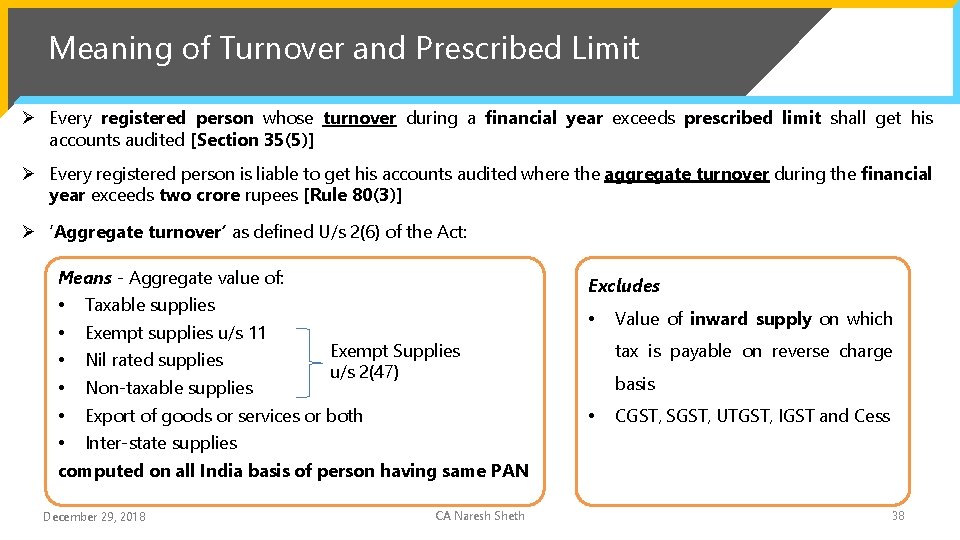
Meaning of Turnover and Prescribed Limit Ø Every registered person whose turnover during a financial year exceeds prescribed limit shall get his accounts audited [Section 35(5)] Ø Every registered person is liable to get his accounts audited where the aggregate turnover during the financial year exceeds two crore rupees [Rule 80(3)] Ø ‘Aggregate turnover’ as defined U/s 2(6) of the Act: Means - Aggregate value of: • Taxable supplies • Exempt supplies u/s 11 Exempt Supplies • Nil rated supplies u/s 2(47) • Non-taxable supplies • Export of goods or services or both • Inter-state supplies computed on all India basis of person having same PAN December 29, 2018 CA Naresh Sheth Excludes • Value of inward supply on which tax is payable on reverse charge basis • CGST, SGST, UTGST, IGST and Cess 38
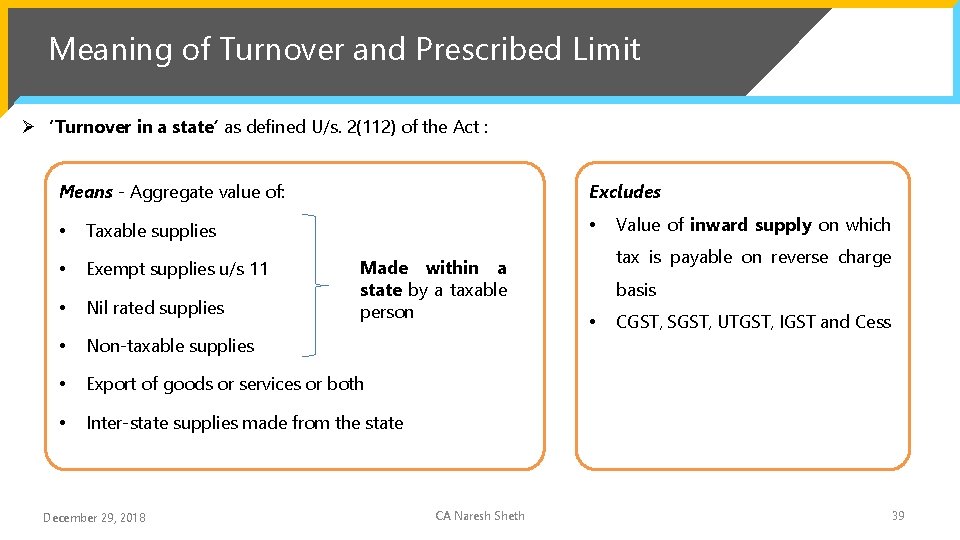
Meaning of Turnover and Prescribed Limit Ø ‘Turnover in a state’ as defined U/s. 2(112) of the Act : Means - Aggregate value of: Excludes • • Taxable supplies • Exempt supplies u/s 11 • Nil rated supplies • Non-taxable supplies • Export of goods or services or both • Inter-state supplies made from the state December 29, 2018 Made within a state by a taxable person CA Naresh Sheth Value of inward supply on which tax is payable on reverse charge basis • CGST, SGST, UTGST, IGST and Cess 39
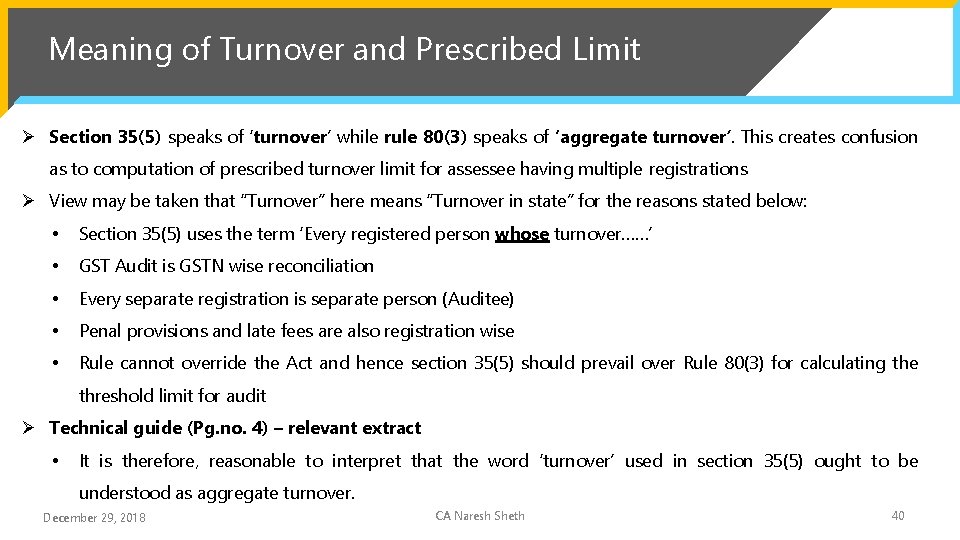
Meaning of Turnover and Prescribed Limit Ø Section 35(5) speaks of ‘turnover’ while rule 80(3) speaks of ‘aggregate turnover’. This creates confusion as to computation of prescribed turnover limit for assessee having multiple registrations Ø View may be taken that “Turnover” here means “Turnover in state” for the reasons stated below: • Section 35(5) uses the term ‘Every registered person whose turnover……’ • GST Audit is GSTN wise reconciliation • Every separate registration is separate person (Auditee) • Penal provisions and late fees are also registration wise • Rule cannot override the Act and hence section 35(5) should prevail over Rule 80(3) for calculating the threshold limit for audit Ø Technical guide (Pg. no. 4) – relevant extract • It is therefore, reasonable to interpret that the word ‘turnover’ used in section 35(5) ought to be understood as aggregate turnover. December 29, 2018 CA Naresh Sheth 40
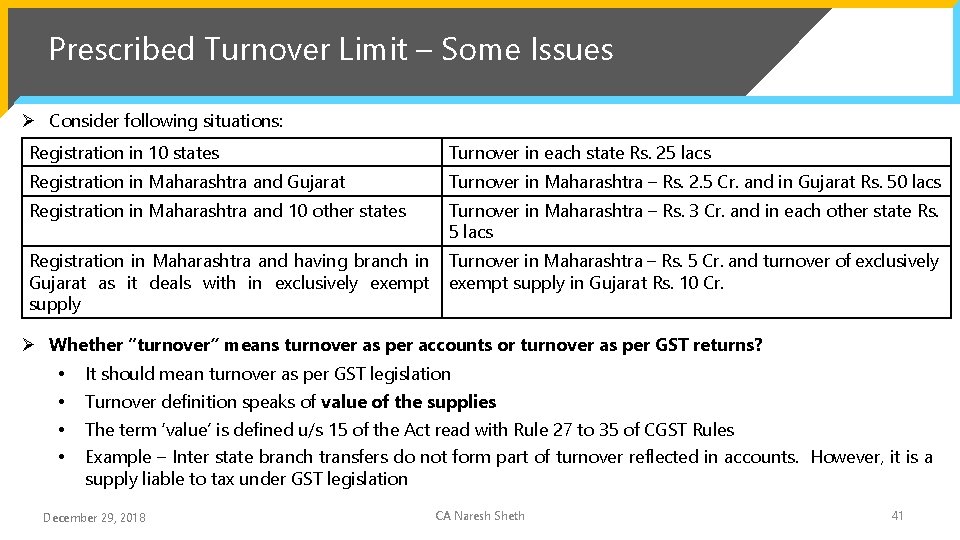
Prescribed Turnover Limit – Some Issues Ø Consider following situations: Registration in 10 states Turnover in each state Rs. 25 lacs Registration in Maharashtra and Gujarat Turnover in Maharashtra – Rs. 2. 5 Cr. and in Gujarat Rs. 50 lacs Registration in Maharashtra and 10 other states Turnover in Maharashtra – Rs. 3 Cr. and in each other state Rs. 5 lacs Registration in Maharashtra and having branch in Gujarat as it deals with in exclusively exempt supply Turnover in Maharashtra – Rs. 5 Cr. and turnover of exclusively exempt supply in Gujarat Rs. 10 Cr. Ø Whether “turnover” means turnover as per accounts or turnover as per GST returns? • • It should mean turnover as per GST legislation Turnover definition speaks of value of the supplies The term ‘value’ is defined u/s 15 of the Act read with Rule 27 to 35 of CGST Rules Example – Inter state branch transfers do not form part of turnover reflected in accounts. However, it is a supply liable to tax under GST legislation December 29, 2018 CA Naresh Sheth 41
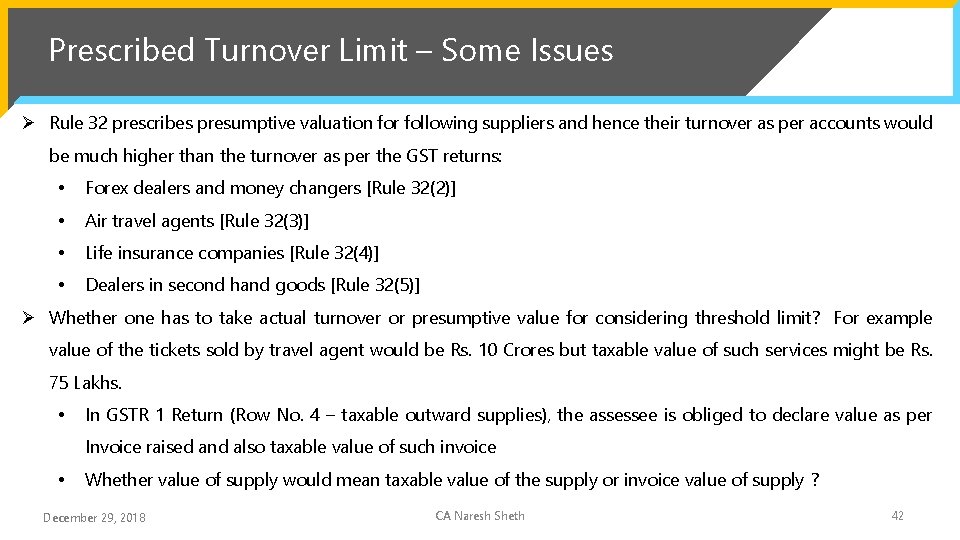
Prescribed Turnover Limit – Some Issues Ø Rule 32 prescribes presumptive valuation for following suppliers and hence their turnover as per accounts would be much higher than the turnover as per the GST returns: • Forex dealers and money changers [Rule 32(2)] • Air travel agents [Rule 32(3)] • Life insurance companies [Rule 32(4)] • Dealers in second hand goods [Rule 32(5)] Ø Whether one has to take actual turnover or presumptive value for considering threshold limit? For example value of the tickets sold by travel agent would be Rs. 10 Crores but taxable value of such services might be Rs. 75 Lakhs. • In GSTR 1 Return (Row No. 4 – taxable outward supplies), the assessee is obliged to declare value as per Invoice raised and also taxable value of such invoice • Whether value of supply would mean taxable value of the supply or invoice value of supply ? December 29, 2018 CA Naresh Sheth 42
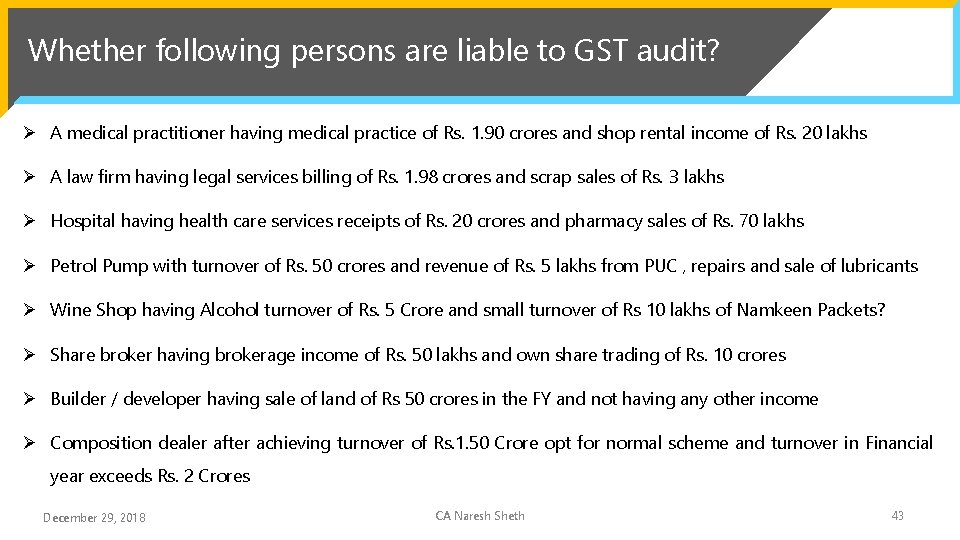
Whether following persons are liable to GST audit? Ø A medical practitioner having medical practice of Rs. 1. 90 crores and shop rental income of Rs. 20 lakhs Ø A law firm having legal services billing of Rs. 1. 98 crores and scrap sales of Rs. 3 lakhs Ø Hospital having health care services receipts of Rs. 20 crores and pharmacy sales of Rs. 70 lakhs Ø Petrol Pump with turnover of Rs. 50 crores and revenue of Rs. 5 lakhs from PUC , repairs and sale of lubricants Ø Wine Shop having Alcohol turnover of Rs. 5 Crore and small turnover of Rs 10 lakhs of Namkeen Packets? Ø Share broker having brokerage income of Rs. 50 lakhs and own share trading of Rs. 10 crores Ø Builder / developer having sale of land of Rs 50 crores in the FY and not having any other income Ø Composition dealer after achieving turnover of Rs. 1. 50 Crore opt for normal scheme and turnover in Financial year exceeds Rs. 2 Crores December 29, 2018 CA Naresh Sheth 43
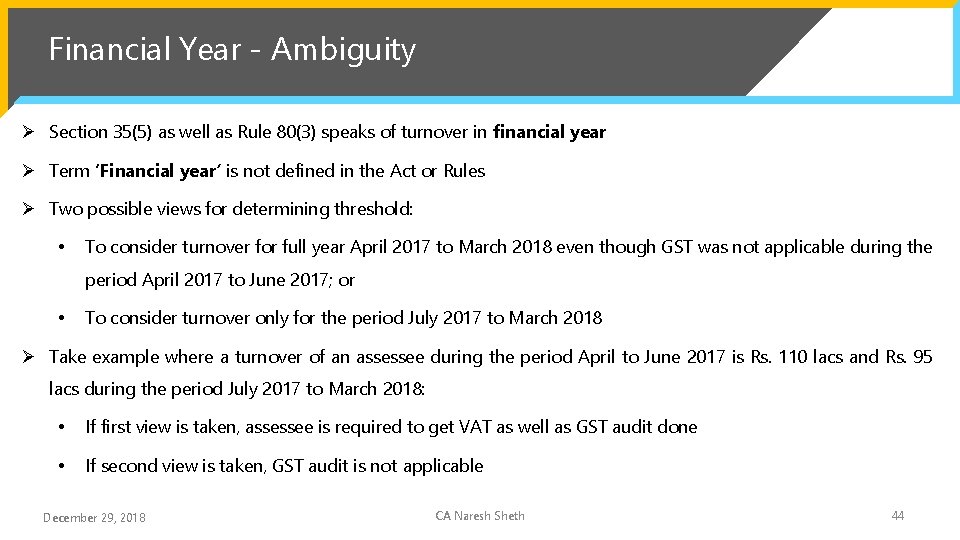
Financial Year - Ambiguity Ø Section 35(5) as well as Rule 80(3) speaks of turnover in financial year Ø Term ‘Financial year’ is not defined in the Act or Rules Ø Two possible views for determining threshold: • To consider turnover for full year April 2017 to March 2018 even though GST was not applicable during the period April 2017 to June 2017; or • To consider turnover only for the period July 2017 to March 2018 Ø Take example where a turnover of an assessee during the period April to June 2017 is Rs. 110 lacs and Rs. 95 lacs during the period July 2017 to March 2018: • If first view is taken, assessee is required to get VAT as well as GST audit done • If second view is taken, GST audit is not applicable December 29, 2018 CA Naresh Sheth 44
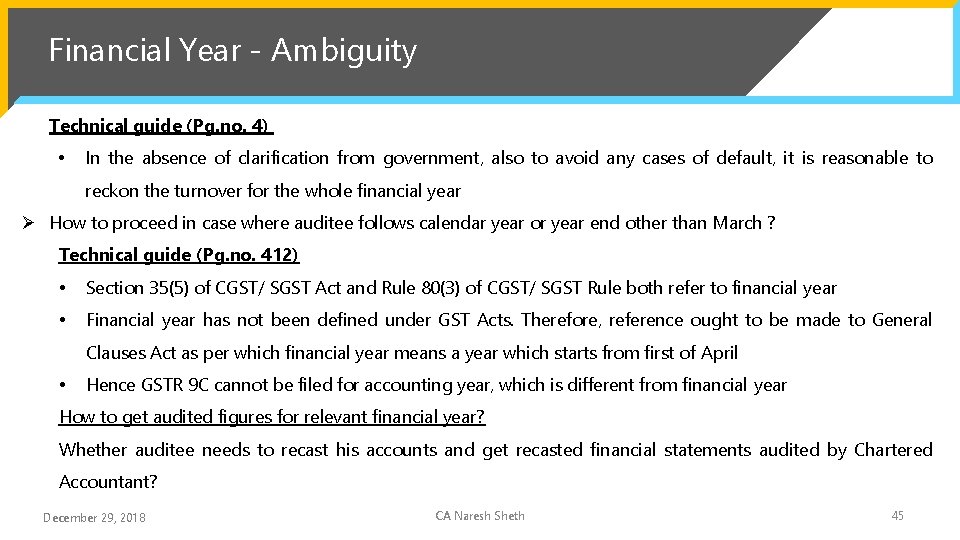
Financial Year - Ambiguity Technical guide (Pg. no. 4) • In the absence of clarification from government, also to avoid any cases of default, it is reasonable to reckon the turnover for the whole financial year Ø How to proceed in case where auditee follows calendar year or year end other than March ? Technical guide (Pg. no. 412) • Section 35(5) of CGST/ SGST Act and Rule 80(3) of CGST/ SGST Rule both refer to financial year • Financial year has not been defined under GST Acts. Therefore, reference ought to be made to General Clauses Act as per which financial year means a year which starts from first of April • Hence GSTR 9 C cannot be filed for accounting year, which is different from financial year How to get audited figures for relevant financial year? Whether auditee needs to recast his accounts and get recasted financial statements audited by Chartered Accountant? December 29, 2018 CA Naresh Sheth 45
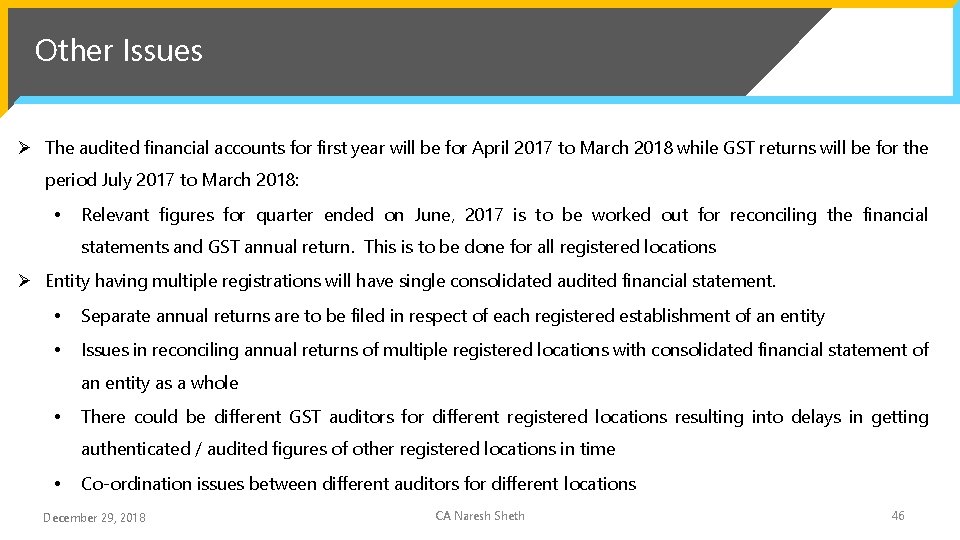
Other Issues Ø The audited financial accounts for first year will be for April 2017 to March 2018 while GST returns will be for the period July 2017 to March 2018: • Relevant figures for quarter ended on June, 2017 is to be worked out for reconciling the financial statements and GST annual return. This is to be done for all registered locations Ø Entity having multiple registrations will have single consolidated audited financial statement. • Separate annual returns are to be filed in respect of each registered establishment of an entity • Issues in reconciling annual returns of multiple registered locations with consolidated financial statement of an entity as a whole • There could be different GST auditors for different registered locations resulting into delays in getting authenticated / audited figures of other registered locations in time • Co-ordination issues between different auditors for different locations December 29, 2018 CA Naresh Sheth 46
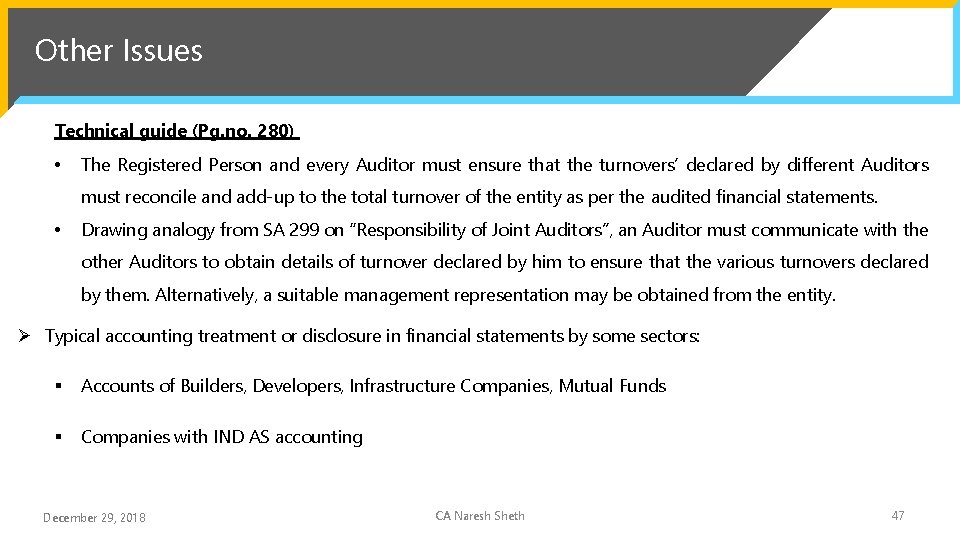
Other Issues Technical guide (Pg. no. 280) • The Registered Person and every Auditor must ensure that the turnovers’ declared by different Auditors must reconcile and add-up to the total turnover of the entity as per the audited financial statements. • Drawing analogy from SA 299 on “Responsibility of Joint Auditors”, an Auditor must communicate with the other Auditors to obtain details of turnover declared by him to ensure that the various turnovers declared by them. Alternatively, a suitable management representation may be obtained from the entity. Ø Typical accounting treatment or disclosure in financial statements by some sectors: § Accounts of Builders, Developers, Infrastructure Companies, Mutual Funds § Companies with IND AS accounting December 29, 2018 CA Naresh Sheth 47
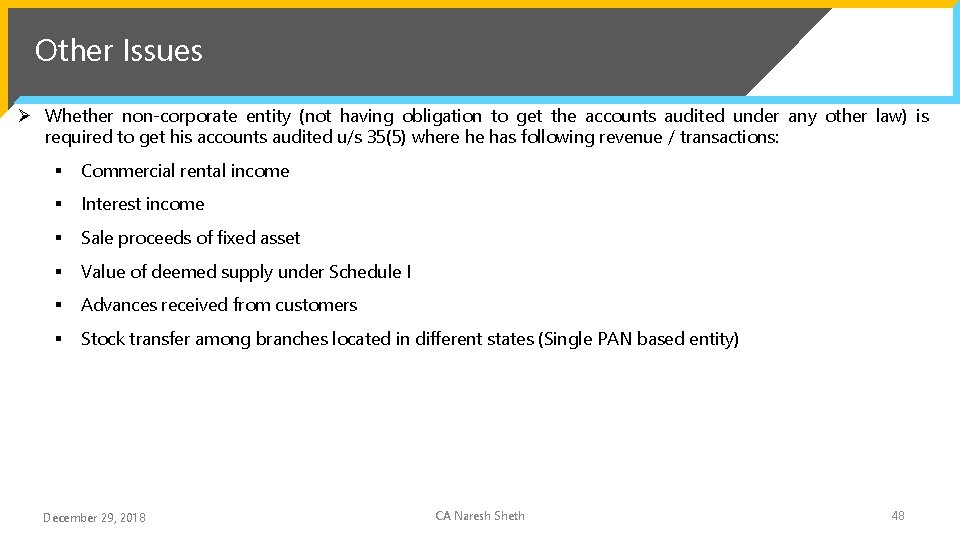
Other Issues Ø Whether non-corporate entity (not having obligation to get the accounts audited under any other law) is required to get his accounts audited u/s 35(5) where he has following revenue / transactions: § Commercial rental income § Interest income § Sale proceeds of fixed asset § Value of deemed supply under Schedule I § Advances received from customers § Stock transfer among branches located in different states (Single PAN based entity) December 29, 2018 CA Naresh Sheth 48

Penal Provisions December 29, 2018 CA Naresh Sheth 49
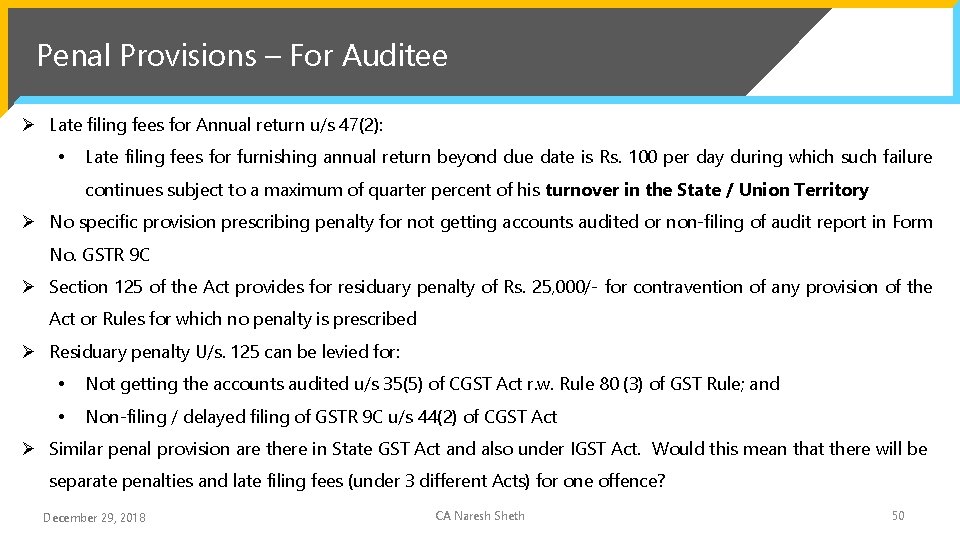
Penal Provisions – For Auditee Ø Late filing fees for Annual return u/s 47(2): • Late filing fees for furnishing annual return beyond due date is Rs. 100 per day during which such failure continues subject to a maximum of quarter percent of his turnover in the State / Union Territory Ø No specific provision prescribing penalty for not getting accounts audited or non-filing of audit report in Form No. GSTR 9 C Ø Section 125 of the Act provides for residuary penalty of Rs. 25, 000/- for contravention of any provision of the Act or Rules for which no penalty is prescribed Ø Residuary penalty U/s. 125 can be levied for: • Not getting the accounts audited u/s 35(5) of CGST Act r. w. Rule 80 (3) of GST Rule; and • Non-filing / delayed filing of GSTR 9 C u/s 44(2) of CGST Act Ø Similar penal provision are there in State GST Act and also under IGST Act. Would this mean that there will be separate penalties and late filing fees (under 3 different Acts) for one offence? December 29, 2018 CA Naresh Sheth 50
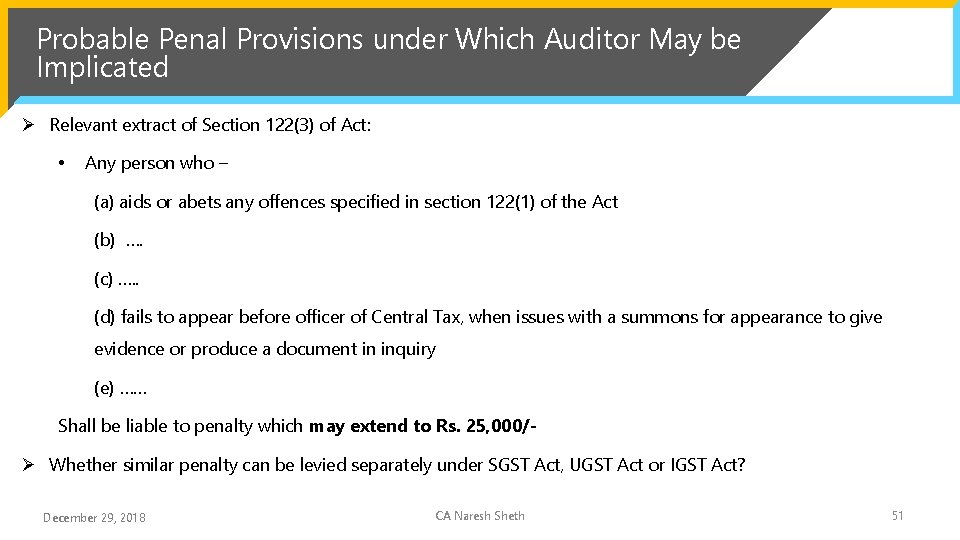
Probable Penal Provisions under Which Auditor May be Implicated Ø Relevant extract of Section 122(3) of Act: • Any person who – (a) aids or abets any offences specified in section 122(1) of the Act (b) …. (c) …. . (d) fails to appear before officer of Central Tax, when issues with a summons for appearance to give evidence or produce a document in inquiry (e) …… Shall be liable to penalty which may extend to Rs. 25, 000/- Ø Whether similar penalty can be levied separately under SGST Act, UGST Act or IGST Act? December 29, 2018 CA Naresh Sheth 51
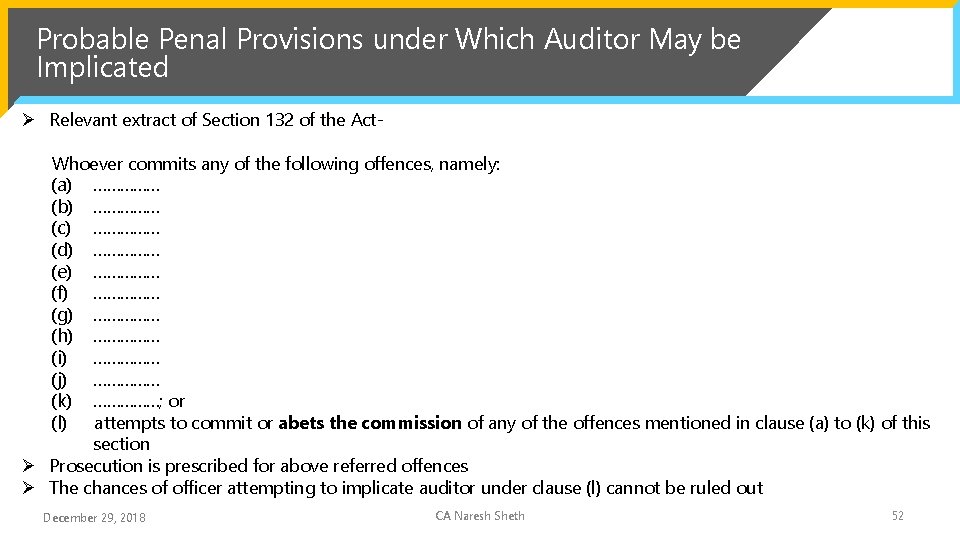
Probable Penal Provisions under Which Auditor May be Implicated Ø Relevant extract of Section 132 of the Act. Whoever commits any of the following offences, namely: (a) …………… (b) …………… (c) …………… (d) …………… (e) …………… (f) …………… (g) …………… (h) …………… (i) …………… (j) …………… (k) ……………; or (l) attempts to commit or abets the commission of any of the offences mentioned in clause (a) to (k) of this section Ø Prosecution is prescribed for above referred offences Ø The chances of officer attempting to implicate auditor under clause (l) cannot be ruled out December 29, 2018 CA Naresh Sheth 52
Persons Qualified to Conduct GST Audit December 29, 2018 CA Naresh Sheth 53
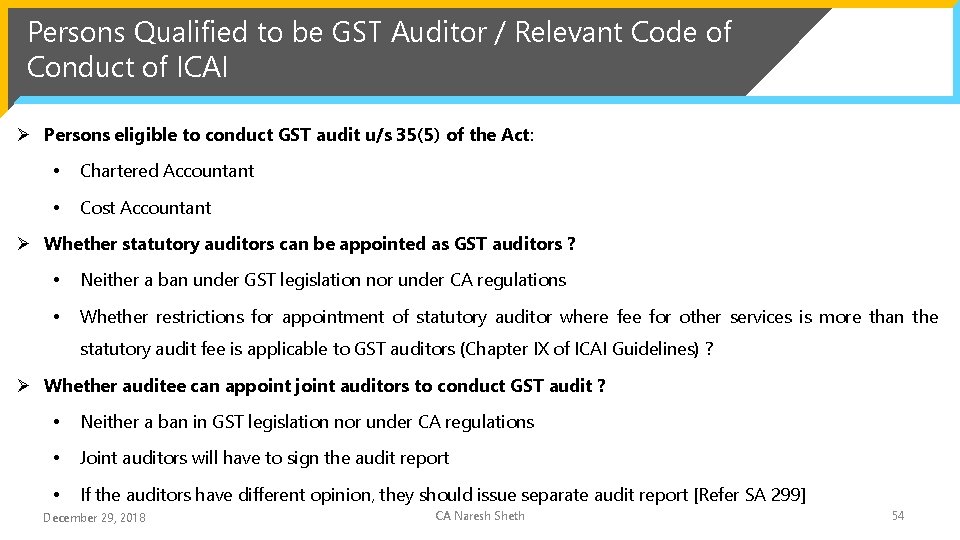
Persons Qualified to be GST Auditor / Relevant Code of Conduct of ICAI Ø Persons eligible to conduct GST audit u/s 35(5) of the Act: • Chartered Accountant • Cost Accountant Ø Whether statutory auditors can be appointed as GST auditors ? • Neither a ban under GST legislation nor under CA regulations • Whether restrictions for appointment of statutory auditor where fee for other services is more than the statutory audit fee is applicable to GST auditors (Chapter IX of ICAI Guidelines) ? Ø Whether auditee can appoint joint auditors to conduct GST audit ? • Neither a ban in GST legislation nor under CA regulations • Joint auditors will have to sign the audit report • If the auditors have different opinion, they should issue separate audit report [Refer SA 299] December 29, 2018 CA Naresh Sheth 54
Persons Qualified to be GST Auditor / Relevant Code of Conduct of ICAI Ø Whether auditee has to appoint different auditors for his different registration or he can appoint single auditor for all its registrations ? • It is at the discretion of the auditee Ø Whether internal auditors can be appointed as GST auditor? • Internal auditor of an auditee cannot be appointed as his tax auditor (378 th ICAI Council resolution during meeting held on 26 th and 27 th September) Ø A chartered accountant who is responsible for writing or the maintenance of books of account of the auditee should not audit such auditee (Clause (4) of Part I of the Second Schedule to the Act). Ø Whether registration as GST Practitioner U/s. 48 is mandatory to Act as GST Auditor? December 29, 2018 CA Naresh Sheth 55
Persons Qualified to be GST Auditor / Relevant Code of Conduct of ICAI Ø Member in a part time practice is not entitled to perform attestation function (242 nd Council meeting resolution) • An employee of a CA firm can have COP but is not eligible to perform attestation function • Only proprietor or partner of CA firm can perform attestation function Ø A chartered accountant having substantial interest in the auditee cannot take up the audit (Clause 4 of Part I of the Second Schedule the Chartered Accountants Act, 1949) • Refer Appendix 9 of CA Regulations 1988 for the meaning of term ‘Substantial interest’ Ø A chartered accountant should not accept the GST audit of a person to whom he is indebted for more than Rs. 10, 000/- (Chapter X of ICAI Guidelines) December 29, 2018 CA Naresh Sheth 56
Persons Qualified to be GST Auditor / Relevant Code of Conduct of ICAI Ø Whether limit on number of tax audits (60 per individuals as prescribed in 331 st Council Meeting held in February 2014) applies to GST Audit? Ø A chartered accountant cannot charge professional fees based on a percentage of profit or which are contingent upon the finding or the result of the professional employment. (Clause 10 of part I of the First Schedule to the CA Act, 1949). Ø Communication with the previous auditor is necessary in terms of Clause (8), Part – I of the First Schedule to the Chartered Accountants Act, 1949. Ø Whether is it necessary to communicate with earlier VAT auditor (wherever applicable) for accepting audit for F. Y. 2017 -18? • Since both these audits are under different statutes, this may not be necessary December 29, 2018 CA Naresh Sheth 57
Words of Caution Ø Views expressed in the presentation are the personal views of faculty based on his interpretation of law Ø Presentation needs to be revised and revisited on amendment in GST Law or release of guidance note by ICAI Ø Presentation is made for educational meeting arranged with a clear understanding that neither the Faculties nor the Rajkot branch will be responsible for any error, omission, commission and result of any action taken by a participant or anyone on the basis of this presentation Ø Views expressed by the faculty should not be treated as professional advice or legal opinion on the issue discussed December 29, 2018 CA Naresh Sheth 58
THANK YOU naresh. sheth@nashah. com December 29, 2018 CA Naresh Sheth 59
- Slides: 59