
Rajarshi Shahu Mahavidyalaya Latur Arms Race Disarmament Dr
- Slides: 34
Rajarshi Shahu Mahavidyalaya, Latur. Arms Race & Disarmament Dr. Mahadev Gavhane Dept. of Political Science Dr. Mahadev Gavhane
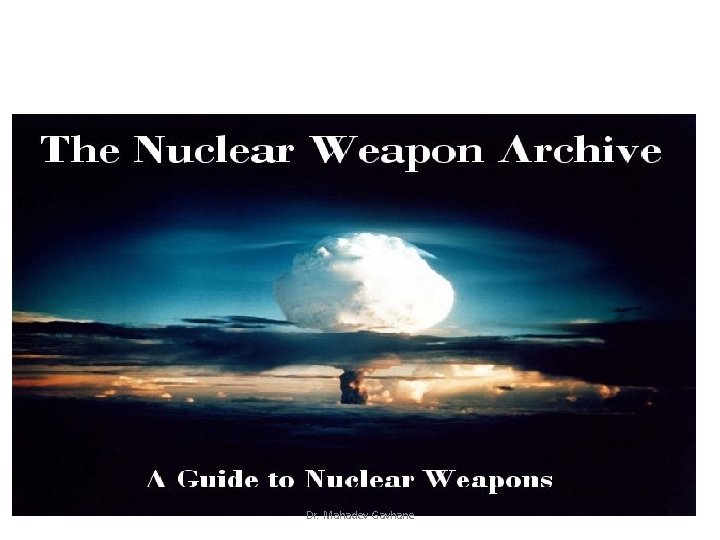
Dr. Mahadev Gavhane
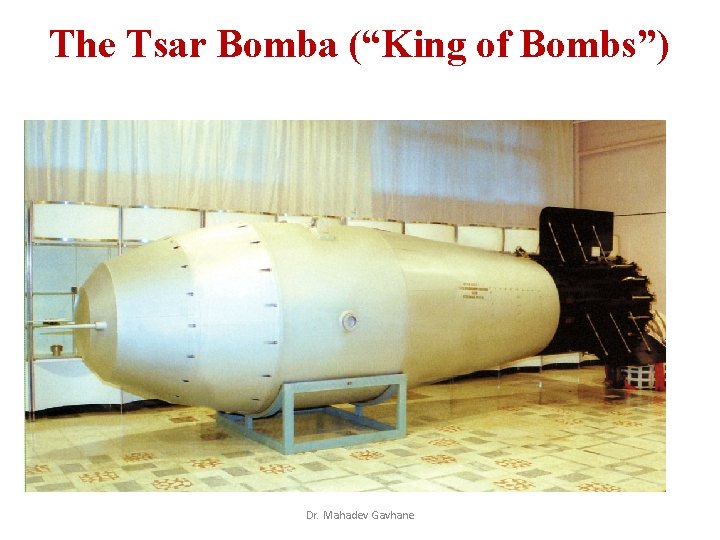
The Tsar Bomba (“King of Bombs”) Dr. Mahadev Gavhane
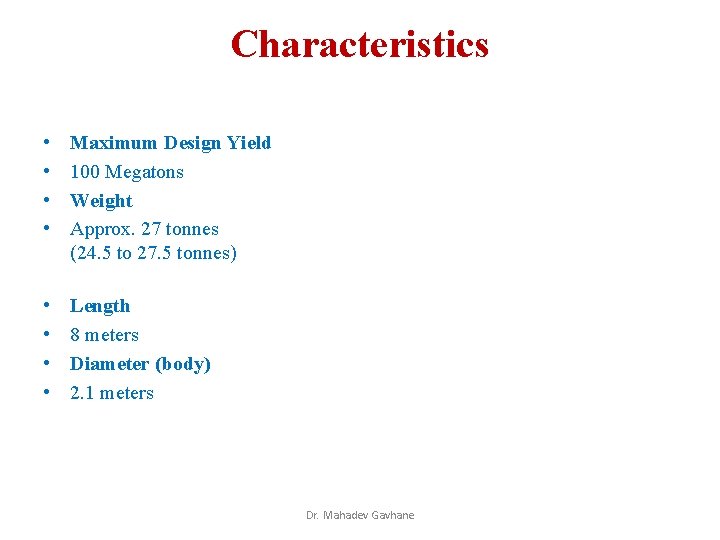
Characteristics • • Maximum Design Yield 100 Megatons Weight Approx. 27 tonnes (24. 5 to 27. 5 tonnes) • • Length 8 meters Diameter (body) 2. 1 meters Dr. Mahadev Gavhane
• Delivery Method • Modified Tu-95 strategic bomber, parachute retarded airburst (ground burst capability? ) • Number Manufactured • Most likely 1 • Design Features • Three stage radiation implosion system • Tertiary (and probably secondary) stages tested with non-fissionable lead tampers • 50% fusion, 50% fission at full yield Dr. Mahadev Gavhane
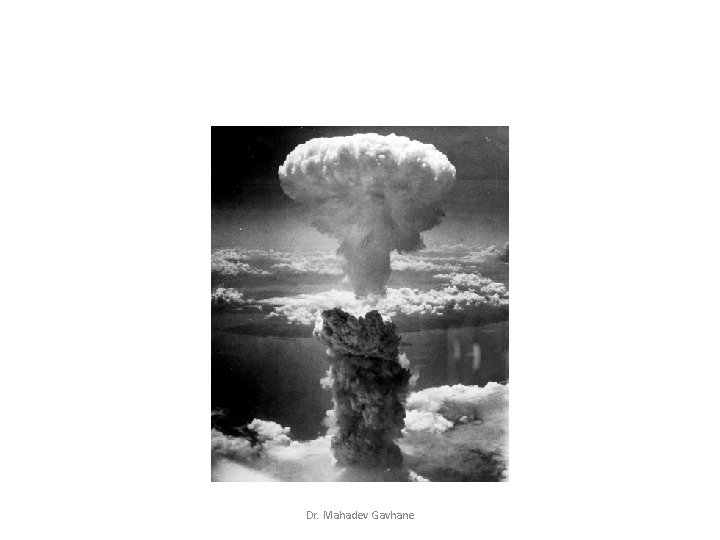
• On August 6, 1945, during World War II (1939 -45), an American B-29 bomber dropped the world's first deployed atomic bomb over the Japanese city of Hiroshima. . Three days later, a second B-29 dropped another A-bomb on Nagasaki, killing an estimated 40, 000 people. Dr. Mahadev Gavhane
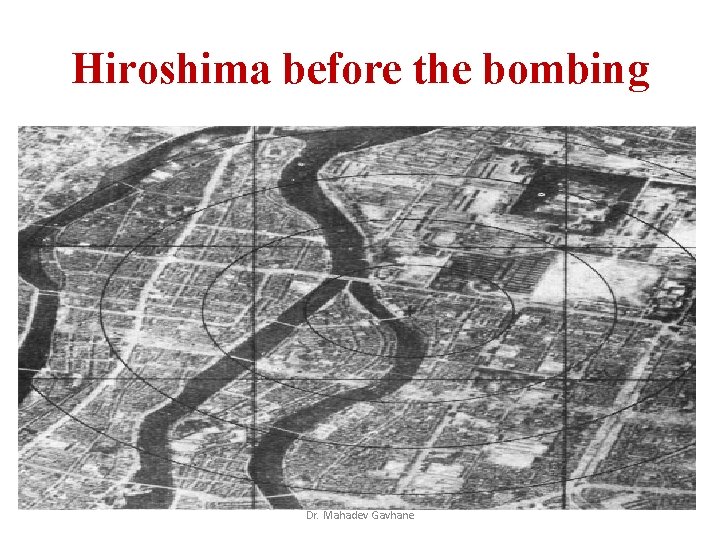
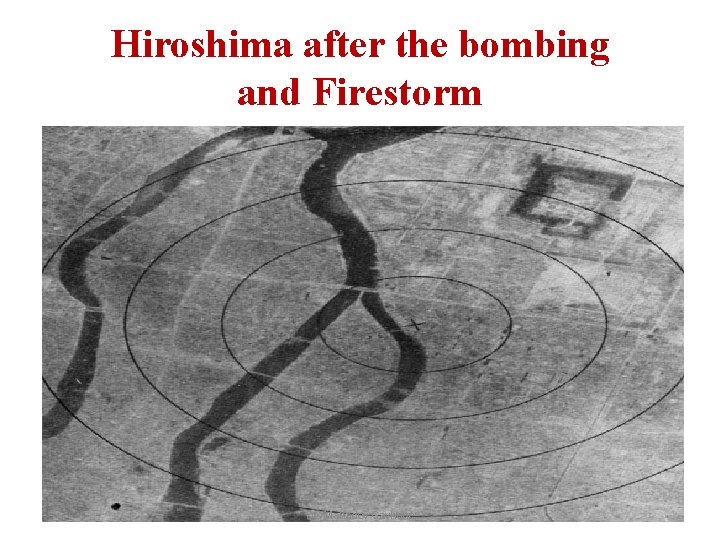
“LITTLE BOY” AND “FAT MAN” • Hiroshima, a manufacturing center of some 350, 000 people located about 500 miles from Tokyo, was selected as the first target. After arriving at the U. S. base on the Pacific island of Tinian, the more than 9, 000 -pound uranium-235 bomb was loaded aboard a modified B-29 bomber christened Enola Gay (after the mother of its pilot, Colonel Paul Tibbets). The plane dropped the bomb–known as “Little Boy”–by parachute at 8: 15 in the morning, and it exploded 2, 000 feet above Hiroshima in a blast equal to 12 -15, 000 tons of TNT, destroying five square miles of the city. Dr. Mahadev Gavhane
• Hiroshima’s devastation failed to elicit immediate Japanese surrender, however, and on August 9 Major Charles Sweeney flew another B-29 bomber, Bockscar, from Tinian. Thick clouds over the primary target, the city of Kokura, drove Sweeney to a secondary target, Nagasaki, where the plutonium bomb “Fat Man” was dropped at 11: 02 that morning. More powerful than the one used at Hiroshima, the bomb weighed nearly 10, 000 pounds and was built to produce a 22 -kiloton blast. The topography of Nagasaki, which was nestled in narrow valleys between mountains, reduced the bomb’s effect, limiting the destruction to 2. 6 square miles. • At noon on August 15, 1945 (Japanese time), Emperor Hirohito announced his country’s surrender in a radio broadcast. The news spread quickly, and “Victory in Japan” or “V-J Day” celebrations broke out across the United States and other Allied nations. The formal surrender agreement was signed on September 2, aboard the U. S. battleship Missouri, anchored in Tokyo Bay. Dr. Mahadev Gavhane
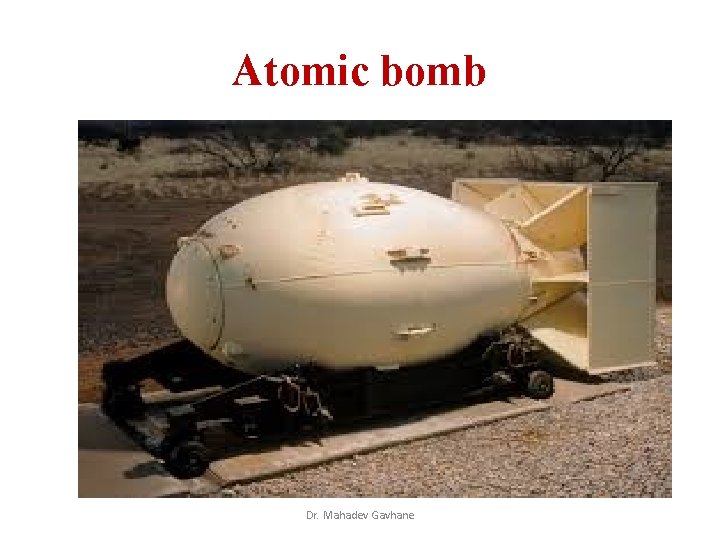
Atomic bomb Dr. Mahadev Gavhane
Dr. Mahadev Gavhane
Hiroshima before the bombing Dr. Mahadev Gavhane
Hiroshima after the bombing and Firestorm Dr. Mahadev Gavhane
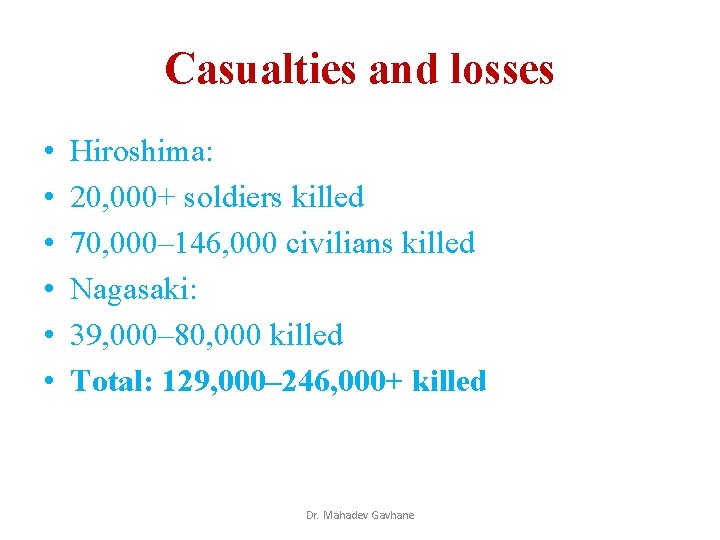
Casualties and losses • • • Hiroshima: 20, 000+ soldiers killed 70, 000– 146, 000 civilians killed Nagasaki: 39, 000– 80, 000 killed Total: 129, 000– 246, 000+ killed Dr. Mahadev Gavhane
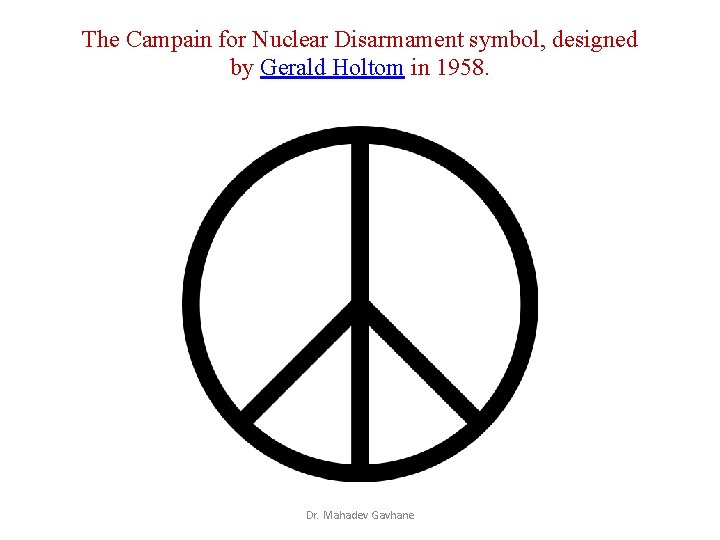
The Campain for Nuclear Disarmament symbol, designed by Gerald Holtom in 1958. Dr. Mahadev Gavhane
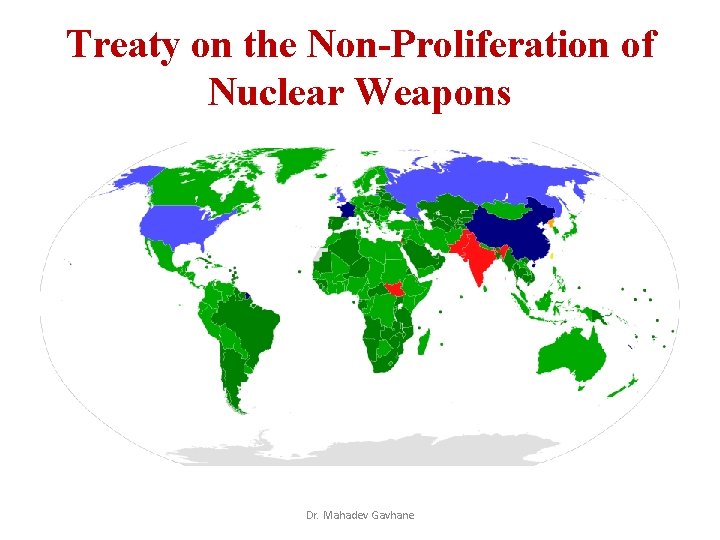
Treaty on the Non-Proliferation of Nuclear Weapons Dr. Mahadev Gavhane
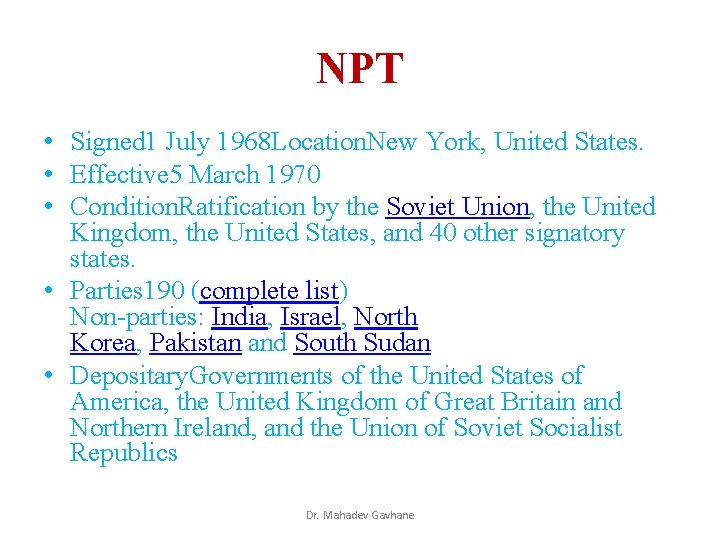
NPT • Signed 1 July 1968 Location. New York, United States. • Effective 5 March 1970 • Condition. Ratification by the Soviet Union, the United Kingdom, the United States, and 40 other signatory states. • Parties 190 (complete list) Non-parties: India, Israel, North Korea, Pakistan and South Sudan • Depositary. Governments of the United States of America, the United Kingdom of Great Britain and Northern Ireland, and the Union of Soviet Socialist Republics Dr. Mahadev Gavhane
SALT- I • • SALT I is the common name for the Strategic Arms Limitation Talks Agreement signed on May 26, 1972. SALT I froze the number of strategic ballistic missile launchers at existing levels and provided for the addition of new submarinelaunched ballistic missile (SLBM) launchers only after the same number of older intercontinental ballistic missile (ICBM) and SLBM launchers had been dismantled. SALT I also limited land-based ICBMs that were in range from the northeastern border of the continental United States to the northwestern border of the continental USSR. In addition to that, SALT I limited the number of SLBM capable submarines that NATO and the United States could operate to 50 with a maximum of 800 SLBM launchers between them. If the United States or NATO were to increase that number, the USSR could respond with increasing their arsenal by the same amount. The strategic nuclear forces of the Soviet Union and the United States were changing in character in 1968. The total number of missiles held by the United States had been static since 1967 at 1, 054 ICBMs and 656 SLBMs but there was an increasing number of missiles with multiple independently targetable reentry vehicle (MIRV) warheads being deployed. MIRVs carried multiple nuclear warheads, often with dummies, to confuse ABM systems, making MIRV defense by ABM systems increasingly difficult and expensive. Dr. Mahadev Gavhane
• • One clause of the treaty required both countries to limit the number of sites protected by an antiballistic missile (ABM) system to two each. The Soviet Union had deployed such a system around Moscow in 1966 and the United States announced an ABM program to protect twelve ICBM sites in 1967. A modified two-tier Moscow ABM system is still used. The United States built only one ABM site to protect a Minuteman base in North Dakota where the "Safeguard" Program was deployed. Due to the system's expense and limited effectiveness, the Pentagon disbanded "Safeguard" in 1975. Negotiations lasted from November 17, 1969, until May 1972 in a series of meetings beginning in Helsinki, with the US delegation headed by Gerard C. Smith, director of the Arms Control and Disarmament Agency. Subsequent sessions alternated between Vienna and Helsinki. After a long deadlock, the first results of SALT I came in May 1971, when an agreement was reached over ABM systems. Further discussion brought the negotiations to an end on May 26, 1972, in Moscow when Richard Nixon and Leonid Brezhnev signed both the Anti-Ballistic Missile Treaty and the Interim Agreement Between The United States of America and The Union of Soviet Socialist Republics on Certain Measures With Respect to the Limitation of Strategic Offensive Arms. [4] A number of agreed statements were also made. This helped improve relations between the United States and the USSR. Dr. Mahadev Gavhane
SALT II • SALT II was a series of talks between United States and Soviet negotiators from 1972 to 1979 which sought to curtail the manufacture of strategic nuclear weapons. It was a continuation of the SALT I talks and was led by representatives from both countries. SALT II was the first nuclear arms treaty which assumed real reductions in strategic forces to 2, 250 of all categories of delivery vehicles on both sides. • SALT II helped the United States to discourage the Soviets from arming their third-generation ICBMs of SS-17, SS-19 and SS-18 types with many more multiple independently targetable reentry vehicles (MIRVs). In the late 1970 s the USSR's missile design bureaus had developed experimental versions of these missiles equipped with anywhere from 10 to 38 warheads each. Additionally, the Soviets secretly agreed to reduce Tu 22 M production to thirty aircraft per year and not to give them an intercontinental range. It was particularly important for the United States to limit Soviet efforts in the Intermediate-Range Nuclear Forces (INF) rearmament area. Dr. Mahadev Gavhane
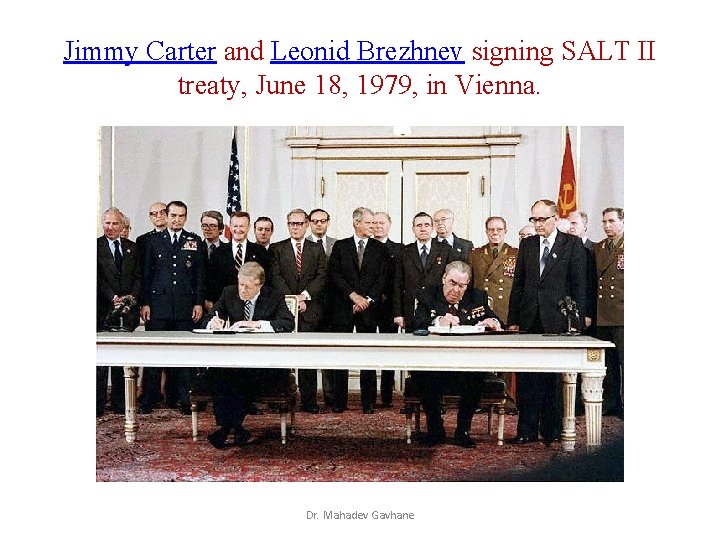
• • The SALT II Treaty banned new missile programs (a new missile defined as one with any key parameter 5% better than in currently deployed missiles), so both sides were forced to limit their new strategic missile types development. However, the United States preserved their most essential programs like the Trident missile, along with the cruise missiles President Jimmy Carter wished to use as his main defensive weapon as they were too slow to have first strike capability. In return, the USSR could exclusively retain 308 of its so-called "heavy ICBM" launchers of the SS-18 type. An agreement to limit strategic launchers was reached in Vienna on June 18, 1979, and was signed by Leonid Brezhnev and Carter. Six months after the signing, the Soviet Union invaded Afghanistan, and in September of the same year, the United States discovered that a Soviet combat brigade was stationed in Cuba. [5] (Although President Carter claimed this Soviet brigade had only recently been deployed to Cuba, the unit had been stationed on the island since the Cuban Missile Crisis of 1962. )[6] In light of these developments, the treaty was never ratified by the United States Senate. Its terms were, nonetheless, honored by the U. S. until it expired. [citation needed] The Soviet Union never abided by either of the SALT treaties. [citation needed] Subsequent discussions took place under the Strategic Arms Reduction Treaty (START) and the Comprehensive Nuclear-Test-Ban Treaty. Dr. Mahadev Gavhane
Jimmy Carter and Leonid Brezhnev signing SALT II treaty, June 18, 1979, in Vienna. Dr. Mahadev Gavhane
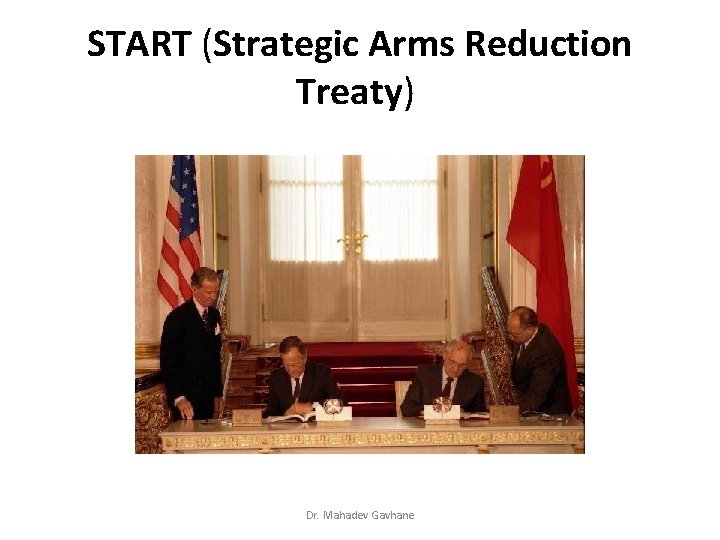
START (Strategic Arms Reduction Treaty) Dr. Mahadev Gavhane
START • Presidents George H. W. Bush and Mikhail Gorbachev sign START, 31 July 1991 • Type. Strategic nuclear disarmament • Drafted 29 June 1982 – June 1991 • Signed 31 July 1991 • Location. Moscow, Russian SFSR, Soviet Union • Effective 5 December 1994 • Condition. Ratification of both parties • Expiration 5 December 2009 • Signatories. George H. W. Bush Mikhail Gorbachev • Parties. United States Soviet Union Dr. Mahadev Gavhane
START • START (Strategic Arms Reduction Treaty) was a bilateral treaty between the United States of America and the Union of Soviet Socialist Republics (USSR) on the reduction and limitation of strategic offensive arms. The treaty was signed on 31 July 1991 and entered into force on 5 December 1994. [1] The treaty barred its signatories from deploying more than 6, 000 nuclear warheads atop a total of 1, 600 intercontinental ballistic missiles (ICBMs) and bombers. START negotiated the largest and most complex arms control treaty in history, and its final implementation in late 2001 resulted in the removal of about 80 percent of all strategic nuclear weapons then in existence. Proposed by United States President Ronald Reagan, it was renamed START I after negotiations began on the second START treaty. • The START I treaty expired 5 December 2009. On 8 April 2010, the replacement New START treaty was signed in Prague by U. S. President Barack Obama and Russian President Dmitry Medvedev. Following ratification by the U. S. Senate and the Federal Assembly of Russia, it went into force on 26 January 2011. Dr. Mahadev Gavhane
START II • START II (Strategic Arms Reduction Treaty) was a bilateral treaty between the United States of America and Russia on the Reduction and Limitation of Strategic Offensive Arms. It was signed by United States President George H. W. Bush and Russian. President Boris Yeltsin on 3 January 1993, [1] banning the use of multiple independently targetable reentry vehicles (MIRVs) on intercontinental ballistic missiles (ICBMs). Hence, it is often cited as the De-MIRV-ing Agreement. It never entered into effect. It was ratified by the U. S. Senate on 26 January 1996 with a vote of 87 -4. Russia ratified START II on 14 April 2000, but on 14 June 2002, withdrew from the treaty in response to U. S. withdrawal from the ABM Treaty. • Instead, SORT came into effect, reducing strategic warheads count per country to 1, 700 - 2, 200. Dr. Mahadev Gavhane
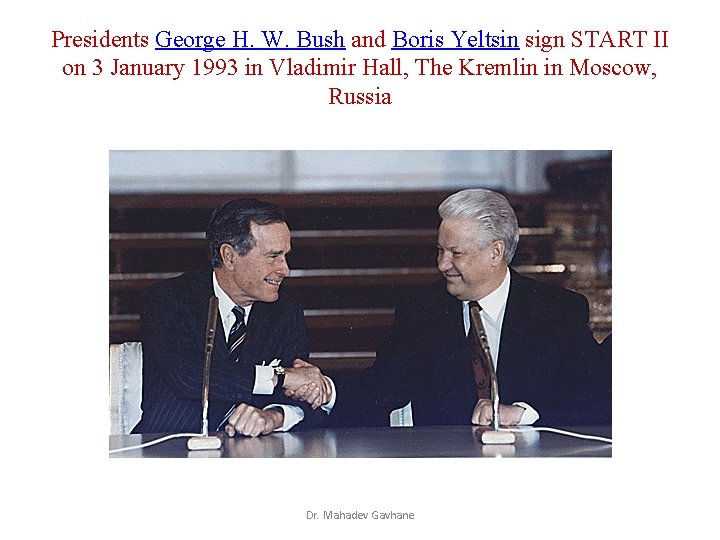
Presidents George H. W. Bush and Boris Yeltsin sign START II on 3 January 1993 in Vladimir Hall, The Kremlin in Moscow, Russia Dr. Mahadev Gavhane
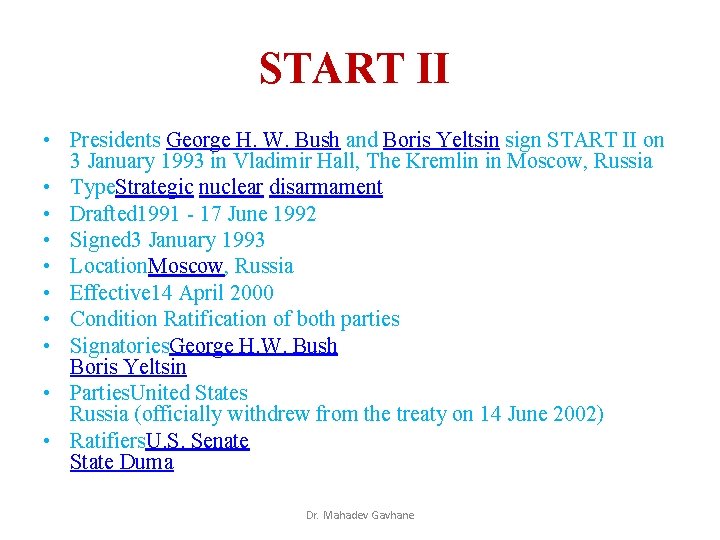
START II • Presidents George H. W. Bush and Boris Yeltsin sign START II on 3 January 1993 in Vladimir Hall, The Kremlin in Moscow, Russia • Type. Strategic nuclear disarmament • Drafted 1991 - 17 June 1992 • Signed 3 January 1993 • Location. Moscow, Russia • Effective 14 April 2000 • Condition Ratification of both parties • Signatories. George H. W. Bush Boris Yeltsin • Parties. United States Russia (officially withdrew from the treaty on 14 June 2002) • Ratifiers. U. S. Senate State Duma Dr. Mahadev Gavhane
Comprehensive Nuclear-Test-Ban Treaty (CTBT ) • The Comprehensive Nuclear-Test-Ban Treaty (CTBT) is a multilateral treaty that bans all nuclear explosions, for both civilian and military purposes, in all environments. It was adopted by the United Nations General Assembly on 10 September 1996 but has not entered into force as eight specific states have not ratified the treaty. Dr. Mahadev Gavhane
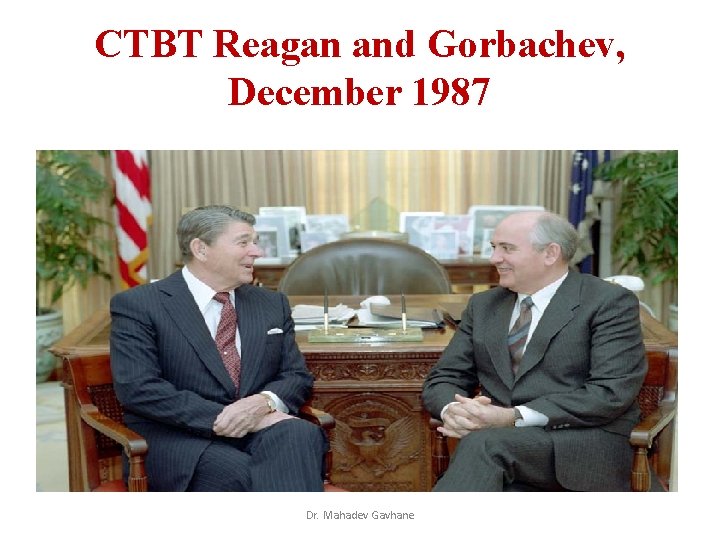
CTBT Reagan and Gorbachev, December 1987 Dr. Mahadev Gavhane
Conference on Disarmament (CD) • The Conference on Disarmament (CD) is a forum established by the international community to negotiate multilateral arms control and disarmament agreements. Established in 1979, it was the forum used by its member states, currently numbering 65, to negotiate the Biological Weapons Convention and the Chemical Weapons Convention. • While the conference is not formally a United Nations (UN) organization, it is linked to the UN through a personal representative of the United Nations Secretary-General; this representative serves as the secretary general of the conference. Resolutions adopted by the UN General Assembly often request the conference to consider specific disarmament matters. In turn, the conference annually reports its activities to the Assembly. • The Conference succeeded the Ten-Nation Committee on Disarmament (1960), • Eighteen-Nation Committee on Disarmament (1962– 68) the Conference of Committee on Disarmament (1969– 78). Dr. Mahadev Gavhane
• On June 28, 2011, the Democratic People's Republic of Korea (North Korea) was appointed to serve a term as president of the Conference. Despite the fact that the chairmanship rotates alphabetically, the move was criticized in the media and by Canada's foreign minister because of the country's track record on nuclear proliferation. • From May 27 to June 23, 2013, the Islamic Republic of Iran was acting chair and president of the Conference on Disarmament. The United States said it refused to send any ambassador to a UN forum on nuclear disarmament when being chaired by a country “in flagrant violation” of UN Security Council and International Atomic Energy Agency obligations stemming from its suspect nuclear program. [5] Dr. Mahadev Gavhane
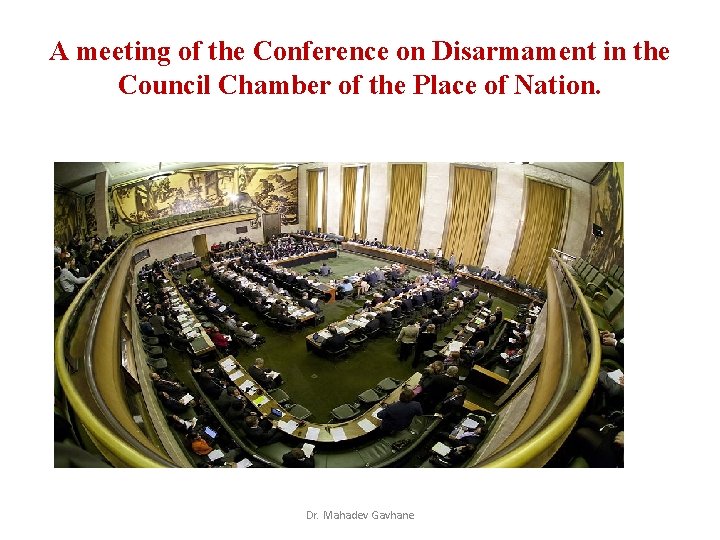
A meeting of the Conference on Disarmament in the Council Chamber of the Place of Nation. Dr. Mahadev Gavhane
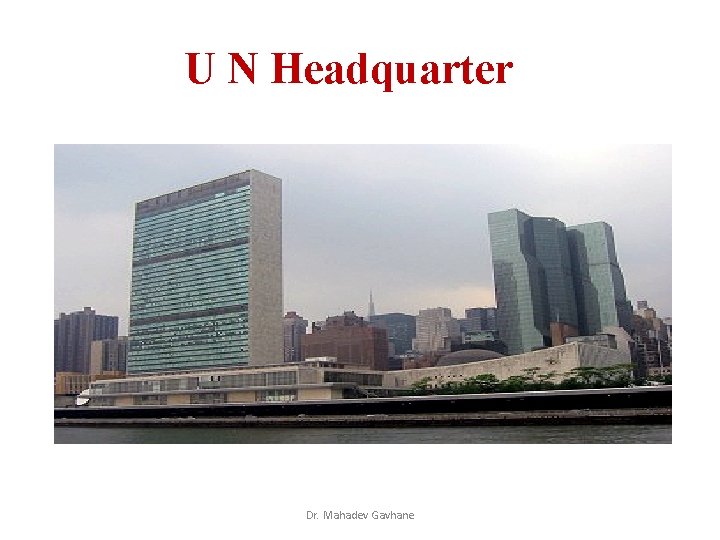
U N Headquarter Dr. Mahadev Gavhane
Thank You Dr. Mahadev Gavhane