
Raising the Bar 2018 Understanding the Guiding Principles
Raising the Bar 2018 Understanding the Guiding Principles of Family Support, Their Underlying Values and How They Look in Practice Facilitators: Margaret Megitt and Chanel Tsang, Regional Directors, FSIO Board of Directors
TAKING PHOTOS? TWEETING? Sharing is caring! Use Hashtag #FSMatters when you tweet. Please tag us in your tweets – we would appreciate it!! @Margaret. Megitt @Chanel. Tsang @FSMatters
LAND ACKNOWLEDGEMENT This conference site is situated upon traditional territories. The territories include the Wendat (wen-dat), Anishinabek (ah-nish-nah-bek) Nation, the Haudenosaunee (ho-den-oh-show nee) Confederacy, the Mississaugas of Scugog (skoo-gog), Hiawatha (hi-ah-wah-tha), Alderville First Nation and the Métis (may-tee) Nation (William Treaties Area). Today, the meeting place of Toronto is still the home to many Indigenous people from across Turtle Island we are grateful to have the opportunity to work in the community, on this territory.
LEARNING OBJECTIVES • Building awareness as to how we are already integrating family support into our work. Co-existing as both an Early Childhood Educator/Family Support Worker. • Gaining a familiarity and understanding of the 12 Guiding Principles as defined by FRP Canada. • Examining How Does Learning Happen (HDLH) through a Family Support Lens. • Highlighting the foundations of family support approach: Strength. Based Approach, Family-Centered and Ecological Perspective to working with families. How can I apply this to my work tomorrow?
GETTING TO KNOW EACH OTHER
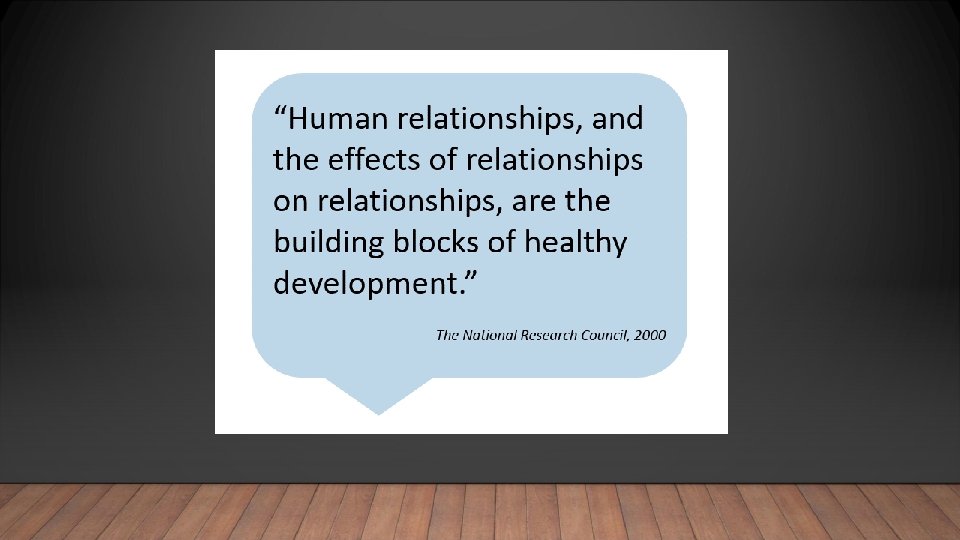
WHAT IS THE FAMILY SUPPORT APPROACH AND WHAT MAKES IT EFFECTIVE? • Family resource programs have a long history of attracting and engaging parents of young children, including those that may be marginalized and distrustful of public systems. • How services are offered is considered even more important that what form they take, since it is the relationship between family and practitioner which defines the outcomes. Adapted from FRP Canada
A Family-Centered Approach These programs strengthen families by offering information, resources and emotional support. Family Support Programs believe: 1. All families need help at some time in their lives, but not all families need the same kind or intensity of support. 2. A child's development is dependent upon the strength of the parent/child relationship, as well as the stability of the relationship among the adults who care for and are responsible for the child. 3. Most parents want to and are able to help their child grow into healthy, capable adults.
A Family-Centered Approach 4. Parents do not have fixed capacities and needs; like their children, they are developing and changing and need support through difficult, transitional phases of life. 5. Parents are likely to become better parents if they feel competent in other important areas of their lives, such as jobs, in school, and in their other family and social relationships. 6. Families are influenced by the cultural values and societal pressures in their communities (Farrow, Grant, & Meltzer, 1990, p. 14). Connard, C & Novick, R. (1996) The Ecology of the Family: A Family-Centered Approach to Education and Social Service Delivery. Portland, Oregon: Northwest Regional Educational Laboratory
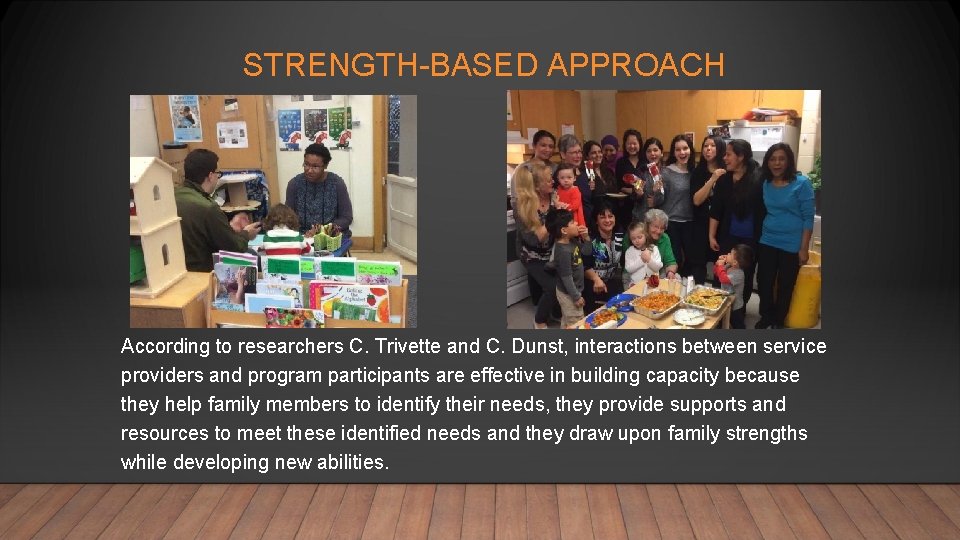
STRENGTH-BASED APPROACH According to researchers C. Trivette and C. Dunst, interactions between service providers and program participants are effective in building capacity because they help family members to identify their needs, they provide supports and resources to meet these identified needs and they draw upon family strengths while developing new abilities.
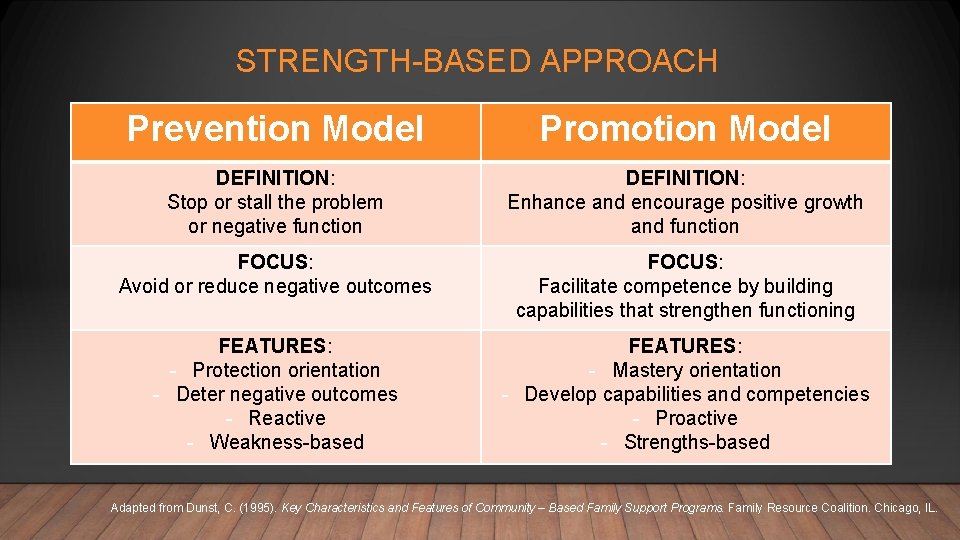
STRENGTH-BASED APPROACH Prevention Model Promotion Model DEFINITION: Stop or stall the problem or negative function DEFINITION: Enhance and encourage positive growth and function FOCUS: Avoid or reduce negative outcomes FOCUS: Facilitate competence by building capabilities that strengthen functioning FEATURES: - Protection orientation - Deter negative outcomes - Reactive - Weakness-based FEATURES: - Mastery orientation - Develop capabilities and competencies - Proactive - Strengths-based Adapted from Dunst, C. (1995). Key Characteristics and Features of Community – Based Family Support Programs. Family Resource Coalition. Chicago, IL.

STRENGTH-BASED APPROACH • When interacting and working with the parents/caregivers (nannies, grandparents, babysitters) are we using a Deficit- or Strengths. Based Approach? • What approach do you see parents/caregivers using for themselves? Chart created as part of the Empowered Teaching course, Drew E. Schwartz

STRENGTH-BASED APPROACH 5 Ways to Make Your Program Strengths- and Family-Oriented 1 Recognize that all families have unique strengths that are based in the families’ beliefs, cultural background, ethnicity, and socioeconomic status. 2 If a family is not displaying competence in any area, it is not viewed as their deficit but rather as a failure of social systems and institutions to create opportunities for these competencies to be displayed or learned. 3 The way we work with families must be based on the positive aspects of how families are functioning rather than ways the families are perceived as being “broken or “needing to be fixed. ” Dunst, C. (1995). Key Characteristics and Features of Community – Based Family Support Programs. Family Resource Coalition. Chicago, IL.
STRENGTH-BASED APPROACH 5 Ways to Make Your Program Strengths- and Family-Oriented 4 Shift away from the treatment and prevention models and adopting promotion and enhancement models as the primary framework when we are structuring our practice 5 Moving from “doing for people” → Helping families become less dependent on professionals for help. Dunst, C. (1995). Key Characteristics and Features of Community – Based Family Support Programs. Family Resource Coalition. Chicago, IL.

HUMAN ECOLOGY THEORY – ECOLOGICAL APPROACH • Developed by Urie Bronfenbrenner, Developmental Psychologist • Microsystem has the most influence on a child (e. g. child care centre, home-based child care, Early. ON programs and adults in child’s life)
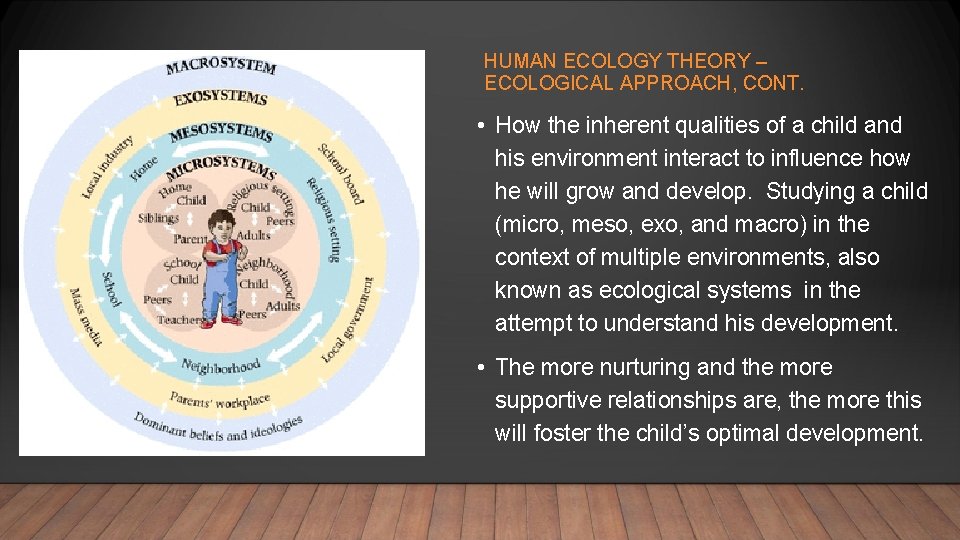
HUMAN ECOLOGY THEORY – ECOLOGICAL APPROACH, CONT. • How the inherent qualities of a child and his environment interact to influence how he will grow and develop. Studying a child (micro, meso, exo, and macro) in the context of multiple environments, also known as ecological systems in the attempt to understand his development. • The more nurturing and the more supportive relationships are, the more this will foster the child’s optimal development.
“…sometimes the best intervention strategy for young children with serious behavioral or emotional problems is to focus directly on the primary needs of those who care for them” National Scientific Council on the Developing Child, 2008

COMEDIC RELIEF MICHAEL MCINTYRE
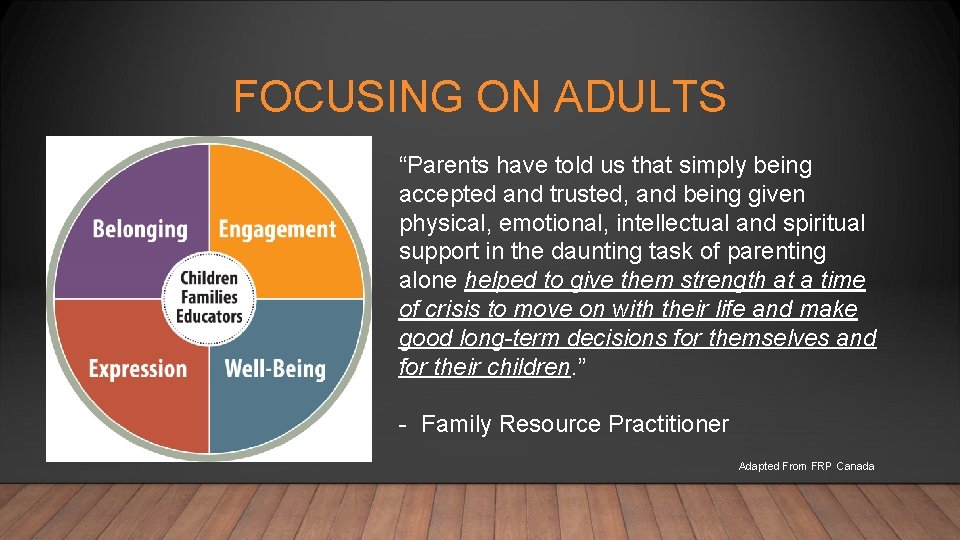
FOCUSING ON ADULTS “Parents have told us that simply being accepted and trusted, and being given physical, emotional, intellectual and spiritual support in the daunting task of parenting alone helped to give them strength at a time of crisis to move on with their life and make good long-term decisions for themselves and for their children. ” - Family Resource Practitioner Adapted From FRP Canada
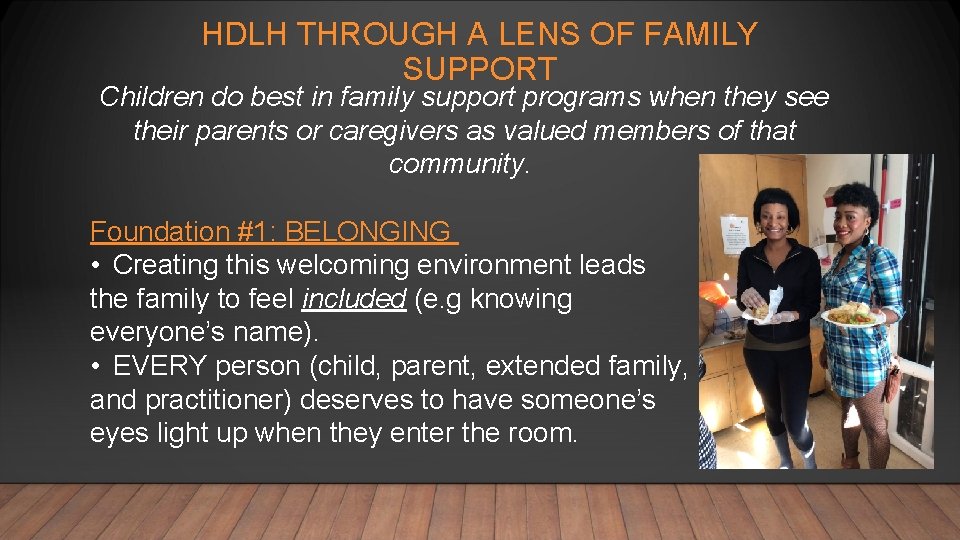
HDLH THROUGH A LENS OF FAMILY SUPPORT Children do best in family support programs when they see their parents or caregivers as valued members of that community. Foundation #1: BELONGING • Creating this welcoming environment leads the family to feel included (e. g knowing everyone’s name). • EVERY person (child, parent, extended family, and practitioner) deserves to have someone’s eyes light up when they enter the room.
HDLH THROUGH A LENS OF FAMILY SUPPORT Self-Reflection Questions: 1. What are the ways that you can facilitate stronger parent-child connections in your program? 2. How are you enabling parents to make a contribution to your program? 3. How do you ensure that parents are afforded the time needed to tell their stories in such a way that conveys the message “you are important and valued? ” Four Foundations, Adapted from Ontario Connections, Volume 23, No. 10/Spring 2015
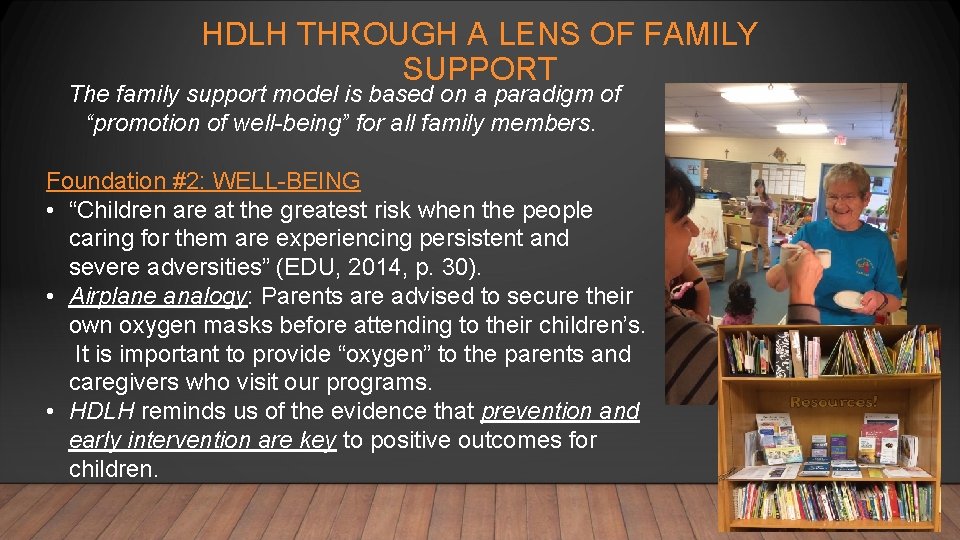
HDLH THROUGH A LENS OF FAMILY SUPPORT The family support model is based on a paradigm of “promotion of well-being” for all family members. Foundation #2: WELL-BEING • “Children are at the greatest risk when the people caring for them are experiencing persistent and severe adversities” (EDU, 2014, p. 30). • Airplane analogy: Parents are advised to secure their own oxygen masks before attending to their children’s. It is important to provide “oxygen” to the parents and caregivers who visit our programs. • HDLH reminds us of the evidence that prevention and early intervention are key to positive outcomes for children.
HDLH THROUGH A LENS OF FAMILY SUPPORT Self-Reflection Questions: 1. How can we nurture and support families to achieve optimum levels of health and well-being? 2. How do we acknowledge and affirm the diverse ways in which families might address and enhance their own well -being?
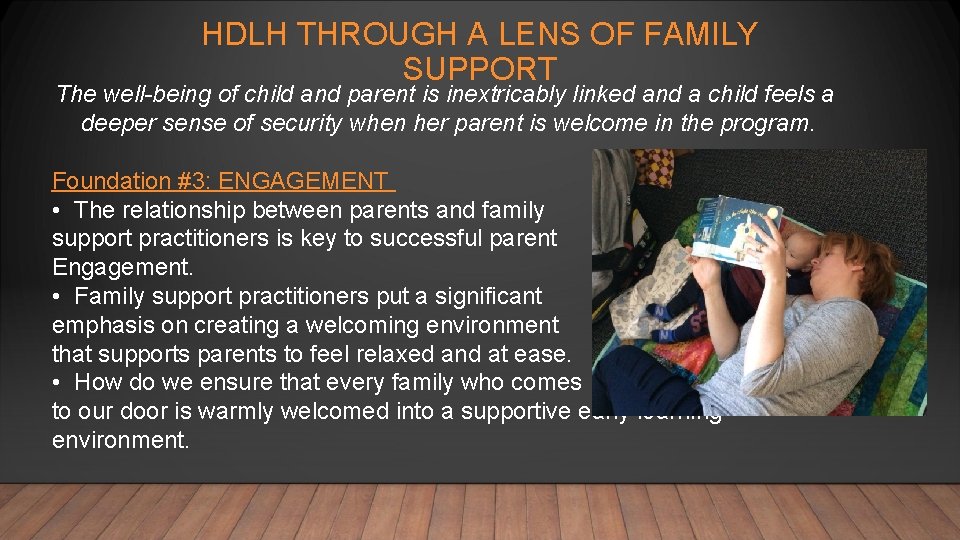
HDLH THROUGH A LENS OF FAMILY SUPPORT The well-being of child and parent is inextricably linked and a child feels a deeper sense of security when her parent is welcome in the program. Foundation #3: ENGAGEMENT • The relationship between parents and family support practitioners is key to successful parent Engagement. • Family support practitioners put a significant emphasis on creating a welcoming environment that supports parents to feel relaxed and at ease. • How do we ensure that every family who comes to our door is warmly welcomed into a supportive early learning environment.
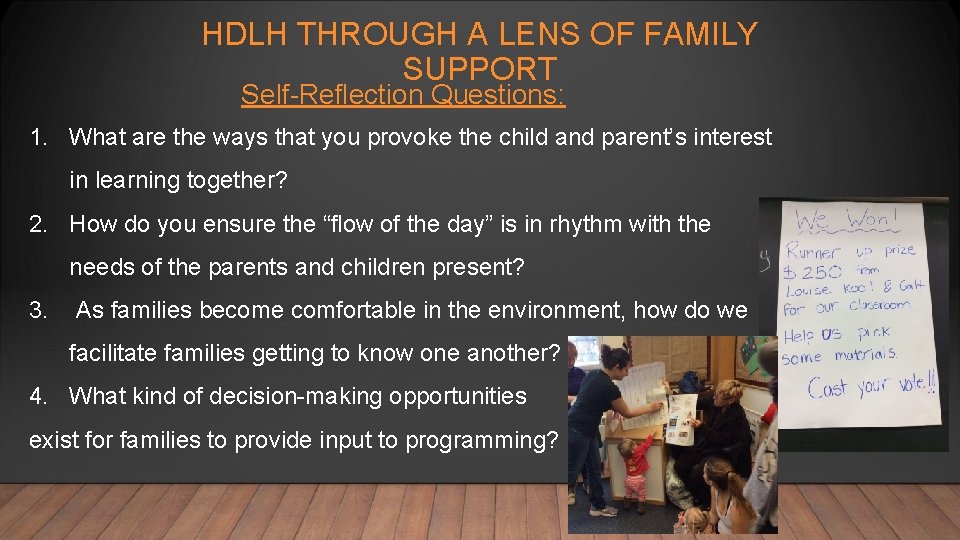
HDLH THROUGH A LENS OF FAMILY SUPPORT Self-Reflection Questions: 1. What are the ways that you provoke the child and parent’s interest in learning together? 2. How do you ensure the “flow of the day” is in rhythm with the needs of the parents and children present? 3. As families become comfortable in the environment, how do we facilitate families getting to know one another? 4. What kind of decision-making opportunities exist for families to provide input to programming?

HDLH THROUGH A LENS OF FAMILY SUPPORT Foundation #4: EXPRESSION We also provide warm environments where there is uninterrupted time at learning centres. We encourage children and adults to be comfortable expressing themselves, and we invite adults to communicate with practitioners and with each other to learn about their children’s expression
HDLH THROUGH A LENS OF FAMILY SUPPORT Self-Reflection Questions: 1. What are ways in which we promote and extend expression and communication that begins at a drop-in? 2. How do we support parents/caregivers to understand support children’s need for free choice in expression? 3. How do we ensure that art activities are always open-ended, varied and available to children at their own level to support their own creative expression?
THE 12 GUIDING PRINCIPLES OF FAMILY SUPPORT CREATED BY FRP CANADA 1. Family support programs are open to all families, recognizing that all families deserve support. 2. Family support programs complement existing services, build networks and linkages, and advocate for policies, services and systems that support families’ abilities to raise healthy children. 3. Family support programs work in partnership with families and communities to meet expressed needs.
THE GUIDING PRINCIPLES (FRP CANADA) 4. Family support programs focus on the promotion of wellness and use a prevention approach in their work. 5. Family support programs work to increase opportunities and to strengthen individuals, families and communities. 6. Family support programs operate from an ecological perspective that recognizes the interdependent nature of families’ lives.
THE GUIDING PRINCIPLES (FRP CANADA) 7. Family support programs value and encourage mutual assistance and peer support. 8. Family support programs affirm parenting to be a life-long learning process. 9. Family support programs value the voluntary nature of participation in their services.
THE GUIDING PRINCIPLES (FRP CANADA) 10. Family support programs promote relationships based on equality and respect for diversity. 11. Family support programs advocate non-violence to ensure safety and security for all family members. 12. Family support programs continually seek to improve their practice by reflecting on what they do and how they do it
OPERATIONALIZING THE PRINCIPLES IN YOUR OWN SETTING – BREAKOUT EXERCISE • At your table, choose a note taker and a presenter. • Provide examples of how the guiding principles are operationalized or can be put into practice in your own setting. • We will discuss as a large group.

TWEETS
HALLMARKS OF FAMILY SUPPORT APPROACH • Mutual aid or parent-to-parent support – participants are encouraged to value their own expertise and build their own social support networks • Facilitation, not instruction – awareness that basic needs should be addressed before parenting issues can be solved • Holistic approach, recognizing the interconnectedness of the multiple dimensions in families’ lives • Cultural sensitivity and respect for participants’ life stories • Flexibility, ability to respond to specific needs quickly. Adapted from FRP Canada
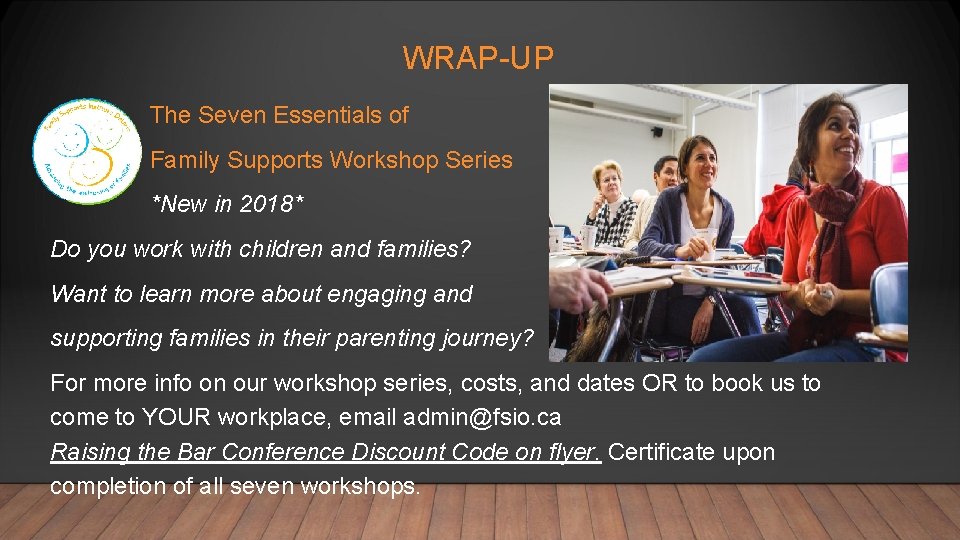
WRAP-UP The Seven Essentials of Family Supports Workshop Series *New in 2018* Do you work with children and families? Want to learn more about engaging and supporting families in their parenting journey? For more info on our workshop series, costs, and dates OR to book us to come to YOUR workplace, email admin@fsio. ca Raising the Bar Conference Discount Code on flyer. Certificate upon completion of all seven workshops.
Always welcoming new members! ✓FSIO’s member work across Ontario in a variety of family support programs and early years settings. ✓Increase your professional recognition and capacity ✓Be informed on the latest in research and practice ✓Have your voice heard in shaping family-friendly policy ✓Connect with other agencies in engaging partnerships ✓Receive members-only savings up to 20% on our professional learning events ✓Receive timely e-news blasts and newsletters related to happenings in the sector, professional elearning events, and job postings ✓Connect to other multi-disciplinary professionals through our online member forum and at networking events
WRAP-UP Thank you for your participation today! Evaluation Forms – What did you think?
STAY CONNECTED… Website: www. fsio. ca Have Questions? E-mail us at admin@fsio. ca Use #FSMatters when tweeting Twitter: @Margaret. Megitt @Chanel. Tsang @FSMatters
- Slides: 38