
RAIS The Risk Assessment Information System Society for
- Slides: 80
RAIS The Risk Assessment Information System Society for Risk Analysis Workshop 3: Application of Web-based Risk Assessment Information System (RAIS) Leslie Galloway, University of Tennessee/Oak Ridge National Laboratory Debra Stewart, University of Tennessee/Oak Ridge National Laboratory Katie Tucker, Ingenium/Oak Ridge National Laboratory Copyright © 2009 The University of Tennessee All Rights Reserved
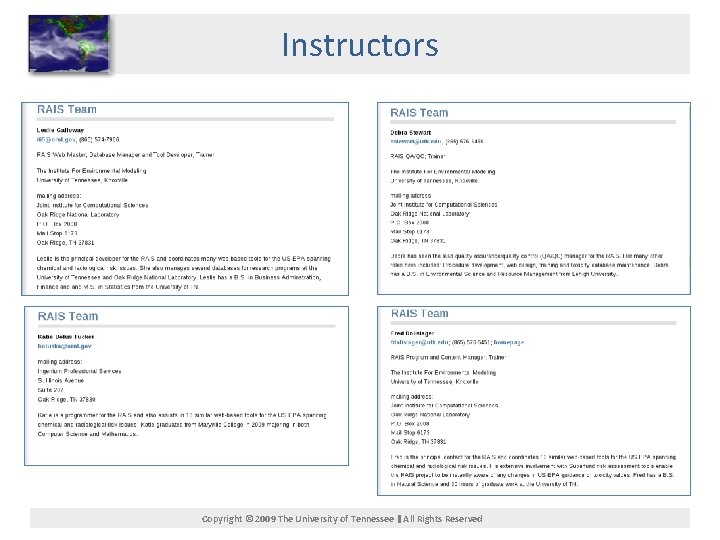
Instructors Copyright © 2009 The University of Tennessee All Rights Reserved
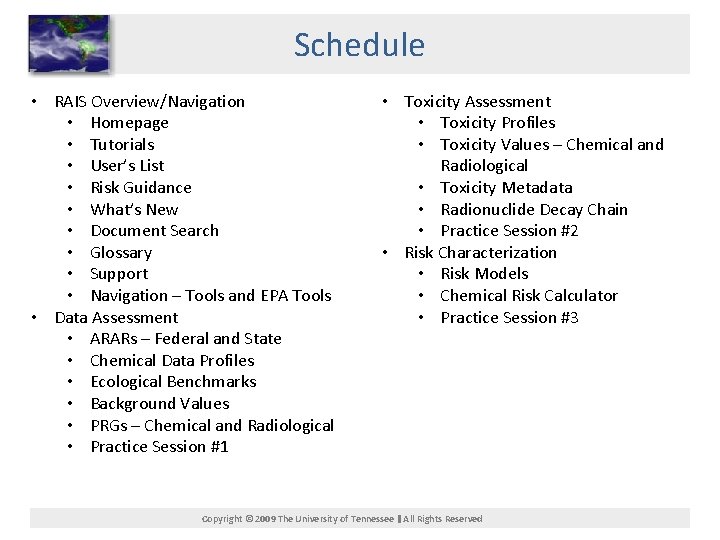
Schedule • RAIS Overview/Navigation • Homepage • Tutorials • User’s List • Risk Guidance • What’s New • Document Search • Glossary • Support • Navigation – Tools and EPA Tools • Data Assessment • ARARs – Federal and State • Chemical Data Profiles • Ecological Benchmarks • Background Values • PRGs – Chemical and Radiological • Practice Session #1 • Toxicity Assessment • Toxicity Profiles • Toxicity Values – Chemical and Radiological • Toxicity Metadata • Radionuclide Decay Chain • Practice Session #2 • Risk Characterization • Risk Models • Chemical Risk Calculator • Practice Session #3 Copyright © 2009 The University of Tennessee All Rights Reserved
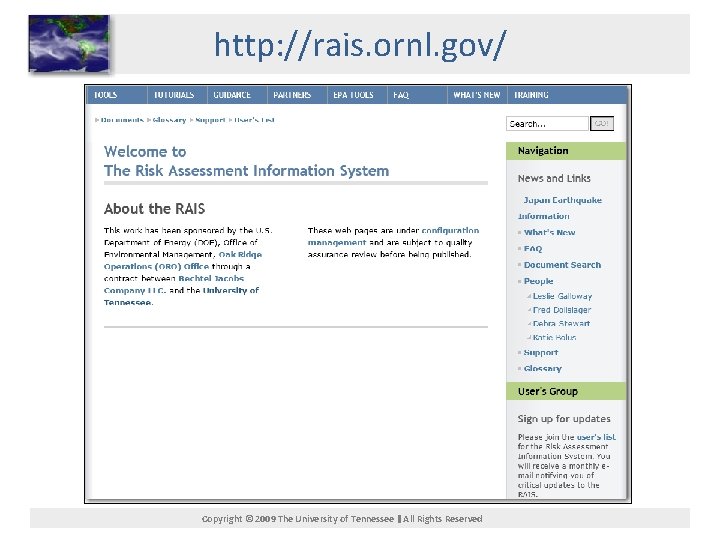
http: //rais. ornl. gov/ Copyright © 2009 The University of Tennessee All Rights Reserved
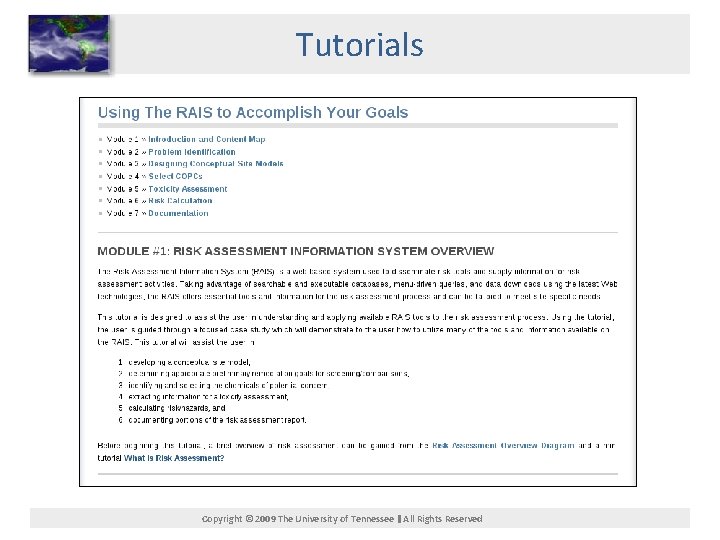
Tutorials Copyright © 2009 The University of Tennessee All Rights Reserved
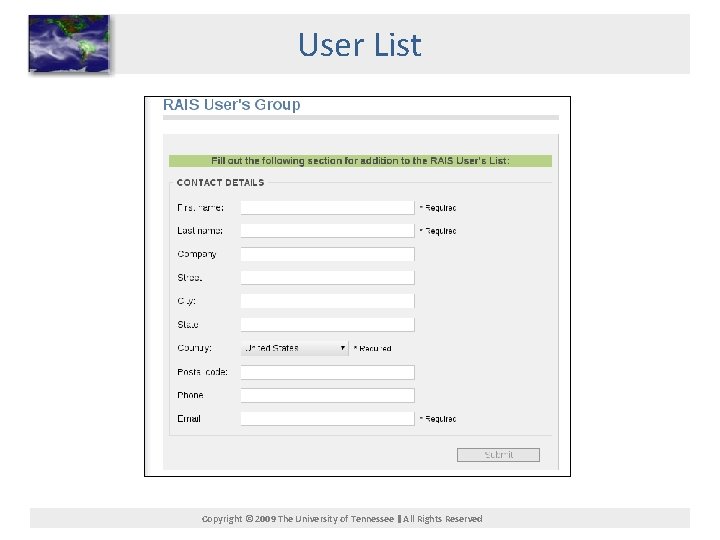
User List Copyright © 2009 The University of Tennessee All Rights Reserved
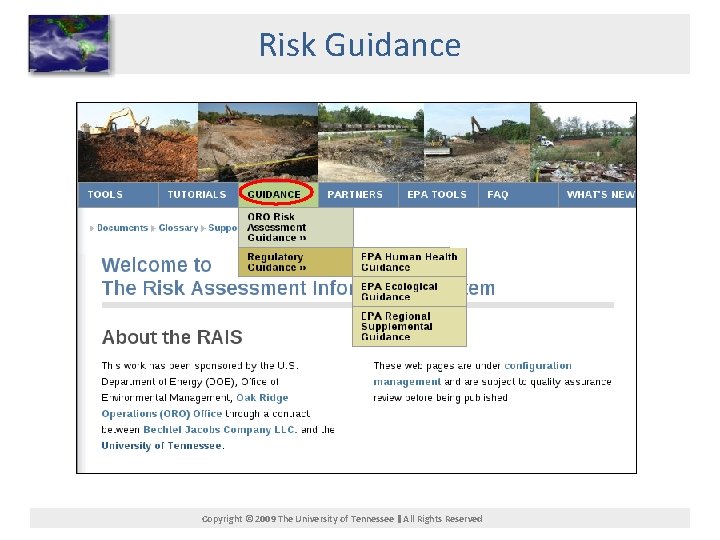
Risk Guidance Copyright © 2009 The University of Tennessee All Rights Reserved
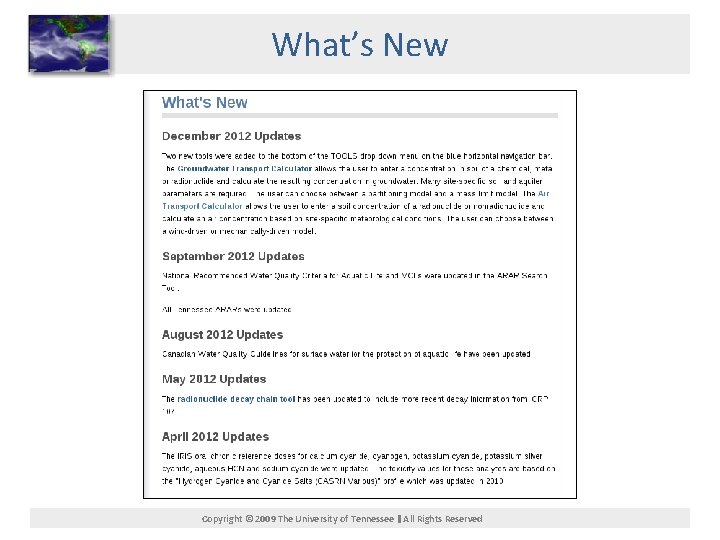
What’s New Copyright © 2009 The University of Tennessee All Rights Reserved
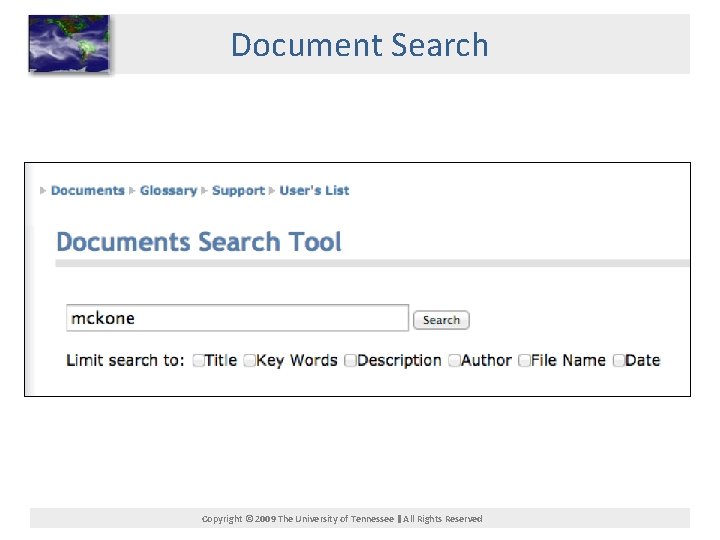
Document Search Copyright © 2009 The University of Tennessee All Rights Reserved
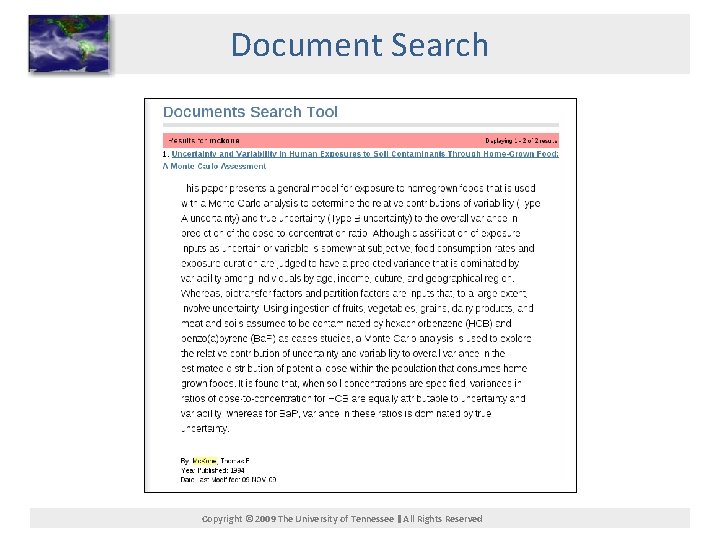
Document Search Copyright © 2009 The University of Tennessee All Rights Reserved
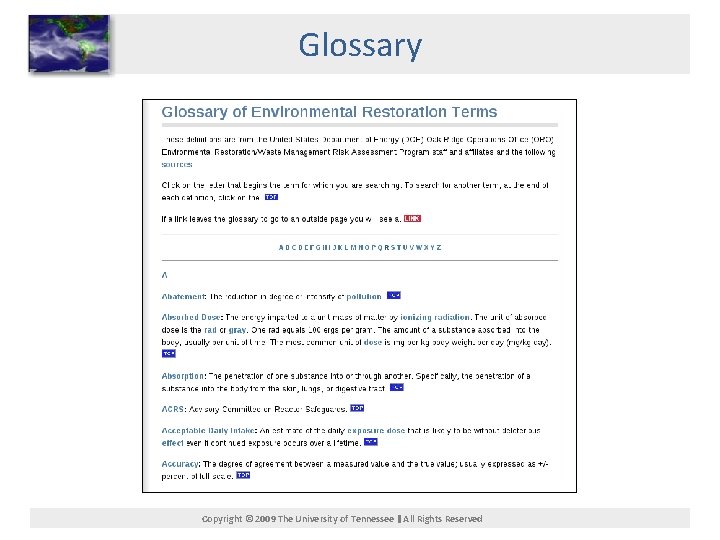
Glossary Copyright © 2009 The University of Tennessee All Rights Reserved
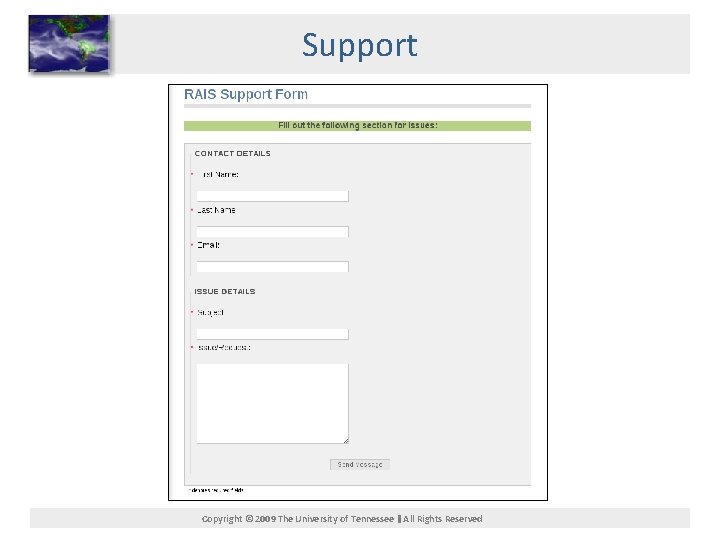
Support Copyright © 2009 The University of Tennessee All Rights Reserved
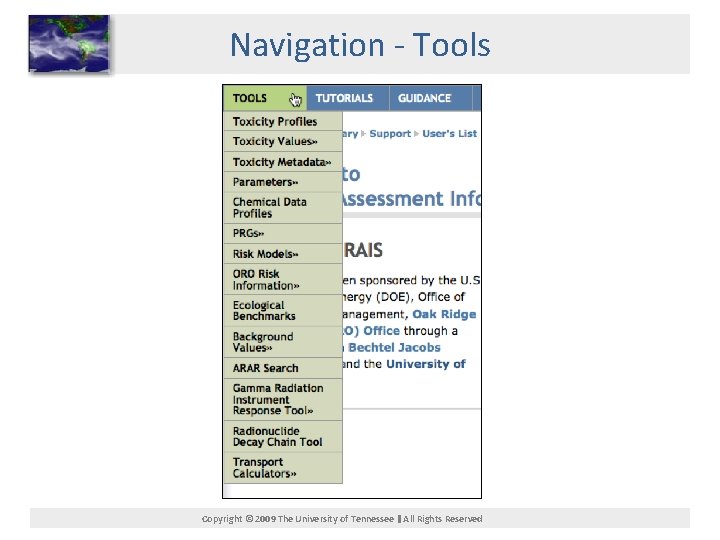
Navigation - Tools Copyright © 2009 The University of Tennessee All Rights Reserved
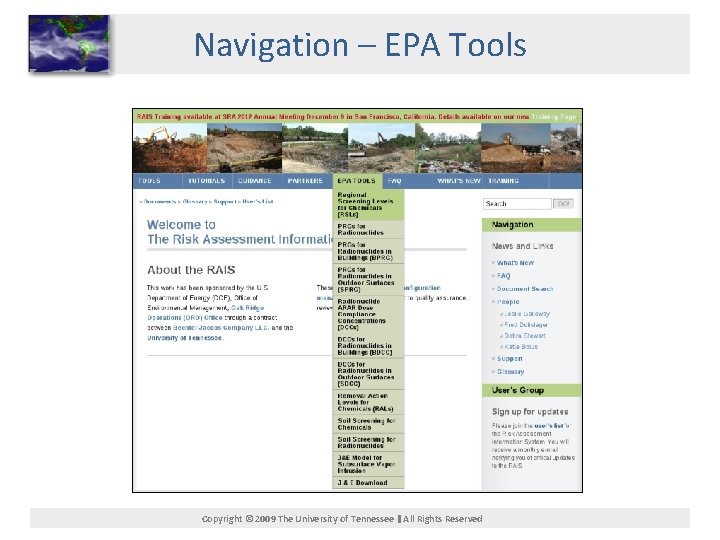
Navigation – EPA Tools Copyright © 2009 The University of Tennessee All Rights Reserved
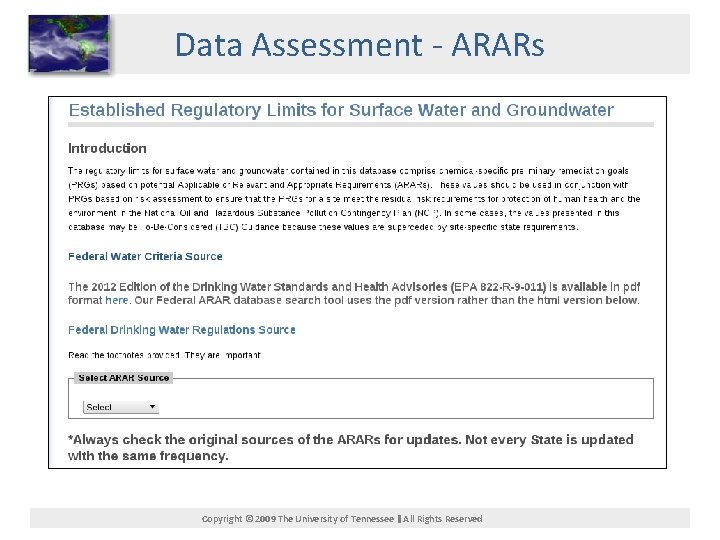
Data Assessment - ARARs Copyright © 2009 The University of Tennessee All Rights Reserved
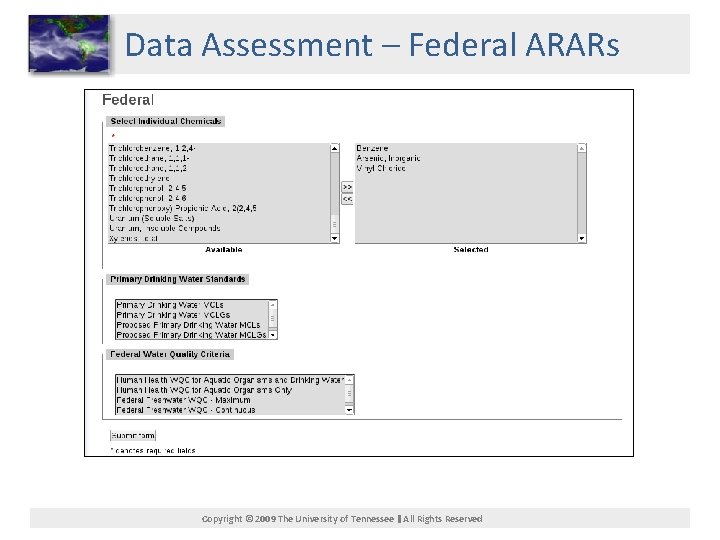
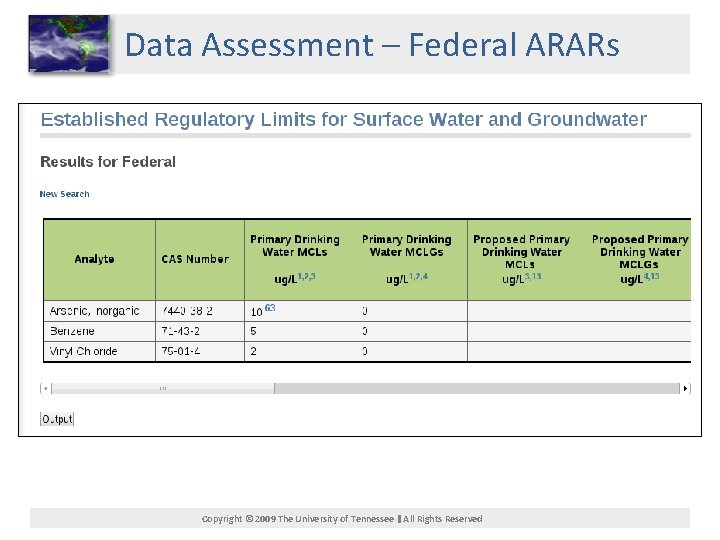
Data Assessment – Federal ARARs Copyright © 2009 The University of Tennessee All Rights Reserved
Data Assessment – Federal ARARs Copyright © 2009 The University of Tennessee All Rights Reserved
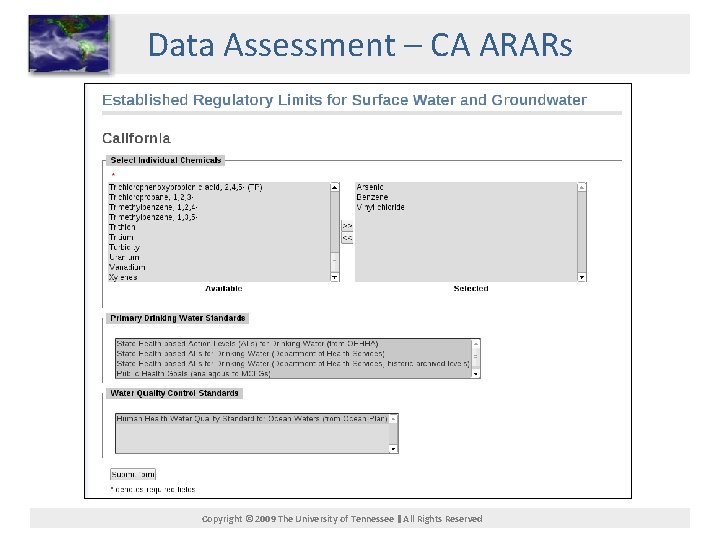
Data Assessment – CA ARARs Copyright © 2009 The University of Tennessee All Rights Reserved
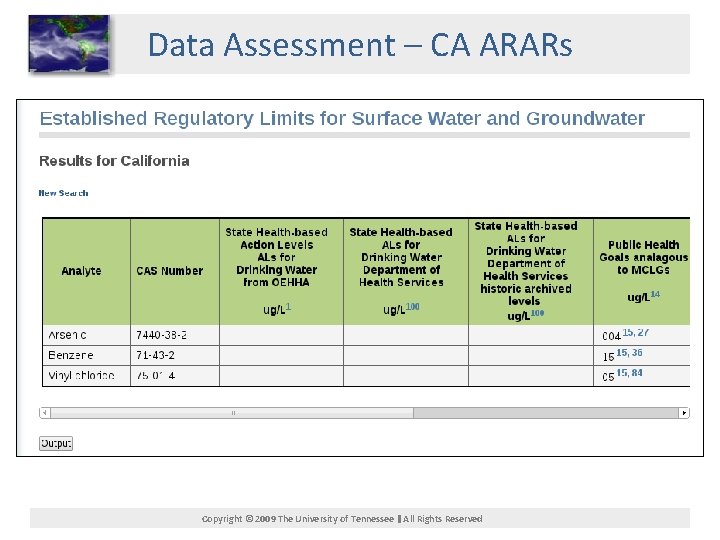
Data Assessment – CA ARARs Copyright © 2009 The University of Tennessee All Rights Reserved
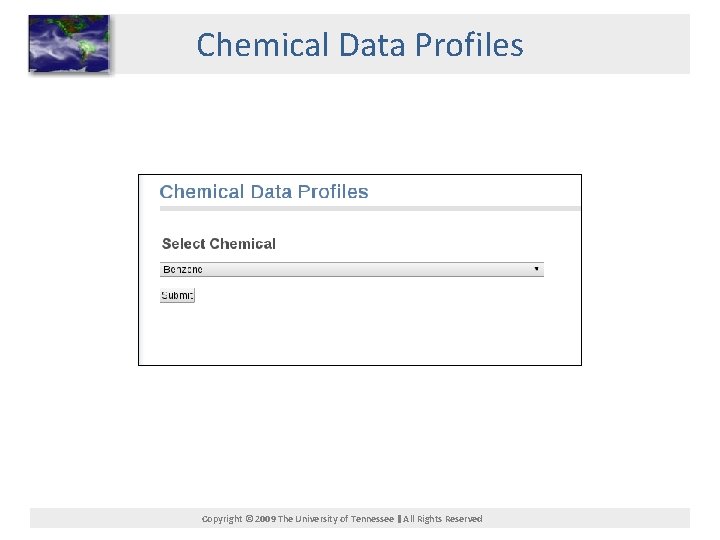
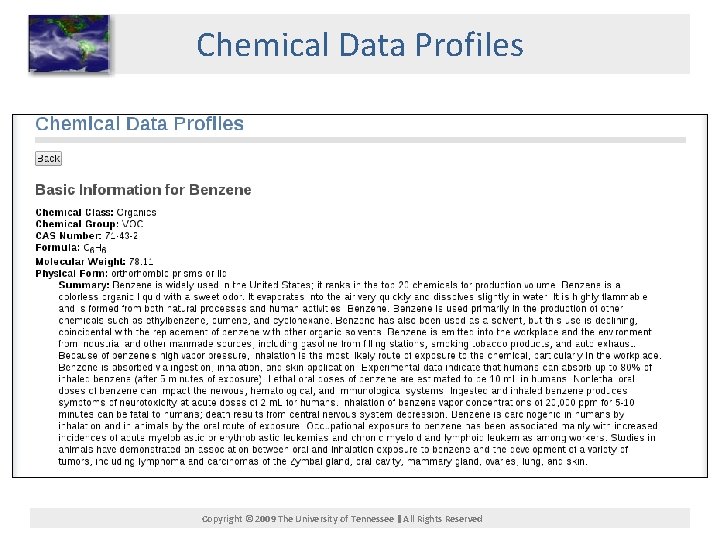
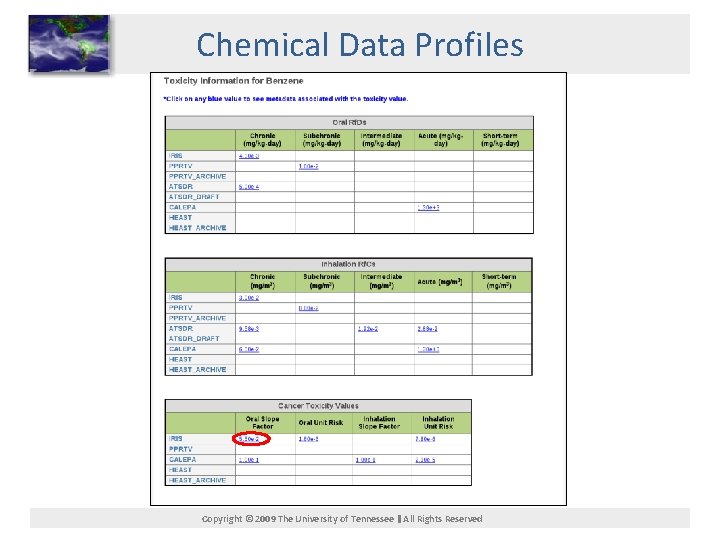
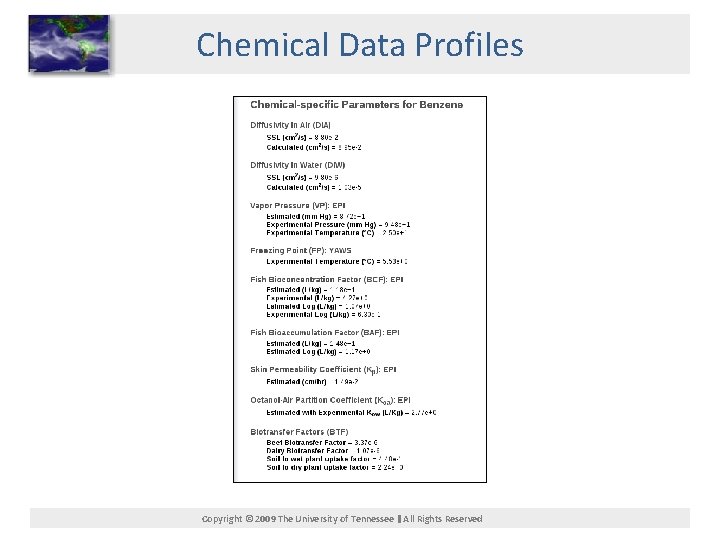
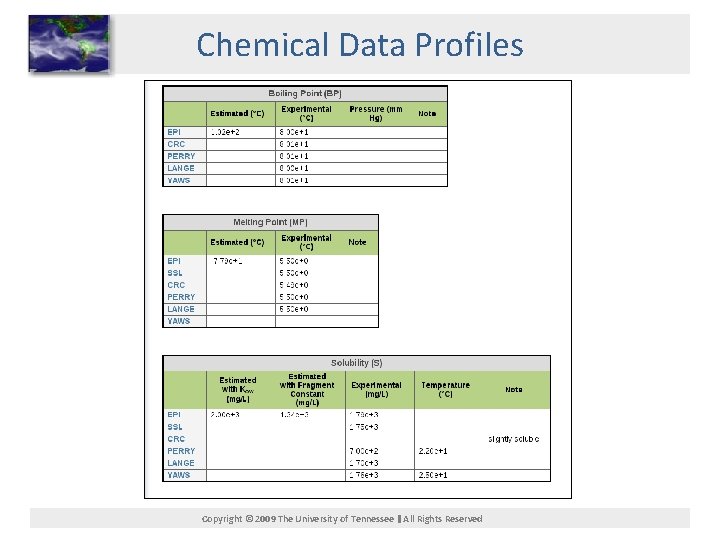
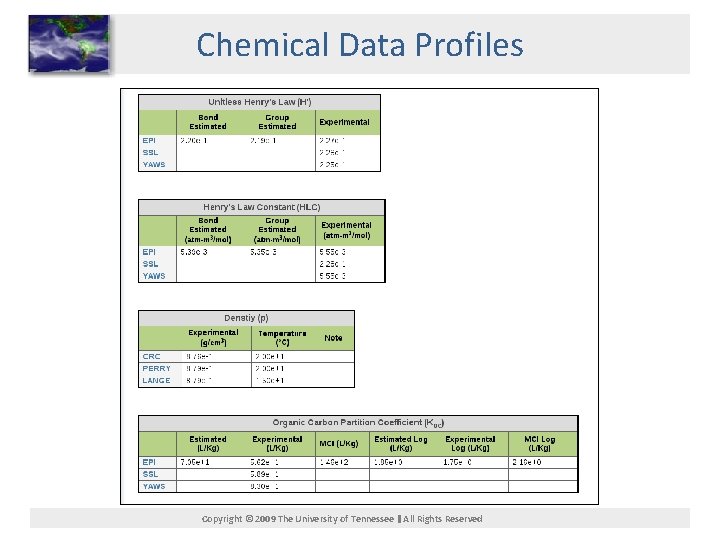
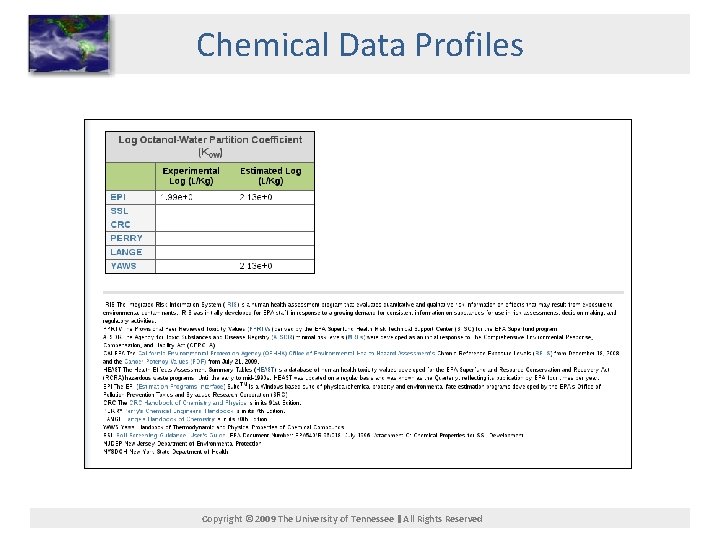
Chemical Data Profiles Copyright © 2009 The University of Tennessee All Rights Reserved
Chemical Data Profiles Copyright © 2009 The University of Tennessee All Rights Reserved
Chemical Data Profiles Copyright © 2009 The University of Tennessee All Rights Reserved
Chemical Data Profiles Copyright © 2009 The University of Tennessee All Rights Reserved
Chemical Data Profiles Copyright © 2009 The University of Tennessee All Rights Reserved
Chemical Data Profiles Copyright © 2009 The University of Tennessee All Rights Reserved
Chemical Data Profiles Copyright © 2009 The University of Tennessee All Rights Reserved
Chemical Data Profiles Copyright © 2009 The University of Tennessee All Rights Reserved
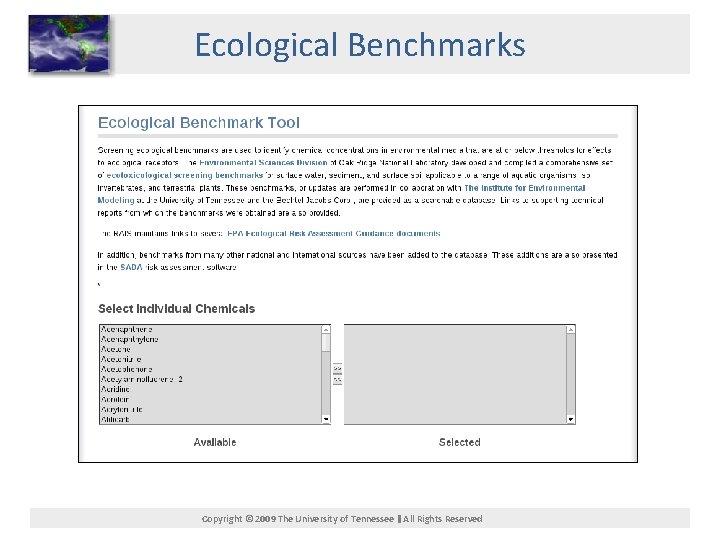
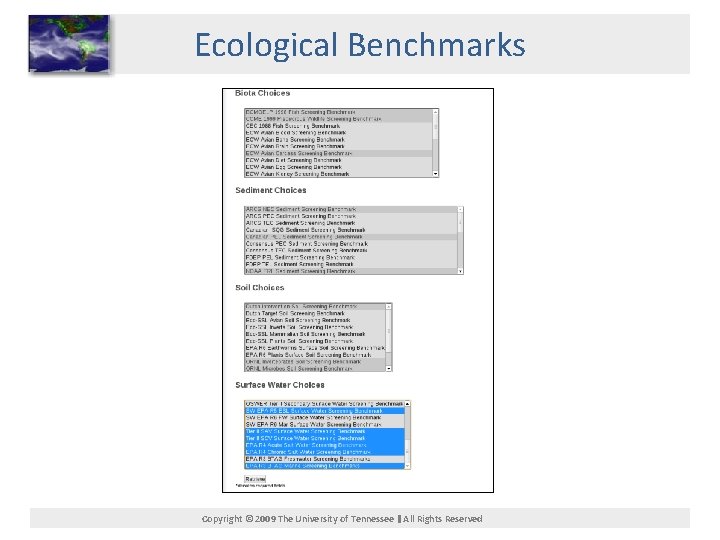
Ecological Benchmarks Copyright © 2009 The University of Tennessee All Rights Reserved
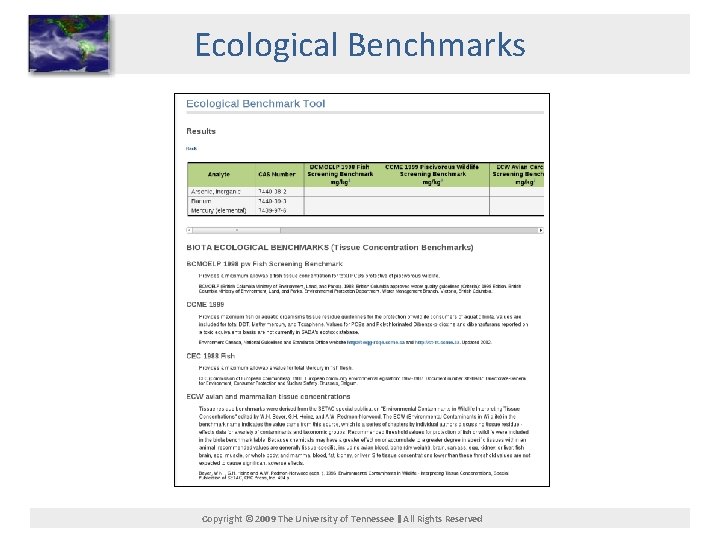
Ecological Benchmarks Copyright © 2009 The University of Tennessee All Rights Reserved
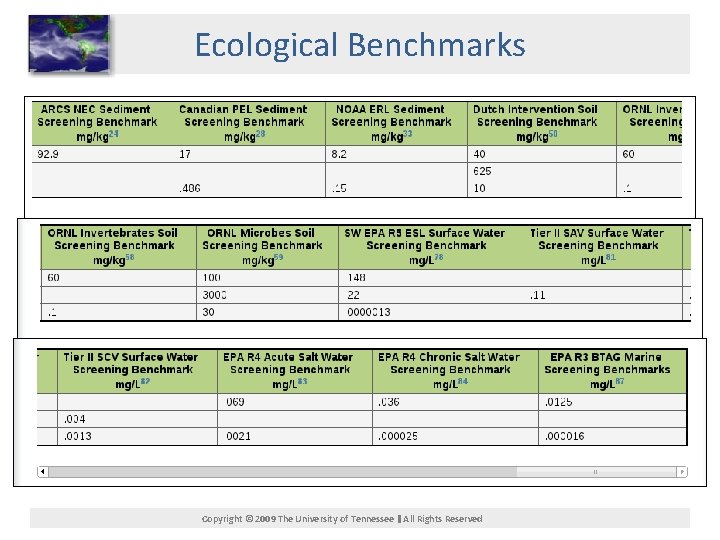
Ecological Benchmarks Copyright © 2009 The University of Tennessee All Rights Reserved
Ecological Benchmarks Copyright © 2009 The University of Tennessee All Rights Reserved
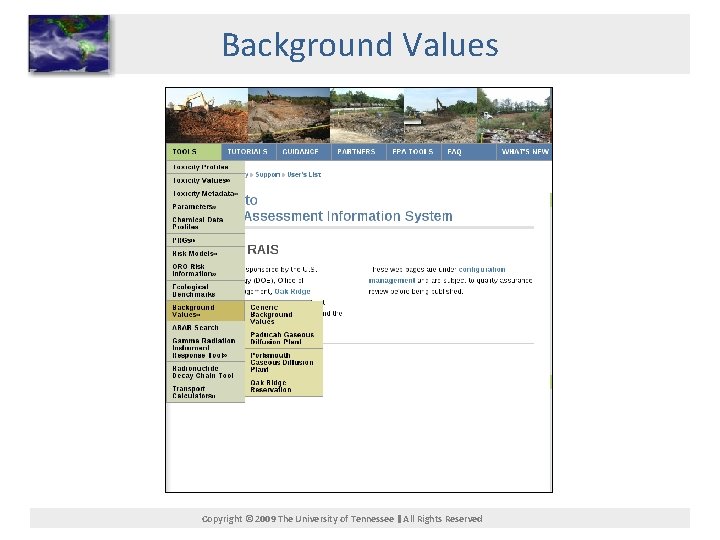
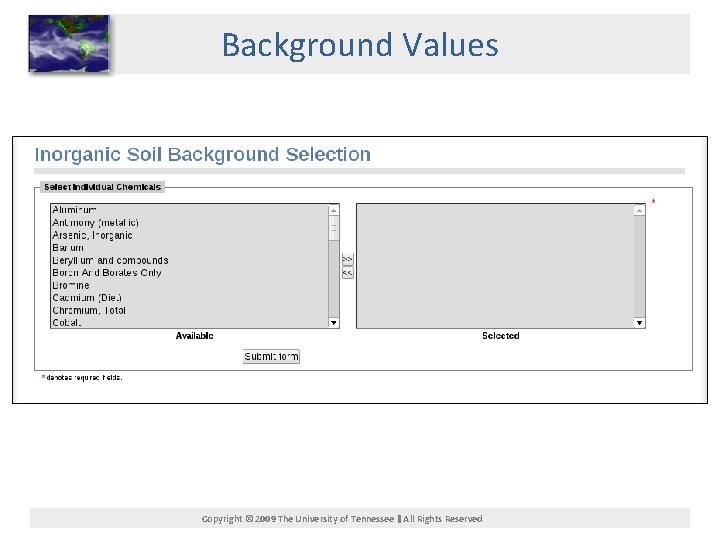
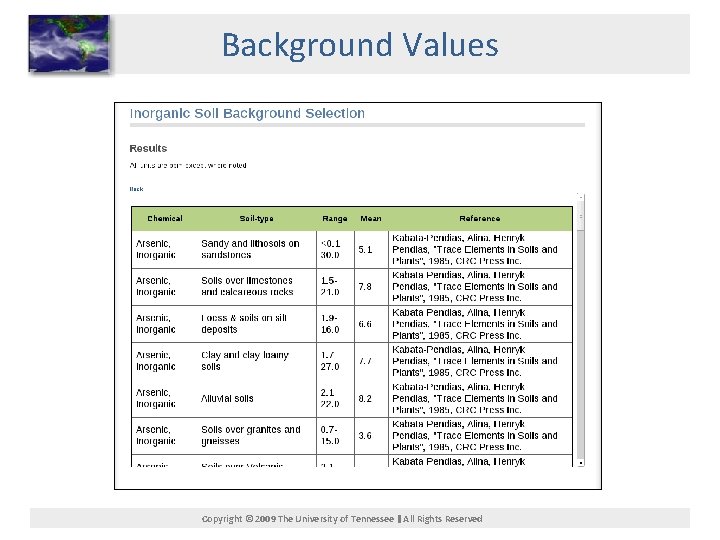
Background Values Copyright © 2009 The University of Tennessee All Rights Reserved
Background Values Copyright © 2009 The University of Tennessee All Rights Reserved
Background Values Copyright © 2009 The University of Tennessee All Rights Reserved
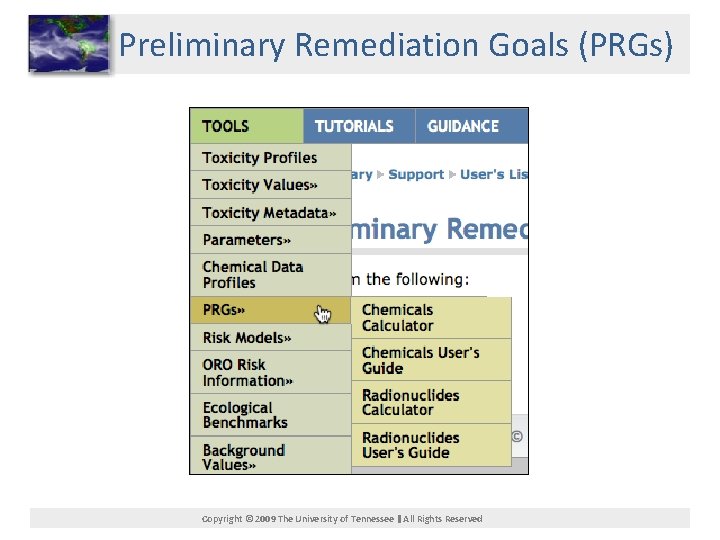
Preliminary Remediation Goals (PRGs) Copyright © 2009 The University of Tennessee All Rights Reserved
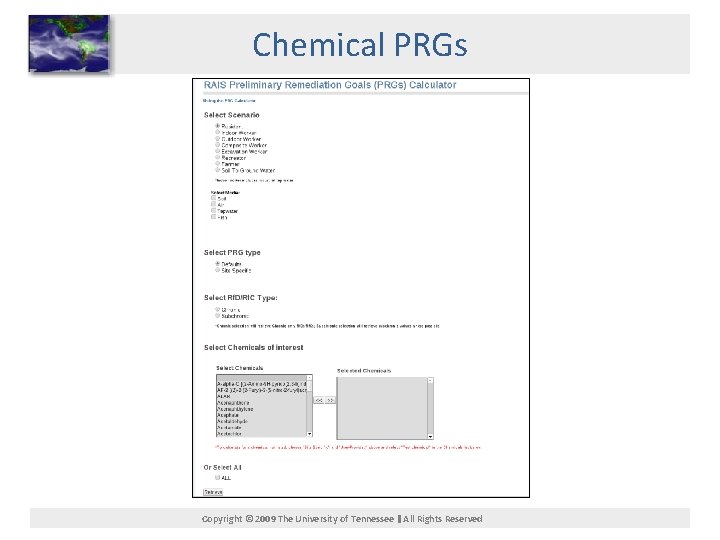
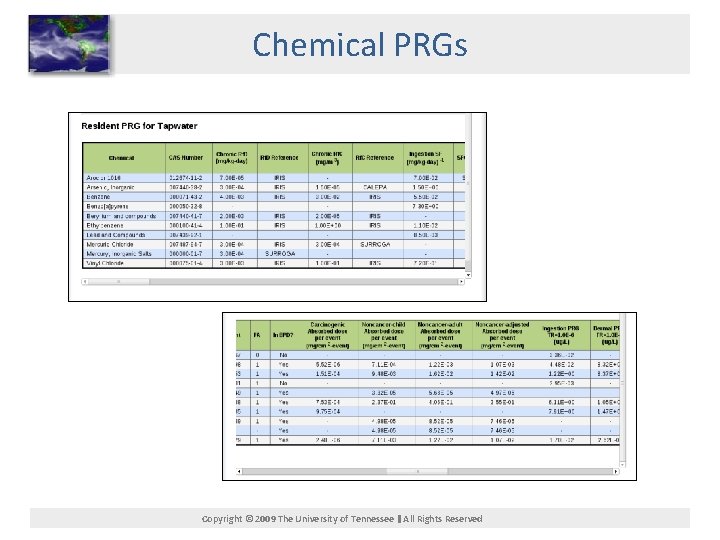
Chemical PRGs Copyright © 2009 The University of Tennessee All Rights Reserved
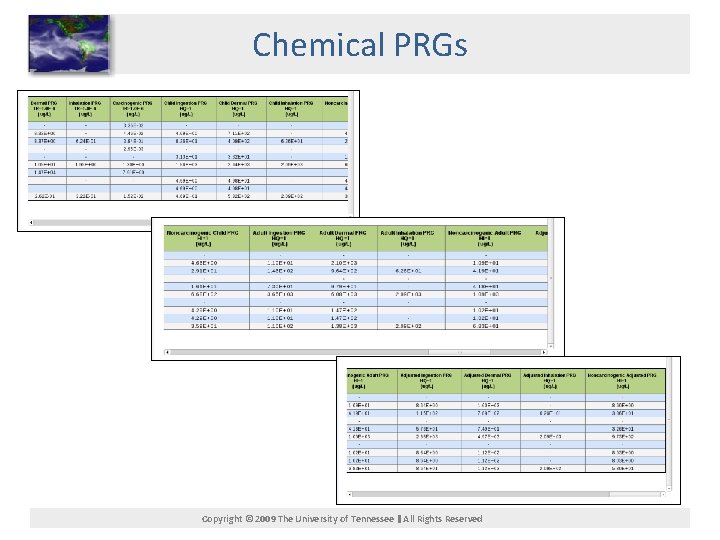
Chemical PRGs Copyright © 2009 The University of Tennessee All Rights Reserved
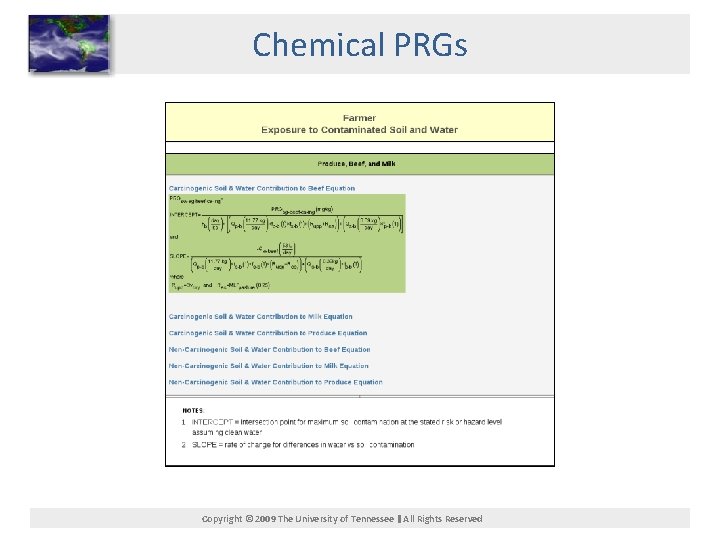
Chemical PRGs Copyright © 2009 The University of Tennessee All Rights Reserved
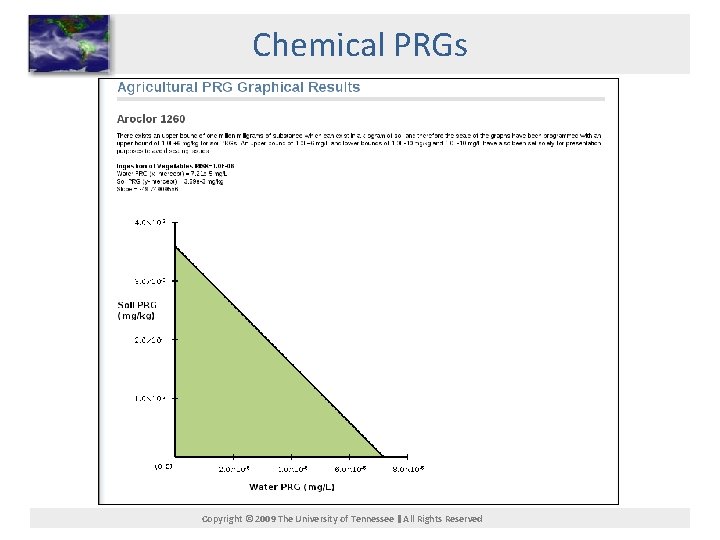
Chemical PRGs Copyright © 2009 The University of Tennessee All Rights Reserved
Chemical PRGs Copyright © 2009 The University of Tennessee All Rights Reserved
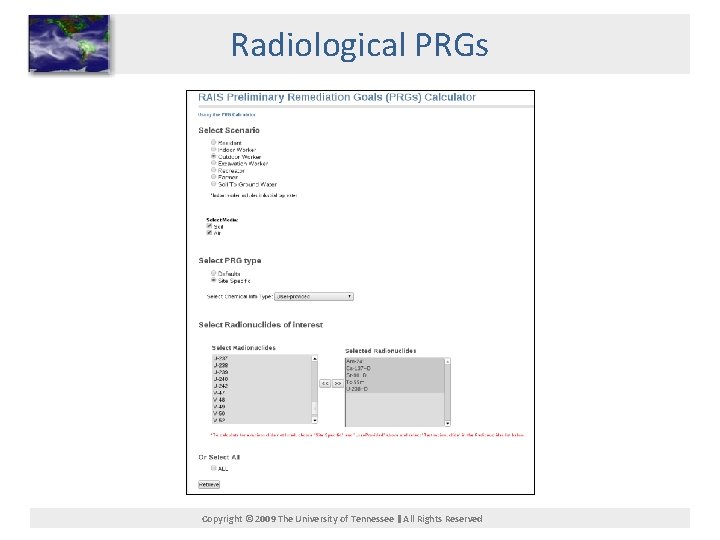
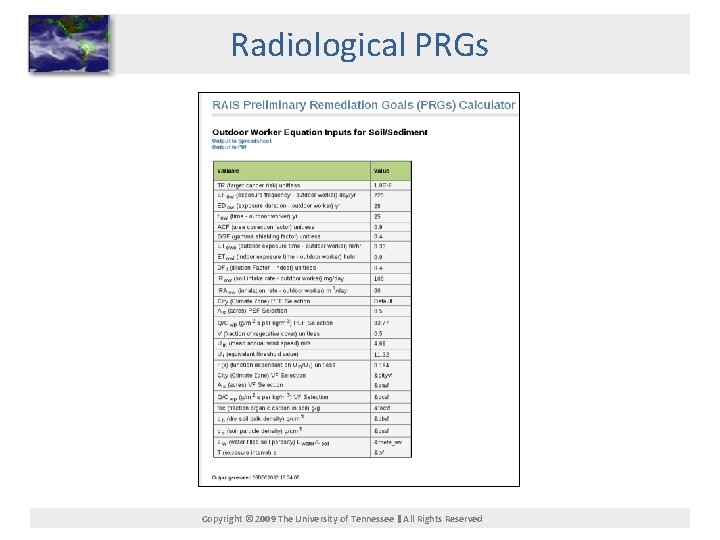
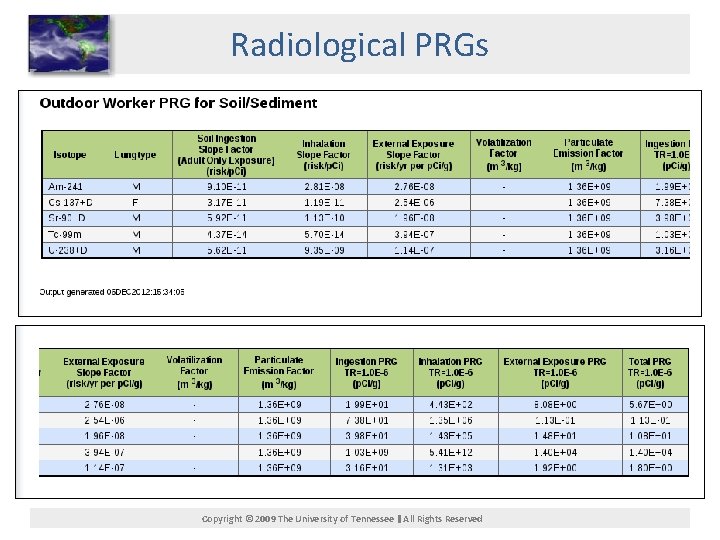
Radiological PRGs Copyright © 2009 The University of Tennessee All Rights Reserved
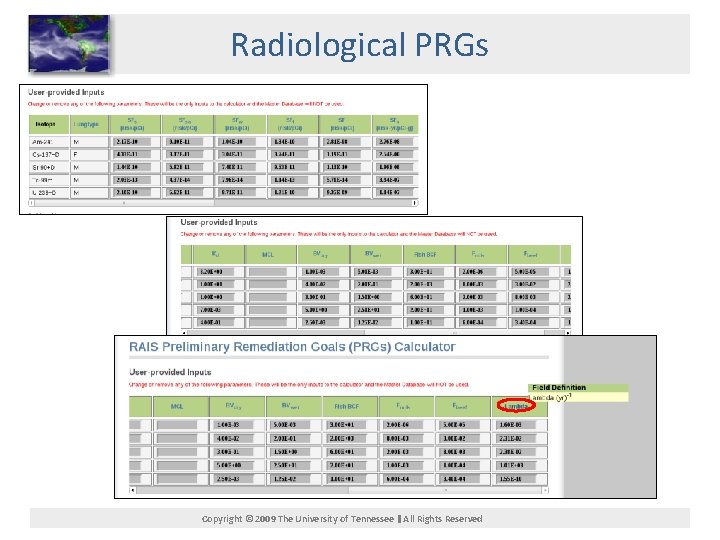
Radiological PRGs Copyright © 2009 The University of Tennessee All Rights Reserved
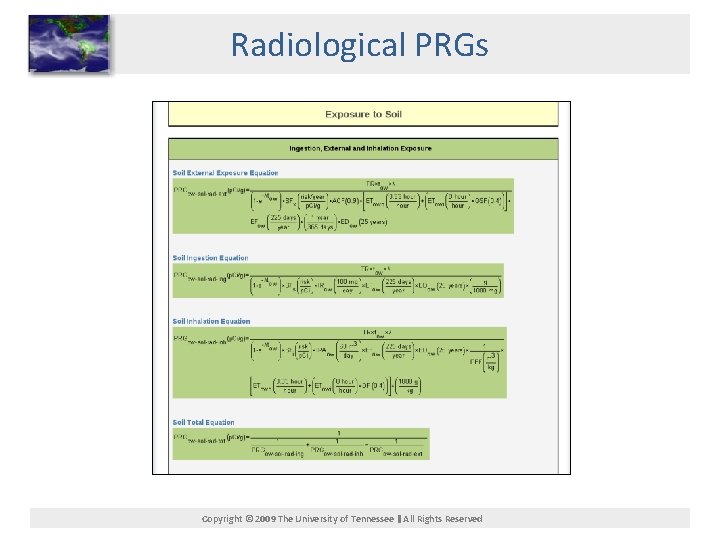
Radiological PRGs Copyright © 2009 The University of Tennessee All Rights Reserved
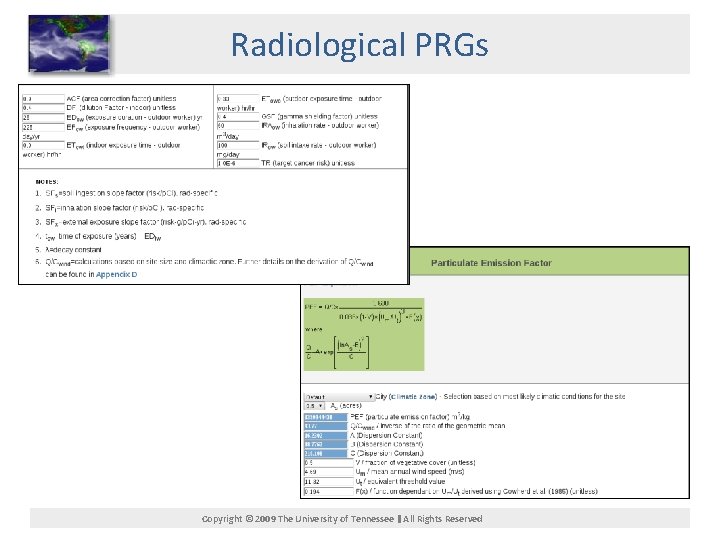
Radiological PRGs Copyright © 2009 The University of Tennessee All Rights Reserved
Radiological PRGs Copyright © 2009 The University of Tennessee All Rights Reserved
Radiological PRGs Copyright © 2009 The University of Tennessee All Rights Reserved
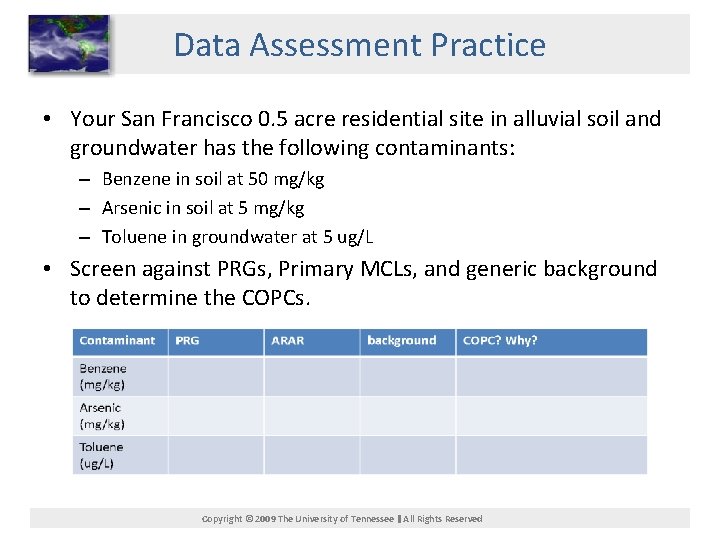
Data Assessment Practice • Your San Francisco 0. 5 acre residential site in alluvial soil and groundwater has the following contaminants: – Benzene in soil at 50 mg/kg – Arsenic in soil at 5 mg/kg – Toluene in groundwater at 5 ug/L • Screen against PRGs, Primary MCLs, and generic background to determine the COPCs. Copyright © 2009 The University of Tennessee All Rights Reserved
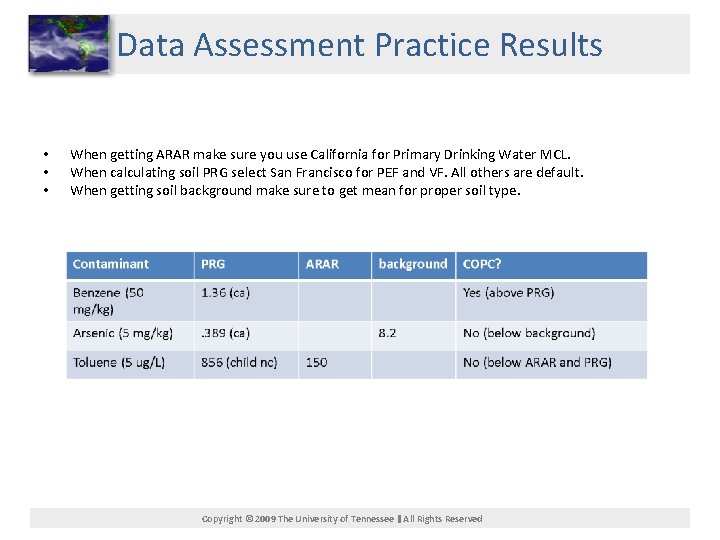
Data Assessment Practice Results • • • When getting ARAR make sure you use California for Primary Drinking Water MCL. When calculating soil PRG select San Francisco for PEF and VF. All others are default. When getting soil background make sure to get mean for proper soil type. Copyright © 2009 The University of Tennessee All Rights Reserved
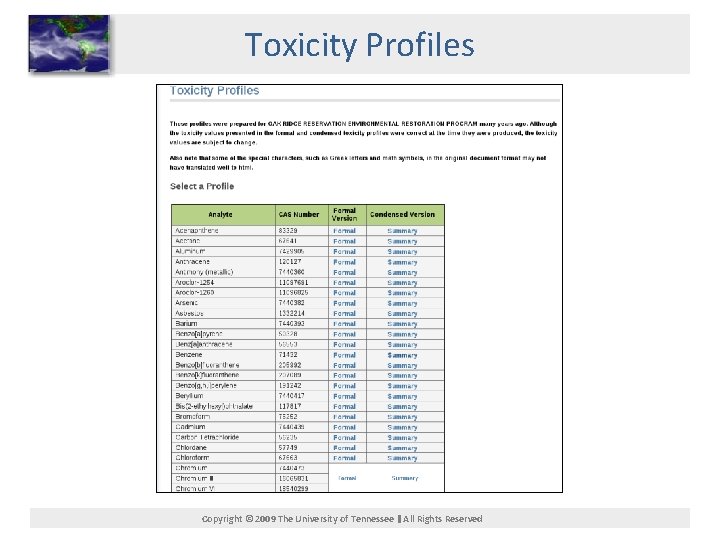
Toxicity Profiles Copyright © 2009 The University of Tennessee All Rights Reserved
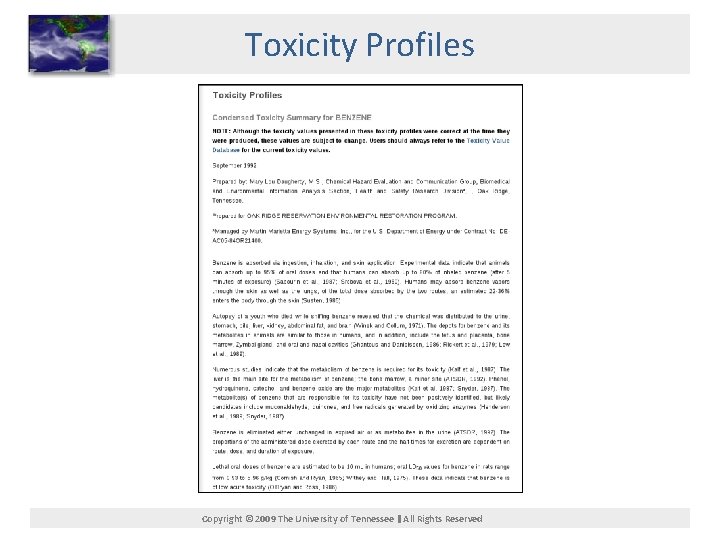
Toxicity Profiles Copyright © 2009 The University of Tennessee All Rights Reserved
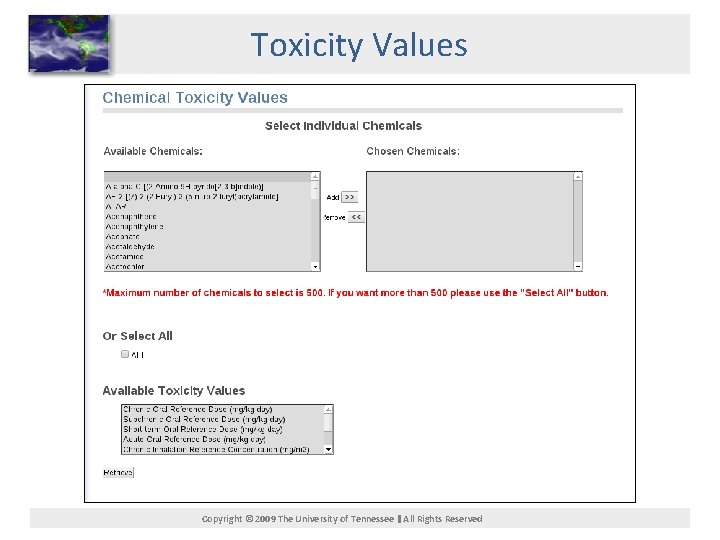
Toxicity Values Copyright © 2009 The University of Tennessee All Rights Reserved
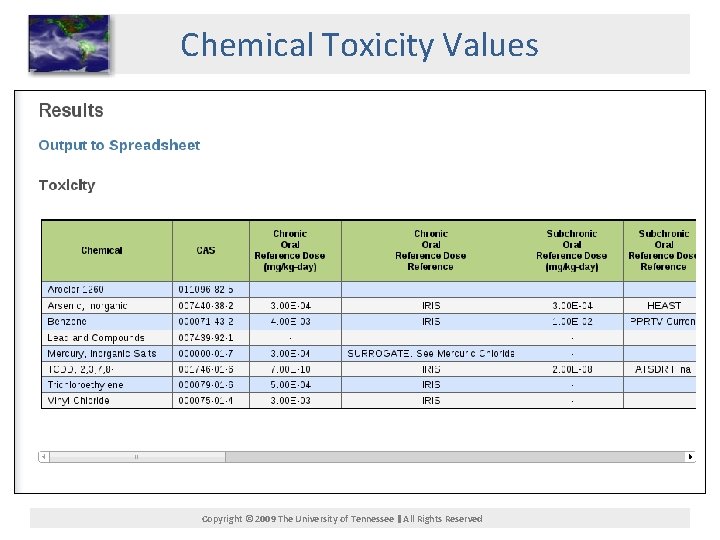
Chemical Toxicity Values Copyright © 2009 The University of Tennessee All Rights Reserved
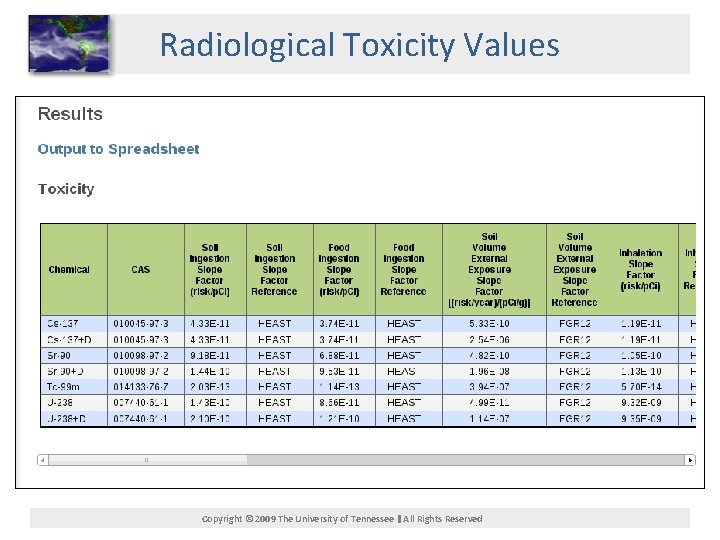
Radiological Toxicity Values Copyright © 2009 The University of Tennessee All Rights Reserved
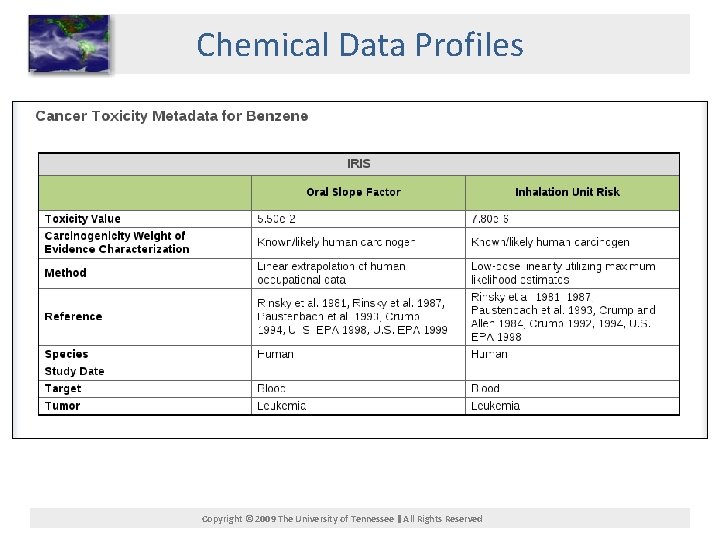
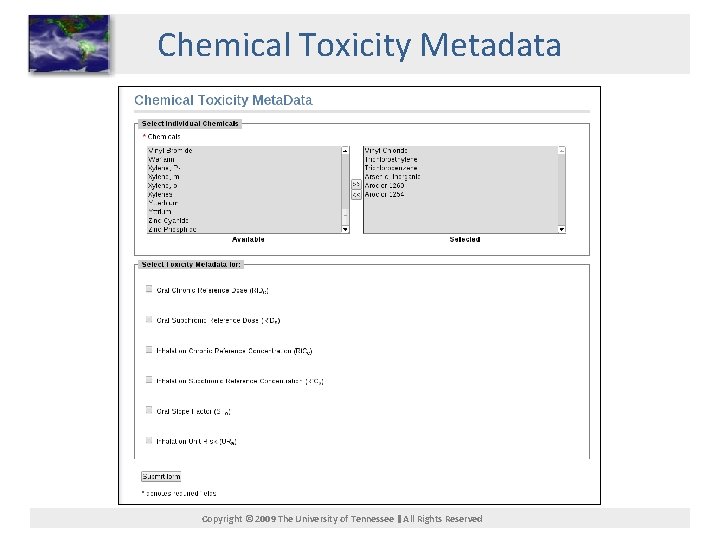
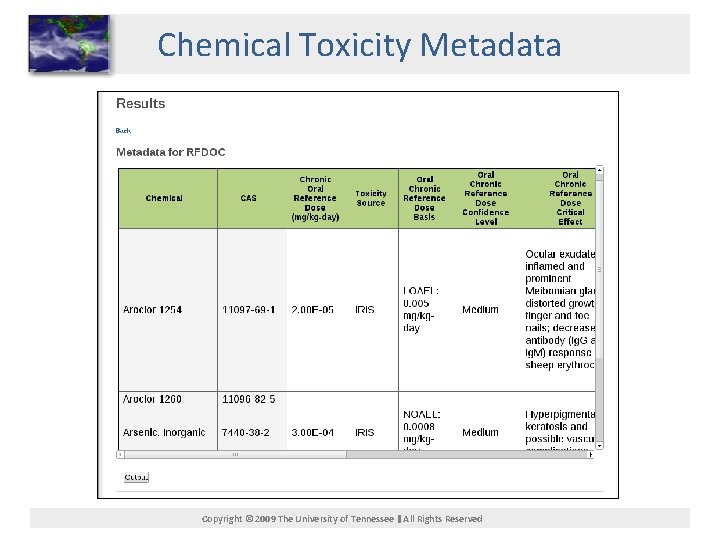
Chemical Toxicity Metadata Copyright © 2009 The University of Tennessee All Rights Reserved
Chemical Toxicity Metadata Copyright © 2009 The University of Tennessee All Rights Reserved
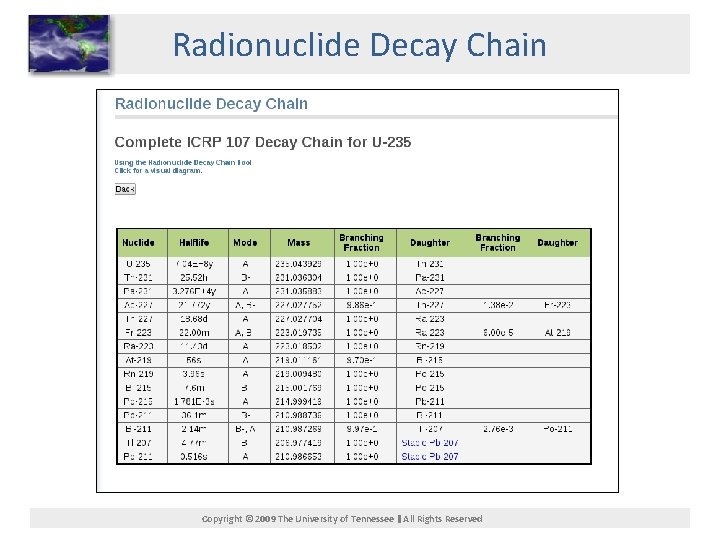
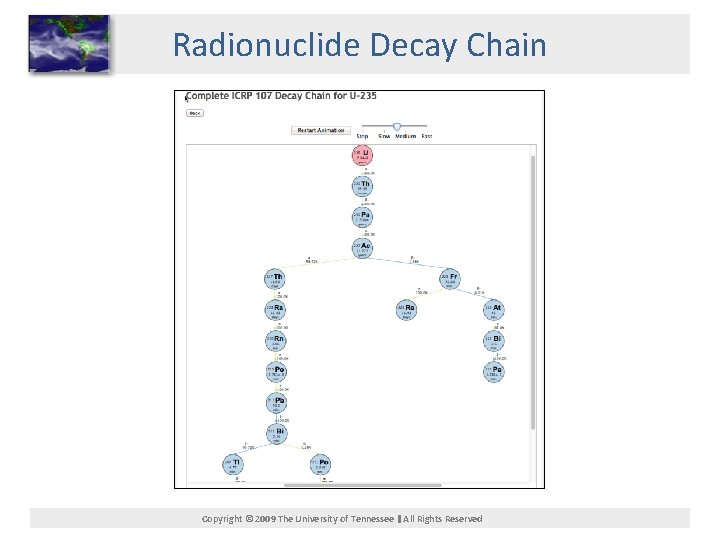
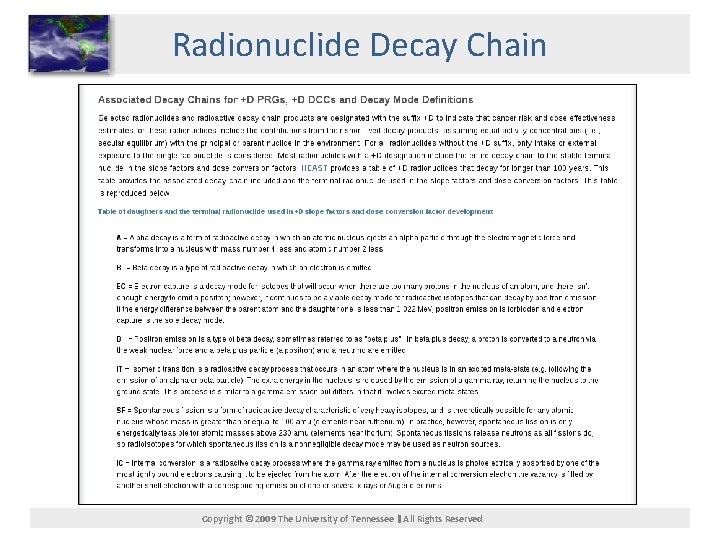
Radionuclide Decay Chain Copyright © 2009 The University of Tennessee All Rights Reserved
Radionuclide Decay Chain Copyright © 2009 The University of Tennessee All Rights Reserved
Radionuclide Decay Chain Copyright © 2009 The University of Tennessee All Rights Reserved
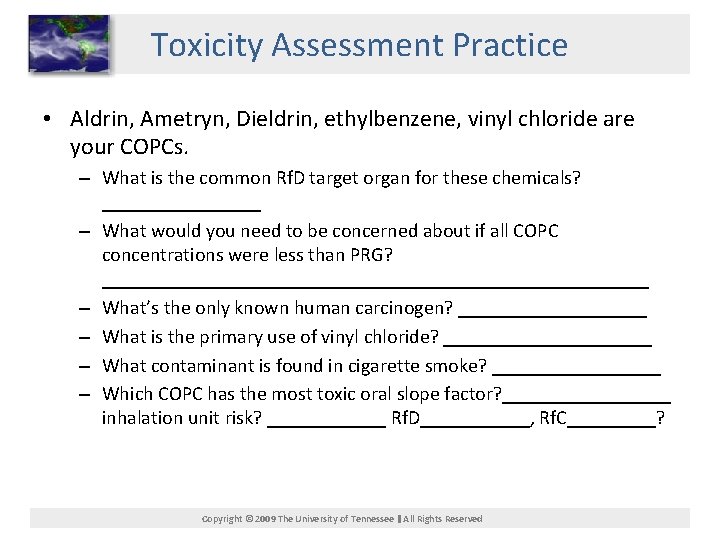
Toxicity Assessment Practice • Aldrin, Ametryn, Dieldrin, ethylbenzene, vinyl chloride are your COPCs. – What is the common Rf. D target organ for these chemicals? ________ – What would you need to be concerned about if all COPC concentrations were less than PRG? ____________________________ – What’s the only known human carcinogen? __________ – What is the primary use of vinyl chloride? ___________ – What contaminant is found in cigarette smoke? _________ – Which COPC has the most toxic oral slope factor? _________ inhalation unit risk? ______ Rf. D______, Rf. C_____? Copyright © 2009 The University of Tennessee All Rights Reserved
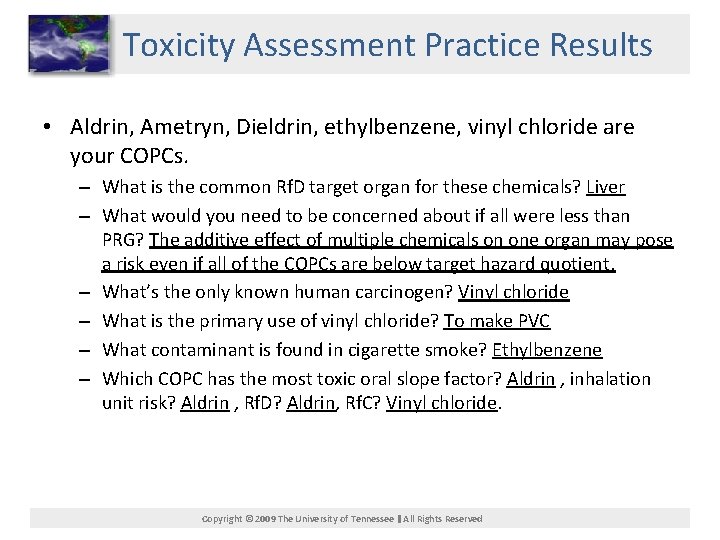
Toxicity Assessment Practice Results • Aldrin, Ametryn, Dieldrin, ethylbenzene, vinyl chloride are your COPCs. – What is the common Rf. D target organ for these chemicals? Liver – What would you need to be concerned about if all were less than PRG? The additive effect of multiple chemicals on one organ may pose a risk even if all of the COPCs are below target hazard quotient. – What’s the only known human carcinogen? Vinyl chloride – What is the primary use of vinyl chloride? To make PVC – What contaminant is found in cigarette smoke? Ethylbenzene – Which COPC has the most toxic oral slope factor? Aldrin , inhalation unit risk? Aldrin , Rf. D? Aldrin, Rf. C? Vinyl chloride. Copyright © 2009 The University of Tennessee All Rights Reserved
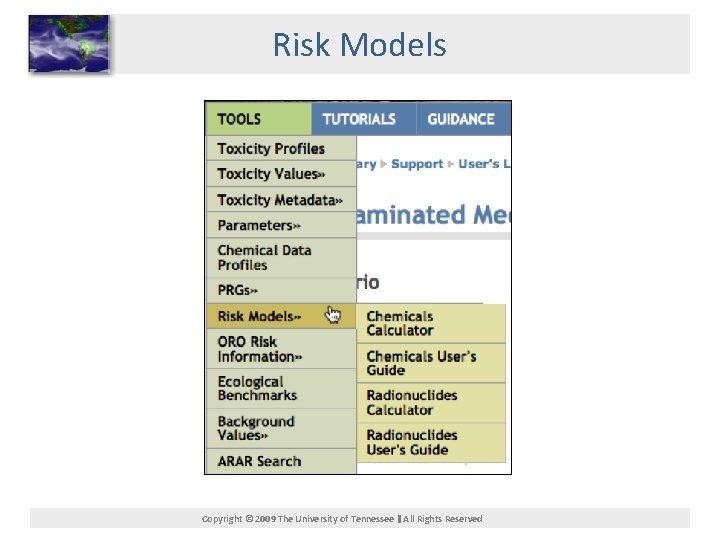
Risk Models Copyright © 2009 The University of Tennessee All Rights Reserved
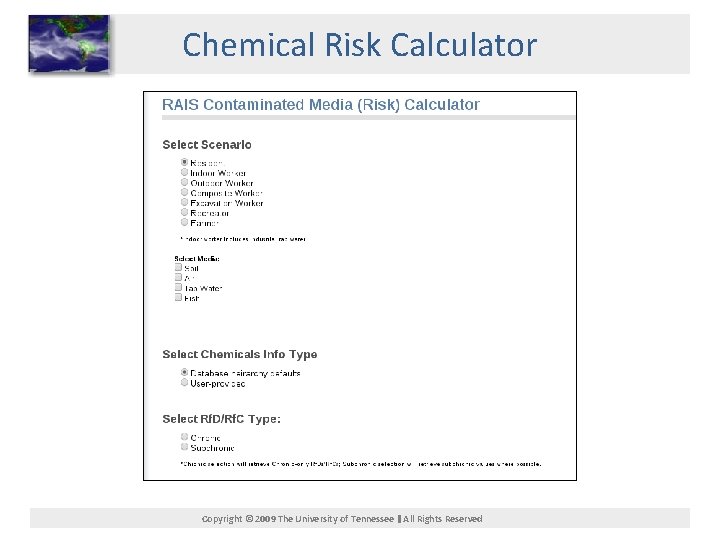
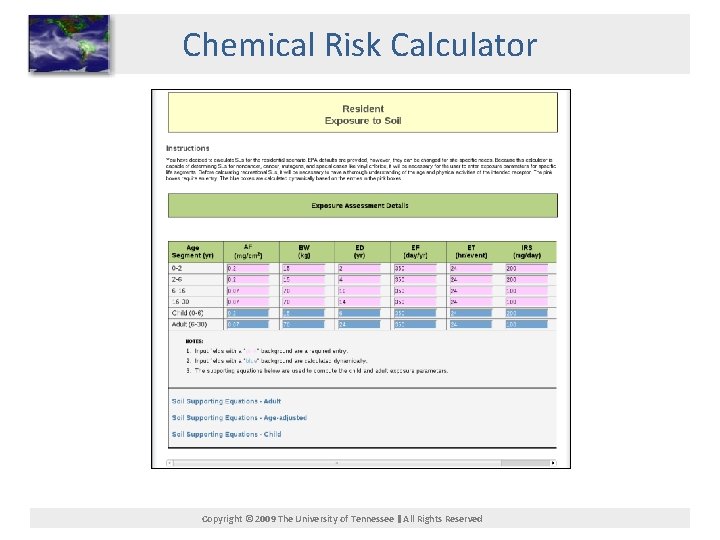
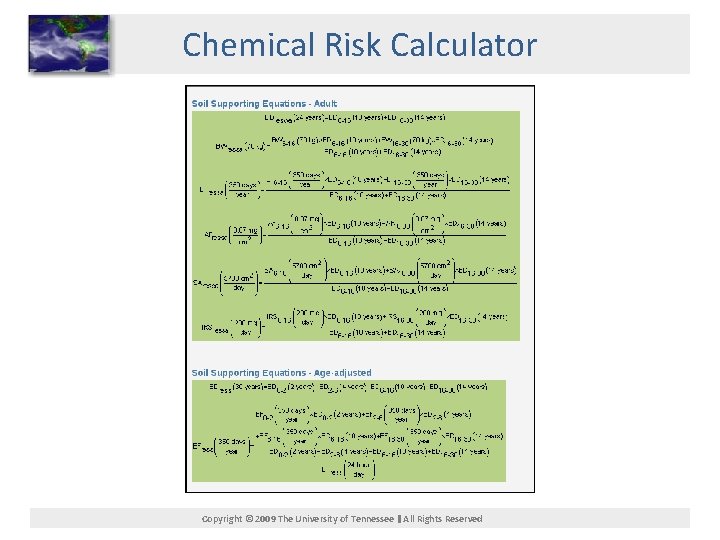
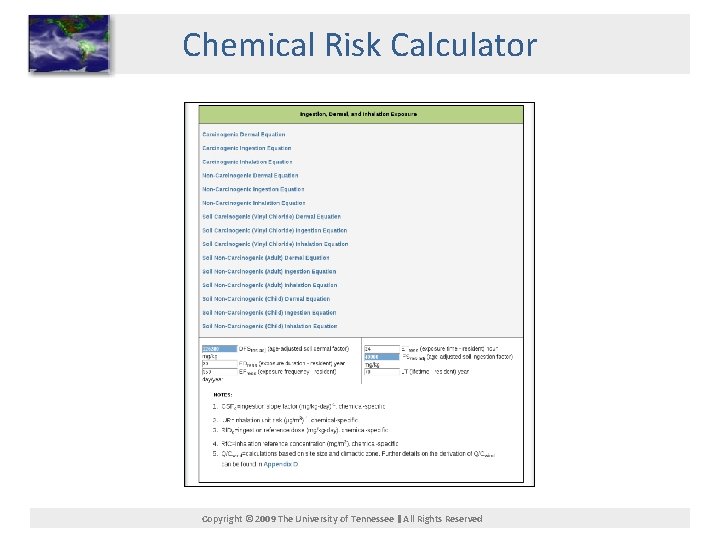
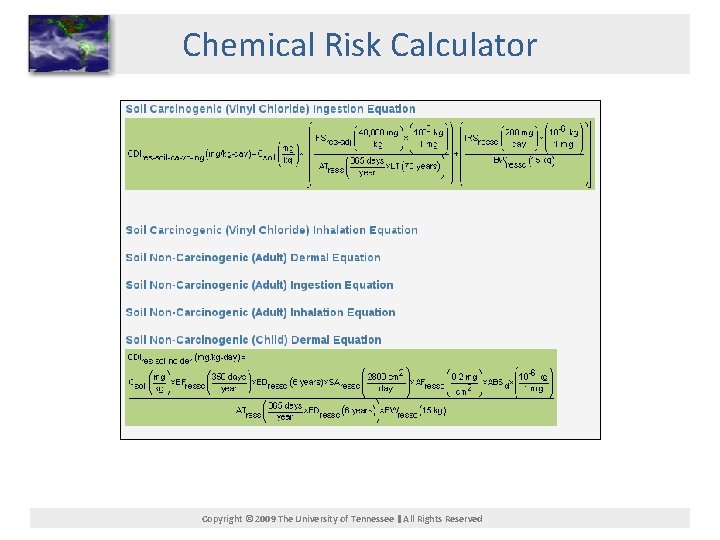
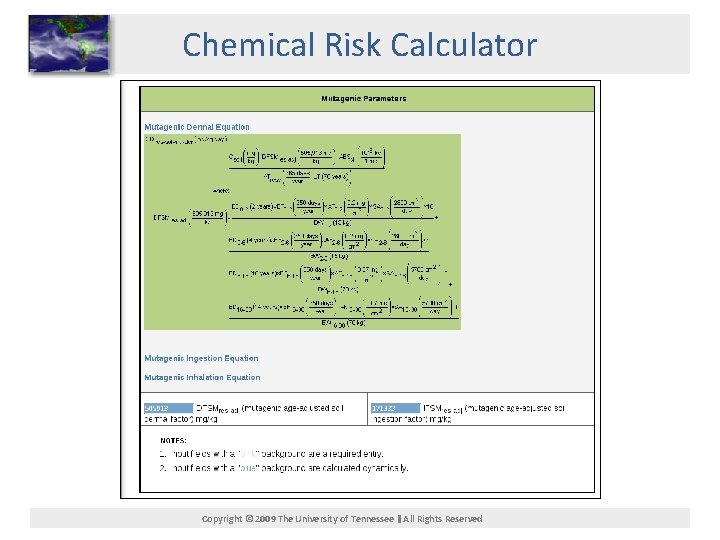
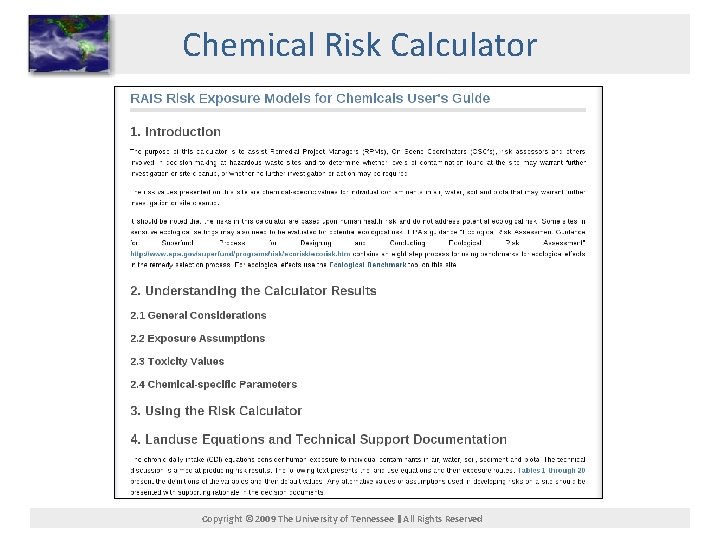
Chemical Risk Calculator Copyright © 2009 The University of Tennessee All Rights Reserved
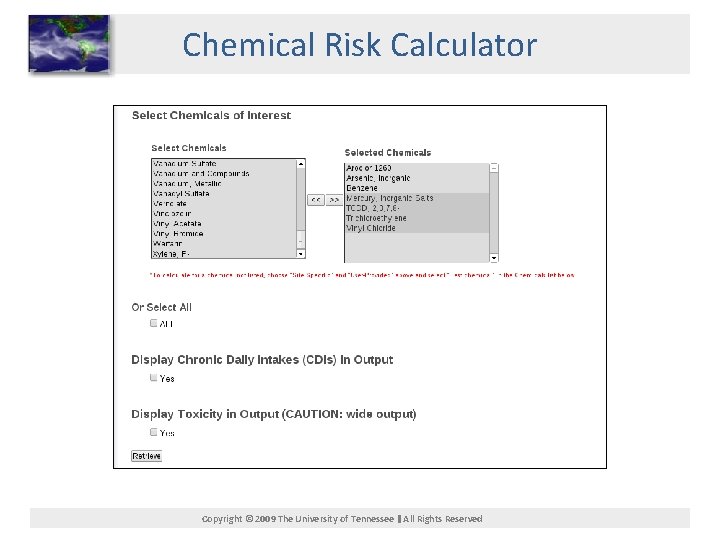
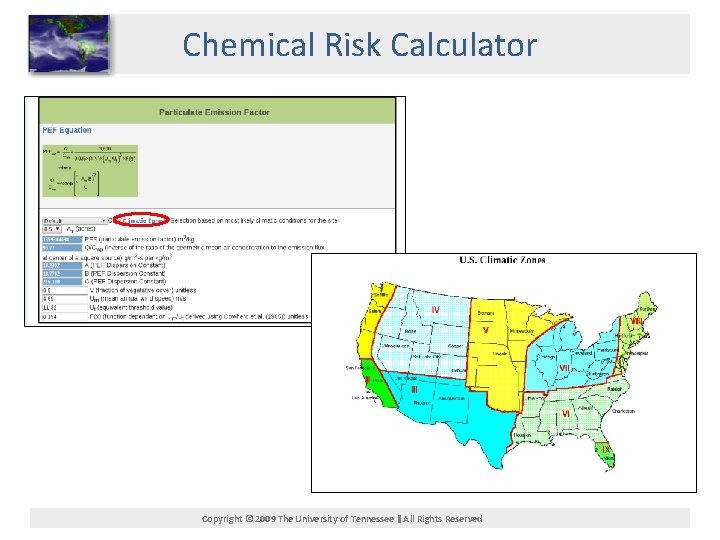
Chemical Risk Calculator Copyright © 2009 The University of Tennessee All Rights Reserved
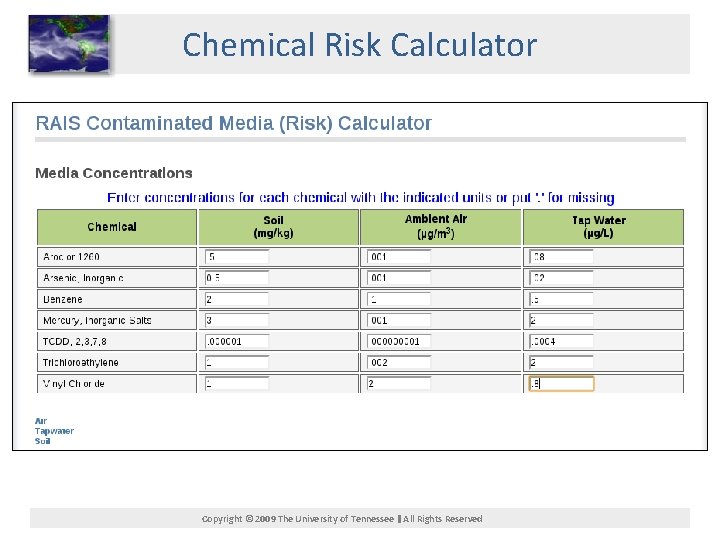
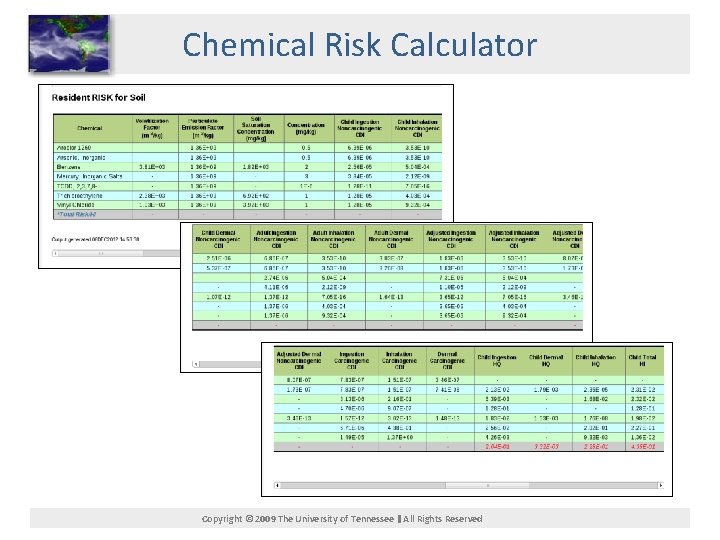
Chemical Risk Calculator Copyright © 2009 The University of Tennessee All Rights Reserved
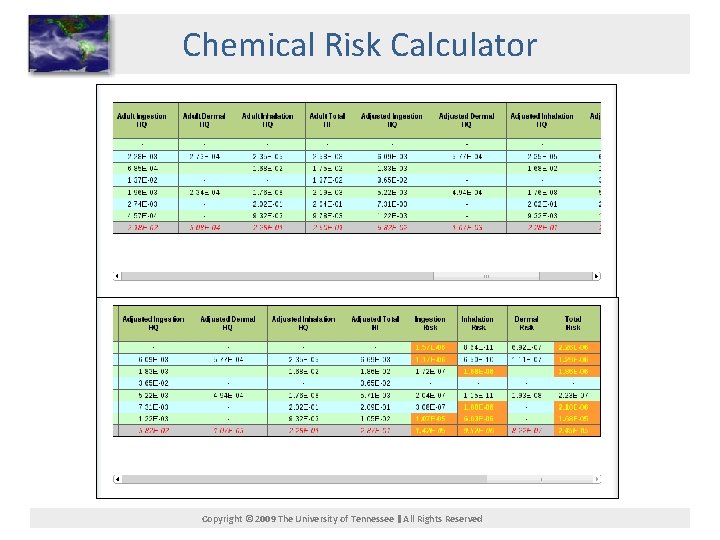
Chemical Risk Calculator Copyright © 2009 The University of Tennessee All Rights Reserved
Chemical Risk Calculator Copyright © 2009 The University of Tennessee All Rights Reserved
Chemical Risk Calculator Copyright © 2009 The University of Tennessee All Rights Reserved
Chemical Risk Calculator Copyright © 2009 The University of Tennessee All Rights Reserved
Chemical Risk Calculator Copyright © 2009 The University of Tennessee All Rights Reserved
Chemical Risk Calculator Copyright © 2009 The University of Tennessee All Rights Reserved
Chemical Risk Calculator Copyright © 2009 The University of Tennessee All Rights Reserved
Chemical Risk Calculator Copyright © 2009 The University of Tennessee All Rights Reserved
Chemical Risk Calculator Copyright © 2009 The University of Tennessee All Rights Reserved
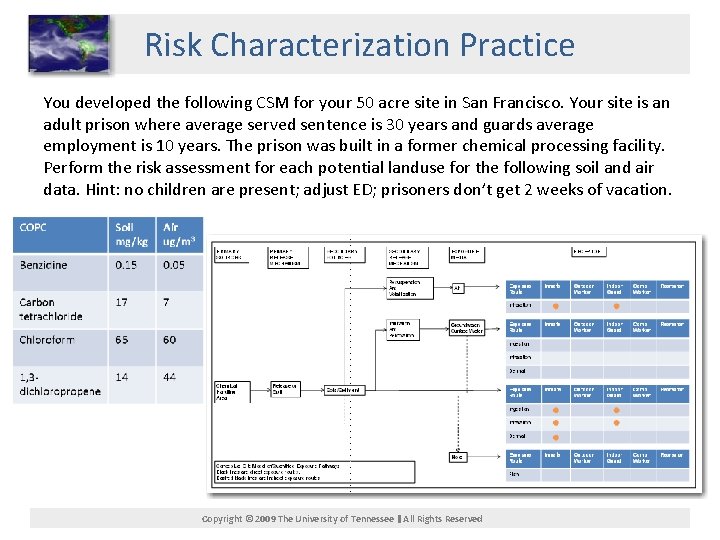
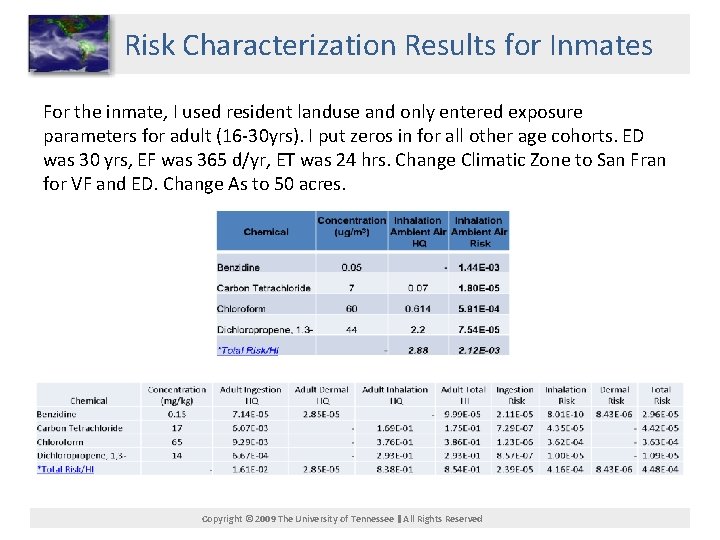
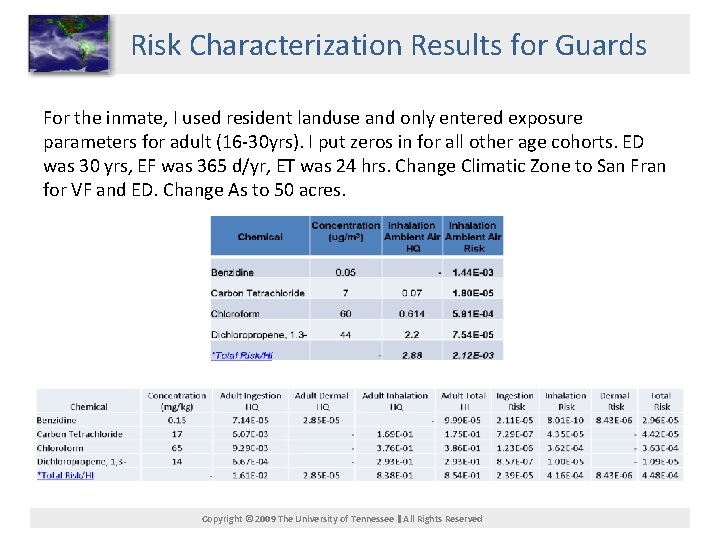
Risk Characterization Practice You developed the following CSM for your 50 acre site in San Francisco. Your site is an adult prison where average served sentence is 30 years and guards average employment is 10 years. The prison was built in a former chemical processing facility. Perform the risk assessment for each potential landuse for the following soil and air data. Hint: no children are present; adjust ED; prisoners don’t get 2 weeks of vacation. Copyright © 2009 The University of Tennessee All Rights Reserved
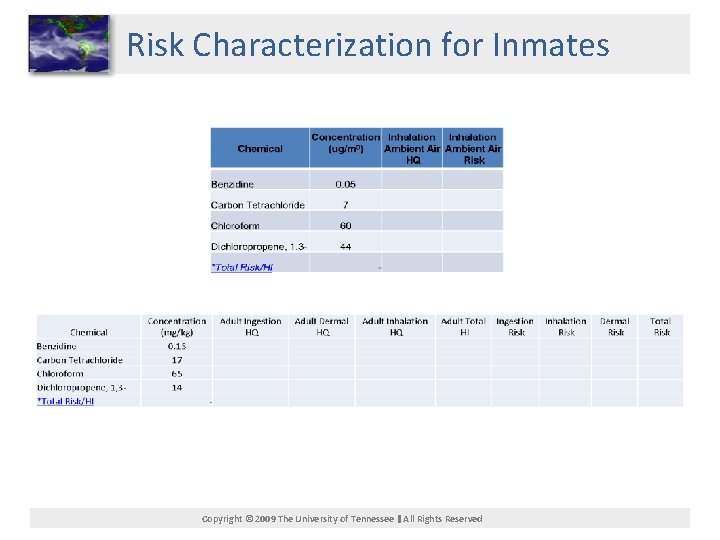
Risk Characterization for Inmates Copyright © 2009 The University of Tennessee All Rights Reserved
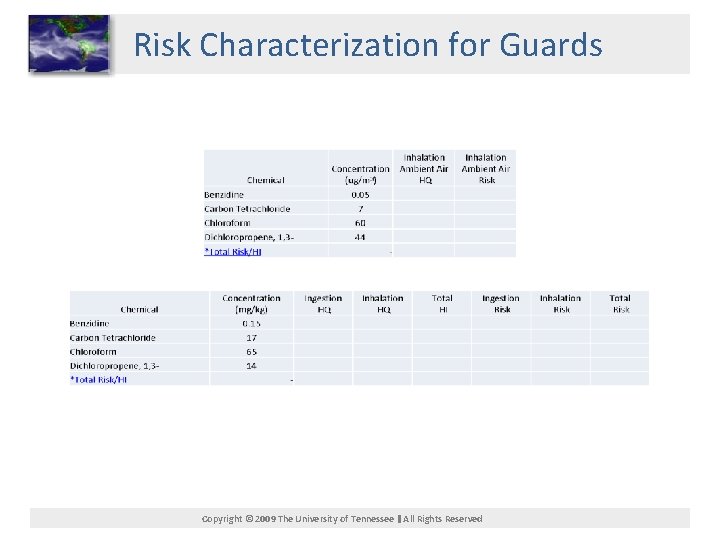
Risk Characterization for Guards Copyright © 2009 The University of Tennessee All Rights Reserved
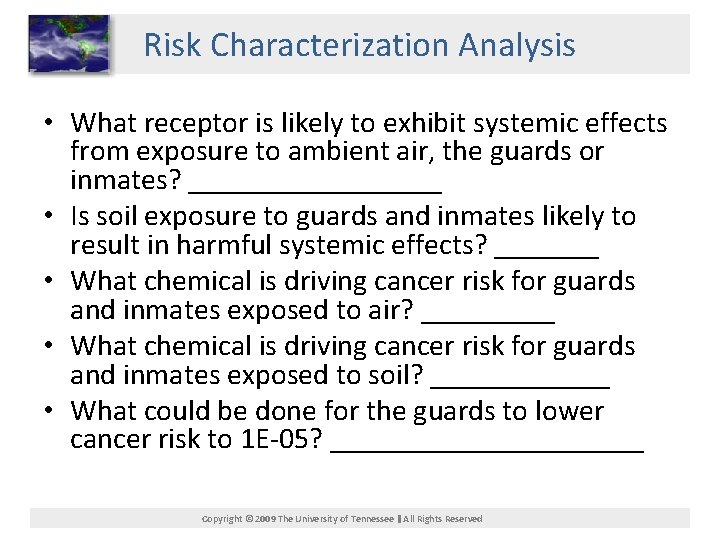
Risk Characterization Analysis • What receptor is likely to exhibit systemic effects from exposure to ambient air, the guards or inmates? _________ • Is soil exposure to guards and inmates likely to result in harmful systemic effects? _______ • What chemical is driving cancer risk for guards and inmates exposed to air? _____ • What chemical is driving cancer risk for guards and inmates exposed to soil? ______ • What could be done for the guards to lower cancer risk to 1 E-05? ___________ Copyright © 2009 The University of Tennessee All Rights Reserved
Risk Characterization Results for Inmates For the inmate, I used resident landuse and only entered exposure parameters for adult (16 -30 yrs). I put zeros in for all other age cohorts. ED was 30 yrs, EF was 365 d/yr, ET was 24 hrs. Change Climatic Zone to San Fran for VF and ED. Change As to 50 acres. Copyright © 2009 The University of Tennessee All Rights Reserved
Risk Characterization Results for Guards For the inmate, I used resident landuse and only entered exposure parameters for adult (16 -30 yrs). I put zeros in for all other age cohorts. ED was 30 yrs, EF was 365 d/yr, ET was 24 hrs. Change Climatic Zone to San Fran for VF and ED. Change As to 50 acres. Copyright © 2009 The University of Tennessee All Rights Reserved
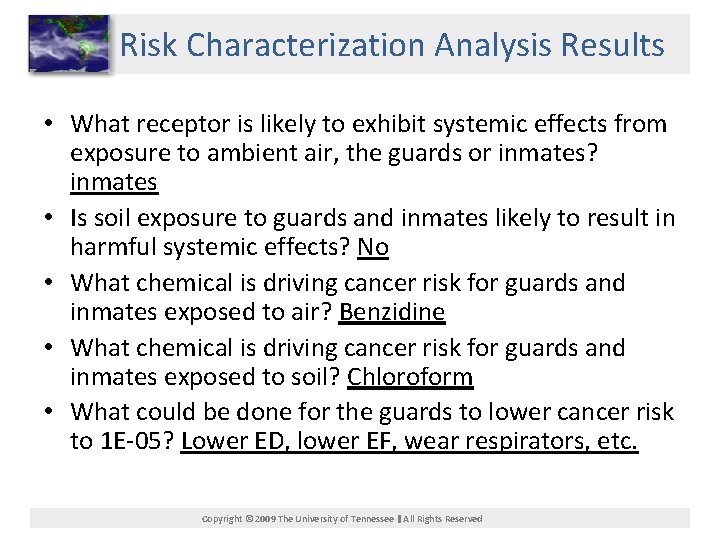
Risk Characterization Analysis Results • What receptor is likely to exhibit systemic effects from exposure to ambient air, the guards or inmates? inmates • Is soil exposure to guards and inmates likely to result in harmful systemic effects? No • What chemical is driving cancer risk for guards and inmates exposed to air? Benzidine • What chemical is driving cancer risk for guards and inmates exposed to soil? Chloroform • What could be done for the guards to lower cancer risk to 1 E-05? Lower ED, lower EF, wear respirators, etc. Copyright © 2009 The University of Tennessee All Rights Reserved