
Rainwater Harvesting Rural Martin Wafler seecon international gmbh
Rainwater Harvesting (Rural) Martin Wafler, seecon international gmbh Rainwater Harvesting
Find this presentation and more on: www. sswm. info. Copyright & Disclaimer Copy it, adapt it, use it – but acknowledge the source! Copyright Included in the SSWM Toolbox are materials from various organisations and sources. Those materials are open source. Following the opensource concept for capacity building and non-profit use, copying and adapting is allowed provided proper acknowledgement of the source is made (see below). The publication of these materials in the SSWM Toolbox does not alter any existing copyrights. Material published in the SSWM Toolbox for the first time follows the same open-source concept, with all rights remaining with the original authors or producing organisations. To view an official copy of the Creative Commons Attribution Works 3. 0 Unported License we build upon, visit http: //creativecommons. org/licenses/by/3. 0. This agreement officially states that: You are free to: • Share - to copy, distribute and transmit this document • Remix - to adapt this document. We would appreciate receiving a copy of any changes that you have made to improve this document. Under the following conditions: • Attribution: You must always give the original authors or publishing agencies credit for the document or picture you are using. Disclaimer The contents of the SSWM Toolbox reflect the opinions of the respective authors and not necessarily the official opinion of the funding or supporting partner organisations. Depending on the initial situations and respective local circumstances, there is no guarantee that single measures described in the toolbox will make the local water and sanitation system more sustainable. The main aim of the SSWM Toolbox is to be a reference tool to provide ideas for improving the local water and sanitation situation in a sustainable manner. Results depend largely on the respective situation and the implementation and combination of the measures described. An in-depth analysis of respective advantages and disadvantages and the suitability of the measure is necessary in every single case. We do not assume any responsibility for and make no warranty with respect to the results that may be obtained from the use of the information provided. Rainwater Harvesting
Find this presentation and more on: www. sswm. info. Contents 1. Concept 2. Roof catchment systems 3. Ground & rock catchment systems 4. Watershed management 5. Applicability 6. Advantages and disadvantages 7. References Rainwater Harvesting 3
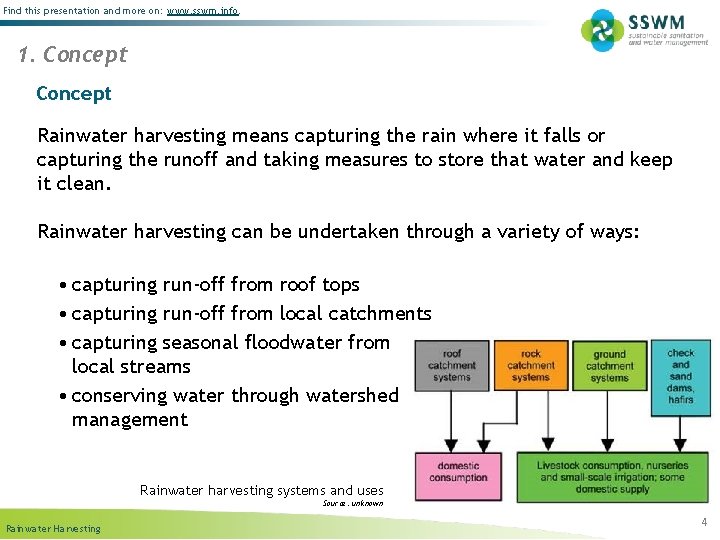
Find this presentation and more on: www. sswm. info. 1. Concept Rainwater harvesting means capturing the rain where it falls or capturing the runoff and taking measures to store that water and keep it clean. Rainwater harvesting can be undertaken through a variety of ways: • capturing run-off from roof tops • capturing run-off from local catchments • capturing seasonal floodwater from local streams • conserving water through watershed management Rainwater harvesting systems and uses Source: unknown Rainwater Harvesting 4
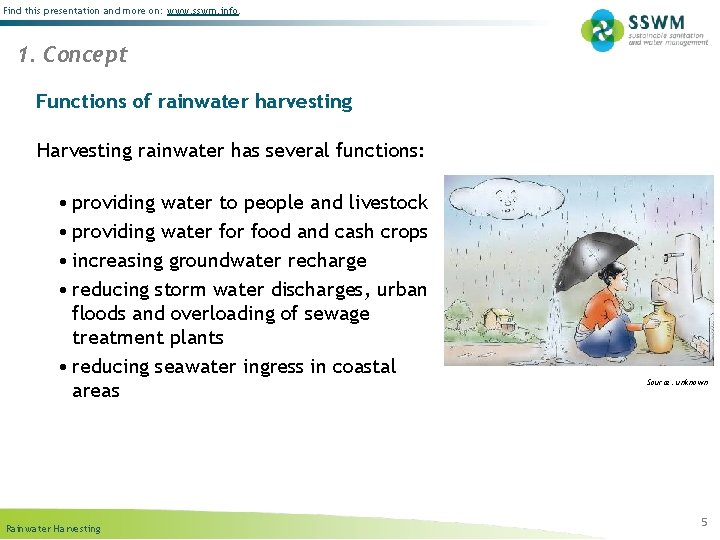
Find this presentation and more on: www. sswm. info. 1. Concept Functions of rainwater harvesting Harvesting rainwater has several functions: • providing water to people and livestock • providing water food and cash crops • increasing groundwater recharge • reducing storm water discharges, urban floods and overloading of sewage treatment plants • reducing seawater ingress in coastal areas Rainwater Harvesting Source: unknown 5
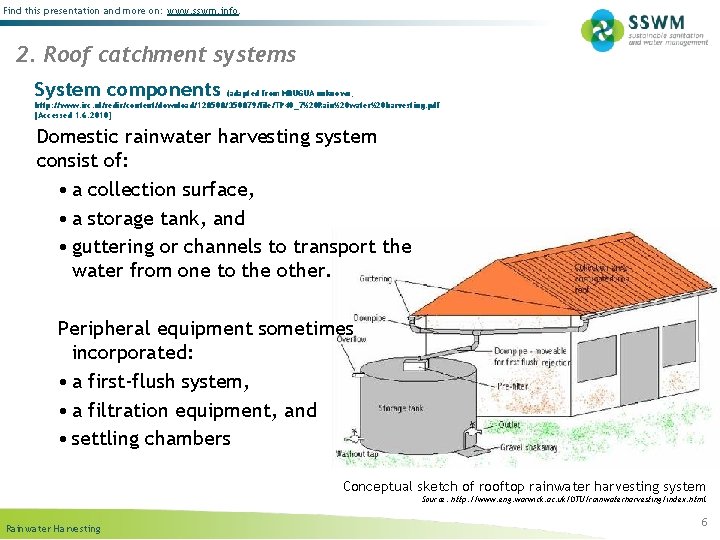
Find this presentation and more on: www. sswm. info. 2. Roof catchment systems System components (adapted from MBUGUA unknown; http: //www. irc. nl/redir/content/download/128508/350879/file/TP 40_7%20 Rain%20 water%20 harvesting. pdf [Accessed 1. 6. 2010] Domestic rainwater harvesting system consist of: • a collection surface, • a storage tank, and • guttering or channels to transport the water from one to the other. Peripheral equipment sometimes incorporated: • a first-flush system, • a filtration equipment, and • settling chambers Conceptual sketch of rooftop rainwater harvesting system Source: http: //www. eng. warwick. ac. uk/DTU/rainwaterharvesting/index. html Rainwater Harvesting 6
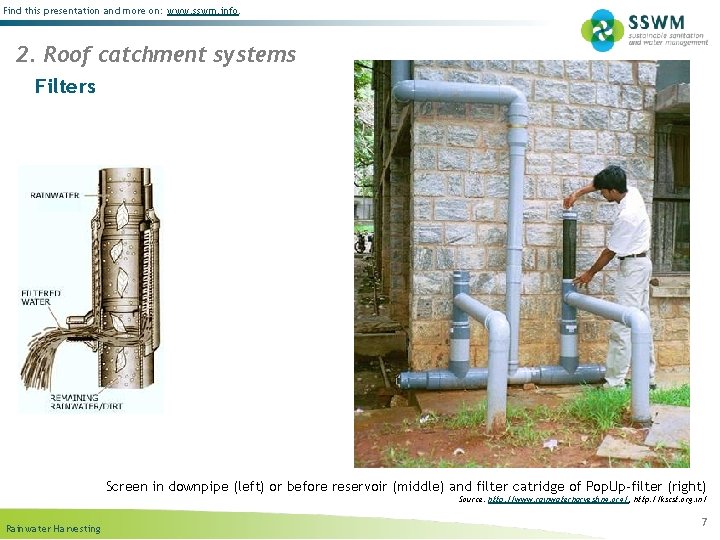
Find this presentation and more on: www. sswm. info. 2. Roof catchment systems Filters Screen in downpipe (left) or before reservoir (middle) and filter catridge of Pop. Up-filter (right) Source: http: //www. rainwaterharvesting. org/; http: //kscst. org. in/ Rainwater Harvesting 7
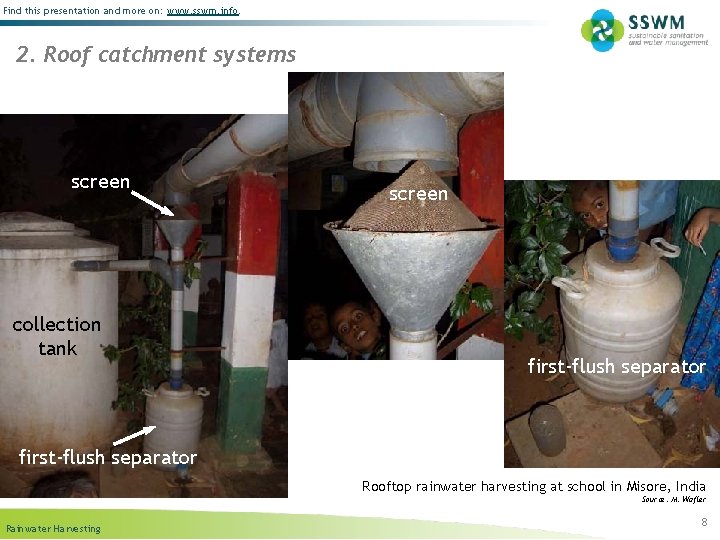
Find this presentation and more on: www. sswm. info. 2. Roof catchment systems screen collection tank screen first-flush separator Rooftop rainwater harvesting at school in Misore, India Source: M. Wafler Rainwater Harvesting 8
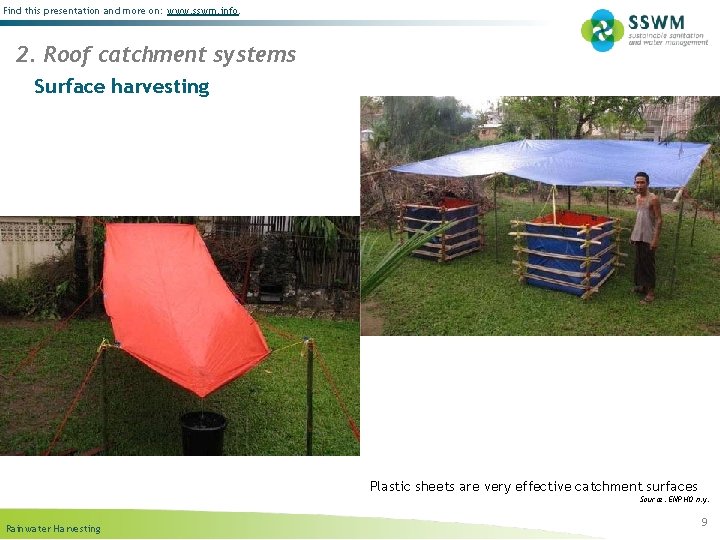
Find this presentation and more on: www. sswm. info. 2. Roof catchment systems Surface harvesting Plastic sheets are very effective catchment surfaces Source: ENPHO n. y. Rainwater Harvesting 9
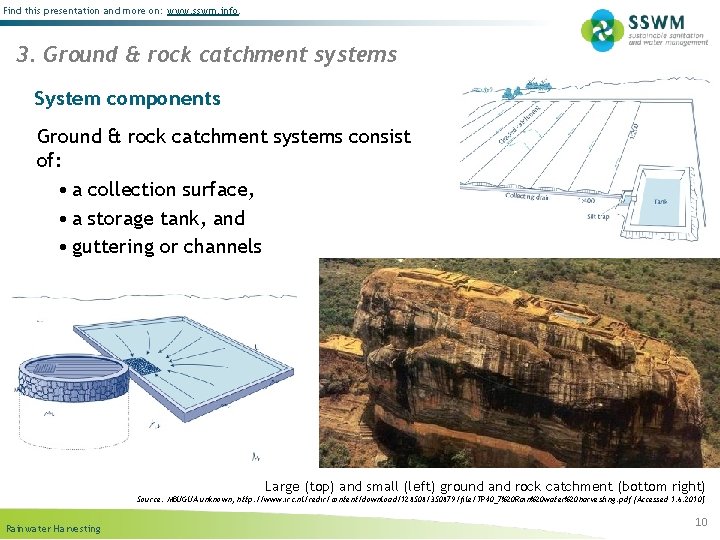
Find this presentation and more on: www. sswm. info. 3. Ground & rock catchment systems System components Ground & rock catchment systems consist of: • a collection surface, • a storage tank, and • guttering or channels Large (top) and small (left) ground and rock catchment (bottom right) Source: MBUGUA unknown; http: //www. irc. nl/redir/content/download/128508/350879/file/TP 40_7%20 Rain%20 water%20 harvesting. pdf [Accessed 1. 6. 2010] Rainwater Harvesting 10
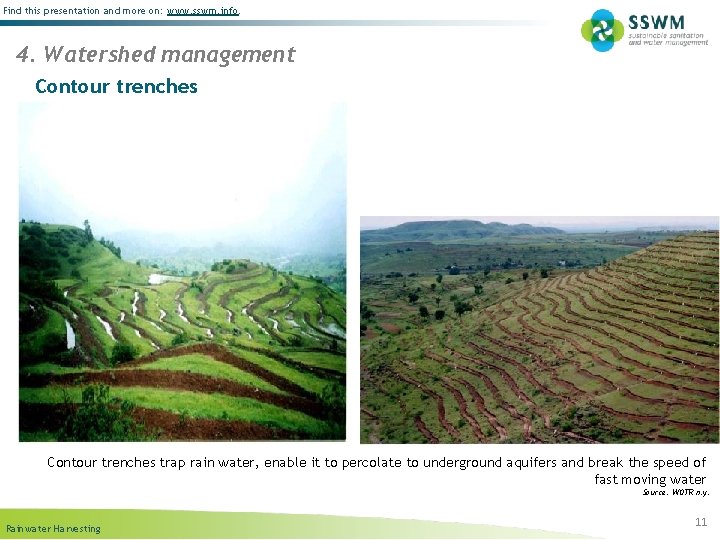
Find this presentation and more on: www. sswm. info. 4. Watershed management Contour trenches trap rain water, enable it to percolate to underground aquifers and break the speed of fast moving water Source: WOTR n. y. Rainwater Harvesting 11
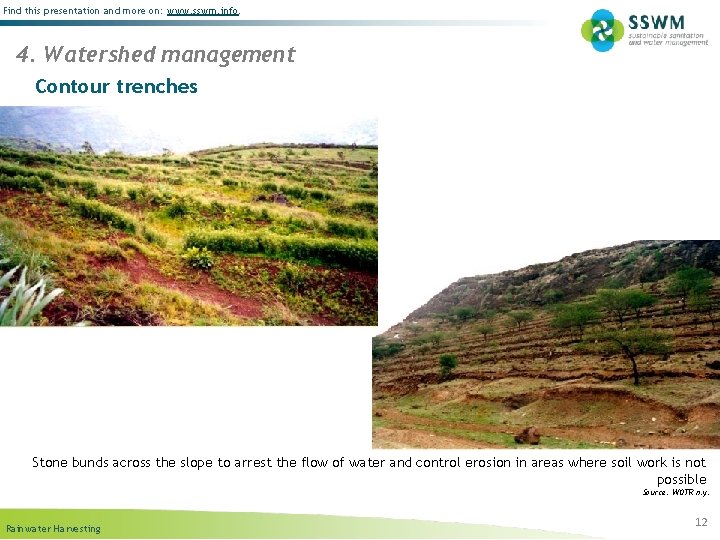
Find this presentation and more on: www. sswm. info. 4. Watershed management Contour trenches Stone bunds across the slope to arrest the flow of water and control erosion in areas where soil work is not possible Source: WOTR n. y. Rainwater Harvesting 12
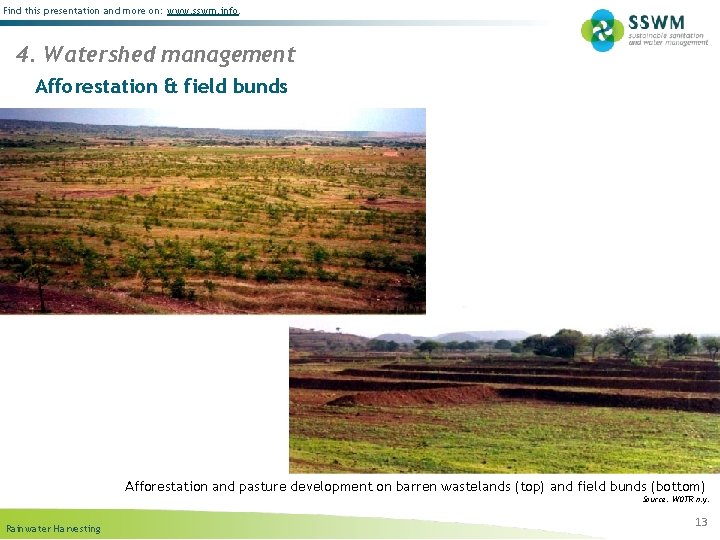
Find this presentation and more on: www. sswm. info. 4. Watershed management Afforestation & field bunds Afforestation and pasture development on barren wastelands (top) and field bunds (bottom) Source: WOTR n. y. Rainwater Harvesting 13
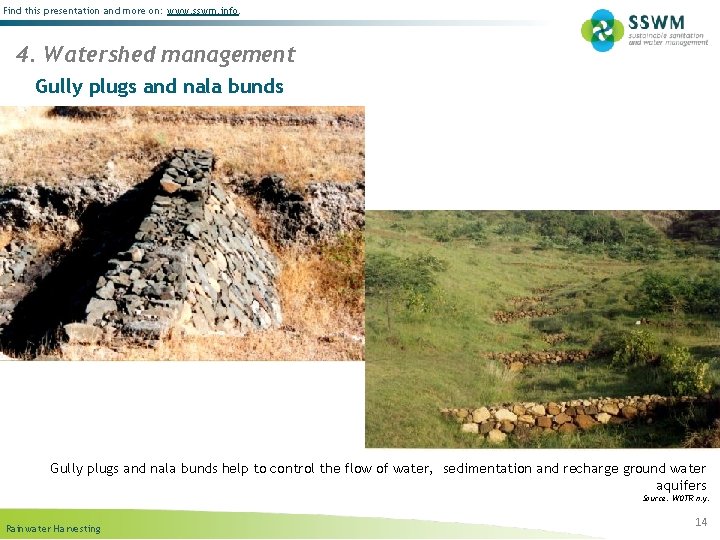
Find this presentation and more on: www. sswm. info. 4. Watershed management Gully plugs and nala bunds help to control the flow of water, sedimentation and recharge ground water aquifers Source: WOTR n. y. Rainwater Harvesting 14
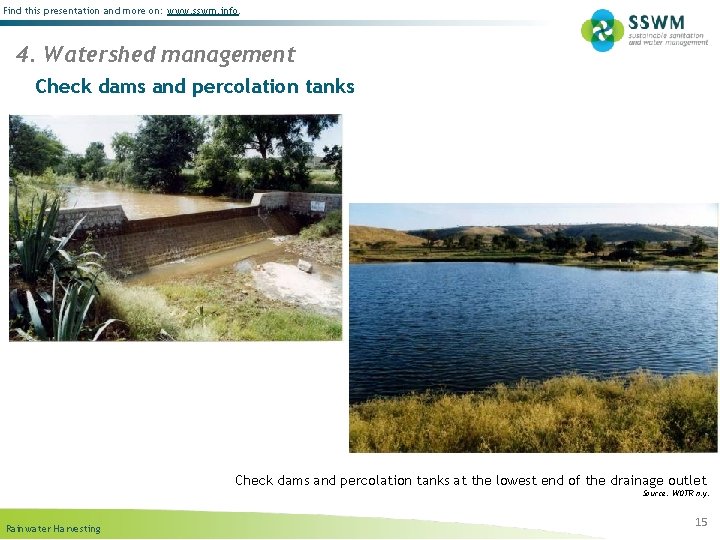
Find this presentation and more on: www. sswm. info. 4. Watershed management Check dams and percolation tanks at the lowest end of the drainage outlet Source: WOTR n. y. Rainwater Harvesting 15
Find this presentation and more on: www. sswm. info. 5. Applicability • water for domestic and agricultural purposes (e. g. drinking, irrigation, flushing toilet, etc. ) 6. Advantages and disadvantages Advantages: Disadvantages: • source of water where groundwater resources are unavailable or costly • Unreliable Rainwater Harvesting 16
Find this presentation and more on: www. sswm. info. 7. References MBUGUA, J. (2002): 7. Rain water harvesting. URL: http: //www. irc. nl/redir/content/download/128508/350879/file/TP 40_7%20 Rain%20 water%20 harvesti ng. pdf. In: SMET, J. , van WIJK, Ch. (2002): Small Community Water Supplies: Technology, people and partnership (=Technical Paper no 40). Available from: http: //www. irc. nl/page/1917 [Accessed 1. 6. 2010] Rainwater Harvesting 17
“Linking up Sustainable Sanitation, Water Management & Agriculture” SSWM is an initiative supported by: Compiled by: Rainwater Harvesting 18
- Slides: 18