
Rainbows and Halos Tony Signal IFS Massey University
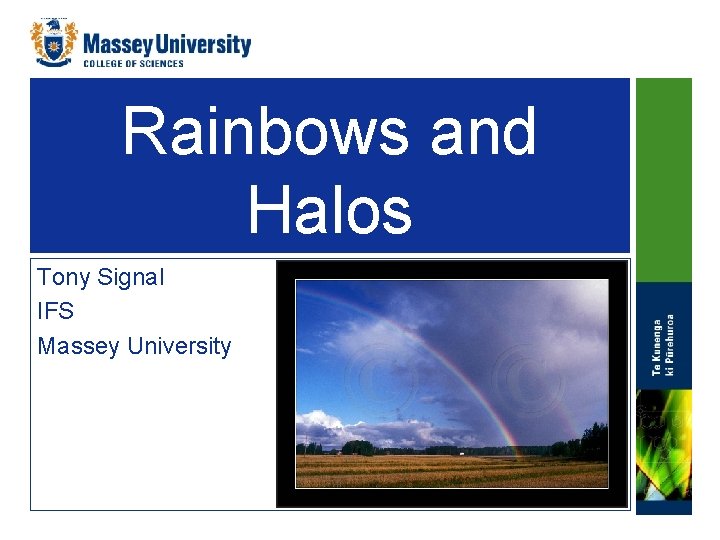
Rainbows and Halos Tony Signal IFS Massey University
Rainbows Formation of Rainbow depends on three optical phenomena • Refraction of light at boundary • Total Internal Reflection • Dispersion
Rainbows Formation of Rainbow depends on three optical phenomena • Refraction • Total Internal Reflection • Dispersion
Rainbows Formation of Rainbow depends on three optical phenomena • Refraction • Total Internal Reflection • Dispersion
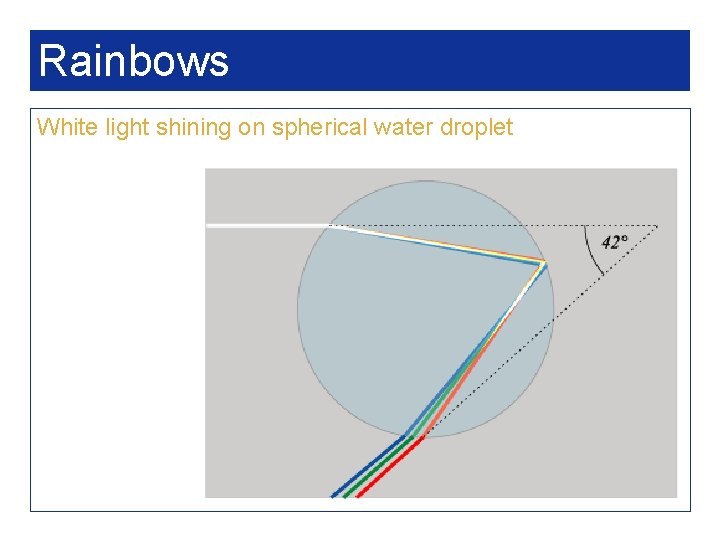
Rainbows White light shining on spherical water droplet
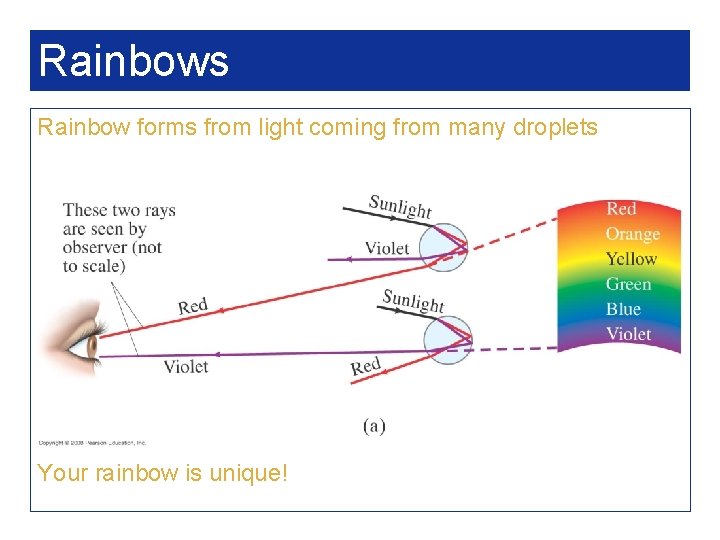
Rainbows Rainbow forms from light coming from many droplets Your rainbow is unique!
Rainbows
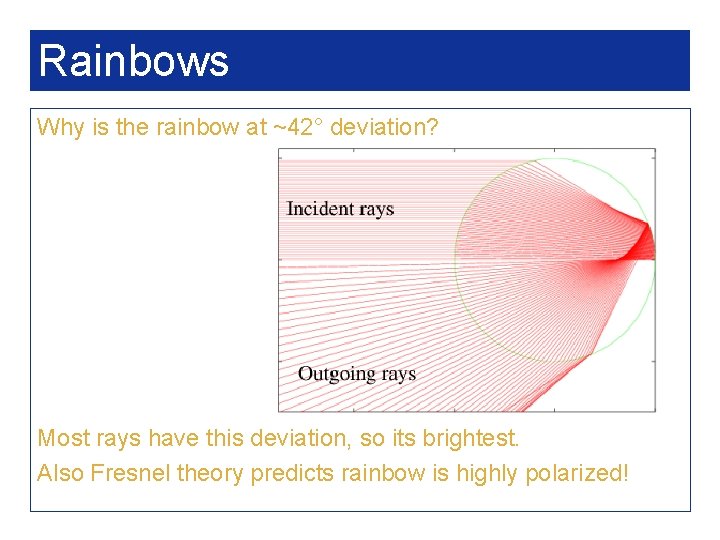
Rainbows Why is the rainbow at ~42° deviation? Most rays have this deviation, so its brightest. Also Fresnel theory predicts rainbow is highly polarized!
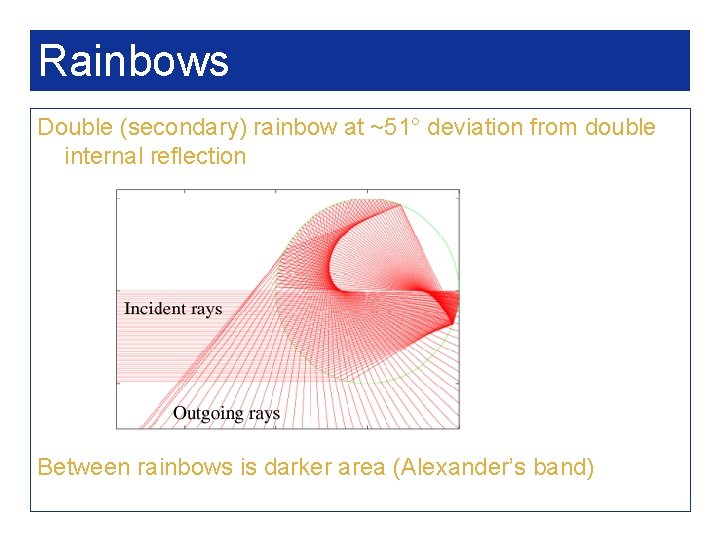
Rainbows Double (secondary) rainbow at ~51° deviation from double internal reflection Between rainbows is darker area (Alexander’s band)
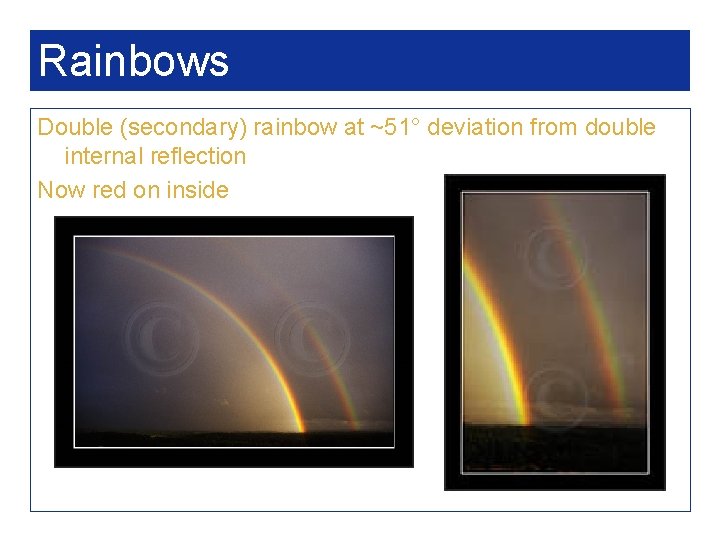
Rainbows Double (secondary) rainbow at ~51° deviation from double internal reflection Now red on inside
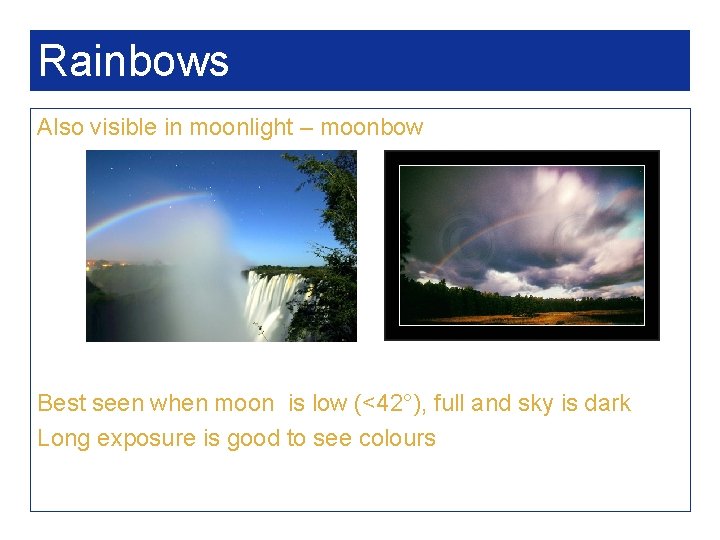
Rainbows Also visible in moonlight – moonbow Best seen when moon is low (<42°), full and sky is dark Long exposure is good to see colours
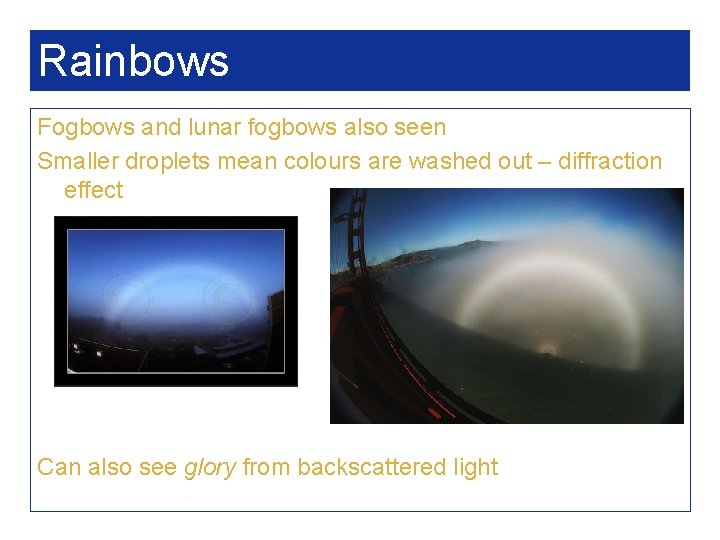
Rainbows Fogbows and lunar fogbows also seen Smaller droplets mean colours are washed out – diffraction effect Can also see glory from backscattered light
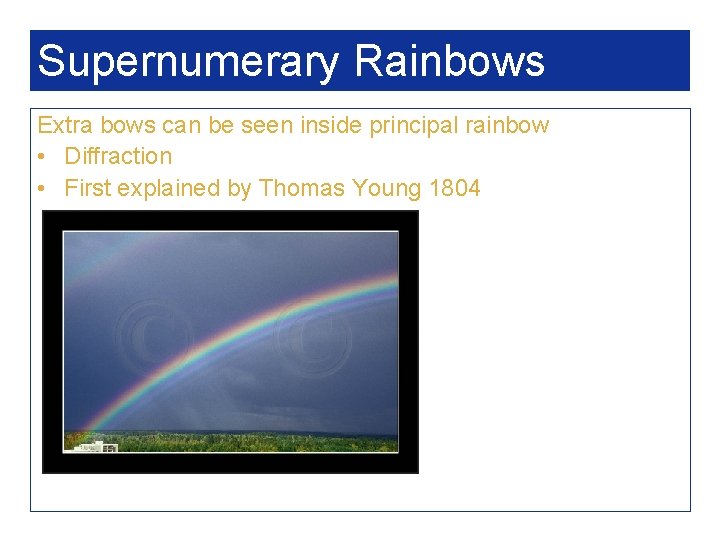
Supernumerary Rainbows Extra bows can be seen inside principal rainbow • Diffraction • First explained by Thomas Young 1804
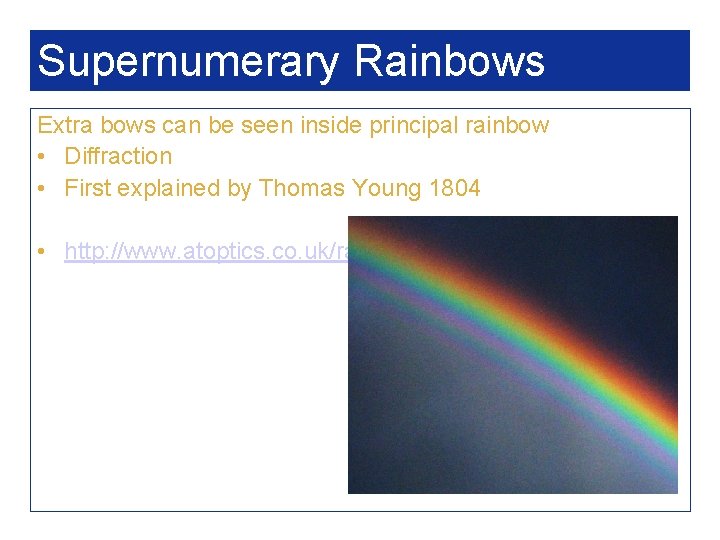
Supernumerary Rainbows Extra bows can be seen inside principal rainbow • Diffraction • First explained by Thomas Young 1804 • http: //www. atoptics. co. uk/rainbows/supdrsz. htm
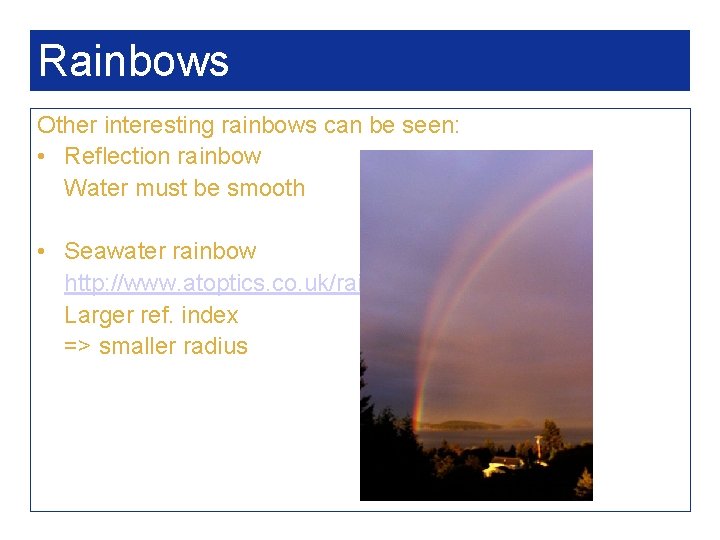
Rainbows Other interesting rainbows can be seen: • Reflection rainbow Water must be smooth • Seawater rainbow http: //www. atoptics. co. uk/rainbows/seabow. htm Larger ref. index => smaller radius
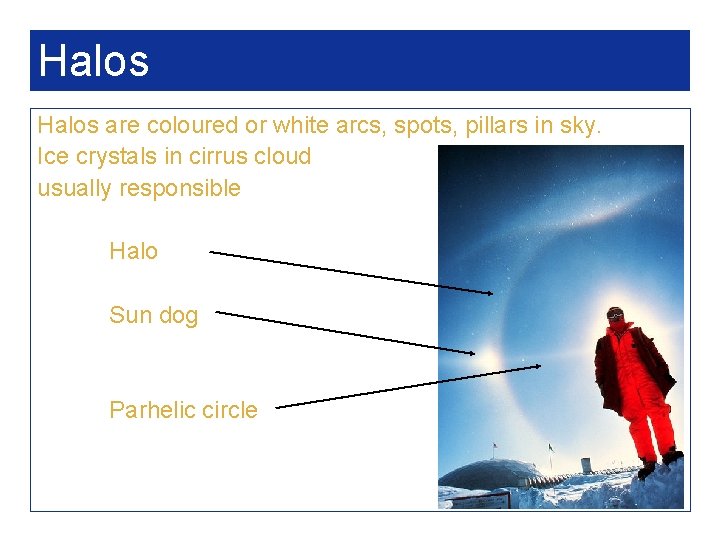
Halos are coloured or white arcs, spots, pillars in sky. Ice crystals in cirrus cloud usually responsible Halo Sun dog Parhelic circle
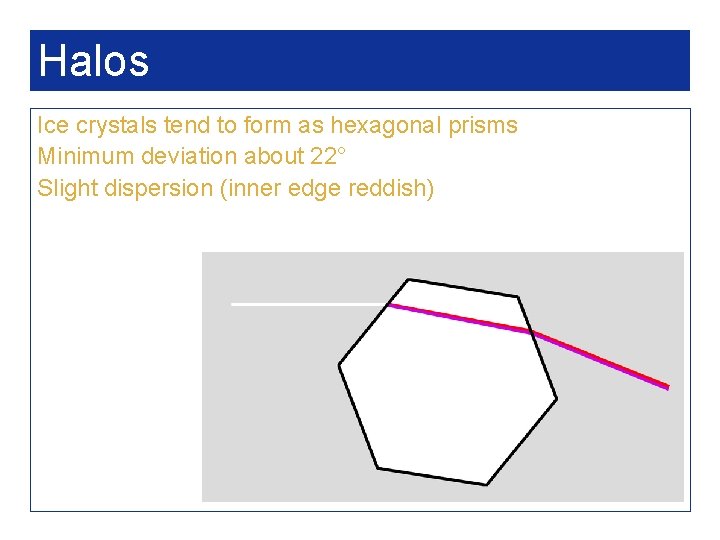
Halos Ice crystals tend to form as hexagonal prisms Minimum deviation about 22° Slight dispersion (inner edge reddish)
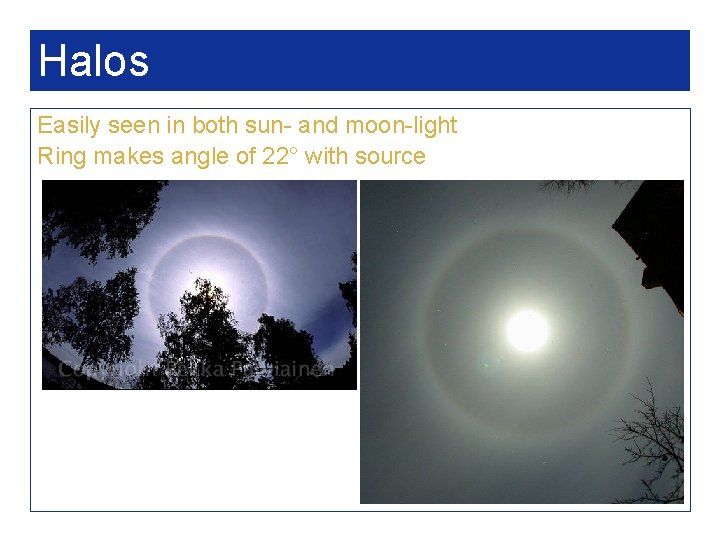
Halos Easily seen in both sun- and moon-light Ring makes angle of 22° with source
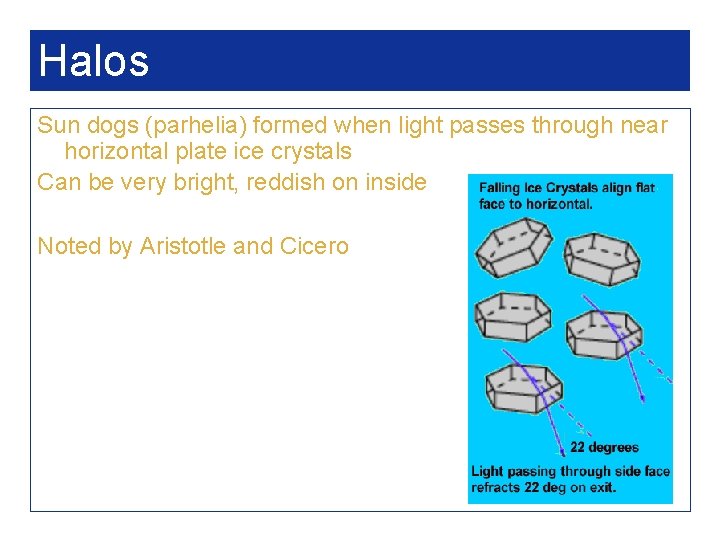
Halos Sun dogs (parhelia) formed when light passes through near horizontal plate ice crystals Can be very bright, reddish on inside Noted by Aristotle and Cicero
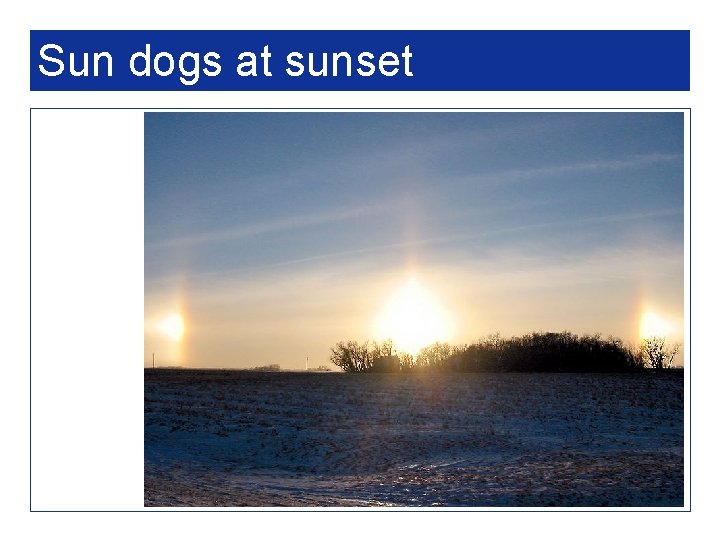
Sun dogs at sunset
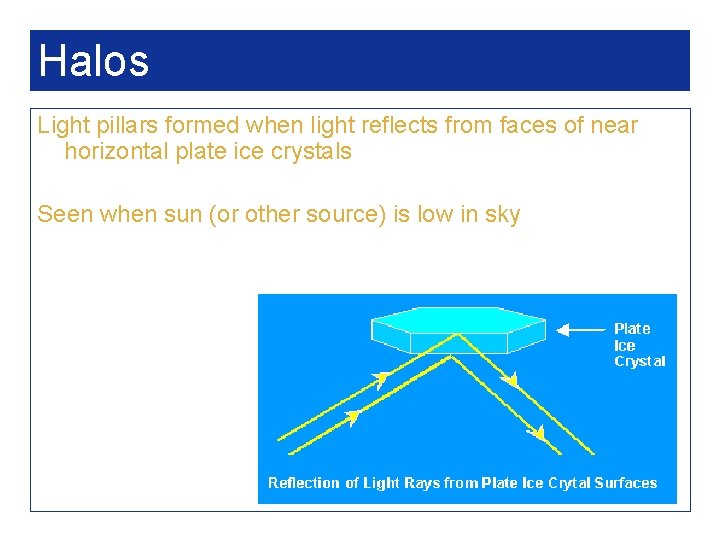
Halos Light pillars formed when light reflects from faces of near horizontal plate ice crystals Seen when sun (or other source) is low in sky
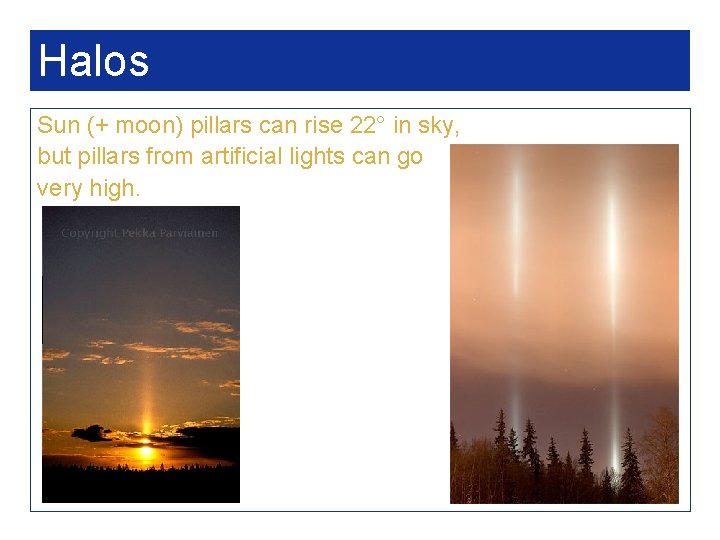
Halos Sun (+ moon) pillars can rise 22° in sky, but pillars from artificial lights can go very high.
More Information Classic text: Light and Color in the Outdoors, M. G. J. Minnaert (Springer, 1993) Good websites: • Atmospheric Optics www. atoptics. co. uk Simulations, clear explanations, many pictures • Polar Image, Pekka Parviainen’s site, 100’s of pictures www. polarimage. fi • The Weather Doctor www. islandnet. com/~see/weather/general/site_map. htm Nice figures, good explanations, pictures
- Slides: 23