
Rain Capture Solutions Pure and Soft Rain Water


- Slides: 21
Rain Capture Solutions Pure and Soft - Rain Water Harvesting
But Why Catch the Rain? It’s Free, Soft n Pure That’s Why !
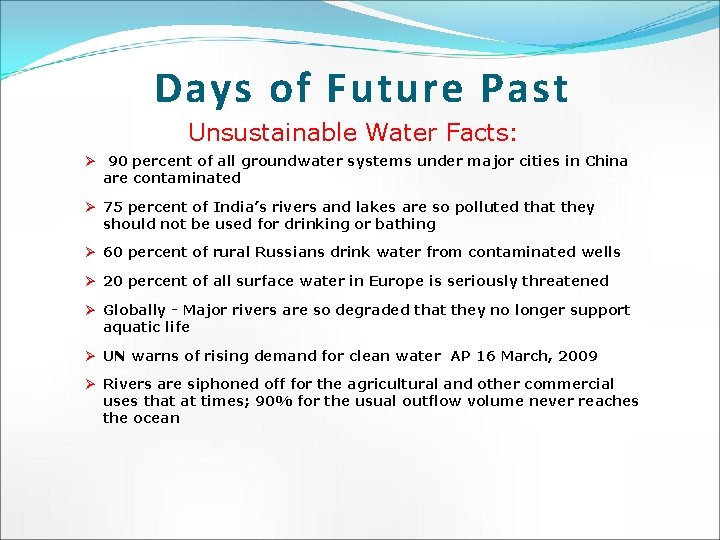
Days of Future Past Unsustainable Water Facts: Ø 90 percent of all groundwater systems under major cities in China are contaminated Ø 75 percent of India’s rivers and lakes are so polluted that they should not be used for drinking or bathing Ø 60 percent of rural Russians drink water from contaminated wells Ø 20 percent of all surface water in Europe is seriously threatened Ø Globally - Major rivers are so degraded that they no longer support aquatic life Ø UN warns of rising demand for clean water AP 16 March, 2009 Ø Rivers are siphoned off for the agricultural and other commercial uses that at times; 90% for the usual outflow volume never reaches the ocean
Black Gold to Blue Gold 1. Oil Tycoons: Now Drilling for Water! 2. Water Rights go for up to $45, 000 per acrefoot. (One square acre (208’ 9” per side by 1’ deep. ) 3. Warren Buffett's Berkshire Hathaway revealed a new position in one of the world's largest water-treatment companies. 4. Blue Gold - the largest opportunities will be in the private sector providing employment at the local level.
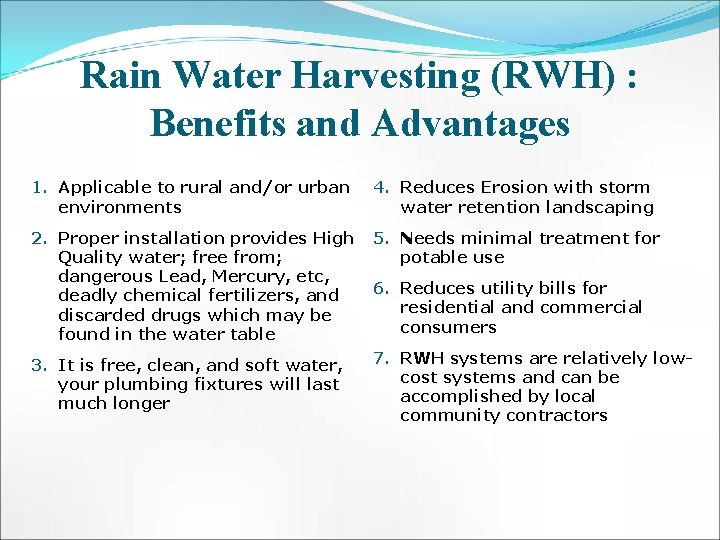
Rain Water Harvesting (RWH) : Benefits and Advantages 1. Applicable to rural and/or urban environments 4. Reduces Erosion with storm water retention landscaping 2. Proper installation provides High Quality water; free from; dangerous Lead, Mercury, etc, deadly chemical fertilizers, and discarded drugs which may be found in the water table 5. Needs minimal treatment for potable use 3. It is free, clean, and soft water, your plumbing fixtures will last much longer 7. RWH systems are relatively lowcost systems and can be accomplished by local community contractors 6. Reduces utility bills for residential and commercial consumers
Alternative Water Sources In urban areas where municipal water systems are available, RWH can be used to collect water for landscape irrigation. That will reduce the load on municipal water treatment systems, because there is no need to use filtered water for landscape irrigation. In suburban and rural areas where municipal systems may be difficult to implement or even non-existent, RWH can be used for providing domestic water supplies as well. Even though rainwater is extremely pure as it falls from the sky, it can collect dust and other impurities from the surface of the roof or through guttering systems. In Texas, simple treatment systems are used if the rainwater is being used for potable purposes. For example, a 5 micron sediment filter, followed by a carbon filter (to improve taste) and a disinfection system such as an ultraviolet light are used to help protect human health. Because RWH is recognized as a valuable source of alternate water supply, the State Legislature and many entities in Texas assist in promoting the practice. The Texas Legislature passed a bill in 2001 that exempted rainwater harvesting supplies and equipment from sales tax, which resulted in a cost reduction of about 8 percent to the consumer. Hays county in Central Texas provides additional benefits in terms of local property tax exemption for the RWH systems. The City of Austin provides discounted rain barrels at $45 each, and also provides cash rebates of up to $500 per customer if they install larger RWH systems.
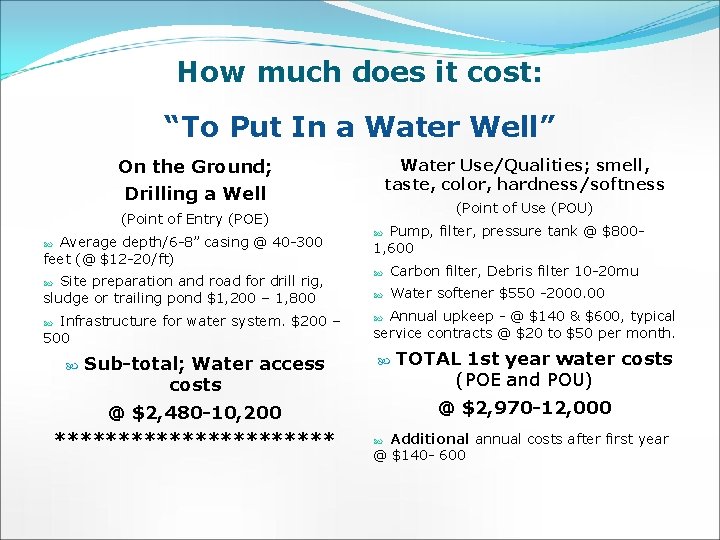
How much does it cost: “To Put In a Water Well” On the Ground; Water Use/Qualities; smell, taste, color, hardness/softness Drilling a Well (Point of Entry (POE) Average depth/6 -8” casing @ 40 -300 feet (@ $12 -20/ft) Site preparation and road for drill rig, sludge or trailing pond $1, 200 – 1, 800 (Point of Use (POU) Pump, filter, pressure tank @ $8001, 600 Carbon filter, Debris filter 10 -20 mu Water softener $550 -2000. 00 Infrastructure for water system. $200 – 500 Sub-total; Water access costs Annual upkeep - @ $140 & $600, typical service contracts @ $20 to $50 per month. @ $2, 970 -12, 000 @ $2, 480 -10, 200 *********** TOTAL 1 st year water costs (POE and POU) Additional annual costs after first year @ $140 - 600
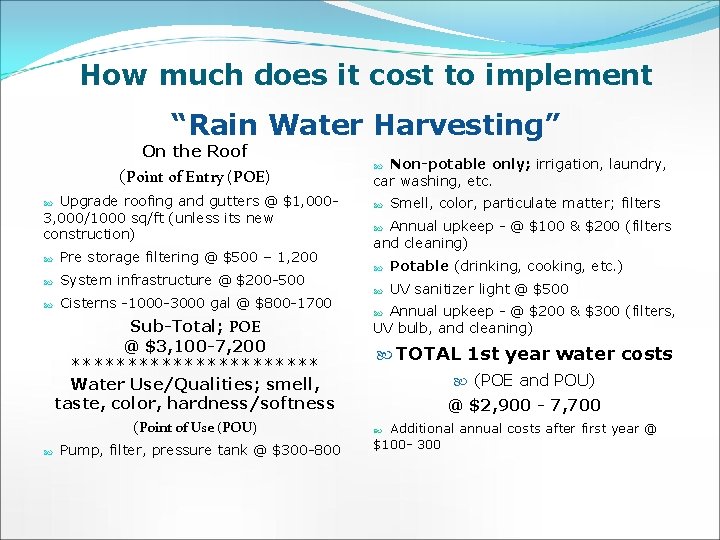
How much does it cost to implement “Rain Water Harvesting” On the Roof (Point of Entry (POE) Upgrade roofing and gutters @ $1, 0003, 000/1000 sq/ft (unless its new construction) Pre storage filtering @ $500 – 1, 200 System infrastructure @ $200 -500 Cisterns -1000 -3000 gal @ $800 -1700 Sub-Total; POE @ $3, 100 -7, 200 *********** Water Use/Qualities; smell, taste, color, hardness/softness (Point of Use (POU) Pump, filter, pressure tank @ $300 -800 Non-potable only; irrigation, laundry, car washing, etc. Smell, color, particulate matter; filters Annual upkeep - @ $100 & $200 (filters and cleaning) Potable (drinking, cooking, etc. ) UV sanitizer light @ $500 Annual upkeep - @ $200 & $300 (filters, UV bulb, and cleaning) TOTAL 1 st year water costs (POE and POU) @ $2, 900 - 7, 700 Additional annual costs after first year @ $100 - 300
Individual Water Needs Plan for required daily and annual volumes per capita? 1. Desired pressure - washing machines, irrigation , fire sprinkler systems, etc, (these systems require 25 -40 psi to operate effectively). 2. Number bathrooms - with sinks, deep tub, shower head, toilet, and/or a typical full bath arrangement - tub with shower head, sink, toilet, etc. 3. Kitchen appliances and fixtures – do you have of a double sink, garbage disposal, dish washer, a fridge with water tap & ice maker, dishwasher? 4. Do you have a washing machine? 5. Number of faucets on the outside of the house. 6. Do you generally drink bottled water & cook with tap water? 7. Do you wash both cars weekly? 8. How often do you water the lawn and/or water the garden, flowers and shrubs? 9. Do have a hot tub/spa, or a swimming pool that you fill several times a year?
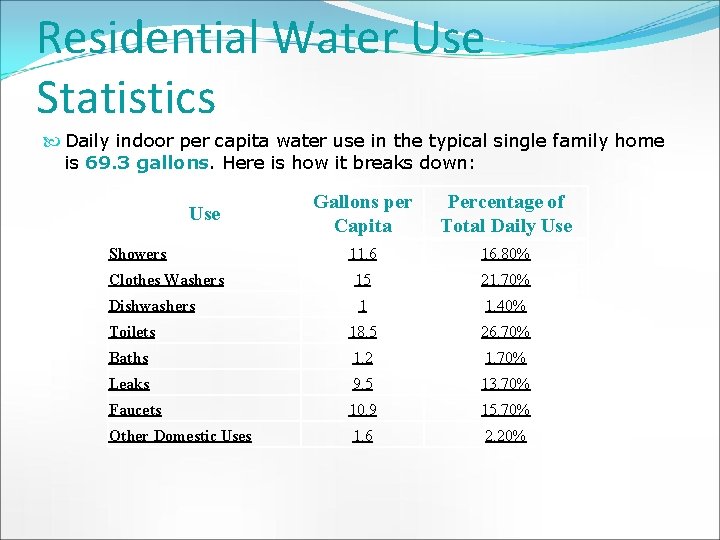
Residential Water Use Statistics Daily indoor per capita water use in the typical single family home is 69. 3 gallons. Here is how it breaks down: Gallons per Capita Percentage of Total Daily Use 11. 6 16. 80% Clothes Washers 15 21. 70% Dishwashers 1 1. 40% Toilets 18. 5 26. 70% Baths 1. 2 1. 70% Leaks 9. 5 13. 70% Faucets 10. 9 15. 70% Other Domestic Uses 1. 6 2. 20% Use Showers
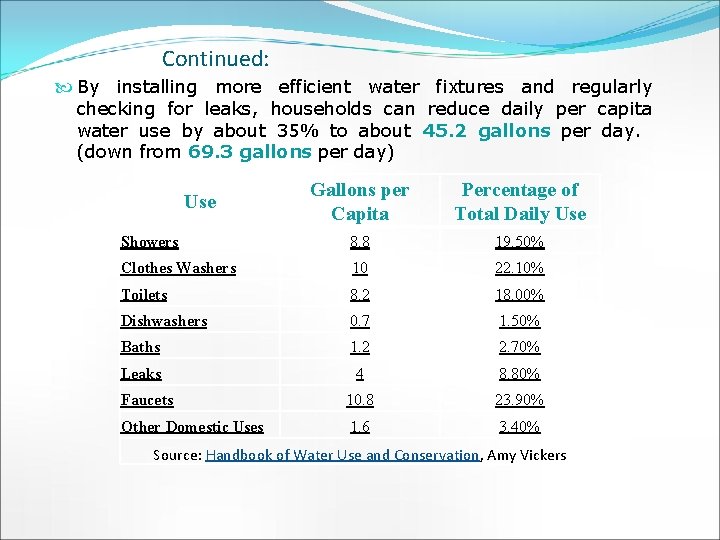
Continued: By installing more efficient water fixtures and regularly checking for leaks, households can reduce daily per capita water use by about 35% to about 45. 2 gallons per day. (down from 69. 3 gallons per day) Gallons per Capita Percentage of Total Daily Use Showers 8. 8 19. 50% Clothes Washers 10 22. 10% Toilets 8. 2 18. 00% Dishwashers 0. 7 1. 50% Baths 1. 2 2. 70% Leaks 4 8. 80% Faucets 10. 8 23. 90% Other Domestic Uses 1. 6 3. 40% Use Source: Handbook of Water Use and Conservation, Amy Vickers
Rainwater harvesting has a number of benefits and advantages, which go far beyond just the conservation methods.
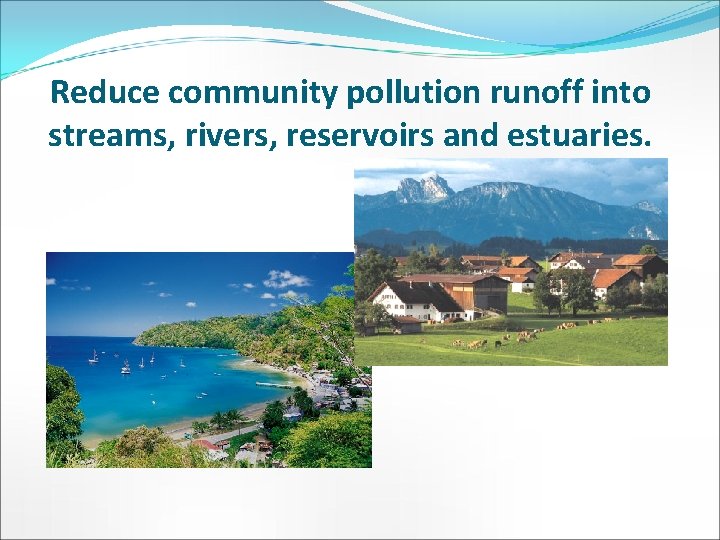
Reduce community pollution runoff into streams, rivers, reservoirs and estuaries.
Factories typically have a large roof covered footprint. An excellent source for capturing the rain Factories also require large paved parking, storage, and loading areas. Captured runoff would be excellent for emergency uses
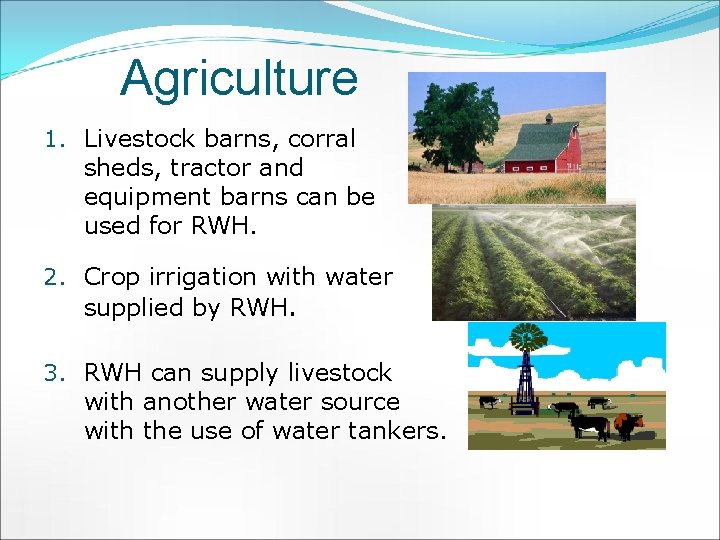
Agriculture 1. Livestock barns, corral sheds, tractor and equipment barns can be used for RWH. 2. Crop irrigation with water supplied by RWH. 3. RWH can supply livestock with another water source with the use of water tankers.
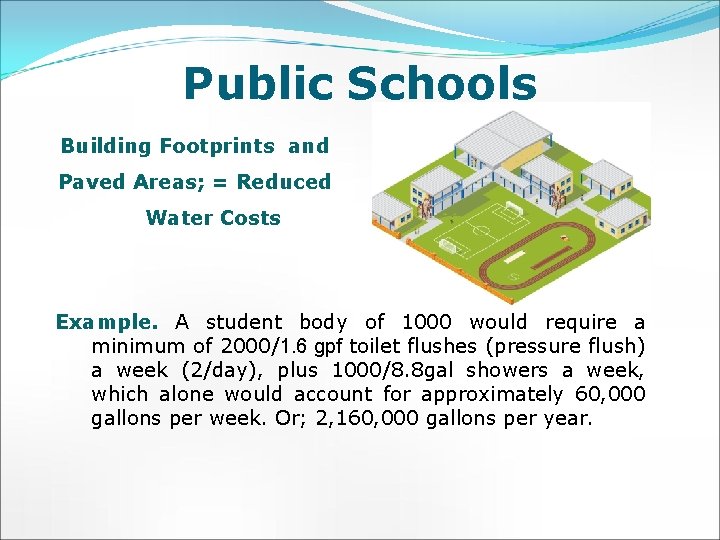
Public Schools Building Footprints and Paved Areas; = Reduced Water Costs Example. A student body of 1000 would require a minimum of 2000/1. 6 gpf toilet flushes (pressure flush) a week (2/day), plus 1000/8. 8 gal showers a week, which alone would account for approximately 60, 000 gallons per week. Or; 2, 160, 000 gallons per year.
Reduce Community Water Infrastructure Requirements RWH is recognized as a valuable source of alternate water supplies. Some communities offer subsidies to users to adopt this alternative water supply. They can do so not only because the communities budget would be reduced by present consumptions, costs of renovations, and adding new capacities. These cost reductions include: 1. 2. 3. 4. 5. 6. 7. Reservoir expansion. Well drilling. Heavy equipment for Laying new Pipelines. Expanding Water Treatment Facilities. Increased use of Chemical treatment. Costs of; Pipelines, Valves, etc. Storage Facilities, etc. (NOTE: Reduction in the above infrastructure requirements, can be used to relate to Energy Carbon Credits)
Enhance Rural and Urban Environments There are many ways a home owner, Community Parks and Recreation, and other agencies can enhance their environment, and at the same time, profiting from this free and natural resource; “Rain Water”. The factory owner, and farmer can also profit with an initial small investment by planning their own water saving landscaping, by reducing pollution and erosion. It’s called “Xeriscaping”. The fundamental element of Xeriscape design is water conservation.
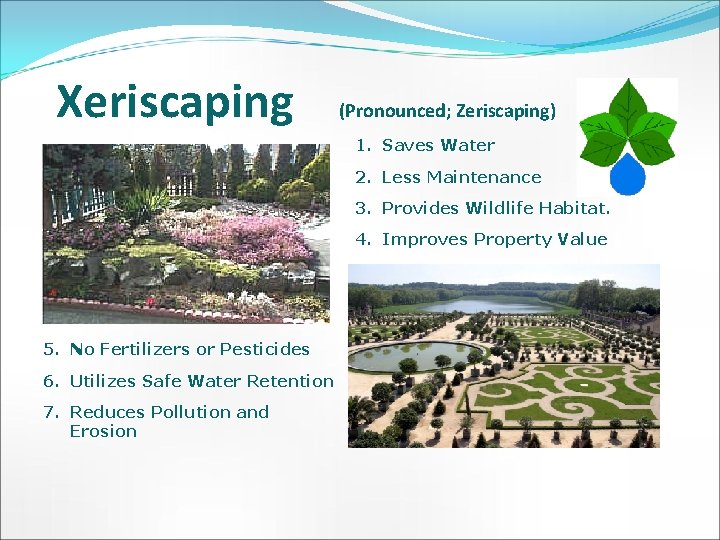
Xeriscaping (Pronounced; Zeriscaping) 1. Saves Water 2. Less Maintenance 3. Provides Wildlife Habitat. 4. Improves Property Value 5. No Fertilizers or Pesticides 6. Utilizes Safe Water Retention 7. Reduces Pollution and Erosion
7 Principles of Xeriscaping The Fundamental Elements of Xeriscape Design are: 1. Water Conservation 2. Soil Improvement 3. Create Limited Turf Areas 4. Porous Path and Road Surfaces 5. Use of Appropriate Plants 6. Mulching Methods 7. Irrigation Techniques Provides: Low Maintenance of your landscape
Key Statements to Ponder Rain water qualities Just say no to lawn watering and car washing bans Residential water use Commercial water use Agricultural water use Rainwater harvesting has a number of benefits and advantages Reduce community pollution run off into streams, rivers, reservoirs and estuaries Upgrade schools and factories cost effectively Reduce community water infrastructure requirements Enhance rural and urban environments It is applicable to rural and/or urban environments High quality water (p. H neutral or slightly acidic) Soft water (excellent for showers, washing, etc) Needs minimal treatment for potable use Relatively low-cost systems Reduces utility bills for consumers Can delay costly expansion of municipal water treatment systems