
RAILWAYS EVOLUTION ROLE AND GROWTH TRENDS INTRODUCTION Indian


- Slides: 30
RAILWAYS: EVOLUTION, ROLE AND GROWTH TRENDS
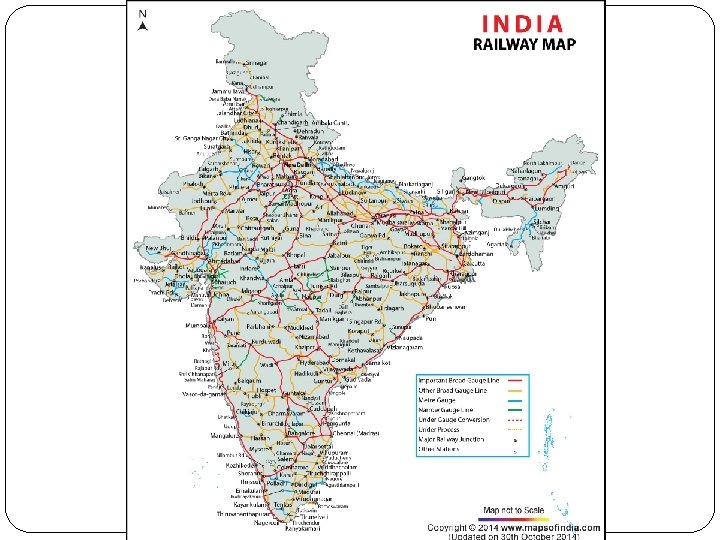
INTRODUCTION � Indian Railways is an Indian state-owned enterprise, owned and operated by the Government of India through the Ministry of Railways. � It is one of the world's largest railway networks comprising 115, 000 km (71, 000 mi) of track over a route of 65, 436 km (40, 660 mi) and 7, 172 stations. � In 2014 -15, IR carried 8. 397 billion passengers annually or more than 23 million passengers a day (roughly half of whom were suburban passengers) and 1050. 18 million tons of freight in the year. In 2014 – 2015 Indian Railways had revenues of 1634. 50 billion (US$26 billion) which consists of 1069. 27 billion (US$17 billion) from freight and 402. 80 billion(US$6. 3 billion) from passengers tickets.
CONTD. � Railways were first introduced to India in the year 1853 from Bombay to Thane. � In 1951 the systems were nationalized as one unit, the Indian Railways, becoming one of the largest networks in the world. IR operates both long distance and suburban rail systems on a multigauge network of broad, metre and narrow gauges. � It also owns locomotive and coach production facilities at several places in India and are assigned codes identifying their gauge, kind of power and type of operation. � Its operations cover twenty nine states and seven union territories and also provides limited international services to Nepal, Bangladesh and Pakistan.
EVOLUTION � The first railway on Indian sub-continent ran over a stretch of 21 miles from Bombay to Thane. � The first passenger train steamed out of Howrah station destined for Hooghly, a distance of 24 miles, on 15 th August, 1854. � In south the first line was opened on Ist July, 1856 by the Madras Railway Company. It ran between Vyasarpadi Jeeva Nilayam (Veyasarpandy) and Walajah Road (Arcot), a distance of 63 miles. In the North a length of 119 miles of line was laid from Allahabad to Kanpur on 3 rd March 1859. � These were the small beginnings which is due course developed into a network of railway lines all over the country. By 1880 the Indian Railway system had a route mileage of about 9000 miles. INDIAN RAILWAYS, the premier transport organization of the country is the largest rail network in Asia and the world's second largest under one management.
VITAL STATISTICS � The total approximate earnings of Indian Railways on originating basis during 1 st April 2014 to 30 th November 2014 were Rs 100, 622 crore (US$ 1. 72 billion) compared to Rs 89, 341. 26 crore (US$ 14. 49 billion) during the same period last year, registering an increase of 12. 63 per cent. The total approximate earnings from goods during April 1, 2014–November 30, 2014 were Rs 67, 130. 96 crore (US$ 10. 89 billion) compared to Rs 60, 144. 16 crore (US$ 9. 76 billion) during the same period last year, registering an increase of 11. 62 per cent. � The total approximate revenue earnings from passengers during April 1, 2014– November 30, 2014 were Rs 28, 510. 24 crore (US$ 4. 62 billion) compared to Rs 24, 523. 71 crore (US$ 3. 97 billion) during the same period last year, registering an increase of 16. 26 percent. � The approximate revenue earnings from other coaching amounted to Rs 2, 669. 55 crore (US$ 433. 05 million) during April – November 2014 compared to Rs 2, 515. 78 crore (US$ 408. 16 million) during the same period last year, registering an increase of 6. 11 per cent. � The Indian Railways has generated Rs 66, 211. 42 crore (US$ 10. 74 billion) of revenue earnings from commodity-wise freight traffic during April-November 2014 as compared to Rs 59, 069. 73 crore (US$ 9. 58 billion) during the corresponding period last year, registering an increase of 12. 09 per cent. Railways carried 713. 11 million tonnes (MT) of commodity-wise freight traffic during April. November 2014 as compared to 677. 58 MT carried during the corresponding
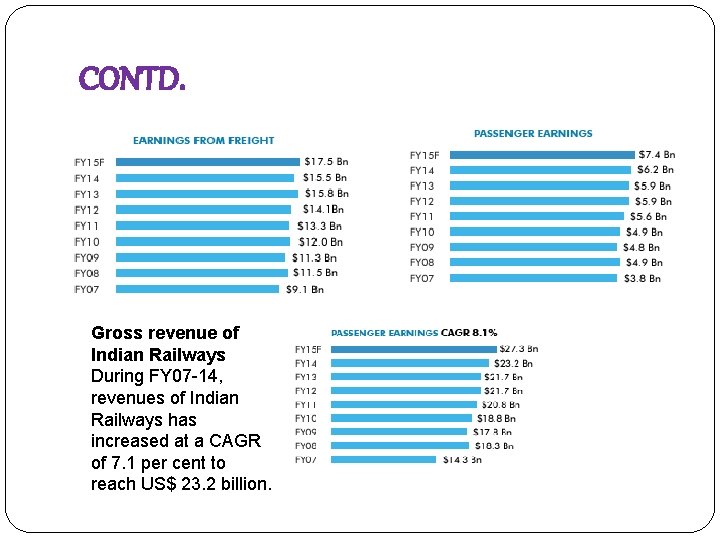
CONTD. Gross revenue of Indian Railways During FY 07 -14, revenues of Indian Railways has increased at a CAGR of 7. 1 per cent to reach US$ 23. 2 billion.
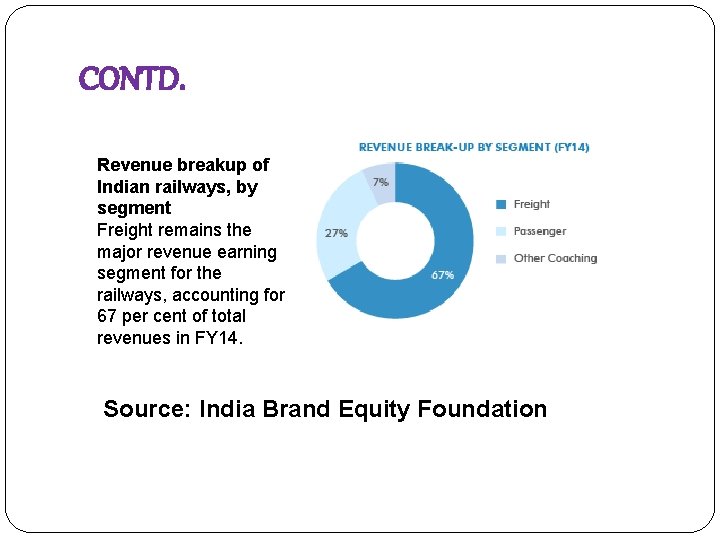
CONTD. Revenue breakup of Indian railways, by segment Freight remains the major revenue earning segment for the railways, accounting for 67 per cent of total revenues in FY 14. Source: India Brand Equity Foundation
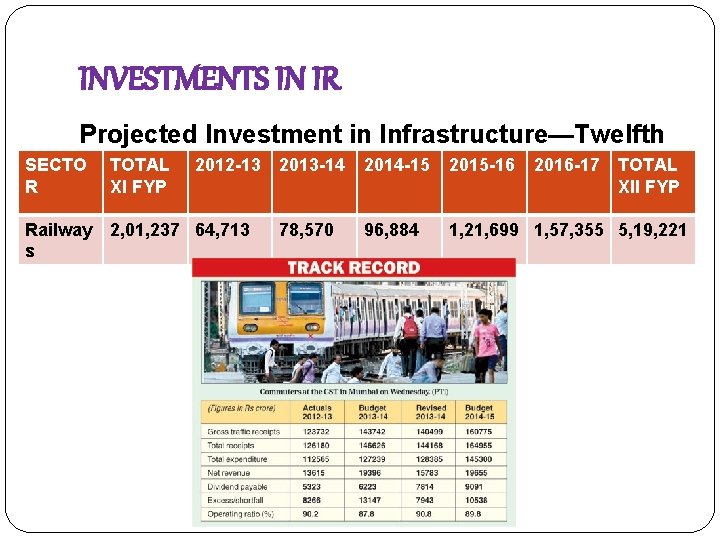
INVESTMENTS IN IR Projected Investment in Infrastructure—Twelfth SECTO Plan TOTAL 2012 -13 2013 -14 2014 -15 2015 -16 2016 -17 TOTAL R XI FYP Railway 2, 01, 237 64, 713 s XII FYP 78, 570 96, 884 1, 21, 699 1, 57, 355 5, 19, 221
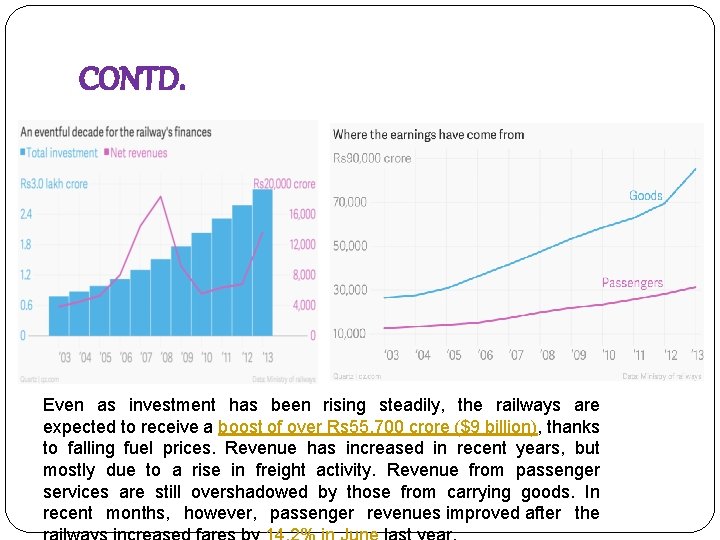
CONTD. Even as investment has been rising steadily, the railways are expected to receive a boost of over Rs 55, 700 crore ($9 billion), thanks to falling fuel prices. Revenue has increased in recent years, but mostly due to a rise in freight activity. Revenue from passenger services are still overshadowed by those from carrying goods. In recent months, however, passenger revenues improved after the
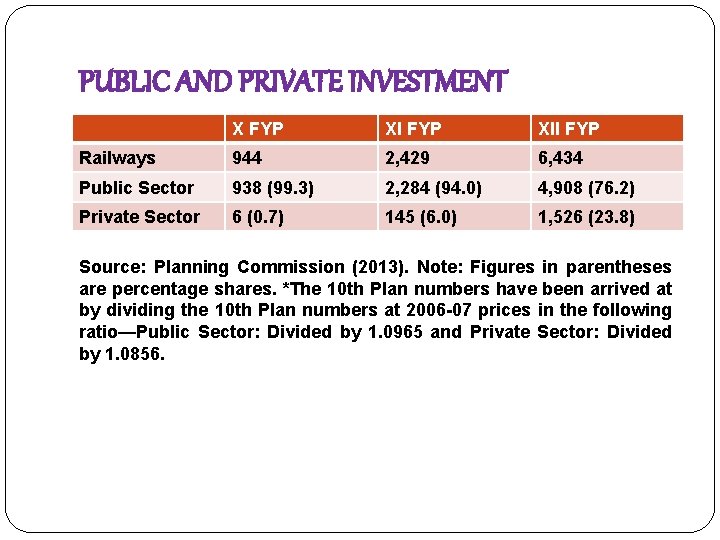
PUBLIC AND PRIVATE INVESTMENT X FYP XII FYP Railways 944 2, 429 6, 434 Public Sector 938 (99. 3) 2, 284 (94. 0) 4, 908 (76. 2) Private Sector 6 (0. 7) 145 (6. 0) 1, 526 (23. 8) Source: Planning Commission (2013). Note: Figures in parentheses are percentage shares. *The 10 th Plan numbers have been arrived at by dividing the 10 th Plan numbers at 2006 -07 prices in the following ratio—Public Sector: Divided by 1. 0965 and Private Sector: Divided by 1. 0856.
NOTABLE TRENDS IN IR � Demand for urban transport: There is a rapid increase in demand for urban mass transportation systems in the country. Several metro rail projects are in progress to improve connectivity within cities. � Mobile Ticketing: Indian railways (IR) launched mobile ticketing services in August 2011 to make the ticket issuing process more efficient. Users can directly buy a ticket from their mobiles that would be delivered to them through a non-transferable SMS. � International Investment: IR has attracted increasing investments from overseas through strategic alliances with various countries over the last few years. Subsidiaries of foreign companies are being set up to cater to the huge demand offered by Indian Railways. � High Speed Rails: IR is planning to build six high-speed rail corridors to provide faster rail connectivity across the country. The trains will be capable of running at speeds up to 300 kilometre per hour.
MAKE IN INDIA: REASONS TO INVEST � 100% FDI in the railway infrastructure segment has been allowed recently which � � � has opened up opportunities for participation in infrastructure projects such as high-speed railways, railway lines to and from coal mines and ports, projects relating to electrification, high-speed tracks and suburban corridors. Indian Railways has begun exploring the PPP mode of delivery and aims to award projects worth USD 1, 000 Billion through the PPP route. The sector aims to boost passenger amenities by involving PPP investments in provision of foot-over bridges, escalators and lifts at all major stations. Last-mile connectivity to boost business activity in and around ports and mines has been proposed through the formation of special purpose vehicle (SPV) companies under the Public Private Partnership (PPP) model. The Indian Railways aims to involve private equity through individuals, NGOs, trusts, charitable institutions, corporates, etc. to provide passenger amenities such as battery-operated carts to facilitate movement for senior citizens and differently abled, at stations. To strengthen rail connectivity with various ports, IR has floated SPVs under the PPP mode. Pipavav Rail Corporation Ltd. , Bharuch-Dahej Railway Company Ltd. , Kutch Railway Company Ltd. , Hassan-Mangalore Rail Development Company, Obullavaripalle-Krishnapatnam Railway Company Ltd. , and Anugul. Sukinda Railway Company Ltd. , have been established. Three rail connectivity projects namely Gevra Road-Pendra Road new line, Raigarh-Bhupdeopur new line and Jaigarh Port connectivity projects are being implemented through the joint venture route.
GROWTH DRIVERS: � The long-term strategic plan of the Ministry of Railways is to construct � � � six high-capacity, high-speed dedicated freight corridors along the Golden Quadrilateral and its diagonals. The 2014– 15 Union Budget envisages a diamond quadrilateral network of high speed rail, connecting major metros and growth centres of the country. During the period of 2012 -17, Mass Rapid Transit Systems (MRTS) projects are being planned in Ahmedabad, Bengaluru, Hyderabad, Chandigarh, Chennai, Delhi, Jaipur, Kochi, Kolkata, Mumbai, Patna, Pune, Lucknow and Surat through the PPP model. Rail tourism is on the anvil, with emphasis on the introduction of ecotourism and education tourism in the North-eastern states, the identification of special pilgrim circuits such as the Devi Circuit, the Jyotirling Circuit, the Jain Circuit, the Christian Circuit, the Sufi Circuit, the Sikh Circuit, the Buddhist Circuit, and the Temple Circuit. Specially packaged trains for these circuits have been proposed and private participation will be encouraged. The development of identified stations to international standards with modern facilities and passenger amenities on the lines of newly developed airports, through PPP mode. A proposal is in place to harness solar energy by utilizing rooftop spaces of railway stations, other railway buildings and land, through the PPP
FDI POLICY: 100% FDI under automatic route is permitted for the following: � Construction, operation and maintenance of sub-urban corridor projects through PPP. � High speed train projects. � Dedicated freight lines. � Rolling stock including train sets and locomotive/coaches manufacturing and maintenance facilities. � Railway electrification. � Signaling systems. � Freight terminals. � Passenger terminals. � Infrastructure in industrial parks pertaining to railway line/siding including electrified railway lines and connectivity to main railway line. � Mass Rapid Transport Systems.
FINANCIAL SUPPORT: STATE INCENTIVES: � State governments offer additional incentives for industrial projects. Incentives are in areas such as rebates in land cost, relaxation in stamp duty on the sale or lease of land, power tariff incentives, concessional rates of interest on loans, investment subsidies/tax incentives, backward areas subsidies and special incentive packages for mega projects. EXPORT INCENTIVES: � Various kinds of incentives on exports are available under foreign trade policy. AREA-BASED INCENTIVES: � Incentives for units in SEZ/NIMZ as specified in respective Acts or setting up of projects in special areas such as the North-east, Jammu & Kashmir, Himachal Pradesh & Uttarakhand. TAX INCENTIVES: R&D INCENTIVES: � Industry/private sponsored research programs: a weighted tax deduction is given under section 35 (2 AA) of the Income Tax Act. Weighted deduction of 200% is granted to assesses for any sums paid to a national laboratory, university or institute of technology, or specified persons with a specific direction, provided that the said sum would be used for scientific research within a program approved by the prescribed authority. � Companies engaged in manufacture, having an in-house R&D centre. Weighted tax deduction of 200% under section 35 (2 AB) of the Income Tax Act for both capital and revenue expenditure incurred on scientific research and development. (Expenditure on land buildings are not eligible for deduction).
IR VISION 2020 This was presented by then Railway Minister Mamata Bannerjee in the year 2009. � VISION 2020 will address four strategic national goals: � Inclusive development, both geographically and socially; � Strengthening national integration; � Large-scale generation of productive employment; and � Environmental sustainability. Basic Approach � Growth with Jobs and not Jobless Growth. Productive employment opportunities � � must be created for all able-bodied Indians, especially for our youth and preferably in their own habitats. Reducing hazardous carbon emissions that have triggered climate change. Gross Revenue of the Indian Railways has remained at a level of around 1. 2% of India's GDP over the last 10 years. Our Vision is to take it to 3% in the next 10 years. Segregation of freight and passenger services, creation of adequate capacity and raising of speeds of both services would be a key challenge if Indian Railways are to retain their market share and improve upon it. To realize this potential, the Indian Railways must achieve annual growth of 10% over the next 10 years. Vision proposes to add 25, 000 kms of New Lines by 2020, supported by government funding and a major increase in Public Private Partnerships (PPPs). This includes the completion of the backlog of 11, 985 kms of lines already sanctioned.
ROLE OF IR IN ECONOMIC DEVELOPMENT � Since its inception, the Indian Railways has served to integrate the fragmented markets and thereby, stimulating the emergence of a modern market economy. � It connects industrial production centers with markets and with sources of raw materials and facilitates industrial development and link agricultural production centers with distant markets. � It provides rapid, reliable and cost-effective bulk transportation to the energy sector. � It links places, enabling large-scale, rapid and lowcost movement of people across the length and breadth of the country. � In the process, the Indian Railways has become a symbol of national integration and a strategic instrument for enhancing our defense preparedness.
CONTD. � The Indian Railways contributes to India's economic development, � � � accounting for about one per cent of the GNP and the backbone of freight needs of the core sector. It accounts for six per cent of the total employment in the organised sector directly and an additional 2. 5 per cent indirectly through its dependent organizations. The Railways has developed indigenous capacity for rolling stock manufacture, including state-of-the-art electric and diesel locomotives and high-speed passenger coaches. It has introduced high-speed Rajdhani and Shatabdi Express trains and Mass Rapid Transit Systems in the metropolitan areas. The Railways is sharpening its Marketing Capability to attract more and more freight and passenger business through constructive pricing mechanisms and tariff rationalization and through customer focus. The Indian Railways has strengthened the high density network to make the system capable of meeting the projected demands of the freight and passenger business. It practices austerity especially in the areas of energy consumption, material management, overtime, travelling allowance and advertisements. It tries to reduce operating costs by improving efficiency in production and maintenance units; by improving the purchasing procedures not only to secure cost reduction but also to improve reliability; by reduction in man power in a phased manner and by improving organizational excellence through human resource development.
CONTD. � For tapping non-traditional sources of funding, the Railways has taken steps to attract external funding by involving domestic financial institutions and private sector participants at concessional rates of interest. The Indian Railways has a glorious past and has achieved a phenomenal growth in both freight and passenger traffic by improving asset utilization and efficiency of operations. The time has come when massive investments are required for expanding the rail infrastructure and give the Railways its due share in the country's infrastructure development.
ECONOMIC SURVEY 2015 � The Economic Survey recommended that the government should revive public investment in services like the Railways which can act as a 'key engine of growth' in the short run. However, it had a caveat: all funds have to be reform-linked. � The Survey says that public investment in an efficient rail network can have positive effect on both manufacturing and aggregate output and the effects are permanent. � The survey has advocated the need for "a bold, accelerated programme of investment in dedicated freight corridors (DFCs) that can parallel the Golden Quadrilateral in the road sector along with associated industrial corridors. “ � It advocated spending on the railways on the grounds that it would link markets, reduce costs and give a boost to manufacturing which was logistics intensive. � However, the survey is clear that funding for the railways should only be for commercially viable projects.
RAILWAY BUDGET 2015 -16 � Thrust: � IR to become prime mover of economy once again Resource � Mobilization for higher � Investments � Decongestion of heavy haul routes and speeding up of trains: emphasis on gauge conversion, doubling, tripling and electrification � Project delivery � Passenger Amenities � Safety � Transparency & System Improvement � Railways to continue to be the preferred � mode of transport for the masses � Sustainability.
CONTD. Four goals for Indian Railways to transform over next five years: a) To deliver a sustained and measurable improvement in customer experience. b) To make Rail a safer means of travel. c)To expand Bhartiya Rail’s capacity substantially and modernise infrastructure. : increase daily passenger carrying capacity from 21 million to 30 million: increase track length by 20% from 1, 14, 000 km to 1, 38, 000 km: grow our annual freight carrying capacity from 1 billion to 1. 5 billion tonnes. d) Finally, to make Bhartiya Rail financially selfsustainable. Generate large surpluses from operations not only to service the debt needed to fund our capacity expansion, but also to invest on an on-going basis to replace our depreciating assets.
FINANCIAL PERFORMANCE OF 2014 -15 � Net reduction in Gross Traffic Receipts by Rs 917 crore compared to the BE of Rs 1, 60, 165 crore. � Growth in Ordinary Working Expenses (O. W. E) scaled down to 11. 7% as against BE of 15. 5% y-o-y. � Appropriation to the Pension Fund has been increased to Rs. 29, 540 crore in RE. � After taking into account the above, "Excess" of receipts over expenditure stands at Rs 7, 278 crore in RE 2014 -15 reflecting better financial management. � Plan size for 2014 -15 increased from Rs 65, 445 crore in the B. E to Rs 65, 798 crore in the � Revised Estimates i. e. by Rs 353 crore with higher provisions under internal resource component and market borrowings for rolling stock requirement.
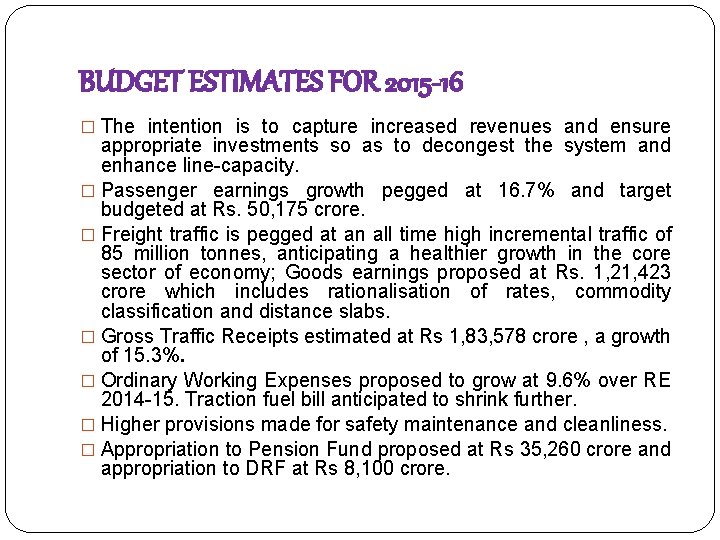
BUDGET ESTIMATES FOR 2015 -16 � The intention is to capture increased revenues and ensure appropriate investments so as to decongest the system and enhance line-capacity. � Passenger earnings growth pegged at 16. 7% and target budgeted at Rs. 50, 175 crore. � Freight traffic is pegged at an all time high incremental traffic of 85 million tonnes, anticipating a healthier growth in the core sector of economy; Goods earnings proposed at Rs. 1, 21, 423 crore which includes rationalisation of rates, commodity classification and distance slabs. � Gross Traffic Receipts estimated at Rs 1, 83, 578 crore , a growth of 15. 3%. � Ordinary Working Expenses proposed to grow at 9. 6% over RE 2014 -15. Traction fuel bill anticipated to shrink further. � Higher provisions made for safety maintenance and cleanliness. � Appropriation to Pension Fund proposed at Rs 35, 260 crore and appropriation to DRF at Rs 8, 100 crore.
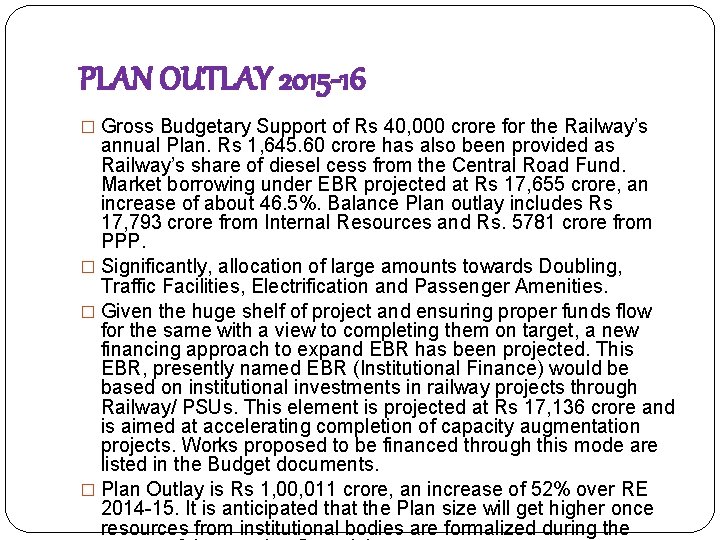
PLAN OUTLAY 2015 -16 � Gross Budgetary Support of Rs 40, 000 crore for the Railway’s annual Plan. Rs 1, 645. 60 crore has also been provided as Railway’s share of diesel cess from the Central Road Fund. Market borrowing under EBR projected at Rs 17, 655 crore, an increase of about 46. 5%. Balance Plan outlay includes Rs 17, 793 crore from Internal Resources and Rs. 5781 crore from PPP. � Significantly, allocation of large amounts towards Doubling, Traffic Facilities, Electrification and Passenger Amenities. � Given the huge shelf of project and ensuring proper funds flow for the same with a view to completing them on target, a new financing approach to expand EBR has been projected. This EBR, presently named EBR (Institutional Finance) would be based on institutional investments in railway projects through Railway/ PSUs. This element is projected at Rs 17, 136 crore and is aimed at accelerating completion of capacity augmentation projects. Works proposed to be financed through this mode are listed in the Budget documents. � Plan Outlay is Rs 1, 00, 011 crore, an increase of 52% over RE 2014 -15. It is anticipated that the Plan size will get higher once resources from institutional bodies are formalized during the
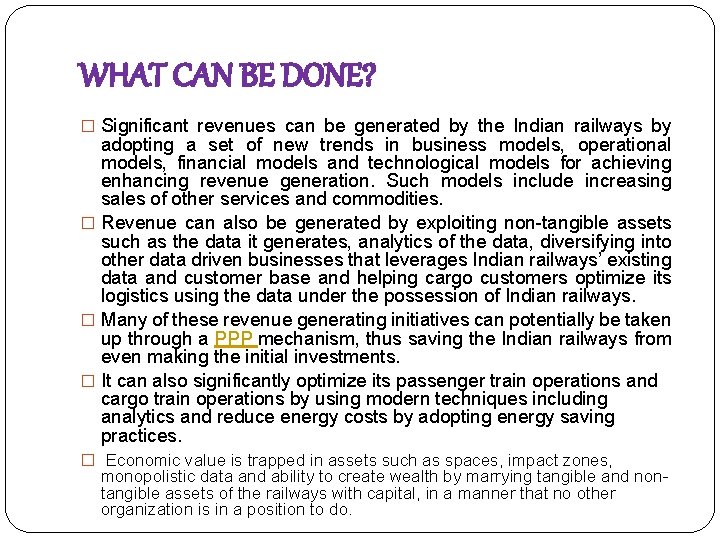
WHAT CAN BE DONE? � Significant revenues can be generated by the Indian railways by adopting a set of new trends in business models, operational models, financial models and technological models for achieving enhancing revenue generation. Such models include increasing sales of other services and commodities. � Revenue can also be generated by exploiting non-tangible assets such as the data it generates, analytics of the data, diversifying into other data driven businesses that leverages Indian railways’ existing data and customer base and helping cargo customers optimize its logistics using the data under the possession of Indian railways. � Many of these revenue generating initiatives can potentially be taken up through a PPP mechanism, thus saving the Indian railways from even making the initial investments. � It can also significantly optimize its passenger train operations and cargo train operations by using modern techniques including analytics and reduce energy costs by adopting energy saving practices. � Economic value is trapped in assets such as spaces, impact zones, monopolistic data and ability to create wealth by marrying tangible and nontangible assets of the railways with capital, in a manner that no other organization is in a position to do.
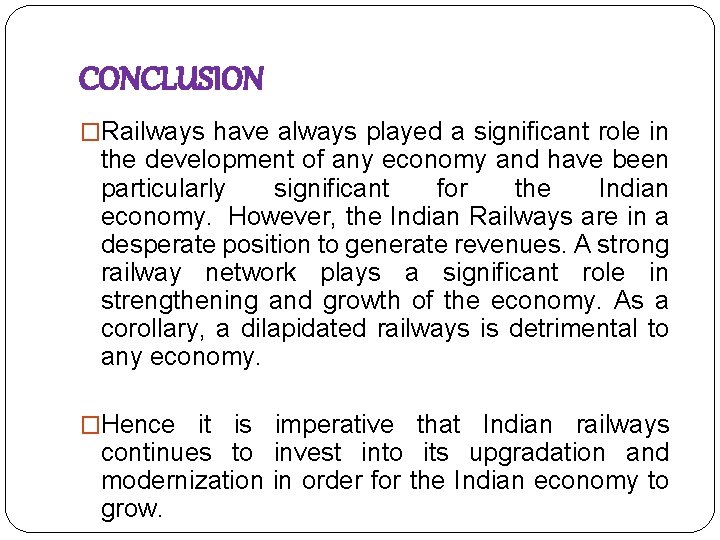
CONCLUSION �Railways have always played a significant role in the development of any economy and have been particularly significant for the Indian economy. However, the Indian Railways are in a desperate position to generate revenues. A strong railway network plays a significant role in strengthening and growth of the economy. As a corollary, a dilapidated railways is detrimental to any economy. �Hence it is imperative that Indian railways continues to invest into its upgradation and modernization in order for the Indian economy to grow.
THANK YOU