
RAID Unix System Administration Is RAID What You

- Slides: 17
RAID Unix System Administration
Is RAID What You Need If You Live in the T/W Towers? n n n Redundant Array of Independent (or Inexpensive) Disks Used to increases capacity of a volume (i. e. span more than on disk) Used to increase the reliability of a volume Used to increase volume performance (i. e. speed) Two flavors: hardware and software-based
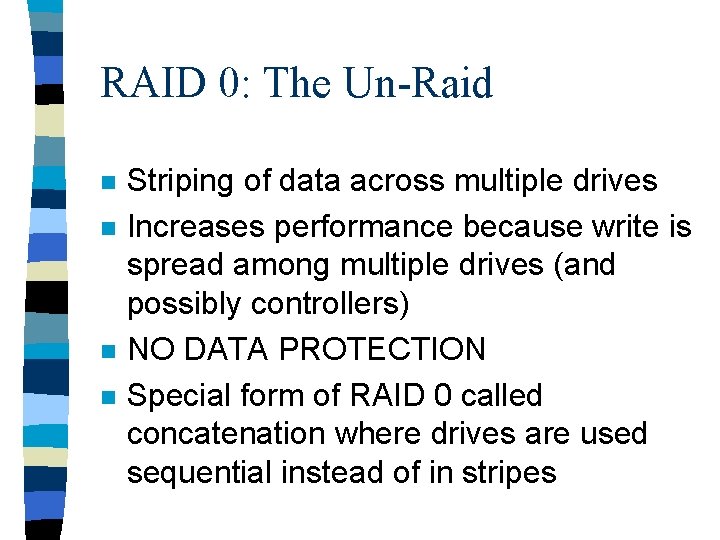
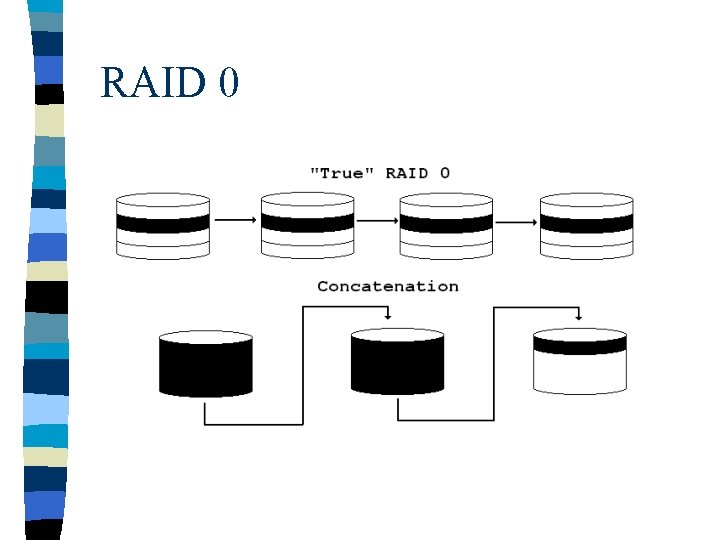
RAID 0: The Un-Raid n n Striping of data across multiple drives Increases performance because write is spread among multiple drives (and possibly controllers) NO DATA PROTECTION Special form of RAID 0 called concatenation where drives are used sequential instead of in stripes
RAID 0
Mirror-Mirror On The Wall, Who’s the Safest RAID of All n n n RAID 1 = Drive Mirroring Failure protection Double the cost or RAID 0 or non-RAID No read performance penalty Only about 25% write performance penalty
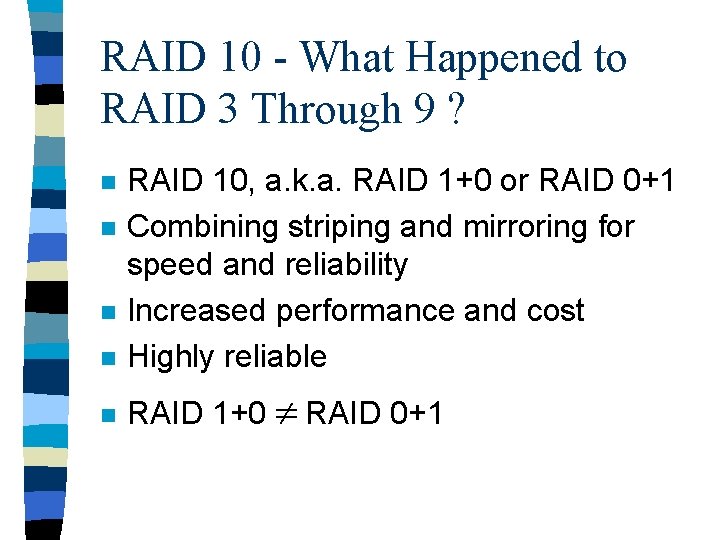
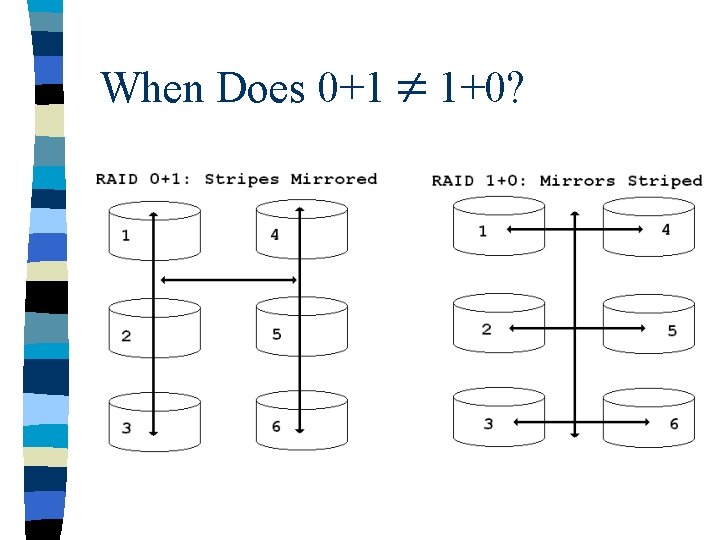
RAID 10 - What Happened to RAID 3 Through 9 ? n RAID 10, a. k. a. RAID 1+0 or RAID 0+1 Combining striping and mirroring for speed and reliability Increased performance and cost Highly reliable n RAID 1+0 ¹ RAID 0+1 n n n
When Does 0+1 ¹ 1+0?
What Ever Happened to RAID 2? n n n Uses Hamming Codes to generate redundant info To CPU intensive to implement; few if any ever implemented it Forget about RAID 2
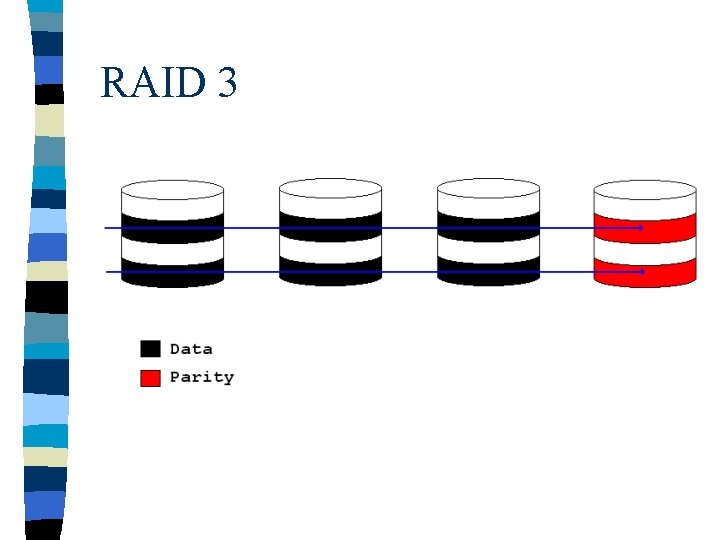
RAID 3 - When RAID Attacks n n n Uses extra disk for storing parity bit Parity bit computed by XOR’ing data bits Can sustain single member failure True RAID 3 requires “spindle synced” drives which are expensive Some vendors advertise RAID 3 when they really do RAID 4
RAID 3
RAID 4: The Unknown n Basically the same as RAID 3 without the requirement for spindle synced drives Typically implemented using regular SCSI drives As in RAID 3, the parity disk is an I/O bottleneck
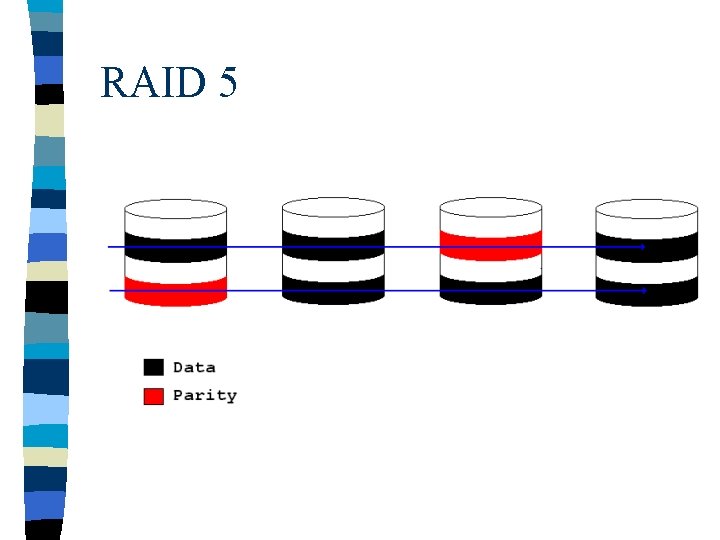
RAID 5: The Next Generation n n Most popular form of RAID for reliable and cost concious RAID 4, but parity is spread among all members instead of a single one More reliable than RAID 0 Less expensive than RAID 1 Performance suffers because of high CPU cost of computing parity
RAID 5
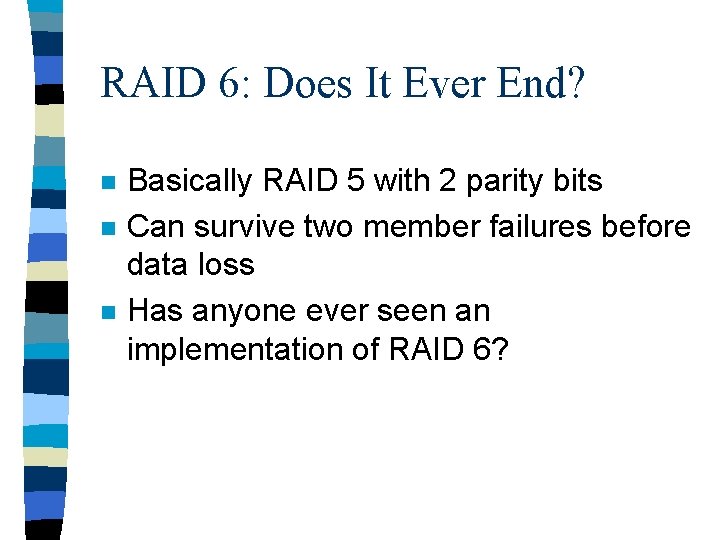
RAID 6: Does It Ever End? n n n Basically RAID 5 with 2 parity bits Can survive two member failures before data loss Has anyone ever seen an implementation of RAID 6?
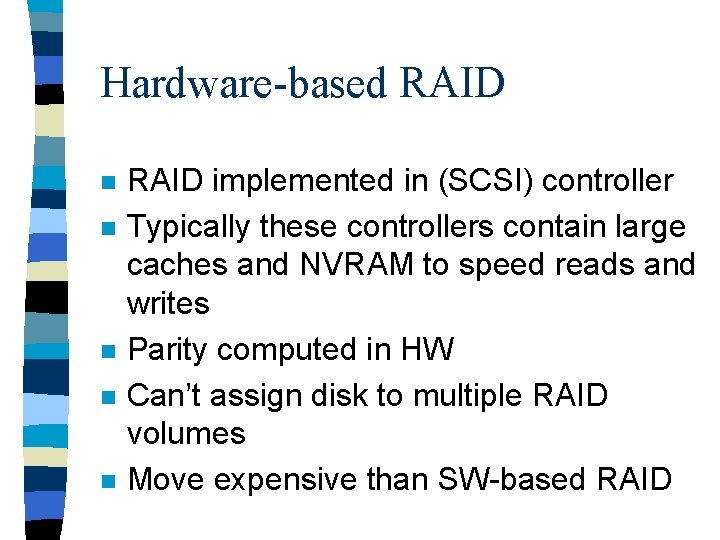
Hardware-based RAID n n n RAID implemented in (SCSI) controller Typically these controllers contain large caches and NVRAM to speed reads and writes Parity computed in HW Can’t assign disk to multiple RAID volumes Move expensive than SW-based RAID
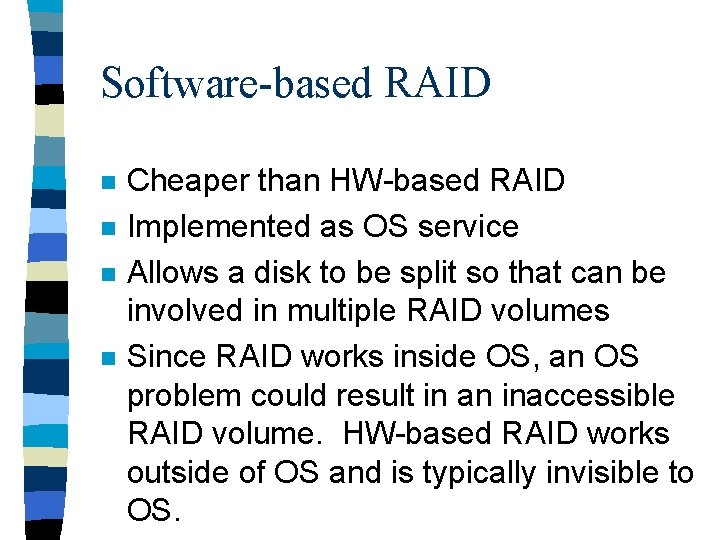
Software-based RAID n n Cheaper than HW-based RAID Implemented as OS service Allows a disk to be split so that can be involved in multiple RAID volumes Since RAID works inside OS, an OS problem could result in an inaccessible RAID volume. HW-based RAID works outside of OS and is typically invisible to OS.
This Is a RAID! Nobody Move. n How could you use RAID to take a point -in-time snapshot for backup purposes? n Does using more disks in a RAID volume make it more or less reliable? How about faster or slower?