
Raging Rivers Pupil Workbook Lesson 1 What is
Raging Rivers Pupil Workbook

Lesson 1: What is the hydrological cycle? Watch this video and read over this Bitesize review about the hydrological cycle and then complete the diagram using the words and phrases below. The following statements describe the hydrologic cycle as illustrated above. Examine the illustration and write the word(s) that best fit the blanks. Select the word(s) from the following list. Each word may be used only once. evaporate liquid atmosphere runoff condensation gas clouds precipitation snow groundwater transpiration oceans wind 1. The ________ are great storehouses of water. They hold about 97% of the world’s water. 2. The heat of the sun causes water to _______ from the ocean. It becomes water vapour which is an invisible _______. 3. The moisture-laden air is blown by the _______ toward the land. 4. As air rises, it cools. It eventually reaches the point where it can no longer hold all of its moisture in gaseous form. Some of the water vapour changes into a ________ around particles of dust, to form tiny droplets of water. When water vapour changes into water, the process is called _______. We can see the results of this process in the atmosphere in the form of _________ that are carried by the wind. 5. Many droplets of water join together and fall to earth as __________. 6. If temperature conditions are suitable, the water vapour may change directly into a solid form. This produces __________. 7. When the rain reaches the ground, or snow melts, the water can follow one of four paths: a. evaporate back into the __________ b. _________ along the surface of the earth c. sink into the earth and become ___________ d. be released into the atmosphere from the leaves of plants by the process of ______
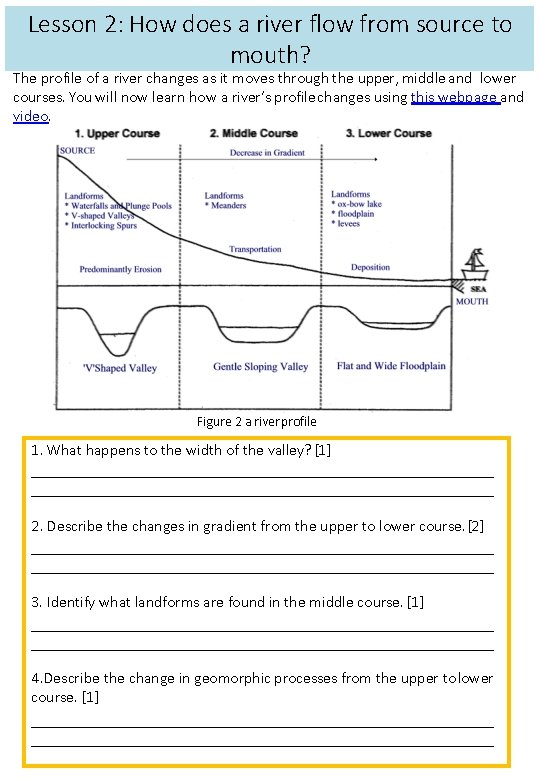
Lesson 2: How does a river flow from source to mouth? The profile of a river changes as it moves through the upper, middle and lower courses. You will now learn how a river’s profile changes using this webpage and video. Figure 2 a river profile 1. What happens to the width of the valley? [1] 2. Describe the changes in gradient from the upper to lower course. [2] 3. Identify what landforms are found in the middle course. [1] 4. Describe the change in geomorphic processes from the upper to lower course. [1]

The Bradshaw Model is a geographical model that represents how a river’s characteristics change downstream (from source to mouth). In the table below, complete the following tasks: 1. Create definitions for each characteristic. 2. Identify how it changes downstream (e. g. increase/decrease etc). 3. Explain why the characteristic changes downstream.
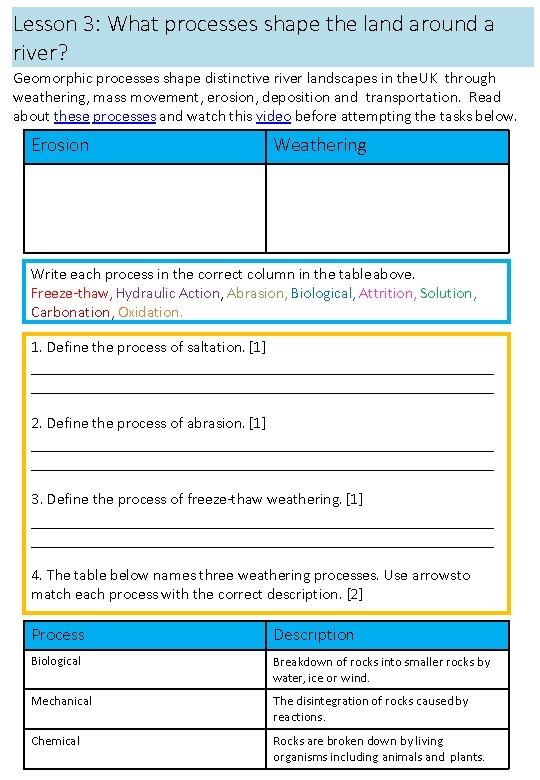
Lesson 3: What processes shape the land around a river? Geomorphic processes shape distinctive river landscapes in the UK through weathering, mass movement, erosion, deposition and transportation. Read about these processes and watch this video before attempting the tasks below. Erosion Weathering Write each process in the correct column in the table above. Freeze-thaw, Hydraulic Action, Abrasion, Biological, Attrition, Solution, Carbonation, Oxidation. 1. Define the process of saltation. [1] 2. Define the process of abrasion. [1] 3. Define the process of freeze-thaw weathering. [1] 4. The table below names three weathering processes. Use arrows to match each process with the correct description. [2] Process Description Biological Breakdown of rocks into smaller rocks by water, ice or wind. Mechanical The disintegration of rocks caused by reactions. Chemical Rocks are broken down by living organisms including animals and plants.
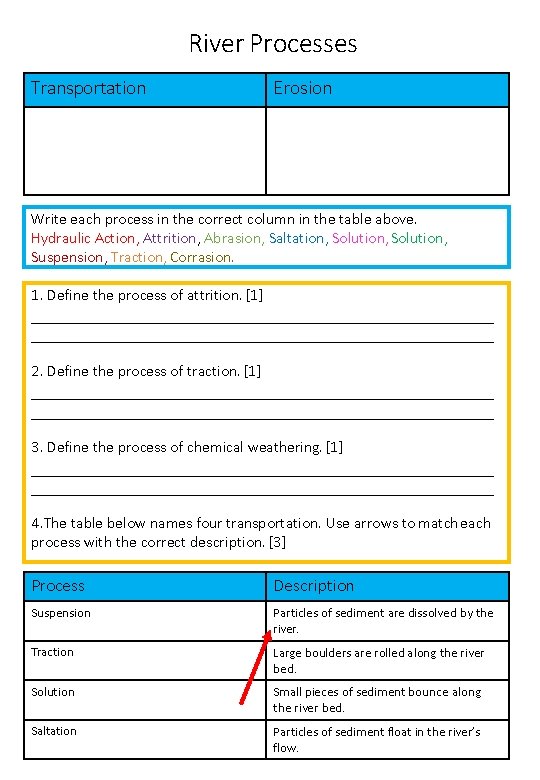
River Processes Transportation Erosion Write each process in the correct column in the table above. Hydraulic Action, Attrition, Abrasion, Saltation, Solution, Suspension, Traction, Corrasion. 1. Define the process of attrition. [1] 2. Define the process of traction. [1] 3. Define the process of chemical weathering. [1] 4. The table below names four transportation. Use arrows to match each process with the correct description. [3] Process Description Suspension Particles of sediment are dissolved by the river. Traction Large boulders are rolled along the river bed. Solution Small pieces of sediment bounce along the river bed. Saltation Particles of sediment float in the river’s flow.
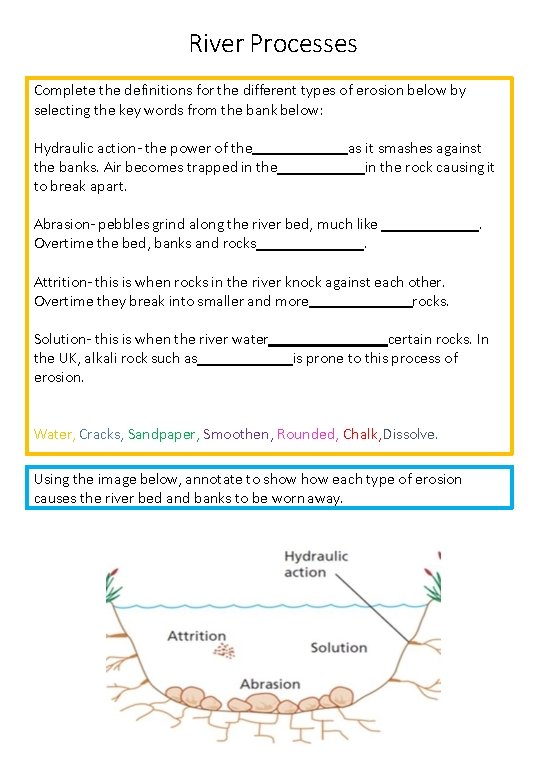
River Processes Complete the definitions for the different types of erosion below by selecting the key words from the bank below: Hydraulic action- the power of the banks. Air becomes trapped in the to break apart. as it smashes against in the rock causing it Abrasion- pebbles grind along the river bed, much like Overtime the bed, banks and rocks. . Attrition- this is when rocks in the river knock against each other. Overtime they break into smaller and more rocks. Solution- this is when the river water the UK, alkali rock such as erosion. certain rocks. In is prone to this process of Water, Cracks, Sandpaper, Smoothen, Rounded, Chalk, Dissolve. Using the image below, annotate to show each type of erosion causes the river bed and banks to be worn away.
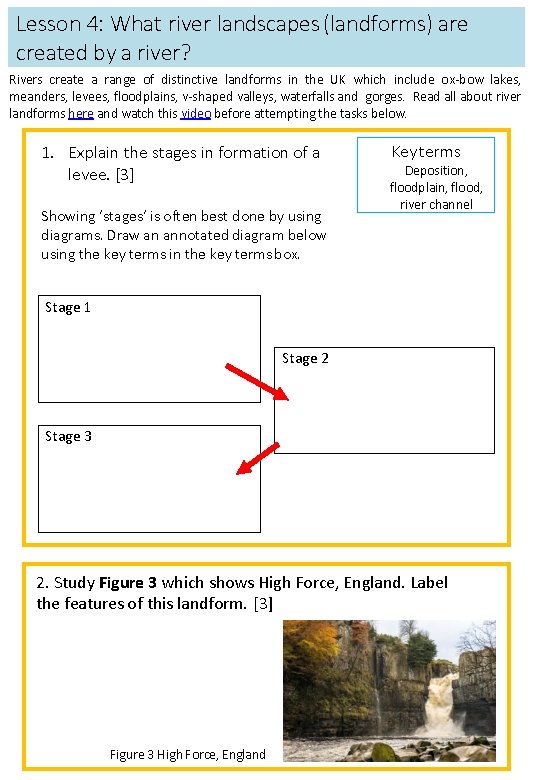
Lesson 4: What river landscapes (landforms) are created by a river? Rivers create a range of distinctive landforms in the UK which include ox-bow lakes, meanders, levees, floodplains, v-shaped valleys, waterfalls and gorges. Read all about river landforms here and watch this video before attempting the tasks below. 1. Explain the stages in formation of a levee. [3] Showing ‘stages’ is often best done by using diagrams. Draw an annotated diagram below using the key terms in the key terms box. Key terms Deposition, floodplain, flood, river channel Stage 1 Stage 2 Stage 3 2. Study Figure 3 which shows High Force, England. Label the features of this landform. [3] Figure 3 High Force, England
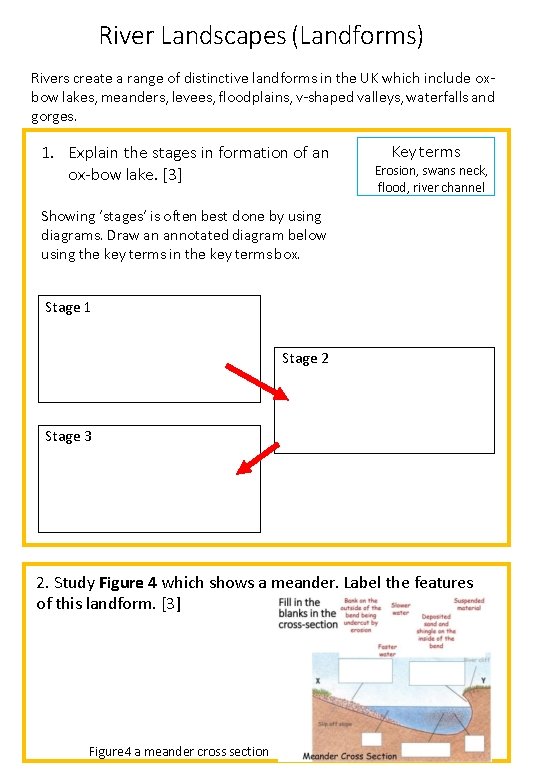
River Landscapes (Landforms) Rivers create a range of distinctive landforms in the UK which include oxbow lakes, meanders, levees, floodplains, v-shaped valleys, waterfalls and gorges. 1. Explain the stages in formation of an ox-bow lake. [3] Key terms Erosion, swans neck, flood, river channel Showing ‘stages’ is often best done by using diagrams. Draw an annotated diagram below using the key terms in the key terms box. Stage 1 Stage 2 Stage 3 2. Study Figure 4 which shows a meander. Label the features of this landform. [3] Figure 4 a meander cross section
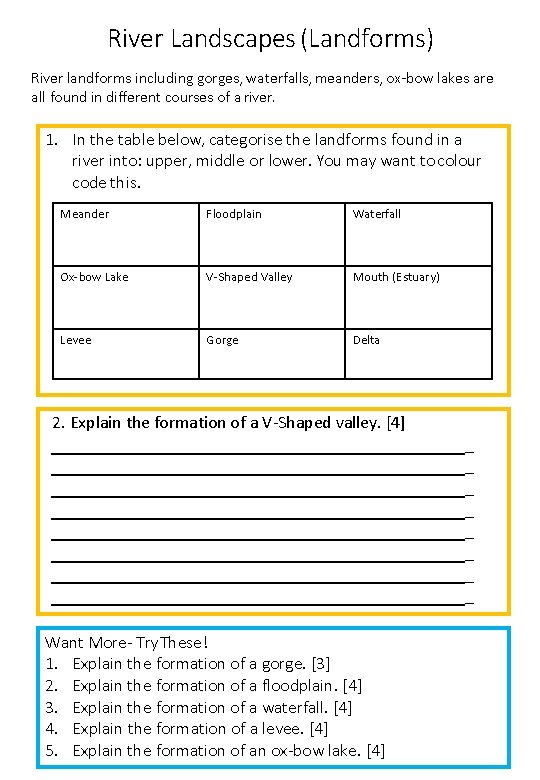
River Landscapes (Landforms) River landforms including gorges, waterfalls, meanders, ox-bow lakes are all found in different courses of a river. 1. In the table below, categorise the landforms found in a river into: upper, middle or lower. You may want to colour code this. Meander Floodplain Waterfall Ox-bow Lake V-Shaped Valley Mouth (Estuary) Levee Gorge Delta 2. Explain the formation of a V-Shaped valley. [4] Want More- Try These! 1. Explain the formation of a gorge. [3] 2. Explain the formation of a floodplain. [4] 3. Explain the formation of a waterfall. [4] 4. Explain the formation of a levee. [4] 5. Explain the formation of an ox-bow lake. [4] _ _ _ _
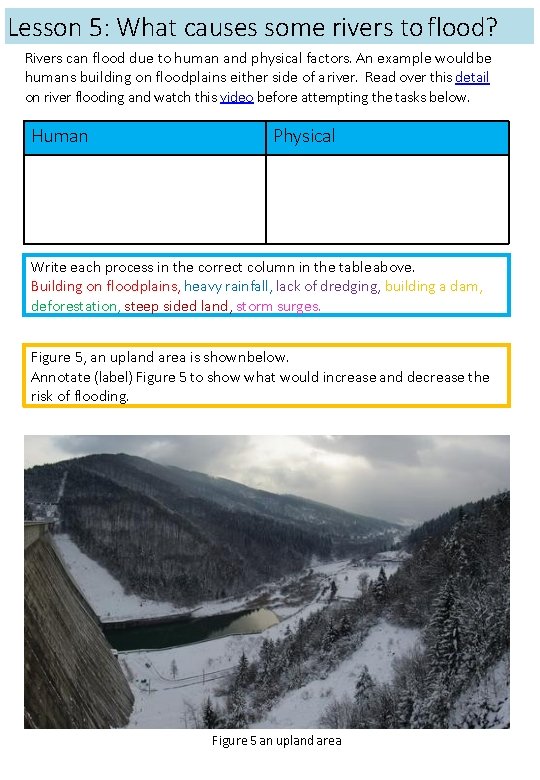
Lesson 5: What causes some rivers to flood? Rivers can flood due to human and physical factors. An example would be humans building on floodplains either side of a river. Read over this detail on river flooding and watch this video before attempting the tasks below. Human Physical Write each process in the correct column in the table above. Building on floodplains, heavy rainfall, lack of dredging, building a dam, deforestation, steep sided land, storm surges. Figure 5, an upland area is shown below. Annotate (label) Figure 5 to show what would increase and decrease the risk of flooding. Figure 5 an upland area
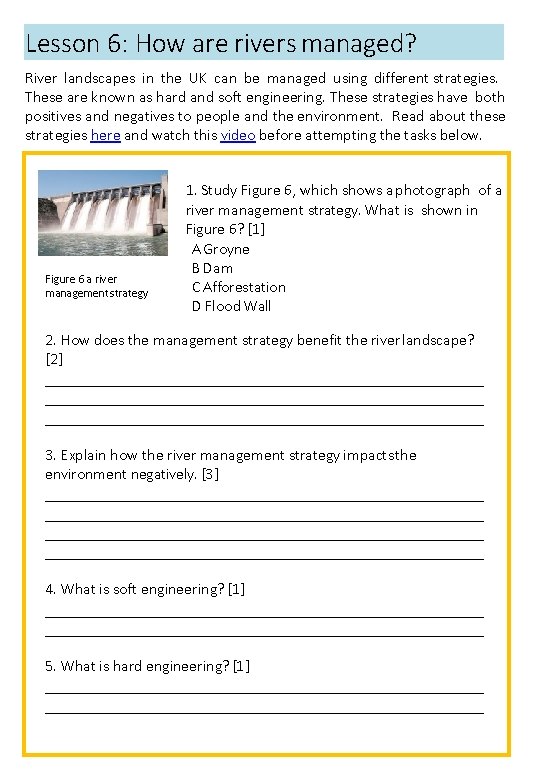
Lesson 6: How are rivers managed? River landscapes in the UK can be managed using different strategies. These are known as hard and soft engineering. These strategies have both positives and negatives to people and the environment. Read about these strategies here and watch this video before attempting the tasks below. Figure 6 a river management strategy 1. Study Figure 6, which shows a photograph of a river management strategy. What is shown in Figure 6? [1] A Groyne B Dam C Afforestation D Flood Wall 2. How does the management strategy benefit the river landscape? [2] 3. Explain how the river management strategy impacts the environment negatively. [3] 4. What is soft engineering? [1] 5. What is hard engineering? [1]
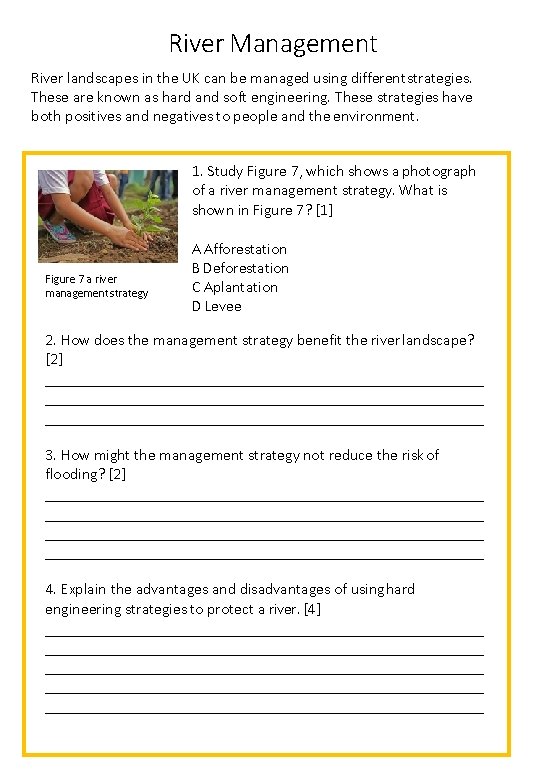
River Management River landscapes in the UK can be managed using different strategies. These are known as hard and soft engineering. These strategies have both positives and negatives to people and the environment. 1. Study Figure 7, which shows a photograph of a river management strategy. What is shown in Figure 7? [1] Figure 7 a river management strategy A Afforestation B Deforestation C Aplantation D Levee 2. How does the management strategy benefit the river landscape? [2] 3. How might the management strategy not reduce the risk of flooding? [2] 4. Explain the advantages and disadvantages of using hard engineering strategies to protect a river. [4]
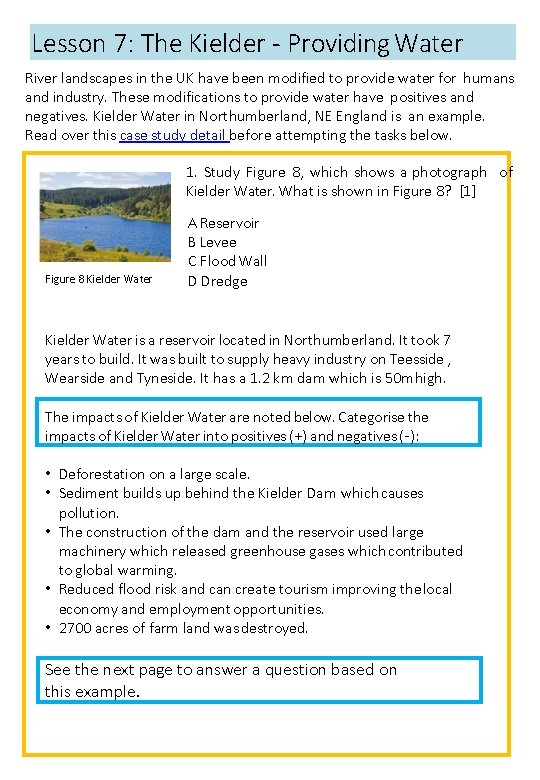
Lesson 7: The Kielder - Providing Water River landscapes in the UK have been modified to provide water for humans and industry. These modifications to provide water have positives and negatives. Kielder Water in Northumberland, NE England is an example. Read over this case study detail before attempting the tasks below. 1. Study Figure 8, which shows a photograph of Kielder Water. What is shown in Figure 8? [1] Figure 8 Kielder Water A Reservoir B Levee C Flood Wall D Dredge Kielder Water is a reservoir located in Northumberland. It took 7 years to build. It was built to supply heavy industry on Teesside , Wearside and Tyneside. It has a 1. 2 km dam which is 50 m high. The impacts of Kielder Water are noted below. Categorise the impacts of Kielder Water into positives (+) and negatives (-): • Deforestation on a large scale. • Sediment builds up behind the Kielder Dam which causes pollution. • The construction of the dam and the reservoir used large machinery which released greenhouse gases which contributed to global warming. • Reduced flood risk and can create tourism improving the local economy and employment opportunities. • 2700 acres of farm land was destroyed. See the next page to answer a question based on this example.
![Kielder: Providing Water 2. Discuss the impacts in the construction of Kielder Water. [6]](http://slidetodoc.com/presentation_image_h2/30ee70e8f2bda46e35b9db86722ced4e/image-15.jpg "Kielder: Providing Water 2. Discuss the impacts in the construction of Kielder Water. [6]")
Kielder: Providing Water 2. Discuss the impacts in the construction of Kielder Water. [6] Highlight the +/- Overall? Consider the overall judgementwas it positive or negative?

- Slides: 16