
RAFT Informed Consent Training Module BEST PRACTICES Process
RAFT Informed Consent Training Module
BEST PRACTICES Process

Elements of Consent Basic Elements Additional Elements • Purpose • Unexpected risks • Risks • Termination • Benefits • Costs • Alternative • Consequences of • Confidentiality withdrawal • Be provided information • Number of participants • Compensation • Contact names • Voluntary
RAFT • Maternal, fetal, neonatal, and childhood risks will be fully explained. • Uncertainty of serial amnioinfusion success will be discussed • Postnatal challenges if survival is achieved will be discussed in detail • These above topics will be discussed by the PI as well as consultants not affiliated with the trial. • Challenges include: need for dialysis, complications from dialysis access, need for supplemental nutrition (likely from a gastrostomy tube), risk of sepsis, recurrent hospitalizations, need for a kidney transplant, immunosuppression after a transplant, need for urinary tract reconstruction, financial and logistical challenges of insurance copays, time away from work, and temporary relocation to a RAFT center. • Be very mindful of the extremely sensitive nature of this consent; mothers will have to agree to not terminate their pregnancy.
RAFT • Consults by Pediatric Nephrology, Neonatology, Transplant Surgery, Pediatric Surgery, Maternal-Fetal-Medicine, a licensed Clinical Social Worker and a Genetic Counselor will take place in nondirective and supportive environment. • A physician will obtain the informed consent. • There are 2 prenatal consent forms • An intervention arm consent (also requires the father's signature) • An expectant management group consent • There is also a postnatal consent form obtained by a physician • To continue to follow the outcomes of the neonate

Consent Form • Your signature signifies that the conversation took place • The participant’s signature indicates that consent and questions were solicited answered • Must be dated & timed ØVerify that the date & time are accurate
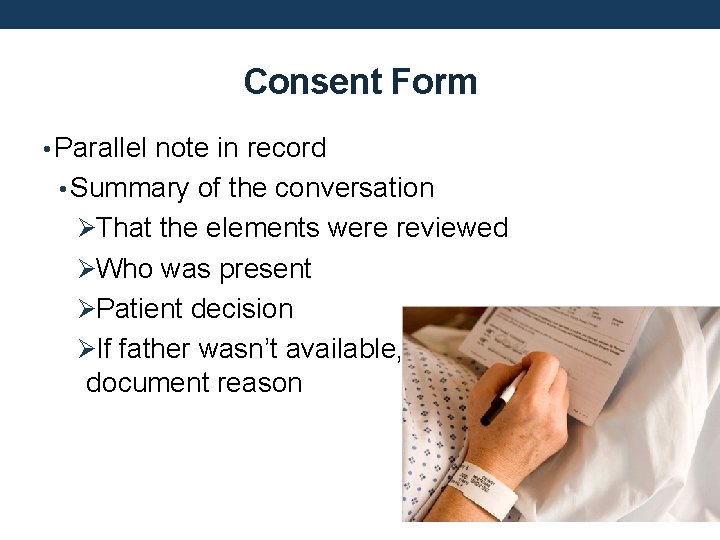
Consent Form • Parallel note in record • Summary of the conversation ØThat the elements were reviewed ØWho was present ØPatient decision ØIf father wasn’t available, document reason
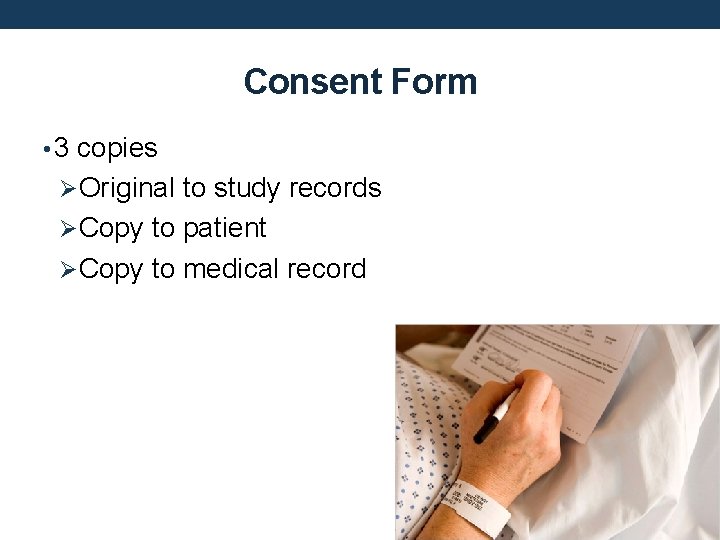
Consent Form • 3 copies ØOriginal to study records ØCopy to patient ØCopy to medical record
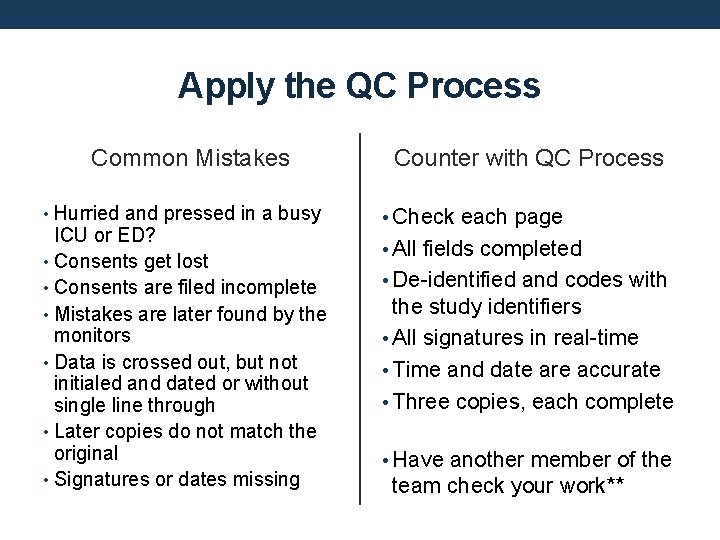
Apply the QC Process Common Mistakes • Hurried and pressed in a busy ICU or ED? • Consents get lost • Consents are filed incomplete • Mistakes are later found by the monitors • Data is crossed out, but not initialed and dated or without single line through • Later copies do not match the original • Signatures or dates missing Counter with QC Process • Check each page • All fields completed • De-identified and codes with the study identifiers • All signatures in real-time • Time and date are accurate • Three copies, each complete • Have another member of the team check your work**
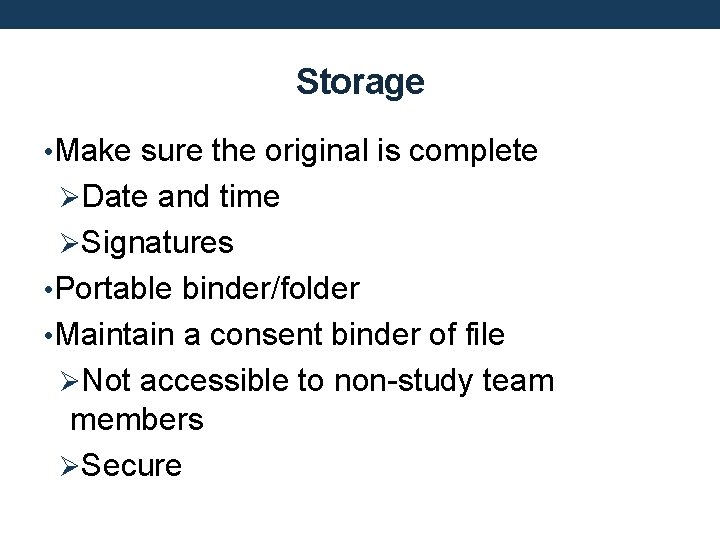
Storage • Make sure the original is complete ØDate and time ØSignatures • Portable binder/folder • Maintain a consent binder of file ØNot accessible to non-study team members ØSecure
BEST PRACTICES The Checklist
Every Site Needs a Recruitment Plan • Materials approved in advance by JHM s. IRB • Materials from the Recruitment Innovation Center • Checklists
BEST PRACTICES Shared Decision-Making
Shared Decision-Making: Competence • Confirm that the patient and/or family is mentally/emotionally competent • competent persons can be emotionally compromised by the situation. • Confirm the family’s understanding • Have the patient repeat back critical counseling points • The father’s signature is required on the intervention arm consent. If the father is not available, document why in the consenting process note.
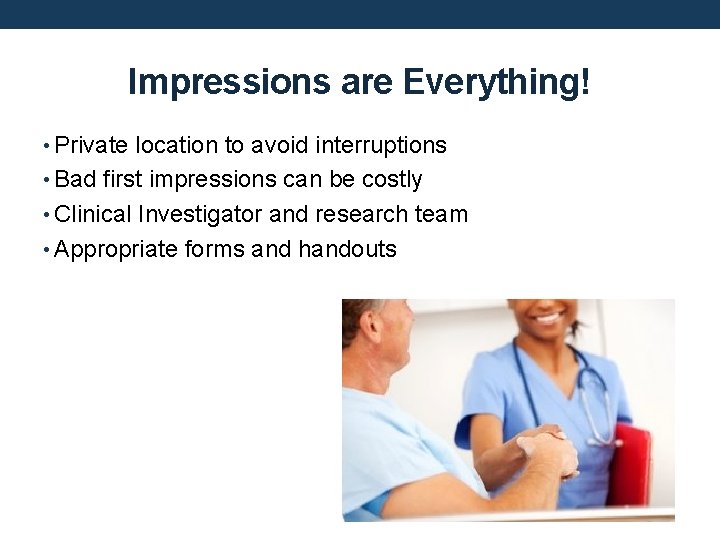
Impressions are Everything! • Private location to avoid interruptions • Bad first impressions can be costly • Clinical Investigator and research team • Appropriate forms and handouts
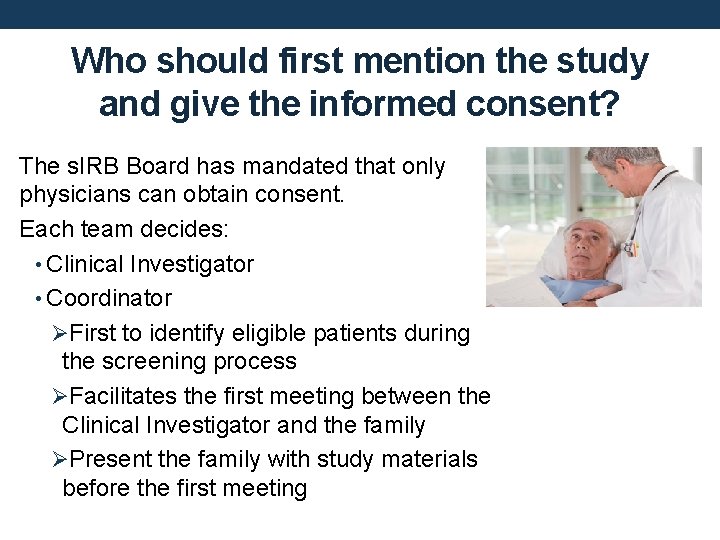
Who should first mention the study and give the informed consent? The s. IRB Board has mandated that only physicians can obtain consent. Each team decides: • Clinical Investigator • Coordinator ØFirst to identify eligible patients during the screening process ØFacilitates the first meeting between the Clinical Investigator and the family ØPresent the family with study materials before the first meeting
Make Time and Sit Down • Physicians are perceived as more compassionate when they sit down • Discuss the trial & the diagnoses • How the RAFT trial might be a good option • Spend considerable time “informing”
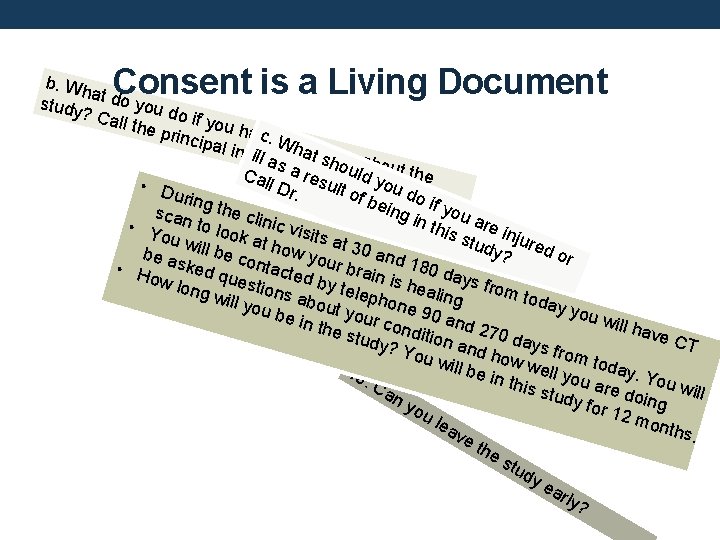
Consent is a Living Document b. Wh a study t do you d ? Ca ll the o if you h a q princ ipal in vce. W u viellsatig heast tsiohns a b s Cal aatroers, Doru. l_d yout the l Dr ult __o_u_d • D of b _o i. uring e ing f you scan the clin in t are ic vis to lo • Y h i inju s o its a ou w k at s t u t h dy? red o be a ill be co ow you 30 and r 1 ntac r 8 b • H sked q 0 rain days ted b ow lo uest i s y from h ions ealin telep ng w toda abou g hone ill yo y yo t u be 9 y u wil in th our con 0 and 2 l hav e stu 70 d ditio e CT n an ays dy? from d ho You w w i w ll be ell yo today. Y 10 i n thi. C s stu u are do ou will an dy fo i yo r 12 ng ul mon ea ths. ve the stu dy ea rly ?
PATIENT APPROACH
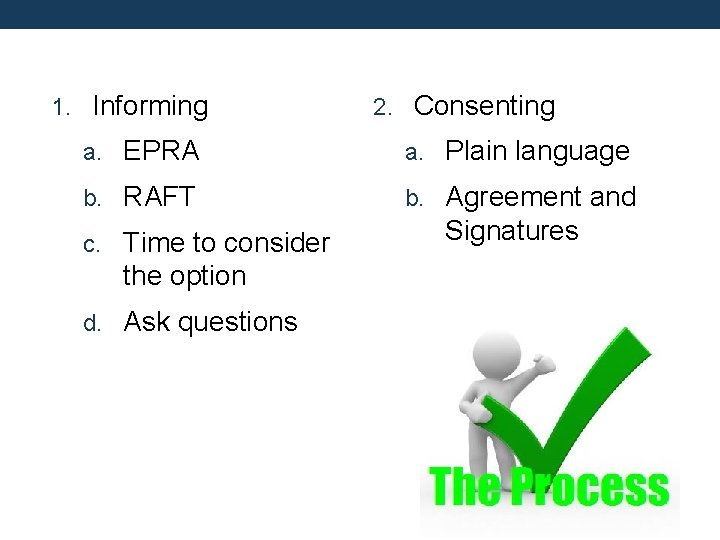
1. Informing 2. Consenting a. EPRA a. Plain language b. RAFT b. Agreement and c. Time to consider the option d. Ask questions Signatures
Open-ended Conversations • Include family members • Avoid leading questions • Probe issues in depth • Let the family lead
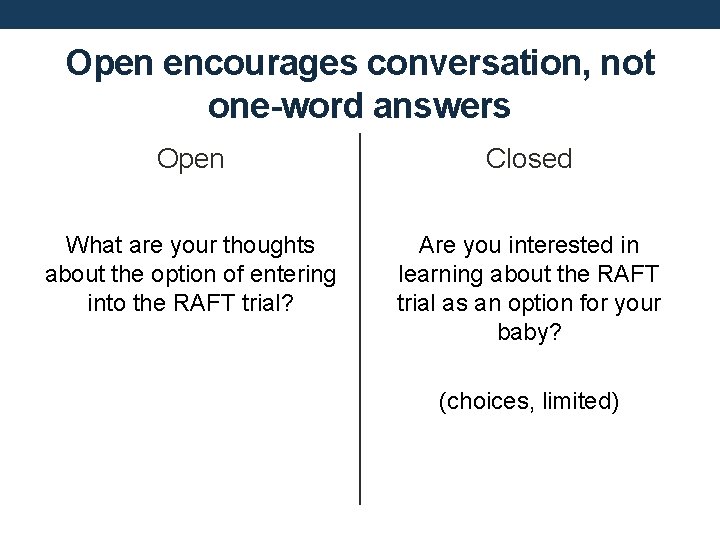
Open encourages conversation, not one-word answers Open Closed What are your thoughts about the option of entering into the RAFT trial? Are you interested in learning about the RAFT trial as an option for your baby? (choices, limited)
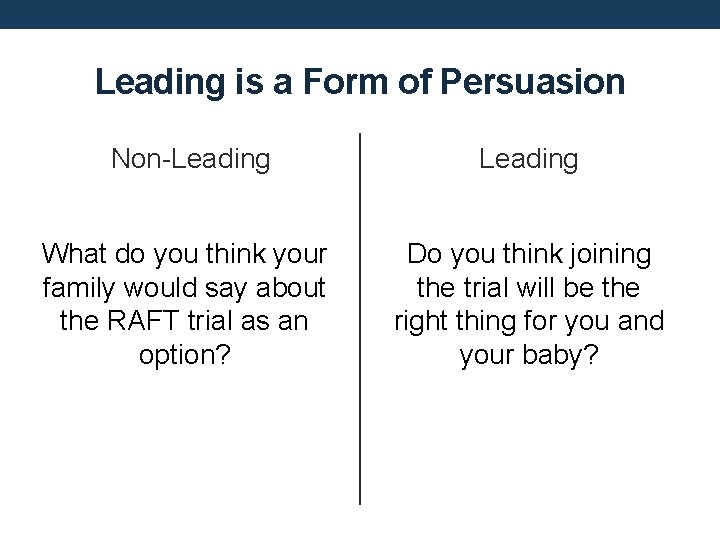
Leading is a Form of Persuasion Non-Leading What do you think your family would say about the RAFT trial as an option? Do you think joining the trial will be the right thing for you and your baby?
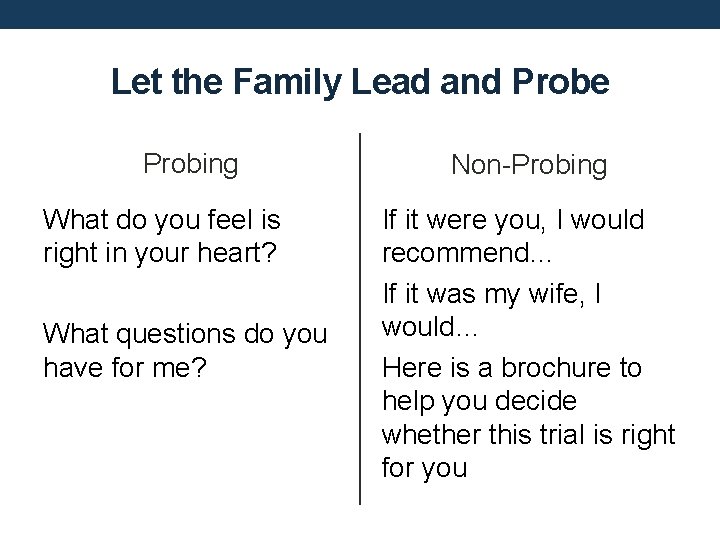
Let the Family Lead and Probe Probing What do you feel is right in your heart? What questions do you have for me? Non-Probing If it were you, I would recommend… If it was my wife, I would… Here is a brochure to help you decide whether this trial is right for you
1 st Important Message Patients and families will receive the best possible care, whether they are in the trial or not.
Most Important Ability: Empathy • Experiencing extreme emotional stress • Compromised ability to make informed decisions • Empathic interaction ØHelping ØTrust-engendering ØActing in his/her best interest
STRATEGIC PLANNING Your Site
Re-visit the Plan Often • Use each patient approached as a learning tool • Identify obstacle(s) to participation in the study and devise solutions for overcoming obstacles • Identify words patients may not understand • Compile an FAQ list & share with your team • Decide who are the best consenters on your team
INFORMED CONSENT CHECKLIST
Remember to: • Know the consent document well • Utilize any printed materials available • Have all consultants meet with the family • Prepare a quiet, comfortable room for all to join in on discussions • Discuss the diagnosis – THEN PAUSE FOR QUESTIONS • Explain both arms of the study – THEN PAUSE FOR QUESTIONS • Explain why the study is a good option - THEN PAUSE FOR QUESTIONS • Discuss the risks - THEN PAUSE FOR QUESTIONS • Describe the follow up period - THEN PAUSE FOR QUESTIONS • Give the family a copy of the consent form and review in detail • Give the spokesperson your card with contact information • Leave and give the family as much time as they to make their decision • Complete the consent form accurately and completely before any study procedures occur • Give the family a copy of the consent • Record the consent and file a copy of the consent in REDCap.
Is there a website where families can go to look for more information about the study? • raft-trial. org is a website devoted to RAFT • http: //www. nih. gov/health/clinicaltrials/also has very good general information for patients considering enrolling in clinical trials
References 1. 2. 3. 4. 5. Patient Recruitment and Retention in Clinical Trials: Ten Strategies for Success. Forte Research Systems Lamberti MJ, Mathias A, Myles JE, Howe D, Getz KA. Evaluating the impact of patient recruitment and retention practices. Drug Inf J. 2012; 46(5): 573 -580 Frank, Genevieve. “Current Challenges in Clinical Trial Patient Recruitment and Enrollment. ” So. CRA SOURCE. Feb 2004. Kremidas, Jim. “Recruitment Roles. ” Applied Clinical Trials Online. Sept. 1, 2011. Williams, Sandra. “Clinical Trials Recruitment and Enrollment: Attitudes, Barriers, and Motivating Factors. ” A Summary of Literature and Market Research Reports Held by NCI as of August 2004.
Additional Resources and References For more information and a recording of a well executed consent meeting, see the CLEAR III June 2012 Webinar, “Best Consent Practice, ” which can be accessed through the BIOS website at http: //braininjuryoutcomes. com/studies/clear-webinars. FDA approved drugs database. Food and Drug Administration Web site. http: //www. accessdata. fda. gov/scripts/cder/drugsatfda. Accessed October 3, 2012. Holmes-Rovner M, Wills C. Improving informed consent, insights from behavioral decision research. Medical Care. 2002; 40(9)30 -38. Mc. Bee, N. Clinical Trial Participation and Placebo: The Unsung Heroes during Consent Discussions. Brain Injury Outcomes (BIOS) CLEAR III Blog. http: //braininjuryoutcomes. com/studies/clear. Published October 3, 2012. Accessed October 8, 2012.
Any Questions? Contact your Site Manager Noeleen Ostapkovich nostapk 1@jhu. edu Contact your monitor Sarah Lenington slenington@optonline. net Contact the CCC Trial leaders Jena Miller, MD, Trial PI jmill 260@jh. edu Meredith A. Atkinson, MD, Trial PI matkins 3@jhmi. edu

THANK YOU!
- Slides: 35