
Radiopharmaceuticals and Methods of Radiolabeling Definition of a

Radiopharmaceuticals and Methods of Radiolabeling

Definition of a Radiopharmaceutical

Definition of a Radiopharmaceutical A radiopharmaceutical is a radioactive compound used for the diagnosis and therapeutic treatment of human diseases. In nuclear medicine nearly 95% of the radiopharmaceuticals are used for diagnostic purposes, while the rest are used for therapeutic treatment. Radiopharmaceuticals usually have minimal pharmacologic e¤ect, because in most cases they are used in tracer quantities. Therapeutic radiopharmaceuticals can cause tissue damage by radiation.
Definition of a Radiopharmaceutical Because they are administered to humans, they should be sterile and pyrogen free, and should undergo all quality control measures required of a conventional drug. A radiopharmaceutical may be a radioactive element such as 133 Xe, or a labeled compound such as 131 I-iodinated proteinsand 99 m. Tclabeled compounds.
Definition of a Radiopharmaceutical Although the term radiopharmaceutical is most commonly used, other terms such as radiotracer, radiodiagnostic agent, and tracer have been used by various groups. We shall use the term radiopharmaceutical throughout, although the term tracer will be used occasionally.

Definition of a Radiopharmaceutical Another point of interest is the di¤erence between radiochemicals and radiopharmaceuticals. The former are not usable for administration to humans due to the possible lack of sterility and nonpyrogenicity. On the other hand, radiopharmaceuticals are sterile and nonpyrogenic and can be administered safely to humans.
Definition of a Radiopharmaceutical A radiopharmaceutical has two components: a radionuclide and a pharmaceutical. The usefulness of a radiopharmaceutical is dictated by the characteristics of these two components. In designing a radiopharmaceutical, a pharmaceutical is first chosen on the basis of its preferential localization in a given organ or its participation in the physiologic function of the organ.
Definition of a Radiopharmaceutical Then a suitable radionuclide is tagged onto the chosen pharmaceutical such that after administration of the radiopharmaceutical, radiations emitted from it are detected by a radiation detector. Thus, the morphologic structure or the physiologic function of the organ can be assessed. The pharmaceutical of choice should be safe and nontoxic for human administration.
Definition of a Radiopharmaceutical Radiations from the radionuclide of choice should be easily detected by nuclear instruments, and the radiation dose to the patient should be minimal.
Ideal Radiopharmaceutical
Ideal Radiopharmaceutical Since radiopharmaceuticals are administered to humans, and because there are several limitations on the detection of radiations by currently available instruments, radiopharmaceuticals should possess some important characteristics. The ideal characteristics for radiopharmaceuticals are:

Ideal Radiopharmaceutical 1. Easy Availability The radiopharmaceutical should be easily produced, inexpensive, and readily available in any nuclear medicine facility Complicated methods of production of radionuclides or labeled compounds increase the cost of the radiopharmaceutical. The geographic distance between the user and the supplier also limits the availability of short-lived radiopharmaceuticals.
Ideal Radiopharmaceutical 2. Short Effective Half-Life A radionuclide decays with a definite half-life, which is called the physical half-life, denoted Tp (or t 1=2). The physical half-life is independent of any physicochemical condition and is characteristic for a given radionuclide
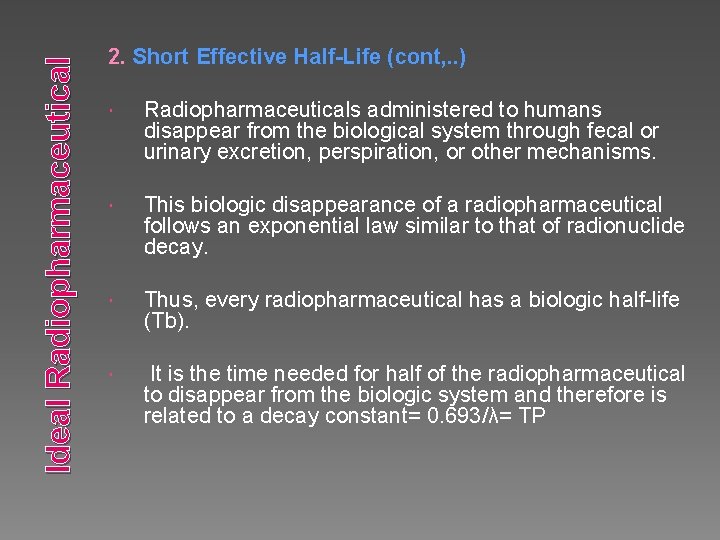
Ideal Radiopharmaceutical 2. Short Effective Half-Life (cont, . . ) Radiopharmaceuticals administered to humans disappear from the biological system through fecal or urinary excretion, perspiration, or other mechanisms. This biologic disappearance of a radiopharmaceutical follows an exponential law similar to that of radionuclide decay. Thus, every radiopharmaceutical has a biologic half-life (Tb). It is the time needed for half of the radiopharmaceutical to disappear from the biologic system and therefore is related to a decay constant= 0. 693/λ= TP
Ideal Radiopharmaceutical 2. Short Effective Half-Life (cont, . . ) Obviously, in any biologic system, the loss of a radiopharmaceutical is due to both the physical decay of the radionuclide and the biologic elimination of the radiopharmaceutical.

Ideal Radiopharmaceutical 2. Short Effective Half-Life (cont, . . ) The net or e¤ective rate (le) of the loss of radioactivity is then related to the physical decay constant lp and the biologic decay constant lb. Mathematically, this is expressed as: λe = λp + λb Since λ = 0. 693/t 1/2, it follows that 1/Te = 1/Tp + 1/Tb OR Te = ( Tp X Tb) / ( Tp + Tb )
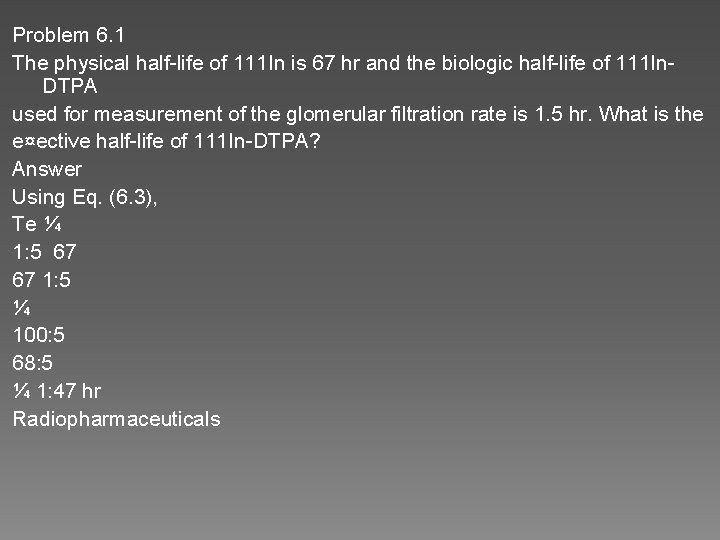
Problem 6. 1 The physical half-life of 111 In is 67 hr and the biologic half-life of 111 In. DTPA used for measurement of the glomerular filtration rate is 1. 5 hr. What is the e¤ective half-life of 111 In-DTPA? Answer Using Eq. (6. 3), Te ¼ 1: 5 67 67 1: 5 ¼ 100: 5 68: 5 ¼ 1: 47 hr Radiopharmaceuticals
Ideal Radiopharmaceutical 3. Particle Emission Radionuclides decaying by a- or b-particle emission should not be used as the label in diagnostic radiopharmaceuticals. These particles cause more radiation damage to the tissue than do g rays. Although g-ray emission is preferable, many bemitting radionuclides, such as 131 I-iodinated compounds, are often used for clinical studies.

Ideal Radiopharmaceutical 3. Particle Emission (cont, . . ) However, a emitters should never be used for in vivo diagnostic studies because they give a high radiation dose to the patient. But a and b emitters are useful for therapy, because of the effective radiation damage to abnormal cells.

Ideal Radiopharmaceutical 4. Decay by Electron Capture or Isomeric Transition Because radionuclides emitting particles are less desirable, the diagnostic radionuclides used should decay by electron capture or isomeric transition without any internal conversion. Whatever the mode of decay, for diagnostic studies the radionuclide must emit a Ɣ radiation with an energy preferably between 30 and 300 ke. V. Below 30 ke. V, Ɣ rays are absorbed by tissue

Ideal Radiopharmaceutical Photon interaction in the Na. I(T 1) detector using collimators. A 30 -ke. V photon is absorbed by the tissue. A> 300 -ke. V photon may penetrate through the collimator septa and strike the detector, or may escape the detector without any interaction. Photons of 30 to 300 ke. V may escape the organ of the body, pass through the collimator holes, and interact with the detector.

Ideal Radiopharmaceutical 4. Decay by Electron Capture or Isomeric Transition (cont, . . ) and are not detected by the Na. I(Tl) detector. Above 300 ke. V, e¤ective collimation of g rays cannot be achieved with commonly available collimators. However, recently manufacturers have made collimators for 511 -ke. V photons, which have been used for planar or SPECT imaging using 18 FFDG. The phenomenon of collimation with 30 - to 300 -ke. V photons is illustrated approximately 150 ke. V, which is most suitable for present-day collimators. Moreover, the photon abundance should be high so that imaging time can be minimized due to the high photon flux.
Ideal Radiopharmaceutical 5. High Target-to-Nontarget Activity Ratio For any diagnostic study, it is desirable that the radiopharmaceutical be localized preferentially in the organ under study since the activity from nontarget areas can obscure the structural details of the picture of the target organ. Therefore, the target-to-nontarget activity ratio should be large.
Ideal Radiopharmaceutical 5. High Target-to-Nontarget Activity Ratio (cont, . . ) An ideal radiopharmaceutical should have all the above characteristics to provide maximum effcacy in the diagnosis of diseases and a minimum radiation dose to the patient. However, it is diffcult for a given radiopharmaceutical to meet all these criteria and the one of choice is the best of many compromises.

Design of New Radiopharmaceuticals

General Considerations Many radiopharmaceuticals are used for various nuclear medicine tests. Some of them meet most of the requirements for the intended test andtherefore need no replacement. For example, 99 m. Tc–methylene diphosphonate (MDP) is an excellent bone imaging agent and the nuclear medicine community is fairly satisfied with this agent such that no further research and development is being pursued for replacing 99 m. Tc-MDP with a new radiopharmaceutical.
General Considerations (cont, . . ) However, there a number of other radio pharmaceuticalthat o¤er only minimal diagnostic value in nuclear medicine tests and thus need replacement. Continual effort is being made to improve or replace such radiopharmaceuticals.
General Considerations (cont, . . ) Upon scrutiny, it is noted that the commonly used radiopharmaceuticals involve one or more of the following mechanisms of localization in a given organ: 1. Passive di¤usion: 99 m. Tc-DTPA in brain imaging, 99 m. Tc-DTPA aerosol and 133 Xe in ventilation imaging, 111 In-DTPA in cisternography. 2. Ion exchange: uptake of 99 m. Tc-phosphonate complexes in bone.

General Considerations (cont, . . ) 3. Capillary blockage: 99 m. Tc macroaggregated albumin (MAA) particles trapped in the lung capillaries. 4. Phagocytosis: removal of 99 m. Tc-sulfur colloid particles by the reticuloendothelial cells in the liver, spleen, and bone marrow. 5. Active transport: 131 I uptake in the thyroid, 201 Tl uptake in the myocardium. 6. Cell sequestration: sequestration of heat-damaged 99 m. Tc-labeled red blood cells by the spleen.
General Considerations (cont, . . ) 7. Metabolism: 18 F-FDG uptake in myocardial and brain tissues. 8. Receptor binding: 11 C-dopamine binding to the dopamine receptors in the brain. 9. Compartmental localization: 99 m. Tc-labeled red blood cells used in the gated blood pool study. 10. Antigen-antibody complex formation: 131 I-, 111 In-, and 99 m. Tc-labeled antibody to localize tumors. 11. Chemotaxis: 111 In-labeled leukocytes to localize infections.
General Considerations (cont, . . ) Based on these criteria, it is conceivable to design a radiopharmaceutical to evaluate the function and/or structure of an organ of interest. Once a radiopharmaceutical is conceptually designed, a definite protocol should be developed based on the physicochemical properties of the basic ingredients to prepare the radiopharmaceutical.

General Considerations (cont, . . ) The method of preparation should be simple, easy, and reproducible, and should not alter the desired property of the labeled compound. Optimum conditions of temperature, p. H, ionic strength, and molar ratios should be established and maintained for maximum effcacy of the radiopharmaceutical.

General Considerations (cont, . . ) Once a radiopharmaceutical is developed and successfully formulated, its clinical effcacy must be evaluated by testing it first in animals and then in humans. For use in humans, one has to have a Notice of Claimed Investigational Exemption for a New Drug (IND) from the U. S. Food and Drug Administration (FDA), which regulates the human trials of drugs very strictly. If there is any severe adverse e¤ect in humans due to the administration of a radiopharmaceutical, then the radiopharmaceutical is discarded.

Factors Influencing the Design of New Radiopharmaceuticals The following factors need to be considered before, during, and after the preparation of a new radiopharmaceutical.

Factors Influencing the Design of New Radiopharmaceuticals 1 - Compatibility • When a labeled compound is to be prepared, the first criterion to consider is whether the label can be incorporated into the molecule to be labeled. • This may be assessed from a knowledge of the chemical properties of the two partners. • For example, 111 In ion can form coordinate covalent bonds, and DTPA is a chelating agent containing nitrogen and oxygen atoms with lone pairs of electrons that can be donated to form coordinated covalent bonds.

Factors Influencing the Design of New Radiopharmaceuticals 1 - Compatibility (cont, . . ) • Therefore, when 111 In ion and DTPA are mixed under appropriate physicochemical conditions, 111 In-DTPA is formed and remains stable for a long time. • If, however, 111 In ion is added to benzene or similar compounds, it would not label them. • Iodine primarily binds to the tyrosyl group of the protein.

Factors Influencing the Design of New Radiopharmaceuticals 1 - Compatibility (cont, . . ) • Mercury radionuclides bind to the sulfhydryl group of the protein. • These examples illustrate the point that only specific radionuclides label certain compounds, depending on their chemical behavior.

Factors Influencing the Design of New Radiopharmaceuticals 2 - Stoichiometry • In preparing a new radiopharmaceutical, one needs to know the amount of each component to be added. • This is particularly important in tracer level chemistry and in 99 m. Tc chemistry. The concentration of 99 m. Tc in the 99 m. Tceluate is approximately 10 -9 M. • Although for reduction of this trace amount of 99 m. Tc only an equivalent amount of Sn 2+is needed, 1000 to 1 million times more of the latter is added to the preparation in order to ensure complete reduction.
Factors Influencing the Design of New Radiopharmaceuticals 2 - Stoichiometry (cont, . . ) • Similarly, enough chelating agent, such as DTPA or MDP, is also added to use all the reduced 99 m. Tc. • The stoichiometric ratio of different components can be obtained by setting up the appropriate equations for the chemical reactions. • An unduly high or low concentration of any one component may sometimes a¤ect the integrity of the preparation.

Factors Influencing the Design of New Radiopharmaceuticals 3 - Charge of the Molecule • The charge on a radiopharmaceutical determines its solubility in various solvents. • The greater the charge, the higher the solubility in aqueous solution. • Nonpolar molecules tend to be more soluble in organic solvents and lipids.
Factors Influencing the Design of New Radiopharmaceuticals 4 - Size of the Molecule • The molecular size of a radiopharmaceutical is an important determinant in its absorption in the biologic system. • Larger molecules (mol. wt. >~60, 000) are not filtered by the glomeruli in the kidney. • This information should give some clue as to the range of molecular weights of the desired radiopharmaceutical that should be chosen for a given study.
Factors Influencing the Design of New Radiopharmaceuticals 5 - Protein Binding • Almost all drugs, radioactive or not, bind to plasma proteins to variable degrees. • The primary candidate for this type of binding is albumin, although many compounds specifically bind to globulin and other proteins as well. • Indium, gallium, and many metallic ions bind firmly to transferrin in plasma. • Protein binding is greatly influenced by a number of factors, such as the charge on the radiopharmaceutical molecule, the p. H, the nature of protein, and the concentration of anions in plasma.
Factors Influencing the Design of New Radiopharmaceuticals 5 - Protein Binding (cont, . . ) • At a lower p. H, plasma proteins become more positively charged, and therefore anionic drugs bind firmly to them. • The nature of a protein, particularly its content of hydroxyl, carboxyl, and amino groups and their configuration in the protein structure, determines the extent and strength of its binding to the radiopharmaceutical. • Metal chelates can exchange the metal ions with proteins because of the • stronger a‰nity of the metal for the protein. • Such a process is called ‘‘transchelation’’ and leads to in vivo breakdown of the complex.

Factors Influencing the Design of New Radiopharmaceuticals 5 - Protein Binding (cont, . . ) • For example, 111 In-chelates exchange 111 In with transferrin to form 111 In-transferrin. • Protein binding a¤ects the tissue distribution and plasma clearance of a radiopharmaceutical and its uptake by the organ of interest. • Therefore, one should determine the extent of protein binding of any new radiopharmaceutical before its clinical use.

Factors Influencing the Design of New Radiopharmaceuticals 5 - Protein Binding (cont, . . ) • This can be accomplished by precipitating the proteins with trichloroacetic acid from the plasma after administration of the radiopharmaceutical and then measuring the activity in the precipitate.
Factors Influencing the Design of New Radiopharmaceuticals 6 - Solubility • For injection, the radiopharmaceutical should be in aqueous solution at a p. H compatible with blood p. H (7. 4). • The ionic strength and osmolality of the agent should also be appropriate for blood.
Factors Influencing the Design of New Radiopharmaceuticals 6 - Solubility (cont, …) • In many cases, lipid solubility of a radiopharmaceutical is a determining factor in its localization in an organ; the cell membrane is primarily composed of phospholipids, and unless the radioparmaceutical is lipid soluble, it will hardly diffuse through the cell membrane. • The higher the lipid solubility of a radiopharmaceutical, the greater the di¤usion through the cell membrane and hence the greater its localization in the organ.
Factors Influencing the Design of New Radiopharmaceuticals 6 - Solubility (cont, …) • Protein binding reduces the lipid solubility of a radiopharmaceutical. Ionized drugs are less lipid soluble, whereas nonpolar drugs are highly soluble in lipids and hence easily di¤use through cell membranes. • The radiopharmaceutical 111 In-oxine is highly soluble in lipid and is therefore used specifically for labeling leukocytes and platelets. • Obviously, lipid solubility and protein binding of a drug play a key role in its in vivo distribution and localization.
Factors Influencing the Design of New Radiopharmaceuticals 7 - Stability • The stability of a labeled compound is one of the major concerns in labeling chemistry. It must be stable both in vitro and in vivo. • In vivo breakdown of a radiopharmaceutical results in undesirable biodistribution of radioactivity.

Factors Influencing the Design of New Radiopharmaceuticals 7 - Stability (cont, . . ) • For example, dehalogenation of radioiodinated compounds gives free radioiodide, which raises the background activity in the clinical study. • Temperature, p. H, and light affect the stability of many compounds and the optimal range of these physicochemical conditions must be established for the preparation and storage of labeled compounds.

Factors Influencing the Design of New Radiopharmaceuticals 8 - Biodistribution • The study of the biodistribution of a radiopharmaceutical is essential in establishing its efficacy and usefulness. This includes tissue distribution, plasma clearance, urinary excretion, and fecal excretion after administration of the radiopharmaceutical.

Factors Influencing the Design of New Radiopharmaceuticals 8 - Biodistribution (cont, …) • In tissue distribution studies, the radiopharmaceutical is injected into animals such as mice, rats, and rabbits. • The animals are then sacrificed at different time intervals, and different organs are removed. • The activities in these organs are measured and compared. The tissue distribution data will tell how good the radiopharmaceutical is for imaging the organ of interest. • At times, human biodistribution data are obtained by gamma camera imaging.
Factors Influencing the Design of New Radiopharmaceuticals 8 - Biodistribution (cont, …) • The rate of localization of a radiopharmaceutical in an organ is related to its rate of plasma clearance after administration. • The plasma clearance halftime of a radiopharmaceutical is defined by the time required to reduce its initial plasma activity to one half. • It can be measured by collecting serial samples of blood at deferent time intervals after injection and measuring the plasma activity. • From a plot of activity versus time, one can determine the • half-time for plasma clearance of the tracer.

Factors Influencing the Design of New Radiopharmaceuticals 8 - Biodistribution (cont, …) • Urinary and fecal excretions of a radiopharmaceutical are important inits clinical evaluation. The faster the urinary or fecal excretion, the less the radiation dose. • These values can be determined by collecting the urine or feces at definite time intervals after injection and measuring the activity in the samples.
Factors Influencing the Design of New Radiopharmaceuticals 8 - Biodistribution (cont, …) • Toxic effects of radiopharmaceuticals must also be evaluated. • These effects include damage to the tissues, physiologic dysfunction of organs, and even the death of the animal.

Methods of Radiolabeling

Methods of Radiolabeling The use of compounds labeled with radionuclides has grown considerably in medical, biochemical, and other related fields. In the medical field, compounds labeled with β-emitting radionuclides are mainly restricted to in vitro experiments and therapeutic treatment, whereas those labeled with ɤemitting radionuclides have much wider applications. The latter are particularly useful for in vivo imaging of different organs.

Methods of Radiolabeling (cont, . . ) These methods and various factors a¤ecting the labeled compounds are discussed below.
Isotope Exchange Reactions In isotope exchange reactions, one or more atoms in a molecule are replaced by isotopes of the same element having different mass numbers. Since the radiolabeled and parent molecules are identical except for the isotope e¤ect, they are expected to have the same biologic and chemical properties. Examples are 125 I-triiodothyronine (T 3), 125 I-thyroxine (T 4), and 14 C-, 35 S-, and 3 H-labeled compounds. These labeling reactions are reversible and are useful for labeling iodine-containing material with iodine radioisotopes and for labeling many compounds with tritium.

Introduction of a Foreign Label In this type of labeling, a radionuclide is incorporated into a molecule that has a known biologic role, primarily by the formation of covalent or coordinate covalent bonds. The tagging radionuclide is foreign to the molecule and does not label it by the exchange of one of its isotopes. Some examples are 99 m. Tc-labeled albumin, 99 m. Tc. DTPA, 51 Cr-labeled red blood cells, and many iodinated proteins and enzymes. In several instances, the in vivo stability of the material is uncertain and one should be cautious about any alteration in the chemical and biologic properties of the labeled compound.

Introduction of a Foreign Label (cont, …) In many compounds of this category, the chemical bond is formed by chelation, that is, more than one atom donates a pair of electrons to the foreign acceptor atom, which is usually a transition metal. Most of the 99 m. Tc-labeled compounds used in nuclear medicine are formed by chelation. For example, 99 m. Tc binds to DTPA, gluceptate, and other ligads by chelation.

Labeling with Bifunctional Chelating Agents In this approach, a bifunctional chelating agent is conjugated to a macromolecule (e. g. , protein, antibody) on one side and to a metal ion (e. g. , Tc) by chelation on the other side. Examples of bifunctional chelating agents are DTPA, metallothionein, diamide dimercaptide (N 2 S 2), hydrazinonicotinamide (HYNIC) and dithiosemicarbazone.

Labeling with Bifunctional Chelating Agents (cont, …) There are two methods—the preformed 99 m. Tc chelate method and the indirect chelatorantibody method. In the preformed 99 m. Tc chelate method, 99 m. Tc chelates are initially preformed using chelating agents such as diamidodithiol, cyclam, and so on, which are then used to label macromolecules by forming bonds between the chelating agent and the protein.

Labeling with Bifunctional Chelating Agents (cont, …) In contrast, in the indirect method, the bifunctional chelating agent is initially conjugated with a macromolecule, which is then allowed to react with a metal ion to form a metal -chelate-macromolecule complex. Various antibodies are labeled by the latter method. Because of the presence of the chelating agent, the biological properties of the labeled protein may be altered and must be assessed before clinical use.

Labeling with Bifunctional Chelating Agents (cont, …) Although the prelabeled chelator approach provides a purer metalchelate complex with a more definite structural information, the method involves several steps and the labeling yield often is not optimal, thus favoring the chelatorantibody approach.

Biosynthesis In biosynthesis, a living organism is grown in a culture medium containing the radioactive tracer, the tracer is incorporated into metabolites produced by the metabolic processes of the organism, and the metabolites are then chemically separated. For example, vitamin B 12 is labeled with 60 Co or 57 Co by adding the tracer to a culture medium in which the organism Streptomyces griseus is grown. Other examples of biosynthesis include 14 C-labeled carbohydrates, proteins, and fats.

Recoil Labeling Recoil labeling is of limited interest because it is not used on a large scale for labeling. In a nuclear reaction, when particles are emitted from a nucleus, recoil atoms or ions are produced that can form a bond with other molecules present in the target material. The high energy of the recoil atoms results in poor yield and hence a low specific activity of the labeled product.
Recoil Labeling (cont, . . ) Several tritiated compounds can be prepared in the reactor by the 6 Li(n, α)3 reaction. The compound to be labeled is mixed with a lithium salt and irradiated in the reactor. Tritium produced in the above reaction labels the compound, primarily by the isotope exchange mechanism, and then the labeled compound is separated.
Excitation Labeling Excitation labeling entails the utilization of radioactive and highly reactive daughter ions produced in a nuclear decay process. During b decay or electron capture, energetic charged ions are produced that are capable of labeling various compounds of interest. Krypton-77 decays to 77 Br and, if the compound to be labeled is exposed to 77 Kr, then energetic 77 Br ions label the compound to form the brominated compound. Similarly, various proteins have been iodinated with 123 I by exposing them to 123 Xe, which decaysto 123 I. The yield is considerably low with this method

Important Factors in Labeling The majority of radiopharmaceuticals used in clinical practice are relatively easy to prepare in ionic, colloidal, macroaggregated, or chelated forms, and many can be made using commercially available kits. • Several factors that influence the integrity of labeled compounds should be kept in mind. • • These factors are described briefly below.

IMPORTANT FACTORS IN LABELING Efficiency of the Labeling Process A high labeling yield is always desirable, although it may not be attainable in many cases. However, a lower yield is sometimes acceptable if the product is pure and not damaged by the labeling method, the expense involved is minimal, and no better method of labeling is available.

IMPORTANT FACTORS IN LABELING Chemical Stability of the Product Stability is related to the type of bond between the radionuclide and the compound. Compounds with covalent bonds are relatively stable under various physicochemical conditions. The stability constant of the labeled product should be large for greater stability.
IMPORTANT FACTORS IN LABELING Denaturation or Alteration The structure and/or the biologic properties of a labeled compound can be altered by various physicochemical conditions during a labeling procedure. For example, proteins are denatured by heating, at p. H below 2 and above 10, and by excessive iodination, and red blood cells are denatured by heating.
IMPORTANT FACTORS IN LABELING Isotope Effect The isotope e¤ect results in di¤erent physical (and perhaps biologic) properties due to diferences in isotope weights. For example, in tritiated compounds, H atoms are replaced by 3 H atoms and the diference in mass numbers of 3 H and H may alter the property of the labeled compounds. It has been found that the physiologic behavior of tritiated water is different from that of normal water in the body. The isotope effect is not as serious when the isotopes are heavier.
IMPORTANT FACTORS IN LABELING Carrier-Free or No-Carrier-Added (NCA) State Radiopharmaceuticals tend to be adsorbed on the inner walls of the containers if they are in a carrier-free or NCA state. Techniques have to be developed in which the labeling yield is not affected by the low concentration of the tracer in a carrier-free or NCA state.

IMPORTANT FACTORS IN LABELING Storage Conditions Many labeled compounds are susceptible to decomposition at higher temperatures. Proteins and labeled dyes are degraded by heat and therefore should be stored at proper temperatures; for example, albumin should be stored under refrigeration. Light may also break down some labeled compounds and these should be stored in the dark. The loss of carrier-free tracers by adsorption on the walls of the container can be prevented by the use of silicon-coated vials.
IMPORTANT FACTORS IN LABELING Specific Activity Specific activity is defined as the activity per gram of the labeled material. In many instances, high specific activity is required in the applications of radiolabeled compounds and appropriate methods should be devised to this end. In others, high specific activity can cause more radiolysis (see below) in the labeled compound and should be avoided.

IMPORTANT FACTORS IN LABELING Radiolysis Many labeled compounds are decomposed by radiations emitted by the radionuclides present in them. This kind of decomposition is called radiolysis. The higher the specific activity, the greater the e¤ect of radiolysis. When the chemical bond breaks down by radiations from its own molecule, the process is termed ‘‘autoradiolysis. ’’ Radiations may also decompose the solvent, producing free radicals that can break down the chemical bond of the labeled compounds; this process is indirect radiolysis. For example, radiations from a labeled molecule can decompose water to produce hydrogen peroxide or perhydroxyl free radical, which oxidizes another labeled molecule. To help prevent indirect radiolysis, the p. H of the solvent should be neutral because more reactions of this nature can occur at alkaline or acidic p. H.
IMPORTANT FACTORS IN LABELING Radiolysis ( cont, …) The longer the half-life of the radionuclide, the more extensive is the radiolysis, and the more energetic the radiations, the greater is the radiolysis. In essence, radiolysis introduces a number of radiochemical impurities in the sample of labeled material and one should be cautious about these unwanted products. These factors set the guidelines for the expiration date of a radiopharmaceutical.

IMPORTANT FACTORS IN LABELING Purification and Analysis Radionuclide impurities are radioactive contaminants arising from the method of production of radionuclides. Fission is likely to produce more impurities than nuclear reactions in a cyclotron or reactor because fission of the heavy nuclei produces many product nuclides. Target impurities also add to the radionuclidic contaminants. The removal of radioactive contaminants can be accomplished by various chemical separation methods, usually at the radionuclide production stage.
IMPORTANT FACTORS IN LABELING Purification and Analysis (cont, . . ) Radiochemical and chemical impurities arise from incomplete labeling of compounds and can be estimated by various analytical methods such as solvent extraction, ion exchange, paper, gel, or thin-layer chromatography, and electrophoresis. Often these impurities arise after labeling from natural degradation as well as from radiolysis.
IMPORTANT FACTORS IN LABELING Shelf Life A labeled compound has a shelf life during which it can be used safely for its intended purpose. The loss of efficacy of a labeled compound over a period of time may result from radiolysis and depends on the physical half-life of the radionuclide, the solvent, any additive, the labeled molecule, the nature of emitted radiations, and the nature of the chemical bond between the radionuclide and the molecule. Usually a period of three physical half-lives or a maximum of 6 months is suggested as the limit for the shelf life of a labeled compound. The shelf-life of 99 m. Tc-labeled compounds varies between 0. 5 and 18 hr, the most common value being 6 hr.
- Slides: 82