
Radiopharmaceutical Production FDG Synthesis Chemistry STOP Overview of
![What is [18 F]FDG? Radiopharmaceutical Production FDG Synthesis Chemistry Content What is FDG? Introducing](https://slidetodoc.com/presentation_image/127d249f7947e78eecd8d87543b069e2/image-3.jpg "What is [18 F]FDG? Radiopharmaceutical Production FDG Synthesis Chemistry Content What is FDG? Introducing")
![What is [18 F]FDG? Radiopharmaceutical Production • FDG Synthesis Chemistry Content What is FDG?](https://slidetodoc.com/presentation_image/127d249f7947e78eecd8d87543b069e2/image-4.jpg "What is [18 F]FDG? Radiopharmaceutical Production • FDG Synthesis Chemistry Content What is FDG?")
![What is [18 F]FDG? Radiopharmaceutical Production FDG Synthesis Chemistry Content What is FDG? Introducing](https://slidetodoc.com/presentation_image/127d249f7947e78eecd8d87543b069e2/image-5.jpg "What is [18 F]FDG? Radiopharmaceutical Production FDG Synthesis Chemistry Content What is FDG? Introducing")
![Radiopharmaceutical Production Process Steps STEP OPERATIONS FDG Synthesis Chemistry Content 1 [18 F]fluoride production:](https://slidetodoc.com/presentation_image/127d249f7947e78eecd8d87543b069e2/image-13.jpg "Radiopharmaceutical Production Process Steps STEP OPERATIONS FDG Synthesis Chemistry Content 1 [18 F]fluoride production:")

- Slides: 25
Radiopharmaceutical Production FDG Synthesis Chemistry STOP
Overview of synthetic routes FDG can be synthesized by several possible routes, general overview of the underlying chemistry will be provided in this section: • Molecular structure of radiolabelled [18 F]FDG • Electrophilic fluorination route • Nucleophilic substitution route • A review paper on the synthesis by Fowler and Ito can be found here Content What is FDG? Introducing radioactive fluorine into glucose core structure Electrophilic fluorination Nucleophilic substitution Process Steps Details on Process Steps STOP
What is [18 F]FDG? Radiopharmaceutical Production FDG Synthesis Chemistry Content What is FDG? Introducing radioactive fluorine into glucose core structure Electrophilic fluorination Nucleophilic substitution Process Steps Details on Process Steps STOP GENERAL INFORMATION • Chemical name of [18 F]FDG is [18 F]-2 -Fluoro-2 -deoxy-β-Dglucopyranose, Chemical Abstract Service registry number 6350312 -8. More commonly it is called [18 F]Fluorodeoxyglucose or simply FDG. • This compound is a radioactive derivative of 2 -deoxy-D-glucose labelled with positron-emitting isotope 189 F in the position 2 of the glucose core structure. Relative molecular mass: 181. 15 g/mol NAMES: FDG [18 F]FLUORODEOXYGLUCOSE [18 F]-2 -Fluoro-2 -deoxy-β-Dglucopyranose For more details please refer to review article on radiohalogenated sugars.
What is [18 F]FDG? Radiopharmaceutical Production • FDG Synthesis Chemistry Content What is FDG? Introducing radioactive fluorine into glucose core structure Electrophilic fluorination • Nucleophilic substitution Process Steps Details on Process Steps • STOP The main relevant property of the employed radioactive isotope fluorine– 18 is its beta-decay mode via emission of positrons with a mean energy of 1. 66 Me. V. – Probability of positron emission is close to 100% – Half-life 110 min – Positron emission is followed by its annihilation and subsequent emission of gamma irradiation with 511 ke. V energy. This feature serves as a basis for Positron Emission Tomography when the emitted gamma-irradiation is detected by the PET camera around the body of the patient who was injected with FDG solution. All physical, chemical and pharmaceutical characteristics of radiolabelled [18 F]FDG resemble those of 2 -fluoro-2 deoxyglucose (see comment on the next page).
What is [18 F]FDG? Radiopharmaceutical Production FDG Synthesis Chemistry Content What is FDG? Introducing radioactive fluorine into glucose core structure Electrophilic fluorination Nucleophilic substitution Process Steps Details on Process Steps STOP Comment: • It must be pointed out that when the nucleophilic source of radionuclide is used in the production process [18 F]fluoride is carrier-free, which means that all macroscopic physico-chemical characteristics of the drug substance, like melting point, density etc. are simply not relevant, since the drug substance amounts are manipulated at sub-microgram scale. • The mean specific radioactivity of the drug product normally is more than 370 GBq/µmol at the end of production. One patient receives in average less than 370 MBq at the injection, which translates into 1 -5 nmol or 0. 2 -0. 9 µg of drug substance in terms of weight amount.
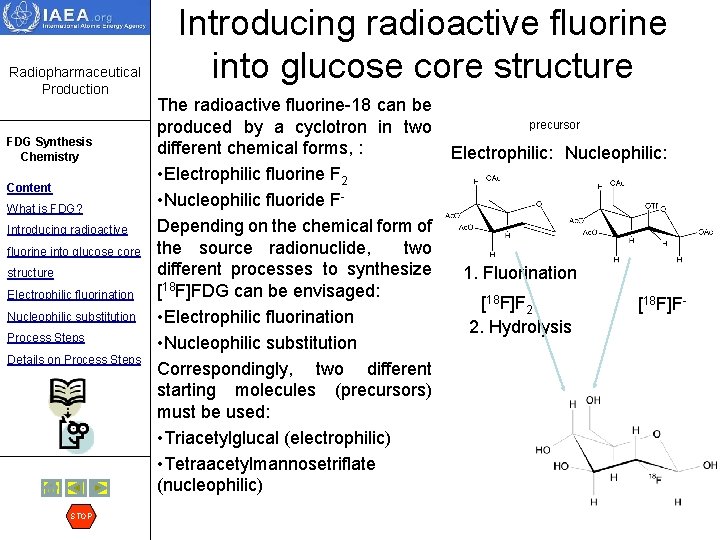
Radiopharmaceutical Production FDG Synthesis Chemistry Content What is FDG? Introducing radioactive fluorine into glucose core structure Electrophilic fluorination Nucleophilic substitution Process Steps Details on Process Steps STOP Introducing radioactive fluorine into glucose core structure The radioactive fluorine-18 can be produced by a cyclotron in two different chemical forms, : • Electrophilic fluorine F 2 • Nucleophilic fluoride FDepending on the chemical form of the source radionuclide, two different processes to synthesize [18 F]FDG can be envisaged: • Electrophilic fluorination • Nucleophilic substitution Correspondingly, two different starting molecules (precursors) must be used: • Triacetylglucal (electrophilic) • Tetraacetylmannosetriflate (nucleophilic) precursor Electrophilic: Nucleophilic: 1. Fluorination [18 F]F 2 2. Hydrolysis [18 F]F-
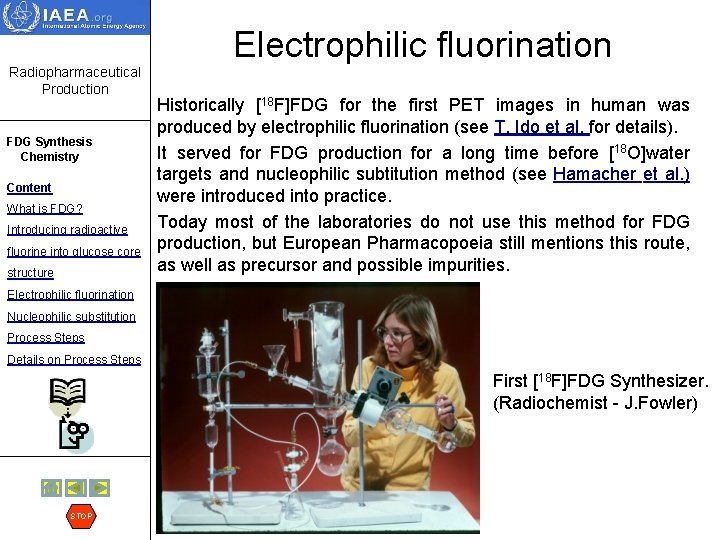
Electrophilic fluorination Radiopharmaceutical Production FDG Synthesis Chemistry Content What is FDG? Introducing radioactive fluorine into glucose core structure Historically [18 F]FDG for the first PET images in human was produced by electrophilic fluorination (see T. Ido et al. for details). It served for FDG production for a long time before [18 O]water targets and nucleophilic subtitution method (see Hamacher et al. ) were introduced into practice. Today most of the laboratories do not use this method for FDG production, but European Pharmacopoeia still mentions this route, as well as precursor and possible impurities. Electrophilic fluorination Nucleophilic substitution Process Steps Details on Process Steps First [18 F]FDG Synthesizer. (Radiochemist - J. Fowler) STOP
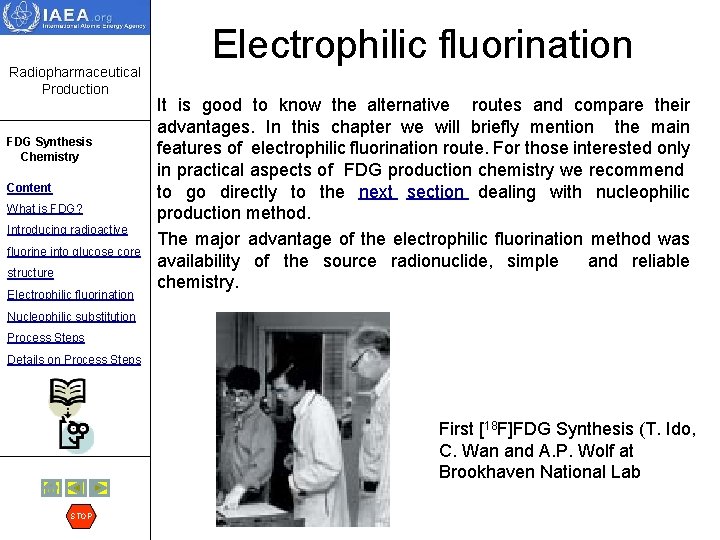
Radiopharmaceutical Production FDG Synthesis Chemistry Content What is FDG? Introducing radioactive fluorine into glucose core structure Electrophilic fluorination It is good to know the alternative routes and compare their advantages. In this chapter we will briefly mention the main features of electrophilic fluorination route. For those interested only in practical aspects of FDG production chemistry we recommend to go directly to the next section dealing with nucleophilic production method. The major advantage of the electrophilic fluorination method was availability of the source radionuclide, simple and reliable chemistry. Nucleophilic substitution Process Steps Details on Process Steps First [18 F]FDG Synthesis (T. Ido, C. Wan and A. P. Wolf at Brookhaven National Lab STOP
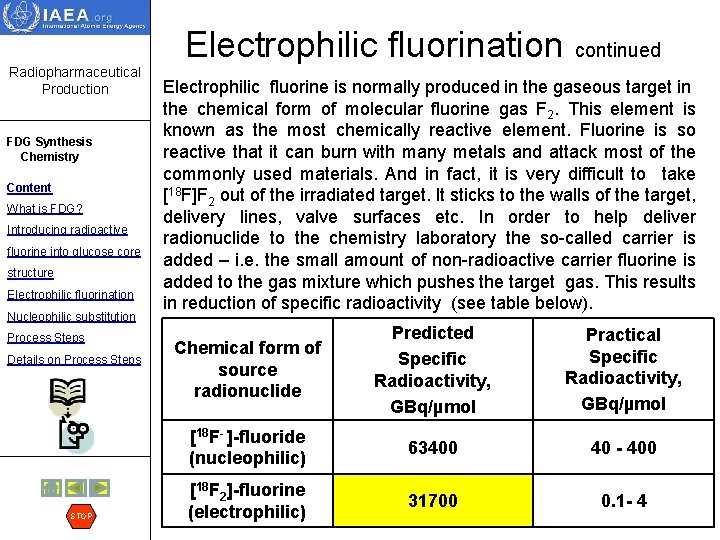
Electrophilic fluorination continued Radiopharmaceutical Production FDG Synthesis Chemistry Content What is FDG? Introducing radioactive fluorine into glucose core structure Electrophilic fluorination Nucleophilic substitution Process Steps Details on Process Steps STOP Electrophilic fluorine is normally produced in the gaseous target in the chemical form of molecular fluorine gas F 2. This element is known as the most chemically reactive element. Fluorine is so reactive that it can burn with many metals and attack most of the commonly used materials. And in fact, it is very difficult to take [18 F]F 2 out of the irradiated target. It sticks to the walls of the target, delivery lines, valve surfaces etc. In order to help deliver radionuclide to the chemistry laboratory the so-called carrier is added – i. e. the small amount of non-radioactive carrier fluorine is added to the gas mixture which pushes the target gas. This results in reduction of specific radioactivity (see table below). Chemical form of source radionuclide Predicted Specific Radioactivity, GBq/µmol Practical Specific Radioactivity, GBq/µmol [18 F- ]-fluoride (nucleophilic) 63400 40 - 400 [18 F 2]-fluorine (electrophilic) 31700 0. 1 - 4
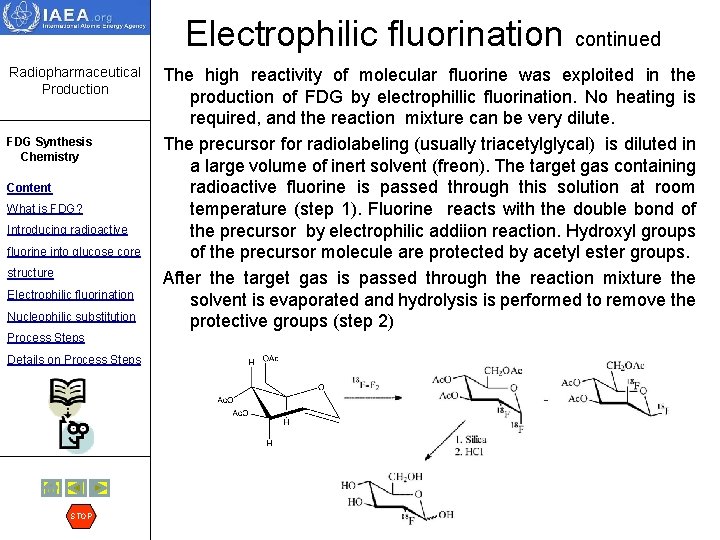
Electrophilic fluorination continued Radiopharmaceutical Production FDG Synthesis Chemistry Content What is FDG? Introducing radioactive fluorine into glucose core structure Electrophilic fluorination Nucleophilic substitution Process Steps Details on Process Steps STOP The high reactivity of molecular fluorine was exploited in the production of FDG by electrophillic fluorination. No heating is required, and the reaction mixture can be very dilute. The precursor for radiolabeling (usually triacetylglycal) is diluted in a large volume of inert solvent (freon). The target gas containing radioactive fluorine is passed through this solution at room temperature (step 1). Fluorine reacts with the double bond of the precursor by electrophilic addiion reaction. Hydroxyl groups of the precursor molecule are protected by acetyl ester groups. After the target gas is passed through the reaction mixture the solvent is evaporated and hydrolysis is performed to remove the protective groups (step 2)
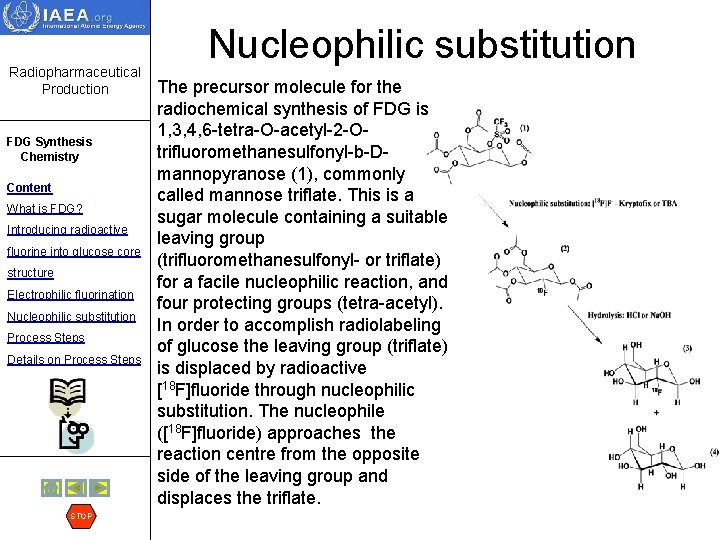
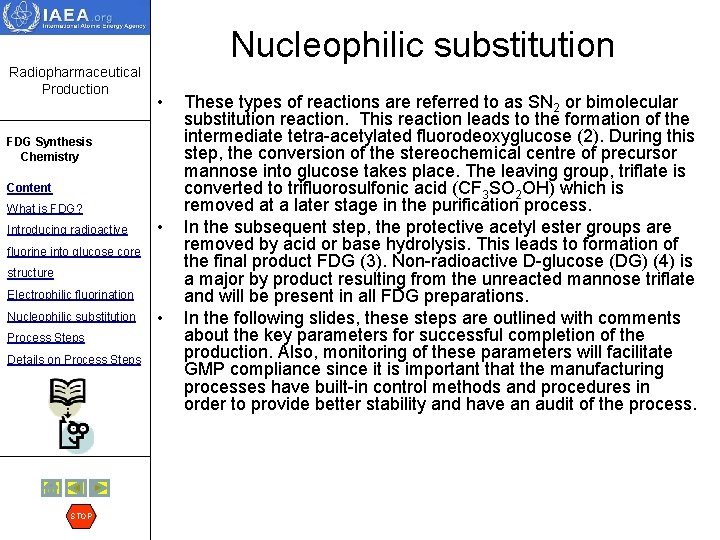
Radiopharmaceutical Production FDG Synthesis Chemistry Content What is FDG? Introducing radioactive fluorine into glucose core structure Electrophilic fluorination Nucleophilic substitution Process Steps Details on Process Steps STOP Nucleophilic substitution The precursor molecule for the radiochemical synthesis of FDG is 1, 3, 4, 6 -tetra-O-acetyl-2 -Otrifluoromethanesulfonyl-b-Dmannopyranose (1), commonly called mannose triflate. This is a sugar molecule containing a suitable leaving group (trifluoromethanesulfonyl- or triflate) for a facile nucleophilic reaction, and four protecting groups (tetra-acetyl). In order to accomplish radiolabeling of glucose the leaving group (triflate) is displaced by radioactive [18 F]fluoride through nucleophilic substitution. The nucleophile ([18 F]fluoride) approaches the reaction centre from the opposite side of the leaving group and displaces the triflate.
Nucleophilic substitution Radiopharmaceutical Production • FDG Synthesis Chemistry Content What is FDG? Introducing radioactive • fluorine into glucose core structure Electrophilic fluorination Nucleophilic substitution Process Steps Details on Process Steps STOP • These types of reactions are referred to as SN 2 or bimolecular substitution reaction. This reaction leads to the formation of the intermediate tetra-acetylated fluorodeoxyglucose (2). During this step, the conversion of the stereochemical centre of precursor mannose into glucose takes place. The leaving group, triflate is converted to trifluorosulfonic acid (CF 3 SO 2 OH) which is removed at a later stage in the purification process. In the subsequent step, the protective acetyl ester groups are removed by acid or base hydrolysis. This leads to formation of the final product FDG (3). Non-radioactive D-glucose (DG) (4) is a major by product resulting from the unreacted mannose triflate and will be present in all FDG preparations. In the following slides, these steps are outlined with comments about the key parameters for successful completion of the production. Also, monitoring of these parameters will facilitate GMP compliance since it is important that the manufacturing processes have built-in control methods and procedures in order to provide better stability and have an audit of the process.
Radiopharmaceutical Production Process Steps STEP OPERATIONS FDG Synthesis Chemistry Content 1 [18 F]fluoride production: 18 O(p, n)18 F Target cooling; Irradiation of Oxygen-18 enriched water Beam in the water targets attached to the energy and cyclotron by the beam of protons. current; Beam efficiency; Duration 2 Trapping of [18 F]fluoride and recovery of oxygen-18 enriched water: Precursors: Anion exchange cartridge; K 2 CO 3; and Kryptofix K 2. 2. 2. or tetra butyl ammonium (TBA) carbonate Resin cartridge preparation; Radioactivity tracking 3 Drying of 18 F-fluoride: Azeotropic evaporation at >85 o. C, ~10 min Process may be repeated 3 times Temperature of reaction vessel; duration What is FDG? Introducing radioactive fluorine into glucose core structure Electrophilic fluorination Nucleophilic substitution Process Steps Details on Process Steps STOP IN-PROCESS CONTROLS *
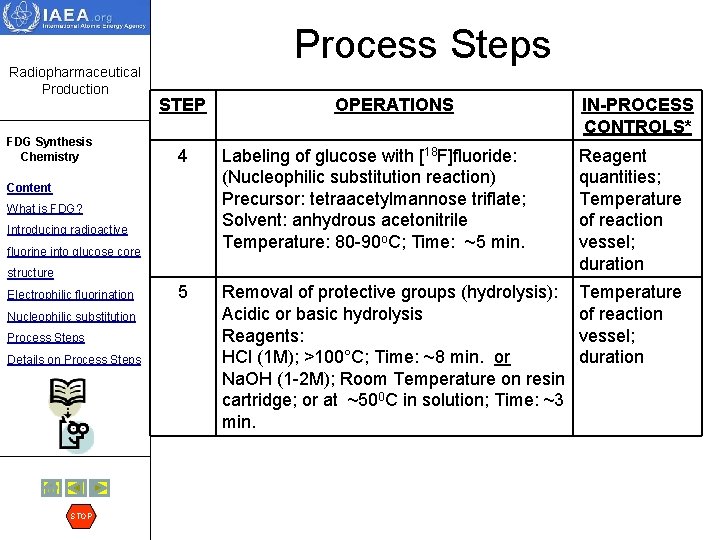
Radiopharmaceutical Production FDG Synthesis Chemistry Process Steps STEP OPERATIONS 4 Labeling of glucose with [18 F]fluoride: (Nucleophilic substitution reaction) Precursor: tetraacetylmannose triflate; Solvent: anhydrous acetonitrile Temperature: 80 -90 o. C; Time: ~5 min. Reagent quantities; Temperature of reaction vessel; duration 5 Removal of protective groups (hydrolysis): Acidic or basic hydrolysis Reagents: HCl (1 M); >100°C; Time: ~8 min. or Na. OH (1 -2 M); Room Temperature on resin cartridge; or at ~500 C in solution; Time: ~3 min. Temperature of reaction vessel; duration Content What is FDG? Introducing radioactive fluorine into glucose core structure Electrophilic fluorination Nucleophilic substitution Process Steps Details on Process Steps STOP IN-PROCESS CONTROLS*
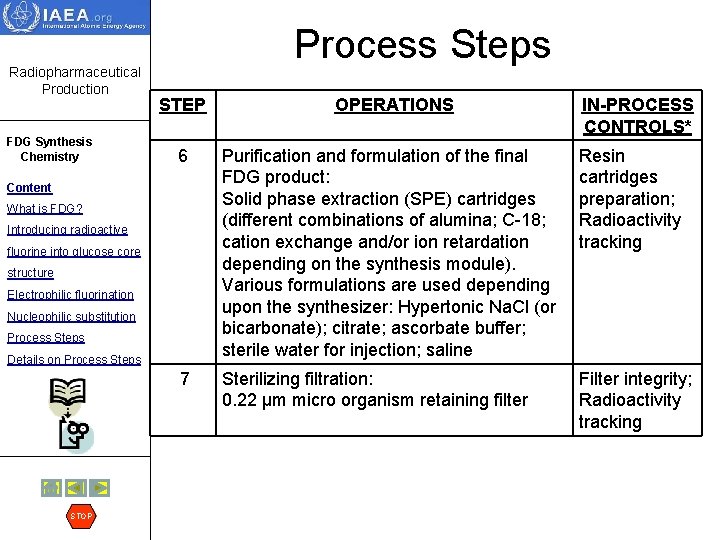
Radiopharmaceutical Production FDG Synthesis Chemistry Process Steps STEP IN-PROCESS CONTROLS* 6 Purification and formulation of the final FDG product: Solid phase extraction (SPE) cartridges (different combinations of alumina; C-18; cation exchange and/or ion retardation depending on the synthesis module). Various formulations are used depending upon the synthesizer: Hypertonic Na. Cl (or bicarbonate); citrate; ascorbate buffer; sterile water for injection; saline Resin cartridges preparation; Radioactivity tracking 7 Sterilizing filtration: 0. 22 µm micro organism retaining filter Filter integrity; Radioactivity tracking Content What is FDG? Introducing radioactive fluorine into glucose core structure Electrophilic fluorination Nucleophilic substitution Process Steps Details on Process Steps STOP OPERATIONS
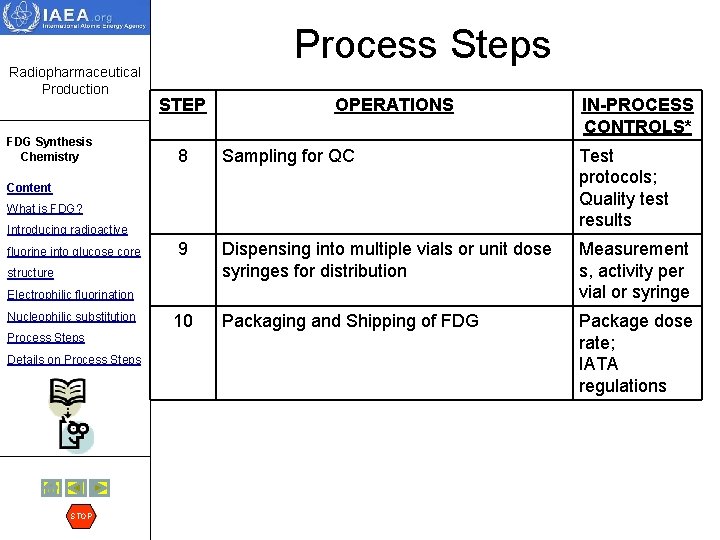
Radiopharmaceutical Production FDG Synthesis Chemistry Process Steps STEP OPERATIONS 8 Sampling for QC Test protocols; Quality test results 9 Dispensing into multiple vials or unit dose syringes for distribution Measurement s, activity per vial or syringe 10 Packaging and Shipping of FDG Package dose rate; IATA regulations Content What is FDG? Introducing radioactive fluorine into glucose core structure Electrophilic fluorination Nucleophilic substitution Process Steps Details on Process Steps STOP IN-PROCESS CONTROLS*
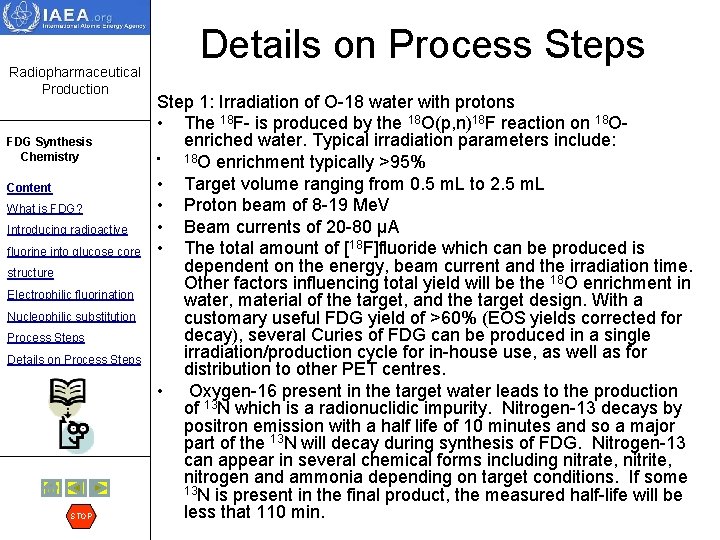
Radiopharmaceutical Production FDG Synthesis Chemistry Content What is FDG? Introducing radioactive fluorine into glucose core structure Electrophilic fluorination Nucleophilic substitution Process Steps Details on Process Steps STOP Details on Process Step 1: Irradiation of O-18 water with protons • The 18 F- is produced by the 18 O(p, n)18 F reaction on 18 Oenriched water. Typical irradiation parameters include: • 18 O enrichment typically >95% • Target volume ranging from 0. 5 m. L to 2. 5 m. L • Proton beam of 8 -19 Me. V • Beam currents of 20 -80 µA • The total amount of [18 F]fluoride which can be produced is dependent on the energy, beam current and the irradiation time. Other factors influencing total yield will be the 18 O enrichment in water, material of the target, and the target design. With a customary useful FDG yield of >60% (EOS yields corrected for decay), several Curies of FDG can be produced in a single irradiation/production cycle for in-house use, as well as for distribution to other PET centres. • Oxygen-16 present in the target water leads to the production of 13 N which is a radionuclidic impurity. Nitrogen-13 decays by positron emission with a half life of 10 minutes and so a major part of the 13 N will decay during synthesis of FDG. Nitrogen-13 can appear in several chemical forms including nitrate, nitrite, nitrogen and ammonia depending on target conditions. If some 13 N is present in the final product, the measured half-life will be less that 110 min.
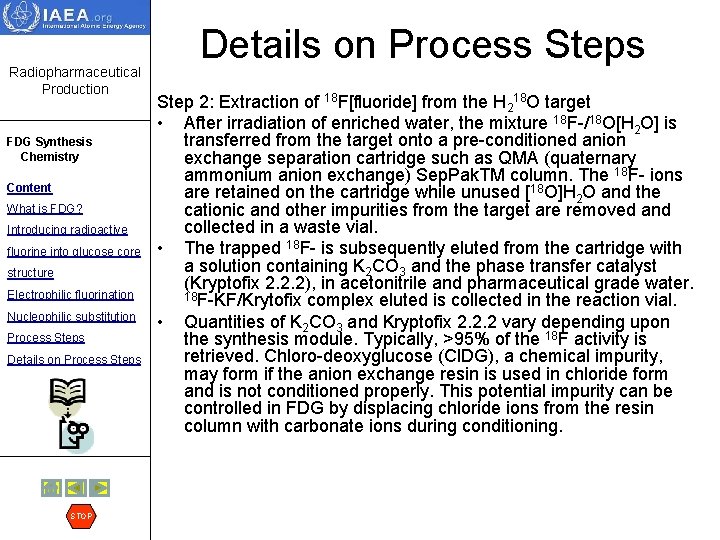
Radiopharmaceutical Production FDG Synthesis Chemistry Content What is FDG? Introducing radioactive fluorine into glucose core structure Electrophilic fluorination Nucleophilic substitution Process Steps Details on Process Steps STOP Details on Process Step 2: Extraction of 18 F[fluoride] from the H 218 O target • After irradiation of enriched water, the mixture 18 F-/18 O[H 2 O] is transferred from the target onto a pre-conditioned anion exchange separation cartridge such as QMA (quaternary ammonium anion exchange) Sep. Pak. TM column. The 18 F- ions are retained on the cartridge while unused [18 O]H 2 O and the cationic and other impurities from the target are removed and collected in a waste vial. • The trapped 18 F- is subsequently eluted from the cartridge with a solution containing K 2 CO 3 and the phase transfer catalyst (Kryptofix 2. 2. 2), in acetonitrile and pharmaceutical grade water. 18 F-KF/Krytofix complex eluted is collected in the reaction vial. • Quantities of K 2 CO 3 and Kryptofix 2. 2. 2 vary depending upon the synthesis module. Typically, >95% of the 18 F activity is retrieved. Chloro-deoxyglucose (Cl. DG), a chemical impurity, may form if the anion exchange resin is used in chloride form and is not conditioned properly. This potential impurity can be controlled in FDG by displacing chloride ions from the resin column with carbonate ions during conditioning.
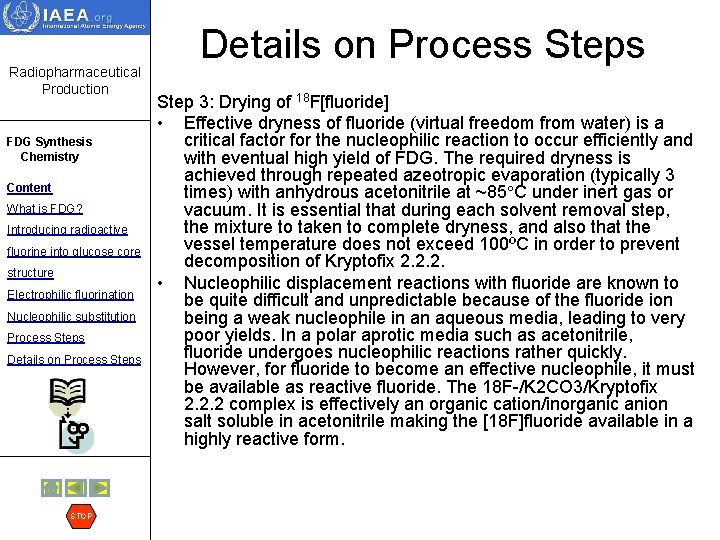
Radiopharmaceutical Production FDG Synthesis Chemistry Content What is FDG? Introducing radioactive fluorine into glucose core structure Electrophilic fluorination Nucleophilic substitution Process Steps Details on Process Steps STOP Details on Process Step 3: Drying of 18 F[fluoride] • Effective dryness of fluoride (virtual freedom from water) is a critical factor for the nucleophilic reaction to occur efficiently and with eventual high yield of FDG. The required dryness is achieved through repeated azeotropic evaporation (typically 3 times) with anhydrous acetonitrile at ~85 C under inert gas or vacuum. It is essential that during each solvent removal step, the mixture to taken to complete dryness, and also that the vessel temperature does not exceed 100ºC in order to prevent decomposition of Kryptofix 2. 2. 2. • Nucleophilic displacement reactions with fluoride are known to be quite difficult and unpredictable because of the fluoride ion being a weak nucleophile in an aqueous media, leading to very poor yields. In a polar aprotic media such as acetonitrile, fluoride undergoes nucleophilic reactions rather quickly. However, for fluoride to become an effective nucleophile, it must be available as reactive fluoride. The 18 F-/K 2 CO 3/Kryptofix 2. 2. 2 complex is effectively an organic cation/inorganic anion salt soluble in acetonitrile making the [18 F]fluoride available in a highly reactive form.
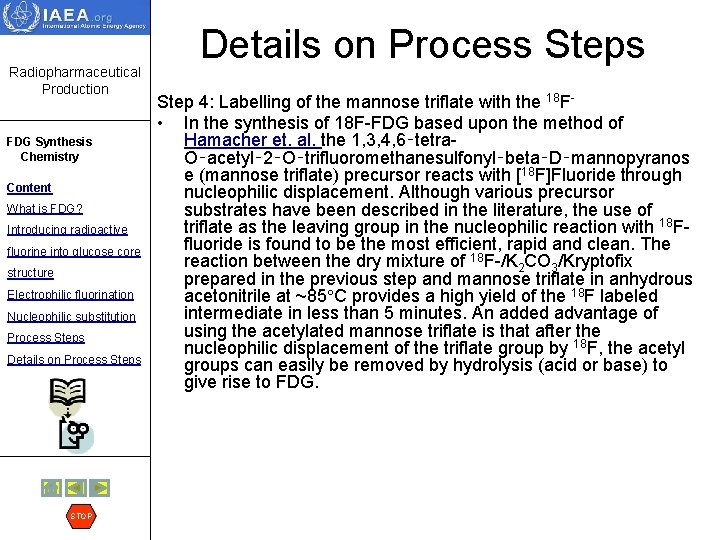
Radiopharmaceutical Production FDG Synthesis Chemistry Content What is FDG? Introducing radioactive fluorine into glucose core structure Electrophilic fluorination Nucleophilic substitution Process Steps Details on Process Steps STOP Details on Process Step 4: Labelling of the mannose triflate with the 18 F • In the synthesis of 18 F-FDG based upon the method of Hamacher et. al. the 1, 3, 4, 6‑tetra. O‑acetyl‑ 2‑O‑trifluoromethanesulfonyl‑beta‑D‑mannopyranos e (mannose triflate) precursor reacts with [18 F]Fluoride through nucleophilic displacement. Although various precursor substrates have been described in the literature, the use of triflate as the leaving group in the nucleophilic reaction with 18 Ffluoride is found to be the most efficient, rapid and clean. The reaction between the dry mixture of 18 F-/K 2 CO 3/Kryptofix prepared in the previous step and mannose triflate in anhydrous acetonitrile at ~85 C provides a high yield of the 18 F labeled intermediate in less than 5 minutes. An added advantage of using the acetylated mannose triflate is that after the nucleophilic displacement of the triflate group by 18 F, the acetyl groups can easily be removed by hydrolysis (acid or base) to give rise to FDG.
Radiopharmaceutical Production FDG Synthesis Chemistry Content What is FDG? Introducing radioactive fluorine into glucose core structure Electrophilic fluorination Nucleophilic substitution Process Steps Details on Process Steps STOP Details on Process Step 5: Removal of the protective acetyl groups by hydrolysis to form FDG • The final chemical step in the synthesis of FDG is the removal of the four acetyl protecting groups, which is easily accomplished through hydrolysis with either mild acid or base. Both methods are equally effective. • The alkaline hydrolysis is the most commonly used method in commercial synthesis modules since it requires less time and lower temperature. In this case, the 18 F-labelled intermediate with intact acetyl groups is treated with mild base (1 -2 M Na. OH) at room temperature to remove the acetyl groups. The alkaline hydrolysis may be performed directly on a C-18 cartridge at room temperature instead of adding base to the reaction vessel. • One possible drawback is that alkaline hydrolysis has a potential for epimerization of FDG to [18 F]Fluorodeoxymannose (FDM) which is a radiochemical impurity that should be controlled in the FDG manufacturing process. It has been shown, however, that formation of FDM is a possible only if the hydrolysis is performed at higher temperature [7]; epimerization at room temperature is negligible.
Radiopharmaceutical Production FDG Synthesis Chemistry Details on Process Step 6: Purification and formulation of the final FDG product. • FDG is purified by passing through a series of columns (e. g. , Sep. Pak. TM cartridges) for removal of impurities. These columns include (not necessarily in this order): Content – Cation exchange for removal of Kryptofix 2. 2. 2 or TBA – C-18 or similar lipophilic column for removal of unhydrolyzed and partially hydrolyzed intermediates – Alumina for removal of unreacted fluoride – Ion retardation for neutralization and p. H adjustment What is FDG? Introducing radioactive fluorine into glucose core structure Electrophilic fluorination Nucleophilic substitution Process Steps Details on Process Steps STOP • In some synthesis modules, the unhydrolyzed intermediates are trapped on a C-18 column and impurities are washed out prior to hydrolysis. Final formulation includes adjustment of isotonicity, p. H and volume adjustment. Some synthesis units utilize cation exchange and ion retardation resins to neutralize the solution, while others use buffers and addition of calculated quantity of hypertonic Na. Cl or Na 2 CO 3 to achieve the required p. H, isotonicity and required volume of the final product.
Radiopharmaceutical Production FDG Synthesis Chemistry Content What is FDG? Introducing radioactive fluorine into glucose core structure Electrophilic fluorination Nucleophilic substitution Process Steps Details on Process Steps STOP Details on Process Step 7: Sterilizing Filtration • Sterilizing filtration is performed by passing the purified FDG solution through a vented 0. 22µm filter. Sterilization with steam (autoclave) may also be applied, but is not required. The filtered product is essentially the final product which is held in quarantine until the time it is qualified for patient use. Step 8: Sampling for QC • A representative test sample is removed from the well-mixed bulk solution. If the production protocol entails dilution, sample must be drawn after dilution. Moreover, sampling must be done aseptically, ensuring not to microbiologically contaminate the final product. The sample size is usually about 0. 5 m. L for QC, and about 1. 0 m. L for retention in case of repeat tests and product complaints. Step 9: Dispensing • The FDG may be dispensed either into unit doses or in multidose vials using either manual or automated systems. This process must be done in an aseptic manner. If the product is dispensed into open vials, it must be done in a class A environment. The applicable GMP regulation should be followed. Practically, the typical injection volume is 2 -5 m. L. The product vial (or the syringe) and the outer lead shielding should be affixed with label containing product information, including: product name; total activity at reference time; expiration time; etc.
Radiopharmaceutical Production FDG Synthesis Chemistry Content What is FDG? Introducing radioactive fluorine into glucose core structure Electrophilic fluorination Nucleophilic substitution Process Steps Details on Process Step 10: Packaging and Shipping Two primary concerns during packaging and shipping are: radiation protection; and maintaining integrity of the product. Compliance with the applicable regulations of radiation protection and transportation of dangerous goods must be observed during packaging and shipping. FDG is shipped either in bulk in vials or as unit doses in syringes and hence the vial or syringe which is packed in a lead container. The lead container together with some absorbent material, to take care of inadvertent spillage, is packed in a secondary container. Appropriate labels must be affixed on the vials/syringe, the lead container and on the final package before shipping. Personnel involved in the transport should be appropriately trained. STOP
Return to Main Menu