
Radiometry Questions how bright will surfaces be what
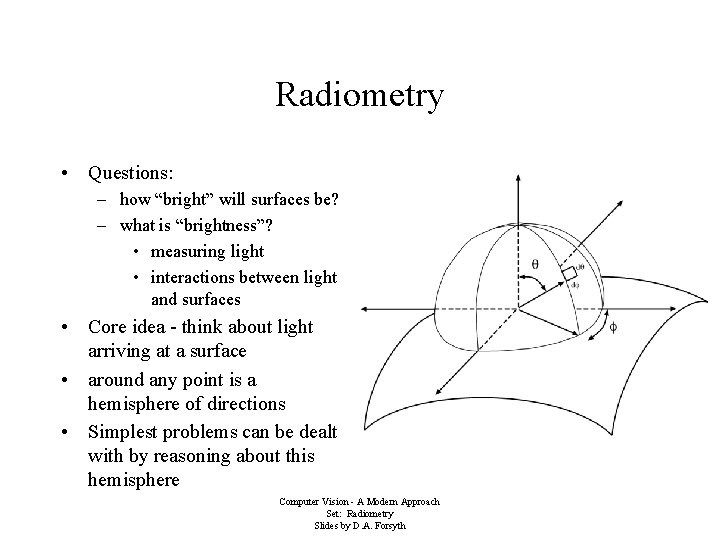
Radiometry • Questions: – how “bright” will surfaces be? – what is “brightness”? • measuring light • interactions between light and surfaces • Core idea - think about light arriving at a surface • around any point is a hemisphere of directions • Simplest problems can be dealt with by reasoning about this hemisphere Computer Vision - A Modern Approach Set: Radiometry Slides by D. A. Forsyth
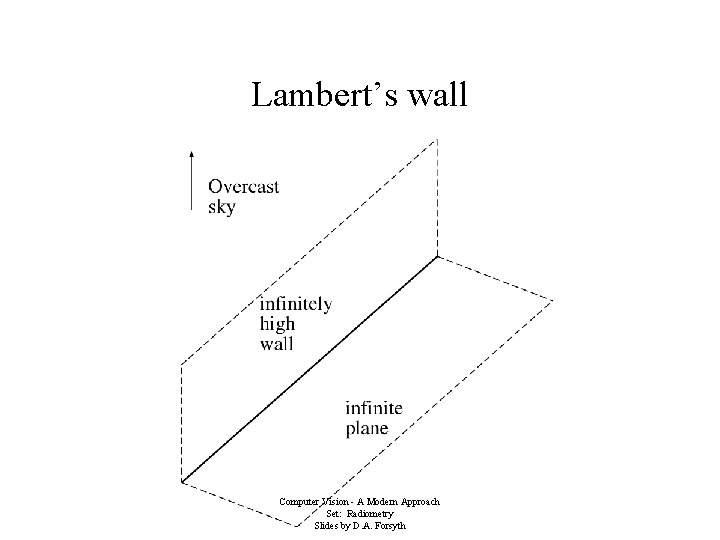
Lambert’s wall Computer Vision - A Modern Approach Set: Radiometry Slides by D. A. Forsyth
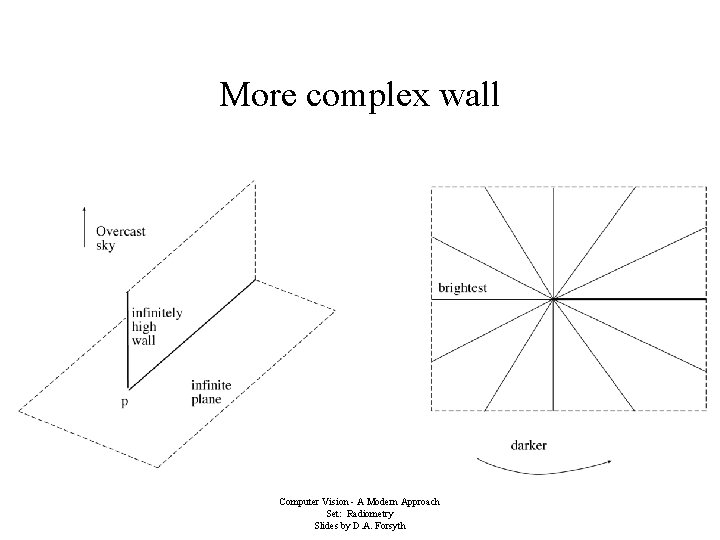
More complex wall Computer Vision - A Modern Approach Set: Radiometry Slides by D. A. Forsyth

Foreshortening • Principle: two sources that look the same to a receiver must have the same effect on the receiver. • Principle: two receivers that look the same to a source must receive the same amount of energy. • “look the same” means produce the same input hemisphere (or output hemisphere) • Reason: what else can a receiver know about a source but what appears on its input hemisphere? (ditto, swapping receiver and source) • Crucial consequence: a big source (resp. receiver), viewed at a glancing angle, must produce (resp. experience) the same effect as a small source (resp. receiver) viewed frontally. Computer Vision - A Modern Approach Set: Radiometry Slides by D. A. Forsyth
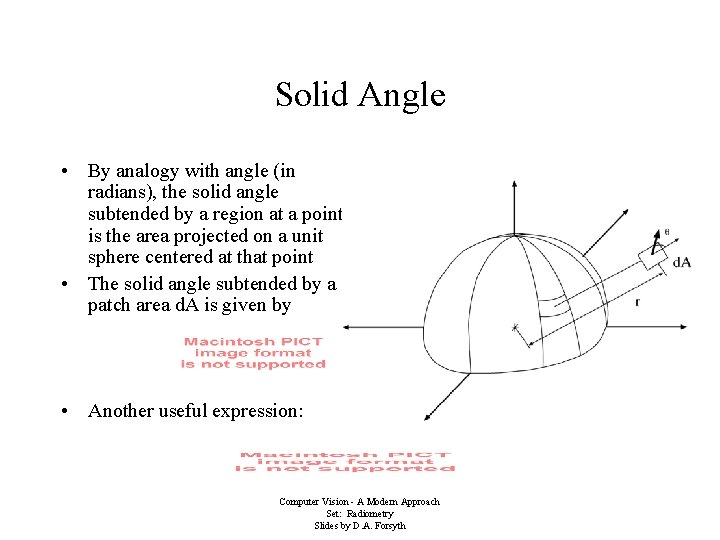
Solid Angle • By analogy with angle (in radians), the solid angle subtended by a region at a point is the area projected on a unit sphere centered at that point • The solid angle subtended by a patch area d. A is given by • Another useful expression: Computer Vision - A Modern Approach Set: Radiometry Slides by D. A. Forsyth
Measuring Light in Free Space • Desirable property: in a vacuum, the relevant unit does not go down along a straight line. • How do we get a unit with this property? Think about the power transferred from an infinitesimal source to an infinitesimal receiver. • We have total power leaving s to r = total power arriving at r from s • Also: Power arriving at r is proportional to: – solid angle subtended by s at r (because if s looked bigger from r, there’d be more) – foreshortened area of r (because a bigger r will collect more power Computer Vision - A Modern Approach Set: Radiometry Slides by D. A. Forsyth
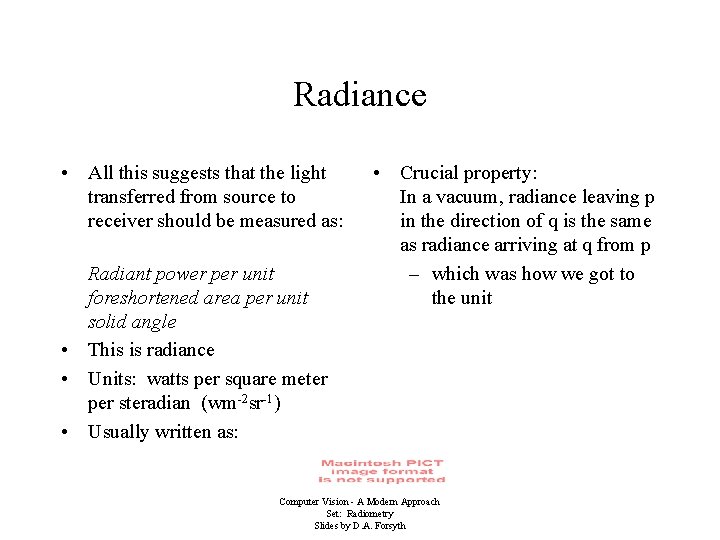
Radiance • All this suggests that the light transferred from source to receiver should be measured as: Radiant power per unit foreshortened area per unit solid angle • This is radiance • Units: watts per square meter per steradian (wm-2 sr-1) • Usually written as: • Crucial property: In a vacuum, radiance leaving p in the direction of q is the same as radiance arriving at q from p – which was how we got to the unit Computer Vision - A Modern Approach Set: Radiometry Slides by D. A. Forsyth
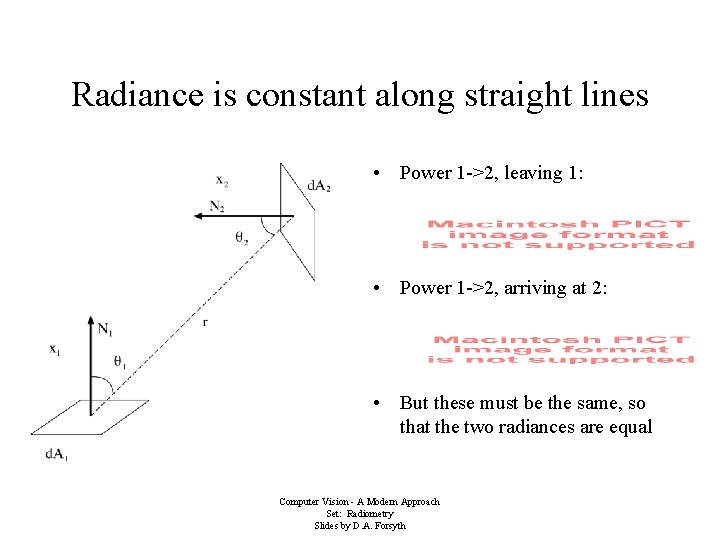
Radiance is constant along straight lines • Power 1 ->2, leaving 1: • Power 1 ->2, arriving at 2: • But these must be the same, so that the two radiances are equal Computer Vision - A Modern Approach Set: Radiometry Slides by D. A. Forsyth
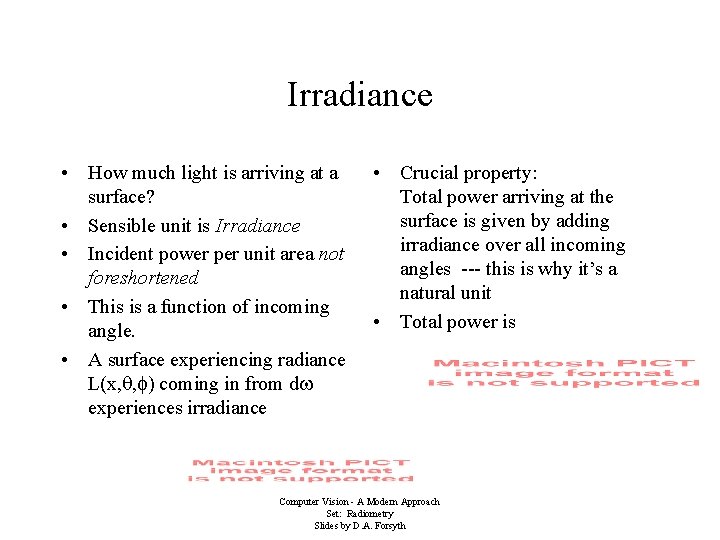
Irradiance • How much light is arriving at a surface? • Sensible unit is Irradiance • Incident power per unit area not foreshortened • This is a function of incoming angle. • A surface experiencing radiance L(x, q, f) coming in from dw experiences irradiance • Crucial property: Total power arriving at the surface is given by adding irradiance over all incoming angles --- this is why it’s a natural unit • Total power is Computer Vision - A Modern Approach Set: Radiometry Slides by D. A. Forsyth
Light at surfaces • Many effects when light strikes a surface -- could be: – absorbed – transmitted • skin – reflected • mirror – scattered • milk – travel along the surface and leave at some other point • sweaty skin • Assume that – surfaces don’t fluoresce • e. g. scorpions, washing powder – surfaces don’t emit light (i. e. are cool) – all the light leaving a point is due to that arriving at that point Computer Vision - A Modern Approach Set: Radiometry Slides by D. A. Forsyth
The BRDF • Assuming that – surfaces don’t fluoresce – surfaces don’t emit light (i. e. are cool) – all the light leaving a point is due to that arriving at that point • Can model this situation with the Bidirectional Reflectance Distribution Function (BRDF) • the ratio of the radiance in the outgoing direction to the incident irradiance Computer Vision - A Modern Approach Set: Radiometry Slides by D. A. Forsyth
BRDF • Units: inverse steradians (sr-1) • Symmetric in incoming and outgoing directions - this is the Helmholtz reciprocity principle • Radiance leaving a surface in a particular direction: – add contributions from every incoming direction Computer Vision - A Modern Approach Set: Radiometry Slides by D. A. Forsyth
Suppressing Angles - Radiosity • In many situations, we do not really need angle coordinates – e. g. cotton cloth, where the reflected light is not dependent on angle • Appropriate radiometric unit is radiosity • Radiosity from radiance? – sum radiance leaving surface over all exit directions, multiplying by a cosine because this is per unit area not per unit foreshortened area – total power leaving a point on the surface, per unit area on the surface (Wm-2) – note that this is independent of the direction Computer Vision - A Modern Approach Set: Radiometry Slides by D. A. Forsyth
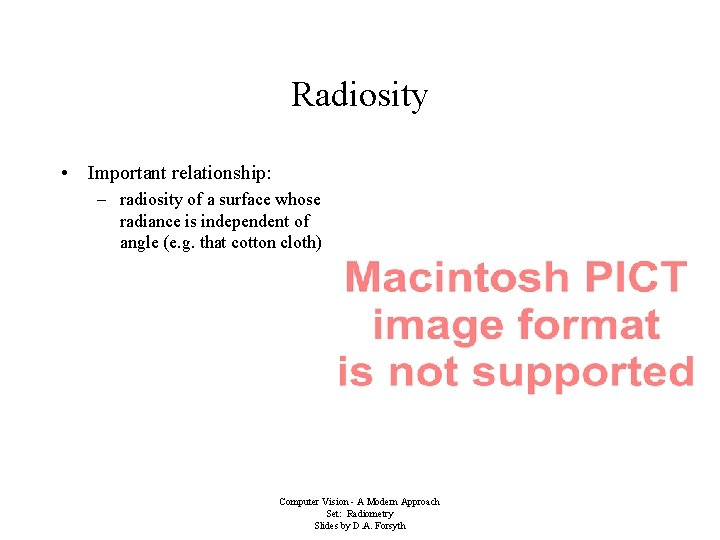
Radiosity • Important relationship: – radiosity of a surface whose radiance is independent of angle (e. g. that cotton cloth) Computer Vision - A Modern Approach Set: Radiometry Slides by D. A. Forsyth
Suppressing the angles in the BRDF • BRDF is a very general notion – some surfaces need it (underside of a CD; tiger eye; etc) – very hard to measure • , illuminate from one direction, view from another, repeat – very unstable • minor surface damage can change the BRDF • e. g. ridges of oil left by contact with the skin can act as lenses • for many surfaces, light leaving the surface is largely independent of exit angle – surface roughness is one source of this property Computer Vision - A Modern Approach Set: Radiometry Slides by D. A. Forsyth
Directional hemispheric reflectance • Directional hemispheric reflectance: – the fraction of the incident irradiance in a given direction that is reflected by the surface (whatever the direction of reflection) – unitless, range is 0 -1 • Note that DHR varies with incoming direction – eg a ridged surface, where left facing ridges are absorbent and right facing ridges reflect. Computer Vision - A Modern Approach Set: Radiometry Slides by D. A. Forsyth
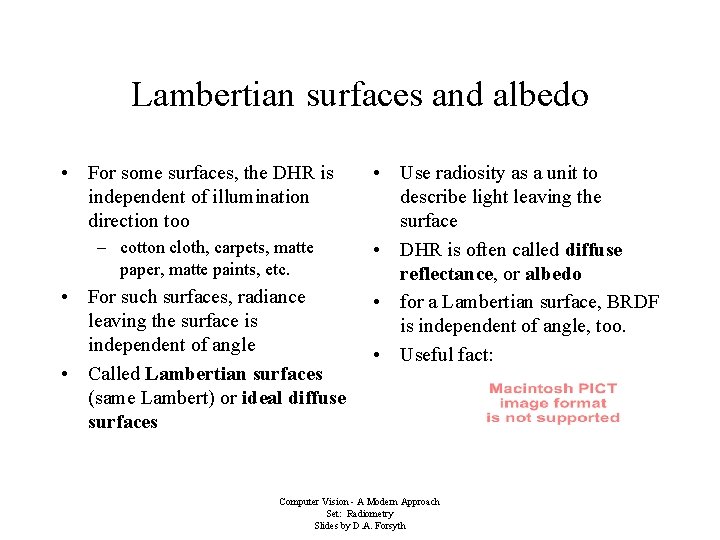
Lambertian surfaces and albedo • For some surfaces, the DHR is independent of illumination direction too – cotton cloth, carpets, matte paper, matte paints, etc. • For such surfaces, radiance leaving the surface is independent of angle • Called Lambertian surfaces (same Lambert) or ideal diffuse surfaces • Use radiosity as a unit to describe light leaving the surface • DHR is often called diffuse reflectance, or albedo • for a Lambertian surface, BRDF is independent of angle, too. • Useful fact: Computer Vision - A Modern Approach Set: Radiometry Slides by D. A. Forsyth
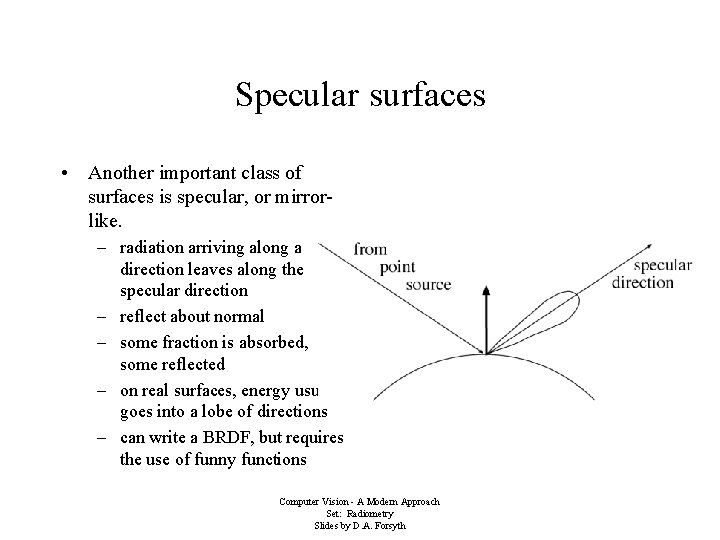
Specular surfaces • Another important class of surfaces is specular, or mirrorlike. – radiation arriving along a direction leaves along the specular direction – reflect about normal – some fraction is absorbed, some reflected – on real surfaces, energy usually goes into a lobe of directions – can write a BRDF, but requires the use of funny functions Computer Vision - A Modern Approach Set: Radiometry Slides by D. A. Forsyth
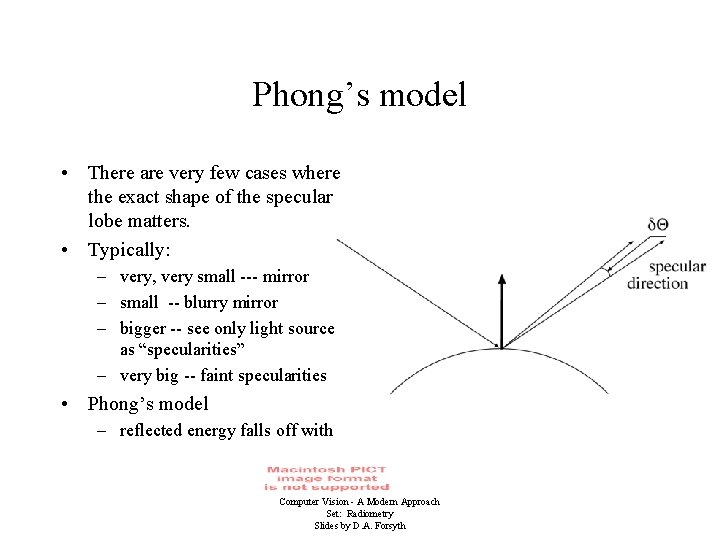
Phong’s model • There are very few cases where the exact shape of the specular lobe matters. • Typically: – very, very small --- mirror – small -- blurry mirror – bigger -- see only light sources as “specularities” – very big -- faint specularities • Phong’s model – reflected energy falls off with Computer Vision - A Modern Approach Set: Radiometry Slides by D. A. Forsyth
Lambertian + specular • Widespread model – all surfaces are Lambertian plus specular component • Advantages – easy to manipulate – very often quite close true • Disadvantages – some surfaces are not • e. g. underside of CD’s, feathers of many birds, blue spots on many marine crustaceans and fish, most rough surfaces, oil films (skin!), wet surfaces – Generally, very little advantage in modelling behaviour of light at a surface in more detail -- it is quite difficult to understand behaviour Computer Vision - A Modern Approach Set: Radiometry of L+S surfaces Slides by D. A. Forsyth
- Slides: 20