
Radiological Incidents and Emergencies An Introduction to Radiation
- Slides: 54
Radiological Incidents and Emergencies An Introduction to Radiation Protection 6 e © 2014 Martin, Harbison, Beach, Cole/CRC Press
Introduction • Types of event inc INES Scale • Loss of shielding • Loss of containment • Major releases from nuclear facilities • Uncontrolled criticality • Dose control in emergencies • Pre-planning for emergencies An Introduction to Radiation Protection 6 e © 2014 Martin, Harbison, Beach, Cole/CRC Press
Types of Event • For planning and control purposes, useful to differentiate between the various levels of events that can occur: – Local incidents, such as minor spills or mishaps with small sources – Site emergencies with potential to have significant radiological impact on-site – Public emergencies with potential for off-site impact and requiring implementation of preprepared emergency plan An Introduction to Radiation Protection 6 e © 2014 Martin, Harbison, Beach, Cole/CRC Press
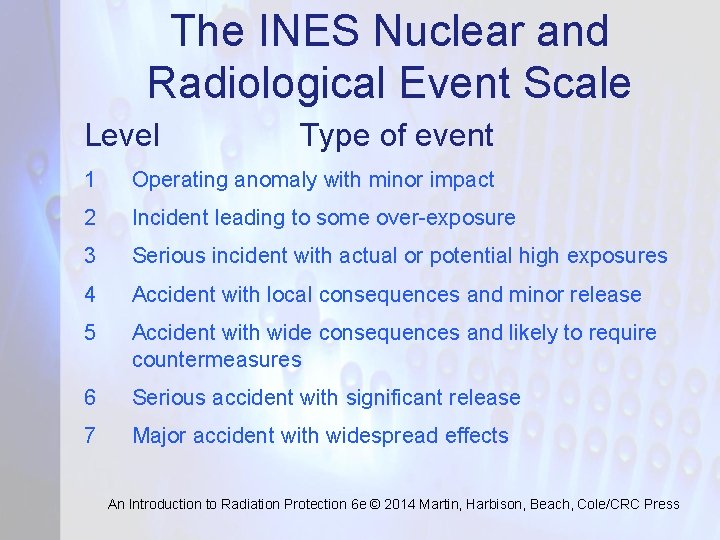
The INES Nuclear and Radiological Event Scale Level Type of event 1 Operating anomaly with minor impact 2 Incident leading to some over-exposure 3 Serious incident with actual or potential high exposures 4 Accident with local consequences and minor release 5 Accident with wide consequences and likely to require countermeasures 6 Serious accident with significant release 7 Major accident with widespread effects An Introduction to Radiation Protection 6 e © 2014 Martin, Harbison, Beach, Cole/CRC Press
Loss of Shielding • Small sealed source • Large sealed source • Entry into shielded cells • Reactor fuel handling incidents An Introduction to Radiation Protection 6 e © 2014 Martin, Harbison, Beach, Cole/CRC Press
Small Sealed Source • Unlikely that source of less than ~100 MBq would give rise to serious problem • The likelihood of an event is minimised by adherence to procedures, use of installed or portable monitoring equipment and by regular source musters • Would generally be Level 2 on INES Scale An Introduction to Radiation Protection 6 e © 2014 Martin, Harbison, Beach, Cole/CRC Press
Large Sealed Sources • Widely used for industrial processing, radiography and medical radiotherapy • Normally in high integrity shielded containers with mechanisms for controlling exposure time • Majority of incidents have occurred in industrial radiography on construction sites • A number of cases in which source has detached from mechanism and remained unshielded and resulted in very large, sometimes fatal, doses • Past events have been 2 to 5 on INES Scale An Introduction to Radiation Protection 6 e © 2014 Martin, Harbison, Beach, Cole/CRC Press
Large Sealed Sources – cont’d • Prevention of incidents depends on: – Correct us and maintenance of appropriate equipment – Thorough training – Strict adherence to monitoring procedures by radiographer – Use of alarm devices wherever possible An Introduction to Radiation Protection 6 e © 2014 Martin, Harbison, Beach, Cole/CRC Press
Entry into Shielded Cells • Large g sources, x-ray machines or linear accelerators are often used in shielded cells • Consequences of entry when source is exposed or equipment live can be extremely serious • Safety is a prime factor in design: – Should fail safe – Incorporate interlock systems – Monitoring and alarm systems An Introduction to Radiation Protection 6 e © 2014 Martin, Harbison, Beach, Cole/CRC Press
Entry into Shielded Cells cont’d • Serious event in 1991 at Teflon treatment facility in France • Machine was in a standby “dark current” mode • Dose rates in room still extremely high – up to several Gy per second • Three workers entered room through exit • Most exposed worker received skin dose of about 40 Sv (effective dose ~ 1 Sv) • Event caused by poor design combined with contravention of operating procedures An Introduction to Radiation Protection 6 e © 2014 Martin, Harbison, Beach, Cole/CRC Press
Reactor Fuel Handling Accidents • In nuclear plants, irradiated fuel and other highly active equipment is transferred routinely e. g. from reactor to storage pond using remotely controlled equipment • Loss of shielding very unlikely because of built-in safety • Greater scope for incidents on research reactors and on fuel cooling ponds • Possibility of incidents minimised by good design and adherence to strict operating procedures • An installed radiation alarm system is an essential safeguard An Introduction to Radiation Protection 6 e © 2014 Martin, Harbison, Beach, Cole/CRC Press
Loss of Containment • Minor spillage of radioactivity • Major spills • Major releases from nuclear facilities An Introduction to Radiation Protection 6 e © 2014 Martin, Harbison, Beach, Cole/CRC Press
Minor Spillage of Radioactivity • Most common incident is minor spill in laboratory • Likelihood is minimised by good practice – double or triple containment of likely sources of spillage • Correct procedures should prevent spread outside immediate area • Use of spillpacks • Incidents can also occur due to loss of ventilation, particularly to glove boxes and fume hoods • Importance of washing and monitoring procedures • Events of this type typically INES Level 1 An Introduction to Radiation Protection 6 e © 2014 Martin, Harbison, Beach, Cole/CRC Press
Major Spills • Spill involving more than 100 MBq or so could cause significant incident (depending on radionuclides) • Immediate steps could include – evacuation of area – shutting off ventilation system and – sealing off area to limit spread • Controlled re-entry would be necessary with appropriate clothing and protection • Subsequent decontamination is much easier where attention has been given to surface finishes An Introduction to Radiation Protection 6 e © 2014 Martin, Harbison, Beach, Cole/CRC Press
Major Releases from Nuclear Facilities • These are much the most serious events because of the very large inventories that could be released • In a nuclear reactor, the fission products are contained within three separate boundaries – The fuel cladding – The boundary of the cooling system, and – The reactor buildings and containment system • Most likely cause of incident is loss of cooling with subsequent overheating and, possibly, melting of cladding and fuel • The loss of cooling could be due to equipment failure possibly initiated by some internal or external event An Introduction to Radiation Protection 6 e © 2014 Martin, Harbison, Beach, Cole/CRC Press
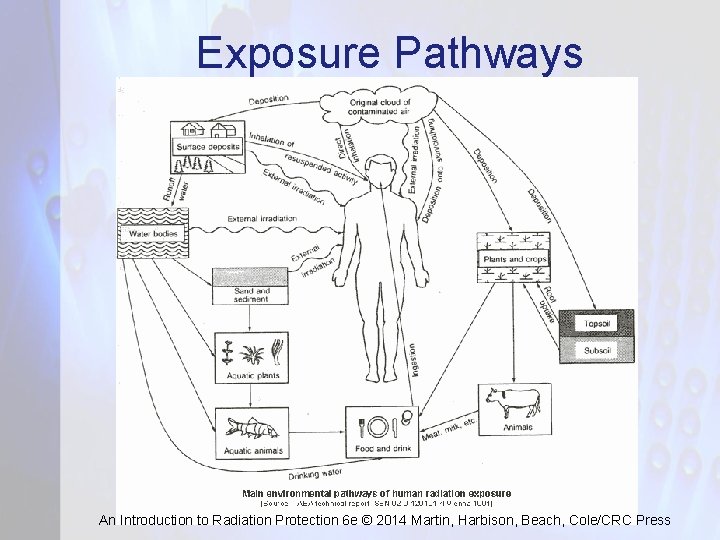
Exposure Pathways An Introduction to Radiation Protection 6 e © 2014 Martin, Harbison, Beach, Cole/CRC Press
Major Releases from Nuclear Facilities • Early nuclear plants were sited in remote areas because of potential for major releases • Later plants incorporate advanced safety features, including high-integrity containment and are located less remotely • Over the last 60 years, there have been several major events including: – Windscale, UK, 1957 – Three Mile Island, USA, 1979 – Chernobyl, Ukraine, 1986 – Fukushima, Japan, 2011 An Introduction to Radiation Protection 6 e © 2014 Martin, Harbison, Beach, Cole/CRC Press
The Windscale Accident • Reactor was of early design using direct cycle air cooling with air discharged through filters and a high stack • During a special operation (Wigner energy release) the fuel overheated and caught fire • The main radionuclide released was I-131 for which the filters were not very effective- total release ~ 7 x 10¹⁴ Bq An Introduction to Radiation Protection 6 e © 2014 Martin, Harbison, Beach, Cole/CRC Press
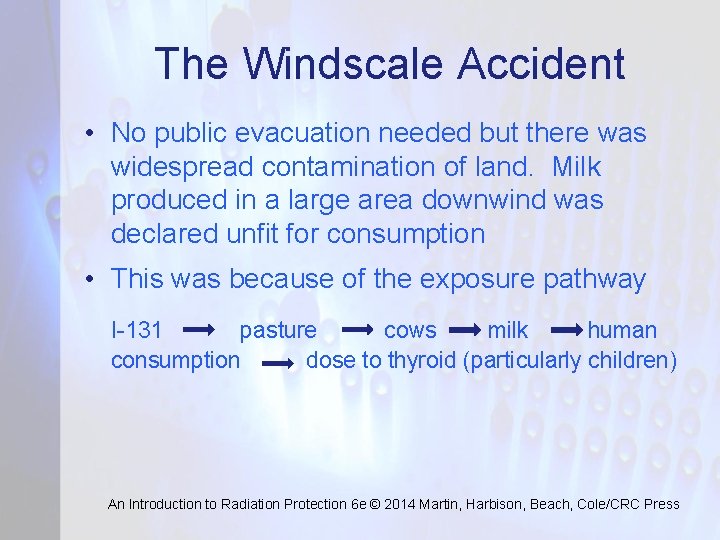
The Windscale Accident • No public evacuation needed but there was widespread contamination of land. Milk produced in a large area downwind was declared unfit for consumption • This was because of the exposure pathway I-131 pasture cows milk human consumption dose to thyroid (particularly children) An Introduction to Radiation Protection 6 e © 2014 Martin, Harbison, Beach, Cole/CRC Press
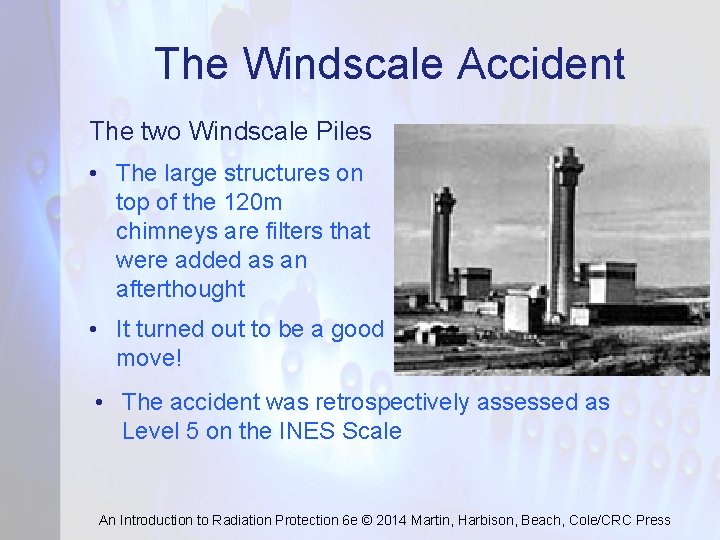
The Windscale Accident The two Windscale Piles • The large structures on top of the 120 m chimneys are filters that were added as an afterthought • It turned out to be a good move! • The accident was retrospectively assessed as Level 5 on the INES Scale An Introduction to Radiation Protection 6 e © 2014 Martin, Harbison, Beach, Cole/CRC Press
Three Mile Island Unit 2 - 1979 • The Three Mile Island complex comprised two x 900 MW commercial Pressurised Water Reactor (PWR) plants • The accident was on Unit 2 and was caused by a major coolant leak due to an incorrectly aligned valve • The resulting loss of cooling led to melting of the fuel and release of radioactivity via the gaseous waste system An Introduction to Radiation Protection 6 e © 2014 Martin, Harbison, Beach, Cole/CRC Press
Three Mile Island Unit 2 - 1979 • The released activity was almost entirely in the form of short-lived fission gases and the radiation dose to the public was very low • The average dose to people within 10 miles was less than 0. 1 m. Sv, with a highest dose of about 1 m. Sv • Some evacuation – mainly young children and pregnant women An Introduction to Radiation Protection 6 e © 2014 Martin, Harbison, Beach, Cole/CRC Press
Three Mile Island Unit 2 - 1979 • The accident had a considerable adverse impact on public attitudes to nuclear power in the USA and worldwide • Led to a 20 year cessation of new nuclear build in the US • The clean-up of the plant took 11 years and cost about US$1 billion • As for the Windscale accident, the TMI event was retrospectively given a Level 5 INES rating An Introduction to Radiation Protection 6 e © 2014 Martin, Harbison, Beach, Cole/CRC Press
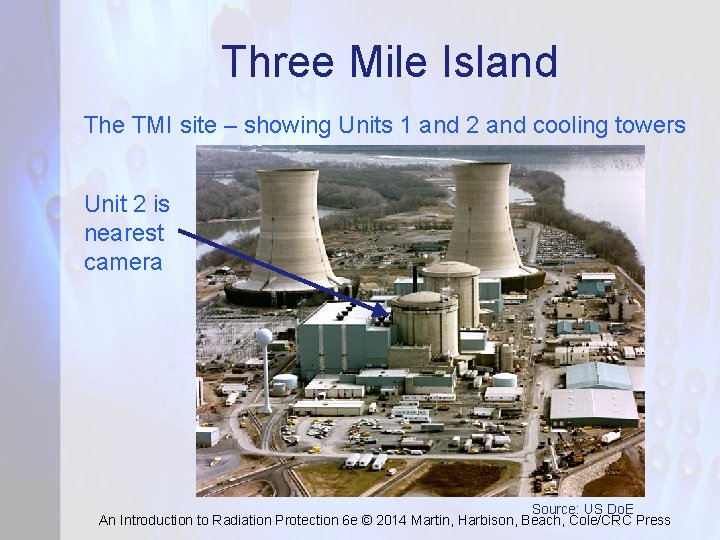
Three Mile Island The TMI site – showing Units 1 and 2 and cooling towers Unit 2 is nearest camera Source: US Do. E An Introduction to Radiation Protection 6 e © 2014 Martin, Harbison, Beach, Cole/CRC Press
Chernobyl - April 1986 • This is the most serious of the major accidents that have occurred • Involved a 1000 MW RBMK graphitemoderated, Boiling Water Reactor (BWR) - a Russian design used only in eastern Europe • Operators were conducting tests which resulted in a very unstable condition, causing a large power surge An Introduction to Radiation Protection 6 e © 2014 Martin, Harbison, Beach, Cole/CRC Press
Chernobyl - April 1986 • Caused a rapid increase in steam generation and pressure and rupture of the primary circuit • A second explosion occurred a few seconds later due to a zirconium-steam reaction and production of hydrogen • Release of radioactivity continued for about 10 days An Introduction to Radiation Protection 6 e © 2014 Martin, Harbison, Beach, Cole/CRC Press
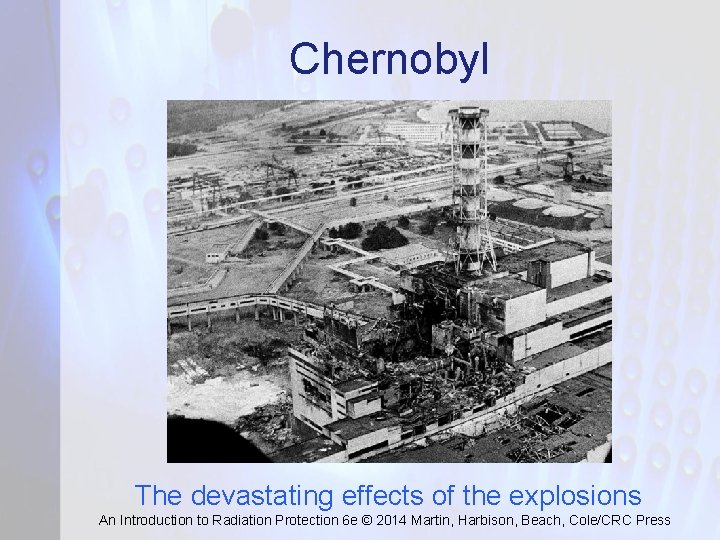
Chernobyl The devastating effects of the explosions An Introduction to Radiation Protection 6 e © 2014 Martin, Harbison, Beach, Cole/CRC Press
Chernobyl - April 1986 • The total release exceeded 1018 Bq – the largest ever uncontrolled release • Extremely high dose rates occurred on the site and doses of up to 20 Sv were received by fire-fighters and other workers, resulting in 28 deaths by the end of July 1986 • Extensive contamination occurred across large areas of Europe. In the town of Pripyat, some 5 km from the site, dose rates of up to 10 m. Sv/h were experienced • The entire population of 45, 000 was evacuated in 3 hours on the second day An Introduction to Radiation Protection 6 e © 2014 Martin, Harbison, Beach, Cole/CRC Press
Chernobyl - April 1986 • The widespread contamination, particularly by Cs -137, necessitated monitoring and control of agricultural products in many countries, including the UK • Epidemiological studies are still being conducted • One of most significant effects has been the increased incidence of thyroid cancer in children • The accident was retrospectively given the maximum rating of 7 on the INES Scale An Introduction to Radiation Protection 6 e © 2014 Martin, Harbison, Beach, Cole/CRC Press
Chernobyl - April 1986 • Internationally, it resulted in a reappraisal of planning and preparation for nuclear accidents and of the methods of monitoring and assessment • Also resulted in an International Convention on Nuclear Safety, intended to improve safety of all plants • Also a Convention on Early Notification of a Nuclear Accident to ensure potentially affected countries are notified rapidly in event of an accident An Introduction to Radiation Protection 6 e © 2014 Martin, Harbison, Beach, Cole/CRC Press
Fukushima - March 2011 • An major earthquake of magnitude 9 occurred off the north-eastern coast of Japan causing a tsunami • Fukushima, situated on coast, is site of six Boiling Water Reactors (BWR) • At the time of the earthquake, three of the reactors were operating and these shut down automatically • The plants and safety equipment generally withstood effects of the earthquake but external grid connection lost An Introduction to Radiation Protection 6 e © 2014 Martin, Harbison, Beach, Cole/CRC Press
Fukushima - March 2011 • Emergency generators started up to supply power to cooling water pumps and other safety equipment • About 1 hour later, a tsunami wave of 14 m over-topped the sea wall leading to the inundation of the site, complete loss of power and hence means of cooling the reactors • Coolant temperatures increased, leading to rising pressure An Introduction to Radiation Protection 6 e © 2014 Martin, Harbison, Beach, Cole/CRC Press
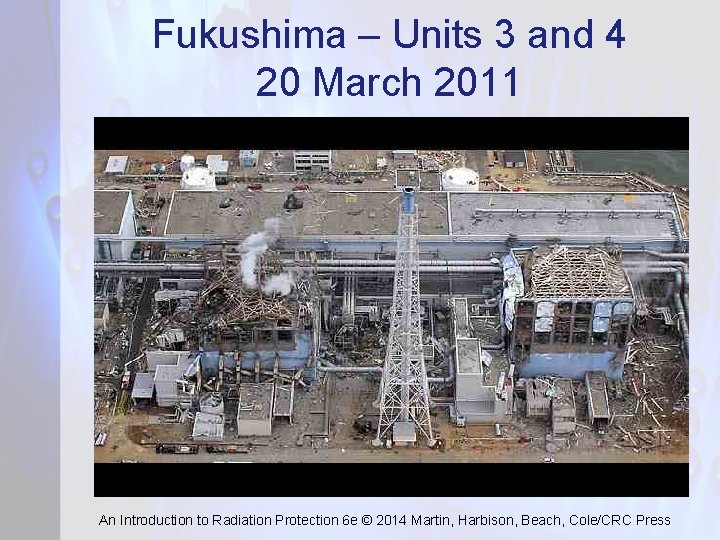
Fukushima - March 2011 • Steam and hydrogen vented into primary containments and later into the reactor buildings • Hydrogen explosions occurred, severely damaging buildings and providing a release path for radioactivity from the over-heated core • Loss of cooling of fuel storage ponds led to evaporation of water and uncovering of fuel, causing high gamma radiation levels on site, impeding recovery operations • Situation not finally under control until December 2011 An Introduction to Radiation Protection 6 e © 2014 Martin, Harbison, Beach, Cole/CRC Press
Fukushima – Units 3 and 4 20 March 2011 An Introduction to Radiation Protection 6 e © 2014 Martin, Harbison, Beach, Cole/CRC Press
Fukushima - March 2011 Radiological impact • A few tens of workers received doses greater than 100 m. Sv but less than the 250 m. Sv limit set for the emergency • Two workers showed minor skin burns due to beta exposure • Some 200, 000 people living within 20 km of site were evacuated and potassium iodate tablets issued over a wider area • Bans on consumption of locally-grown foodstuffs in various areas. Some likely to persist over long period • Large volumes of contaminated water arose on site, much of which was discharged to sea An Introduction to Radiation Protection 6 e © 2014 Martin, Harbison, Beach, Cole/CRC Press
Fukushima - March 2011 • This incident is unique – first major accident to be initiated by an external event • Initially classed as INES Level 5 but later revised to Level 7 because all six reactors were affected to some degree • The overall radiological impact was much less than for Chernobyl An Introduction to Radiation Protection 6 e © 2014 Martin, Harbison, Beach, Cole/CRC Press
Fukushima - March 2011 • Remarkably, apart from two cases of skin burns, there was no evidence of short-term radiation effects in workers or the general population • Overall, the health effects of the off-site release were very low compared with the wider effects of the earthquake and tsunami which killed about 18, 500 people An Introduction to Radiation Protection 6 e © 2014 Martin, Harbison, Beach, Cole/CRC Press
Other Potential Sources • Apart from nuclear reactors, other potential sources of major release include nuclear fuel reprocessing plants and associated waste storage facilities • In reprocessing most of the radioactivity appears in the highly-active liquid waste stream • This is stored in high integrity tanks with cooling and ventilation arrangements and which are located within massive concrete cells to provide both shielding and protection An Introduction to Radiation Protection 6 e © 2014 Martin, Harbison, Beach, Cole/CRC Press
Uncontrolled Criticality • Whenever there is sufficiently large amounts of fissile material there is a possibility of an uncontrolled criticality • Main feature is a flash of intense prompt neutron and gamma radiation • In unshielded situations, such as fuel manufacturing plants, it can result in very high external doses • If it occurs within a reactor core, the hazard is reduced by the shielding • If the energy release is very large an explosive reaction can occur with a resulting loss of containment An Introduction to Radiation Protection 6 e © 2014 Martin, Harbison, Beach, Cole/CRC Press
Uncontrolled Criticality • There are three general approaches to prevention of criticality: − Provision of neutron absorbers − Use of safe geometry − Limitation of quantity (batching) • In a reactor, neutron absorption is most important • In other types of plant, safe geometry and batching are used separately or in combination An Introduction to Radiation Protection 6 e © 2014 Martin, Harbison, Beach, Cole/CRC Press
Criticality in Reactors • Criticality is controlled mainly by adjusting the position of control rods (absorbers) • Uncontrolled criticality and increase in power could occur if control rods are accidentally withdrawn or ejected • A number of uncontrolled criticalities have occurred in reactors but mainly on low-power experimental facilities • Usually due to a combination of factors, such as poor design, mechanical or electrical failure and operator error An Introduction to Radiation Protection 6 e © 2014 Martin, Harbison, Beach, Cole/CRC Press
The SL 1 Accident - 1961 • The SL 1 reactor was a low-power experimental reactor at Idaho Falls, USA • A three-man crew was re-assembling control rod drives in preparation for start-up • A central rod was accidentally withdrawn about 0. 5 m causing the reactor to go critical and surge to a high power • The energy generated by the critical excursion caused violent steam explosion which killed the three operators • Recovery operations hampered by high dose rates • The accident was caused by a serious design fault and inadequate supervision and training An Introduction to Radiation Protection 6 e © 2014 Martin, Harbison, Beach, Cole/CRC Press
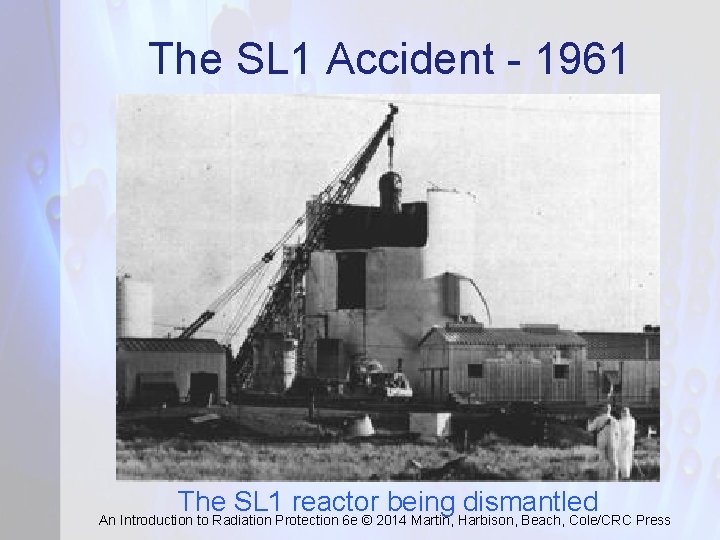
The SL 1 Accident - 1961 The SL 1 reactor being dismantled An Introduction to Radiation Protection 6 e © 2014 Martin, Harbison, Beach, Cole/CRC Press
Tokai Mura - 1999 • A criticality occurred at a fuel reprocessing facility at Tokai Mura, Japan in 1999 • Three operators added a bucket of enriched uranyl nitrate solution to a process vessel already close to criticality • Criticality occurred. No explosion occurred but very high levels of neutron and gamma radiation • Intermittent criticality occurred for some 20 hours An Introduction to Radiation Protection 6 e © 2014 Martin, Harbison, Beach, Cole/CRC Press
Tokai Mura - 1999 • The three operators received doses of up to 20 Sv. One died after 12 weeks and another after 7 months • Other workers on site and a few members of public received doses of up to 10 m. Sv • Caused by inadequate training and supervision, human error and breaches of safety procedures An Introduction to Radiation Protection 6 e © 2014 Martin, Harbison, Beach, Cole/CRC Press
Pre-Planning for Emergencies • The fundamental requirement for any facility is to undertake a prior risk assessment to identify situations that could give rise to an incident • Contingency plans appropriate to scale of potential events should be drawn up • These plans need to be included as a component of training • Plans should be exercised periodically An Introduction to Radiation Protection 6 e © 2014 Martin, Harbison, Beach, Cole/CRC Press
Pre-Planning for Emergencies • Since Chernobyl accident, increasingly formal approach to emergency planning • Operators required to carry out formal hazard and risk assessments to: − Identify measures to prevent accidents and mitigate consequences of any that occur − Provide structured basis for planning and disseminating information to public − Supply information to authorities to enable an off-site plan to be prepared • In UK, the Radiation (Emergency Preparedness and Public Information) Regulations adopted to implement relevant aspects of the BSS An Introduction to Radiation Protection 6 e © 2014 Martin, Harbison, Beach, Cole/CRC Press
Dose Control in Emergencies • Doses above normal limits may be authorised for volunteer workers for saving lives or preventing escalation of incident • For life saving operations, usually considered that whole body doses up to about 1 Sv could be justifiable • At Fukushima, the Japanese initially set a reference level of 100 m. Sv for personnel struggling to bring the incident under control • This was later increased to 250 m. Sv as the scale of the incident escalated An Introduction to Radiation Protection 6 e © 2014 Martin, Harbison, Beach, Cole/CRC Press
Dose Control in Emergencies • Similarly, for members of public in vicinity of site, decisions on countermeasures need to balance detriments against dose saving • Internationally agreed Intervention Levels (or Emergency Reference Levels) provide broad guidance on expected dose saving that would be justified by countermeasures • In practice early decisions on countermeasures need to be taken before adequate information available – base on nature of event and state of plant An Introduction to Radiation Protection 6 e © 2014 Martin, Harbison, Beach, Cole/CRC Press
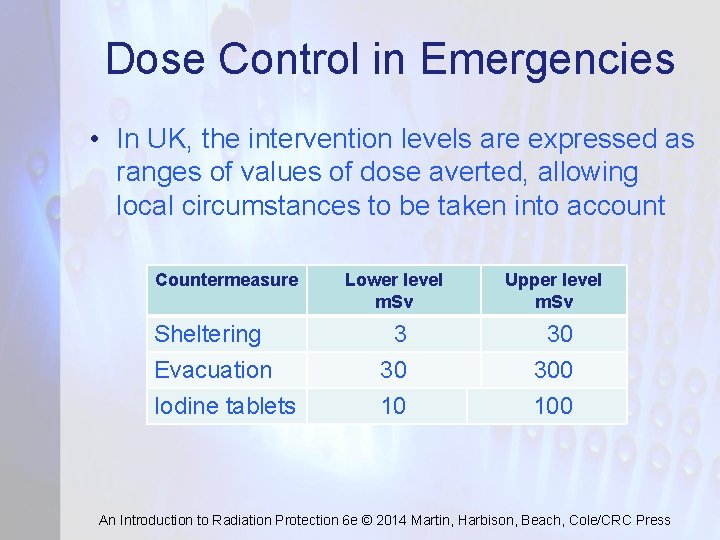
Dose Control in Emergencies • In UK, the intervention levels are expressed as ranges of values of dose averted, allowing local circumstances to be taken into account Countermeasure Lower level m. Sv Upper level m. Sv Sheltering Evacuation Iodine tablets 3 30 10 30 300 100 An Introduction to Radiation Protection 6 e © 2014 Martin, Harbison, Beach, Cole/CRC Press
Pre-Planning • Pre-planning for emergencies begins at design stage of a facility • Detailed safety analysis identifies the major hazards and enables means of reducing them to be incorporated in the design • However, there always remains the possibility of an accident and an emergency organisation is required to cover this eventuality An Introduction to Radiation Protection 6 e © 2014 Martin, Harbison, Beach, Cole/CRC Press
Emergency Organisation • Size and composition depends on nature and size of plant. Typically, representatives from – Administration Dept – transport, liaison, communications – Engineering Dept – provide rescue and damage control teams, emergency equipment, decontamination services – Medical Dept – deals with casualties, liaises with external medical services – Health Physics – provides monitoring equipment and personnel; advises on radiation protection An Introduction to Radiation Protection 6 e © 2014 Martin, Harbison, Beach, Cole/CRC Press
Emergency Procedures • The responsibilities and actions are detailed in the Emergency Procedures • This includes instructions on evacuation, monitoring, communications, re-entry and use of emergency equipment • Emergency equipment includes rescue equipment, medical equipment, protective clothing, respiratory protection and monitoring instruments Exercising the Emergency Procedures is vitally important An Introduction to Radiation Protection 6 e © 2014 Martin, Harbison, Beach, Cole/CRC Press
Summary • Types of event inc INES Scale • Loss of shielding • Loss of containment • Major releases from nuclear facilities • Uncontrolled criticality • Dose control in emergencies • Pre-planning for emergencies An Introduction to Radiation Protection 6 e © 2014 Martin, Harbison, Beach, Cole/CRC Press