
Radiological Category Thoracic Principal Modality 1 Radiography Principal


- Slides: 10
Radiological Category: Thoracic Principal Modality (1): Radiography Principal Modality (2): None Case Report # 788 Submitted by: Robert E. Klinglesmith, M. D. , Psy. D. Faculty reviewer: Emma C. Ferguson, M. D, The University of Texas Medical School at Houston Date accepted: 4 June, 2010
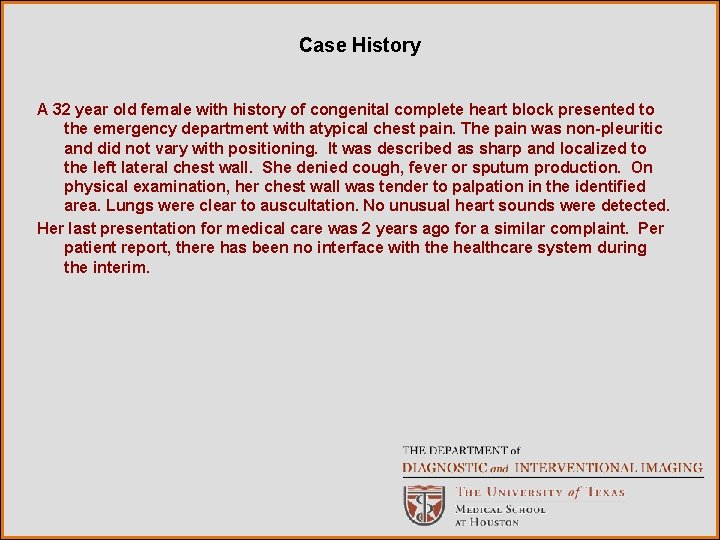
Case History A 32 year old female with history of congenital complete heart block presented to the emergency department with atypical chest pain. The pain was non-pleuritic and did not vary with positioning. It was described as sharp and localized to the left lateral chest wall. She denied cough, fever or sputum production. On physical examination, her chest wall was tender to palpation in the identified area. Lungs were clear to auscultation. No unusual heart sounds were detected. Her last presentation for medical care was 2 years ago for a similar complaint. Per patient report, there has been no interface with the healthcare system during the interim.
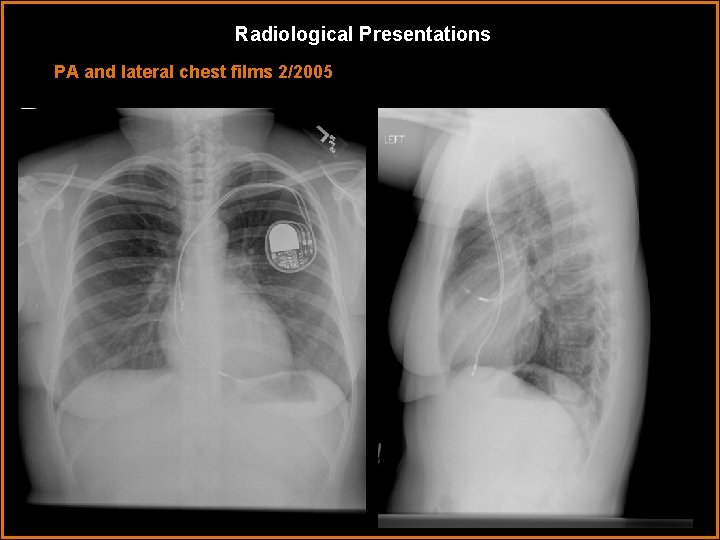
Radiological Presentations PA and lateral chest films 2/2005
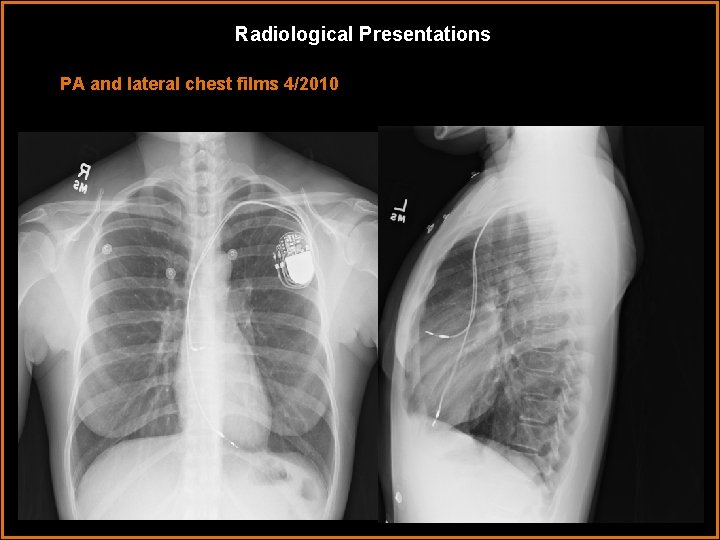
Radiological Presentations PA and lateral chest films 4/2010
Test Your Diagnosis Which one of the following is your choice for the appropriate diagnosis? After your selection, go to next page. • No intrathoracic abnormalities • Reel Syndrome • Twiddler’s Syndrome • Poland Syndrome
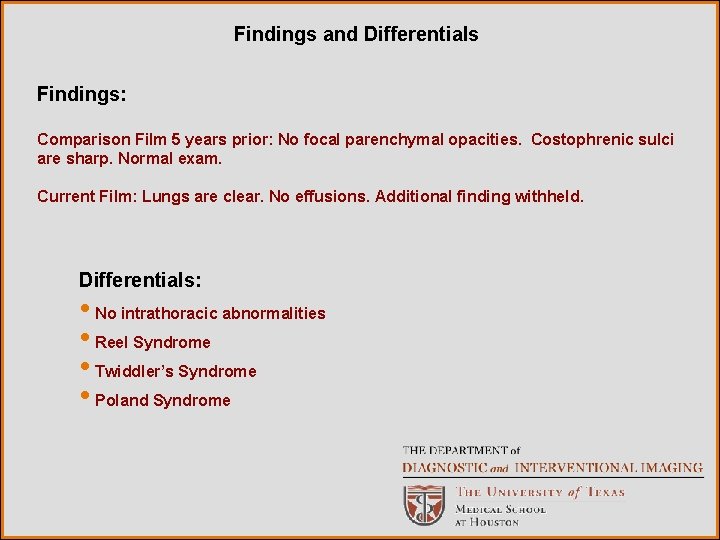
Findings and Differentials Findings: Comparison Film 5 years prior: No focal parenchymal opacities. Costophrenic sulci are sharp. Normal exam. Current Film: Lungs are clear. No effusions. Additional finding withheld. Differentials: • No intrathoracic abnormalities • Reel Syndrome • Twiddler’s Syndrome • Poland Syndrome
Discussion Post-implantation chest radiography is standard procedure after placement of an implantable cardiac pacemaker/defibrillator. It verifies lead location and security of the lead wires. It also allows for quick assessment of iatrogenic pneumothorax. Although the pulse generators are radiolucent, the lead wires and battery are radiopaque. Sutures are frequently used to anchor the leads inside the cutaneous pocket in which the pacer is placed. These anchoring sutures can occasionally produce a false radiographic appearance of lead line fracture [1]. Early complications are easily demonstrated using conventional radiography. However, certain complications beyond one month are less easy to image. Specifically, there are no reliable ways to identify infection, lead fracture or electric dysfunction using the chest radiograph. Gross disturbances such as lead retraction, hematoma, migration or Twiddler’s Syndrome may still be demonstrated [2]. Poland syndrome is congenital partial or total absence of the pectoralis major muscle. On conventional radiography, it presents as unilateral hyperlucency of the hemithorax, and may mimic the appearance of a radical mastectomy [3]. First described in in 1968, Twiddler’s syndrome was identified when the pacer leads are retracted due to a capstan effect from rotation of the pulse generator in a cutaneous pocket that had become too loose to secure the battery [4].
Discussion Although in this case presentation the more recent examination reveals a normal thorax with AICD, there is a finding that differs from the comparison. There is no pneumothorax in either examination. The current exam shows rotation of the pulse generator approximately 180 degrees clockwise. The lead wires have fallen behind the pulse generator, and thus have not retracted the leads from their implantation sites. The evolving shapes and sizes of pulse generators made the original, long-axis twisting of Twiddler’s Syndrome less likely. However, rotation along the transverse axis of the pulse generator was a sufficient mechanism to retract, and in some cases unseat, the leads [5]. This rolling of the leads around the pulse generator resembled the winding of fishing line around a reel, giving this variation the term “Reel Syndrome”. Patel et al [6] argue that this reeling, if coupled with a ratcheting of the leads through their anchoring sutures, represents an entirely separate entity from the “Twiddler’s Syndrome”. Although the imaging findings more closely resemble the “reel” phenomenon, the lead placement is preserved as the lead wires have coiled behind the pulse generator. Thus, the diagnosis of “Twiddler’s Syndrome” was made.
Diagnosis Twiddler’s syndrome with preserved AICD lead placement.
References 1. Bejvan SM, Ephron JH, Takasugi JE, Godwin JD, Bardy GH. Imaging of cardiac pacemakers: AJR 1997; 169: 1371 -1379 2. Gupta A, Zegel HG, Dravid VS, Nierenberg SJ, Freiman DB. Value of radiography in diagnosing complications in cardioverter defibrillators implanted without thoracotomy in 437 patients: AJR 1997; 168: 105 -108 3. Jeung M, Gangi A, Gasser B, et al. Imaging of chest wall disorders: Radiographics 1999; 19: 617 -637 4. Bayliss CE, Beanlands DS, Baird RJ. The pacemaker-twiddler’s syndrome: an new complication of implantable transvenous pacemakers: CMAJ 1968; 99: 371 -373 5. Carnero-Varo A, Perez-Paredas M, Ruiz-Ros JA, et al. “Reel syndrome”: A new form of Twiddler’s syndrome? : Circulation 1999; 100: 45 -46 6. Patel MB, Pandya K, Shah AJ, Lojewski E, Castellani MD, Thakur R. Reel syndrome – not a twiddler variant: J Interventional card electrophysiol 2008; 23: 243 -246