
Radiological Category Musculoskeletal Principal Modality 1 MRI Principal
- Slides: 12
Radiological Category: Musculoskeletal Principal Modality (1): MRI Principal Modality (2): None Case Report 724 Submitted by: Navid Zaer , M. D. Faculty reviewer: Manickam Kumaravel, M. D. The University of Texas Medical School at Houston Date accepted: 12 April 2010
Case History 58 year old man with left shoulder pain.
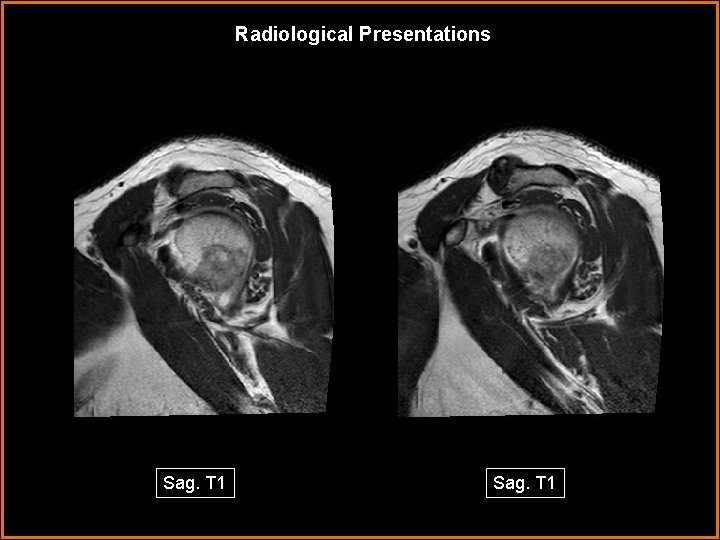
Radiological Presentations Sag. T 1
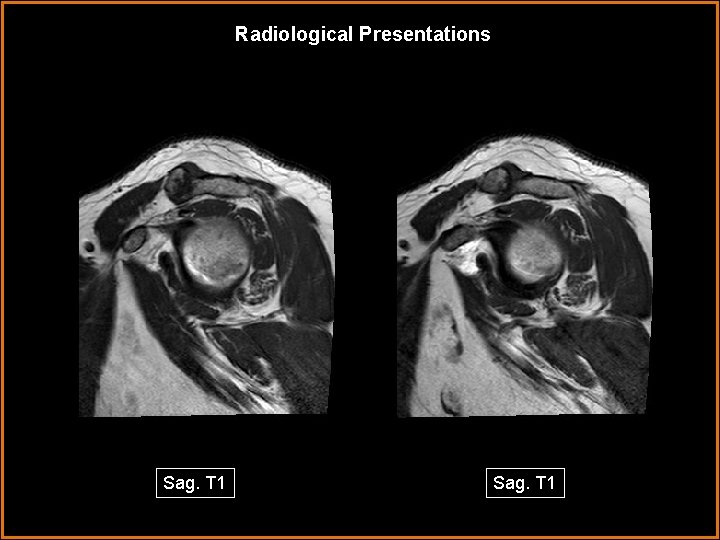
Radiological Presentations Sag. T 1
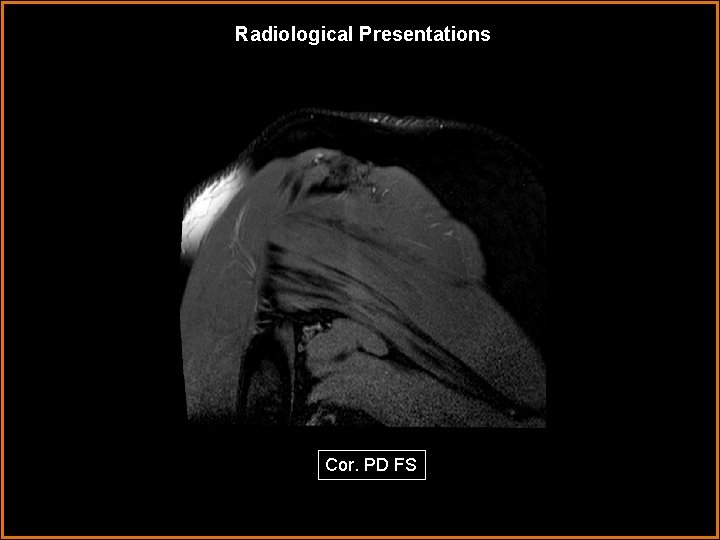
Radiological Presentations Cor. PD FS
Test Your Diagnosis Which one of the following is your choice for the appropriate diagnosis? After your selection, go to next page. • Nonspecific myositis • Traumatic Neurapraxia • Parsonage-Turner Syndrome
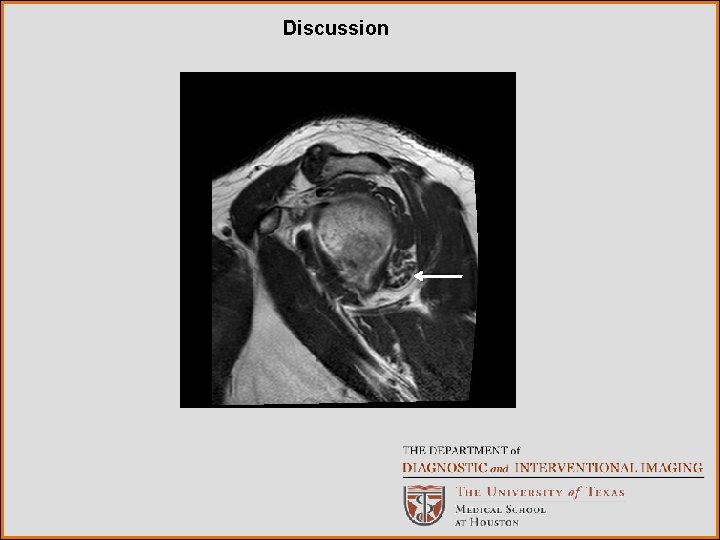
Findings and Differentials Findings: Selective, heterogeneously increased signal within the teres minor muscle belly on sequential sagittal T 1 weighted images consistent with fatty infiltration and atrophy. Atrophic changes noted again within the teres minor on PD FS imaging with heterogeneous signal drop-out. The supraspinatus and infraspinatus muscles appear intact. Differentials: • Nonspecific Myositis • Traumatic Neurapraxia • Parsonage-Turner Syndrome
Discussion [Not shown on these images are the Type II acromion and supraspinatus tendinosis present in his shoulder. ] Parsonage-Turner Syndrome (acute brachial neuritis, neuralgic amyotrophy) is characterized by acute onset of severe shoulder pain followed by weakness in at least one shoulder muscle – it is often clinically confused with rotator cuff tear or cervical radiculopathy. It may follow illness, surgery or immunization. Denervation often involves any combination of subscapular, suprascapular and axillary nerves – essentially any of the shoulder girdle muscles (supraspinatus, infraspinatus etc. . ) can demonstrate this pathology. In our patient, it is isolated to the teres minor. Diagnostic clues include muscle belly swelling/enlargement in the acute/subacute phase and atrophy in the chronic phase. MRI abnormalities appear after approximately 2 weeks and MRI protocols should include T 1 and PD FS. T 1 demonstrates streaky regions of increased signal in chronic cases (fatty atrophy). T 2 and PD FS show increased signal intensity associated with edema in the acute/subacute phases.
Discussion
Discussion Up to 50% of patients report a viral illness/vaccination prior to symptoms. The reported age range is 3 months to 74 years with males affected 2 -4 times greater than females. The majority of cases resolve within a year and conservative treatment with physical therapy is often prescribed. Other clinical considerations include post-traumatic neurapraxia which is the least severe nerve injury involving transient focal demyelination without axonal loss. Function can return within days to weeks and MRI is often not helpful. Nonspecific myositis can be the cause of muscle dysfunction and increased signal on PD FS images. The distinguishing factor is that myositis often does not follow a single nerve distribution pattern. Once again, rotator cuff injuries and extrinsic compression by masses should be excluded on evaluation.
Diagnosis Parsonage-Turner Syndrome.
References 1. Helms, CA et. al. Acute Brachial Neuritis: MR Imaging Appearance – report of three cases. Radiology 1998; 207: 255 -259. 2. Sallomi D et al: Muscle denervation patterns in upper limb nerve injuries: MR imaging findings and anatomic basis. AJR Am J Roentgenol. 1998; 171(3): 779 -84. 3. www. statdx. com