
RADIOGRAPHIC QUALITY S Guilbaud Education Director School of
RADIOGRAPHIC QUALITY S. Guilbaud, Education Director School of Radiologic Sciences
Radiographic Quality Radiography seeks to provide the maximum diagnostic information about a particular anatomic area by recording the radiographic image. This success depends on the production of images that are of superb quality. Radiographs of poor quality may cause errors in diagnosis through inadequate recording of information. S. Guilbaud, Education Director
Radiographic Quality n n The Fidelity with which the anatomic structure is imaged on the recording medium. Or The visible sharpness of images of structural details such as bone trabeculae and small pulmonary vessels. S. Guilbaud, Education Director
Recorded Detail n Acutance n n The abruptness of the boundary b/w the detail and its surroundings. Resolution n n The ability of an image receptor to produce separate images of closely spaced small objects. Note: Although related, they are affected differently by contrast and density. S. Guilbaud, Education Director

Recorded Detail n n An all inclusive term that includes: sharpness, detail, visibility and visibility of detail. The distinctness of the radiographic image margins. S. Guilbaud, Education Director
Recorded Detail n High Contrast Resolution (spatial resolution) n n Abrupt differences b/w adjacent structures. (bone and soft tissue). Low Contrast Resolution (contrast detectability) n Subtle differences b/w adjoining structures. S. Guilbaud, Education Director
Recorded Detail n Influenced by 5 principal factors n n n 1. 2. 3. 4. 5. Noise Contrast Density Distortion Blur S. Guilbaud, Education Director
Recorded Detail Noise n n An undesirable fluctuation in the optical density of the image. Or Any random audible or visible disturbances that obscure information. S. Guilbaud, Education Director
Recorded Detail n Radiographic Noise n Three components n n n Film graininess Structure mottle Quantum Mottle S. Guilbaud, Education Director

Recorded Detail Film graininess n Caused by the random distribution in size and space of the silver halide crystals in the emulsion. S. Guilbaud, Education Director

Recorded Detail Structure Mottle n Caused by the phosphor that is used in the construction of the intensifying screens. S. Guilbaud, Education Director

Recorded Detail Quantum Mottle n n Any random audible or visible disturbances that obscure information. Is caused by the random nature in which x-rays interact with the image receptor. S. Guilbaud, Education Director

Recorded Detail Contrast n n The range of density variation among the light and dark areas on a radiographic image. A difference in density on adjacent anatomic structures. S. Guilbaud, Education Director

Radiographic Contrast is a product of two factors. n n Film Contrast Subject Contrast S. Guilbaud, Education Director

Film Contrast n n n Films vary in their contrast, depending on their emulsion characteristics. Films are designed for long, medium and short scale contrast. Development also affects film contrast. n Chemical fog due to prolonged processing reduces contrast. S. Guilbaud, Education Director

Subject Contrast n Determined by the patient. n n Size Part shape Attenuation characteristics of the subject. Standardization of film contrast is critical while subject contrast fluctuates with each patient. S. Guilbaud, Education Director
3. Density (Optical Density) Degree of blackening on the radiographic film or the amount of darkening of a radiographic film. n n Thus the greater the total amount of light or radiation reaching the film, the greater will be the degree of darkening of the film. Due to exposure of the radiographic film by light or X-rays. S. Guilbaud, Education Director
3. Density (optical density) The degree of blackening on the film also depends upon the amount of radiation reaching the radiographic film. n Is measured by an instrument called a Densitometer which indicates the relationship between the intensity of light reaching one side of a given area of the film and the intensity of the light passing through. S. Guilbaud, Education Director
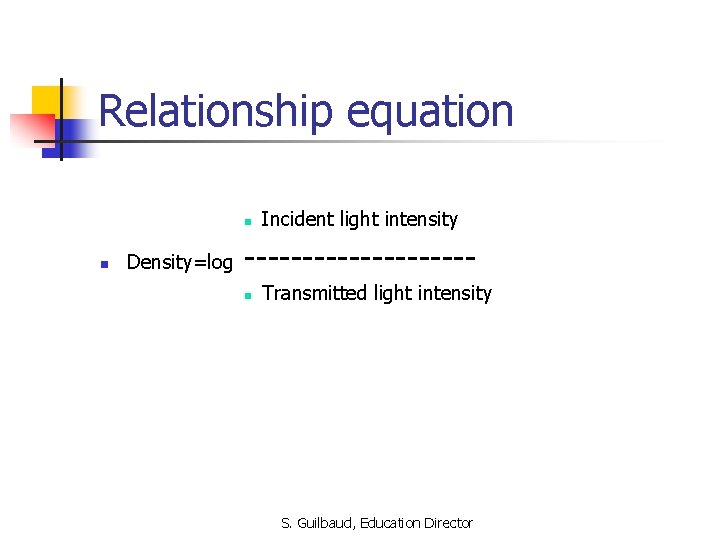
Relationship equation n n Density=log Incident light intensity ----------n Transmitted light intensity S. Guilbaud, Education Director
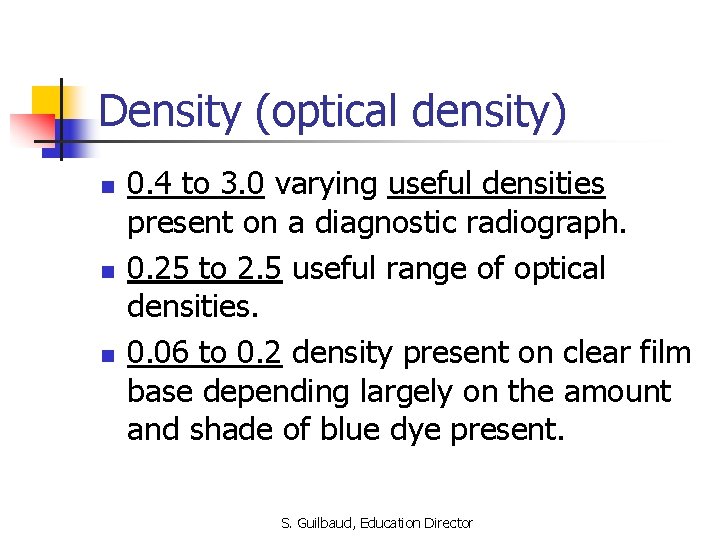
Density (optical density) n n n 0. 4 to 3. 0 varying useful densities present on a diagnostic radiograph. 0. 25 to 2. 5 useful range of optical densities. 0. 06 to 0. 2 density present on clear film base depending largely on the amount and shade of blue dye present. S. Guilbaud, Education Director
Density (optical density) n Very important factor, it carries the information. n n n No density = no image No density = no recorded detail Density in excess conceals information through loss of visibility of recorded detail. S. Guilbaud, Education Director
Five factors that govern radiographic density 1. 2. 3. 4. 5. Milliamperage (m. A) Time (seconds or milliseconds) Distance Kilovoltage (k. V) Part thickness and Attenuation properties. S. Guilbaud, Education Director
Five factors that govern radiographic density. n 1. Milliamperage (m. A) n n n A measure of electron flow per second, from cathode to anode. An increase in flow rate increases photon production at the target. Exposure rate (R/sec) is proportional to m. A. Doubling m. A doubles exposure rate. Note: m. A determines exposure rate only. S. Guilbaud, Education Director
Five factors that govern radiographic density. n 2. Time. n n n An increase or decrease in time causes a proportional increase or decrease in the number of photons emitted by the target. A longer exposure time allows the radiation at a given exposure rate to act longer, thereby affecting more silver halide crystals in the film emulsion and increasing radiographic density. m. A X sec = m. As or milliampere-seconds. S. Guilbaud, Education Director
Five factors that govern radiographic density. n 2. Time. n n m. As is a measure of the charge transferred from cathode to anode during an exposure. E. g. n n 100 m. A and 0. 1 sec = 10 m. As if a shorter time was to be used to minimize patient motion, 400 m. A and 0. 025 or 1/40 sec. = 10 m. As S. Guilbaud, Education Director
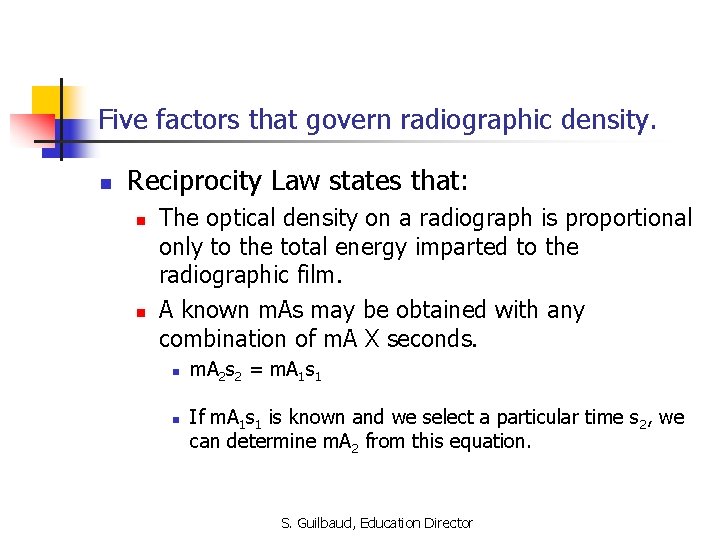
Five factors that govern radiographic density. n Reciprocity Law states that: n n The optical density on a radiograph is proportional only to the total energy imparted to the radiographic film. A known m. As may be obtained with any combination of m. A X seconds. n n m. A 2 s 2 = m. A 1 s 1 If m. A 1 s 1 is known and we select a particular time s 2, we can determine m. A 2 from this equation. S. Guilbaud, Education Director
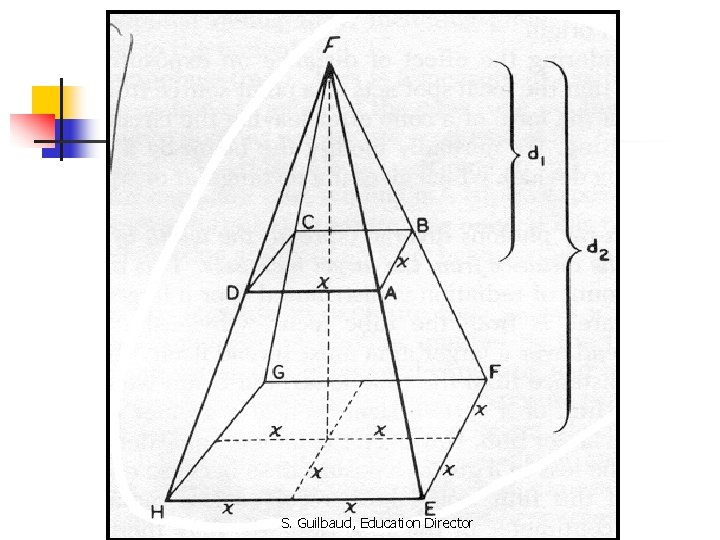
Five factors that govern radiographic density. n 3. Distance Radiographic exposure rate decreases as the Source to Image Distance (SID) increases. Assume that the focal spot acts as a point source from which X-rays spread in the form of a cone after leaving the port of the tube housing. X-ray photons diverge after leaving the tube, this means that the same amount of radiation is distributed over a larger area the farther this is from the tube focus. Thus the same radiation spread over a larger area must spread itself thinner. n n S. Guilbaud, Education Director
S. Guilbaud, Education Director
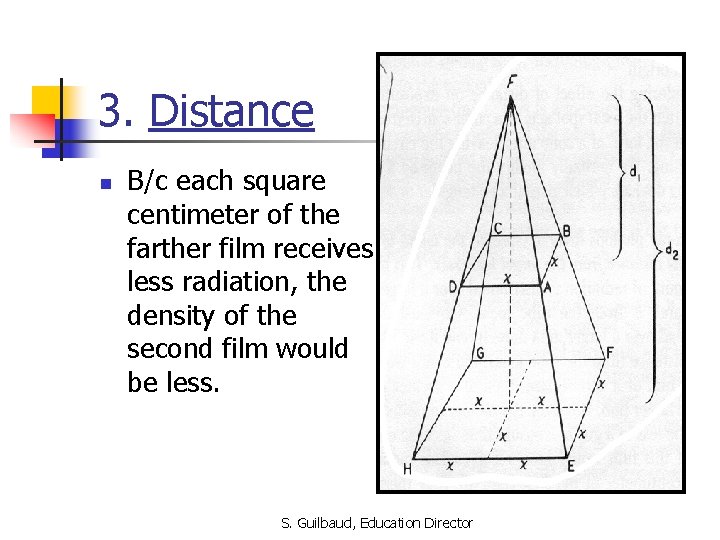
3. Distance n B/c each square centimeter of the farther film receives less radiation, the density of the second film would be less. S. Guilbaud, Education Director
Five factors that govern radiographic density. n 4. Kilovoltage (k. V) n n n Increase in k. V, increases the exposure rate and the % of higher energy photons. Causes a larger fraction of primary beam to reach the intensifying screens. Thus, this causes an increase in radiographic density. S. Guilbaud, Education Director
Five factors that govern radiographic density. n 4. Kilovoltage (k. V) n n A 15% increase in k. V approximately doubles the exposure. n E. g. . 40 k. V X 15% = 46 n 70 k. V X 15% = 80 This relationship is not strictly proportional b/c as density increases, the subject contrast decreases. S. Guilbaud, Education Director
Five factors that govern radiographic density. n n 4. Kilovoltage (k. V) Note: use of 85 k. V or higher with grids of 8: 1 ratio or less is not recommended b/c this produces excess scatter which impairs contrast. S. Guilbaud, Education Director
Five factors that govern radiographic density. n n 4. Kilovoltage (k. V) At higher k. V, equipment efficiency increases b/c less heat is produced at the anode and there is a greater certainty that the part will be penetrated. S. Guilbaud, Education Director
Five factors that govern radiographic density. n 5. Part thickness and attenuation properties. n n With an increased thickness of tissue traversed by the X-ray beam, there are more atoms available for interactions (absorption & scatter). Radiopacity = the degree of x-ray attenuation in a tissue. n Greater x-ray transmission means that less radiation is transmitted through the patient or less exit radiation is available for radiography. S. Guilbaud, Education Director
Five factors that govern radiographic density. n 5. Part thickness and attenuation properties. n n Radiolucency = the degree of x-ray transmission in a tissue. An increase in the amount of radiation available for radiography or more exit radiation available to interact with the image receptor system. S. Guilbaud, Education Director
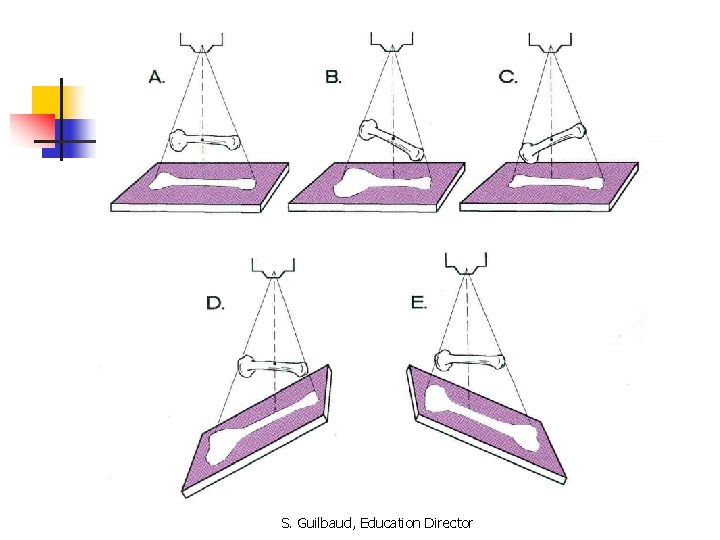
Influenced by 5 principal factors. n 4. Distortion. n n A misrepresentation of the size or shape of the structures being examined. This misrepresentation can be classified as either size or shape distortion. Like detail, distortion exists even when it cannot be seen due to poor visibility (when the density and or contrast are poor). Note: careful attention to SID, direction and angulation b/w part , CR & image receptor can minimize distortion. S. Guilbaud, Education Director
Influenced by 5 principal factors. n 4. Distortion. n n In radiology, only Magnification is possible. Thus all size distortion may be controlled by, SID and OID. Special conditions must be created to achieve diagnostically acceptable magnification images. S. Guilbaud, Education Director
S. Guilbaud, Education Director
4. Distortion. n Source to Image Distance (SID). n The greater the SID, the smaller the magnification. n As SID increases the % of the total distance that makes up OID decreases. Thus the OID becomes the critical distance for magnification and resolution. S. Guilbaud, Education Director
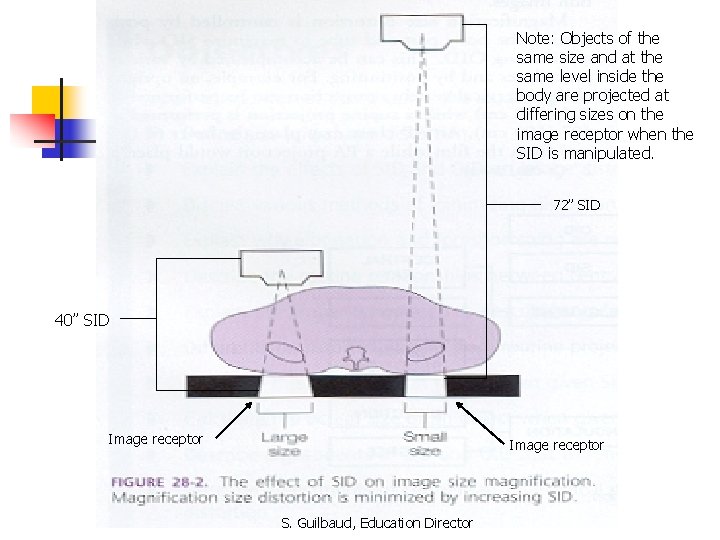
Note: Objects of the same size and at the same level inside the body are projected at differing sizes on the image receptor when the SID is manipulated. 72” SID 40” SID Image receptor S. Guilbaud, Education Director
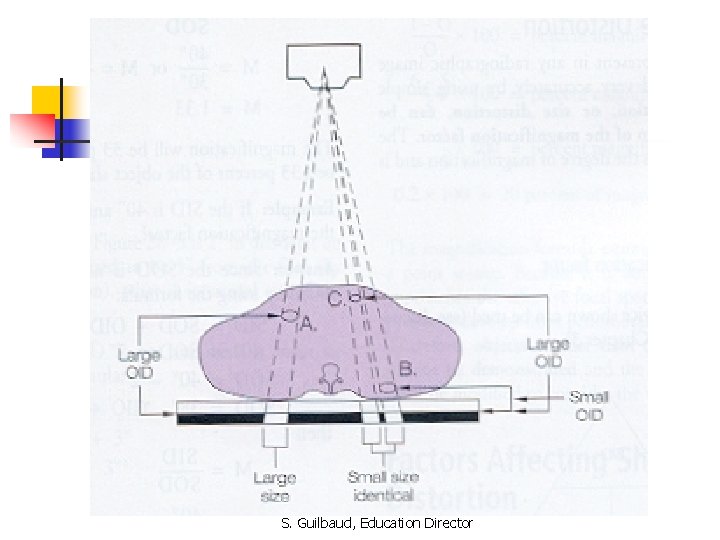
4. Distortion. n Object to Image Distance (OID). n n n Also a critical distance in magnification and resolution. When objects w/in a structure at different levels, they are projected onto the image receptor as different sizes. This is similar to how the eyes process info for depth perception; smaller objects are perceived as more distant and larger objects appear closer. S. Guilbaud, Education Director
S. Guilbaud, Education Director
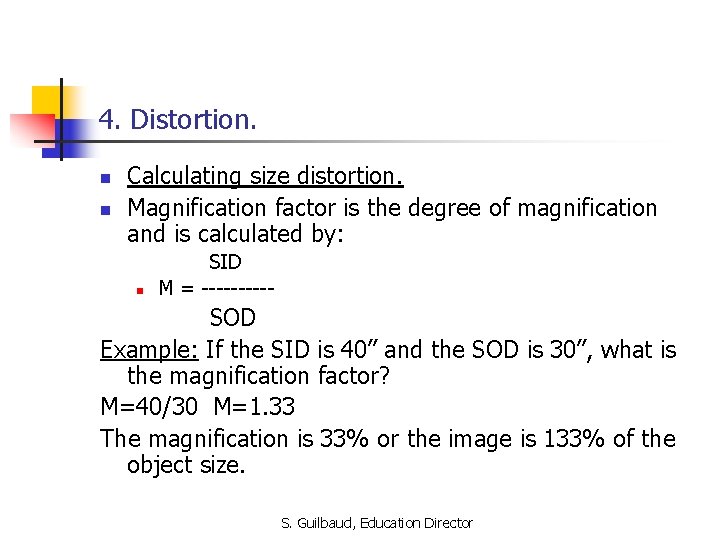
4. Distortion. n n Calculating size distortion. Magnification factor is the degree of magnification and is calculated by: n SID M = ----- SOD Example: If the SID is 40” and the SOD is 30”, what is the magnification factor? M=40/30 M=1. 33 The magnification is 33% or the image is 133% of the object size. S. Guilbaud, Education Director
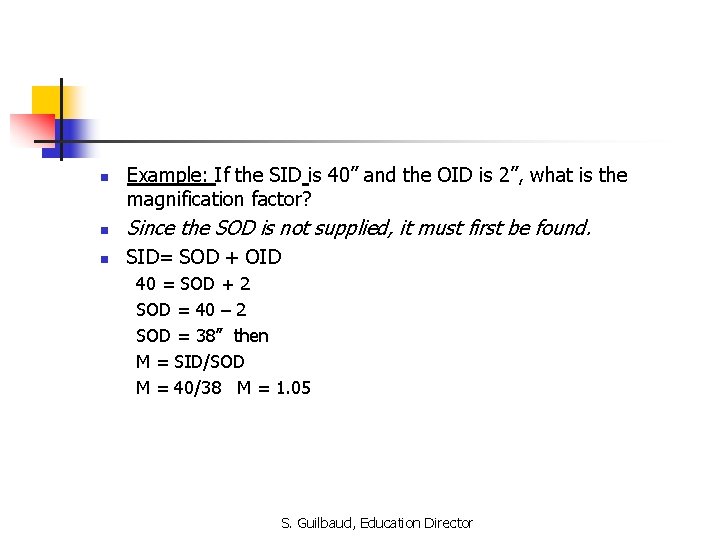
n Example: If the SID is 40” and the OID is 2”, what is the magnification factor? n Since the SOD is not supplied, it must first be found. n SID= SOD + OID 40 = SOD + 2 SOD = 40 – 2 SOD = 38” then M = SID/SOD M = 40/38 M = 1. 05 S. Guilbaud, Education Director
4. Distortion. This is one reason for performing two projections as near to 90 degrees as possible. When this cannot be achieved, two oblique projections will suffice. This will provide a positional relationship of the structures in question. S. Guilbaud, Education Director
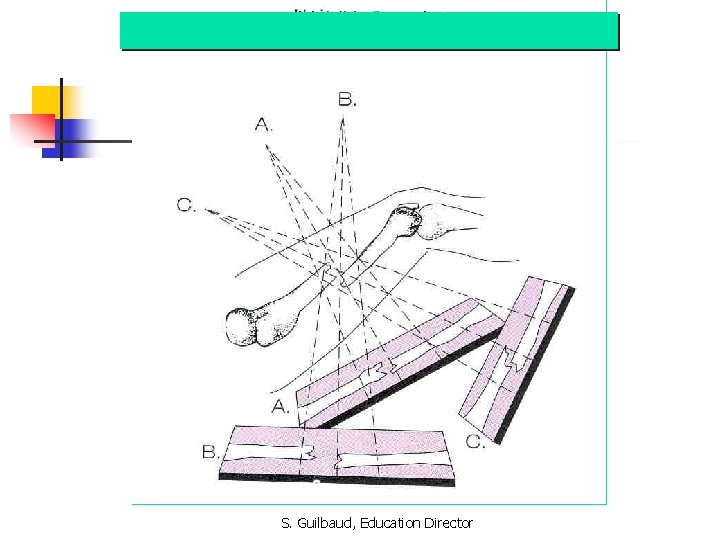
Distortion caused by CR & Film orientation S. Guilbaud, Education Director
4. Distortion. Shape distortion: The misrepresentation by unequal magnification of the actual shape of the structure being examined. This shape distortion causes displacement of the objects from their actual position. This is described as: Elongation or Foreshortening. S. Guilbaud, Education Director
Elongation: Projects the object so it appears longer than its actual size. This will occur when the tube or image receptor is improperly aligned. Foreshortening: Projects the object so that it appears shorter than its actual size. This occurs only when the part is improperly aligned. Note: Changes in tube angle causes elongation, never foreshortening. S. Guilbaud, Education Director
5. Blur Motion (unsharpness) Blur Caused by voluntary and or involuntary motion of the patient or part being examined during the exposure. This results in a blurring of the radiographic image. Thus causing a loss of radiographic quality. S. Guilbaud, Education Director

Focal Spot Blur An area of poor spatial resolution on a radiographic image caused by the size of the effective focal spot and the anode target angle. S. Guilbaud, Education Director
Geometric Blur (penumbra) is dependent on three factors; 1. Effective Focal Spot Size. 2. Source-to-image receptor distance (SID). 3. Object-to image receptor distance (OID). S. Guilbaud, Education Director
Geometric Blur A. Size of the effective focus. 1. Focal spot sizes on radiographic tubes range from 0. 3 to 2. 0 mm. Therefore, x-rays originate from innumerable points on the focal spot. They spread as they pass the edge of the object and proceed towards the film. This produces a blurred margin. The width of the blur is proportional to the effective focal spot size. S. Guilbaud, Education Director
Geometric Blur Source-to Image Receptor Distance (SID). B. 1. C. The degree of blurring also depends on the distance b/w the source and the image receptor. As the SID increases, the OID remains unchanged. The x-rays undergo less spread after passing the object edge on their way to the image receptor. Object-to-Image Receptor Distance (OID). 1. Recorded detail deteriorates with an increase in OID, which causes magnification to increase. S. Guilbaud, Education Director
References Bushong, S. Radiologic Science for Technologists, Physics, Biology, and Protection, 6 th Edition, Mosby, 1997. Bushberg, et al. The Essential Physics of Medical Imaging, Williams & Wilkins, 1994. Carlton et al. Principles of Radiographic Imaging an Art and a Science, 3 rd Edition, Delmar, 2001. Selman, J. The Fundamentals of X-Ray and Radium Physics, 8 th Edition, Charles Thomas, 1994. S. Guilbaud, Education Director
- Slides: 54